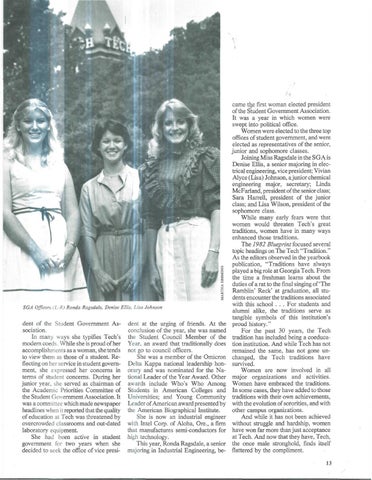
SGA Officers (L-R) Ronda Ragsdale, Denise Ellis, Lisa Johnson
dent of the Student Government Association. In many ways she typifies Tech's modern coeds. While she is proud of her accomplishments as a woman, she tends to view them as those of a student. Reflecting on her service in student government, she expressed her concerns in terms of student concerns. During her junior year, she served as chairman of the Academic Priorities Committee of the Student Government Association. It was a committee which made newspaper headlines when it reported that the quality of education at Tech was threatened by overcrowded classrooms and out-dated laboratory equipment. She had been active in student government for two years when she decided to seek the office of vice presi-
dent at the urging of friends. At the conclusion of the year, she was named the Student Council Member of the Year, an award that traditionally does not go to council officers. She was a member of the Omicron Delta Kappa national leadership honorary and was nominated for the National Leader of the Year Award. Other awards include Who's Who Among Students in American Colleges and Universities; and Young Community Leader of American award presented by the American Biographical Institute. She is now an industrial engineer with Intel Corp. of Aloha, Ore., a firm that manufactures semi-conductors for high technology. This year, Ronda Ragsdale, a senior majoring in Industrial Engineering, be-
came the first woman elected president of the Student Government Association. It was a year in which women were swept into political office. Women were elected to the three top offices of student government, and were elected as representatives of the senior, junior and sophomore classes. Joining Miss Ragsdale in the SGA is Denise Ellis, a senior majoring in electrical engineering, vice president; Vivian Alyce (Lisa) Johnson, a junior chemical engineering major, secretary; Linda McFarland, president of the senior class; Sara Harrell, president of the junior class; and Lisa Wilson, president of the sophomore class. While many early fears were that women would threaten Tech's great traditions, women have in many ways enhanced those traditions. The 1982 Blueprint focused several topic headings on The Tech "Tradition." As the editors observed in the yearbook publication, "Traditions have always played a big role at Georgia Tech. From the time a freshman learns about the duties of a rattothe final singing of "The Ramblin' Reck' at graduation, all students encounter the traditions associated with this school . . . For students and alumni alike, the traditions serve as tangible symbols of this institution's proud history." For the past 30 years, the Tech tradition has included being a coeducation institution. And while Tech has not remained the same, has not gone unchanged, the Tech traditions have survived. Women are now involved in all major organizations and activities. Women have embraced the traditions. In some cases, they have added to those traditions with their own achievements, with the evolution of sororities, and with other campus organizations. And while it has not been achieved without struggle and hardship, women have won far more than just acceptance at Tech. And now that they have, Tech, the once male stronghold, finds itself flattered by the compliment. 13