Text by Linda Terrell
They told her not to try engineering at one time and now she is just months away from being the first female Ph. D. in A. E.
Mary Anne T.
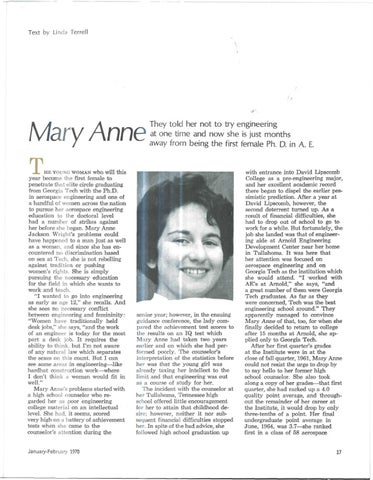
HE YOUNG WOMAN who will this year become the first female to penetrate that elite circle graduating from Georgia Tech with t h e P h . D . in aerospace engineering a n d one of a handful of women across t h e nation to pursue her aerospace engineering education to the doctoral level h a d a number of strikes against her before she began. M a r y Anne Jackson Wright's problems could have happened to a m a n just as well as a woman, a n d since she has encountered n o discrimination based on sex a t Tech, she is not rebelling against tradition or pushing women's rights. She is simply pursuing the necessary education for t h e field in which she wants to work a n d teach. " I wanted to go into engineering as early as age 12," she recalls. And she sees no necessary conflict between engineering a n d femininity: "Women have traditionally held desk jobs," she says, " a n d the work of an engineer is today for the most part a desk job. I t requires the ability to think, b u t I'm not aware of any natural law which separates the sexes on this count. B u t I can see some areas in engineering—like h a r d h a t construction work—where I don't think a woman would fit in well." M a r y Anne's problems started with a high school counselor who regarded her as poor engineering college material o n a n intellectual level. She had, it seems, scored very high on a battery of achievement tests when she came to t h e counselor's attention during the
January-February 1970
senior year; however, in t h e ensuing guidance conference, t h e l a d y compared the achievement test scores to the results on a n IQ test which M a r y Anne h a d taken two years earlier a n d on which she h a d performed poorly. T h e counselor's interpretation of the statistics before her was t h a t the young girl was already taxing her intellect to t h e limit and t h a t engineering was out as a course of study for her. T h e incident with the counselor a t her Tullahoma, Tennessee high school offered little encouragement for her to a t t a i n t h a t childhood desire; however, neither it nor subsequent financial difficulties stopped her. In spite of the b a d advice, she followed high school graduation u p
with entrance into David Lipscomb College as a pre-engineering major, and her excellent academic record there began to dispel t h e earlier pessimistic prediction. After a year a t David Lipscomb, however, t h e second deterrent t u r n e d u p . A s a result of financial difficulties, she h a d to drop out of school to go to work for a while. B u t fortunately, t h e job she landed was t h a t of engineering aide a t Arnold Engineering Development Center n e a r h e r home in Tullahoma. I t was h e r e t h a t her attention was focused on aerospace engineering a n d on Georgia Tech as the institution which she would attend. " I worked with A E ' s a t Arnold," she says, " a n d a great n u m b e r of t h e m were Georgia Tech graduates. As far as t h e y were concerned, T e c h was t h e best engineering school around." T h e y apparently managed to convince M a r y Anne of that, too, for when she finally decided to return to college after 15 m o n t h s a t Arnold, she a p plied only to Georgia Tech. After her first quarter's grades a t the Institute were in a t t h e close of fall quarter, 1961, M a r y Anne could not resist the urge t o d r o p b y to say hello to her former high school counselor. She also took along a copy of her grades—that first quarter, she h a d racked u p a 4.0 quality point average, a n d throughout the remainder of her career a t the Institute, it would drop b y only three-tenths of a point. H e r final undergraduate point average in J u n e , 1964, was 3.7—she ranked first in a class of 58 aerospace
17