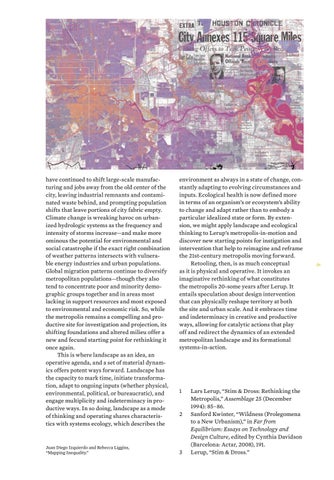
Juan Diego Izquierdo and Rebecca Liggins, “Mapping Inequality.”
environment as always in a state of change, constantly adapting to evolving circumstances and inputs. Ecological health is now defined more in terms of an organism’s or ecosystem’s ability to change and adapt rather than to embody a particular idealized state or form. By extension, we might apply landscape and ecological thinking to Lerup’s metropolis-in-motion and discover new starting points for instigation and intervention that help to reimagine and reframe the 21st-century metropolis moving forward. Retooling, then, is as much conceptual as it is physical and operative. It invokes an imaginative rethinking of what constitutes the metropolis 20-some years after Lerup. It entails speculation about design intervention that can physically reshape territory at both the site and urban scale. And it embraces time and indeterminacy in creative and productive ways, allowing for catalytic actions that play off and redirect the dynamics of an extended metropolitan landscape and its formational systems-in-action.
1 Lars Lerup, “Stim & Dross: Rethinking the Metropolis,” Assemblage 25 (December 1994): 85–86. 2 Sanford Kwinter, “Wildness (Prolegomena to a New Urbanism),” in Far from Equilibrium: Essays on Technology and Design Culture, edited by Cynthia Davidson (Barcelona: Actar, 2008), 191. 3 Lerup, “Stim & Dross.”
9
have continued to shift large-scale manufacturing and jobs away from the old center of the city, leaving industrial remnants and contaminated waste behind, and prompting population shifts that leave portions of city fabric empty. Climate change is wreaking havoc on urbanized hydrologic systems as the frequency and intensity of storms increase—and make more ominous the potential for environmental and social catastrophe if the exact right combination of weather patterns intersects with vulnerable energy industries and urban populations. Global migration patterns continue to diversify metropolitan populations—though they also tend to concentrate poor and minority demographic groups together and in areas most lacking in support resources and most exposed to environmental and economic risk. So, while the metropolis remains a compelling and productive site for investigation and projection, its shifting foundations and altered milieu offer a new and fecund starting point for rethinking it once again. This is where landscape as an idea, an operative agenda, and a set of material dynamics offers potent ways forward. Landscape has the capacity to mark time, initiate transformation, adapt to ongoing inputs (whether physical, environmental, political, or bureaucratic), and engage multiplicity and indeterminacy in productive ways. In so doing, landscape as a mode of thinking and operating shares characteristics with systems ecology, which describes the