Phase 1: Knowledge-Building Each semester students undertake collaborative research into specific topics relevant tothe entire studio development in order to produce a shared pool of resources and expertise. Topics explored include (1) Fibrous Systems in Biology, (2) Fibrous Materials in Technology, (3) Fibrous Fabrication in Technology with a focus on advanced fabrication processes for fiber-reinforced composites, (4) Fibrous Systems in Architecture from historical to cutting-edge projects and experiments, and (5) Fibrous Systems in Experimental Design Research fore-
14
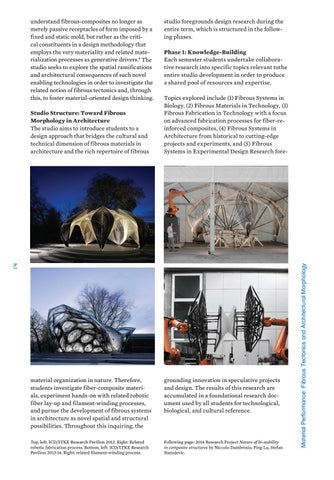
Studio Structure: Toward Fibrous Morphology in Architecture The studio aims to introduce students to a design approach that bridges the cultural and technical dimension of fibrous materials in architecture and the rich repertoire of fibrous
studio foregrounds design research during the entire term, which is structured in the following phases.
material organization in nature. Therefore, students investigate fiber-composite materials, experiment hands-on with related robotic fiber lay-up and filament-winding processes, and pursue the development of fibrous systems in architecture as novel spatial and structural possibilities. Throughout this inquiring, the
grounding innovation in speculative projects and design. The results of this research are accumulated in a foundational research document used by all students for technological, biological, and cultural reference.
Top, left: ICD/ITKE Research Pavilion 2012. Right: Related robotic fabrication process. Bottom, left: ICD/ITKE Research Pavilion 2013-14. Right: related filament-winding process.
Following page: 2014 Research Project Nature of bi-stability in composite structures by Niccolo Dambrosio, Ping Lu, Stefan Stanojevic.
Material Performance: Fibrous Tectonics and Architectural Morphology
understand fibrous-composites no longer as merely passive receptacles of form imposed by a fixed and static mold, but rather as the critical constituents in a design methodology that employs the very materiality and related materialization processes as generative drivers.9 The studio seeks to explore the spatial ramifications and architectural consequences of such novel enabling technologies in order to investigate the related notion of fibrous tectonics and, through this, to foster material-oriented design thinking.