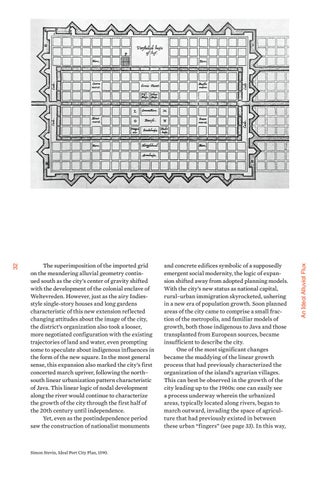
Simon Stevin, Ideal Port City Plan, 1590.
and concrete edifices symbolic of a supposedly emergent social modernity, the logic of expansion shifted away from adopted planning models. With the city’s new status as national capital, rural–urban immigration skyrocketed, ushering in a new era of population growth. Soon planned areas of the city came to comprise a small fraction of the metropolis, and familiar models of growth, both those indigenous to Java and those transplanted from European sources, became insufficient to describe the city. One of the most significant changes became the muddying of the linear growth process that had previously characterized the organization of the island’s agrarian villages. This can best be observed in the growth of the city leading up to the 1960s: one can easily see a process underway wherein the urbanized areas, typically located along rivers, began to march outward, invading the space of agriculture that had previously existed in between these urban “fingers” (see page 33). In this way,
An Ideal Alluvial Flux
32
The superimposition of the imported grid on the meandering alluvial geometry continued south as the city’s center of gravity shifted with the development of the colonial enclave of Weltevreden. However, just as the airy Indiesstyle single-story houses and long gardens characteristic of this new extension reflected changing attitudes about the image of the city, the district’s organization also took a looser, more negotiated configuration with the existing trajectories of land and water, even prompting some to speculate about indigenous influences in the form of the new square. In the most general sense, this expansion also marked the city’s first concerted march upriver, following the north– south linear urbanization pattern characteristic of Java. This linear logic of nodal development along the river would continue to characterize the growth of the city through the first half of the 20th century until independence. Yet, even as the postindependence period saw the construction of nationalist monuments