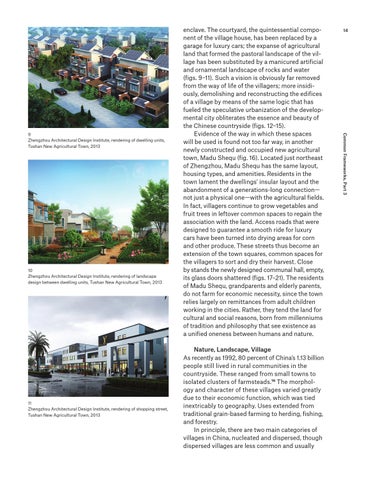
10 Zhengzhou Architectural Design Institute, rendering of landscape design between dwelling units, Tushan New Agricultural Town, 2013
11 Zhengzhou Architectural Design Institute, rendering of shopping street, Tushan New Agricultural Town, 2013
Nature, Landscape, Village As recently as 1992, 80 percent of China’s 1.13 billion people still lived in rural communities in the countryside. These ranged from small towns to isolated clusters of farmsteads.16 The morphology and character of these villages varied greatly due to their economic function, which was tied inextricably to geography. Uses extended from traditional grain-based farming to herding, fishing, and forestry. In principle, there are two main categories of villages in China, nucleated and dispersed, though dispersed villages are less common and usually
14
Common Frameworks, Part 3
9 Zhengzhou Architectural Design Institute, rendering of dwelling units, Tushan New Agricultural Town, 2013
enclave. The courtyard, the quintessential component of the village house, has been replaced by a garage for luxury cars; the expanse of agricultural land that formed the pastoral landscape of the village has been substituted by a manicured artificial and ornamental landscape of rocks and water (figs. 9–11). Such a vision is obviously far removed from the way of life of the villagers; more insidiously, demolishing and reconstructing the edifices of a village by means of the same logic that has fueled the speculative urbanization of the developmental city obliterates the essence and beauty of the Chinese countryside (figs. 12–15). Evidence of the way in which these spaces will be used is found not too far way, in another newly constructed and occupied new agricultural town, Madu Shequ (fig. 16). Located just northeast of Zhengzhou, Madu Shequ has the same layout, housing types, and amenities. Residents in the town lament the dwellings’ insular layout and the abandonment of a generations-long connection— not just a physical one—with the agricultural fields. In fact, villagers continue to grow vegetables and fruit trees in leftover common spaces to regain the association with the land. Access roads that were designed to guarantee a smooth ride for luxury cars have been turned into drying areas for corn and other produce. These streets thus become an extension of the town squares, common spaces for the villagers to sort and dry their harvest. Close by stands the newly designed communal hall, empty, its glass doors shattered (figs. 17–21). The residents of Madu Shequ, grandparents and elderly parents, do not farm for economic necessity, since the town relies largely on remittances from adult children working in the cities. Rather, they tend the land for cultural and social reasons, born from millenniums of tradition and philosophy that see existence as a unified oneness between humans and nature.