40
Common Frameworks, Part 2
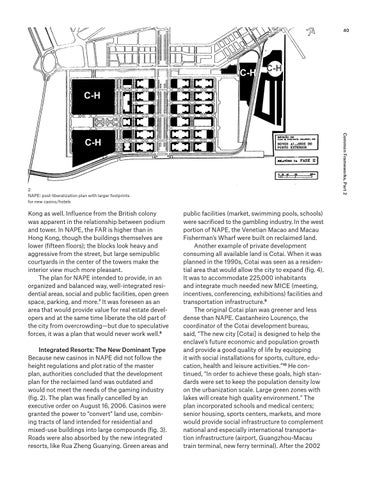
2 NAPE: post-liberalization plan with larger footprints for new casino/hotels
Kong as well. Influence from the British colony was apparent in the relationship between podium and tower. In NAPE, the FAR is higher than in Hong Kong, though the buildings themselves are lower (fifteen floors); the blocks look heavy and aggressive from the street, but large semipublic courtyards in the center of the towers make the interior view much more pleasant. The plan for NAPE intended to provide, in an organized and balanced way, well-integrated residential areas, social and public facilities, open green space, parking, and more.7 It was foreseen as an area that would provide value for real estate developers and at the same time liberate the old part of the city from overcrowding—but due to speculative forces, it was a plan that would never work well.8 Integrated Resorts: The New Dominant Type Because new casinos in NAPE did not follow the height regulations and plot ratio of the master plan, authorities concluded that the development plan for the reclaimed land was outdated and would not meet the needs of the gaming industry (fig. 2). The plan was finally cancelled by an executive order on August 16, 2006. Casinos were granted the power to “convert” land use, combining tracts of land intended for residential and mixed-use buildings into large compounds (fig. 3). Roads were also absorbed by the new integrated resorts, like Rua Zheng Guanying. Green areas and
public facilities (market, swimming pools, schools) were sacrificed to the gambling industry. In the west portion of NAPE, the Venetian Macao and Macau Fisherman’s Wharf were built on reclaimed land. Another example of private development consuming all available land is Cotai. When it was planned in the 1990s, Cotai was seen as a residential area that would allow the city to expand (fig. 4). It was to accommodate 225,000 inhabitants and integrate much needed new MICE (meeting, incentives, conferencing, exhibitions) facilities and transportation infrastructure.9 The original Cotai plan was greener and less dense than NAPE. Castanheiro Lourenço, the coordinator of the Cotai development bureau, said, “The new city [Cotai] is designed to help the enclave’s future economic and population growth and provide a good quality of life by equipping it with social installations for sports, culture, education, health and leisure activities.”10 He continued, “In order to achieve these goals, high standards were set to keep the population density low on the urbanization scale. Large green zones with lakes will create high quality environment.” The plan incorporated schools and medical centers; senior housing, sports centers, markets, and more would provide social infrastructure to complement national and especially international transportation infrastructure (airport, Guangzhou-Macau train terminal, new ferry terminal). After the 2002