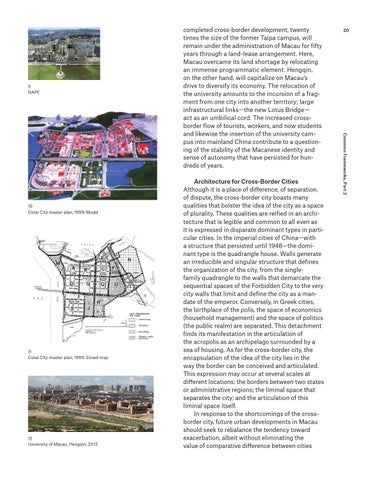
9 NAPE
11 Cotai City master plan, 1999: Zoned map
12 University of Macau, Hengqin, 2013
Architecture for Cross-Border Cities Although it is a place of difference, of separation, of dispute, the cross-border city boasts many qualities that bolster the idea of the city as a space of plurality. These qualities are reified in an architecture that is legible and common to all even as it is expressed in disparate dominant types in particular cities. In the imperial cities of China—with a structure that persisted until 1948—the dominant type is the quadrangle house. Walls generate an irreducible and singular structure that defines the organization of the city, from the singlefamily quadrangle to the walls that demarcate the sequential spaces of the Forbidden City to the very city walls that limit and define the city as a mandate of the emperor. Conversely, in Greek cities, the birthplace of the polis, the space of economics (household management) and the space of politics (the public realm) are separated. This detachment finds its manifestation in the articulation of the acropolis as an archipelago surrounded by a sea of housing. As for the cross-border city, the encapsulation of the idea of the city lies in the way the border can be conceived and articulated. This expression may occur at several scales at different locations: the borders between two states or administrative regions; the liminal space that separates the city; and the articulation of this liminal space itself. In response to the shortcomings of the crossborder city, future urban developments in Macau should seek to rebalance the tendency toward exacerbation, albeit without eliminating the value of comparative difference between cities
20
Common Frameworks, Part 2
10 Cotai City master plan, 1999: Model
completed cross-border development, twenty times the size of the former Taipa campus, will remain under the administration of Macau for fifty years through a land-lease arrangement. Here, Macau overcame its land shortage by relocating an immense programmatic element. Hengqin, on the other hand, will capitalize on Macau’s drive to diversify its economy. The relocation of the university amounts to the incursion of a fragment from one city into another territory; large infrastructural links—the new Lotus Bridge— act as an umbilical cord. The increased crossborder flow of tourists, workers, and now students and likewise the insertion of the university campus into mainland China contribute to a questioning of the stability of the Macanese identity and sense of autonomy that have persisted for hundreds of years.