l e t t e r s to t h e e d i to r rly arteerly uart Qu Groton School Q V, No. 1 LXXV, LXX Winter 2013 | Vol. LXXV
When Martin Luther King, Jr. Spoke at Groton February 4, 1963
50
T
H
AN
N
IV
ER
SA
RY
In the Winter Quarterly, John Rhinelander ’51 stated that William Thorndike’s statement in the Fall Quarterly—that Jake Congleton converted the offense from single-wing to T-formation in 1957—was wrong, noting that Larry Noble did that in the 1940s. Actually, both statements are correct. During 1953-6, between Larry Noble and Jake Congleton, the Groton coach was Jack Davison, who had been the fullback of the Princeton team, which used the single wing. So Groton used it during his period as coach, before Congleton went back to the T-formation. Theodore Chase Jr. ’56 * * * I just finished reading this winter’s Quarterly on Martin Luther King and feel so moved that I want to thank you for what might be the most important Quarterly I have ever read—at least the most moving to me! Jack Crocker was my grandfather, and the story of the MLK visit was never terribly clear to me—therefore this series is much appreciated. I plan to share it with my cousins and aunts and uncles, as well as the many great-great-grandchildren in the Crocker clan. And, of course, Mary Crocker was my grandmother, who may have had as much if not more to do with getting Dr. King to the School. “We do what’s right”—what a quote. Thanks so much for great work. It has made me very proud and recommitted to saving the world! Tom Cleveland ’70
* * * I want to call your attention to a recurring grammatical error in the 2013 Winter issue. The Rev. Dr. John Crocker, his formal and proper title, is referred to as “Reverend Crocker.” This is not only bad style, it is bad grammar. “Reverend” is very much like “Honorable”; the former is used for clergy, the latter for judges and others. One would never refer to the Supreme Court Justice as Honorable Ginsburg. The proper style is the Honorable Ruth Bader Ginsburg. Note that the “t” is not capitalized unless it is the first word in a sentence. The title “Reverend” should be treated in the same way. Admittedly, the repeated use of “the Reverend” for Episcopal and other clergy feels somewhat clumsy in a written article. There are several ways around that; Mr. Crocker (which is what we students called him in our day) is one option. On a positive note, my issue of the Quarterly is correctly addressed to “The Rev. Nathaniel W. Pierce.” Nathaniel Pierce ’60, form secretary Editor’s Note: The Quarterly’s style guide does note the need for “the” before Reverend. We regret the error. *
*
*
Given Mr. Crocker’s principled position on social issues, his invitation to Dr. King was not surprising. Fully a decade earlier, Groton had signaled its commitment to integration by admitting its first student of color; pushed back against McCarthyism by welcoming the blacklisted folk singer, Pete Seeger; and provided support to the nascent civil rights movement by inviting activist Bayard Rustin to give a Chapel Talk. As a black, gay, Socialist pacifist, Rustin chilled us with his accounts of prison brutality, jolting many out of an otherwise comfortable complacency. For a school steeped in tradition and normally respectful of the status quo,
these events offered an alternative view of the world and a challenge to our collective conscience to take personal action against injustice. Charles H. Rathbone ’54
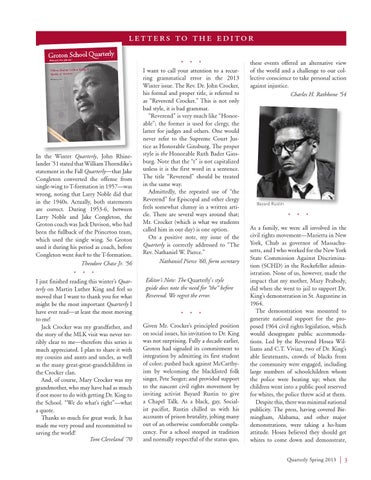
bayard rustin
*
*
*
As a family, we were all involved in the civil rights movement—Marietta in New York, Chub as governor of Massachusetts, and I who worked for the New York State Commission Against Discrimination (SCHD) in the Rockefeller administration. None of us, however, made the impact that my mother, Mary Peabody, did when she went to jail to support Dr. King’s demonstration in St. Augustine in 1964. The demonstration was mounted to generate national support for the proposed 1964 civil rights legislation, which would desegregate public accommodations. Led by the Reverend Hosea Williams and C.T. Vivian, two of Dr. King’s able lieutenants, crowds of blacks from the community were engaged, including large numbers of schoolchildren whom the police were beating up; when the children went into a public pool reserved for whites, the police threw acid at them. Despite this, there was minimal national publicity. The press, having covered Birmingham, Alabama, and other major demonstrations, were taking a ho-hum attitude. Hosea believed they should get whites to come down and demonstrate, Quarterly Spring 2013
| 3