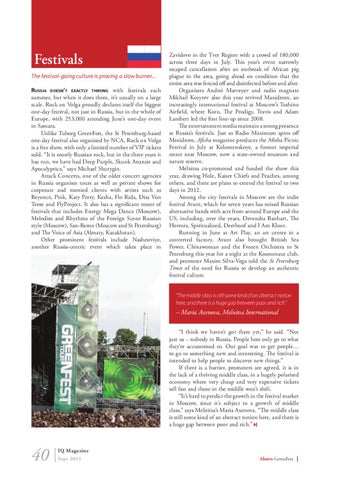
Festivals The festival-going culture is proving a slow burner... RUSSIA DOESN’T EXACTLY THRONG with festivals each summer, but when it does them, it’s usually on a large scale. Rock on Volga proudly declares itself the biggest one-day festival, not just in Russia, but in the whole of Europe, with 253,000 attending June’s one-day event in Samara. Unlike Tuborg GreenFest, the St Petersburg-based one-day festival also organised by NCA, Rock on Volga is a free show, with only a limited number of VIP tickets sold. “It is mostly Russian rock, but in the three years it has run, we have had Deep Purple, Skunk Anansie and Apocalyptica,” says Michael Shurygin. Attack Concerts, one of the older concert agencies in Russia organises tours as well as private shows for corporate and monied clients with artists such as Beyoncé, Pink, Katy Perry, Kesha, Flo Rida, Dita Von Teese and FlyProject. It also has a significant roster of festivals that includes Energy Mega Dance (Moscow), Melodies and Rhythms of the Foreign Scene Russian style (Moscow), San-Remo (Moscow and St Petersburg) and The Voice of Asia (Almaty, Kazakhstan). Other prominent festivals include Nashestviye, another Russia-centric event which takes place in
Zavidovo in the Tver Region with a crowd of 180,000 across three days in July. This year’s event narrowly escaped cancellation after an outbreak of African pig plague in the area, going ahead on condition that the entire area was fenced off and disinfected before and after. Organisers Andrei Matveyev and radio magnate Mikhail Kozyrev also this year revived Maxidrom, an increasingly international festival at Moscow’s Toshino Airfield, where Korn, The Prodigy, Travis and Adam Lambert led the first line-up since 2008. The entertainment media maintain a strong presence at Russia’s festivals. Just as Radio Maximum spins off Maxidrom, Afisha magazine produces the Afisha Picnic Festival in July at Kolomenskoye, a former imperial estate near Moscow, now a state-owned museum and nature reserve. Melnitsa co-promoted and funded the show this year, drawing Hole, Kaiser Chiefs and Peaches, among others, and there are plans to extend the festival to two days in 2012. Among the city festivals in Moscow are the indie festival Avant, which for seven years has mixed Russian alternative bands with acts from around Europe and the US, including, over the years, Devendra Banhart, The Horrors, Spiritualized, Deerhoof and I Am Kloot. Running in June at Art Play, an art centre in a converted factory, Avant also brought British Sea Power, Chinawoman and the Frozen Orchestra to St Petersburg this year for a night at the Kosmonaut club, and promoter Maxim Silva-Vega told the St Petersburg Times of the need for Russia to develop an authentic festival culture. “The middle class is still some kind of an abstract notion here, and there is a huge gap between poor and rich.”
– Maria Axenova, Melnitsa International “I think we haven’t got there yet,” he said. “Not just us – nobody in Russia. People here only go to what they’re accustomed to. Our goal was to get people… to go to something new and interesting. The festival is intended to help people to discover new things.” If there is a barrier, promoters are agreed, it is in the lack of a thriving middle class, in a hugely polarised economy where very cheap and very expensive tickets sell fast and those in the middle won’t shift. “It’s hard to predict the growth in the festival market in Moscow, since it’s subject to a growth of middle class,” says Melnitsa’s Maria Axenova. “The middle class is still some kind of an abstract notion here, and there is a huge gap between poor and rich.”
40
IQ Magazine Sept 2011
Above: GreenFest