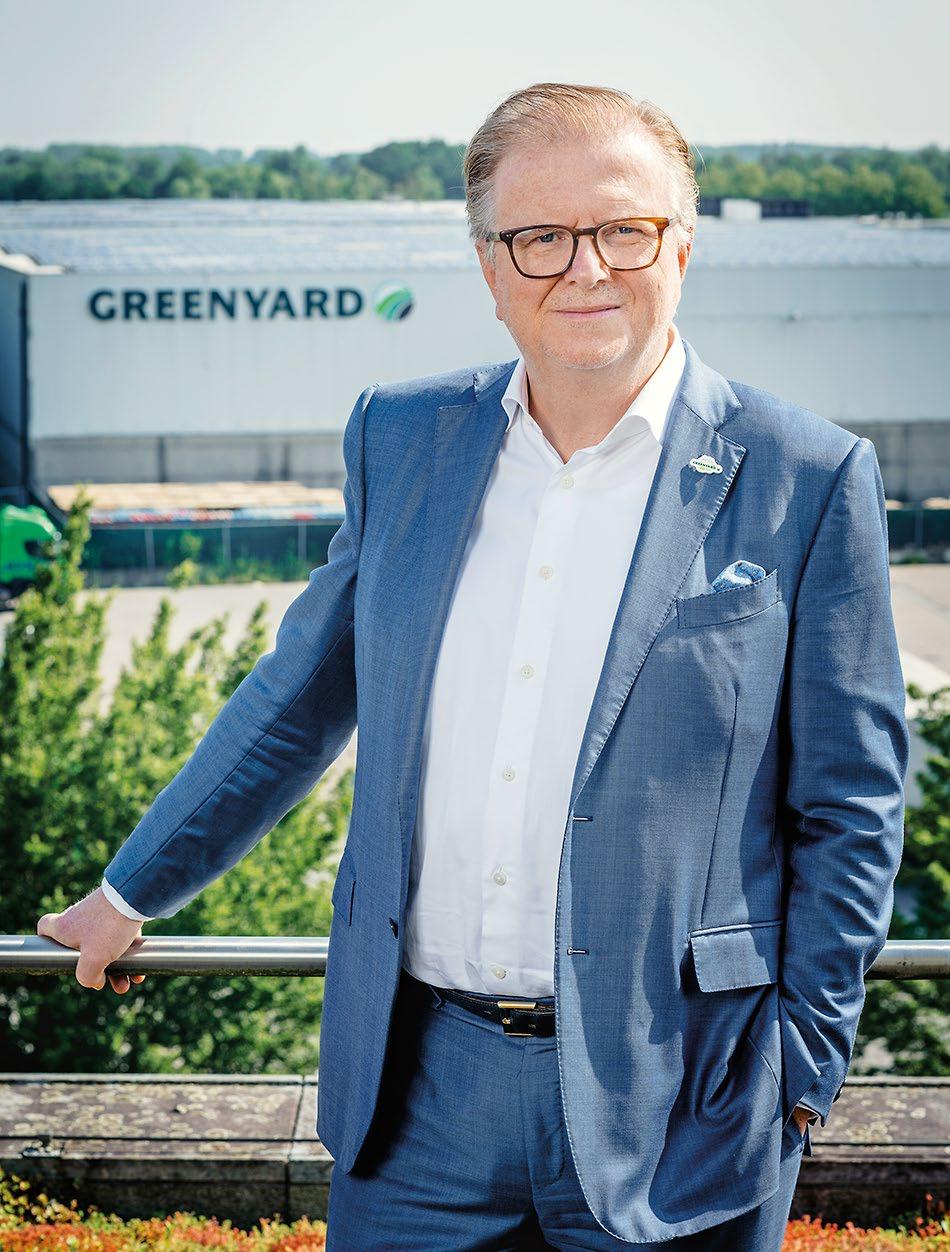
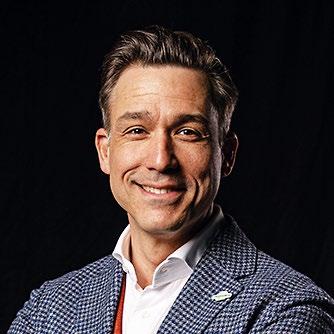
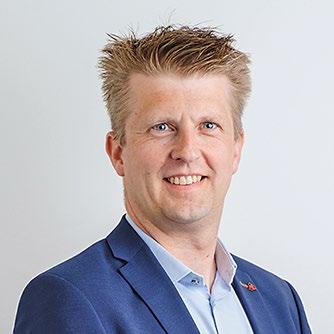
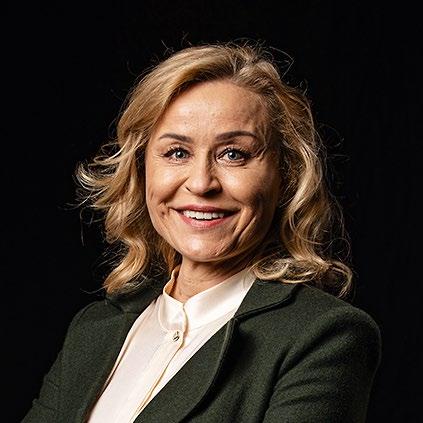
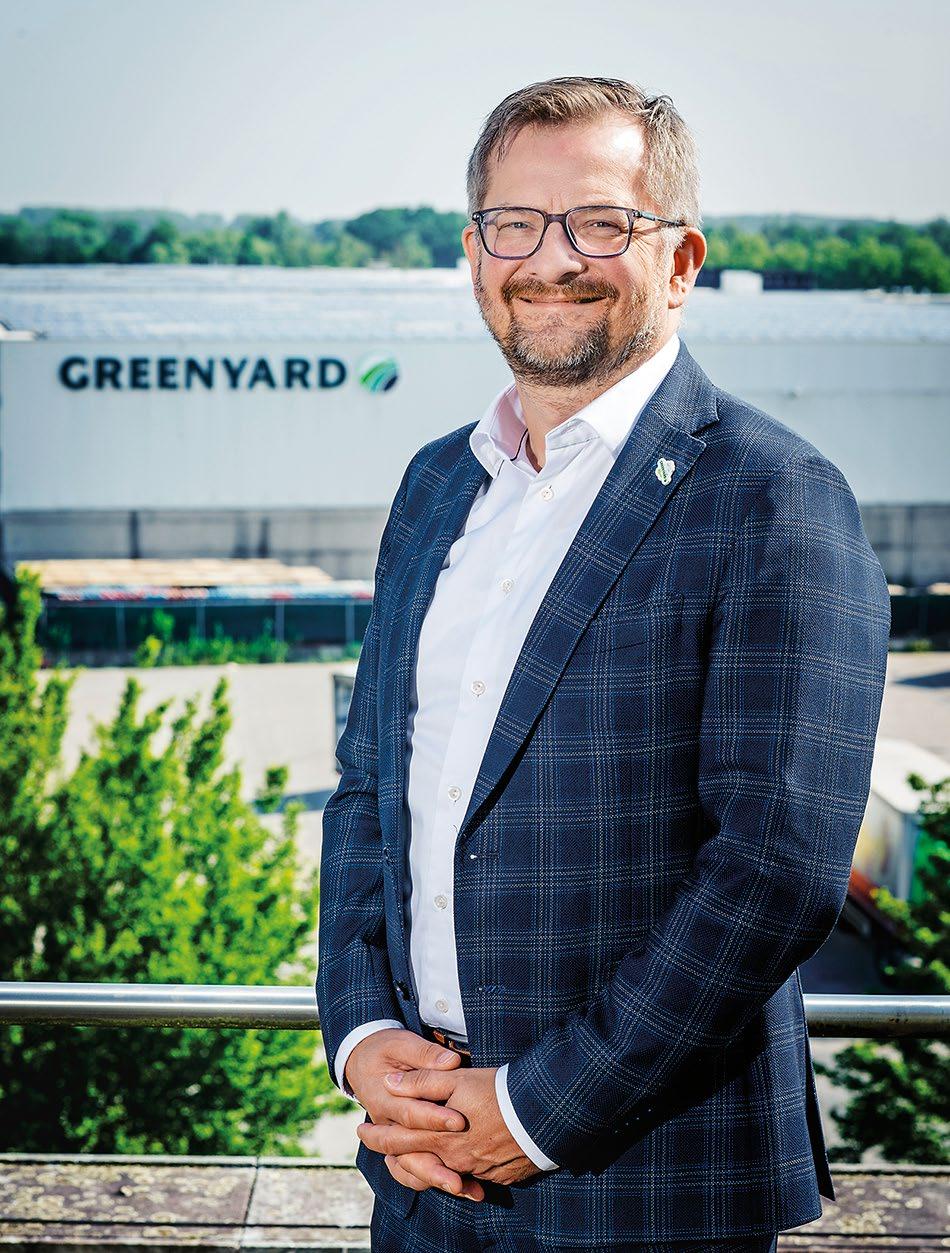
Word from our Founder & Executive Director Hein Deprez
Leading the necessary shift towards nutritious and sustainable pure-plant diets
Just over 40 years ago, Greenyard was founded from a bold and clear vision on the future of food, which only becomes more relevant as time moves on. Today, consensus is clear: we need to change the way we consume and produce food. A diet shift towards more pure-plant foods, and less reliance on animal proteins, is no longer optional. It is the only path forward for healthier lifestyles and a more sustainable food chain.
The world today is facing two defining challenges: public health and environmental sustainability. The facts are harsh: unhealthy diets now cost the global economy an estimated 11 trillion dollars each year, and climate change is no longer a distant threat. We see the impact of extreme and unpredictable weather circumstances around us every day. Our industry, fruit and vegetables, finds itself in a great paradox: it is one of the most affected by the climate crisis, and yet it holds a vital part of the solution.
Shifting to more pure-plant diets can drastically reduce our environmental footprint: studies show that replacing just 100 grams of meat per day with pureplant alternatives cuts carbon emissions by 75%. Food production accounts for roughly 34% of global emissions, so a simple shift in mindset and consumption habits could address up to 25% of total emissions worldwide.
Truly unlocking the potential of our category, starts with understanding our business, deeply and thoroughly. We need to understand the facts, the arguments, and the logic that underpin the power we hold as a fruit and vegetable industry. Only then can we speak with one voice, take up our responsibility and carry more weight in the public debate. When everyone pulls in the same direction, our message becomes clearer and our execution sharper.
From the very beginning, we also believed that a different approach was needed in our industry. We established a unique business model that connects every stakeholder in our food value chain, from consumers to retailers to growers, in a demand-driven fashion. That same Fork-toField model still sets us apart, and makes us the trusted partner for Europe’s largest retailers, connecting them to our global grower network and providing consumers with the right assortment, all year round. Across every market segment, whether in Fresh or Long Fresh, we bring tasty, easy to prepare, and nutritious pure-plant solutions to the table, while ensuring they are affordable for all. That is how we win hearts, shelves, and minds.
Our Fork-to-Field model also ensures that growers can build a sustainable business, both economically and ecologically. We not only provide them with access to millions of consumers, we also help them improve their efficiency, reduce their ecological impact and – increasingly important – cope with the negative effects of climate change they are confronted with. The pureplant future of food simply cannot exist without a healthy agricultural sector.
We are conscious that this past year was marked by rapidly shifting market dynamics, tough competition in our markets and mounting climatological challenges. Although our visionary approach to building the company over the past four decades ensures we are prepared for this, this reality also demands agility and a firm commitment from everyone within the Greenyard family.
“ Our industry, fruit and vegetables, finds itself in a great paradox: it is one of the most affected by the climate crisis, and yet it holds a vital part of the solution.”
Real engagement starts with the right mindset. As a family-business, everyone at Greenyard feels personally invested. That emotional connection is what drives us to permanently improve small inefficiencies, from an unchecked pallet to an unnecessary delay. These details matter, as they compound over time and directly contribute to our business.
We remain faithful to our unique founding vision, even in challenging times. It requires hard work, expertise and dedication from our people, every day. Therefore, I would like to thank everyone for their support and their commitment on our journey to a healthier, pure-plant future. Together, we can really make the difference on our plates and for our planet.
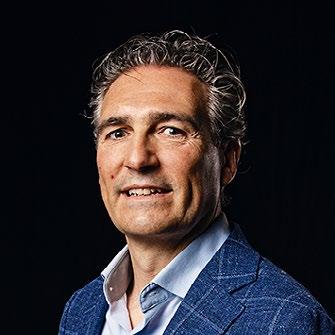
Hein Deprez, Founder & Executive Director of the Board
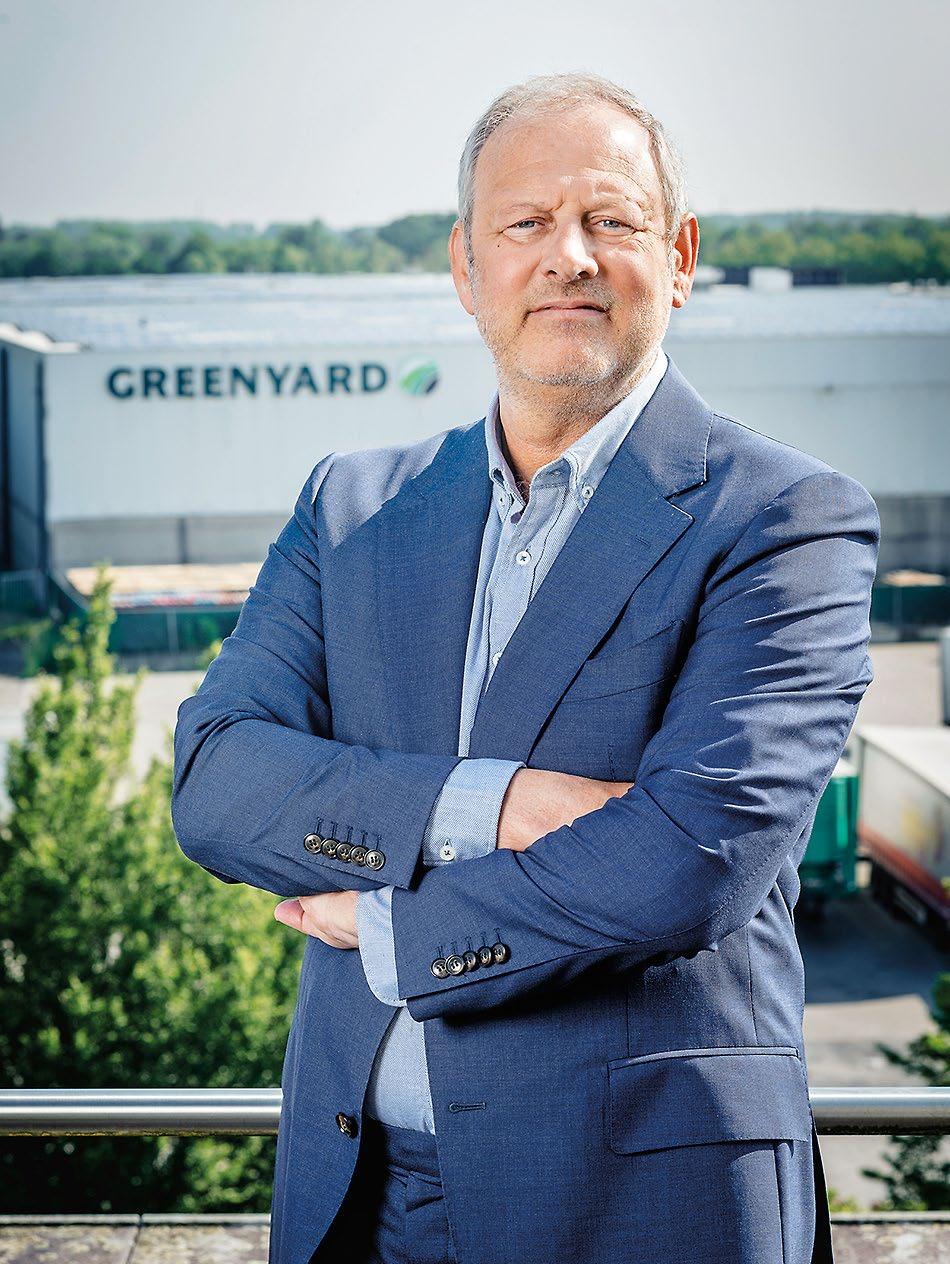
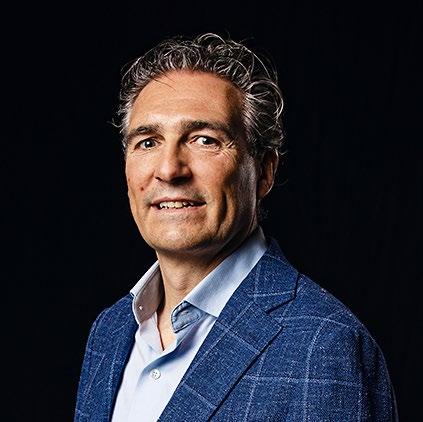
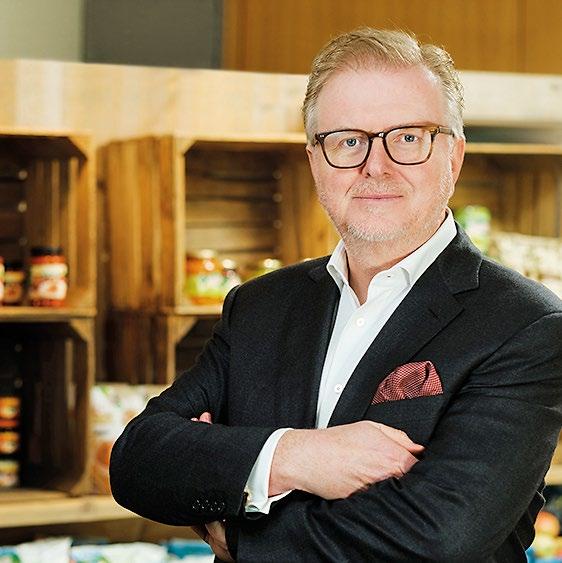
Message from our CEO Francis Kint
Chief Executive Officer
“ In the past financial year 24/25 we navigated through a highly complex and volatile environment. During difficult market circumstances, we remained true to our purpose-driven strategy. Since our founding, we are committed to supporting our customers in bringing tasty, healthy, nutritious and sustainable foods to consumers across the world. By further strengthening our ties with growers and retailers and through continued investments in our infrastructure, we have been able to improve efficiency across our value chain, increase our volumes and ensure that our products remained available and affordable. Our focus on technology and innovation has enabled us to capture the growing demand for healthy food solutions that combine convenience with great taste and nutritional value.”
Navigating through market and climate volatility
In the first half of the last financial year, many growers were confronted with extreme weather conditions – long periods of drought in some growing regions, intense rainfall and floods in other regions. These have inevitably led to extra efforts in our sourcing and higher handling costs to ensure volumes and quality remained at the same level.
By the end of 2024, industries saw the effects of declining consumer confidence due to geopolitical tensions and uncertain economic perspectives, leading to a higher price sensitivity and much more careful food spending. In some of our markets, competition amongst suppliers continued, resulting in a strong price pressure.
Despite these challenges, we further grew sales in most divisions. Fruit and vegetables remain the top driver of store traffic, more than ever drawing consumers in. The strength of this category – and our leadership within it – positions us strategically with our customers and across the food value chain. In the Fresh segment, we even outperformed the market, thanks to our Integrated Customer Relationships (ICR).
The Frozen category landed well, driven by rising demand for pure-plant and convenient options, and we were able to create a brand momentum with the introductions of small, yet disruptive brands in valuable categories.
In the Prepared division, we have seen a decline in demand for traditional canned products, which we were able to largely offset by strong, double-digit growth in more innovative convenience categories such as sauces, soups and dips.
This resulted in steady sales growth on a like-for-like basis, with 5,1%, to € 5,3bn. Adjusted EBITDA decreased with € 3,5m to € 183,0m. Our financial result was impacted by two one-off divestments: the closing process of Greenyard Fresh France and our service centre in Munich, Germany, leading to a net negative result of € -2,9m. Nevertheless, we managed to improve our free cashflow to € 72,4m and further reduce our Net Financial Debt to € 256,5m, resulting in a leverage ratio of 1,86x.
IGR and ICR – the power of an integrated value chain
Our Fork-to-Field approach remains the foundation of our company’s unique business model. Through integrated collaboration with growers (IGR) and retailers (ICR) we have established a demand-driven value chain that prevents food waste, ensures availability of the right produce at the right time and reduces the overall environmental impact of the entire value chain. This model enables us to remain agile in even the most challenging conditions, adapting swiftly when needed, while consistently focusing on delivering added value to all stakeholders. In a landscape defined by tight margins and high complexity, this level of integration and responsiveness is what sets us apart.
Through our ICR, we unburden our customers by helping them respond to growing demand for healthy food and adding value to the pure-plant category. We are further integrating with customers in every division, from developing new on-trend products as a private label partner in the Long Fresh division to offering the full assortment of fruit and vegetables in the Fresh division. Our new partnership with a foodservice customer in Belgium proves that our ICR model perfectly fits that sector as well, as we deliver products across all divisions: Fresh, Frozen and Prepared.
On the other side of our value chain, we are stepping up our efforts to intensify our collaboration with our growers through our Integrated Grower Relationships (IGR). The establishment of the Green Farmers Group in Italy and the exclusive negotiations with Gelagri are just two examples of how we walked the talk.
Closer collaboration with growers will be more critical than ever in the years ahead to ensure consumers have year-round access to the best nature has to offer. Our IGR approach provides a solid foundation to strengthen and expand this strategic pillar. Our grower base is incredibly diversified: producer organisations and cooperatives, local and overseas growers, large farms and small familyowned businesses. Despite their diversity, they all feel the effects of climate change, along with the impact of regulatory changes and economic challenges. It is our responsibility to help them cope with these challenges – through joint investments in mechanisation or more effective use of crop protection, introducing more sustainable ways of working, and most importantly, ensuring their hard work is rewarded.
Infrastructure – at the forefront of food-tech
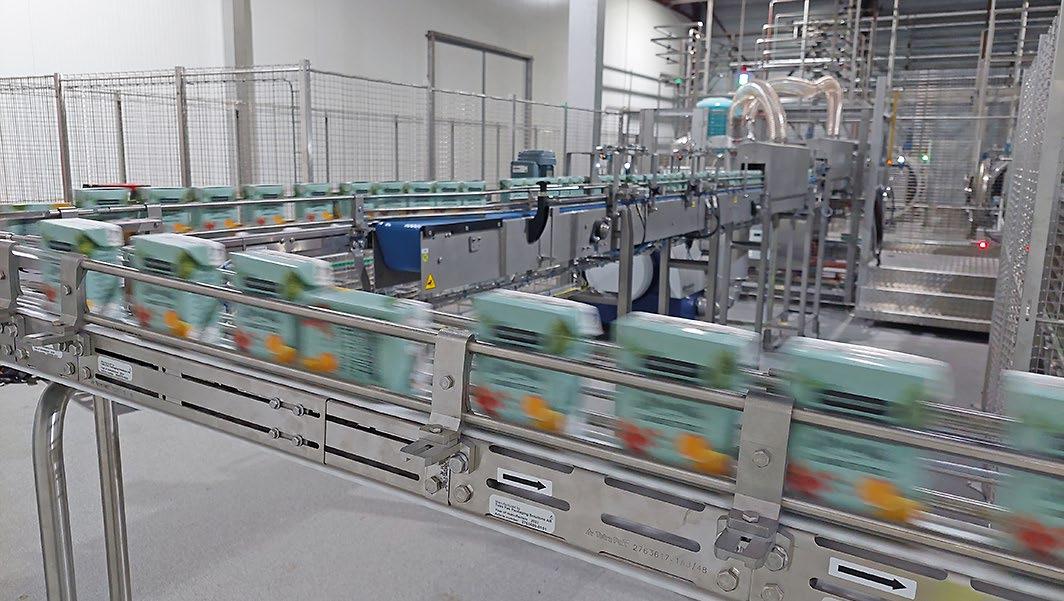
We have also continued to invest in our infrastructure, improving efficiency and operational excellence across all our divisions. The growing demand for our convenience products not only requires extra production capacity, it also requires state-of-the-art manufacturing facilities. The new Tetra Pak® line at Greenyard Prepared is an excellent example of this, providing new attractive packaging that makes our products stand out on the shelves. In our Frozen division, we continue to invest in our infrastructure and capacity, with new spinach lines in Comines (France) and a new, automated packing line in Lipno (Poland) as just two examples. With the acquisition of Crème de la Crème, we added 25 years
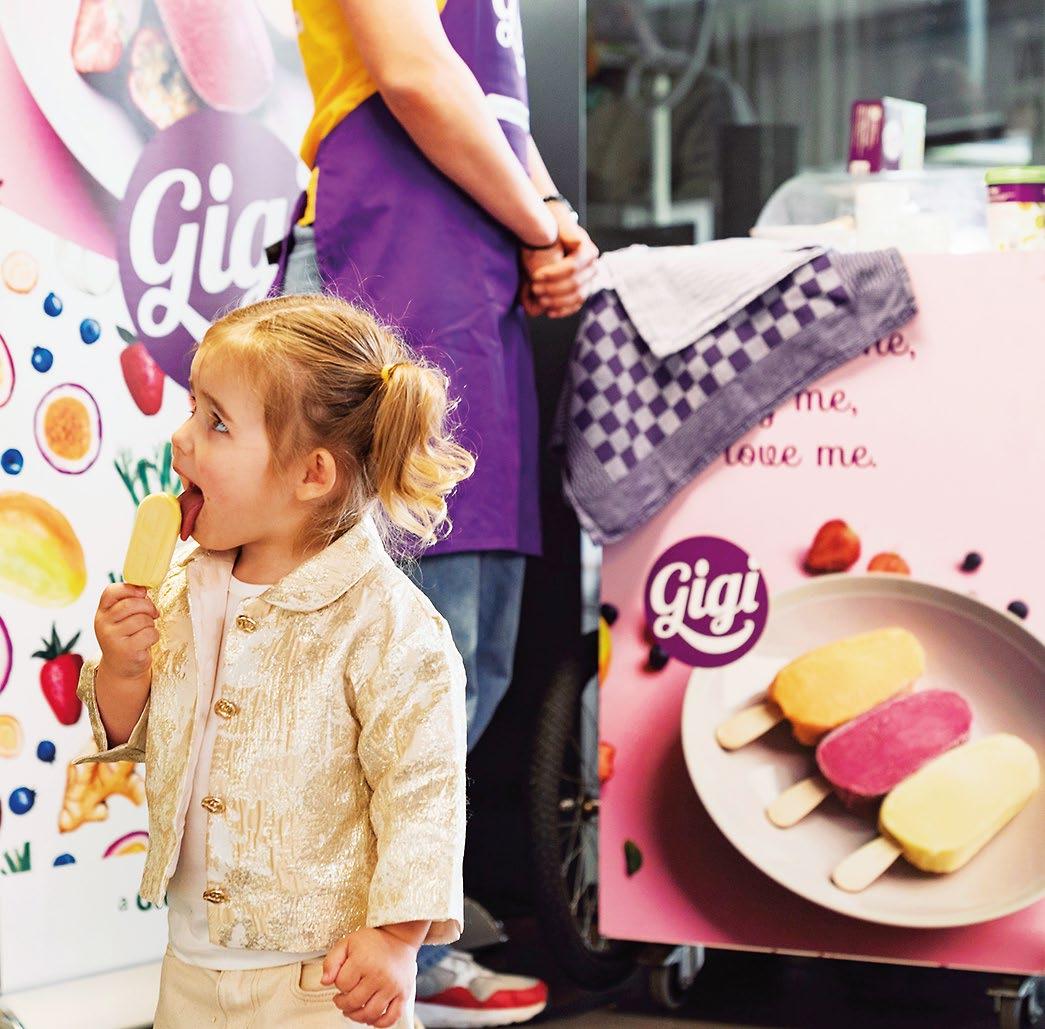
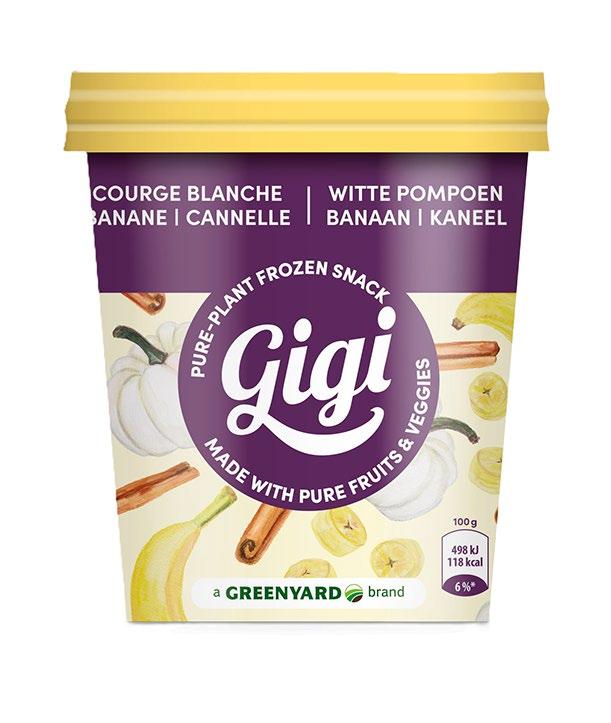
of manufacturing knowhow in dairy-free desserts, a very promising category we entered last year with our own brand Gigi.
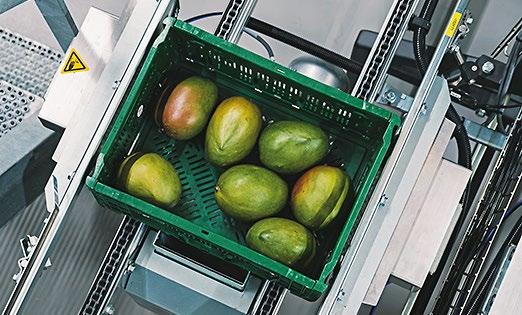
In the Netherlands, Bakker has started construction of a new cutting-edge service centre, a true milestone for the company, that will support future growth. The company has also taken a new state-of-the-art mango sorting line into operation to ensure the best possible quality always ends up on the shelf.
Making the healthy choice an easy and attractive one
While it’s clear that economic and geopolitical uncertainties have led consumers to become more cautious in their food spending, they are still looking for food solutions that offer a great combination of taste, convenience, high nutritional value and affordability. In AY 24/25, we have continued our innovation efforts to meet this demand and facilitate the shift to healthier diets.
The success of our meal-kits in the Fresh division speaks for itself. We are expanding and rotating recipes to bring extra variety and provide new and inspiring answers to the question “what’s for dinner tonight”? We are also reaching new markets for our meal-kits, including the Czech Republic.
In the Long Fresh division, we are adding new convenience products to our private label portfolio almost daily. We help our customers in retail and foodservice tap into new consumer trends, such as high-protein products, readyto-eat meals and meal components, along with a wide range of sauces, soups and snacks that bring the world cuisine into the homes of millions of consumers.
Meanwhile, we are also working on food concepts that will open up new opportunities for more pureplant consumption throughout the day. Following the successful campaign for our Gigi pure-plant gelato in 2024, we will be launching the cross-divisional PlanTasty brand in AY 25/26, which will introduce pure-plant solutions within new and existing food categories.
A people’s business
Finally, I would like to thank our employees worldwide for their hard work during this challenging year. Our business remains in essence a people’s business. It’s based on dayto-day collaborations and close partnerships throughout the entire value chain, from consumer to grower and back again. It’s about passion for great and healthy food and translating that passion into innovative products and added-value services. Inclusion and diversity are key to feed our passionate culture. Different perspectives make us stronger and help us gain insight in different markets and strengthen ties with partners all over the world.
They are the true driving force behind our company. With our Greenyard family mindset, we are more than ever a creative, reliable, and entrepreneurial company, continuing our journey to a healthier and more sustainable future.
I invite you to dive into this report and discover how we contributed to shaping the future of foods in our AY 24/25.
Enjoy
the reading,
Francis Kint, CEO Greenyard
This is Greenyard
Greenyard is one of the world’s largest providers of fruit and vegetables. We bring the best of nature to the plates of tens of millions of consumers every day. Sourced from local farmers or from the best regions across the globe. Fresh, frozen, and prepared. For every lifestyle, every occasion and every budget.
A timeless vision
Building on a rich legacy that began over 40 years ago when Founder Hein Deprez started with a single mushroom farm in 1983, Greenyard’s mission and vision have been clear from the start: to improve life by making the consumption of fruit and vegetables easy, fast, and pleasurable for everyone, while fostering nature. This timeless vision, focused on the end-consumer as the starting point, aims to deliver healthy, nutritious, and delicious pure-plant products in the most effective way possible.
Through entrepreneurship and passion, Greenyard has evolved from its humble beginnings into a game-changing global fast-moving consumer goods company. Today, the Group stands as a trusted partner for major European retailers, connecting them with a vast network of growers through a sustainable and data-driven supply chain, effectively challenging traditional models and creating true impact on food experiences with the pure power of plants.
Pure. Plant. Power.
PURE
What nature brings
Fruit and vegetables are and have always been our core product. Processing is limited to what consumers would do in their home kitchen: cutting, freezing, cooking, steaming, seasoning and preserving.
PLANT
In all their authentic natural glory
We believe in fruit and vegetables in all their natural greatness: close-to-crop and close to the harvested product. Always with maximum respect for their authentic taste, colour and texture.
POWER
Bursting with natural nutrients
Our products come straight from the field, bursting with energy and the natural nutrients people need to get powered up: carbs, healthy fats, proteins… Providing all minerals, fibres and vitamins for a healthy lifestyle.
Fresh
Greenyard Fresh and Bakker, a Greenyard company, provide Europe’s biggest retailers with a full range of fresh fruit and vegetables, sourced from our worldwide grower network for the best quality. Thanks to our strategically located service centres and state-of-the-art logistics, we unburden our customers in the pure-plant category.
Prepared
Greenyard Prepared provides retailers, foodservice companies and the food industry with an extensive pure-plant portfolio. The offering ranges from classic preserved products in cans, liquid cardboard or jars to delicious dips, soups and sauces tailored to today’s consumer trends.
Frozen
Greenyard Frozen turns freshly harvested fruit and vegetables into innovative frozen food products. They are tailored to modern consumers who want to enjoy healthy, nutritious and tasty pure-plant foods. We ensure they always require minimal preparation time and maximal portionability.
Greenyard in numbers
Net Sales (like-for-like)
€ 5 330,3 M
Leverage
1,86 X
Adjusted EBITDA-margin
3,4 %
Net Financial Debt (excl. lease accounting)
€ 256,5 M
€ -2,9 M
€ 183,0 M Result
Adjusted EBITDA
8 600 employees on avg.
12 innovative production sites (Frozen & Prepared) Approx.
Approx.
2 600 Kton sales volume > 80 countries
23 service centres (Fresh)
Business Review: deploying the Greenyard-strategy
in AY 24/25
Fruit and vegetables are the right choice for a healthier future for both people and planet. Guided by our strategic pillars, Greenyard is leading the way thanks to our unique business model, our advanced food-tech infrastructure, new and exciting products and the drive of our people and planet. The Greenyard-strategy remains deeply aligned with our commitment to health and sustainability, and it continues to be powered by close collaborations throughout the chain.
Over the past financial year, we further leveraged our unique business model, building on advanced developments in our infrastructure and focusing on new, exciting products, with our people as most valuable assets. Discover more in the pages below.
Connecting the food value chain
We connect growers, retailers and consumers in a demand-driven supply chain. A one-of-a-kind business model that reduces waste, improves quality and ensures thousands of products remain available for everyone, all year round.
Go to p. 16 →
Innovating for a healthier future
We are committed to driving innovation to provide consumers with food that is nutritious, affordable, convenient, and, above all, tasty. We regard it as a fundamental aspect of our mission to encourage and empower individuals to make healthy choices consistently, all day, every day. And we do so, by co-creating with our customers.
Go to p. 24 →
Advancing our infrastructure
With one of the most advanced food-tech infrastructures in our sector, we have everything in place to provide people with the future of pure-plant food experiences.
Go to p. 20 →
People are the driving force behind our company
Our business is a people’s business, based on close collaborations and long-term partnerships. Our colleagues around the world form a set of 8 600 ambassadors, driven by our purpose to improve life and committed to driving excellence and continuous improvement across our operations.
Go to p. 27 →
Connecting the food value chain
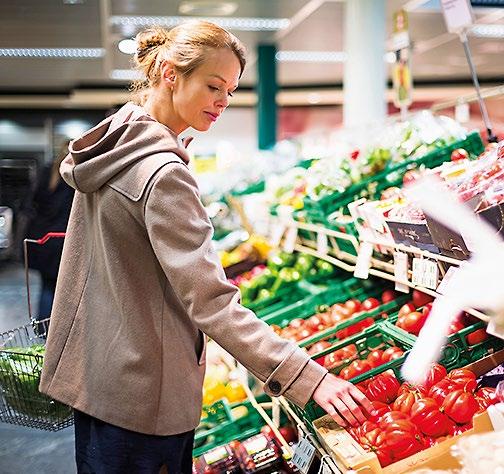
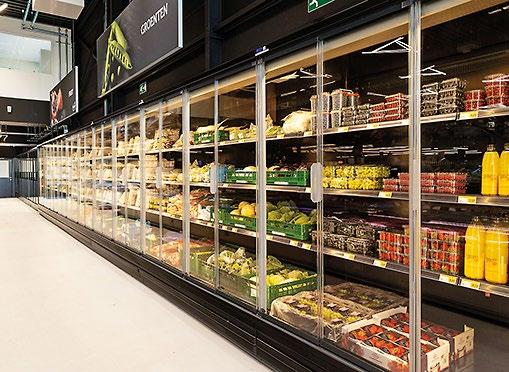
As shoppers move through the fresh, frozen, and ambient aisles of their local supermarket, the sophisticated supply chain networks that make their preferred products available often go unnoticed. But behind the scenes, we are operating a complex supply chain, which connects customers, growers and consumers in a demand-driven Fork-to-Field supply chain to ensure quality, availability and affordability.
Working with perishable products of nature, we only have a short window to ensure they get to our customers at their very best. Our fresh produce is sourced from both local growers and growers around the world, with the origins often varying depending on the time of year. Only by carefully matching demand with supply, can we get each of our products on the shelves in the best quality, while preventing waste. In Long Fresh we are sourcing from growers within 150 km of our sites, allowing us to quickly preserve their taste and nutritional value within two hours after harvesting.
Integrated Customer Relationships (ICR)
Unburdening retailers
With our Integrated Customer Relationship (ICR) model, we have been pioneering a truly unique business model in the world of fruit and vegetables. The basic idea behind ICR is to fully unburden retailers and foodservice companies in the pure-plant category. We offer a complete assortment of fruit, vegetables and innovative pure-plant products, all year round, fresh, frozen and prepared.
Depending on our customers’ specific needs, we can draw up an entire menu of added-value services, including logistics, packaging, ripening services, category management and direct-to-store deliveries. As a private label partner, we develop new product varieties and new recipes, taking inspiration from consumer trends and fully in line with each customer’s brand positioning.
The ultimate aim is to help retailers and foodservice companies successfully develop and expand the fruit and vegetables category. Through our product knowledge and our expertise, we enable them to really stand out from their competitors in one of the most important categories for today’s consumers.
Our integrated partnerships are gaining traction in the market, with the share of ICR customers in our business growing year by year – ICR now represents 80% of the business in our Fresh segment and continues to expand in our Long Fresh segment. We continue to add new customers within this way of working, even in new sectors such as the foodservice industry where we closed a partnership with a new customer in Belgium. In parallel, we continue to grow our business at our existing customers, of which some are partnerships that have been active for decades.
New horizons for our Integrated Customer Relationships
In March 2025, Greenyard Fresh Belgium closed a partnership agreement with a foodservice customer in Belgium to supply its stores with a complete assortment of fresh fruit, vegetables and potatoes. The new partnership proves we can bring the benefits of our integrated partnerships beyond the retail world.
The customer is a leading wholesale supplier in the foodservice market, servicing thousands of restaurants and catering companies with a total offering in highquality food and beverage products. A long-time customer of our Long Fresh segment in both Frozen and Prepared, the company now partners with Greenyard Fresh Belgium for the entire range of fresh fruit, vegetables and potatoes, crucial categories in today’s foodservice market.
By resolutely opting for high-quality, sustainable and locally grown produce, the foodservice customer focusses on short supply chains whenever possible. Greenyard
Integrated Grower Relationships (IGR)
Helping growers build a healthy and sustainable business
Greenyard has been building long-term partnerships with a wide network of growers. Some of these partnerships go back for decades, from one generation of farmers to the next one, and we either deepen these relations, or add new collaborations to our network, as evidenced by the establishment of the Green Farmers Group and our strategic alliance with Gelagri. We source directly from both local growers, working close to our European markets, and growers in other regions around the world.
Our IGR model can take on different shapes and sizes and can include guaranteed volumes, contract-growing and even joint ventures. But it’s about more than just volumes and conditions. We also support our growers in their daily operations and help them explore the latest agricultural techniques and practices, including mechanisation and even AI-based crop protection like we did in our
Fresh Belgium will streamline the entire process from product sourcing until the delivery to individual stores. The partnership covers more than 1,5 million items, including apples, pears, lettuce, chicory and strawberries from Belgian growers.
Telespazio project, ensuring their business remains sustainable in the long run, both from an economical and an ecological perspective.
This will become even more important as the effects of climate change are being felt. We offer them support and advice to cope with extreme weather conditions and climatological evolutions, which impact the quality and availability of fruit and vegetables. It is therefore a necessity to further strengthen Greenyard’s connection with both existing and new growers and make it clear that we are on a journey together, towards a better and more sustainable future.
Artificial Intelligence in the battle against weeds
Greenyard Frozen in Belgium continues to invest in the latest precision farming techniques, in close collaboration with growers and grower associations. In 2024, the company carried out a test project with Telespazio, a company that uses drones to detect harmful weeds in the crop fields.
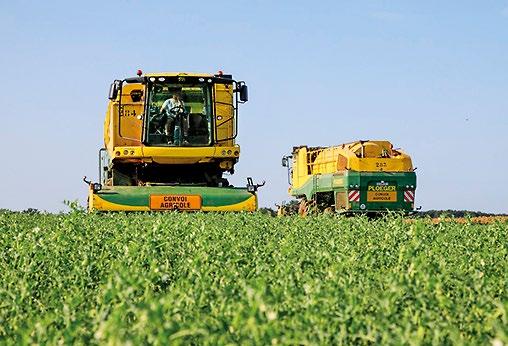
The drones were flown over 1 600 ha of pea and bean fields to detect harmful weeds such as black nightshade and potato berries. From a height of 30 metres, they can spot weeds of just one centimetre – one single leaf can be enough. Using sophisticated algorithms to analyse the images, a virtual map of the field is created, precisely indicating where the weeds are located. The coordinates
STRATEGIC ALLIANCE WITH
are then sent to the grower’s smartphone, who can take the necessary measures to remove them.
The Telespazio project is the latest in a long line of investments in similar new and ground-breaking foodtech innovation. “Our team of agronomists helps farmers increase their efficiency and introduce more sustainable practices. Our growers do not always have the time and the financial means to experiment with these new technologies. By making the investments ourselves, we can accelerate adoption and further reduce the use of crop protection,” says Stefaan Goudeseune, Agro Director, Greenyard Frozen Belgium.
Opening new markets for Breton agriculture
In March 2025, Greenyard Frozen France and Gelagri Bretagne announced the start of exclusive negotiations to create a strategic alliance with Greenyard as the majority shareholder. By consolidating their respective grower base, production capacity and commercial power, the expanding historical partnership will further support both parties’ position in a growing market for healthy and convenient foods. The new entity is expected to become a reality by the end of 2025.
Founded in 1978, Gelagri Bretagne offers a wide range of frozen vegetables and ready-made pure-plant products to French retailers and catering professionals. The company is a subsidiary of the Eureden agricultural cooperative, which unites more than around 1 750 Breton growers and has been a long-time partner of Greenyard.
The alliance fits in perfectly with Greenyard’s vision of creating Integrated Grower Relationships (IGR), combining Gelagri’s base of experienced growers in one of Europe’s prime agricultural regions with Greenyard’s
strong commercial ties with retailers. As the European market for frozen vegetables and pure-plant convenience products continues to grow, it will open up many new opportunities for Breton farmers and Breton agriculture in general, while expanding the range of frozen pureplant products for both Gelagri’s current and future customers.
GELAGRI
Helping Italian growers thrive in a changing market
Maicol Galeati, Managing Director of Greenyard Fresh Italy
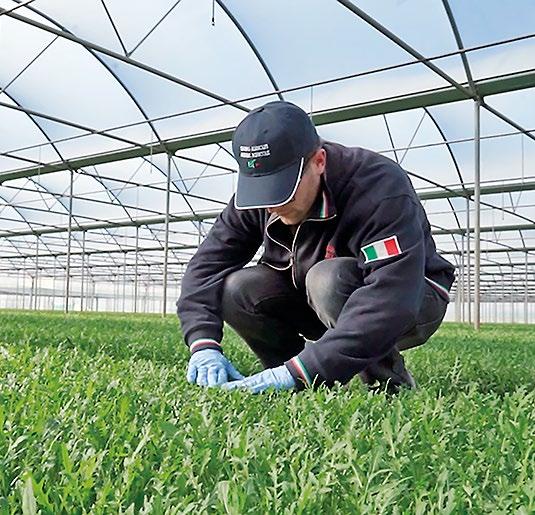
The Green Farmers Group unites over 100 growers in one of the largest producer organisations in Italy. In 2021, Greenyard Fresh Italy supported the founding of the organisation, which has considerably strengthened its position in the marketplace thanks to strong relationships with retailers and the introduction of new varieties.
With over 100 growers, 780 hectares of production and 15 packing stations, the Green Farmers Group covers an extensive fruit and vegetables range, with continuous production throughout the year. By working Fork-toField, the organisation benefits from Greenyard’s strong relationships with European retailers. It also allows them to seize new opportunities in the market by growing new and in-demand varieties.
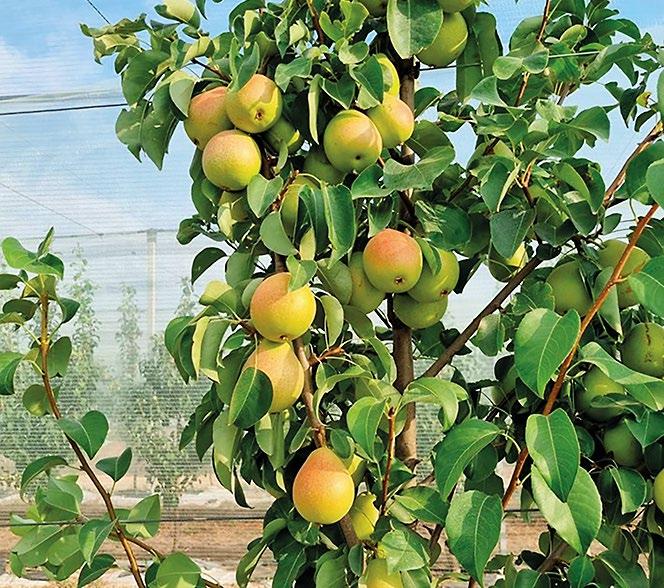
Greenyard has licensed three varieties to the producer organisation. For example, the yellow kiwi is already a big hit among European consumers, while the flat nectarines follow the example of the hugely popular flat peaches. The Eden pear takes its cue from more popular sweet apples to introduce a sweeter alternative to classic pear varieties. All three are developed to the appeal of consumers that are looking for healthy food and crave something different.
“Introducing new varieties in the marketplace is not as straightforward as you would think,” says Maicol Galeati, Managing Director of Greenyard Fresh Italy. “A lot of upfront investment is needed. New trees need time to grow, and you need the support of retailers to get access to consumers. Through our Integrated Grower Relationship (IGR) model, we can bridge the gap between the demand in the marketplace and the necessary production capacity on the farms. It enables us to create sustainable partnerships with new growers, while adding new products to our portfolio that drive pure-plant consumption.”
Advancing our infrastructure
Greenyard operates one of the world’s most advanced and elaborate food-tech infrastructures, which we continue to expand. We invest in the latest state-of-the-art technology to bring the food of the future to today’s consumers. It enables us to develop and produce new pure-plant food experiences in line with their expectations.
Data-driven supply chains
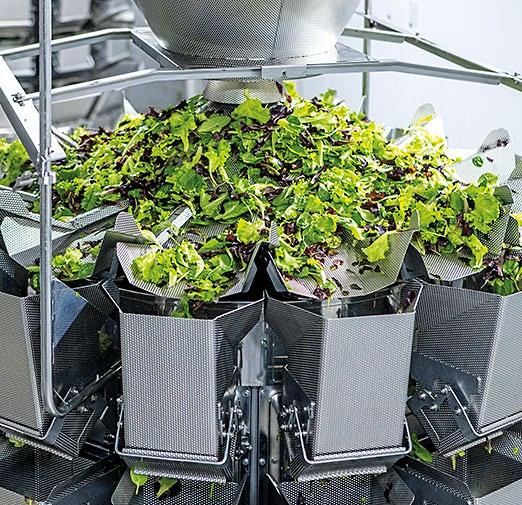
In our Fresh division, we use forecasting tools to carefully match demand and supply in a seamless, data-driven supply chain, reducing waste to a minimum and ensuring the shelves of our customers are always filled with the best assortment from growers around the world. In our ripening rooms, we use climate-control technology to get products such as bananas, avocados and mangoes in the stores when they are at their very best.
Preserving everything that’s good for us
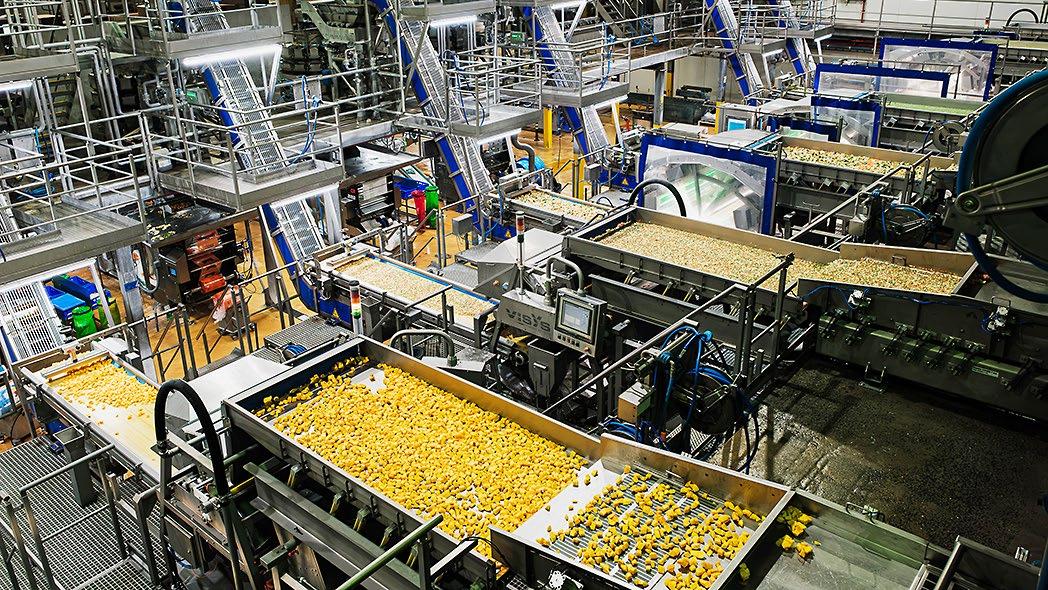
In our Long Fresh division, we use our long-standing industrial expertise to freeze and conserve freshly harvested fruit and vegetables. This ensures that their nutritional value, taste and texture are optimally preserved for later consumption. From our advanced
kitchens, that are in many ways Research, Innovation & Development centres, our culinary experts are working on the pure-plant innovations of the future, creating new recipes and new products daily.
Focus on the natural product
Still, despite the state-of-the-art technology, the basic techniques Greenyard uses are no different from what people would do at home: cutting, heating, freezing, mixing – no additives, no artificial colours or flavours, and little to no processing. The original crop is always at the core of everything we do.
Reinventing ambient food packaging for today’s consumers
Johnny Van Holzaet, Managing Director at Greenyard Prepared
In May 2024, Greenyard Prepared started building a new Tetra Pak® cardboard packaging line in Bree, Belgium. The new line will enable the company to broaden its product portfolio and expand production capacity alongside its existing lines for glass jars, tin cans and pouches. Production started in the spring of 2025.
To set up the cardboard packaging line, 2 750 m² of warehouse space was freed up. Within that area, a hygienic hall of 1 170 m² was built, consisting of a preparation area with blanchers, conveyors and sorting lines and a filling plant with two identical Tetra Pak® filling machines. Both with a capacity of handling 6 000 packs per hour.
Traditional ambient packaging solutions such as glass jars and tin cans are still much used among consumers but are also confronted with changing consumer preferences. We see a growing demand for new and attractive packaging solutions. This is especially true for convenience products such as soups, mixes and sauces, although pulses in cardboard packaging are already more commonplace at Northern European retailers.
“Thanks to the many design options, Tetra Pak® packaging can make our products stand out on the shelves. This creates new opportunities to make pure-plant innovations even more enticing for consumers,” explains Johnny Van Holzaet, Managing Director at Greenyard Prepared. “They are also easier to pack and store – saving valuable space on pallets, shelves and in home kitchen cabinets.”
There are also important advantages from a sustainability standpoint, when the entire lifecycle is considered. Made from FSC-certified paperboard, this packaging format reduces CO2 emissions by 80% when compared to traditional ambient packaging. Less energy is needed to produce cardboard packaging when compared to metal or glass, which require higher temperatures during production. They are also lighter, using less material and reducing emissions during transport, while offering a similar shelf-life.
A state-of-the-art service centre for Bakker
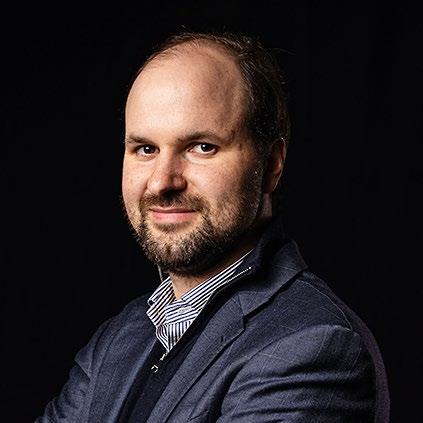
Maarten van Hamburg, Managing Director of the Bakker division
In January 2025, Bakker Barendrecht, a Greenyard company, started with the construction of a new fruit and vegetables service centre in Ridderkerk, the Netherlands. The ultramodern centre will use the latest ripening, warehousing, packing and cooling technologies to provide consumers with high quality fresh produce – in an affordable and sustainable way. Bakker will start using the new site in phases as from mid-2026.
The service centre will cover an area of 55 600 m² and will feature one of the largest ripening centres in Europe. In the future, more than 130 ripening cells will be equipped with high-precision temperature and humidity control to get fresh products in stores at their peak. Furthermore, the centre will feature a next step in mechanizing the assembly lines for meal-kits, for which the market continues to grow, and state-of-the-art sorting lines for
A NEW MANGO SORTING LINE
specialist fruit categories such as grapes, citrus and soft fruits. Sustainability is also a key consideration in the service centre’s design. Thanks to the latest, energysaving cooling technologies, the centre will be running on 100% green energy, of which a significant part will be self-generated.
“We have been working with a leading Dutch retailer as a strategic partner for 65 years. Together, we have been growing the consumption of fruit and vegetables in the Netherlands with a clear focus on quality, affordability and innovation. The new service centre will enable us to respond to the growing consumer demand for fresh and healthy food, while bringing our carbon footprint close to zero,” says Maarten van Hamburg, Managing Director of the Bakker division.
Exactly how you want them
Combining a pleasant juicy sweetness with plenty of vitamins and antioxidants, mangoes are increasingly popular among consumers. They are also one of Bakker’s many specialty products. The Greenyard company recently invested in a new advanced sorting line for mangoes at its site in Ridderkerk, The Netherlands, which became fully operational in 2024 and enables the supply of mangoes to meet precise specifications.
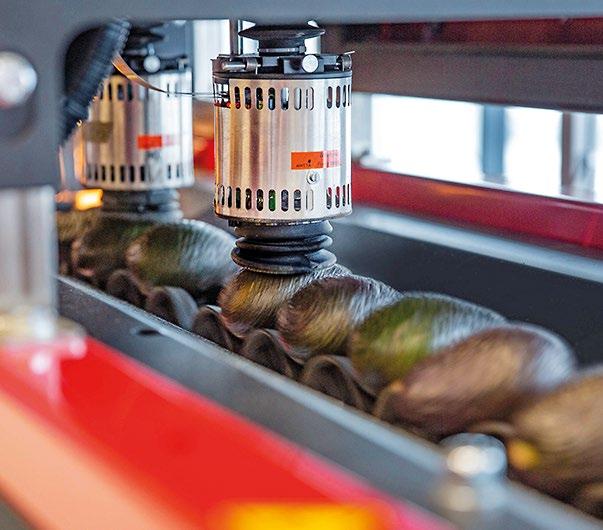
Located in a dedicated facility, the sorting line uses a series of modern technologies to distinguish and separate different qualities. Each individual mango is treated with a sound sensor and softly tapped to measure its hardness, while more than 100 photos are taken of every mango to determine colour and calibre. This allows Bakker to deliver the mangoes according to exact customer specifications and market preferences – some customers may prefer smaller and softer mangoes than others. In certain countries the little red blush is a must, in other countries it is not.
The new sorting line also generates large amounts of data that allows Bakker to make detailed quality analyses for each batch, farm and region. This is fed back to both buyers and growers, providing valuable insights for both to systematically optimise and perfect the full supply chain. This then results in more consistent, better qualities, less waste throughout the chain and spot-on value for all.
DE LA CRÈME ENTERS THE GREENYARD FAMILY
25 years of knowhow in pure-plant, dairy-free indulgence
Martijn Dingenen, Operations Manager at Greenyard Hasselt
In April 2024, Greenyard acquired Crème de la Crème and integrated the company in its Frozen division and commercial system: Greenyard Hasselt was born. The Belgian company has been developing and crafting dairy-free ice cream, gelato, sorbets and frozen desserts for more than 25 years. The additional capacity, their manufacturing know-how and product expertise will be crucial to further expand Greenyard’s pure-plant range of frozen indulgence.
While market demand for pure-plant frozen snacks and desserts is growing, the most important factor for success is quality. The taste, texture and bite need to be just right. To achieve this, every detail counts. It’s all about adding and mixing the right ingredients at exactly the right time and temperature.
The company has mastered this fine art as no other and develops and produces hundreds of dairy-free innovations as a private label partner for retailers and foodservice companies. These include scoop ice, sticks, smoothies on a stick and sorbets. As Greenyard Hasselt, they will also produce the new Gigi tubs, which were introduced in spring 2025 and will be available in two flavour combinations: white pumpkin, banana and cinnamon, and cucumber, avocado and dill.
“Even in a market that is brimming with innovation, Gigi distinguishes itself as a truly unique and ground-breaking concept,” says Martijn Dingenen, Operations Manager at Greenyard Hasselt. “It’s not just the smooth and creamy texture; it’s also in the pairing of vegetable and fruit flavours. Once you’ve experienced Gigi, you’re coming back for more.”
CRÈME
Innovating for a healthier future
Fruit and vegetables are the food of the future – even though they have always been a crucial part of our diets. Not only do they help us lead healthier lives and do they enrich our diets with important nutrients. They also play a crucial role in combatting climate change, as they require much less energy, water, land and natural resources than any other food category. As a major player in the world of fruit and vegetables, Greenyard is well-positioned to serve as a catalyst in this transition.
Our innovation strategy is centred around creating products that cater to evolving consumer expectations, with a mission to place fruit and vegetables at the centre of the plate and as core components of modern meals. With variety, nutritional value, convenience and – above all –great taste at the heart of our offering, we’re not just keeping up with the future of food, we’re shaping it together with our customers.
Available and affordable for everyone
We believe the many benefits of fruit and vegetables should be available and affordable for everyone. Working closely with our growers and our retail customers, we have streamlined our supply chain to make sure the best possible products are available at the right time, with the right quality and the right price. Making the healthy choice the easy choice.
Putting a nutritious meal on the table should not be difficult or time-consuming. Through product innovation, we are looking for new ways to fit fruit and vegetables into our changing lifestyles: consumers are snacking more, eating on the go, and prioritising food that is both convenient and nourishing. Pre-cut or ready-made, fresh, frozen or prepared, conveniently packaged or as a mealkit, we offer solutions for every budget and every taste, for everyday cooking and for special occasions with friends and family.
Inspiring people with new food experiences
With an incredible variety in taste, colour and texture, nature offers us a wealth of inspiration and endless possibilities for pure-plant food. Taking cues from great local traditions and the latest trends in world cuisine, our food experts create new and exciting food experiences in fresh, frozen and prepared while staying true to the natural power of fruit and vegetables.
Creating new moments to enjoy pure-plant
Our ultimate ambition is to accompany people throughout the entire day with a pure-plant solution for every possible eating moment, from breakfast to latenight snacking, from aperitif to dessert. Along the way, we invent entirely new categories and redefine what healthy food tastes and looks like.
A new brand is born – pure-plant with a twist
Cedric Pauwels, Group Marketing, Communications & Public Affairs Director
Market research shows that taste, indulgence and price are the most important drivers to buy foods. The traditional plant-based category is sometimes perceived as ultra-processed, lacking in taste and texture, while being considered expensive as well. That’s where Greenyard wants to do things differently. In 2024, Greenyard has been preparing the launch of a new brand that redefines the pure-plant snacking and dining category and create additional moments of consumption for fruit and vegetables throughout the day.
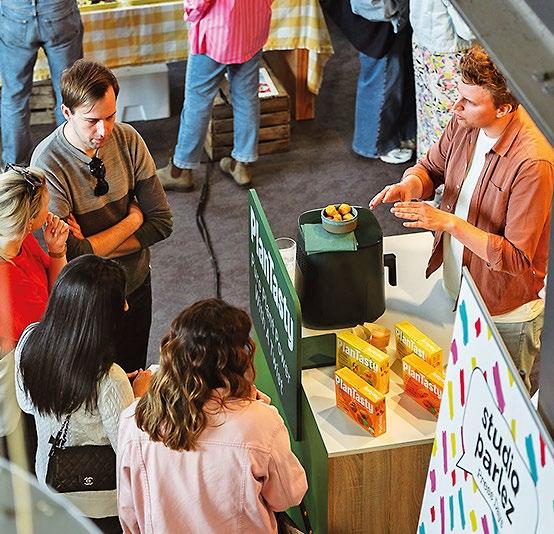
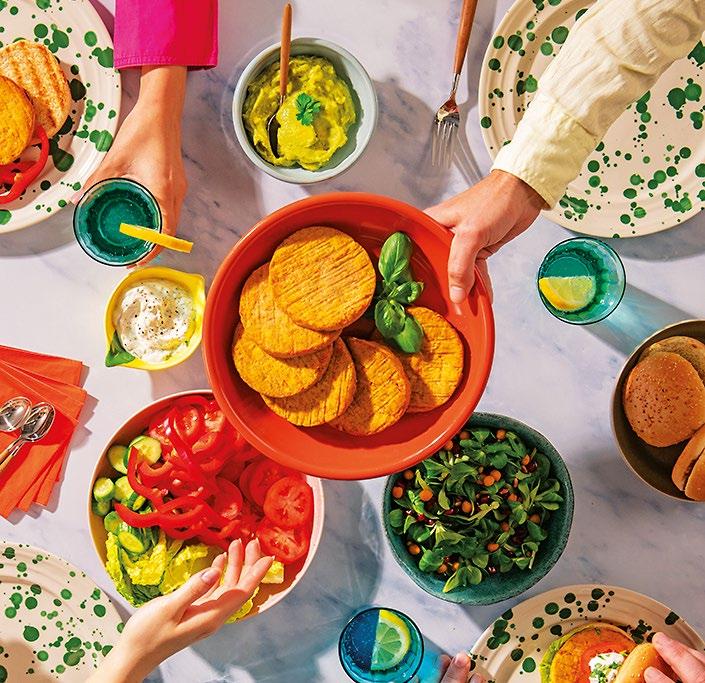
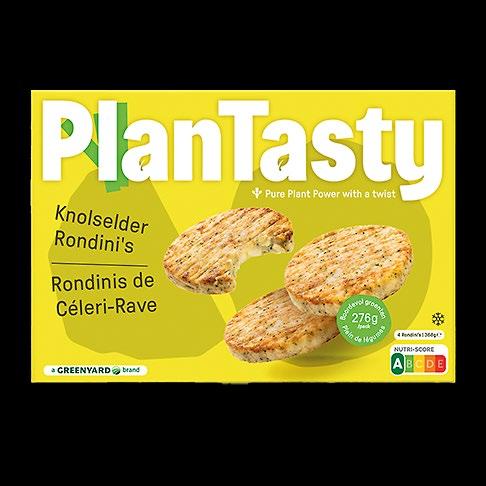
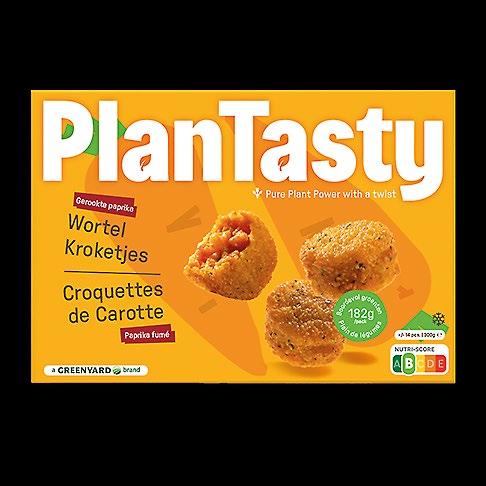
PlanTasty focuses on the natural taste and bite of vegetables, a true pure-plant sensation. But it also stands for value and convenience as we aim to make high nutritional value affordable for everyone, while the products are easy to prepare in any kitchen. The first two products are currently available at selected Belgian retailers. The Rondini’s are frozen vegetable slices, with
75% real vegetable pieces, that can be served as a main course or in a bun. They are available in two varieties: celeriac and carrot-sweet potato. The Croquettes are frozen, crispy bite-sized snacks, available in two globally inspired flavours: celeriac with Indian curry and barbecue carrot.
“Although the Rondini’s and the Croquettes are currently both frozen products, PlanTasty is set up as a crossdivisional brand, with plans for an ambient range already underway. Interesting fact: our research indicates the majority of Belgian households would consider purchasing products from our PlanTasty range, showing they appeal to a wide audience and highlighting their strong potential to attract new shoppers and grow the category,” states Cedric Pauwels, Group Marketing, Communications & public Affairs Director.
GROWING IN CONVENIENCE WITH OUR CUSTOMERS
Keeping things fresh, simple and creative
Valentijn Verhaeghe, Business Unit Manager Convenience at Greenyard Frozen
Convenience is a key category within Greenyard’s Frozen division, which continues to grow. More than one third of the division’s sales now comes from convenience, frozen fruit and ice. “Consumers’ perceptions of the frozen category are changing. Whereas freezers in the supermarket used to be all about fries, unhealthy snacks and ice cream, we are working with our retail customers to open up more space for new and exciting pure-plant innovations,” says Valentijn Verhaeghe, Business Unit Manager Convenience for the Frozen division.
As a private label partner, these innovations in pure-plant convenience are always the result of close collaborations with our customers. Sometimes they are based on their specific requests, but we also proactively present new ideas and recipes, based on new trends that our chefs and teams pick up. Lately, the focus has been on high-protein products, pure-plant meal components and vegan bowls.
“The entire range we developed for a major German retailer is a great example of our approach. It’s an entirely pure-plant range, which combines vegetables, pulses and grains such as bulgur, quinoa and buckwheat, accompanied with various seasonings for an extra flavour experience. Consumers can serve them as a wholesome meal, but also as a healthy side dish. It was initially set up a couple of years ago for the German market as a one-off promotional item. Today, it is being sold in more than 15 countries. In the summer of 2025, we will be launching another new reference in the range, further building on the success of pure-plant convenience,” says Valentijn Verhaeghe, Business Unit Manager Convenience at Greenyard Frozen.
People are the driving force behind our company
Fruit and vegetables are a people’s business, based on close collaborations and long-term partnerships. But most of all, it’s about passion for great, healthy food. Today, Greenyard has a diverse workforce with more than 80 nationalities, speaking a variety of languages, and working across 21 different countries. Despite their differences in background, education and skills, they all have one thing in common – they are the Greenyard family. It is their hard work, their knowledge and their passion that have made our Group what it is today. It is our mission to support, connect and strengthen every one of our employees and create a workplace where they can fully develop their talents and share their knowledge. A safe haven where everyone feels respected, with chances to grow and contribute to our purpose.
Sharing knowledge
By providing ongoing training and skills development, our employees gain knowledge and confidence to perform at their best. This enhances productivity and product quality but also supports employee satisfaction and long-term business growth. Sharing knowledge and learning from each other is the common thread through our Group Development Programs, which stimulate people to look beyond their own entity and their own field of expertise, and work together on strategic themes. Internal growth is another important focus point, of which we had numerous examples across the Group, divisions and entities this year. Finally, in 2024, the Greenyard Academy was launched at Greenyard’s Bakker division which gathers all information and tools for our employees’ personal development in one single platform.
Safety in the workplace
Healthy and safe workplaces are an absolute priority for our company. We have robust management systems in place that protect the well-being of employees, customers and visitors and reduce workplace injuries and work-related illnesses to an absolute minimum. We actively promote a strong safety culture. In 2024, we launched a major Internal Transport Campaign aimed at implementing Behaviour-Based Safety (BBS) for all our drivers. This initiative covered our sites, factories and warehouses across all divisions. Additionally, several local sites organised Safety Days for employees, providing valuable insights and training on workplace safety.
Diversity drives growth
We believe that our diversity drives innovation and helps us better understand the consumers we are working for. As we source and sell in more than 80 countries, we need our organisation to accurately reflect our markets. When people from different backgrounds work together, we are much quicker to identify blind spots, biases and false assumptions.
Our Diversity, Equity & Inclusion (DE&I) Committee, established a few years ago, brings together people from different levels, countries, and divisions to promote an inclusive culture. The Committee identified our first three focus points, which include the employment of people distanced from the labour market, accelerating female leadership and embracing cultural differences on the work-floor.
Ultimately, all employees play their part in fostering an inclusive environment, at every level of our company. Our focus is on the evolution towards a gender balance at all levels and at retaining employees across all age categories by providing a supportive work environment. Greenyard is also an active provider of social employment, for which there are many opportunities in different levels of the organisation.
Greenyard Frozen UK recognised as a Disability Confident Employer
Laura Dixon, Communication & Community Projects Manager at Greenyard Frozen UK
At its site in Boston in the United Kingdom, Greenyard Frozen UK has a shift in its packing department which has six deaf colleagues working in different roles, varying from Team Leader to Palletiser Operative. These colleagues have been with the company for several years and are extremely valued members of the team.
Approximately 11 million people in the UK experience a degree of hearing loss, which makes it the second most common disability in Britain. Unfortunately, as an invisible disability, it often goes unnoticed, leading to those living with hearing loss to be ignored or forgotten. A study conducted in 2014 found that 74% of respondents felt that their employment opportunities were restricted because of their hearing loss. Equally, 70% agreed that their hearing loss negatively impacted their ability to fulfil their potential at work.
“As a Disability Confident Committed employer, we pride ourselves on providing equal opportunities to all our workers and supporting any additional needs our employees may have. Not only do we have a shift with six deaf employees manning a packaging line on our site, we also support them with professional British Sign Language interpreters, captioning software (sign live links) and communication apps. We also implicate our hearing employees, with workshops on sign language and effective communication. By promoting mutual understanding, we create a truly inclusive workplace where everyone feels valued and diversity is embraced as a way to foster fresh perspectives,” says Laura Dixon, Communication & Community Projects Manager at Greenyard Frozen uK.
SETTING UP INTERNAL LEGAL TRAININGS AND PROCEDURES
Clear agreements make for successful collaborations
Elissa Lippens, Group Legal Director at Greenyard
Greenyard’s Group Legal department provides everyone working within the company with support and advice in all legal matters, big or small – from signing a standard leasing contract for a company car to drawing up a tender for sourcing exotic fruits from Ecuador or negotiating the construction of a new distribution centre.
With the Centurio project, the Group Legal team educates colleagues in the basics of all things legal, heightening their awareness and guiding them in their day-to-day business. The department not only organises trainings, but also provides standardised contract templates and streamlines approval procedures.
THE GREENYARD ACADEMY PLATFORM
“We believe that a proactive approach is key. Better safe than sorry is our motto. Drawing up a good, clear agreement from the very beginning leads to smoother collaborations and reduces the risk of misunderstandings and conflicts. This is crucial in our business, which depends on close collaborations with so many of our stakeholders,” says Elissa Lippens, Group Legal Director at Greenyard.
Empowering our people through personal development
Bakker took the first step in developing a Group wide Greenyard Academy, a platform that enables life-long learning and personal development within the company. End of 2024, the platform went live at the Bakker division. Plans are well under way to roll out the Academy in other Greenyard divisions over the coming years.
The idea behind the Greenyard Academy is to gather all information and tools for our employees’ personal development in one single platform. Product knowledge, safety instructions, language courses, operating manuals for machines and production lines, training programs – in short, everything you need for growing and developing as a person, colleague and employee.
The Greenyard Academy not only ensures one single version of the truth is always available within the Group, it also allows people to take control of their career, develop in their current job and start preparing for the next steps.
The Sustainability Round Table
Improving life for everyone –the Greenyard approach
Fruit and vegetables – pure-plant food experiences – have been our core business since day one, putting sustainability at the heart of everything we do. But how do we reduce the impact in our own daily operations? And how do we safeguard sustainability in our value chain? To answer these questions, we set up a round table with the Managing Directors of our four divisions and our Group Sustainability, Quality and Health & Safety Director.
How does our purpose to improve life contribute to a healthier and more sustainable society?
Olivier Galard, Group Sustainability, Quality and Health & Safety Director at Greenyard: “Everyone agrees that a major shift in our eating habits is needed, both for our health and for the sustainability of our food chains. Fruit and vegetables are not just the foundation for any healthy diet, they are also the best way forward to feed the growing world population within the limits of our planet, as they use up less valuable land and resources than any other food category. Together with our customers and other stakeholders, we make every effort to further develop the pure-plant category, moving fruit and vegetables to the centre of our plates and making the healthy choice the easy choice for consumers.”
How do we reduce our impact in our daily operations?
Anna Jęczmyk , Managing Director of the Greenyard Frozen division: “First of all, we have set clear and ambitious targets to reduce energy and water consumption, increase the use of renewable energy sources and prevent waste in all our operations. Sustainability is also an important consideration in every investment we make. To give just one example for our division: we intend to build a new water treatment and re-use installation on our site in Westrozebeke, which will enable us to save 200 000 m3 of water every year. It’s a crucial project in a region with increasing water scarcity.”
Do we have plans to become a carbonneutral company and where do our biggest challenges lie in this regard?
Johnny Van Holzaet, Managing Director of the Greenyard Prepared division: “In 2024, we presented a comprehensive plan for the gradual electrification of our plant in Bree, Belgium. Over the last few years, we already switched our electricity contract to 100% green electricity, and we have just added another 7 500 solar panels, bringing the total to 9 000. The next frontier will be the electrification of production processes that are powered by natural gas. This will be quite a challenge, both economically and technically. Electricity prices are still at least twice as high as those for natural gas, while transitioning our energyintensive processes requires considerable investments. We also need to get more electrical power to our plant to use an e-boiler. Therefore, we have already started researching the different options in collaboration with a local energy partner. We are confident we can make great progress over the next few years.”
Olivier Galard ↑
Johnny Van Holzaet ↗
Anna Jęczmyk →
How does our Fork-to-Field business model contribute to the sustainability of our company and our value chain?
Maarten van Hamburg, Managing Director of the Bakker division: “Our Integrated Customer Relationships give us much more leverage in our sustainability efforts. By working Fork-to-Field, we are creating a demand-driven supply chain, in which waste is reduced to an absolute minimum, to the benefit of everyone: the retailer, the farmer and the consumer. Our end-to-end approach in the ICR way of working allows us to deploy leading sustainability programs.”
How do we take our responsibility towards our value chain and our growers in particular?
Charles-Henri Deprez , Managing Director of the Greenyard Fresh division: “We must never forget we have an important social responsibility to the many people working in our value chain. We need to make sure everyone can work in safe and healthy conditions and can benefit from their hard work, including the people who are picking the fruit on the other side of the world. It is our duty to help growers adapt and cope with extreme weather conditions and climatological evolutions. Safeguarding biodiversity and reducing our impact on natural ecosystems will be just as crucial in the long run. There can be no pure-plant future without a healthy agricultural sector.”
With the latest edition of our Sustainability Report, we offer our stakeholders a unique insight into our operations and how we put our sustainability strategy in daily practice. Using the new CSRD guidelines for maximum transparency, we report on the main actions we undertook in AY 24/25 and the progress on our targets for crucial topics such as our carbon footprint, water consumption, waste reduction and social responsibility. We hope it provides readers with valuable insights on how we improve life for everyone in our value chain.
“ Fruit and vegetables are not just the foundation for any healthy diet, they are also the best way forward to feed the growing world population within the limits of our planet, as they use up less valuable land and resources than any other food category.”
Olivier Galard
Charles-Henri Deprez →
← Maarten van Hamburg
General information sustainability
Basis for preparation
BP-1, BP-2
Greenyard’s sustainability statements have been prepared on a consolidated basis for the Group. The scope of consolidation for the sustainability statements is consistent with the financial statements. It includes material information regarding the Group's upstream and downstream value chain in connection with the material topics identified in its assessment of impacts, risks and opportunities based on the principle of double materiality (DMA). More information on our value chain is provided in the materiality assessment section. We have not omitted any disclosures because of ongoing negotiations, nor have we omitted any information due to reasons of intellectual property.
We have applied our sustainability accounting policies consistently during the financial year, as well as for comparative figures. In most situations, we provide comparative figures, but where new indicators were implemented in AY 24/25, comparative figures are not available.
Some metrics are subject to measurement uncertainty or are partially calculated using value chain estimates. Measurement uncertainty arises primarily from conversions applied to harmonise the input data used in the Scope 3 Greenhouse gas (GHG) emissions and the resource-use related metrics. Value chain estimates are mostly prevalent in Scope 3 GHG emissions and some resource use-related metrics. More information on value chain estimates and measurement uncertainties is disclosed in the accounting policies for the relevant metrics and Appendix 4. No metrics have been validated by another external body other than the assurance provider.
Unlike previous reporting periods, in which we reported in accordance with Global Reporting Initiative (GRI) standards, we have prepared these sustainability statements in accordance with the European Sustainability Reporting Standards (ESRS). The main effects of this change relate to additional disclosures around policies, actions, metrics and targets regarding material sustainability matters. The restatements of prior period or baseline figures, where applicable, are disclosed under the relevant metric.
IRO-2 Disclosure Requirements in ESRS covered by the undertaking’s sustainability statements
An index listing all the ESRS disclosure requirements in ESRS 2 and the eight topical standards that are material to Greenyard is available in Appendix 1. Some information has been incorporated by reference to other chapters of the Annual Report, an overview of these disclosure requirements and data points is available in Appendix 2. Appendix 3 lists all the data points that derive from other EU legislation as listed in ESRS 2, appendix B.
E2 Pollution and S3 Affected communities were deemed to be non-material topics in our 2024 Double Materiality Assessment (DMA). Relevant aspects related to Pollution are incorporated into the material topics of E3 water and marine resources and E4 Biodiversity and ecosystems. We will continue to track and assess our impacts, risks and opportunities related to these topics, and their materiality will be continually reassessed each year as part of our annual DMA process.
Governance
GOV-1, GOV-2, GOV-3
Greenyard’s executive management holds ultimate responsibility for the company’s sustainability strategy, overseeing its vision, governance, and implementation. It approves group-wide programs, targets, and resources, and regularly updates the Board of Directors on priorities and performance. The Group Sustainability, Quality, Health & Safety Director coordinates efforts at the group level and reports directly to the CEO
The Sustainability and Health & Safety Group functions report to the Group Sustainability, Quality, Health & Safety Director. The Group HR Director oversees HR aspects within own operations, including diversity, equity, and inclusion. The Governance & Compliance Group function, reporting to the CFO, handles specific social and governance matters. The CFO also oversees sustainability-related financial activities and reporting.
In each entity and/or division Local Sustainability roles lead and manage the appropriate sustainability programs or initiatives, embedded in the local organization and supported by the local entity’s management team. They form a broader sustainability community that meets quarterly to support this alignment and drive initiatives within their operations. The Sustainability Committee brings together representatives from key divisions, entities, and senior corporate roles to align local approaches with Greenyard’s shared sustainability vision and execution plans. This ensure a streamlined execution of Greenyard’s Sustainability Strategy.
Sustainability is a core part of Greenyard’s mission and strategy, supported by a roadmap including time-bound targets. Since AY 22/23, the implementation of this roadmap has been linked to the performance evaluations and incentives of executive management and managing directors. All colleagues who contribute to making our products and operations more sustainable play an active role in achieving our goals.
The implementation of the sustainability roadmap is embedded in the agenda of Greenyard’s Leadership Team—comprising the CEO, CFO, Divisional Managing Directors, and key corporate functions. Progress is reported quarterly and discussed with the Board of Directors. In the reporting year, Impacts, risks and opportunities addressed included carbon emissions, water use, food waste, packaging procurement, and working conditions in the value chain.
Other information on governance is incorporated by reference to the Corporate governance statement and Remuneration report, see also Appendix 2.
GOV-4 Sustainability due diligence statement
As a global market leader in fruits & vegetables, we are fully aware of our responsibilities within the food value chain regarding the products and services we deliver to our customers as well towards all other involved stakeholders in our value chain. We continually assess and mitigate risks in our own operations and supply chains, working daily to meet all our legal, regulatory, ethical, environmental, social, and health and safety obligations.
In 2022 Greenyard started to formalize its sustainability due diligence approach by developing its Supplier Code of Conduct alongside its Code of Conduct for its employees. In 2025 we released our Sustainability due diligence policy which summarises the current state of play and the Group’s priorities for the near future, in full awareness that stakeholders’ expectations regarding due diligence remain dynamic.
Our Due Diligence approach focuses both on the own operations and supply chain and considers both environmental and social sustainability aspects. It is inspired by both the due diligence framework laid down in the OECD Guidelines for Multinational Enterprises as well as guidance provided by international instruments dealing with human rights and responsible business conduct.
Core elements of due diligence
Embedding due diligence in governance, strategy and business model
Engaging with affected stakeholders in all key steps of the due diligence
identifying and assessing adverse impacts
Taking actions to address those adverse impacts
Tracking the effectiveness of these efforts and communications
GOV-5 Risk management & internal controls over sustainability reporting
Our sustainability reporting process is guided by a Group Sustainability Reporting Manual laying down the roles and responsibilities, required data points and reporting frequency. We developed our own data collection and reporting tool which meets audit requirements and ensures the same consolidation approach as our financial reporting process. All data points are clearly defined and annual training sessions ensure all users are up to date with new features. The data collection frequency is monthly for key performance indicators and annually for other indicators.
To effectively address sustainability reporting risks and meet limited assurance requirements, we have developed robust processes and internal control procedures for the sustainability data points. We maintain process documentation and evidence of control procedures to demonstrate our review, reconciliation and validation of data reported. The input is reviewed on a quarterly basis, with a focus on data consistency and understanding outliers, ensuring data is collected in a consistent manner from every division, entity and location. At year-end all entities submit an annual audit form explaining all material deviations. The Sustainability teams at Group and local level are herein supported by the Finance teams.
The monthly and quarterly reporting schedule runs parallel with the financial reporting at Group level and enables management to analyse performance, detect trends and deviations, and steer operations in the right direction. The sustainability performance is reported on a quarterly basis to the Leadership Team and Board of Directors. The Audit Committee is periodically (at least twice a year) updated on the sustainability reporting process and observations from the limited assurance process.
Strategy & business model
SBM-1
Making fruit and vegetables a larger part of our daily diet is the best choice for our health and the most sustainable choice for the planet. To promote this, it is important that fruit and vegetables are available and affordable. We believe this is best achieved through our unique Fork-toField approach. It is both the backbone of our Integrated Customer Relationship (ICR) model and a driving force for sustainability.
Greenyard acts as a linking pin in the food supply chain, optimising all parts of the chain – from the farms of our growers all the way to the supermarkets or restaurants where consumers enjoy our healthy, pure-plant products. Because of our scale and our extensive network of growers we can optimise transport from all over the world to our distribution centres and production sites. Together with our customers, we define their specific needs before every season and connect them to the best possible growers to develop year-round programmes. During the growing season we are in constant contact with growers and retailers to match the demand and supply nature is providing us. This way of working ensures an efficient and sustainable food supply chain with a low environmental impact. And as it is optimised and low in waste it is also the most economical way of working, ensuring fruit and vegetables are accessible, available and affordable for everyone.
Sourcing footprint
Today’s consumers expect all year-round availability of their favourite fruit and vegetables. Greenyard has built a strong worldwide network of growers and suppliers. We have been working with most of these growers for a very long time. We team up with them and provide them with feedback, resulting in a steady supply of high-quality products for our customers.
For all our products we look for the places where we can best grow them. The majority of the fruit and vegetables for our frozen and prepared products come from fields within 150 kilometres of our production sites. If products must travel longer distances from field to market, we focus on the optimisation of transport and the best conditions to minimise waste along the food value chain. we source over 2 600 000 tonnes of fruit and vegetables from over 80 countries.
Operational footprint
At Greenyard, we have an extensive network of stateof-the-art service centres and production sites, spread across our core markets and our growing regions. Our core operations are situated in Austria, Belgium, Brazil, Czech Republic, France, Germany, Italy, the Netherlands, Poland, Spain, United Kingdom and the United States of America. For a breakdown of employees by country, see the section S1 Own workforce.
By combining our sourcing and technical expertise with our extensive network, we have developed the capacity to offer world-leading added-value services. We collaborate closely with some of the world’s largest retailers and food service companies, helping them to expand their offerings, develop new markets and successfully anticipate consumer trends. Long-term and solid relationships with retailers allow us to keep the consumer top-of-mind in all our activities.
This unique way of working does not only allow us to optimally link supply with the actual consumer demand, it also enables us – together with our customers – to actively drive the shift towards healthier lifestyles and an increased consumption of fruit and vegetables, while working towards an ever more sustainable food value chain.
Sustainability roadmap
Greenyard’s Sustainability roadmap is an integral part of its corporate strategy. With ambitious targets across the five focus areas that are most material for our business and our stakeholders, our roadmap supports our purpose to improve life. It was developed in 2021 in collaboration with the senior management of our local entities and with the broader team of sustainability leads working across the Group’s divisions and locations. The approach was approved and endorsed by Greenyard’s Leadership Team and the Board of Directors.
The roadmap and its targets have been developed based on thorough stakeholder engagement processes and materiality assessments. Since 2017, we have undertaken regular materiality assessments to identify and prioritise the issues most significant to our stakeholders and the planet. These assessments have gathered the views of customers, suppliers, investors, public organisations, consumers and our employees. The roadmap will be reviewed by the end of 2025 as the target year for various focus areas will soon be reached.
Impact, risk & opportunity management
IRO-1 Double materiality assessment
Our 2024 materiality assessment is based on the double materiality principle, considering both impact materiality and financial materiality in line with ESRS requirements. Impact materiality reflects the inside-out perspective: the actual or potential impacts of Greenyard on people and the environment over the short, medium and long term. Financial materiality reflects the outside-in perspective: the most significant sustainability-related risks and opportunities for Greenyard over the short, medium and long term.
As part of this process, we engaged with internal and external stakeholders, focusing where necessary on specific activities and geographies that could give rise to heightened risk of adverse impacts. The different stakeholders assessed the impact materiality of topics through a variety of stakeholder engagement formats such as business impact workshops, an employee panel and interviews.
We created a long list of sustainability topics, also covering entity-specific topics that could potentially be material for Greenyard. We researched and referenced insights from international reporting standards, including ESRS; our previous materiality assessments; peer reports; rating agency reports; risk analyses; and insights gathered from our engagement with stakeholders. Where necessary we clustered topics, updating materiality labels and definitions based on feedback from stakeholders.
In a next step we evaluated the impacts, risks and opportunities associated with the short-listed sustainability topics. For negative impacts, we assessed severity using scale, scope and irremediability, and for positive impacts, using scale and scope. We used a fivepoint scale that standardizes evaluations across scale, scope, and irremediability. We attributed a score to financial risks and opportunities based on the opportunity to leverage resources for growth and capitalize on relationships with stakeholders versus the risk on the continuation of use of resources and the reliance on the relationships on a scale of 1-4. The assessment resulted in a materiality score for each sustainability topic.
After assessing and scoring, by applying a threshold or cut-off point, we were able to determine which were material and non-material. Thresholds were determined at levels that ensured the most material topics were
appropriately included for disclosure and validated by the outcomes of our stakeholder engagement activities. The results were validated and approved by the Sustainability Committee and Leadership Team. The outcome of the double materiality assessment (DMA) re-confirmed the key sustainability topics in our Sustainability roadmap and corporate strategy. Each year, we will perform a light review of our DMA, updating it based on desk research and inquiry with internal stakeholders to identify if there are any triggering events. We aim to perform a thorough DMA every three to four years, unless a significant event triggers an earlier reassessment.
Furthermore Greenyard actively supported an industry initiative establishing a sectoral double materiality assessment framework by European industry association Freshfel. The collective process involved a multitude of operators along the value chain and reached stakeholders which are harder to involve as individual companies (NGOs, policy makers). While not replacing companyspecific double materiality assessments, the framework informed Greenyard in more detail of its impacts, risks and opportunities. Future updates of our DMA will be further aligned with the sectoral framework.
Greenyard’s current enterprise risk management (ERM) framework has been set up primarily with a financial impact focus in areas on which Greenyard has direct control. We are working to align the DMA process with our ERM where possible. Group functions, including Group Sustainability, perform annual risk assessments related to their areas to contribute to the ERM process. DMA outputs related to risk are used as ESG inputs for the ERM. These are consolidated with inputs from other Group functions, prioritised in a risk radar and presented to the Leadership Team and Audit Committee.
Our DMA concluded that impacts, risks and opportunities related to pollution are non-material since their material impacts originate in different topical standards. Water pollution in our own operations is considered under both E3 Water and Marine resources and E5 Biodiversity and ecosystems. Pollution associated with the production of fruit & vegetables and flowers & plants is considered under E4 Biodiversity and ecosystems.
SBM-3 Material impacts, risks, and opportunities
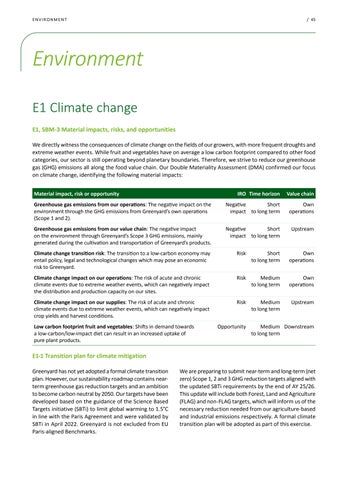
Impacts, risks and opportunities (IROs) exist throughout our value chain, from the cultivation of our fruit & vegetables to the sale of our products. Our DMA identified material IROs across eight topical standards, presented below. All IROs stem from sub-topics and subsub-topics in ESRS. We report entity-specific disclosures
on sustainable agriculture (biodiversity), responsible sourcing (value chain workers) and food quality & safety (consumers & end-users). A more detailed overview of material IROs specific to each topic is shown under SBM-3 for each topical standard.
Climate
Climate
-
Stakeholder engagement
SBM 2
As a responsible company, we commit to a sustainability strategy that reflects the views of our stakeholders and addresses the issues that really matter. To this end, our plans are shaped by a continuous dialogue with stakeholders, including that which formed part of our double materiality assessment, and our knowledge of the impact our activities have along the value chain.
At Greenyard, we are seeking to balance the various expectations and interests of our stakeholders and we are a connecting force from the consumer back to the growers - from Fork-to-Field. We always consider our external environment when doing business. It is important to understand which aspects of sustainability are the most relevant to each of our stakeholder groups and how to address them in the best way. Our main stakeholder groups include employees, consumers, customers, growers and suppliers, industry associations, policymakers, NGOs, knowledge institutions and investors. Feedback from these engagement processes is shared with our Sustainability Community and Leadership Team on an ongoing basis.
Greenyard actively participates in industry associations and stakeholder alliances to drive the industry forward. Senior experts and managers serve as board members or participate in specific projects and working groups. These initiatives are essential to promote healthy lifestyles and increase the consumption of fruit and vegetables. Additionally, they enable a more sustainable growth of produce and foster responsible business behaviour towards everyone involved in the food value chain.
Daily contacts in the field (sales, quality, NpD, sustainability, …)
Customer audits & questionnaires
Growers & suppliers
public organisations (industry associations, NGOs, policymakers, knowledge institutions)
Communicate expectations on social environmental and ethical topics through product specifications
Business reviews with key growers & suppliers
Due diligence & audits to evaluate supplier performance
Training
Board representation in industry associations participation in working groups & stakeholder committees
Meetings, roundtables & conferences
Internships, lectures
Investors information dispersion through different deliverables
Bilateral contact via investor roadshows, conferences
Support on equity research by brokers
EsG questionnaires & ratings
Organisation/Tools
Employee communications: Newsflash, Around the Yard
Code of Conduct e-learning tool
Greenyard Academy
Whistleblower channels
Company website, social media
Key Account Management
Food safety audits: BRC, IFS, QS, …
Sustainability assessments: CDP, Ecovadis
Greenyard quality agreements
Greenyard sourcing connections
Good Agricultural practices: GlobalGAp, Vegaplan, …
Food safety: BRC, IFS, QS, …
Social compliance: GlobalGAP GRASP, Rainforest Alliance, SIZA, …
industry associations: Freshfel, profel, international Fresh produce Association, …
Sustainability alliances: Sustainability initative for Fruit and vegetables (siFAv), The shift, …
Knowledge institutions: Flanders Food, KU Leuven, UGent, Wageningen
University & Research, Brightlands Materials Centre, …
Annual report, press releases
Investor calls
Equity research documents
Moody’s EsG, MsCi, sustainalytics, World Benchmarking Alliance
Environment
E1 Climate change
E1, SBM-3 Material impacts, risks, and opportunities
We directly witness the consequences of climate change on the fields of our growers, with more frequent droughts and extreme weather events. While fruit and vegetables have on average a low carbon footprint compared to other food categories, our sector is still operating beyond planetary boundaries. Therefore, we strive to reduce our greenhouse gas (GHG) emissions all along the food value chain. Our Double Materiality Assessment (DMA) confirmed our focus on climate change, identifying the following material impacts:
Greenhouse gas emissions from our operations: The negative impact on the environment through the GhG emissions from Greenyard’s own operations (Scope 1 and 2).
Greenhouse gas emissions from our value chain: The negative impact on the environment through Greenyard’s Scope 3 GHG emissions, mainly generated during the cultivation and transportation of Greenyard’s products.
Climate change transition risk: The transition to a low-carbon economy may entail policy, legal and technological changes which may pose an economic risk to Greenyard.
Climate change impact on our operations: The risk of acute and chronic climate events due to extreme weather events, which can negatively impact the distribution and production capacity on our sites.
Climate change impact on our supplies: The risk of acute and chronic climate events due to extreme weather events, which can negatively impact crop yields and harvest conditions.
Low carbon footprint fruit and vegetables: shifts in demand towards a low-carbon/low-impact diet can result in an increased uptake of pure plant products.
E1-1 Transition plan for climate mitigation
Greenyard has not yet adopted a formal climate transition plan. However, our sustainability roadmap contains nearterm greenhouse gas reduction targets and an ambition to become carbon neutral by 2050. Our targets have been developed based on the guidance of the Science Based Targets initiative (SBTi) to limit global warming to 1.5°C in line with the Paris Agreement and were validated by SBTi in April 2022. Greenyard is not excluded from EU Paris-aligned Benchmarks.
We are preparing to submit near-term and long-term (net zero) Scope 1, 2 and 3 GHG reduction targets aligned with the updated sBTi requirements by the end of AY 25/26. This update will include both Forest, Land and Agriculture (FLAG) and non-FLAG targets, which will inform us of the necessary reduction needed from our agriculture-based and industrial emissions respectively. A formal climate transition plan will be adopted as part of this exercise.
Our sustainability roadmap focuses primarily on climate mitigation efforts. The main levers to reduce our Scope 1 and 2 emissions are a shift to renewable electricity consumption and production, a focus on energyefficiency initiatives, a switch to low-carbon fuels in terms of our transport fleet and investments to reduce the need for natural gas in our heating and steaming processes, including heat pumps and e-boilers. In terms of Scope 3 emissions, we currently rely on a supplier engagement initiative due to the lack of standard methodology to track progress among suppliers. Beyond climate mitigation, our plan also considers climate adaptation with a focus on improved supply diversification, sustainable water management practices and the introduction of regenerative agricultural practices.
Greenyard relies on natural gas for the heating and steaming processes in its vegetable production sites. While multiple energy-efficiency efforts are undertaken, the technical feasibility and business case for switching from gas boilers to e-boilers does not yet allow us to discontinue investments in new gas boilers. We are undertaking further efforts to investigate alternative possibilities. As such, we do expect to face some potential locked-in GHG emissions that are hard to abate and will need to be covered through carbon removals to reach carbon neutrality.
To ensure that our climate action ambitions become a reality, we have anchored our sustainability roadmap into our overall business strategy and financial planning processes. Climate action, along with other key elements of Greenyard's sustainability roadmap, are tracked on a monthly basis and included in the management review cycle. Progress is discussed in the Leadership Team and Board of Directors. Greenyard’s climate targets were approved by the Group’s Leadership Team upon submitting the targets to SBTi in 2022.
Greenyard’s current and future allocated resources in terms of climate change are discussed in the section E1-3, E1-4 Targets and actions. We have no specific objectives to align with EU Taxonomy criteria, as our main business activities are not in Scope of the Climate Change Mitigation or Climate Change Adaptation objectives of the EU Taxonomy. This will be performed once the manufacturing of food is in Scope as an eligible economic activity under the Taxonomy Regulation.
E1, IRO-1 / SBM-3 Processes to identify and assess material impacts, risks, and opportunities / Resilience analysis
Greenyard started measuring its company carbon footprint in AY 19/20, initially covering only its Scope 1 and 2 GHG emissions and from AY 20/21 onwards also its Scope 3 GHG emissions. Our company carbon footprint helps us to understand where we impact climate change directly and indirectly, and at which stage of the value chain. It forms the basis for setting our climate mitigation targets, identifying the key levers and understanding the key challenges to achieve our targets.
We based ourselves on the recommendations of the Task Force on Climate-related Financial Disclosures (TCFD) to identify and assess our climate-related risks and opportunities. These findings were complemented by our existing analyses and research, and the shortlisted risks and opportunities were then discussed by internal stakeholders to further understand the implications and validate the result.
We applied three ranges of scenarios, including sources from the Intergovernmental Panel on Climate Change (IPCC) and the Network for Greening the Financial System (NGFS): a scenario in line with limiting global warming to 1.5°C (RCp 2.6 / ssp1 and NGFs disorderly delayed transition scenario), an intermediate emission scenario (RCP 6 / ssp 3) and a high emission scenario (RCp 8.5 / ssp 5). These scenarios were applied to the analysis with time horizons of 2025, 2030 and 2050.
For both transition and physical risks, we identified and assessed climate-related risks within our operations and throughout the upstream and downstream value chain. This analysis used our existing work as a starting point, analysis of past weather events, water risk assessment, our company carbon footprint and our double materiality assessment.
The NGFS disorderly delayed transition scenario was chosen for our evaluation of climate transition risks and opportunities. We identified and shortlisted transition risks connected with our business activities, identified to which part of our business they apply and consequently assessed their materiality. The evaluation shows that carbon pricing costs and the availability of renewable
energy may pose a material financial risk in the medium to long term. However, we identified that these risks can be mitigated through continued investments in energy efficiency measures and the achievement of the climate mitigation targets within our sustainability roadmap. Our efforts in developing on-site renewable energy production capacity along with strategic procurement address the risk in terms of the availability of renewable energy.
For physical climate risks, representative sites were assessed for several acute and chronic hazard types, including heatwaves, floods, storms, changing temperature and water stress. The analysis offers insights into the vulnerability of our assets under the three abovecited scenarios. While no material financial risks could be identified for our own operations, we consider the highest risk is situated in our upstream value chain and are therefore further developing our knowledge. As part of these efforts, we conducted a risk assessment focusing on the supply chain of green beans in our Long Fresh segment. Globally, the overall risk for green beans, sown at different dates, seems to remain at a moderate risk for most of the supplying areas towards the 2050 horizon. The risk for droughts (water stress) may however increase to extreme levels for most of the growing areas. Irrigation offers an adequate mitigation option for drought risks, consequently the production of green beans has moved almost entirely to growing areas with availability of irrigation.
We aim to gain further insights in other product supply chains. At Group level, we are taking measures to increase the resilience of our supplies among others by diversifying our sourcing footprint, requiring sustainable water management practices in high water risk regions and developing regenerative agriculture practices.
Overall, we believe we are able to adjust and adapt our strategy and business model to climate change in several ways. From a net risk perspective, we find that most risks can be nearly fully mitigated. Other hazards still pose relevant residual risks for which we need to continue monitoring the effectiveness of our mitigating actions. Our resilience is further improved through local response options (including the ability to shift and outsource production batches) in case of hazardous events. We consider climate-related impacts when relevant in our financial planning. However, as we do not expect significant immediate financial implications from these impacts, they are not integrated into the financial statements.
E1-2 Policies
Greenyard formalised its climate objectives in a Group Environmental policy, covering all our activities and locations. The policy’s objectives ensure that we use all our energy sources as efficiently as possible and use more renewable energy. It also lays out our commitment to reduce our GHG emissions in line with limiting the global temperature rise to 1.5°C as demanded by the Paris Agreement, both in our operations and our value chain. It requires suppliers to adopt GHG reduction targets, as covered in our Supplier Code of Conduct. Climate change adaptation objectives are addressed in the water and biodiversity sections.
The policy is publicly available on the company website Responsibility for the environmental policy lies with our Group Sustainability Director. We review and, if necessary, revise the policy every two years to meet the evolving requirements and expectations of a wide range of stakeholders, as assessed in our materiality assessments.
E1-3, E1-4 Targets and actions
Reducing GHG emissions in our own operations
Greenyard commits to reduce its Scope 1 and 2 GHG emissions by 50% by the end of AY 25/26 from a AY 20/21 baseline and by 70% in AY 30/31. Our nearterm reduction target includes all Scope 1 and 2 (marketbased) GHG emissions and is in line with limiting the global temperature rise to 1.5°C. It was validated by the Science Based Targets initiative (SBTi – certificate GRENBEL-001-OFF) in April 2022.
We set our first science-based target in AY 20/21 (Scope 1 & 2 emissions) which was consequently set as baseline year. When there are significant changes, such as mergers and acquisitions or divestments, we review whether the baseline needs to be recalculated. The baseline value was adjusted to take into account material divestments in 2021. No other adjustments took place since then.
Our sustainability roadmap is generally progressing in line with expectations. In AY 24/25 we reduced our Scope 1 and 2 emissions by 45% compared to baseline year AY 20/21. Our progress is mainly driven by the switch to renewable and low-carbon energy sources, and a continued focus on energy efficiency.
In recent years, we have made significant progress in transferring our grid electricity contracts to 100% renewable electricity. Following Austria, Belgium, Czech Republic, Germany, the Netherlands and Poland, our US entities will make the switch as from AY 25/26. Operations in other countries are either mainly relying on nuclear electricity production or are not material in terms of energy consumption. in AY 24/25 more than 60% of our electricity came from renewable sources.
Together with our energy partners we are also ramping up on-site production of renewable energy. New solar panels at Greenyard prepared in Belgium (3 600 Mwh) and Bakker in the Netherlands (1 400MWh) have allowed to double the on-site production in AY 24/25. Plans for a windmill at the Prepared site in Bree, Belgium have further advanced with the application for an environmental permit. Along with other solar panel projects in the pipeline, we expect to double the production capacity again in the next two years.
The next frontier will be the gradual electrification of production processes that are powered by natural gas. This will be quite a challenge, both economically and technically. Electricity prices are still up to twice as high as those for natural gas. Processes which require relatively low temperatures can already be powered by electrical heat pumps, but for more energy-intensive processes, technologies are still in development. Still, we are already preparing for the future, with a particular focus on further reducing gas consumption and recuperating heat in our processes wherever we can.
In this light we joined Rethink Energy 4 Food, a fouryear collective research & development programme coordinated by Flanders Food which started in 2024. Within the focus track Energy Resilience, they investigate how to flexibly handle fluctuating energy supply without compromising process stability. To achieve this, they explore energy storage technologies to store excess heat or generated energy for later production runs, as well as energy management systems to deploy the energy supply as efficiently as possible.
Another key lever in reducing GHG emissions in our own operations is the switch to low-carbon fuels for our transport fleet. Hydrotreated Vegetable Oil (HVO) currently makes up 15% of the transport fleet fuel mix. We consider HVO and other biofuels as a transition technology to make our road transport more sustainable pending the scalability of electrification and modal shifts. At present, we operate 4 electric trucks for short hauls only. For our leased car fleet, we are also switching to fully electric cars. At present 50% of the car fleet in core markets is electric.
Elsewhere we are rolling out battery packs that allow trailers to be 100% electrically cooled, instead of relying on diesel. The energy is generated kinetically by the movement of the vehicle which generates enough power to electrically cool the trailer, both during transport and during loading and unloading. A total of 17 trucks have been equipped with these battery packs, corresponding to 17% of the fleet. Trials with on-board solar panels to power the cooling units are ongoing with 3PL-partners and show promising results.
We do not calculate detailed emission reductions achieved based solely on our specific actions. Further assessment of levers and expected emission reductions per lever will be part of our roadmap development. We do not have GHG removals and GHG mitigation projects financed through carbon credits. Elsewhere we do not apply internal carbon pricing.
Our sustainability roadmap to 2030 is aligned with a 1,5°C pathway. We have considered other climate scenarios in the framework of a climate risk assessment of our own operations as well as our value chain. We take into account the potential fluctuations in market prices for lower-carbon fuel alternatives as demand rises and policy changes, including carbon pricing and carbon taxes. We are diversifying our energy mix to take these factors into account.
The implementation of the emissions reduction actions may pose various challenges, including material availability and added procurement costs. Additionally, the availability of infrastructure, including energy grid connections and charging infrastructure for electric vehicles, can also delay our actions. Challenges and risks are considered in our roadmap planning, allowing us to prioritise cost-efficient solutions that can drive the agenda to reach our targets.
Reducing GHG emissions in our supply chain
The majority of our GHG emissions originate from our value chain, particularly purchased goods and upstream logistics and transportation. We commit that 70% of our suppliers (by spend covering purchased goods and services, upstream and downstream transportation and distribution) will have set science-based climate targets by the end of 2026. Our scope 3 target was validated by the Science Based Targets initiative (SBTi – certificate GREN-BEL-001-OFF) along with our Scope 1 and 2 targets.
We actively engage with our suppliers with the objective of undertaking reduction initiatives and setting targets. At present, approximately 31% of our suppliers have set science-based targets or have committed to set science-based targets within two years. A larger group is actively working on climate mitigation. We recognise the limited awareness of small and medium-size suppliers for calculating company carbon footprints, let alone setting science-based reduction targets. We actively participate in initiatives that support growers in this domain. One example is Klimrek-T, a 3-year project started in 2023 which assists Belgian farmers with climate and water scans to identify improvement areas and assess the financial and practical feasibility of climate adaptation and mitigation measures. We trust the broader implementation of science-based targets by customers and peers will further raise awareness.
The shift to regenerative and circular agriculture practices will play a crucial in lowering the impacting the climate of fruit and vegetable production while at the same time increasing its resilience against acute and chronic climate risks. For more information on our efforts in terms of sustainable farming, see E4 Biodiversity and ecosystems.
Elsewhere we continuously strive to optimise and improve the sustainability of our packaging, aiming to reduce the environmental and climate impact while maintaining functionality and quality. In this context, the Prepared division started a partnership with Tetra Pak for a new packaging line of liquid packaging board.
In order to effectively track progress of reduction initiatives in the supply chain, we need reliable and scalable calculation of the environmental and carbon footprint of products. Greenyard is taking a leading role in the Freshfel Environmental Footprint Initiative, an industry initiative establishing common rules in this domain, known as the Product Environmental Footprint Category Rules (PEFCR). The methodology was developed with the support of Wageningen Economic Research and will be made available as a sector-wide open resource in the summer of 2025. In line with these developments, Greenyard is also testing Lifecycle Assessment (LCA)-tools to calculate the footprint of products and identify the best levers to reduce their impact. This will be essential with a view to shift towards absolute Scope 3 emissions reduction targets. Meanwhile one division has started to collect primary data from suppliers, which will enable even more specific reporting of Scope 3 emissions.
Actions to seize the opportunity of the low carbon footprint of fruit and vegetables and respond to the shifts in demand towards low-carbon/low-impact diets are discussed in S4 Consumers & end-users.
Current and future allocated resources
For the actions to reduce our GHG emissions through energy efficiency (including replacement investments), on-site renewable electricity production and offering packaging with a lower carbon footprint, we invested € 13,5m in AY 24/25. some of the resources overlap with Eu Taxonomy economic activities (CCM 6.6, CCM 7.4 and CCM 7.6), although core activities related to the food sector are not Taxonomy-eligible to date. Other
E1-5 Energy consumption and mix
investments are an integrated part of our capital cost allocations and are therefore not reported here, but in general capital expenditures (CAPEX). Purchasing of renewable electricity or biofuels instead of fossil fuels happens through existing procurement channels and are included in general operational expenditures (OPEX). The figures for the total OPEX and CAPEX can be found in the financial statements: Cash flow from investing activities on p.194 and Operating expenses p.213.
ACCOUNTING POLICIES
Energy consumption
The energy consumption related to our operations includes fuel consumption at sites and by owned and leased vehicles, and consumption of purchased and self-generated energy (electricity and heat). The fuel consumption at sites and by vehicles can be split into fossil fuels (natural gas, oil, petroleum products and other fossil sources) and renewable fuels (biofuel). The purchased energy can be split into renewable and nonrenewable (fossil and nuclear). Self-generated renewable energy comes from solar power and combined heat power installations. Lower heating values are applied to convert fuel consumption into energy. Greenyard obtains Guarantees of Origin and power purchase agreements (PPA) to source its renewable electricity.
Energy intensity
Energy intensity is calculated as the total energy consumption divided by total net sales. All revenue generating activities are either directly related to the processing and wholesale of food or support that objective. They are considered high climate impact sectors. Therefore, there is no difference in Scope compared to total energy consumption and total net sales. The figure for total net sales can be found in the financial statements, income statement (p.190).
Greenyard also reports the most relevant energy intensity ratio pertaining to its Long Fresh segment which is calculated as total energy consumption (excluding vehicle fuel consumption) per unit processed volume.
Note: All Greenyard subsidiaries are
E1-6 Greenhouse gas emissions
ACCOUNTING POLICIES
Scope 1 GHG emissions
Scope 1 GHG emissions include all direct GHG emissions from energy consumption and the use of refrigerants in own operations, calculated in line with the GHG Protocol. Energy consumption includes all direct energy sources (oil, natural gas and biogas) at owned sites (production sites, distribution centres and offices) or by vehicles (including leased vehicles). GHG emissions are calculated as energy consumption multiplied by relevant emission factors. The GHG emissions from our production site with regulated emissions trading schemes have been divided by total emissions to calculate the share from regulated emissions trading schemes.
In 2025, we improved the calculation by applying betteraligned emission factors for diesel (average biofuel blend instead of 100% mineral diesel). This led to an adjustment of -837 t CO2e in AY 23/24 and -921 t CO2e in the baseline year.
Scope 2 GHG emissions
Scope 2 GHG emissions include indirect GHG emissions from the generation of electricity and heat purchased and consumed, calculated in line with the GHG Protocol. Both location- and market-based GHG emissions are calculated by multiplying the amount of energy purchased by country-specific emission factors. Marketbased emissions take into account renewable electricity purchased through power purchase agreements (PPAs), or Guarantees of Origin.
Scope 3 GHG emissions
Scope 3 GHG emissions include indirect GHG emissions from operations in the value chain, covering both upstream and downstream activities, including joint ventures that Greenyard does not have operational control over. Scope 3 GHG emissions are calculated in line with the GHG Protocol. Greenyard does not report on Scope 3 emissions in categories 2 (capital goods), 7 (employee commuting), 8 (upstream leased assets), 10 (processing of sold products), 11 (use of sold products), 12 (end-of-life treatment of sold products), 13 (downstream leased assets), 14 (franchises) and 15 (investments) since these activities are not applicable (8, 13, 14), required (11) or significant (2, 7, 10, 15) for Greenyard.
Category 1 : upstream GHG emissions related to the cultivation of fruit & vegetables, processed products & ingredients, flowers & plants, packaging materials, water consumed at the production sites and third-party warehousing.
Category 3: upstream well-to-tank (WTT) GHG emissions related to fuel consumed and energy purchased (as included in Scope 1 and 2).
Category 4 : GHG emissions related to the inbound and outbound transportation of fruit and vegetables and processed products & ingredients, excluding transportation by Greenyard’s own fleet.
Category 5 : downstream GHG emissions related to the external waste treatment of waste generated in Greenyard’s operations.
Category 6: business-related air travel of employees paid for by Greenyard.
Category 9: downstream GHG emissions related to the transport from customer distribution centres (DCs) to supermarket and foodservice outlets and cooling in the DCs and outlets.
For more information on the applied emission factors for Scope 1-3 GHG emissions and more detailed accounting policies for the Scope 3 GHG emission categories, please see Appendices 5 and 6. For more information on any measurement uncertainties and value chain estimates, please see Appendix 4.
(market-based)
emissions not included in Scope 1 GHG emissions
Biogenic emissions not included in Scope 2 GHG emissions
Biogenic emissions not included in Scope 3 GHG emissions
ACCOUNTING POLICIES
GHG intensity
GHG intensity is calculated as total market-based and location-based GHG emissions per € million net sales. The figure for total net sales can be found in the financial statements, income statement (p.190).
Contractual instruments
Contractual instruments consist of purchased energy bundled with attributes about energy gene-ration (i.e. PPAs, Guarantees of Origin from the energy supplier) and energy purchased from unbundled instruments. Greenyard only uses bundled contractual instruments. The shares reflect the location-based Scope 2 GHG emissions associated with the use of these instruments.
Biogenic emissions
Biogenic emissions not included in scope 1 include CO₂ emissions from the combustion of biofuels in vehicles and biogas from on-site wastewater treatment installations. The emissions are calculated in line with the GHG Protocol and by multiplying the input data by the relevant emission factors. Biogenic emissions not included in Scope 2 are not deemed material. Biogenic emissions not included in Scope 3 are currently not included as organic waste flows do not qualify as degradation of biomass. We will report on biogenic emissions from purchased goods as from AY 25/26.
E3 Water and marine resources
E3, SBM-3 Material impacts, risks, and opportunities
Water is an essential resource for Greenyard, both within our own operations and for our growers. The production processes within Long Fresh use considerable amounts of fresh water to wash, transport, process, peel, heat and preserve products. The availability of fresh
water is equally essential for the cultivation of fruit and vegetables. As a responsible and values led company we are committed to reduce consumption and mitigate risks every way we can – not just in our own operations, but all through the value chain.
Our DMA confirmed our focus on water, identifying the following material impacts:
Water consumption in our production processes: The consumption of water could worsen water stress, especially in areas of high water risk.
Water consumption for irrigation of crops: The consumption of water could worsen water stress, especially in areas of high water risk.
Water re-use in the production of processed fruit and vegetables: Water re-use installations reduce the risk of water stress and/or direct costs.
Water stewardship projects: Water stewardship projects reduce the risk of water stress in sourcing regions.
Negative impact Short to long term Own operations
Negative impact Short to long term Upstream
positive impact Short to long term Own operations
positive impact Medium to long term Upstream
E3, IRO-1 Processes to identify and assess material impacts, risks, and opportunities
Our efforts to reduce our water withdrawals are guided by a solid understanding of the water risks facing our operations. Greenyard’s processing activities are water-intensive and make up 95% of the Group’s water withdrawals. The production sites mostly operate under multi-year environmental permits reducing short-term risks. The water risk of all production sites of Greenyard are evaluated at local and at group level and are reviewed every two years based on the WWF Water Risk Filter, based on three types of water risk: physical, regulatory and reputational. Water re-use projects are prioritised at the sites with the highest water scarcity risk.
As we do in our own operations, we also use WWF’s Water Risk Filter tool to determine the risks facing our suppliers. Following our initial water risk mapping exercise of the grower base, water risk is now a standard feature of our sustainability due diligence and growers in regions with water stress are required to implement sustainable water management standards.
Water availability was a prominent feature in Greenyard’s climate risk assessment covered in chapter E1 Climate change, both for our own operations and our supply chain. In terms of the supply chain risk, we are further developing our knowledge. As part of this effort, we have conducted a risk assessment focussing on the supply chain of green beans in our Long Fresh segment. Globally, the overall risk for green beans, sown at different dates, seems to remain at a moderate risk for most of the supplying areas towards the 2050 horizon. The risk for droughts may however increase to extreme levels for most of the growing areas. This represents a problem for the flowering and the pod development of green beans. Irrigation offers an adequate mitigation option for drought risks, consequently the production of green beans has moved almost entirely to growing areas with availability of irrigation.
Furthermore, we work closely with the Sustainability Initiative for Fruit and Vegetables (SIFAV) to develop water stewardship projects in areas with water stress. Under SIFAV, all private sector partners commit to actively promote best water practices, water use efficiency, and collective action in three jointly selected catchments. Projects are conducted in close cooperation with local partner organisations, which engage with local communities affected and other local stakeholders.
E3-1 Policies
Greenyard formalised its water objectives in a Group Environmental policy, covering all our activities and locations. The policy’s objectives ensure that we reduce water withdrawals and reuse processing water in our own operations and promote sustainable water management throughout our supply chain, particularly in regions with water stress. It requires suppliers in regions with water stress to implement sustainable water standards, as covered in our Supplier Code of Conduct. It also lays out our commitment to engage with local stakeholders and multi-stakeholder initiatives to address water-related issues.
The policy is publicly available on the company website Responsibility for the environmental policy lies with our Group Sustainability Director. We review and, if necessary, revise the policy every two years to meet the evolving requirements and expectations of a wide range of stakeholders, as assessed in our materiality assessments.
E3-2, E3-3 Targets and actions
Reducing water withdrawals in our own operations
Greenyard will reduce its total water withdrawals by 10% by the end of AY 25/26 compared to AY 20/21. it is a voluntary target that was set by Greenyard management pending the development of science-based targets. We aligned the baseline year with the baseline year for our climate targets for the sake of consistency.
We aim to reduce our water withdrawals at our production sites through continued water-efficiency investments and increased recycling of processing water, allowing for municipal water to be reused. These production sites are part of our Frozen, Prepared and Fresh convenience entities and are responsible for >95% of water withdrawals within the Greenyard Group.
Water withdrawals (m3) by division
Fresh
Frozen
Prepared
Greenyard’s water reduction efforts focus on the sites with the highest water withdrawals and/or highest water scarcity risk, particularly the Prepared site in Bree and the Frozen site in Westrozebeke. Both located in Belgium. In November 2024 the Board of Directors principally approved the commissioning of a large re-use installation at the site in Bree and a water treatment and re-use installation for the site in Westrozebeke.
The installation in Bree will deliver full-year savings of 300 000 m³ on groundwater withdrawals and is expected to enter into service at the start of AY 26/27. The realisation of the installation in Westrozebeke is foreseen during AY 26/27 and will deliver full-year savings of 250 000 m³. Besides these large-scale projects, we reduce water withdrawals across all production sites through continuous improvement initiatives.
In AY 24/25 Greenyard used 4 020 million m³ of water, a reduction of 1.5% compared to AY 20/21 baseline and an increase of 1.4% compared to last year. Water withdrawals were highly impacted by the exceptionally wet weather circumstances in the winter and spring leading to lower, less predictable and interrupted supply towards the Long Fresh production sites. Overall, the water intensity within the Long Fresh division improved, due to higher volumes and optimisation projects to save or re-use water. Delays in the environment permit approval of the first water re-use installations will not allow to fully capture the anticipated savings in water withdrawals in AY 25/26, we are however confident to reach the reduction target during AY 26/27.
Promoting sustainable water management and water stewardship
Greenyard aims to promote sustainable water management in its value chain, particularly in regions with water stress. As of AY 24/25 Greenyard gradually requires suppliers in regions with water stress to implement sustainable water standards. Greenyard commits 85% of its suppliers that are active in regions with water stress will implement water standards by AY 30/31. At the end of AY 24/25, 55% of suppliers have implemented water standards.
The target was developed in the framework of the Sustainability Initiative Fruit and Vegetables (SIFAV), a multi-stakeholder initiative in which all private sector partners commit to the implementation of water standards for products sourced from regions with water stress.
Water stewardship requires action beyond the implementation of water standards, which is why within SIFAV, Greenyard also takes part in water stewardship projects in the Ica catchment in Peru as well as the Doñana and Mar Menor in Spain and the Western Cape in South Africa.
In Peru, private and public sector actors have been working together on catchment analysis and stakeholder alignment to build momentum in preparation for a collective action project. The first phase of the project in 2023-24 has already delivered 68 km of infiltration ditches and orchestrated the planting of thousands of native trees. While upstream infiltration alone is not enough, it has successfully brought together a coalition of public and private actors in Peru and Europe committed to manage water responsibly for the relevant stakeholders in the catchment. In 2025 the project will focus on laying the groundwork for scaling broader interventions.
In Spain we are working together with SIFAV and the Waste & Resources Action Programme (WRAP) since 2024. The aim of the projects is to understand water risks, disseminate good agricultural practices, strengthen certification standards, and advocate for sustainable water management. In Doñana, efforts focus on legal water use verification and capacity building, while in Mar Menor, a 30-month water stewardship plan is being developed. A total of 24 businesses have committed to contributing funds for three years.
At the end of 2024 we also joined WRAP’s Water Roadmap projects in Western Cape, South Africa. The key fruit growing regions have been affected by drought in recent
years, which has in turn affected fruit crop yields and availability. Although the drought situation has been alleviated, the trend for drier conditions is predicted to continue. The projects, led by WWF, focus on bolstering
climate resilience and water security in the priority catchments, impacting on local livelihoods, particularly by creating job opportunities, enhancing water security, and supporting sustainable agricultural practices.
ACCOUNTING POLICIES
Water standards
Water standards cover the third-party verified sustainable water management schemes included in the basket of standards adopted by the multi-stakeholder initiative SIFAV. Greenyard requires suppliers in regions with high water risk to implement water standards. The list of regions with high water risk has been compiled by
SIFAV and is based on the overall water risk (score > 3) of the WWF Water Risk Filter. The share of the grower base in high water risk regions certified for sustainable water management is calculated based on the adoption of water standards captured in Greenyard’s supplier approval platforms. At present only growers from the Fresh segment were considered.
Current and future allocated resources
In terms of water-related CAPEX, the main expenditures are related to maintenance (spare parts) of existing installations. We estimate a stable trend going forward as we are actively engaging with utility companies to minimise direct capital expenditure and have new on-site wastewater treatment plants directly operated by these companies. Nevertheless, some general infrastructure adaptations may be required while we anticipate the building of new treatment plants. We expect waterrelated OPEX to increase as a result of the new wastewater treatment plants, notwithstanding savings resulting from reduced water withdrawals and ongoing water efficiency initiatives.
Other actions are integrated into regular operations at Group and divisional level, utilising human and financial resources. Consequently, resources allocated to sustainable water management and water steward-ship in the value chain are currently not tracked independently but included in overall CAPEX and OPEX. The figures for the total OPEX and CAPEX can be found in the financial statements: Cash flow from investing activities on p.194 and Operating expenses p.213.
ACCOUNTING POLICIES
Water withdrawal
Water withdrawal covers all water withdrawn to be used at Greenyard. Water withdrawal encompasses three main sources: municipal water, groundwater and rainwater. Municipal water includes water purchased from external suppliers. Groundwater refers to water sourced from on-site boreholes, while rainwater refers to water collected by the company. The total volume of water withdrawal is measured based on meter readings or invoices from suppliers, except for small offices where a proxy is used.
Water intensity
Water intensity is calculated as water consumption per € million net revenue. Greenyard also reports the most relevant water intensity ratio pertaining to its Long Fresh segment which is calculated as water withdrawals per unit processed volume.
Water recycled and reused
Water recycled and reused covers treated effluent from on-site water treatment installations reused for process activities at production sites and is measured based on meter readings. Greenyard will report the volumes from its new water reuse installations as from AY 26/27.
Water discharge
Water discharge covers all planned and unplanned discharges of water from Greenyard. For production sites, wastewater discharges are recorded based on meter readings. They comprise of discharges to surface water following on-site wastewater treatment and discharges directly to the public water discharge grid for further treatment in public and private wastewater treatment plants. For distribution centres and offices, wastewater discharges are presumed to be equivalent to 90% of water withdrawals.
Water consumption
Water consumption is calculated as water withdrawal minus wastewater discharge.
Water risk
Water risk is determined at site level and corresponds to the water availability risk as per Greenyard’s analysis in WWF Water Risk Filter (global dataset) of all its production sites. The calculated output is Greenyard’s freshwater withdrawals and total water consumption by water risk areas.
Wastewater Chemical and Biological Oxygen Demand
Wastewater Chemical Oxygen Demand (COD) and Biological Oxygen Demand (BOD) covers the total wastewater load of production sites during the reporting period. It is calculated as the weighted average of samples multiplied with the water discharge volumes during the reporting period.
E4 Biodiversity & ecosystems
E4, SBM-3 Material impacts, risks, and opportunities
Our ecosystems are under increasing pressure due to climate change, land-use and land change, pollution and water consumption. On the one hand, biodiversity is essential for our core activities, both in our own operations and for the growers within our supply chain.
On the other hand, we acknowledge the impact of our own activities and those in our value chain on biodiversity. As a responsible and value-oriented company, we are committed to reduce our impact together with our suppliers and growers.
Our Double Materiality Assessment (DMA) confirmed our focus on biodiversity, identifying the following material impacts:
Biodiversity impacts from sourcing fruit and vegetables: The negative impact on biodiversity and the ecosystem through pollution from chemical fertilizers and pesticides during the cultivation of fruit and vegetables.
Water consumption in our production processes: The potential negative impact arising from water consumption in our production sites, especially in the proximity of biodiversity sensitive areas. Negative impact Short to long term Own operations
E4, IRO-1 Processes to identify and assess material impacts, risks, and opportunities
In 2024, we joined the Biodiversity in Action (BiA) Program of The Shift and WWF, a twelve-month program to develop our Nature Strategy. As part of this program, we conducted our first nature-related assessment aligned with the methodology of the Taskforce on Nature-related Financial Disclosures (TNFD). Several tools were used to support the exercise including WWF’s Biodiversity Risk Filter, Integrated Biodiversity Assessment Tool (IBAT), Exploring Natural Capital Opportunities, Risks and Exposure (ENCORE), Natura2000 and Key Biodiversity Areas (KBA).
Both the agricultural activities in our upstream supply chain and the production of frozen and prepared products in our own operations have been identified as having a negative impact on biodiversity. The negative impact of agricultural activities is mainly attributed to high water consumption, which depletes natural resources, disrupts ecosystems and contributes to water stress.
Additionally, large areas of land are needed for the cultivation of crops, which leads to habitat destruction, while pesticides, fertilizers and waste pollute soil and water. In the coming years we will go in more detail on the impact, risks and opportunities of agricultural activities in our supply chain. Our first focus will be on high impact commodity crops (e.g. avocados, bananas)
that have been identified as major drivers of biodiversity loss by the Science-Based Targets for Nature.
Furthermore, our production processes were found to have no significant impact on biodiversity. However, our water consumption and waste generation can have an impact on ecosystems. In an analysis of our own operations, all sites and their surrounding areas within a radius of 4 km were assessed. Four production sites were considered as material due to their proximity to biodiversity sensitive areas and Natura 2000 sites. Due to their proximity, these sites must adhere to stringent national and local legislation and comply with environmental permits including biodiversity mitigation measures:
• Greenyard Prepared site (Bree, Belgium): biodiversity sensitive areas Hamonterheide, Hageven, Buitenheide, Mariahof and Stamprooierbroek, Abeek with adjacent wetlands, and Itterbeek met Brand, Jagersborg and Schootsheide and Bergerven.
• Greenyard Prepared site (Rijkevorsel, Belgium): Natura2000 areas Heesbossen, Vallei van Marke and Merkske and Ringven with valley lands along the Heerlese Loop.
• Greenyard Frozen sites (King’s Lynn and Boston, UK): protected area The Wash and the rivers that flow directly into this estuarian nature reserve.
E4-1 Resilience Analysis
So far, we have not yet conducted a resilience analysis, but this will be part of the earlier mentioned BiA Program. However, our DMA already identifies the risks of our activities on biodiversity. Our due diligence approach relies on a sustainability risk assessment that includes factors such as biodiversity, deforestation, soil degradation, and the use of fertilizers and pesticides with our suppliers. This assessment helps us understand potential environmental impacts and guides our efforts toward more sustainable practices.
E4-2 Policies
Our biodiversity risks are principally governed through our environmental policy. Greenyard formalised its environmental sustainability objectives in a Group Environmental policy, covering all its activities and locations. The policy’s objectives ensure that we reduce water consumption and reuse processing water in our own operations and promote sustainable agricultural practices. The adoption of Good Agricultural Practices (GAP) is a prerequisite to do business with Greenyard and reduces the biodiversity impacts from sourcing fruit and vegetables. This requirement is included in the Greenyard Quality & Food Safety Policy. As we are still
developing our nature strategy, a comprehensive policy on biodiversity and sustainable farming encouraging farmers and suppliers to adopt regenerative agriculture practices will be finalised by the end of AY 25/26.
Our suppliers are required to take measures to preserve biodiversity, protect wildlife and endangered species while adhering to all relevant environmental laws and regulations, as covered in our Supplier Code of Conduct. Our environmental policy includes our commitment to zero deforestation by 2025 across the raw materials we purchase. Neither social consequences of biodiversity and ecosystem-related impacts nor biodiversity and ecosystem protection policies in or near biodiversitysensitive areas are currently addressed in our environmental policy.
The policy is publicly available on the company website Responsibility for the environmental policy and the further development of the biodiversity policy lies with our Group Sustainability Director. We review and, if necessary, revise the policy every two years to meet the evolving requirements and expectations of a wide range of stakeholders, as assessed in our materiality assessments.
E4-3,
E4-4
Targets and actions
we expect to set biodiversity related targets in 2026 once we have developed our Nature Strategy within the BiA Program. Nevertheless, through the targets we have set for climate and water management (for more details, see E1 Climate change and E3 – Water management) we are reducing GHG emissions and optimising our water consumption, both of which have a direct impact on biodiversity.
In 2024, we have joined the Biodiversity in Action (BiA) Program of The Shift and WWF to deepen our knowledge and understanding of biodiversity together with peers from other industries, experts and policymakers. The program will help us gather valuable insights to prevent biodiversity loss, which will ultimately contribute to developing our own Nature Strategy. BiA is a twelvemonth program set to conclude in January 2026.
Sustainable farming
In 2023, we already developed a regenerative agriculture framework to improve and preserve soil organic matter, lower our climate impact, improve our water footprint, enhance and protect biodiversity, and support resilient and profitable farming systems. Still, regenerative agriculture is a complex matter as practices are both crop- and region specific. We are working with specialised organisations with local field knowledge to support us in this transition. We do not expect to set regenerative agriculture targets before the end of 2025.
In the meantime, Greenyard engages in projects with individual growers to test precision farming techniques or set up measurements for biodiversity aspects such as soil quality and organic matter. Via our Bakker division, we are actively involved in the Better for Nature & Farmer
and Green Farming Programs, which support farmers in the transition to more sustainable agricultural practices with a focus on lowering CO2 emissions and enhanced biodiversity.
Additionally, we collaborate with research institutes and our clients on projects focused on biodiversity and regenerative agriculture. We are part of the BeeOmetrics R&D project to develop cost-effective green technology for environmental monitoring and remediation, using wild bees as scalable bioindicators. By tracking pollution and biodiversity metrics, and leveraging AI for predictive insights, BeeOmetrics facilitates ecosystem health analysis and supports biodiversity restoration. In this project, 5 BeeOtels have been placed at open field pilot growers in Belgium. Additional placement of BeeOtels in other countries is ongoing.
Deforestation
Greenyard committed to zero deforestation by 2025 across the raw materials it purchases. While fruit and vegetables are not primary deforestation-linked raw materials, we are mindful of any risks in this domain. As we purchase small volumes of products (beef, cacao, soy) which fall within the scope of the EU Deforestation Regulation (EUDR), we are taking the necessary steps in terms of due diligence to ensure compliance by 1 January 2026.
Current & future allocated resources
Key actions are integrated into regular operations at Group and divisional level, utilising human and financial resources. Consequently, resources allocated to biodiversity are currently not tracked independently but included in overall CAPEX and OPEX.
E4-5 Impact metrics
Greenyard’s key impact metrics in terms of biodiversity are currently covered through the targets we have set for climate and water management. We aim to include further impact metrics upon the finalisation of our Nature strategy early 2026. in line with previous reports, we disclose the share of organic products sold and have
added the share of products certified for good agricultural practices. Despite some pressure on organic sales in the market, Greenyard’s own share remains stable and represents around 8% of Fresh volumes and 5% of Long Fresh volumes.
ACCOUNTING POLICIES
Good agricultural practices
The volume share of fresh products purchased from growers certified to an FSA 3.0 silver medal equivalent farm sustainability scheme (e.g. FSA, GlobalGAP, Red Tractor, QS, Vegaplan). It is calculated based on the certification status captured in Greenyard’s supplier approval platforms. The volumes are directly measured through procurement reports related to fruit and vegetables.
Organic
products
The volume share of organic products covers the thirdparty sales of fruit and vegetable products certified according to EU Organic Farming standards or equivalent. It is calculated based on the organic certification status captured in Greenyard’s ERP-systems. The volumes are directly measured through sales invoices.
Volume share of fresh fruit & vegetables certified for good agricultural practices (FSA 3.0 silver medal equivalent)
E5 Resource use & circular economy
E5, SBM-3 Material impacts, risks, and opportunities
Circular economy is an essential theme for Greenyard, both within our own operations and for our growers. We are committed to reduce all our waste flows and close the (recycling) loop for materials such as packaging, organic waste and by-products. Our Double Materiality
Assessment (DMA) identified two material negative impacts in our value chain that relate to resource use and the circular economy. It also identified one material financial opportunity that the circular economy presents for our business in the short term.
Food waste: Impact on the environment and food security through the waste of (scarce) food resources (intended for human consumption) across the value chain.
Food waste reduction initiatives: initiatives reducing food waste lead to reduced disposal costs and a reduced impact on biodiversity and nature.
Purchasing of packaging materials: Impact on the environment through the production, use and disposal of primary and secondary packaging materials used.
Negative impact Short to long term All stages
positive impact, Opportunity Short term Own operations, upstream
Negative impact Short to long term Own operations
E5, IRO-1 Processes to identify and assess material impacts, risks, and opportunities
Food waste negatively impacts the environment and food security through the waste of (scarce) food resources that are intended for human consumption. Compared to other food categories, fruit and vegetables have a low environmental impact (cfr. Barilla Double Pyramid). Within this context, we have not conducted an in-depth assessment of our product-related activities in terms of circular economy. Nonetheless we use a life cycle assessment tool for more in-depth evaluation of the environmental footprint of our products, at present mainly for the carbon footprint. This tool uses the industrystandardised method co-developed by Greenyard, known as the Product Environmental Footprint Category Rules (PEFCR) for fruit and vegetables.
The purchase of packaging materials has a negative impact on the environment through the production, use and disposal of primary and secondary packaging materials used upstream in our value chain. We use life cycle assessments to assess the impact of packaging. Whereas glass and steel cans are 100% recyclable and contain recycled content, they have a very high impact in terms of greenhouse gas emissions. We have introduced liquid cardboard as an alternative given its better environmental footprint. We assess the recyclability of our packaging by considering the material composition and monitoring the development of recycling rates in our markets.
As part of our DMA process, we screened our activities to identify material impacts, risks and opportunities and conducted interviews with internal and external stakeholders (waste management companies, packaging manufacturers and clients) in relation to resource use and circular economy (see also section Stakeholder engagement).
Material impact, risk or opportunity
IRO Time horizon Value chain
E5-1 Policies
Greenyard formalised its circular economy and waste objectives in a Group Environmental policy, covering all our activities and locations. We are committed to reduce food waste and packaging waste, not just in our own operations, but all through the value chain. We closely work with partners to reduce the consumption of packaging materials and increase the share of recycled content in our packaging. Additionally, we raise awareness on circular economy, waste impacts, and possible actions that can be taken to reduce our waste. A policy on the sourcing of certified cardboard and paper packaging will be developed in the course of AY 25/26.
The Group Environmental policy is publicly available on the company website . Responsibility for the environmental policy lies with our Group Sustainability Director. We review and, if necessary, revise the policy every two years to meet the evolving requirements and expectations of a wide range of stakeholders, as assessed in our materiality assessments.
E5-2, E5-3 Targets and actions
Food waste prevention
Greenyard aims to valorise all residual streams and by-product flows of our food production by the end of AY 25/26. The target is in line with the Eu waste Framework Directive. Furthermore, we are contemplating a bettersuited food waste target in line with the revised EU Waste Framework Directive which is currently being finalised by the EU co-legislators.
Our primary focus lies in waste prevention, together with our customers and our suppliers. We strive to maximise recycling or valorisation and ensure the closure of material loops for all waste streams. This is the case for all other regular waste types such as cardboard, paper, plastics, residual waste, as well as for bio-waste and by-products.
Most of our by-products stem from the processing operations of our Frozen and Prepared divisions and mostly consist of peelings from vegetables. Most of these streams are valorised as animal feed. If unsuitable for human or animal consumption, they are diverted towards fermentation or composting. If we have any overstocks (e.g. due to lower-than-expected demand) that cannot be
sold to customers, we try to ensure they are kept within the food chain, for example by delivering them to foodprocessing companies or to food banks. In the past year we directed 4 806 tonnes of fruit and vegetables to food banks, charities and food industry.
In AY 24/25 Greenyard generated around 202 000 tonnes of by-products and waste of which around 74 293 tons was valorised as feed. When including the re-use of sludge, sand and soil, in total 56,1% is re-used. This is similar to last year with a higher share of sludge, sand and soil due to difficult harvesting conditions and lower raw material quality. The share of recycled waste is just over 40%, similar to last year, with a higher share of organic waste for fermentation and composting due to increased processing volumes.
Waste & Recycling
● Reuse (mainly animal feed)
● Recycling
● Fermentation & Composting
● Incineration (energy recovery)
Greenyard’s demand-driven, Fork-to-Field, business model is the best possible way to prevent (avoidable) food waste, as it establishes a close connection between consumer demand and the actual production of fruit and vegetables in the field. Via strategic partnerships with customers, we gain a better insight into expected demand, which is then connected to available stocks in our distribution centres and the planned production of our growers.
We continuously investigate innovative ways to prevent food waste throughout the chain. These include the use of forecasting tools to better predict demand, based on a wide range of parameters such as weather forecasts, events and promotions.
Packaging
Greenyard aims to have 100% of its primary packaging recyclable by the end of AY 25/26. The target is in line with the EU Packaging and Packaging Waste Regulation (PPWR) and aims to increase circular design. We are contemplating better-suited targets on recycled content for plastic packaging with a view to minimise the use of primary raw material. As private label supplier we greatly depend on our customers’ packaging strategy, as such targets will be in line with legislation.
i n AY 24/25 we used about 58 362 tonnes of primary packaging, of which 99,7% is considered recyclable, similar to last year. Packaging materials mainly consist of plastics and cardboard in the Fresh division, plastics in the Frozen division, and steel cans and glass in the Prepared division.
Multi-layer stand-up pouches for soups and sauces are the main packaging type which is not 100% recyclable yet. They are increasingly popular because of their low weight, resulting in a better transport footprint. An industry-wide project was set up with Brightlands Materials Center to develop a recyclable alternative. During development, both p olyethylene terephthalate (PET) and polypropylene (PP) were tested. While PET showed poor sealability, PP proved more promising. Further finetuning ultimately led to a suitable PP-variant the industry can further develop. We are investigating further steps in the roll-out of recyclable pouches in close cooperation with our customers.
Elsewhere we continuously strive to optimise and improve the sustainability of our packaging, aiming to reduce the environmental impact while maintaining functionality and quality. In this context, the Prepared division started a partnership with Tetra Pak for a new packaging line of liquid packaging board. This completely new line is operating alongside the existing lineup of glass and cans.
Current & future allocated resources
Key actions are integrated into regular operations at Group and divisional level, utilising human and financial resources. Consequently, resources allocated to circular economy are currently not tracked independently but included in overall CAPEX and OPEX.
Primary
E5-4 Resource inflows
ACCOUNTING POLICIES
Total weight of products and biological materials
The total weight of products and biological materials includes purchased food products (fresh fruit and vegetables and (semi-)processed fruit and vegetables) and packaging materials (primary: metal, glass, plastic, cardboard and liquid packaging board); secondary and tertiary: cardboard and plastic) both of which were assessed as material in terms of impact. The biological materials are directly measured through procurement reports and include the main material inflows related to the distribution of fresh fruit and vegetables and the production of processed fruit and vegetables and convenience meals. The packaging materials are measured by tracking packaging tax declarations if applicable, or alternatively procurement data.
Recycled component in packaging
The recycled component in packaging is calculated based on the sum of recycled components in metal, glass and cardboard packaging. The recycled component is based on assumptions from suppliers and industry federations (see Appendix 5). We aim to disclose information on the recycled component of plastic packaging in future sustainability statements.
Primary packaging
Primary packaging is the packaging in direct contact with food products (metal, glass, plastic and (liquid) cardboard).
Recyclable primary packaging
The share of primary packaging that is recyclable is calculated as the weight of recyclable primary packaging divided by the total weight of primary packaging. We assume that glass, metal, paper and cardboard are 100% recyclable. For plastics the share of non-recyclable plastics is deducted.
For information on the share of biological materials that are sustainably sourced we refer to the indicators on the implementation of good agricultural practices and the sales of organic products in section E4 Biodiversity & ecosystems.
E5-5 Resource outflows
ACCOUNTING POLICIES
Food donated to charities
Products donated to food banks or other charities (or sold below cost price to these institutions).
By-products for human consumption
By-product flows from processing operations (peeling, cutting, sorting) or quality control collected separately and re-used in the food industry as food ingredient (e.g. avocados for guacamole or avocado oil).
We have made a correction to the reported number of by-products destined to food industry in previous years due to a misclassification, resulting in an adjustment of (601) Tonnes in AY 23/24 and (725) Tonnes in AY 22/23.
Total waste
Total waste generated includes organic waste from processing fruit and vegetables; sludge, sand and soil; packaging waste (cardboard, plastic, wood, metal and glass) and a limited amount of hazardous waste.
Non-recycled waste
Non-recycled waste consists of waste directed to disposal (incineration and landfill). It represents a small amount of waste streams which could not be recycled (e.g. damaged packaging).
Waste streams are directly measured through invoices from the utility companies and delivery notes or sales invoices in the case of food donations or by-products.
EU Taxonomy disclosure
Introduction
The EU Taxonomy Regulation (EU 2020/852) aims to define the criteria for determining whether an economic activity can be considered environmentally sustainable and in line with the EU objectives laid down in the EU Green Deal, including EU Climate targets. By clearly defining what is sustainable, it is believed that a transition towards a more sustainable economy is fostered as investments can be directed towards Taxonomy aligned activities.
Greenyard’s key revenue-generating activities consist of the wholesale and distribution of fresh fruit and vegetables and the production of frozen and prepared fruit and vegetables. As is the case for the broader food sector, these do not match any eligible economic activities as outlined in the Climate Delegated Act and the Environmental Delegated Act. This means our main activities are out of scope and Greenyard’s Taxonomyeligible shares of revenue, CAPEX and OPEX are not material.
Taxonomy-eligible activities
We have identified our taxonomy-eligible activities by screening the economic activities in the Climate Delegated Act (Commission Delegated Regulation (EU) 2021/2139), the Complementary Climate Delegated Act (Commission Delegated Regulation (EU) 2022/1214), the Environmental Delegated Act (Commission Delegated Regulation (Eu) 2023/2486), and the amendments to the Climate Delegated Act (Commission Delegated Regulation (EU) 2023/2485).
Notwithstanding Greenyard’s main activities are not eligible, four activities in the delegated acts have been identified as eligible for Greenyard:
• Freight transport services by road (CCM 6.6)
• Installation, maintenance and repair of energy efficiency equipment (CCM 7.3)
• Installation, maintenance and repair of charging stations for electric vehicles in buildings (CCM 7.4)
• Installation, maintenance and repair of renewable energy technologies (CCM 7.6)
Transport services by road are a small part of all activities performed by Greenyard and largely outsourced to subcontractors. Greenyard has a small truck fleet of its own. As transport services are almost exclusively part
of the overall cost price of the main product or service invoiced to its customers, only the turnover from two specific entities (Bakker Trans SRO in the Czech Republic and Greenyard Transport Belgium) invoicing transport services are reported. Elsewhere the CAPEX and OPEX associated with freight transport services by road are reported for the entire Group.
Section 7 of the Climate Delegated Act focuses primarily on real estate developers and building and construction companies. Greenyard however reports the CAPEX related to energy efficiency equipment (7.3), charging stations for electric vehicles (7.4) and renewable energy technologies (7.6) which all have a direct relation to Greenyard’s sustainability strategy. We invest in energy efficiency equipment through relighting projects and the installation or replacement of insulation materials within our service centres and production sites. The charging stations support the transition of our lease (passenger) car fleet for employees to electric vehicles as well as the introduction of electric trucks in the coming years. In terms of renewable energy technologies, Greenyard typically does not invest directly in these technologies but concludes power purchase agreements (PPA) with the landlord of our service centres or a third party. However, Greenyard invests in ancillary technical equipment (e.g. reinforcement of the roof or cabling, minor changes in the electrical installation on site) to enable the offtake of the energy produced.
Taxonomy-aligned activities
Regulation (EU) 2020/852, article 3, sets out criteria which an economic activity must meet to qualify as environmentally sustainable (taxonomy-aligned):
• Comply with technical screening criteria (TSC) for substantially contributing to one or more of the six environmental objectives.
• Comply with TSC for doing no significant harm (DNSH) to the other five environmental objectives.
• Comply with minimum safeguards covering social and governance standards.
Taxonomy alignment of our eligible activities has subsequently been assessed against annex I of the Climate Delegated Act. The TSC for the environmental objectives have been assessed per activity. Minimum safeguards have been assessed on Group level.
Substantial contribution
We have assessed and documented whether our taxonomy-eligible activities (6.6, 7.3, 7.4 and 7.6) fulfil the substantial contribution criteria to climate change mitigation.
For activity 6.6, unlike AY 23/24 no new electric trucks entered into service in AY 24/25. Greenyard’s other freight transport services by road activities are not performed with zero emission vehicles and the associated turnover, CAPEX and OPEX are therefore not considered aligned.
For activity 7.3, our relighting projects are covered under the installation and replacement of energy efficient light sources which fulfil the substantial contribution criteria to climate change mitigation. Other energy efficiency measures are not considered aligned as the current minimum requirements are written with a focus on energy efficient office buildings or residential buildings which typically do not match the characteristics of industrial buildings like warehouses or factories.
For activities 7.4 and 7.6, our charging stations for electric vehicles and the installation, maintenance and repair of the ancillary technical equipment associated with renewable energy technologies automatically fulfil the substantial contribution criteria to climate change mitigation.
Do no significant harm (DNSH)
We have assessed and documented whether our taxonomy-eligible activities (7.3, 7.4 and 7.6) fulfilling the substantial contribution criteria to climate change mitigation, also fulfil the do no significant harm criteria to the other five environmental objectives.
Climate adaptation: we have conducted a robust climate risk and vulnerability assessment of the assets where the relevant activities (7.3, 7.4 and 7.6) took place. Greenyard estimates none of its assets are at risk from one or more of the physical climate risks listed in Section II of the Regulation (EU) 2020/852 and thus comply with the criteria set out in appendix A to annex I of the Climate Delegated Act.
Pollution prevention and control: the LED-lamps used in relighting projects (activity 7.3) meet the criteria set out in appendix C to annex I of the Climate Delegated Act.
Minimum safeguards
Our human rights policy set out our commitment to respect human rights and lives up to the UN Guiding Principles on Business and Human Rights and OECD’s guidelines for multinational enterprises, including the principles of the Declaration of the International Labour Organization on Fundamental Principles and Rights at Work and the International Bill of Human Rights, both in our own operations and in our supply chain. Together with our good governance practices and policies (code of conduct, supplier code of conduct), our due diligence approach ensures we have robust minimum safeguards in place on human rights, corruption, taxation, and fair competition.
ACCOUNTING POLICIES
Our accounting policies for the taxonomy KPIs are based on our interpretation of annex I to the Disclosures Delegated Act (Commission Delegated Regulation (EU) 2021/4987) and available guidelines from the European Commission.
Taxonomy-eligible turnover
Revenue associated with taxonomy-eligible activities as a proportion of our total revenue. Only the revenues from two specific entities (Bakker Trans SRO in the Czech Republic and Greenyard Transport Belgium) invoicing transport services are reported.
Taxonomy-eligible CAPEX
CAPEX related to assets or processes associated with taxonomy-aligned activities as a proportion of our CAPEX that is accounted for based on iA s 16 (73: (e)(i) and (iii)), iA s 38 (118: (e)(i)), and iFR s 16 (53: (h)).
Taxonomy-eligible OPEX
OPEX related to our assets or processes associated with taxonomy-eligible activities as a proportion of our total OPEX. The operating expenditure covers direct non-capitalised costs relating to research and development, short-term lease, maintenance and other direct expenditures relating to the day-to-day servicing of assets of property, plants and equipment that are necessary to ensure the continued and effective use of such assets. This definition is narrower compared to our accounting definition of operating expenses
of turnover from products or services associated with Taxonomy-aligned economic activities – disclosure covering year 2024-2025
Proportion of CapEx from products or services associated with Taxonomy-aligned economic activities – disclosure covering year 2024-2025
Proportion of OpEx from products or services associated with Taxonomy-aligned economic activities – disclosure covering year 2024-2025
Social
S1 Own workforce
S1, SBM-3 Material impacts, risks, and opportunities
Our own workforce forms the cornerstone of all we do at Greenyard, and we take great care to listen to and engage with them in order to create the best workplace possible. Our double materiality assessment (DMA) identified six material impacts related to our own workforce over the short term, two of which are negative and four of which are positive. All employees and contractors are potentially subject to these impacts and are included in the scope of our disclosure. A description of the types of employees and non-employees is provided in the characteristics of non-employees in the undertaking’s own workforce section.
No significant risk of forced or child labour has been identified in our operations. Our transition plans for achieving greener and climate-neutral operations do not have any major implications for material impacts on workers.
Material impact, risk or opportunity
Health and Safety: The risk of not following health and safety requirements which could lead to injuries ranging from minor to severe cases, and even fatalities.
Workforce harassment: The negative impact of workplace harassment including bullying, sexual harassment, or discrimination on our own workers, especially vulnerable groups such as women and migrant workers.
Work-life balance: Work-life balance in the workplace presents an opportunity to enhance employee well-being, improve job satisfaction, foster higher productivity, and strengthen the organization’s ability to attract and retain employees.
Diversity, equity & inclusion: Addressing gender equity issues and promoting women's participation presents an opportunity to benefit from greater diversity of perspectives and more informed and innovative contributions.
Collective bargaining: The adoption of collective bargaining mechanisms contributes to fairer and safer working conditions.
Training and skills development: By providing ongoing training and skills development, our employees gain knowledge and confidence to perform at their best. This enhances productivity and product quality but also supports employee satisfaction and long-term business growth.
S1-1 Policies
Our people strategy and approach to managing the Impact, Risks & Opportunities (IROs) relating to our own workforce are underpinned by the policies below. All of these are available internally on our Intranet platform, and all except for the Health & Safety Policy are publicly available online on our company website. They apply to all our own workforce. We review and, if necessary, revise the policies every two years to meet the evolving requirements and expectations of a wide range of stakeholders, as assessed in our materiality assessments.
Code of Conduct
Greenyard’s People Strategy originates from a shared set of values and ethical principles within the Group. The Code of Conduct lays out those principles and guides all our employees to act with integrity toward customers, communities, suppliers, business partners and each other:
• Ensuring product safety, integrity and quality
• Fostering a positive working environment
• Conducting business with integrity
• Ensuring financial integrity and fiscal responsibility
• Protection of privacy, confidentiality and other assets
• Fostering nature
Along with these ethical principles, we work to create a culture where everyone has the courage to speak up, share concerns, ask questions and report any potential misconduct. For more information: see G1 Business conduct.
Human Rights Policy
Our approach to respecting human rights, including labour rights, is outlined in our Code of Conduct, our Supplier Code of Conduct and our Human Rights Policy. We strictly prohibit child labour, forced labour, human trafficking and modern slavery. We respect the freedom of association and collective bargaining, as well as ensuring decent working hours, fair remuneration and benefits. We also prohibit all forms of discrimination and harassment. Our hiring and employment decisions, including those related to compensation, benefits, promotion, training, discipline, and termination, are made solely based on the skills, abilities, and performance of employees. We are committed to maintaining high standards of health, safety and wellbeing at the workplace.
We respect all internationally recognized human rights across our global operations and value chain as outlined in the Universal Declaration of Human Rights,
the International Labour Organisation Declaration on Fundamental Principles and Rights at Work, the UN Guiding Principles on Business and Human Rights, the UN Convention on the Elimination of All Forms of Discrimination against Women, the UN Sustainable Development Goals and the OECD Guidelines for Multinational Enterprises on Responsible Business Conduct.
Furthermore, we have established the necessary processes and mechanisms to embed these guidelines in our organisation. And, we have implemented a compliance framework that includes the following key mechanisms: a Code of Conduct onboarding training for key functions, a Code of Conduct E-learning Tool and a whistleblowing mechanism, which is accompanied by internal communication campaigns to urge employees to report any violations related to human rights, labour rights, corruption, or unethical business practices.
The policy applies to all our associates, including employees, agency workers, consultants and other individuals working on behalf of Greenyard, but also any business partners like suppliers or contractors. Overall responsibility for human rights at Greenyard lies with the Group CEO.
Health & Safety Policy
Greenyard’s Health & Safety Policy outlines clear guidelines to protect our employees and promote safe operations. This policy applies across all our facilities and the entire workforce. We integrate these principles into every aspect of our decision-making and daily activities, proactively implementing measures to prevent workplace accidents and ensure a safe, healthy working environment for all. We continuously improve our health and safety management system, and we conduct internal audits to identify potential gaps in our policies. These gaps are addressed through specific action plans, with their implementation and completion monitored on a regular basis.
Our Health & Safety Policy is based on ISO standards and outlines our approach. It defines our commitment to eliminate or reduce occupational injuries and illnesses and ensure a safe working environment for our total workforce. Our policy also extends to contractors working at Greenyard sites. The responsibility for Health & Safety lies with our Group Sustainability, Quality, Health & Safety Director.
Diversity, Equity & Inclusion Statement
Greenyard fosters a diverse, equitable and inclusive workplace where every employee feels safe and at home. We provide equal opportunities for every employee and create a workplace where every employee, regardless of age, gender, ability, ethnic background, sexual orientation, religious belief or socioeconomic status, feels safe, respected and valued. Our commitment is outlined in our Code of Conduct, our Human Rights Policy, and our Diversity, Equity & Inclusion Statement.
We believe that diversity drives innovation, strengthens our human and organizational culture and fosters a better representation and understanding of the diverse needs of our consumer base. By bringing people from different backgrounds together, we can more quickly identify blind spots, biases and assumptions. Our Diversity Equity & Inclusion efforts enhance our culture and leadership, engage and inspire employees, and create a high-performing workplace ready for further growth. We believe that promoting equity and inclusion is the foundation for achieving diversity.
We prohibit all forms of discrimination based on, but not limited to, race, religion, culture, gender, age, political opinion, national origin or extraction, social origin, pregnancy and maternity, sexual orientation, gender identity or expression, or any other arbitrary means. Furthermore, we rule out all forms of physical, verbal, sexual and written harassment, bullying, assaults, or any kind of violence. Also behaviour that is threatening, offensive, humiliating, or intimidating is not tolerated and is strongly impeded within Greenyard.
All our employees are responsible for upholding the principles outlined in our Diversity, Equity & Inclusion Statement. Managers are held accountable for promoting diversity and equity within their teams. Leadership teams, directors and managers are accountable for implementing specific actions that support our Diversity, Equity & Inclusion Statement within their respective teams, countries or divisions. The overall policy is owned by the Group HR Director and based on the UN Sustainable Development Goals.
Due diligence policy
Our Due Diligence Policy was adopted in January 2025 and focuses both on our own operations and our supply chain and considers both environmental and social sustainability aspects. It is inspired by both the due diligence framework laid down in the OECD Guidelines for Multinational Enterprises as well as guidance provided
by international instruments dealing with human rights and responsible business conduct.
Greenyard is a member of the Supplier Ethical Data Exchange (SEDEX) and uses the SEDEX Self-assessment questionnaires (SAQ) to evaluate the inherent risks of all its sites along with the implementation level of the local risk management controls. The SEDEX SAQ focuses on 15 risk dimensions: company profile, workplace impact, management systems, freely chosen employment, freedom of association, health & safety, living accommodation, children & young workers, wages, working hours, discrimination, regular employment, discipline & grievance, environment and business ethics.
Greenyard uses the outcome of the SEDEX SAQs to evaluate the state of prevention measures in terms of its own operations. All sites are required to adopt standard industry practices across the various dimensions. Third party audits on social (all sites) and environmental (production sites) domains offer further assurance that the risks are adequately prevented and mitigated. Audits are gradually rolled out across divisions and must be conducted at least every 3 years. At present 24% of our sites have been audited on social and where relevant environmental compliance in the last 3 years.
S1-2 Employee engagement
We engage with our employees through various channels. One initiative is our Employee Engagement Survey, conducted over time by the different local entities. This survey provides valuable insights into employees’ perceptions of Greenyard as an employer, covering aspects such as strategy, values, daily work experiences, leadership interactions, and overall job satisfaction. The survey findings serve as a basis for meaningful dialogue and drive actionable improvements across the organisation. The results are communicated and discussed at multiple levels, ensuring transparency and alignment.
Moreover, employees have different channels to voice their opinions and engage both with other colleagues and with management. These channels being: our HR Business Partners, occupational health and safety representatives, local work councils and personal development dialogues. Engagement and employee representation is achieved through more formal bodies, such as work councils and health and safety committees, are generally regulated by local legislation or are locally agreed with the respective employee representation body. The frequency of engagement is both regularly recurring meetings and extraordinary ones, aimed to enhance the company’s operations while ensuring employees have opportunities to influence decisions that impact their work and working conditions.
To gauge the effectiveness of our engagement efforts, we monitor several key metrics. Most importantly the trends in participation, engagement and satisfaction levels of our employee engagement surveys inform adjustments to our engagement strategy. Talent turnover and retention serve as additional indicators of our engagement effectiveness. The Group HR Director is ultimately responsible for global engagement processes to ensure consistency and alignment with our values.
S1-3 Remedy of negative impacts and grievance mechanisms
Greenyard works actively to ensure a safe and inclusive working environment. If needed, employees (including non-employees) can report grievances and complaints via the designated mechanisms, depending on the nature of the incident: workforce harassment, health and safety, working conditions, ... Access to remedy allows people to seek recourse and find a solution when they feel that their rights have been violated, promoting a more equitable and fairer workplace. We are committed to providing or cooperating in the remediation of adverse human rights impact which we may have caused or contributed to. We provide several internal whistleblowing channels to raise concerns or report misconduct, which are described in our Whistleblower Policy.
The Whistleblower Policy is available on the company website (publicly, for external stakeholders) and on the intranet (for our own workforce). Since 2022, Greenyard has conducted an annual whistleblower awareness campaign, promoting the tool through posters, wobblers and articles on the intranet and in the company newsletter.
Employees are encouraged to first consider using internal reporting channels, such as their direct line manager, supervisor, general manager or managing director, local HR manager, the Group Governance & Compliance department or Internal Audit. If employees feel uncomfortable or reluctant to report through these channels, we offer an alternative through our internal Whistleblower Tool, which allows employees to report misconduct confidentially or anonymously. This Whistleblowing Tool is hosted and serviced through a third-party software provider.
Regardless of the reporting mechanism chosen and the level of severity, we take all incidents seriously and handle all cases in a professional and confidential manner where all parties’ needs are taken into consideration. We take prompt and appropriate remedial action in response to any misconduct, ensuring that the action is proportional to the severity of the misconduct and aligned with our internal procedures. Such remedial action may include disciplinary action against the accused party, including termination of employment. For more information on how we conduct investigations and protect whistleblowers against retaliation, see G1 Business conduct.
As part of the half-yearly and annual reporting, the Group Governance & Compliance department conducts an assessment to evaluate the effectiveness of the grievance mechanisms. This is done by analysing the data on the number of reports filed, the aggregated data on the locations and entities involved (country, entity, division), and the subject matter of the complaints. These insights help us to evaluate whether the Whistleblower Policy is functioning effectively.
The Group Governance & Compliance department has observed an increase in the number of cases over the years and a greater spread of cases across different countries and locations. This indicates that employees are becoming more aware of the tool and feel more comfortable using it as a reliable mechanism for raising concerns or reporting misconduct.
In AY 24/25, 38 whistleblower reports were filed according to our Whistleblowing Policy of which 11 were substantiated and confirmed as a breach of our Code of Conduct. Appropriate actions were taken. In two instances, disciplinary measures were imposed, including dismissal for cause. In the remaining cases, corrective actions focused on behaviour improvement through awareness initiatives, procedural reviews, training, and enhanced follow-up were taken. This reporting includes incidents of discrimination, including harassment, which in AY 24/25 totalled 14 cases, of which 5 were substantiated and confirmed as a breach of our Code of Conduct.
Incidents of severe human right issues
Severe human right issues and incidents connected to own workforce that are cases of non-resepect of UN Guiding principles and OECD Guidelines for Multinational Enterprises
amount of fines, penalties and compensations related to incidents of severe human right issues
filed to National Contact points for OECD Multinational Enterprises
ACCOUNTING POLICIES
Whistleblower reports
Internal whistleblower reports filed according to our Whistleblowing Policy.
Confirmed incidents
Internal whistleblower reports which were substantiated and confirmed as breaches of our Code of Conduct following internal investigation. The reported incidents of discrimination and harassment include all substantiated cases of bullying and harassment, sexual harassment, discrimination and retaliation regarding our own employees.
Fines, penalties and compensation for damages
Fines, penalties and compensation for damages refer to any financial payments paid in relation to confirmed incidents within the fiscal year.
S1-4, S1-5 Targets and actions
Whereas a wide range of actions are implemented to contribute to the policy objectives mentioned above, Greenyard currently does not have group targets in place for its own workforce impacts, risk and opportunities. We are committed to measure progress on the relevant impacts and aim to disclose further information on local targets in future sustainability statements.
Health &
Safety
Health and safety are vital aspects of our broader commitment to social responsibility, sustainability, corporate governance, and risk management. A safe and healthy work environment is essential for delivering high-quality products and services.
We have robust management systems in place that protect the well-being of employees, customers, visitors, and the public while also minimising financial and reputational risks associated with workplace injuries and poor health. We expect the same level of commitment from our partners and contractors. We actively promote a strong safety culture, and all our employees are covered under our Health & Safety management system.
Confirmed severe human rights incidents connected to own workforce
Confirmed severe human rights incidents refer to reported figures of confirmed severe human rights incidents (defined in line with the UN Guiding Principles on Business and Human Rights (UNGPs) regarding our employees, including cases recorded through the Whistleblowing Policy, social compliance audits, and substantiated lawsuits and public reports. All human rights incidents are assessed annually based on their scale, scope and remediability, and categorised as severe on a case-by-case basis.
Key Actions
In 2024, we launched a major Internal Transport Campaign aimed at implementing Behaviour-Based Safety (BBS) for all our drivers. This initiative covered our sites, factories, and warehouses across all divisions. Additionally, to enhance awareness and reinforce safety culture, several local sites organised Safety Days for employees, providing valuable insights and training on workplace safety. We also celebrate significant milestones when sites exceed a certain number of accident-free days, recognising and repeatedly emphasising the importance of a safe working environment.
Additionally, we have partnered with an external specialist in safe driving behaviour to strengthen workplace safety and reduce incidents with internal transport equipment. We have set up a pilot project to introduce personalised safety coaching sessions, tailored to each driver's specific driving behaviour. This initiative has already led to an improved performance at the pilot site. Building on this success, we plan to expand the project to other sites in the coming years.
Proactive Health & Safety Management
Health and Safety are embedded in our management processes, allowing us to identify and respond swiftly to performance trends. Regular discussions at the different managerial levels enable us to take proactive and preventive measures when needed. These discussions take place within the Greenyard Leadership team, divisional management teams and Health & Safety Committees.
To support informed decision-making, we share health and safety reports frequently, provide monthly incident updates, and continuously update dashboards. Additionally, every site maintains a dynamic risk assessment register, ensuring ongoing monitoring and mitigation of potential risks. We conduct incident investigations to identify root causes and share learnings across the organisation.
In 2025 we will implement a centralised, user-friendly platform designed to streamline and improve overall efficiency of notification and reporting of safety incidents. The platform ensures transparency, traceability, and regulatory adherence across our organisation, particularly in safety incident management. It will enable proactive risk mitigation by facilitating incident reporting, investigation, and resolution. By doing so we drive a culture of continuous improvement in our safety practices.
Performance
To measure progress, we track lost-time accidents and the lost-time incident frequency rate (LTIFR) across our operations. These targets apply to all Greenyard employees, and we actively engage our workforce on performance through Safety Week initiatives and regular awareness campaigns.
In AY 24/25, we experienced 293 lost-time accidents, an increase compared to previous year. Notwithstanding this increase, both the frequency rate and severity rate further decreased. This performance matches our expectations and reflects our long-term focus on creating a culture of health and safety.
ACCOUNTING POLICIES
Health and safety management system coverage
The percentage of own employees covered by a health & safety management system is calculated based on the headcount number while the percentage of nonemployees is presented on a full-time equivalent basis due to the absence of the head count number for nonemployees.
Work-related accident
A work-related accident with lost time refers to an injury that occurs during the working hours and due to the work performed. Due to the accident the worker is unable to perform his/her job and requires time-off to recover. The work-related accident can occur on work premises (irrespective of the cause), or while traveling as part of work duties. The number of recordable work-related accidents covers our own employees and non-employees, whereas the number of fatalities covers both our own employees, non-employees and contractors.
Lost-time incident frequency rate
The lost-time incident frequency rate (LTIFR) indicates how many incidents with lost time occur per 1 million of worked hours and is calculated as the number of workrelated accidents with lost time divided by the total hours worked multiplied by 1 million.
The total hours worked used to calculate the frequency rate and severity rate are based on actual hours worked recorded in time registration systems or in absence of this an estimation using the average hours worked per period multiplied by the average FTE figure over the same period
Severity rate
The severity rate indicates the number of lost days per 1 000 hours worked and is calculated as the number of lost days related to work-related accidents multiplied by thousand and divided by the total worked hours.
Diversity, Equity and Inclusion
As a global player, Greenyard’s workforce is socially diverse with more than 80 different nationalities working in the various divisions. We respect diversity in all its forms – nationality, religion, culture, language, age, gender and sexual preference – and ensure equal opportunities for all employees. We want our organisation to be a safe haven, where everyone finds trust and support.
Our Diversity, Equity & Inclusion (DE&I) Committee, established in 2023, brings together people from different levels, countries, and divisions to join forces on promoting an inclusive culture. Members raise awareness throughout our organisation, support existing initiatives and create new ones, and advise our leadership in this domain.
We have a clear vision on Diversity, Equity & Inclusion and we have identified our first three focus points, which include the employment of people distanced from the labour market, accelerating female leadership and embracing cultural differences on the work-floor. The DE&I Committee acts as the guardian of Greenyard’s DE&I vision, but ultimately, all employees must play their part in fostering an inclusive environment, at every level of our company. Through our activities, we hope to inspire and encourage everyone who wants to make a positive impact.
Our focus is on the evolution towards a gender balance at all levels and at retaining employees across all age categories by providing a supportive work environment. Greenyard is also an active provider of social employment, for which there are many opportunities in different levels of the organisation. We are committed to measure progress across these areas and take further action where relevant or required.
S1-9
ACCOUNTING POLICIES
Number of employees
The number of employees per country, gender, contract type, workplace and age distribution is based on headcounts at the end of the reporting period. This is a methodology change as last year on average headcount over the reporting period was reported. Comparative figures are restated. The headcount figure includes all employees having a labour contract with Greenyard and is reported internally on a monthly basis. Our sourcing/ sales offices are excluded from the detailed reporting on employee characteristics (gender, contract type, workplace and age distribution) due to immateriality, but are included in the number of employees per country.
Gender is based on the gender stated by the employee (while respecting local data protection regulations).
Age is based on the age of each employee at the end of the reporting period.
Top management includes all employees and selfemployed managements positions which are maximum two reporting levels below the executive management team
The categorisation by workplace (warehouse/office) is performed based on the statute of blue and white collar in countries where this is a legal distinction or based on the function description otherwise.
The classification as a disabled employee is in accordance with the applicable national regulation regarding persons with disabilities.
Gender pay gap
The gender pay gap is calculated as the difference of the average pay levels between male and female employees divided by the average pay level of male employees. The pay gap is unadjusted for other parameters influencing the pay level like function, performance, seniority and country. The gross hourly pay is calculated based on the total remuneration which is used for the total remuneration ratio and divided by the standard working time in each separate entity.
Talent development
Greenyard offers a wide range of formal and informal training programmes to its employees, both in the local entities and on Group level. Employee trainings are essential to enhance their skill set. They are crucial to improve a broad variety of key drivers for our continued growth, such as employee productivity, employee satisfaction, agility, and quality, while stimulating internal growth and career development.
Today’s talented people want to work for a company with a clear purpose and positive impact. Greenyard is perfectly positioned in this regard. To attract and retain young talent, some entities offer an extended program of traineeships. At Group level, development programs for high potentials (Gamechangers) and leaders (DRIVE) are in place.
In AY 24/25 the Bakker division took the first step in developing a Group-wide Greenyard Academy, a platform that enables life-long learning and personal development within the company. End of 2024, the platform went live at the Bakker division. Plans are well under way to roll out the Academy in other Greenyard divisions over the coming years.
ACCOUNTING POLICIES
Training hours
The number of training hours include internal and external training either online or on site followed by our own employees.
Current & future allocated resources
Key actions are integrated into regular operations at Group and divisional level, utilising human and financial resources. Consequently, resources allocated to own workforce, workers in the value chain and consumers are not tracked independently, but included in overall CAPEX and OPEX.
Greenyard is undertaking a transformative initiative to implement a global Human Resources Information System (HRIS). This strategic move aims to consolidate and modernise HR processes, enhance compliance, and improve operational efficiency. With over 120 disparate HR systems currently in place, this initiative will establish a unified platform, ensuring consistency, data accuracy, and streamlined decision-making. As such it will contribute to the tracking of the above-mentioned actions and the overall quality of the S1 data points. The implementation started early 2025 and will take until 2026 to roll out across the entire Group.
S1-13
S1-6, S1-7 Characteristics of the own workforce
Note: The corresponding financial reconciliation for FTE figures can be found on p.214.
ACCOUNTING POLICIES
Employee by contract type
A breakdown by employment type is provided for our own employees. It includes employees with a permanent contract, temporary employees with a fixed-term contract and non-guaranteed hours employees. The latter includes all employees who do not have a guarantee of a minimum or fixed number of working hours.
Non-employees
Non-employees are all persons working for - and under the direction of the organisation and mainly consist of temporary labour. This excludes service providers and subcontractors. The number of non-employees is expressed on a full time equivalent (FTE) basis at the end
of the reporting period. This is a methodology change as last year average FTEs over the reporting period and service providers were reported, comparative figures have not been restated. The FTE number is calculated as the total hours worked divided by the standard working time and is reported internally on a monthly basis.
Turnover
Employee turnover covers all persons who left the organisation during the reporting year for voluntary reasons, retirement or dismissal. The turnover rate is calculated as the total number of employees who left the organisation during the reporting period divided by the average total number of employees over the same period.
S1-8 Collective bargaining coverage and social dialogue
Collective bargaining agreements are typically negotiated at a local level in each market, complying with all relevant laws and regulations regarding labour rights. Most collective bargaining agreements are agreed at sectoral level. We annually monitor the number of employees
covered by collective bargaining agreements in every market where we operate. i n AY 24/25, 62% of our employees were covered by collective bargaining agreements and 77% were working in an entity with worker’s representatives.
The Netherlands, Poland
80-100% Belgium, The Netherlands Belgium
ACCOUNTING POLICIES
Collective bargaining coverage
Collective bargaining agreements that cover Greenyard employees include agreements signed by a Greenyard entity, or agreements signed by an employer or sectoral organisation of which Greenyard is a member. The percentage of employees covered by collective bargaining agreements is calculated as the number of own employees working in an entity having an agreement divided by the total number of own employees.
S1-10 Adequate wages
We conducted a review of all the countries where we operate to gather data on the lowest wage paid. This data was benchmarked against national minimum wages where available, and an external benchmark of living wages where national minimum wages were not available. The country specific benchmark is compared to the lowest hourly base salary pay of our own employees excluding apprentices, marginal employment, non-guaranteed
Social dialogue
The percentage of employees covered by worker’s representatives is calculated as the number of own employees working in an entity with worker’s representatives divided by the total number of own employees.
There are no agreements with employees for representation by a European Works Council (EWC), a Societas Europaea (SE) works council, or a Societas Cooperativa Europaea (SCE) works council.
hours, paid by third party and employees on parental leave, or on sick pay. The base salary consists of the gross salary and any other guaranteed fixed remuneration and excludes variable salary components and benefits in kind. Findings confirmed that we are paying all employees at or above the minimum wage or living wage. Data collection and review exercises will continue annually.
S2 Value chain workers
S2, SBM-3 Material impacts, risks, and opportunities
Each year, we source more than 2,6m tonnes of fruit and vegetables worldwide. At the heart of these activities are the people who make it possible. Our value chain workers include farmers, harvesters, packers, transporters, and others involved in sourcing, processing, and delivering our products. Whether employed directly by us or by our suppliers and partners, these individuals play a vital role. Our Double Materiality Assessment (DMA) identified two
material risks in our value chain related to suppliers not adhering to standards and legislation on critical topics such as work conditions, child labour, health and safety, human rights, environmental practices, and product quality. It also identified one material opportunity of establishing integrated grower relationships (IGR). All value chain workers who can be materially impacted by the Group are included in our disclosure under ESRS 2.
Working conditions in the value chain: Upstream value chain employees may be subject to working conditions that are non-compliant with local regulations and/or Greenyard policies (e.g. poor working conditions, excessive working hours, inadequate wages or inadequate personal protective equipment).
Integrated Grower Relationships (IGR): Establishing Integrated Grower Relationships based on trust, supported by rigorous selection processes and ongoing monitoring, enhances supply chain integrity and reduces risks associated with non-compliance.
The nature of seasonal agricultural work and the global production of fruit and vegetables can materially affect value chain workers, whether working on-site or provided by third parties. Migrant workers are particularly vulnerable to forced labour, while women workers may face challenges related to gender equality and the protection of their rights. For young workers, health and safety conditions can be an area of concern. These risks vary depending on the governance levels in countries of origin. Around 50% of our fruit and vegetables originate from high and medium-risk countries, driven largely by overseas volumes from the Fresh division. In some contexts, such as regions with a high number of undocumented migrants, the risk of forced labour can be widespread. In rare cases, there may also be a risk of child labour. To mitigate these risks, we require social compliance certification from producers located in high- and medium-risk origins. The level of required standards is higher in high-risk countries compared to medium-risk ones.
In 2022, we actively engaged with the multi-stakeholder initiative Sustainability Initiative for Fruit & Vegetables (SIFAV) to identify the most important risks for the fruit and vegetables value chain and develop a Sustainability Risk Assessment tool. A similar tool was developed for the floricultural value chain by the multi-stakeholder initiative Floriculture Sustainability Initiative (FSI). For each of the risk dimensions, the available data sources were assessed and integrated in a comprehensive database which will be updated once a year. Young workers, women workers and migrant workers are explicitly addressed in this regard.
S2-1 Policies related to value chain workers
Our approach to managing the Impact, Risks & Opportunities (IROs) relating to value chain workers are underpinned by the policies below. All of these are publicly available online on our company website. We review and, if necessary, revise the policies every two years to meet the evolving requirements and expectations of a wide range of stakeholders, as assessed in our materiality assessments.
Human Rights Policy
Our general approach to respecting human rights in our own operations and value chain is laid down in our Human Rights Policy. For more information see S1 – Own workforce.
Supplier Code of Conduct
Through Greenyard’s Supplier Code of Conduct (SCOC) we hold our supply chain partners to the same standards as we hold ourselves. It applies to all suppliers of Greenyard and enables us to engage on material sustainability issues relating to their operations. In terms of value chain workers the SCOC focuses particularly on human & labour rights, employment conditions and health & safety. We strictly prohibit child labour, forced labour, human trafficking and modern slavery.
We recognise and adhere to the international instruments dealing with human rights and responsible business conduct: the Universal Declaration of Human Rights, the International Labour Organisation Declaration on Fundamental Principles and Rights at Work, the UN Guiding Principles on Business and Human Rights, the UN Convention on the Elimination of All Forms of Discrimination against Women, the UN Sustainable Development Goals and the OECD Guidelines for Multinational Enterprises on Responsible Business Conduct.
Likewise, we expect suppliers to adhere to the abovementioned instruments and comply with all applicable and relevant laws and regulations that govern their business operations and activities. We require suppliers located in high- and medium-risk origins to implement social standards. Responsibility for the Supplier Code of Conduct lies with our Group Sustainability Director.
Due Diligence Policy
Our Due Diligence Policy was adopted in January 2025 and focuses both on our own operations and our supply chain (direct and indirect spend) and considers both environmental and social sustainability aspects. It is inspired by both the due diligence framework laid down in the OECD Guidelines for Multinational Enterprises as well as guidance provided by international instruments dealing with human rights and responsible business conduct.
Greenyard currently prioritises fresh produce and food products as part of its supply chain due diligence approach. They represent a higher risk compared to indirect spend categories such as packaging or transport, which will be covered in a forthcoming update of our Due Diligence p olicy in 2026. Responsibility for the Due Diligence Policy lies with our Group Sustainability Director.
We have implemented a Whistleblower Policy & Procedure that is accessible to external stakeholders, including suppliers and value chain workers. All reports of potential violations of our Supplier Code of Conduct are taken seriously and thoroughly investigated. If a breach is identified, suppliers may be required to implement corrective action plans, which can be verified through audits. When suppliers are unwilling to cooperate or remain in breach, contract termination may follow. To date, no violations linked to our suppliers have been observed.
S2-2 Processes for engaging with value chain workers
Our engagement with value chain workers primarily occurs indirectly through multi-stakeholder initiatives such as FSI, SIFAV and Stronger together. However, direct engagement may take place during second- or thirdparty audits or when concerns are raised through our Whistleblower Tool. During second- or third-party audits, migrant and women workers are explicitly considered. In other cases, we rely on the information from multistakeholder initiatives and organisations such as the Business & Human Rights Resource Centre.
While our indirect engagement occurs annually, direct engagement is subject to the number of third-party supplier audits and external whistleblower cases. Our Group Sustainability, Quality and Health & Safety Director is the most senior executive responsible for engagement activities. For information on the interests and views of affected stakeholders, see General information section Stakeholder Engagement. To date, the effectiveness of our stakeholder engagement has not explicitly been assessed.
S2-3 Processes to remediate negative impacts and channels for value chain workers to raise concerns
We have a Whistleblower Policy & Procedure in place which is accessible to external stakeholders. For more information on how we conduct investigations, protect whistleblowers against retaliation and provide remedy, see G1 - Business conduct.
However, we recognise that value chain workers impacted by poor working conditions may find it more difficult to find us and have access to the Whistleblower Tool. Therefore, we expect suppliers to establish easily accessible, trustworthy and fair grievance mechanisms to prevent, identify, limit and remediate harm to their employees. The functionality of these mechanisms should be reviewed annually. This expectation is also reflected in our Supplier Code of Conduct. Additionally, we support Appellando, a multi-stakeholder alliance for grievance mechanisms in supply chains with a specific focus on agricultural supply chains. We expect that over time these mechanisms will complement our own grievance mechanism.
S2-4, S2-5 Targets & actions
Greenyard carries out a variety of actions and initiatives to reduce negative impacts related to value chain workers. We collaborate with multi-stakeholder initiatives to structurally tackle complex social issues and enable lasting improvements to the sector’s sustainability. Greenyard is a member of the Sustainability Initiative for Fruit and Vegetables (SIFAV) and the Floriculture Sustainability Initiative (FSI). Both initiatives shape our sustainable sourcing strategies and projects. By setting up baskets of approved social standards, SIFAV and FSI are also aiming to drive harmonisation, to support alignment of market requirements to best practices and to promote transparency and comparability.
We aim to ensure responsible labour practices in the supply chain, particularly in high- and medium-risk origins. We commit to have 100% of our growers from high-risk countries certified for social compliance by AY 25/26 and those in medium-risk countries by AY 30/31. These targets were developed in the framework of the Sustainability Initiative Fruit and Vegetables (SIFAV), a multi-stakeholder initiative in which all private sector partners commit to the implementation of social standards for products sourced from high- and mediumrisk origins. A number of environmental and development NGOs are part of the Steering Committee which monitors the progress against targets and makes recommendations for improvements where necessary.
In AY 24/25, 92% of our suppliers in high-risk countries have implemented social standards compared to 90% in AY 23/24. In medium-risk countries the implementationlevel reached 91% compared to 85% in AY 23/24. We are taking further steps to ensure we meet our target for high-risk countries by the end of AY 25/26, but recognise that certain markets do not yet require the level of standards we aim for which consequently affects the level of awareness of the supply base to these markets.
We foster Integrated Grower Relationships to enhance supply chain integration and where relevant jointly take part in projects contributing to the sustainable development of local agriculture:
• We conduct an ambitious program to assist Polish growers of our Frozen division to be Farm Sustainability Assessment (FSA) certified in the coming years. We started in early 2023 with a small group of 17 growers of broccoli and cauliflower in the vicinity of our production plant. Early 2025 a total of 203 growers joined. For next year, we plan to have another group of 250 growers certified.
• We actively participate in projects to improve living wages and income for farmers, usually in close cooperation with our retail customers. There is a clear need to develop methods to ensure that the extra income from these projects goes to the farm workers. In 2024 we started a collaboration-project with Elucid, a German-based social enterprise, to provide health insurance to 350 households in our banana value chain in Ecuador.
We have put in place a Due Diligence Policy which provides risk assessment and prevention measures to ensure responsible sourcing practices and contribute to the improvement of working conditions of value chain workers. We continue to roll-out our due diligence approach throughout the Group. We prioritise fresh produce and food products whereby certification standards are a first line of defence to prevent social and environmental risks. Based on the risk level of our suppliers, further prevention measures may be envisaged in the form of self-assessment questionnaires, document reviews, farm visits, second-party audits or third-party audits.
Due diligence is a circular process in which observations from audits, ratings, media reports and our grievance mechanisms feed improvements to our policies and management systems. With a view to monitor the effectiveness of our due diligence approach we participate in ESG benchmarking initiatives and conduct third-party audits both in our operations and with supply chain partners. Identified improvement areas are prioritised and where necessary corrective actions are implemented. Greenyard uses supplier approval platforms such as Agriplace and SEDEX to track the implementation of its certification requirements. During AY 24/25 we conducted 12 audits with suppliers including those performed in the Polish grower program.
Current and future allocated resources
Key actions are integrated into regular operations at Group and divisional level, utilising human and financial resources. Consequently, resources allocated to own workforce, workers in the value chain and consumers are not tracked independently but included in overall CAPEX and OPEX.
ACCOUNTING POLICIES
Social standards
Social standards cover the third-party verified social compliance schemes included in the basket of standards adopted by the multi-stakeholder initiative SIFAV (include link). Greenyard requires suppliers in high- and mediumrisk countries to adopt social compliance standards. The list of countries has been compiled by SIFAV and is based on the world Governance indicators (score > 60). The calculated output is Greenyard’s share of certified volumes in respectively high- and medium-risk countries.
The volume share of the grower base in respectively high and medium risk origins certified for social compliance is calculated based on the adoption of social compliance standards captured in Greenyard’s supplier approval platforms. The volumes are directly measured through procurement reports related to fruit and vegetables.
Fair Trade products
The volume share (purchased volumes) of Fair Trade certified products in Greenyard’s Fresh segment.
Third party supplier audits
Number of formal supplier sustainability audits performed on behalf of Greenyard by third parties such as independent certification bodies or auditing firms that are external to the organisation. These audits fit within Greenyard's Due Diligence Policy to check the effectiveness of its measures and come on top of thirdparty audits commissioned by suppliers for certification purposes.
S4 Consumers and end-users
S4, SBM-3 Material impacts, risks, and opportunities
Our company is a leading provider of fresh, frozen, and prepared fruit and vegetables. Hence, we recognise the significant impact we can have on the consumer’s wellbeing. The nutritional value of our products, which are predominantly pure fruit and vegetables, contributes
positively to public health and supports healthy diets across diverse consumer groups. Our Double Materiality Assessment (DMA) confirmed this positive impact and identified food safety and quality incidents as a risk.
Food safety and quality incidents: consumer exposure risks following food safety and quality incidents which can result in health hazards due to contaminants (microbiological, chemical, or physical), allergens, or incorrect labeling.
Health & nutrition: fruit and vegetables contribute to a healthy diet, increased demand for healthy diets offers opportunities for an increased uptake of pure plant products.
Our rigorous quality controls and Group Quality & Food Safety Management System (QFSMS) are essential to mitigating risks. Greenyard uses a risk-based quality assurance system that considers vulnerable groups —such as the young, elderly, pregnant and immunocompromised—in its Hazard Analysis & Critical Control Points (HACCP) risk assessments. These assess-ments identify, evaluate and control food safety hazards by emphasising prevention over final product testing.
impact, opportunity
Fruit and vegetables offer a unique combination of essential nutrients such as carbohydrates, proteins, healthy fats, fibre, minerals and vitamins. Nevertheless, consumption levels remain below recommended guidelines globally. Recent studies have highlighted their vital role in preventing chronic conditions such as obesity, improving public health, reducing healthcare costs and lessening the environmental impact of food systems.
Furthermore, an increasing number of European countries like Denmark and Finland are implementing food policies to encourage a higher consumption of fruit and vegetables. This reflects the slow but steady shift from global awareness on the matter towards structural change of both our food production and consumption.
The gap between the recommended and the actual daily consumption of fruit and vegetables, along with national plant-based policies to create change in daily diets, offers growing market opportunities for Greenyard. By expanding our operations and promoting pure-plant food experiences for every meal or moment of consumption throughout the day, we contribute to improved public health and create economic value for everyone in the food value chain. This requires a strategic focus on innovation within the pure-plant category, positioning Greenyard to capitalise on the growing demand for healthy, sustainable food options in both private label and brands.
S4-1 Policies
Our Group Quality & Food Safety Policy applies to all business unities or entities within Greenyard, across the divisions Fresh, Frozen and Prepared. The policy defines our minimum mandatory requirements, supports continuous improvement and aims at establishing an integrated and positive food safety culture. The Policy outlines the expectations and requirements towards local management teams and stipulates their management responsibility with regards to Quality & Food safety.
Furthermore, the policy mandates (non-exhaustive list):
• Certification for production sites & growers
• Implementation of HACCP-based Food Safety Plans
• Good Hygienic Practices, Good Manufacturing Practices
• Regular audits, both internal and external
• Food defense and food fraud assessments & mitigation
• Employee training programs tailored to respective roles
• Complaint handling & Corrective and Preventive Action (CAPA) systems
The policy is available internally on our intranet. It is reviewed and, if necessary, revised every two years to meet the evolving requirements and expectations of a wide range of stakeholders, as assessed in our materiality assessments. Responsibility for the Quality & Food Safety Policy lies with our Group Sustainability, Quality and Health & Safety Director, who is part of our Leadership Team.
S4-2 Processes
for engaging with consumers and end-users
We maintain close partnerships with our customers, primarily retailers and foodservice providers, to understand and meet their evolving needs in terms of quality, food safety and innovation. While we don't regularly engage with consumers directly, we guarantee that our products support their healthy eating goals. Though most products are sold under customer brands, our teams are committed to operating at the highest standards and ensure all quality and safety requirements are met.
Besides direct engagement, Greenyard plays a key role within the diverse food industry associations, to share additional knowledge and insights on the positive impact a diet shift towards pure-plant foods can have. We are present on the Board of European and US industry associations, such as Freshfel, Profel and IFPA, and in the Steering Committees on healthier lives and diet shifts within the global Consumer Goods Forum. All with the ambition to enable the industry to speak with one voice towards consumers and emphasise the importance of healthy and sustainable food choices.
Our Group Sustainability, Quality and Health & Safety Director and our Group Marketing, Communications & Public Affairs Director are the most senior executives responsible for activities targeted respectively at quality & food safety and health & nutrition.
For information on the interests and views of affected stakeholders, see General information section Stakeholder Engagement. To date the effectiveness of our stakeholder engagement has not explicitly been assessed.
S4-3 Processes to remediate negative impacts and channels for consumers and end-users to raise concerns
Consumers may reach us through customer services or branded communication channels, both internally and third-party. Our complaint handling processes ensure that all incidents are investigated and resolved in a transparent and timely manner. Serious incidents trigger emergency response procedures aligned with the Group’s Quality & Food Safety Policy, which include recall and withdrawal procedures.
We have a Whistleblower Policy & Procedure in place which is accessible to external stakeholders, including consumers and end-users. For more information on how we conduct investigations, protect whistleblowers against retaliation and provide remedy, see G1 - Business conduct. However, as a mainly private label company we recognise that consumers and end-users may find it more difficult to find us and have access to the Whistleblower Tool.
S4-4, S4-5 Targets & actions
Whereas a wide range of actions are implemented to contribute to the policy objectives mentioned above, Greenyard currently does not have formal group targets in place for impacts, risks and opportunities related to consumers and end-users. We are committed to measure progress on the relevant impacts and aim to disclose further information on local targets in future sustainability statements.
Quality & Food Safety
Product quality and safety are fundamental to our business strategy and essential for maintaining our license to operate. We are committed to preserving the natural qualities of fruit and vegetables while ensuring exceptional safety and hygiene throughout our supply chain.
Our Quality & Food Safety Policy is implemented across our divisions. It ensures:
• Compliance with food safety legislation & certifications
• Consistent quality that meets or exceeds customer specifications,
• Safe consumption for all population groups including vulnerable individuals,
• Transparent communication & traceability from farm to fork.
Our Quality & Food Safety Management System (QFSMS) is designed to manage quality, traceability, and food safety throughout the value chain. It aligns with international food safety standards – such as BRCGS and IFS – and is applied at all production sites and business units. All sites are required to certify under a recognised food safety scheme appropriate to their activities. Additionally, growers and suppliers should be certified by an independent third party against a Greenyard-accepted food safety standard, including GlobalGAP and FSA. This applies to both directly and indirectly sourced fruit and vegetables.
In accordance with Codex Alimentarius, EU Regulation (EC) No 852/2004 and local regulatory requirements, our sites maintain a documented Food Safety Plan developed and reviewed by cross-functional Food Safety Teams. The plan identifies critical control points, preventive controls, monitoring procedures and corrective actions, pertinent to a site’s activity.
For that purpose, our company applies the internationally recognised HACCP-methodology as a cornerstone of its Food Safety Plans. This science-based, preventive system identifies, evaluates and controls hazards critical to food safety. These hazards include microbiological, chemical and physical risks that may be present in raw materials, processing, packaging, or distribution.
The effectiveness of each Food Safety Plan is regularly assessed through internal and external audits and updated to reflect operational changes, incidents or new regulations. Risk assessments include vulnerable groups such as children, the elderly, pregnant individuals and the immunocompromised. Sites must review their Food Safety Plan annually, with management oversight built into the process. Customer complaints serve as our main quality performance indicator and are reviewed across divisions to support continuous improvement.
During 2024–2025, we focused on strengthening our QFSMS through:
• Closer collaboration between quality and food safety experts within the Fresh Division,
• Continued roll-out of Greenyard’s Food Safety Culture Program across all divisions, more specifically finalizing the program in Long Fresh (Frozen and Prepared) through dedicated action plans,
• Introducing standardized definitions and KPIs for complaints and developing a unified Quality scorecard in Long Fresh.
Greenyard’s key impact metrics in terms of quality and food safety are listed below. In line with previous reports, we disclose the share of facilities operating to a recognised food safety standard and have added the share of products certified for good agricultural practices and food safety. Whilst all suppliers are certified against farm sustainability standards and food safety standards, we are actively working to reach a higher certification level for all our suppliers and aim to include further impact metrics in the future.
Food safety, quality & traceability
to an international food safety system
volume share of fresh fruit & vegetables certified for good agricultural practices (FsA 3.0 silver medal equivalent)
Volume share of processed products & ingredients purchased from suppliers certified for food safety (GFsi)
ACCOUNTING POLICIES
Facilities operating to an international food safety system
The share of Greenyard facilities certified by an independent third party against a recognised food safety standard such as Global Food Safety Initiative (GFSI) recognised standards. It is calculated based on the certification status of all Greenyard facilities.
Good Agricultural Practices certification
The volume share of fresh products purchased from growers certified to an FSA 3.0 silver medal equivalent farm sustainability scheme (e.g. FSA, GlobalGAP, Red Tractor, QS, Vegaplan). It is calculated based on the certification status captured in Greenyard’s supplier approval platforms. The volumes are directly measured through procurement reports related to fruit and vegetables.
Health & nutrition
Innovation & new product development
To fully leverage the shift towards healthier, pure-plant diets, Greenyard places innovation at the heart of its strategic approach. It adopts a consumer-centric model in product development, ensuring that its offerings respond to evolving tastes, lifestyles and nutritional expectations. Through this lens, Greenyard aims not only to meet demand but also to shape it, acting as a catalyst within the so important diet shift. As a company, Greenyard actively builds, expands and consolidates the pure-plant category. The ambition is to lead by example and be recognised as a frontrunner in delivering sustainable, pure-plant food solutions.
Food safety certification
The volume share of processed products and ingredients from suppliers certified by an independent third party against a GFSI-recognised food safety standard. It is calculated based on the certification status captured in Greenyard’s supplier approval platforms. The volumes are directly measured through procurement reports related to processed products and ingredients.
To achieve this, Greenyard is developing integrated innovation processes that harness the full potential of the group’s capabilities. By fostering synergies across its divisions, it unlocks efficiencies and accelerates the journey from idea to impact. At the same time, Greenyard embraces the power of collaboration — betting on a future where partnerships and open innovation are key to driving food transitions.
Greenyard wants to ensure high-quality fruit and vegetables are available, affordable and convenient. The healthy choice should also be an easy choice for consumers. We team up with customers to grow the fruit and vegetables category by offering added-value services and a strong product range. The Fresh division offers a year-round attractive assortment of fresh produce, along with meal-kits, fresh-cut vegetables and salads. The Frozen and Prepared divisions turn fruit and vegetables into convenience products that allow yearround availability.
In the past year, Greenyard has again developed and marketed a wide range of new products, product varieties, dishes and packaging. As a mainly private label company, Greenyard develops many of its recipes in close collaboration with customers. Within our new product development, a good Nutriscore is always important, for both private label and own brands. Nutriscore is a color-coded nutritional label system (A to E) widely used across Europe and is currently the most popular nutrition labeling method in the EU. It helps consumers quickly identify healthier food options, with "A" (green) indicating the healthiest choices and "E" (red) representing the least healthy.
In the Fresh division all products are in line with Nutriscore A, as these products are pure-plant. In the Frozen and Prepared divisions, most products have an A-score as the main focus lies on actions consumers can undertake within their own kitchen – such as seasoning, cutting, mixing, freezing, with a clear focus on making the products longer fresh, with hardly any processing, and no additives used.
Ready-to-eat products usually have either an A- or B-score. Only a few products – mostly cheesy and creamy sauces and cream soups – still have a C-score. Scores for these specific products are improved by re-thinking the recipes whenever possible. Through voluntary efforts and covenants with authorities, the industry has systematically reduced the amount of added salt and sugar. Ensuring the taste remains at a similarly high level remains an important challenge, and an important focus area as it is the number one driver in the food category.
As of this year, Greenyard addresses consumers directly with its own brands Gigi and PlanTasty. With these brands, the company takes the lead in creating new subcategories and reshuffling existing categories, as Gigi did for the ice category, by introducing pure-plant ice which always contains at least one vegetable and has a fruit and vegetable content above 60%. By creating ice that is
creamy without the cream, and guilt-free indulgence, Greenyard is committed to helping consumers shift their diet, based on tasty experiences. This is where consumeroriented innovation is key and shows direct commercial and health value for the company.
On the other hand, the company also creates entirely new categories, based on key consumption moments for consumers. With the development of PlanTasty during the past fiscal year, Greenyard was able to bring pureplant solutions to the centre of the plate, and to the hot snacking segment. The brand is to be launched at all major retailers in AY 25/26, first in Belgium, and creates an entire universe around creative, tasty and fun food experiences. The products are developed to contain more than 70% of vegetables for the centre of the plate rondini’s (slices) and over 60% of vegetables in the hot snacking segment, the croquettes.
Promoting Pure Plant Power
Greenyard’s engagement for healthy and nutritious foods goes beyond product expertise and product development. Greenyard is engaged in a long-term partnership with We’re Smart, the world’s foremost culinary reference for fruit and vegetables. Together, we encourage and inspire people to make smarter food choices, resulting in a better health and a lower carbon footprint. This is translated in various communication efforts, ranging from public speaking at major events such as the World Economic Forum in Davos, award ceremonies in Spain or global newsletters being sent out.
In 2024, the @greenyard.stories Instagram channel inspired nearly 4 million consumers with delicious, sustainable and nutritious meal ideas, making Instagram our primary platform for sharing these culinary inspirations. Meanwhile, on Facebook and LinkedIn, we reached over 5 million consumers by focusing on strengthening our corporate brand, engaging with our community through local and global innovation, sustainability or employee stories, and immersing followers in our world of Pure Plant Power. All with the aim of inspiring and embedding our purpose with our employees, key partners and other stakeholders.
Current and future allocated resources
Other key actions are integrated into regular operations at Group and divisional level, utilising human and financial resources. Consequently, resources allocated to own workforce, workers in the value chain and consumers are not tracked independently, but included in overall CAPEX and OPEX.
Governance
G1 Business conduct
G1, SBM-3 Material impacts, risks, and opportunities
Good governance and sound business conduct are the foundation for a healthy, thriving company, and a necessity for achieving our ESG ambitions. Our DMA identified corruption and bribery as a potential negative material impact and risk over the short, middle and long term.
Corruption and bribery: Corruption and bribery could result in unethical or illegal actions which in turn could negatively impact fair competition and have indirect negative environmental consequences
G1-1 Policies
We foster a robust corporate culture through strong leadership commitment, targeted communication, and periodic awareness campaigns that make business ethics and compliance a visible priority within our organization. Our efforts are underpinned by the policies below. All of these are available internally on our Intranet platform, and all except for the Anti-Bribery and Corruption are publicly available online on our company website. We review and, if necessary, revise the policies every two years to meet the evolving requirements and expectations of a wide range of stakeholders, as assessed in our materiality assessments.
Code of conduct
Our Code of conduct serves as a foundation for our ethical principles, defining a set of rules, principles, and values that we consider essential for our long-term success. It provides clear guidance on the expected behaviour of all employees within the company and their interactions with stakeholders and business partners.
The Code details our ethical standards across a wide range of areas, including fair employment practices, discrimination and harassment, workplace health and safety, bribery and corruption, conflicts of interest, competition law, data protection and privacy, antimoney laundering, political activities and donations, and environmental protection. It aligns with international standards for human rights and responsible business conduct.
The Code is available in 9 languages and is easily accessible for all employees. We have a broad communication strategy to keep employees informed and engaged in upholding our Code of Conduct, including regular communication on updates. A user-friendly, mandatory e-learning module helps employees to understand the Code of Conduct and how to act when faced with common dilemmas. We aim for a bi-annual training frequency for white collars and we are investigating how we can address the most relevant topics of the Code for blue-collar audiences.
The Code is overseen by our Group Governance & Compliance department and our Audit Committee. The Group CEO is accountable for its implementation.
Material impact, risk or opportunity
IRO Time horizon Value chain
Negative impact, risk
Short term All stages
Anti-Bribery and Corruption Policy
Our Anti-bribery and Corruption Policy expands on the Code of Conduct by providing more detailed guidance on how to identify and avoid high-risk situations. The policy aligns with the principles of the United Nations Convention against Corruption. We are fully committed to complying with all relevant anti-corruption laws, including, but not limited to, the OECD Anti-Bribery Convention, the U.S. Foreign Corrupt Practices Act (FCPA) and the UK Bribery Act 2010 (UKBA). We maintain a strict zero-tolerance approach towards bribery and corruption, whether public or private, active or passive, direct or indirect.
The policy adopted in November 2024 and available in 8 languages, is currently being rolled out. We have already organized tailored training sessions for certain divisions or entities within the Group to ensure awareness and proper implementation.
The policy applies globally to all employees and contract workers. The Group Governance & Compliance director is responsible for implementing the policy.
Whistleblower Policy
Our Whistleblower Policy explains to our employees and any external stakeholders how to confidentially raise concerns about potential breaches of our Code of Conduct or the national law of the relevant jurisdiction, and how their concerns are investigated. The aim is to create a safe environment where employees feel comfortable reporting any misconduct within our organization. To that end, the following protective measures were put in place: the confidential treatment of the identity of the whistleblower, the possibility for the whistleblower to remain anonymous when submitting a report and the prohibition of any form of retaliation against the whistleblower and related parties.
While employees are encouraged to share their concerns directly with managers or local HR or compliance representatives, any individual – internal or external – can report concerns anonymously through our on-line Whistleblower Tool. The tool is available in 8 languages and was launched in 2022 through a campaign using posters and videos to raise awareness among employees. Since then, we have conducted annual whistleblower awareness campaigns, promoting the whistleblower tool through posters, wobblers and articles on our intranet and in the company newsletter.
The employees within our organization that handle the whistleblower reports, are informed and trained on the Whistleblowing Policy to ensure compliance with the procedures. The Group Governance & Compliance director is responsible for implementing the policy, which aligns with the EU Whistleblowing Directive (EU) 2019/1937.
We evaluate our corporate culture via employee engagement surveys, which include specific questions around culture and the way we conduct our business. We also analyse reports to our whistleblower procedure, as well as the Code of Conduct training completion rates and turnover rates.
G1-2 Management of relationships with suppliers
Greenyard has been building long-term partnerships with a wide network of growers. Some of these partnerships go back for decades, from one generation of farmers to the next one. Our grower base is incredibly diversified: producer organisations and cooperatives, local and overseas growers, large farms and small family-owned businesses. We source directly from both local growers, working close to our European markets, and growers in other regions around the world.
We are stepping up our efforts to intensify our collaboration with our growers through our Integrated Grower Relationships (IGR). Closer collaboration with growers will be more critical than ever in the years ahead to ensure consumers have year-round access to the best nature has to offer. Our IGR approach provides a solid foundation to strengthen and expand this strategic pillar. It can take on different shapes and sizes and can include guaranteed volumes, contract-growing and even joint ventures. We also support our growers in their daily operations and help them explore the latest agricultural techniques and practices.
We are fully aware of our responsibilities within the food value chain regarding the products and services we deliver to our customers as well towards all other involved stakeholders in our value chain and continually shape our response to assess supply chain risks, working daily to meet all our legal, regulatory, ethical, environmental, social, and health and safety obligations. We can only achieve this with the cooperation of all of our supply chain partners, which we hold to the same standards as ourselves. This is reflected in our Supplier Code of Conduct which applies to all suppliers of Greenyard and includes where applicable certification requirements for social compliance and sustainable water management. For more information on our Supplier Code of Conduct and Sustainability due diligence policy, see S2 Value chain workers. Our expectations in terms of environmental sustainability and food quality and safety are covered in the respective topical standards.
G1-3 Prevention and detection of corruption and bribery
We do not tolerate any form of bribery and corruption and we have robust global policies and practices in place to prevent, detect and address concerns. We have performed a Bribery and Corruption Risk Assessment to analyse various aspects of our operations – including business relationships, transactions, geographic locations, and industry practices – to identify, understand and mitigate potential risks.
Our Anti-Bribery and Corruption Policy embeds anticorruption measures into our culture and operations. Primary risks are linked to our sourcing, procurement and sales activities, which are decentralized and spread across divisions. This means each division faces exposure to risks, particularly in interactions with suppliers and growers. These risks are heightened due to our fruit sourcing activities in regions such as Africa and Latin America, where corruption risks are inherently higher.
Our Anti-Bribery & Corruption Training reinforces Greenyard’s commitment to the highest standards of integrity, as outlined in our Code of Conduct. The mandatory training on the Anti-Bribery & Corruption Policy emphasizes the responsibility of every employee to actively prevent bribery and corruption in all its forms, ensuring full compliance with legal and regulatory requirements across our operations. The training sessions are held live (where possible) or online to all relevant functions at risk, including management, procurement, sales and sourcing. At the end of AY 24/25 35% of the functions at risk have completed the AntiBribery & Corruption training. We plan to train all implied employees by the end of the calendar year 2025.
The training equips employees with the knowledge and tools needed to recognize and manage corruption-related risks. It provides clear guidance on what is permissible and what is not, specifically focusing on:
• A clear understanding of what constitutes corruption, including definitions and various forms;
• The ability to identify, prevent, and respond to unethical behaviour;
• Awareness of applicable anti-corruption laws and compliance obligations;
• Recognition of red flags and adoption of best practices, supported by case studies in our industry.
This program is a key component of our integrity framework, empowering employees to act confidently and responsibly in their daily work.
The target audience for the Anti-Bribery & Corruption training are the functions at risk, mainly including sales, sourcing, procurement functions and the members of the management of all the entities. To identify the target audience for the Anti-Bribery & Corruption training, we compiled a list of "at-risk functions," primarily including roles within local management teams as well as sales, sourcing, and procurement across all local entities. The reported participation rate reflects the proportion of individuals in these identified roles who completed the training by the end of the fiscal year, relative to the total number of employees assigned to such functions to be trained. Additionally, training was extended to other relevant roles based on the specific risk profiles and input provided by local organizations, ensuring an actual and more tailored approach.
We also include in the next e-training on the Code of Conduct, scheduled for release end of 2025, some cases on bribery and corruption, to keep the awareness alive.
Actual and potential breaches of our Anti-Bribery and Corruption Policy are identified through internal controls, internal audits and our whistleblower procedure, which is open to internal and external stakeholders globally.
Internal investigation process
Reports on misconduct will be promptly and thoroughly investigated in accordance with our Whistleblowing Policy. All investigations are conducted with strict adherence to the principles of confidentiality, impartiality, and fairness.
Reports are initially handled by case handlers, referred to as Local Confidants. Each Greenyard entity appoints one or more Local Confidants, selected by both local and corporate management. The case handler may contact the whistleblower to request additional information or evidence related to the reported misconduct. If necessary for a thorough and confidential investigation, external parties such as legal counsels, investigative firms and accounting firms may also be engaged.
The Whistleblowing Policy explicitly excludes individuals with a conflict of interest from the investigation team. We provide multiple reporting channels, such as HR and Internal Audit, locally or at the group level, to ensure flexibility and reduce the risk of conflicts of interest. We do not tolerate any form of retaliation, threat, penalty, or discrimination against the whistleblower, individuals connected to the whistleblower such as colleagues or relatives, or anyone who has assisted the whistleblower in submitting a report or participated in the investigation. We will take appropriate action against anyone who engages in or threatens to retaliate.
The investigation team, in collaboration with local or divisional management, or the Executive Management (as appropriate), determines whether the reported
G1-4 Incidents of corruption and bribery
Based on the information available and to the best of our knowledge, Greenyard has not incurred any fines for violations of anti-bribery and anti-corruption laws during AY 24/25.
No breaches related to corruption or bribery were reported or detected during the reporting period, except for a single, minor bribery incident involving an employee. To the best of our knowledge, no mitigation measures
ACCOUNTING POLICIES
Functions at risk
Functions at risk refer to employees whose tasks and responsibilities expose them to potential risks of corruption and bribery, which encompass all employees involved in management, procurement, sales and sourcing.
Convictions for violation of anti-corruption and anti-bribery laws
Instances where a Greenyard legal entity has been convicted for violations of anti-bribery or anti-corruption laws by a court of law.
misconduct is substantiated. The team will also define the necessary actions to address the misconduct and safeguard the company.
The whistleblower is informed of the conclusion and decision via the Whistleblower Tool no later than three months after the acknowledgement of receipt. The HR Director is kept informed and aligned, when necessary, regarding the investigation and measures to be taken in substantiated cases.
Internal Audit is informed of whistleblowing cases and may initiate its own investigation if required. Whistleblowing cases are reported to our Audit Committee, composed of one independent director out of three non-executive directors, at least twice a year.
were required or implemented beyond those taken in response to this specific case. The incident led to one dismissal, but aside from that, there were no contract terminations or non-renewals linked to corruption or bribery. Furthermore, no public legal actions were initiated against Greenyard, except for the mentioned case, which is currently subject to ongoing litigation before the Court.
Fines for violation of anti-corruption and anti-bribery
laws
Instances where a Greenyard legal entity has been imposed a fine exceeding €5 000 in connection with enforcement actions brought against the company for violations of anti-corruption and anti-bribery laws.
Confirmed incidents of corruption or bribery
Internal whistleblower reports which were substantiated and confirmed as a breach against Greenyard’s AntiBribery and Corruption Policy and Code of Conduct following internal investigation.
Appendix 1 ESRS disclosure requirements index
The following index lists all the ESRS disclosure requirements in ESRS 2 and the eight topical standards that are material to Greenyard and have guided the preparation of our sustainability statements. The index can be used to navigate to information relating to a specific disclosure requirement within the sustainability statements. Unless otherwise stated, ESRS 2-related
disclosures for topical standards are included in ESRS 2. Some disclosure requirements are incorporated by reference to the Remuneration Report (REM), Corporate Governance Statement (COR) or other sections of the Financial Statements (FIN), a detailed overview is available in Appendix 2.
Appendix 2
ESRS data points incorporated by reference
The following index lists the disclosure requirements or data points that have been incorporated by reference.
EsRs 2 GOv-1 The role of the administrative, management and
EsRs 2 GOv-3 integration of sustainability-related performance in incentive schemes
ESRS 2 SBM-1 § 40 (b) Total revenue
EsRs s1-16 Total remuneration
EsRs G1-GOv1 The role of the administrative, management and
Appendix 3
ESRS data points from other EU legislation
The following index lists all the data points that derive from other EU legislation as listed in ESRS 2, appendix B, indicating where the data points can be found in the sustainability statements, and which data points are assessed as not material (NM), not stated (NS), or not relevant (NR).
EsRs 2 sBM-1 involvement in activities related to fossil fuel activities § 40 (d) i
EsRs 2 sBM-1 involvement in activities related to chemical production § 40 (d) ii
EsRs 2 sBM-1 involvement in activities related to controversial weapons § 40 (d) iii
EsRs 2 sBM-1 involvement in activities related to cultivation and production of tobacco § 40 (d) iv
ESRS E1-1 Undertakings excluded from Paris-aligned Benchmarks § 16 (g)
E1-4 GhG emission reduction targets § 34
EsRs E1-5 Energy consumption from fossil sources disaggregated by sources (only high climate impact sectors) § 38
EsRs E1-5
EsRs E1-7 GhG removals and carbon credits § 56
EsRs E1-9 Exposure of the benchmark portfolio to climate-related physical risks § 66
EsRs E1-9 Disaggregation of monetary amounts by acute and chronic physical risk § 66 (a)
ESRS E1-9 Breakdown of the carrying value of its real estate assets by energy-efficiency classes § 67 (c)
EsRs E1-9 Degree of exposure of the portfolio to climate-related opportunities § 69
ESRS E2-4 Amount of each pollutant listed in Annex II of the E-PRTR Regulation (European pollutant Release and Transfer Register) emitted to air, water and soil, § 28
E3-1 Water and marine resources § 9
E3-1
policy § 13
ESRS E3-1 Sustainable oceans and seas § 14
2 - sBM 3 - E4 § 16 (a) i
2 - sBM 3 - E4 § 16 (b)
EsRs 2 - sBM 3 - E4 § 16 (c)
EsRs E4-2 sustainable land / agriculture practices or policies § 24 (b)
EsRs E4-2 sustainable oceans / seas practices or policies § 24 (c
§ 24 (d)
ESRS 2 - SBM3 - S1
ESRS S2-4 Human rights
ESRS S4-1
EsRs G1-4 Fines for violation of anti-corruption and anti-bribery laws § 24 (a)
EsRs G1-4 standards of anti-corruption and anti-bribery § 24 (b)
Appendix 4
Value chain estimates and measurement uncertainties
The following index lists the value chain estimates and measurement uncertainties as required by ESRS 2 BP-2 §10 en §11. We continuously refine our data collection to improve the accuracy of the data points.
Value chain estimates
Activity data
Recycled or reused materials
Recyclable packaging materials
Scope 3 GHG emissions: purchased goods (cat. 1)
Estimate
Recycled content proxy calculated based on available data from suppliers and industry associations
Cans, cardboard, corrugated board, glass and mono-plastics (pp, pE, pET) are assumed to be 100% recyclable.
Only publicly available emission factors have been used to date; more information on the sources and methodology are available in Appendices 5 and 6.
Scope 3 GHG emissions: transport (cat. 4) Transport distances are based on supplier/customer country of origin/ destination. A standard distance from Greenyard facilities to the country capital or central location in the country of origin/destination is used. Transport on the European continent is assumed to be 100% by road, while other origins/destination will factor in transport by sea as well. For overseas inbound shipments the distance from the port of Rotterdam to the main port in the country of origin is used, for outbound shipments the Port of Antwerp is used as reference.
Measurement uncertainties
Activity
water consumption, water discharge in the event invoices of water utility companies would deviate significantly from Greenyard’s meter readings, a further assessment is carried out to determine the value to be reported. where actual water discharge data are absent , we apply a ratio of 90% of water withdrawals.
Scope 2 GHG emissions, Water consumption: energy and water consumption from sourcing and sales offices
scope 3 GhG emissions, Resource inflows, Resource outflows: purchased fruit and vegetables
in the absence of actual energy and water consumption data, the consumption of Greenyard’s headquarters is applied to estimate consumption in offices with more than 5 FTEs. Offices with less than 5 FTE are not accounted for (<0,1% of total consumption).
Input data for fruit and vegetables is sourced from procurements reports, where information on the unit of measurement is inconsistent and can vary throughout the year. where purchased quantities are reported in units other than weight, we apply conversion factors where necessary. The conversion factors are based on local reporting guidance and leads to some degree of measurement uncertainty.
Scope 3 GHG emissions: purchased flowers & plants
input data for flowers & plants is sourced from procurements reports, where information on the unit of measurement can vary throughout the year. where purchased quantities are reported in units other than stems or pots, we apply the most applicable conversion factor based on the product specification. This leads to some degree of measurement uncertainty.
Scope 3 GHG emissions: purchased food products
Scope 3 GHG emissions: transport & distribution (cat. 9)
Own workforce data points
Products without publicly available emission factors were allocated to proxy products or the category ‘other fruit’ and ‘other vegetables’. Processed products and ingredients were aggregated in 9 general product categories, which leads to some degree of measurement uncertainty.
Downstream transport & distribution was assumed to be 100% to retail clients, whereas material volumes also go to foodservice and industry clients. This conservative estimate leads to some degree of measurement uncertainty.
Greenyard currently has no group-wide integrated hR information System (HRIS) in place. As such HR data points were collected locally and consolidated manually on corporate level. This results in information and data being less standardized and consistent, which in turn leads to some degree of measurement uncertainty. We will roll out both a group-wide hRis and health & safety reporting system which should significantly reduce any measurement uncertainty as from AY 25/26.
Appendix 5 Emission factors applied to Greenhouse Gas emissions (GHG)
Note: GHG emission calculations are performed in May and make use of the most recent available emission factors from the different databases at the time of calculation.
Appendix 6
Detailed accounting policies on scope 3 GHG emissions
ACCOUNTING POLICIES
Category 1: upstream GHG emissions related to the cultivation of fruit & vegetables, processed products & ingredients, flowers & plants, packaging materials, water consumed at the production sites and third-party warehousing. GHGemissions from fruit & vegetables are calculated based on the weight of the products using publicly available cultivation emission factors, and production emission factors for processed products & ingredients (as from AY 24/25 nonfruit & vegetable ingredients are accounted for as well). GHGemissions from flowers and plants are calculated based on the number of stems and pots using life-cycle emission factors (incl. transport). We have further refined our calculations using emission factors from the EcoInvent and Agribalyse databases and considered all purchased products aggregated in 88 product categories. GHG emissions from packaging materials are calculated based on the weight of the materials using publicly available emission factors. GHG emissions from water are calculated based on total water consumption. GHG-emissions from third-party warehousing are calculated based on m² months and only consider frozen goods (longterm energy-intensive storage). The conversion factors do not take into consideration Greenyard’s specific purchasing conditions but provide an overview of the priority products for further action.
In 2025, we improved the calculation of vegetables and processed products & ingredients by applying better-aligned emission factors and ensuring consistent application throughout the data sets used, which led to an adjustment of -159 456 tonnes CO2e in AY 23/24. Elsewhere we noted an error in the calculation of the number of flowers & plants in previous years which led to an adjustment of 56 179 tonnes CO2e in AY 23/24.
Category 4 : GHG emissions related to the inbound and outbound transportation of fruit and vegetables and processed products & ingredients, excluding transportation by Greenyard’s own fleet. GHG-emissions from inbound transport of agricultural products and packaging products and outbound transport of our products are calculated based on the weight of the materials, supplier location, freight method (airfreight, boat, truck) and temperature regime (ambient, chilled,
frozen). Furthermore, emissions from cooling in between transportation legs has also been factored in using the average data method. Publicly available emission factors were used. A different emission factor is used for refrigerated transport, which is applied to both chilled and frozen transport. No distinction in emission factor could be made between chilled and frozen transport.
Category 6: business-related air travel of employees paid for by Greenyard. GHG emissions from air travel are calculated based on travel distance, considering three categories of flights: short haul (>700km), medium haul (750-2 500 km) and long haul (>2 500 km). The travel distance data are supplied by our travel agencies.
Category 9: downstream GHG emissions related to the transport from customer distribution centres (DCs) to supermarket and foodservice outlets and cooling in the DCs and outlets. As Greenyard does not pay for the distribution, it has limited insights and GHG emissions are based on average distribution data from publicly available emission factors. Following a review of our calculations and emissions factors used, it was decided to This resulted in a significant decrease of category 9 emissions, consequently emissions of previous years were restated.
In 2025, we improved the calculation by applying better-aligned emission factors differentiating three temperature regimes (ambient, chilled, frozen) instead of one general emission factor (frozen). This led to an adjustment of -450 016 tonnes CO2e in AY 23/24.
At present 0% of Greenyard GHG emissions are derived from supplier-specific emission factors. We aim to further refine scope 3 emission calculations in the coming years using data from suppliers and value chain partners where possible. Steps have been taken to facilitate the calculation of primary data through the development of Product Environmental Footprint Category Rules (PEFCR) for the fruit & vegetables and flowers & plants sectors (see also E1 Climate change). Three business entities have started collecting primary data which we aim to disclose from AY 25/26.
Appendix 7
Tax transparency
Tax transparency was not deemed material in the framework of Greenyard’s Double Materiality Assessment. Nevertheless, we seek to continue disclosing information on this topic as in previous years. Please note however this appendix is not subject to the limited assurance of the sustainability statements by the statutory auditor.
In AY24/25, the cash taxes for corporate income taxes contributed by the Group to local tax authorities amounted in total to € 15,1m. Next to the aforementioned amount, the group also contributes significant other amounts of taxes in all of the jurisdictions where activities are carried out such as payroll taxes, social security, and VAT. In line with the Group’s tax policy, a correct determination and timely payment of the taxes due in compliance with applicable tax laws are pursued. The taxes paid by the Group are a key part of its wider economic and social impact and the Group is aware that it plays an important role in the development and/or stability of the jurisdictions where it operates. Therefore the correct payment of taxes is considered an important element of the Group’s commitment to grow in a sustainable and socially inclusive manner.
The Group commits to conduct its tax matters in a consistent way with the following objectives:
• Compliance with all relevant tax laws and regulations and minimisation of the risk of violating any tax regulation or the risk of abuse of any tax measures. The group has a dedicated tax team working closely with the Group’s business to provide advice and guidance where needed to ensure accuracy and compliance with tax law. When considering how Group entities structure their business arrangements, tax implications are analysed in parallel with other consequences such as capital efficiency and legal and regulatory aspects.
• Application of professional diligence and care in the management of all risks associated with tax matters. In certain circumstances where the application and/ or the interpretation of tax regulations is unclear, the Group pursues help from external specialist advisers to support decisions. When appropriate, the competent local tax authorities are consulted.
• Fostering a good relationship with local tax authorities, based on values of correctness, open communication and transparency. The Group consults competent local tax authorities on the tax impact of certain transactions and is part of (informal horizontal) monitoring programs in certain jurisdictions. Moreover, detailed and accurate documentation is proactively prepared on the group’s transfer pricing policy in accordance with the OECD Transfer Pricing Guidelines and this is shared with the tax authorities in a timely manner, as required.
• The Group only uses tax incentives and reliefs where appropriate and in line with business activities. The Group does not carry out transactions that are primarily tax driven nor does it set up business and/ or make investments in jurisdictions classified as tax havens with the aim to reduce taxes on operational activities elsewhere. Any presence in jurisdictions with tax rates lower than Belgium are driven by business operations. Reference is made to the consolidated financial statements for reporting of financial, business and tax information for each jurisdiction in which the Group operates.
Limited assurance statement
Statutory auditor’s limited assurance report on the consolidated sustainability information of Greenyard NV
To the general meeting
In the context of the legal limited assurance engagement on the consolidated sustainability information of Greenyard NV (“the Company”) and its subsidiaries (jointly “the Group”), we provide you with our report on this engagement.
We were appointed by the general meeting of September 20, 2024 in accordance with the proposal of the board of directors on the recommendation of the audit committee and as presented by the workers’ council of the Company to perform a limited assurance engagement on the consolidated sustainability information of the Group included in the section Report of the Board of Directors – Sustainability statements of the Greenyard Annual Report 2024/2025 as of March 31, 2025 and for the year ended on this date (the “sustainability information”).
Our mandate will expire on the date of the general meeting deliberating on the annual accounts for the year ended March 31, 2026 This is the first year that we have performed the assurance engagement on the sustainability information of the Group.
Limited assurance conclusion
We have performed a limited assurance engagement on the sustainability information of the Group.
Based on the procedures performed and assurance evidence obtained, nothing has come to our attention to cause us to believe that the sustainability information of the Group is in all material respects:
• not prepared in accordance with the requirements of article 3:32/2 of the Companies’ and Associations’ Code, including compliance with the applicable European standards for sustainability information (European Sustainability Reporting Standards (ESRS));
• not in compliance with the process carried out by the Group to identify the sustainability information (“the Process”) in accordance with the European Standards as disclosed in section ‘Impact, risk & opportunity management’ of the sustainability information; and
Statutory auditor’s limited assurance report on the consolidated sustainability information of Greenyard NV
• not in compliance with article 8 of EU Regulation 2020/852 (the “Taxonomy Regulation”) regarding the publication of the disclosure included in the section ‘EU taxonomy’ of the Greenyard Annual Report 2024/2025.
Our conclusion on the sustainability information does not extend to any other information that accompanies or contains the sustainability information and our report.
Basis for conclusion
We conducted our limited assurance engagement in accordance with International Standard on Assurance Engagements (ISAE) 3000 (Revised), Assurance Engagements Other Than Audits or Reviews of Historical Financial Information, issued by the International Auditing and Assurance Standards Board (IAASB), as adopted in Belgium.
Our responsibilities under this standard are further described in the “Responsibilities of the statutory auditor for the limited assurance engagement on the sustainability information” section of our report.
We have complied with the ethical requirements that are relevant to our assurance engagement on the sustainability information in Belgium, including the independence requirements
Our firm applies International Standard on Quality Management (ISQM) 1. This standard requires the firm to design, implement and operate a system of quality management, including policies or procedures regarding compliance with ethical requirements, professional standards and applicable legal and regulatory requirements.
We have obtained from the board of directors and the Company’s officials the explanations and information necessary for our limited assurance engagement. We believe that the assurance evidence we have obtained is sufficient and appropriate to provide a basis for our conclusion.
Other matter
The scope of our procedures is limited to our limited assurance engagement on the sustainability information of the Group. Our limited assurance engagement does not extend to information relating to the comparative figures.
Board of directors’ responsibilities for the preparation of the sustainability information
The board of directors of the Company is responsible for designing and implementing the Process and for disclosing this Process in section ‘Impact, risk & opportunity management’ of the sustainability information. This responsibility includes:
• understanding the context in which the Group’s activities and business relationships take place and developing an understanding of its affected stakeholders;
Statutory auditor’s limited assurance report on the consolidated sustainability information of Greenyard NV
• identifying the actual and potential impacts (both negative and positive) related to sustainability matters, as well as risks and opportunities that affect, or could reasonably be expected to affect, the Group’s financial position, financial performance, cash flows, access to finance or cost of capital over the short-, medium-, or long-term;
• assessing the materiality of the identified impacts, risks and opportunities related to sustainability matters by selecting and applying appropriate thresholds; and
• making assumptions and estimates that are reasonable in the circumstances.
The board of directors of the Company is further responsible for the preparation of the sustainability information, which includes the information determined by the Process:
• in accordance with the requirements of article 3:32/2 of the Companies’ and Associations’ Code, including compliance with the applicable European standards for sustainability information (European Sustainability Reporting Standards (ESRS)); and
• in compliance with the requirements of Article 8 of EU Regulation 2020/852 (the “Taxonomy Regulation”) regarding the publication of the information included the section ‘EU taxonomy’ of the Greenyard Annual Report 2024/2025
This responsibility entails:
• designing, implementing and maintaining such internal controls that the board of directors determines are necessary to enable the preparation of the sustainability information such that it is free from material misstatement, whether due to fraud or error; and
• selecting and applying appropriate sustainability reporting methods and making assumptions and estimates that are reasonable in the circumstances.
The audit committee is responsible for overseeing the Company’s sustainability information reporting process
Inherent limitations in preparing the sustainability information
In reporting forward-looking information in accordance with ESRS, the board of directors of the Company is required to prepare the forward-looking information on the basis of disclosed assumptions about events that may occur in the future and possible future actions by the Group. The actual outcome is likely to be different since anticipated events frequently do not occur as expected and the deviations may be material.
Statutory auditor’s limited assurance report on the consolidated sustainability information of Greenyard NV
Responsibilities of the statutory auditor for the limited assurance engagement on the sustainability information
It is our responsibility to plan and perform the assurance engagement to obtain limited assurance about whether the sustainability information is free from material misstatement, whether due to fraud or error, and to issue a limited assurance report that includes our conclusion. Misstatements can arise from fraud or error and are considered material if, individually or in the aggregate, they could reasonably be expected to influence decisions of users taken on the basis of the sustainability information as a whole.
As part of a limited assurance engagement in accordance with ISAE 3000 (Revised), as adopted in Belgium, we exercise professional judgment and maintain professional skepticism throughout the engagement. The work carried out in an engagement with a view to obtaining a limited degree of assurance, for which we refer to the section "Summary of the work performed", is less in extent than for a reasonable assurance engagement. We therefore do not express a reasonable assurance conclusion.
As the forward-looking information contained in the sustainability information and the assumptions on which it is based, relate to the future, it may be affected by events that may occur and/or by possible actions of the Group. The actual outcome is likely to differ from the assumptions, as the anticipated events will frequently not occur as expected and the deviations may be material. Our conclusion is therefore not a guarantee that the actual outcomes reported will be consistent with those included in the forward-looking information included in the sustainability information.
Our responsibilities in relation to the Process for reporting the sustainability information, include:
• obtaining an understanding of the Process but not for the purpose of providing a conclusion on the effectiveness of the Process, including the outcome of the Process; and
• designing and performing procedures to evaluate whether the Process is consistent with the Group’s description of its Process, as disclosed in section ‘Impact, risk & opportunity management’ of the sustainability information.
Our other responsibilities in respect of the sustainability information include:
• obtaining an understanding of the Group’s control environment, relevant processes and information systems for the preparation of the sustainability information but not evaluating the design of particular control activities, obtaining evidence about their implementation or testing their operating effectiveness;
• identifying areas in the sustainability information where material misstatements are likely to arise, whether due to fraud or error; and
Statutory auditor’s limited assurance report on the consolidated sustainability information of Greenyard NV
• designing and performing procedures focused on disclosures in the sustainability information where material misstatements are likely to arise. The risk of not detecting a material misstatement resulting from fraud is higher than for one resulting from error, as fraud may involve collusion, forgery, intentional omissions, misrepresentations, or the override of internal control.
Summary of the work performed
A limited assurance engagement involves performing procedures to obtain assurance evidence about the sustainability information. The procedures performed in a limited assurance engagement vary in nature and timing from, and are less in extent than for, a reasonable assurance engagement. Consequently, the level of assurance obtained in a limited assurance engagement is substantially lower than the assurance that would have been obtained had a reasonable assurance engagement been performed.
The nature, timing and extent of our procedures depend on our professional judgment, including the identification of disclosures where material misstatements are likely to arise, whether due to fraud or error, in the sustainability information.
In conducting our limited assurance engagement with respect to the Process, we have:
• obtained an understanding of the Process by:
- performing inquiries to understand the sources of the information used by management (e.g., stakeholder engagement and strategy documents); and
- reviewing the Group’s internal documentation of its Process; and
• evaluated whether the assurance evidence obtained from our procedures about the Process implemented by the Group was consistent with the description of the Process set out in section ‘Impact, risk & opportunity management’ of the sustainability information.
In conducting our limited assurance engagement with respect to the sustainability information, we have amongst others:
• obtained an understanding of the Group’s reporting processes relevant to the preparation of its sustainability information by, through the performance of inquiries, obtaining an understanding of the Group’s control environment, relevant processes and information systems for the preparation of the sustainability information;
• evaluated whether material information identified by the Process is included in the sustainability information;
• evaluated whether the structure and the presentation of the sustainability information is in accordance with the ESRS;
• performed inquiries of relevant personnel and analytical procedures on selected disclosures in the sustainability information;
Statutory auditor’s limited assurance report on the consolidated sustainability information of Greenyard NV
• performed substantive assurance procedures based on the basis of a limited sample on selected disclosures in the sustainability information;
• obtained assurance evidence on the methods for developing material estimates and forward-looking information as further described in the “Responsibilities of the statutory auditor for the limited assurance engagement on the sustainability information” section of our report;
• obtained an understanding of the process of the Group to identify taxonomyeligible and taxonomy-aligned economic activities and the corresponding disclosures in the sustainability information.
Information about the independence
Our audit firm and our network have not performed any engagement which is incompatible with the limited assurance engagement and our audit firm remained independent of the Group during the term of our mandate.
Antwerp, June 16, 2025
KPMG Bedrijfsrevisoren
Statutory Auditor represented by
Digitally signed by Filip De Bock
Date: 2025.06.16
22:22:34 +02'00'
Filip De Bock
Bedrijfsrevisor
Digitally signed by Steven Mulkens (Signature)
Date: 2025.06.16
21:34:17 +02'00'
Steven Mulkens
Bedrijfsrevisor
Message from our CFO
Nicolas De Clercq Chief Financial Officer
Topline growth in challenging circumstances
“ During AY 24/25 our industry faced challenging climatological and market conditions. Despite the impact of reduced consumer confidence and spending, especially in the Long Fresh segment we note an increase in our volumes – like-for-like-sales grew with 5,1% to € 5,3 billion. The combination of volume and margin pressure in the Long Fresh segment and increased costs due to the quality of produce resulted in a decrease of the Adjusted EBITDA with -1,9% to € 183,0m. Our results were also impacted by non-recurring items, higher depreciations and taxes and a lower financial result, resulting in a bottom line net result of € -2,9m.”
Climate change has been affecting our business for many years, decades even, as our growers experience the adverse effects of increasingly extreme weather conditions first hand. Last year was no exception. The situation in our markets proved to be equally challenging, with shifts in consumer spending and ongoing fierce competition in the retail market.
Looking at our performance at the level of our segments, we see very different dynamics at work. Our Fresh segment recorded strong growth, with like-for-like sales increasing with 5,9% to € 4,3bn. Our integrated partnerships continue to bear fruit, as we continue to grow strongly even in our longest partnerships, proving our business model has lost none of its power. Adjusted EBITDA margin in the Fresh segment decreased slightly to 2,2%, due to extra labour costs as a result of the quality of produce and continued price pressure, especially in the German market.
Growth was less strong in our Long Fresh segment (likefor-like +1,7%), although we did surpass € 1 bn in sales for the first time in our company’s history. The weakening of consumer demand in the second half of AY 24/25 had a clear effect on volumes in the same period for both the Frozen and the Prepared division. Adjusted EBITDA fell with 5,4% to € 84,4m due to higher operating costs. Unfavourable weather conditions during harvesting required extra handling and sourcing efforts to ensure quality and volumes remained at the same level.
The lower volumes were mainly in traditional products, but the more innovative convenience solutions continued to grow. This was especially apparent in our Prepared division, where we saw a market-wide decline in canned fruit and vegetables in the second half of our accounting year. These lower sales were largely offset by a strong demand for our convenience products, with double-digit growth in some categories, displaying the importance of our efforts in product innovation.
Our net result was further impacted by non-recurring restructuring costs due to the closing of our Fresh entity in France and the streamlining of operations in Germany. Although these can be considered as one-off restructuring costs, we still expect some additional costs from our streamlining operation in Germany, in AY 25/26.
“ We remain focused on efficiency, innovations, and sustainability to meet evolving market demands and support our partners.”
Thanks to the strong free cash flow improvement of € 37,0m – by improving our working capital – we were able to reduce our Net Financial Debt to € 256,5m despite increased inventory in Long Fresh (€ 48,4m) and the acquisition of Crème de la Crème earlier this year. The leverage ratio also further decreased to 1,86x.
In AY 24/25 we renegotiated our factoring contracts and reduced our financial costs. We also saw the continuation of our CAPEX investment plans to increase the capacity of our infrastructure, improve the efficiency of our operations and support our product innovation. Bakker Barendrecht has started construction of a new cutting-edge service centre in the Netherlands to fulfil its long-standing partnership with one of the largest Dutch retailers in the coming decades. At Greenyard Prepared, the new Tetra Pak® line opens new opportunities for product innovation in the ambient market. In the Frozen division, we expanded our spinach lines in Comines, France and commissioned a new engine room in the United Kingdom. Meanwhile, we further expanded our capacity in renewable energy and started the implementation of a new ERP system in the Fresh division.
Finally, we continued to make progress in our new product development efforts, despite declining consumer confidence. Demand for convenient and innovative pureplant solutions continues to grow. Investing in product innovation, both as a private label partner and through the development of our own brands, enables us to tap into this potential and strengthen our position in both existing and new categories.
We remain focused on efficiency, innovations, and sustainability to meet evolving market demands and support our partners. With a solid strategy in place and continued investment in capabilities and infrastructure, we look forward to living up to our mission to increase the consumption of fruit and vegetables in the years to come.
Key financial information
(1) l ike-for-like sales are the reported sales corrected for the sales of divestitures (Greenyard Fresh u K and Greenyard Fresh France incl. subsidiaries).
Sales
in AY 24/25, Greenyard sales increased with +5,1% or € 257,9m on a like-for-like basis, from € 5 072,4m in AY 23/24 to the current € 5 330,3m. The growth is driven by both volume growth of +2,9% and price increases of +1,3%, the latter mainly caused by annualizations of last year’s price increases. Furthermore, service sales increased by +0,9%.
Adjusted EBITDA
The Adjusted EBiTDA decreased with €-3,5m during AY 24/25 from € 186,5m to € 183,0m which represents a decrease of -1,9%. Predominantly caused by a lower margin in the Long Fresh segment, marketing expenses and a lower margin in the Fresh segment.
Net result
Greenyard reports a net result of €-2,9m for the year ended 31 March 2025, compared to € 15,2m in the same period last year due to the lower operational result, increased depreciations resulting from higher capital expenditures the past years and non-recurring restructuring expenses in the Fresh segment. Furthermore, Greenyard incurred higher tax expenses and net finance costs.
Leverage
Net financial debt (NFD) was reduced by €-9,8m compared to 31 March 2024, to € 256,5m on 31 March 2025. This translates into a leverage of 1,86x slightly lower than the leverage on 31 March 2024, whereby the reduction of the operating result was offset by various improvement initiatives on the cash conversion cycle, despite the increase in inventory.
(1) Divestitures relate to Greenyard Fresh u K and Greenyard Fresh France incl. subsidiaries.
EB i T amounted to € 61,3m at AY 24/25 compared to € 71,9m last year. in AY 24/25 the non-recurring items are substantially higher than last year, while depreciation and amortization costs increased due to higher capital expenditures over the last years.
The non-recurring adjustments increased from € 1,5m last year to € 4,9m this year, mainly due to higher reorganization costs related to the divestiture of the Fresh France business, partially offset by the positive result from the sale of warehouses in Germany. The non-recurring adjustments within ‘Unallocated’ in AY 24/25 relate to Corporate legal and other consulting costs, mainly related to the conditional takeover bid of the Group.
The adjustment for ‘current year’s EBITDA of divestitures’ refers to Fresh France (incl. subsidiaries), while last year also included Fresh UK.
Sales and Adjusted EBITDA per operating segment
Key segment figures - FRESH
(1) l ike-for-like sales are the reported sales corrected for the sales of divestitures (Greenyard Fresh u K and Greenyard Fresh France incl. subsidiaries).
During AY 24/25, like-for-like (lfl) Fresh sales increased by +5,9% compared to AY 23/24 or € 241,2m, to € 4 321,3m. The share of sales realized with the Integrated Customer Relationships (ICR) thereby increased from 79% to 80% of Fresh segment sales thanks to a strong volume growth within the ICR customers. The sales growth is mainly explained by an increase in (i) volume of +4,8% and (ii) service sales representing +0,7%. The price effect in sales amounts to +0,4% whereby price dynamics in Fresh are not only driven by input cost inflation but also by supply-demand volatility in the different fruit and vegetables categories caused by elements like weather, geopolitical changes, etc.
The Adjusted EBITDA of the Fresh segment is € 0,3m better than in AY 23/24 thanks to strong volume growth, despite higher sorting and packing costs following a low quality grape season, an early Easter with flower volumes and margins accounted for in AY 23/24 and a late start of the citrus season in the US. Greenyard’s long-term oriented customer relationships were very resilient in the current volatile economic environment and resulted in higher sales growth rates than the overall market.
Key
in AY 24/25, lf l long Fresh sales increased by +1,7% YoY to € 1 009,0m, up € 16,8m from € 992,2m in AY 23/24. The growth is driven by +5,1% price increases and +1,4% transport recharges, but this positive evolution was partially offset by a negative volume growth of -4,9% caused by lower vegetable orders in the canning business and lower sales in the food service channel.
In absolute terms, the Adjusted EBITDA decreased with €-4,8m driven by lower sales volumes and worse raw material and labour yields due to bad product quality following wet weather conditions. In addition, sales prices did not fully cover increased raw material and labour costs and marketing expenditures were made to support the launch of Gigi ice. The margin decreased from 9,0% to 8,4%.
Report of the board of directors
Comments on the consolidated financial statements
These comments relate to the consolidated financial statements of Greenyard NV (‘the Company’) and its subsidiaries (together, ‘the Group’) for the year ended on 31 March 2025.
1. Consolidated income statement
Sales
During AY 24/25, Greenyard sales increased with +5,1% or € 257,9m on a like-for-like basis, from € 5 072,4m in AY 23/24 to € 5 330,3m. The growth is driven by both volume growth of +2,9% and price increases (+1,3%), the latter mainly caused by annualizations of last year’s price increases. Furthermore, service sales increased by +0,9%.
Gross profit
Greenyard’s gross profit increased in AY 24/25 to € 341,1m (€ 331,5m in AY 23/24) and the gross margin percentage decreased with -9bp from 6,45% to 6,36% in a complex economic context marked by geopolitical and environmental disturbances, affecting supply, cost and quality of produce and declining consumer confidence. AY 24/25 was marked by decreasing energy prices, continued inflation of labour cost and increase of minimal wages in certain countries. In this context, price pressure on food remains high. Despite the launch of saving programs, Greenyard was not able to completely offset this impact, mainly in the German market.
Earnings before interest and tax (EBIT)
Despite the increase in gross profit, EBi T decreased from € 71,9m to € 61,3m primarily driven by an increase in (i) overhead costs, predominantly due to higher labour costs following salary indexations and lower quality of produce and additional resources related to the acquisition of Crème de la Crème and the start of Frische Hub, (ii) restructuring costs and (iii) fees mainly related to the preparation of the conditional takeover bid of the Company and the sustainability audit.
Net finance income/cost
The interest expenses ameliorated with € 2,8m thanks to (i) improved interest margin resulting from the Group’s lower leverage and achieved sustainability KPI’s end March 2024 and (ii) lower EURIBOR rates, which impacted the non-hedged portion of our credit lines and factoring programs. This effect was tempered by our sales growth which led to higher factoring volumes.
Other finance result decreased with €-5,0m caused by less foreign exchange gains, mainly related to the evolution of the Polish Zloty. Furthermore, an existing interest rate swap contract related to factoring was designated as a hedging instrument in a cash flow hedge relationship as from 1 October 2023, as such the previously recognized gains are recognized as an expense in the income statement over the lifetime of the hedge relationship as part of the ineffective portion of the change in fair value of the hedging instrument.
Income tax expense/income
Income tax for AY 24/25 amounted to € 9,0m (AY 23/24: € 5,0m). This implies a consolidated effective tax rate of 147% (AY 23/24: 25%). The high effective tax rate in AY 24/25 is attributable in part to the high taxable profits in certain jurisdictions resulting in current tax expenses and, on the other hand, to the tax losses suffered in other jurisdictions for which no deferred tax assets have been recognised during the year. The deferred tax movement in the previous year was significantly impacted by recognition of previously unrecognized deferred tax assets on unused tax credits.
2. Consolidated statement of financial position
Non-current assets
Non-current assets decreased by €-5,9m to € 1 207,3m at 31 March 2025, which is primarily the net effect of an increase in property, plant & equipment (€ 15,5m), offset by a decrease in intangible assets (€-6,5m), right-of-use assets (€-7,7m) and other financial assets (€-7,3m).
Property, plant & equipment increased during AY 24/25, which is primarily the combined effect of € 57,7m additions, € 6,2m assets acquired through the business combination of Crème de la Crème Belgium Nv and a € 2,3m increase from foreign exchange rate offset by € 50,4m depreciations. The additions in AY 24/25 in the Fresh segment mainly relate to new trailers/trucks. In Long Fresh, the investments mainly concern a cardboard packaging machine, a new engine hall, the modernization of the green bean line, the new spinach line and the IQF grader. Sales and disposals mainly relate to the sale of property and equipment in Germany, within the Fresh segment.
The decrease in intangible assets is mainly driven by the amortization charge of € 23,9m (of which € 13,6m related to customer relationships and brands), partially offset by software and license additions (€ 13,5m – mainly assets under construction in Fresh) and the business acquisition of Crème de la Crème (€ 3,9m).
Right-of-use assets decreased primarily due to higher depreciation charges (€ 38,8m) compared to the additions of the year (€ 23,6m).
The decrease in other financial assets is due to the lower market values of the interest rate swaps hedging the primary indebtedness and factoring exposure.
Current assets
Current assets amounted to € 840,5m at 31 March 2025, an increase of € 79,0m versus last year, of which € 48,4m in inventory, driven by higher processing volumes due to extreme wet weather conditions leading to lower harvest and processing yields in combination with a slow-down of sales volumes in Long Fresh and to a lesser degree also price and foreign currency impact.
In AY 24/25, trade and other receivables net of factoring decreased with €-23,3m, while cash and cash equivalents increased by € 53,3m.
Equity
At 31 March 2025, total equity amounts to € 453,6m and represents 22,2% of the total balance sheet versus 24,2% last year (restated). The decrease of €-24,5m is primarily a result of the dividend payment (€-12,3m), the net result of the year of €-2,9m, €-4,8m impact of net change in treasury shares and €-6,1m negative fair value change of the cash flow hedges, partly offset by positive currency translations (€ 1,9m).
In AY 24/25, the Group identified an historical error in the calculation of deferred taxes amounting to € 11,4m which primarily related to tax rate changes pre AY 22/23 that were not correctly applied to calculate deferred taxes on temporary differences with respect to customer relationships. Consequently, opening equity as per AY 23/24 and AY 24/25 was overstated with €11,4m, deferred tax assets were overstated by € 1,4m and deferred tax liabilities were understated by € 10,0m. The error has been corrected by restating each of the affected financial line items for the prior periods. This error did not materially affect the income statement of either AY 23/24 and AY 24/25.
Non-current liabilities
Non-current liabilities decreased slightly by €-2,8m to € 546,3m as of 31 March 2025: long-term interest-bearing loans increased by € 14,3m due to higher drawings on the revolving credit facility, despite € 25,0m transfer of the Term loan to current, which was compensated by €-13,6m lower lease liabilities.
The decrease in deferred tax liabilities is attributable mainly to an increase in the netting amounts of deferred tax assets against liabilities as compared to the previous year arising from the change in the net fair value of the interest rate swaps and restatement of certain past balances.
Current liabilities
Current liabilities amounted to € 1 047,9m at 31 March 2025, representing a € 100,6m increase compared to last year. This increase is primarily driven by higher trade and other payables (€ 65,5m) as a result of the very strong volume evolution in the Fresh segment, due to organic growth of existing business and additional programs within the Integrated Customer Relations and growth through new partnerships. In addition, current interest-bearing loans increased by € 28,0m due to the new commercial paper program.
There are no changes in valuation rules with a significant impact on the Group’s reported results or financial position, apart from those included in Note 2.3. Basis of consolidation
3. Consolidated statement of cash flows
The increase in net cash and cash equivalents for AY 24/25 amounted to € 52,0m. Operating and investing activities contributed € 131,6m, compared to € 113,4m last year.
Cash flow from operating activities
The cash inflow from operating activities amounted to € 191,3m in AY 24/25, compared to a cash inflow from operating activities of € 170,9m in AY 23/24, or an increase of € 20,5m. This improvement is mainly the result of a decrease in working capital of € 33,9m in AY 24/25 (AY 23/24: € 6,7m) due to a higher factoring efficiency and higher business volume leading to higher trade payables, partially compensated by a higher inventory level (€+42,4m) and is partially offset by the lower operating result.
Cash flow from investing activities
Capital expenditures were in line with last year (approximately € 62m) and during AY 24/25 the Group acquired Crème de la Crème Belgium for a consideration of € 2,5m.
Cash flow from financing activities
The cash outflow from financing activities decreased significantly from €-155,9m in AY 23/24 to an outflow of €-79,1m in AY 24/25 due to higher drawings on the revolving credit facilities and the new commercial paper program (net impact of approximately € 115,0m), offset by €25,0m installment repayment of the Term loan, € 7,2m higher dividend payment and a net cash out of € 4,8m related to treasury shares during the year.
Consequently, the net cash position increased by € 52,0m to € 127,8m at 31 March 2025.
Dividends
Greenyard’s Board of Directors has decided to propose to the shareholders at the Annual Shareholders' Meeting that no dividend will be paid for the full year ending March 2025.
Position of the company: risks and uncertainties
The Group is required to disclose the key risks and uncertainties which have affected or may impact its financial position and results. Together with their associated mitigating actions, these risks are described below. The list does not, however, rank the risks by priority; nor is it an exhaustive description of all risks currently faced.
Availability and prices produce and consumables
The results of the Group may be adversely affected by shortages in produce and consumables.
Fresh obtains most of its supply directly from a solid and extensive network of third-party growers. For all its business models, sourcing is done at market prices or price ranges negotiated in advance. In general, growers are compensated based on the prices obtained from the customers with a fixed % margin for Greenyard, occasionally with a minimum guaranteed price or based on a fixed price or agreed price ranges.
Regarding the production of frozen fruit and vegetables, Long Fresh obtains fresh supplies from around 800 farmers in the UK, Belgium, France, Germany and Poland. The UK supplies are secured by agricultural cooperatives and various dealers. For canned fruit and vegetable production, on the other hand, the supply of fresh produce is sourced from approximately 3,600 ha of agricultural land in Belgium, Germany and the Netherlands within a radius of 150 km of the main processing sites in Belgium. Long Fresh sources with mostly pre-season fixed-price annual contracts. Possible shortfalls can be compensated for by purchasing raw or frozen materials on the spot market. Depending on the type of fresh produce, the number of hectares and the expected yield (tons per hectare) are set.
Despite the attention and efforts dedicated to these aspects and active supplier relationship management, the Group is however exposed to temporary weather phenomena, while climate and soil conditions can also influence availability, harvesting conditions, supplies and raw materials prices (see separate item).
Energy prices
Due to the high energy intensity of the production, cooling, ripening and storage processes, the Group is affected by trends in energy prices (mainly gas, electricity, and oil prices). The Group is typically fixing the forward prices of gas and electricity to secure prices for the coming two to three years.
Customer dependence
The Group faces some customer concentration, i.e., its top three customers, primarily retailers, represent approximately 60% of its total sales (top 10 represents almost 80%). The Group believes its customers make purchase decisions based on, among other things, price, product quality, consumer demand, availability, added value services, supply certainty, innovation, sustainability of our operations and desired inventory levels.
Although the Group uses advanced planning with continuous revision loops, to match purchases with expected sales, sudden changes in customer strategies or purchasing patterns may adversely affect the operating profit by supply and demand mismatches resulting in waste or a lower valuation of surplus volumes.
Customers may also reduce their purchases, diversify their purchase strategy by involving other market players or purchase directly from growers or through own purchase organisations. However, Greenyard is already doing business with the top ten customers for many years and cooperation is renewed constantly with new programs.
The Group believes that its customer intimacy strategy, embedded in the Integrated Customer Relation model (ICR), is key to its pursuit of margin and volume stability. Based on multi-year ICR contracts, Greenyard and its partner retailers can fully streamline the value chain and better align supply and demand. This leads to plenty of benefits like efficiencies, dedicated investments, better quality, fair pricing, less waste, and more sustainability. As this is a tailored approach for each customer, and both parties commit to integration, these relations are typically for the long run.
Integrated customer relationship model
The Group’s strategy of establishing integrated partnerships with major retailers and vertically integrating with them has been further developed successfully over the last years, especially in the Fresh segment. In the Long Fresh segment, the Group has also long-term relationships with customers, but less in an ICR model. In the Fresh segment the Group has several multi-year contracts with retailers where it provides an assortment of products and customised services. By closely co-operating as partners and investing in a joint strategy to grow the fruit and vegetable category, a constructive interdependence exists between both parties. This makes it worthwhile to continually build on this instead of switching to alternatives.
However, pursuing a transition from a trading model to long-term, integrated customer relationships might not succeed with all customers. For instance, it implies Greenyard and the retailer to work together in a culture of trust and transparency. Moreover, the retailer must be willing to change from transaction-based purchasing to category management. Transition to the new model is a complex process as it implies a far-reaching alignment between both partners which typically takes time and effort. The benefits of an integrated customer relationship model increase step-by-step over time (typically years) when both partners are more and more integrating activities and intensifying co-operation.
Climate conditions
From time to time, the growers supplying Greenyard experience crop disease, insect infestation, severe weather conditions (such as abundant precipitation, droughts, wind- and hailstorms, and hurricanes), natural disasters (such as earthquakes and floods) and other adverse environmental conditions. Severe weather conditions can be further exacerbated due to the impacts of climate change. These adverse environmental conditions, and more specifically unpredictable weather patterns, can result in production and price volatility. As far as possible, the Group mitigates this risk by the geographical spread of its sourcing through an extensive and global network of growers.
Concerning produce from growers, the Fresh segment often works on a free consignment basis and shares the risk of adverse environmental conditions given its long-term relationship with growers. In addition, the Fresh segment may occasionally finance crop production of some growers and suppliers and can be adversely affected if it is not repaid or repayment is postponed due to detrimental environmental conditions affecting those growers and suppliers.
Where the Long Fresh segment is concerned, the Group actively works together with its growers to minimize the climate impact for instance by stimulating irrigation or draining of the land, adapting sowing plans, etc. In addition, a lot of flexibility has been secured against shortages by building sufficient inventories and managing a broad mix of products making alternatives available. Moreover, being present with factories in different countries, that closely co-operate, mitigates the climate risk. Worst case, the Group will have to buy additional volumes at higher prices on the spot market.
Along with other elements, such as soil fatigue in fields for specific crops, weather conditions can be a compelling reason for the Group to reduce its dependence on the harvest in a specific region as much as possible. This risk is mitigated by the geographical spread of the activities and by long-term relations with the growers.
Seasonality and working capital
Seasonality is a material risk element for the Group. Opposing underlying trends exist across the operating segments. Long Fresh has a production peak in the period from July to November with a corresponding inventory build-up, whereas demand is relatively stable throughout the year. This gives rise to large swings in working capital during the calendar year.
Fresh achieves a greater portion of its sales during the first two quarters of the calendar year, whereas the third and fourth calendar quarters typically have slightly lower sales and less homogenous sales patterns than the first half of the calendar year. As Fresh reports a negative working capital figure, the positive working capital of Long Fresh is partly offset at Group level.
Due to high seasonality, production volumes can greatly influence the Group’s results during high season and lead to large inventories that must be held and financed. The Group actively manages and closely monitors working capital and liquidity to cope with large swings in working capital and continuously secures its funds and resources accordingly.
Geopolitical changes
In the past few years, the US, the EU and the UN have increased their imposition of various sanctions and embargoes on trade with countries such as Iran, Syria, Sudan and others. Similar sanctions were taken by the US and EU against the Russian Federation and subsequently by the Russian Federation against the US and the EU. As the activities and operations of the Group are worldwide, the Group and its competitors, distributors, suppliers and customers may suffer from such trade sanctions and embargoes.
In February 2022 the Ukraine-Russian war started. Historically far-reaching trade sanctions have been installed. Furthermore, high concern on EU dependency on Russian gas was raised. Greenyard does not suffer any direct impact not having operations in these countries and hardly deals with any customers or growers in these regions. However, there is of course an important indirect impact due to inflation and availability of input (see separate items).
Increasing political and geopolitical tensions in the world, for example in the middle east or installing trade tariffs, can create economic uncertainty, can impact the interest rates, inflation, and consumer trust, which can severely impact operations, revenue and profit. Although we believe that pure-plant food will remain key in consumption, this can cause short term disturbances in the results of the Company.
The Group’s management monitors global geopolitical trends and promptly takes the appropriate measures, where required. The geographical spread of operations and sourcing channels also partly mitigates the geopolitical risks.
Product liability
In the execution of its activities, the Group may be subject to inadvertent events that may potentially or effectively affect the quality or food safety of its products and give rise to corrective actions that may impact the results of its operations.
The Group may be exposed to product recalls, including voluntary recalls or withdrawals, and adverse public relations if its products are alleged to cause injury or illness, or if the Group is alleged to have mislabelled or misbranded its products or otherwise violated regulations. The decreasing allowed residue levels of crop protection products can increase the number of product recalls. The Group may also voluntarily recall or withdraw products that it considers below its quality standards to protect its (brand) reputation. Consumer or customer concerns (whether justified or not) regarding the safety of the Group’s products can adversely affect its business. A product recall or withdrawal can result in substantial and unexpected expenditure, the destruction of product inventory and lost sales due to the unavailability of the product for a period. Consequently, the Group may also experience adverse public exposure and product liability claims.
The Group applies recognized food safety standards, and its activities are GFSI certified (Global Food Safety Initiative). Group, division, and local management actively monitor quality and compliance with these standards. Long-standing relationships have been developed with key growers and suppliers who offer the required commitment and compliance with the Group’s quality standards and requirements.
Changes in legislation and regulations
The Group’s activities are subject to extensive regulation in the countries in which it operates, including corporate governance, labour, tax, competition, environmental and health and safety legislation. Failure to comply with existing laws and regulations could result in damages, fines and criminal sanctions being levied on the Group or the loss of its operating licenses and could adversely affect its reputation. Compliance with future material changes in food safety or health related regulations and increased governmental regulation of the food industry (such as proposed requirements designed to enhance food safety, impose health-protection requirements or to regulate imported ingredients) could result in material increases in operating costs and could require interruptions in the Group’s operations to implement such regulatory changes, thereby affecting its profitability.
There has been a broad range of regulations aimed at reducing the effects of climate change which have been proposed and adopted at national and international level. Such regulations apply or could apply in countries where the Group has or could have interests in the future. The Group reviews the impact of any changes on a regular basis and seeks to ensure it budgets appropriately for future capital and operating expenditures to maintain compliance with environmental and health and safety regulations.
Talent attraction and retention
The Group’s future success depends on its ability to attract, retain, and motivate qualified and talented employees. Being unable to do so would compromise its ability to fulfil its strategic ambitions. To enhance its recruitment pool, it has initiated a global employer brand, supporting its recruitment activities and communication with potential candidates. Furthermore, a people-focussed culture, attractive development and training programmes, adequate remuneration and incentive schemes and a safe and healthy work environment, also mitigate this risk.
Human rights and anti-corruption
Risks from the improper behaviour of employees and business partners, breaching fundamental human rights, could adversely affect the Group’s reputation and its business prospects, operating results and financial situation. It could thus be liable under human rights, corruption, environmental, health and safety laws or regulations, or fines, penalties, or other sanctions. Therefore, high ethical standards are maintained throughout the entire Group at all levels with zero tolerance for corruption or bribery and any conduct which inappropriately or unreasonably interferes with work performance, diminishes the dignity of any person, or creates an intimidating, hostile, exclusionary, or otherwise offensive working environment. This includes discrimination, harassment, bullying, or exclusion based on race, colour, religion, gender, age, national origin, sexual orientation, marital status, or disability.
Exchange rate risk
The Group operates internationally and is exposed to foreign exchange risk in relation to various currencies. The Polish Zloty, US dollar and the British pound are the most important non-euro currencies. Of lesser importance is the Czech koruna. The Group’s management has strict guidelines requiring subsidiaries to manage their foreign exchange risk against their functional currency. These guidelines require subsidiaries to hedge their entire foreign exchange risk exposure with Corporate Treasury. To manage its foreign exchange risk arising from future commercial transactions, the Group uses foreign exchange forward contracts. Although the Group engages in natural and transactional hedging, there can be no assurance that the Group will be able to successfully mitigate foreign exchange exposure, particularly over the long term. Further reference is made in Note 6.18. Risk management policy.
Interest rate risk
The Group’s financing positions are almost fully exposed to floating interest rates. The Group is exposed to floating interest rates through a revolving credit facility, (reverse) factoring programs and term loans.
The Group has interest-rate swaps for an important share of its floating rate commitments. Reference is made to this in Notes 6.16 Interest-bearing loans and 6.18. Risk management policy.
Credit risk
The Group is exposed to the risks associated with their counterparties being unable to perform their contractual obligations. The credit risk comes from its operating activities (primarily trade receivables) and from its financing activities, including deposits with banks and financial institutions, foreign exchange transactions and other financial instruments.
The Group’s customers have varying degrees of creditworthiness, exposing it to the risk of non-payment or other forms of default of its contracts and other arrangements with them. To protect itself against customer defaults and bankruptcies, the Group uses the services of international credit insurers and applies internal customer credit limits. Credit insurance is mandatory for all trade receivables sold to the factor company. For entities excluded from the factoring program, the receivables are included in the credit insurance. If credit limits are not sufficient, internal limits could be allocated.
The Group also makes advances to key suppliers, generally to secure overseas produce in key categories, based on a diligent analysis. Advances made are generally interest-bearing and recovered by deductions from the payments made in respect of the produce delivered by the counterparty. Further reference is made to this in Note 6.18. Risk management policy.
Financing, liquidity risk and covenant compliance
The Group is financed by syndicated term and revolving credit facilities which are in place until September 2027. Moreover, a lease and leaseback loan is in place with a lease term of 20 years. Consequently, Greenyard secured sufficient financial means to a) finance the working capital and investment needs of the business, b) settle annual term loan repayments in March of each year. The size of the credit facilities has been aligned based on the Group’s business plan and liquidity forecasts considering sufficient headroom. Moreover, financial covenants i.e., leverage ratio and interest cover, have been aligned to this.
A continuous increase in cash generation and liquidity has been foreseen based on further sales growth and improvement of profitability margins, which has been underpinned by a 5-year business plan up to AY 29/30. Significant investments have been included in the plan to support this growth and further strengthen the position of the Group.
Furthermore, liquidity is also dependent on the working capital conditions with suppliers and customers. At customer side the Group relies on factoring of outgoing invoices and on reversed factoring. At supplier side credit limits granted by credit insurers are important. Management expects working capital, factoring and credit limits to grow normally in line with the business.
ICT systems and cyber security
In our business it is of utmost importance to meet very high service levels to secure a constant high quality and availability of our products to our customers. To execute and follow up seamlessly large numbers of different transactions, we rely on information systems and technology both on premise and in the cloud. Availability of these systems is key to run the day-to-day operations. Greenyard therefore constantly strives to comply with high standards and adapt to new evolutions in relation to applications, hardware platforms and cyber security. As to applications, we are currently upgrading our networks and ERP systems in different entities to improve efficiency, simplify and harmonise. Typically, the go-live of a new application might lead in a transition phase to operational inefficiencies and risk of internal control deficiencies. As to cyber security, this is a major attention area which has been embedded in our management processes and is reviewed, monitored, and improved on a permanent basis. As to hardware, we take care of regular upgrades, replacements, redundancy, and back-ups and actively screen our suppliers and systems.
Input cost and sales price inflation
Greenyard is mainly impacted by increases in prices of energy, labour, packaging and transport. Also, though later, prices of produce and food additives rise after a period of increased inflation. The Group continues to look for efficiency improvements, but must align the sale prices to increased inflation to keep the business and the whole food value chain healthy.
As Greenyard mainly works with long-term integrated customer and grower relations, the Group is more resilient to inflation than other market players that would be more operating based on spot contracts. At the sale side, we benefit for instance from cost-plus or target margin models, at the purchasing side, inflation resilience comes from agreements with fixed margins contrary to fixed prices.
Over AY 24/25 and AY 23/24, Greenyard could recharge all input cost increases to its customers.
Greenyard expects that customer and consumer prices will further adapt to the input cost prices, and that the latter will gradually stabilize. Furthermore, thanks to the integrated customer relations it is well positioned to better anticipate and align on price evolutions and create extra added value through optimisation in the whole value chain, together with the retailers, to mitigate price increases and margin pressure.
Input availability and supply chain disruption
To counter the potential lack of availability of transport, packaging and labour due to worldwide supply and demand imbalances the Group constantly optimizes its processes and ways of working to become more agile and less vulnerable to this supply disruption. It has also attained that for all resource categories there is access to several alternatives. Over the last years this risk was managed successfully so that availability of product and services at our customers was secured and Greenyard continues to be acknowledged as a reliable, stable partner.
The lower availability and higher prices of transport, energy and packaging, also stimulate the Group and its customers to become more efficient and consume less resources. For instance, by loading trucks better, by having more energy efficient installations or by using less of packaging.
Important events after balance sheet date
For a description of the important events after balance sheet date, we refer to the Notes to the consolidated financial statements, more specifically Note 7.5. Events after balance sheet date
Corporate governance statement
Governance principles
Greenyard (or the Company) applies the Belgian Code on Corporate Governance which came into force on 1 January 2020 (2020 Code) and uses it as a reference code in accordance with article 3:6, §2 of the Belgian Companies and Associations Code (BCAC ) and the Royal Decree of 12 May 2019 laying down the corporate governance code to be complied with by listed entities. The BCAC fully applies to Greenyard since 17 October 2019, the date on which Greenyard’s articles of association, amended in accordance with the BCAC, were published in the annexes to the Belgian Official State Gazette.
The main aspects relating to Greenyard’s governance policy, including its governance structure and the terms of reference of the Board of Directors (including the role of the Executive Director on the Board of Directors), its permanent advisory committees, the Executive Management, and the Leadership Team are outlined in Greenyard’s Corporate Governance Charter (CG Charter). The CG Charter provides comprehensive information on the governance rules that apply within the Company, encompassing the remuneration policy and the applicable rules relating to the prevention of conflicts of interest, as well as internal policies such as the Dealing Code and the Code of Conduct (see section 6., below).
The Board of Directors revises the CG Charter regularly and, where needed, makes modifications. If changes to or reforms in the applicable legislation, the 2020 Code, or Greenyard’s governance structure require an amendment to the CG Charter, the Company Secretary will propose such amendments to the Board of Directors. The Board of Directors will decide on the matter, where appropriate after seeking advice from the relevant permanent advisory committee of the Board of Directors. The CG Charter, initially adopted on 2 July 2015 and subsequently amended on 26 March 2020 and 16 February 2023, was last updated, and modified by the Board of Directors on 17 June 2024. The key changes to the updated and revised CG Charter are explained in the relevant Sections of this Corporate Governance Statement.
The most recent version of the CG Charter is available on the Company’s website (www.greenyard.group) as are the internal policies and the remuneration policy referred to above.
Code on Corporate Governance of 2020 (2020 Code)
The Company meets the provisions provided for by the 2020 Code, except as explicitly otherwise stated and justified in this Corporate Governance Statement. The 2020 Code applies the ‘comply or explain’ principle, meaning that any deviations from the recommendations must be justified.
As at the date of this Annual Report, Greenyard fully complies with the provisions of the 2020 Code, except for a limited number of deviations in relation to non-executive and executive remuneration as set out in respectively, provisions 7.6 and 7.9 of the 2020 Code. During AY 24/25 the Company also deviated from provision 3.11 regarding non-executive directors meeting at least once a year in the absence of executives. The deviations are indicated and explained in the relevant Sections of this Statement.
The 2020 Code is available online at www.corporategovernancecommittee.be.
One-tier governance structure
Greenyard has opted for a one-tier governance structure, as referred to in articles 7:85 et seq. BCAC. At least once every five years, the Board of Directors will evaluate whether the chosen governance structure is still appropriate. The option for the current governance structure has been reaffirmed by the Board of Directors in the framework of the self-assessment conducted in AY 22/23.
As a collegial management body, the Board of Directors has full power to perform and execute all necessary or useful acts to accomplish Greenyard’s corporate object, save for those acts reserved, by law or the Company’s articles of association to the Shareholders’ Meeting.
During AY 24/25, the daily operational management at Greenyard has been exercised by the Chief Executive Officer (CEO), to whom the Board of Directors delegated the daily operational management effective from that date (see Section 4.2., below). The CEO, together with the Chief Financial Officer (CFO), constitutes the Executive Management of the Company. Additionally, the Board of Directors retains the right to delegate specific executive powers to other individuals, and in particular the Executive Director on the Board of Directors (see Section 1.4., below).
The Board of Directors has also established two permanent advisory committees: the Audit Committee and the Nomination and Remuneration Committee. These committees advise the Board of Directors on decision-making, ensure proper handling of certain matters, and, if necessary, bring specific topics or issues to the Board’s attention (see Section 2., below).
1. Board of Directors
1.1. Composition of the Board of Directors
Principles
In accordance with the Company’s articles of association, the Board of Directors consists of a minimum of three directors. The CG Charter stipulates that at least half of the directors should be non-executive. A minimum of three directors must qualify as an independent director in the meaning of article 7:87 BCAC, complying at least with the independence criteria set forth in provision 3.5 of the 2020 Code, in accordance with article 7:86/1 BCAC. Additionally, the Board of Directors ascertains that at least one-third of the directors are of a different gender than the other directors, in accordance with article 7:86 BCAC.
The composition of the Board of Directors aims to achieve a proper balance of experience, backgrounds, knowledge, and competencies, along with sufficient expertise in Greenyard’s operations and activities, enabling the Board of Directors to effectively fulfil its role.
Moreover, the following principles must also be applied:
• Adherence to diversity requirements and sufficient expertise in Greenyard’s areas of activity.
• Compliance with the legal requirements on gender diversity and independence as provided for in article 7:86 BCAC and article 7:86/1 BCAC respectively.
• Conformity with specific qualitative requirements for individual members outlined in the CG Charter. These include:
– possessing independent and constructive judgment,
– having adequate academic and/or practical skills to make high-standard decisions,
– demonstrating commitment to Greenyard’s strategic objectives, including its environmental, social human rights and governance (ESG) objectives,
– possessing sufficient strategic insights in financial, social, ecological, and economic trends,
– maintaining high ethical standards,
– handling confidential information with discretion, and
– maintaining an impeccable reputation, including being in no professional ban situations as outlined in article 20 of the Belgian Act of 25 April 2014 on the statute of and the supervision on credit institutions (the Bank Law).
• Limitation of board membership in listed companies to no more than five.
Procedure for (Re)Appointment of Directors
In addition to evaluating a candidate’s suitability for (re)appointment as a (non-independent or independent) director based on a predefined minimum set of qualitative criteria specified in the CG Charter (outlined below), the following additional assessments must be conducted by the Board of Directors when proposing a candidate-director for (re)appointment:
• An assessment to confirm the effective independence in the case of candidacy for an independent directorship, aimed at eliminating any doubts regarding the candidate’s independence. This assessment considers at least the independence criteria set forth in provision 3.5 of the 2020 Code, in accordance with article 7:86/1 BCAC and article 7:87 BCAC.
• An assessment to confirm that the candidate is not subject to any of the professional ban situations outlined in article 20 of the Bank Law.
Furthermore, as referred to above, the Nomination and Remuneration Committee shall conduct a separate evaluation of directors who are candidates for reappointment based on the following qualitative criteria specified in the CG Charter:
• The director’s level of commitment, dedication and constructive participation in discussions and decision-making within the Board of Directors.
• The attendance rate of the director concerned at meetings of the Board of Directors and its permanent advisory committees, as applicable.
• The director’s strategic insights and added value in the achievement of the Company’s strategic policy aimed at long-term sustainable value creation.
• The director’s individual contribution in terms of skills, knowledge and experience needed on the Board of Directors, considering, on the one hand, the areas of activity in which Greenyard operates and its strategic policy and, on the other hand, the current needs of the Company in a broad macro-economic context.
• For mandates as director representing a shareholder of the Company, the relevance of the representation in the Board of Directors of the shareholder(s) concerned taking into account the current shareholder structure.
• In the case of an independent director, confirmation that the director concerned continues to meet at least the independence criteria set forth in provision 3.5 of the 2020 Code for the duration of the new mandate, with no indications of compromised independence.
Membership of the Board of Directors as of 31 March 2025
As of 31 March 2025, the Board of Directors consisted of nine members:
• Except for Executive Director Mr. Hein Deprez (permanent representative of Deprez Invest NV), all directors serve as non-executive directors.
• There are four independent directors, as defined in article 7:87 BCAC, who meet at least the independence criteria set forth in provision 3.5 of the 2020 Code, which criteria are also met by their respective permanent representatives, in accordance with article 7:86/1 BCAC.
• One-third of the directors are of a different gender than the other directors, in accordance with article 7:86, §1 BCAC.
Moreover, the Board of Directors fulfils diversity requirements in respect of educational background, professional experience, knowledge, and expertise (see below).
Changes in the composition of the Board of Directors with respect to AY 24/25
During AY 24/25, the mandate of one director, Aalt Dijkhuizen B.V. (permanently represented by Mr. Aalt Dijkhuizen) as independent director, whose term of office as member of the Board of Directors of the Company was scheduled to expire, was renewed by the Annual Shareholders’ Meeting of 20 September 2024 for a subsequent four years until the Annual Shareholders’ Meeting in 2028 with respect to AY 27/28. Simultaneously with the renewal of its directors’ mandate, its chairmanship of the Nomination and Remuneration Committee was also renewed by the Board of Directors for the duration of its directors’ term (see Section 2., below).
Additionally,
• The mandates of two other directors, who were (re)appointed on 16 s eptember 2022, extend until the Annual shareholders’ Meeting in 2026 with respect to AY 25/26:
– Ahok BV (permanently represented by Mr. Koen Hoffman), as independent director.
– Alro BV (permanently represented by Mr. Gert Bervoets), as independent director.
• The mandates of six other directors, who were reappointed on 15 September 2023, extend until the Annual shareholders’ Meeting in 2027 with respect to AY 26/27:
– Deprez Invest NV (permanently represented by Mr. Hein Deprez), as Executive Director.
– Alychlo NV (permanently represented by Ms. Els Degroote), as non-executive director.
– Bonem Beheer BV (permanently represented by Mr. Marc Ooms), as non-executive director.
– Galuciel BV (permanently represented by Ms. Valentine Deprez), as non-executive director.
– Gescon BV (permanently represented by Mr. Dirk Van Vlaenderen), as independent director.
– Management Deprez BV (permanently represented by Ms. Veerle Deprez), as non-executive director.
Furthermore, it is noted that no director’s mandate is scheduled to expire during AY 25/26. however, if, further to the announcement by the Deprez family, supported by Solum Partners LP (Solum), of their intention to launch through Garden S.à r.l., a newly incorporated holding company (Garden), a voluntary and conditional takeover bid in cash on all shares in Greenyard not already owned by Garden or persons affiliated to it (the Intended Bid ), the Intended Bid is launched and successfully completed, changes to the composition of the Board of Directors may be expected.
(1) The reference to AGM is the abbreviation for Annual s hareholders’ Meeting, with a reference to the year in which the Annual s hareholders’ Meeting is held.
(2) Between 1 February 2018 until 31 December 2023, Mr. h ein Deprez (permanent representative of Deprez i nvest N v ) was authorized and responsible for the daily operational management of Greenyard as (co-)CEO and Managing Executive Director. As from 1 January 2024, Mr. h ein Deprez continues to focus further on his role as Executive Director on the Board of Directors, delegated by the Board of Directors with executive responsibilities (excluding daily management) (see below).
(3) Chairman of the Board of Directors.
(4) i ndependent director within the meaning of article 7:87 BCAC.
(5) Number of years until 31 March 2025, rounded up to the nearest full figure.
Biographies
The following paragraphs set out the biographical information of the members of the Board of Directors as at 31 March 2025, including information on board memberships held in other (listed) companies:
Hein Deprez | Executive Director (°1961)
Permanent representative of Deprez Invest NV
Mr. Hein Deprez is an entrepreneur and the founder of Greenyard, which today has grown into a leading global fruit and vegetable company. His journey in the industry began in 1983 with the establishment of a small mushroom business. In 1987, he founded Univeg, which eventually became today’s Greenyard Fresh segment. Recognizing new opportunities, he ventured into what is now known as the Long Fresh segment, through his participation in the publicly listed company Pinguin in 2007, specializing in frozen fruit and vegetables. Pinguin acquired ScanaNoliko in 2011, active in canned fruit and vegetables, which later became the former Greenyard Foods group, which name was afterward changed to Greenyard. Formerly holding the position of (co-) Chief Executive Officer until 31 December 2023, Mr. Deprez currently focuses on his role as Executive Director on the Board of Directors. In this role, and as Founder, he continues to oversee, build and drive the long-term vision and strategic direction of Greenyard. Additionally, he serves as a board member in various companies, both in Belgium and internationally, belonging to the Group and De Weide Blik group.
Aalt Dijkhuizen | independent director (°1953)
Permanent representative of Aalt Dijkhuizen B.V.
Mr. Aalt Dijkhuizen has a Ph.D. in Animal Health Economics and a master’s degree in Agricultural Economics. He is a former Managing Director of the Agri NorthernEurope Business Group of Nutreco and, from 2002 to 2014, served as President and CEO of Wageningen University & Research. From 2014 to 2020, he was President of Topsector Agri & Food in the Netherlands. He is currently a supervisory board member at Royal De Heus, Hendrix Genetics and Ploeger Oxbo Group (Chairman) and co-director of the Holland Center in China. Formerly, he served as Chairman of the Food & Beverage Innovation Forum in Shanghai and acted as high-level expert to the European Commission in Brussels. Mr. Dijkhuizen was awarded Honorary Citizen of Fujian Province in 2008, and Commander of the Order of Orange-Nassau in the Netherlands in 2014. Mr. Dijkhuizen does not hold any board memberships in other listed companies on 31 March 2025.
Dirk Van Vlaenderen | independent director (°1959)
Permanent representative of Gescon BV
Mr. Dirk Van Vlaenderen has a master’s degree in Applied Economics. He was an Arthur Andersen LLP partner from 1993 and a member of the audit management committee and Managing partner at Deloitte from 2002 until 2016. he has served a wide range of national and international companies as statutory auditor. He was also a lecturer at the Universities of Brussels and Leuven in IFRS Basics and Reporting in an International Context. He serves as a board member in other companies including at two listed companies Accentis SA and IEP Invest NV.
Els Degroote | non-executive director (°1976)
Permanent representative of Alychlo NV
Ms. Els Degroote holds a master of Commercial Engineer, and an MBA Financial Management and an MBA High Potential Banking & Insurance from the Vlerick Business school. Between 2000 and 2016, she worked at KBC securities, where she was Executive Director Corporate Finance until 2012, in which position she led a deal team on several and large transactions. In 2012 she became Head of Corporate Finance of KBC securities. in the period 2016 until March 2022, she was M&A partner in Strategy & Transactions, and Brussels Regional Managing Partner at EY. She was responsible for M&A in the Belgian market with focus on (international) private equity firms and larger corporates. In this function, she also advised Greenyard on several projects. As from April 2022 Ms. Degroote is appointed Investment Principal at Alychlo NV, an investment company founded and owned by Mr. Marc Coucke, with investments in multiple listed and non-listed companies. Both Alychlo NV and its permanent representative Ms. Els Degroote serve as a board member of several private companies.
Gert Bervoets | independent director (°1970)
Permanent representative of Alro BV
Mr. Gert Bervoets holds a master of Commercial Engineer. Between 1994 and 2002, he worked at Nestlé as Group Product Manager. In 2002 he started at H. Essers as General Manager Warehousing. H. Essers is a Belgian logistics organisation, providing integrated solutions for sustainable transport and logistics across Europe, and acting as a long-term supply chain partner for clients in various industries. He is CEO of H. Essers since March 2013. Mr. Bervoets does not hold any board memberships in other listed companies on 31 March 2025.
Koen Hoffman | independent director & Chairman of the Board of Directors (°1968)
Permanent representative of Ahok BV
Mr. Koen Hoffman obtained a master’s degree in Applied Economics and an MBA at v lerick Business s chool. Between 1992 and July 2016, he was active at KBC Group where he began his career in the corporate finance department becoming CEO of KBC s ecurities in October 2012. since August 2016, he has been the CEO of the asset management company Value Square. Mr. Koen Hoffman serves also as an independent board member at two listed companies Fagron (Chairman) and MdxHealth (Chairman).
Marc Ooms | non-executive director (°1951)
Permanent representative of Bonem Beheer BV
Mr. Marc Ooms was General Partner of the Petercam group, a Benelux Investment Bank, and Chairman of Petercam Bank Nederland until 2011. He is currently a private equity investor and on the board of several companies including Sea-Invest Corporation, Baltisse, BMT, and listed company Universal Partners.
Valentine Deprez | non-executive director (°1989)
Permanent representative of Galuciel BV
Ms. Valentine Deprez holds a master of Arts in Art History from the Catholic University of Leuven, went to Vlerick Business School and holds a Postgraduate Diploma in Hospitality from the Glion Institute of Higher Education in Switzerland. Being born into the Company’s founding family, Ms. Deprez has been involved with the business from a very early stage. Besides her mandate as director, she is active as an executive coach. Ms. Deprez does not hold any board memberships in other listed companies on 31 March 2025.
Veerle Deprez | non-executive director (°1960)
Permanent representative of Management Deprez BV
Ms. Veerle Deprez started her career with Alcatel Bell in 1980. In 1987, with her brother, Mr. Hein Deprez, she laid the foundations of Univeg, which would later become the Greenyard Fresh segment. Ms. Deprez also serves as a board member at listed company Tessenderlo Group, as well as at various companies belonging to the Group and De Weide Blik group.
Diversity in the Board of Directors
The diagrams presented below provide a comprehensive visual representation of the Board of Directors’ composition, illustrating the diversity in terms of age, gender, nationality, and relevant competencies and expertise. Each diagram shows the number of directors within their respective category out of the total of nine directors on the Board of Directors.
Greenyard is committed to promoting diversity in the Board of Directors and its permanent advisory committees (i.e., the Audit Committee and the Nomination and Remuneration Committee) by striving to achieve a balanced mix of executive, non-executive and independent directors. Therefore, a comprehensive procedure for the (re)appointment of directors has been established to ensure that the Board of Directors and its permanent advisory committees are composed of individuals with a diverse set of skills, knowledge, experience, and educational and professional backgrounds, while also complying with the gender diversity and independence requirements as stipulated in article 7:86 BCAC and article 7:86/1 BCAC, respectively. All this in addition to the professional integrity required for the performance of their role and responsibilities as a director and committee member, as applicable.
The CG Charter describes the specific steps of the (re)appointment procedure. An essential part of this procedure is the assessment by the Nomination and Remuneration Committee of the existing skills, knowledge, and experience deemed relevant or required within the Board of Directors, taking into account Greenyard’s operations and areas of activity. This assessment is carried out, among other things, based on a competence matrix proposed by the Nomination and Remuneration Committee, where appropriate in consultation with the Chairman of the Board of Directors, showing the competencies, areas of knowledge, and types of expertise sufficiently present in the Board of Directors. The Committee is responsible for determining, on this basis, the required profile for a vacant position of director.
Moreover, in the case of directors applying for reappointment, the Nomination and Remuneration Committee will take into account the directors’ individual contribution to the skills, knowledge, and experience needed on the Board of Directors, when making recommendations to the Board of Directors on their reappointment.
In the context of the self-assessment conducted by the directors in AY 22/23 for the purpose of evaluating the performance of the Board of Directors and its permanent advisory committees, particular attention was given to further enhancing diversity and complementarity of skills within their composition. The positive outcomes of these efforts are reflected and realized in the composition of the Board of Directors, which on 31 March 2025, comprises nine members, three of whom are female, and four are independent directors, thereby ensuring compliance with the gender diversity and independence requirements of article 7:86 BCAC and article 7:86/1 BCAC, respectively. The Board also includes representatives of two nationalities and different age categories. The directors have complementary experience and knowledge and come from diverse educational and professional backgrounds, as evidenced in their professional biographies and visually illustrated in the diagrams above.
1.2. Role and responsibilities of the Board of Directors
Role of the Board of Directors
The role of the Board of Directors is to define a value-based strategy aimed at achieving long-term sustainable success for Greenyard. As a collegial body, the Board of Directors supervises the performance of the Company and endeavors to foster sustainable value creation by establishing and assuring effective, responsible, and ethical leadership as well as efficient risk management and control.
The medium- and long-term strategic direction of Greenyard is determined by the Board of Directors, based on proposals from the Executive Management. The Board of Directors regularly reviews the implementation of this strategy. Mr. Hein Deprez, serving as a member of the Board of Directors in the capacity of Executive Director (permanent representative of Deprez Invest NV), with executive responsibilities assigned to him as detailed in Section 1.4., below, plays a pivotal role in defining the organization’s strategic vision, overseeing the execution of this strategy alongside the Board of Directors, and providing direct reports to the Board of Directors on his activities. In addition to his role as Executive Director, Mr. Deprez serves as a valuable resource to the Executive Management, which he is no longer part of given the agreed upon separation of roles with the Chief Executive Officer and the specific responsibilities assigned to him. He offers insights derived from his position as Greenyard’s Founder and serves as a privileged sparring partner on strategic and operational matters.
The Board of Directors evaluates the risk levels that Greenyard is willing to take to achieve its strategic objectives and assures the necessary financial and human resources for Greenyard to meet its goals.
In fulfilling its role, the Board of Directors is simultaneously mindful of sustainability issues and the interests of various stakeholders, including Greenyard’s shareholders, employees, customers, suppliers, and growers, as well as the community and environment in which Greenyard operates.
Furthermore, the Board of Directors supports and supervises the Executive Management in the performance of its duties and challenges its members constructively whenever appropriate.
Role of the Chairman of the Board of Directors
Independent director Mr. Koen Hoffman (permanent representative of Ahok BV) has been Chairman of the Board of Directors since 1 February 2018. He was appointed Chairman for the duration of his term of office as a director. Following his reappointment as an independent director at the Annual shareholders’ Meeting of 16 september 2022, he continues to chair the Board of Directors as its Chairman.
As Chairman, Mr. Hoffman plays a crucial role in ensuring that the Board of Directors operates in an effective and efficient manner. He presides over the Board of Directors’ meetings to facilitate constructive discussions and decisionmaking while maintaining an open and respectful atmosphere. He further oversees the proper introduction and onboarding of new directors to ensure that they are adequately acquainted with their duties and responsibilities.
Mr. Hoffman also chairs the Company’s Shareholders’ Meetings and maintains effective communication with shareholders. He serves as the primary liaison for all matters falling within the Board of Directors’ purview and strives to maintain a professional and constructive interaction between the Board of Directors and the Executive Management. Furthermore, he maintains close relationships with the Chief Executive Officer and the Executive Director, providing support and advice, while respecting their respective executive responsibilities.
Activities of the Board of Directors in AY 24/25
The Board of Directors convenes as often as the interest of the Company requires, sufficiently regularly to effectively fulfill its duties and responsibilities, and at a minimum, meets six times a year on predetermined dates. Decisions of the Board of Directors are made by majority vote, though the Board of Directors endeavors to reach a consensus. The Board of Director operates according to the Company’s articles of association and to its terms of reference as contained in the CG Charter.
In AY 24/25, the Board of Directors met nine times. Of these meetings, three were held via videoconference. In addition, the possibility of passing resolutions by unanimous written consent of the directors, as permitted by article 7:95 BCAC and article 19 of the Company’s articles of association, was used on seven occasions.
All meetings were attended by the Company Secretary, Ms. Fran Ooms (as permanent representative of Arthé BV). Additionally, the members of the Executive Management, who have a standing invitation to attend Board of Directors’ meetings, were invited to attend each meeting. Other members of the Leadership Team and senior managers responsible for corporate teams were selectively invited to brief or advise the Board of Directors on a particular topic or agenda item.
The main responsibilities of the Board of Directors are listed (non-exhaustively) in the CG Charter. Specifically for AY 24/25, the Board of Directors addressed the following matters:
• Reviewing business, operational, and financial performance reports and updates at Group and divisional levels, including oversight by the Audit Committee.
• Receiving updates on the implementations of Greenyard’s 2030 Strategy, with a focus on transitioning to a “pureplant powerhouse”.
• Analysing and approving the Budget for AY 25/26 and the new five-year long-Range plan until 2030, developed under the leadership of the Executive Management.
• Monitoring Greenyard’s progress on sustainability & ESG commitments captured in Greenyard’s Sustainability Roadmap and its AY 23/24 sustainability report, including oversight by the Audit Committee.
• Following up on forecast reviews by the Executive Management, including an assessment of the impact of macroeconomic factors and geopolitical conflicts on business operations in AY 24/25 (such as increased inflation rate, supply chain interruptions, product shortages, climate change, tariffs and price competition in the retail landscape), as well as the mitigating measures proposed and implemented by the Executive Management.
• Participating in deep-dive business sessions.
• Monitoring compliance with the Code of Conduct, including oversight of the whistleblowing tool, as part of the Audit Committee’s reporting.
• Monitoring the status and making decisions on continuing, including closing, potential (or to be further investigated) divestments, business developments, investments, partnerships, M&A opportunities and strategic consolidations, including, but not limited to, opening a state-of-the-art sauce installation at Greenyard Prepared in Bree, Belgium, entering into a new partnership with Tetra Pak® for a new cardboard packaging line at Greenyard Prepared in Bree, Belgium, the start of the construction of a state-of-the-art centre for fresh fruit and vegetables in Ridderkerk, The Netherlands, entering into a new partnership with Sligro Food group for fresh fruit, vegetables and potatoes,
negotiations on the partnership with Gelagri Brittany to combine frozen vegetable production and commercial activities, and entering into partnerships for water treatment projects.
• Following up on the Group’s Enterprise-Resource-Planning (ERP) projects.
• Monitoring the status and making preliminary decisions on the Intended Bid.
• Overseeing and approving the commercial paper program for a maximum amount of € 40 million.
• Following up on the achievement of the ESG KPIs defined within the framework of the Company’s sustainabilitylinked loan.
• Convening the Annual Shareholders’ Meeting of 20 September 2024, preparing relevant resolutions for approval, and reviewing and approving Greenyard’s financial reporting.
• In line with the reinstated dividend policy as of AY 22/23, proposing to the Annual Shareholders’ Meeting of 20 September 2024 to approve a dividend of € 0,25 per share for the full financial year ended 31 March 2024.
• Monitoring the changes to the Group’s senior management and overhead cost reduction.
• Following up on the (re)appointment procedure for directors and committee members as outlined in the CG Charter, coordinated by the Nomination and Remuneration Committee.
• Evaluating and analysing the performance of the Leadership Team members (including Executive Management) for AY 23/24, and approving the short-term incentive objectives for AY 24/25 in line with the applicable remuneration policy. This is based on recommendations from the Nomination and Remuneration Committee, which take into account substantiated proposals from the CEO (for Leadership Team members other than himself), and the advice provided by the Executive Director with respect to the performance evaluation of Executive Management.
• Monitoring compliance with the Market Abuse Regulation requirements, particularly regarding the disclosure of inside information.
• Approving press releases related to the announcement of (semi-)annual financial results and other press releases labelled as regulated information during AY 24/25.
• Monitoring, assessing and approving Capex requests, at the recommendation of the Executive Management, and if requested, explained in more detail by the management teams at divisional level.
1.3. Evaluation of the Board of Directors – self-assessment
At least once every three years, the Board of Directors evaluates its own performance in terms of its size, composition, functioning and performance as well as that of its permanent advisory committees and the interaction with the Executive Management.
The aim is to encourage continuous improvement in the corporate governance of Greenyard by recognizing the Board of Directors’ strengths while identifying areas for improvement. The Board of Directors’ self-assessment exercise is coordinated by the Company Secretary, under the leadership of its Chairman, and is monitored by the Nomination and Remuneration Committee.
The self-assessment exercise has the following main objectives:
• Verifying whether the actual composition of the Board of Directors and its permanent advisory committees is appropriate and represents sufficient expertise in Greenyard’s areas of activity.
• Assessing the effective contribution of each director in terms of presence and constructive involvement in the discussions and decision-making.
• Verifying whether the chosen one-tier governance structure is still appropriate.
• Reviewing the functioning of the Board of Directors and its permanent advisory committees, and the execution of their responsibilities.
• Verifying whether the interaction with the Executive Management takes place transparently.
• Verifying whether relevant or important topics can be discussed in an informed manner and whether there is sufficient time to discuss them properly.
The most recent evaluation of the Board of Directors through a self-assessment exercise has been carried out in January 2023 (during AY 22/23). The Nomination and Remuneration Committee jointly concluded that the outcome of the evaluation was satisfactory and positive in respect of the current governance structure, the cooperation and dynamics within the Board of Directors, the interaction with its permanent advisory committees (i.e., the Audit Committee and the Nomination and Remuneration Committee) and the Executive Management, and the contribution of each director and their level of commitment. Based on the directors’ input, the Nomination and Remuneration Committee proposed concrete suggestions to improve the efficient functioning and performance of the Board of Directors and its committees. These proposals were approved by the Board of Directors of 16 February 2023 and implemented accordingly. As recommended by the 2020 Code and incorporated in the CG Charter, such self-assessment exercise shall be organized at least every three years. Taking the above into account, the next evaluation of the Board of Directors will take place in AY 25/26.
When considering the reappointment of a director, as part of the (re)appointment procedure for directors, the Nomination and Remuneration Committee will assess, among other things, the commitment and constructive involvement of the director concerned in Board of Directors’ discussions and decision-making, as well as the director’s skills and relevance in the light of its recommendation to the Board of Directors. The Board of Directors ensures that any appointment or re-election allows an appropriate balance of skills, knowledge and experience to be maintained.
The non-executive directors regularly evaluate their interaction with the Executive Management. In addition, the non-executive directors meet at least once a year in the absence of the Executive Director, who is the sole executive director on the Board of Directors, as stipulated in provision 3.11 of the 2020 Code.
The Board of Directors did not consider that an annual formal meeting of the non-executive directors, without the presence of the Executive Director, as stipulated in provision 3.11 of the 2020 Code would be necessary in AY 24/25.
The non-executive directors maintain regular contact with each other and with the Chairman of the Board of Directors, including through their participation in meetings of the permanent advisory committees (i.e., the Audit Committee and the Nomination and Remuneration Committee). Minutes of these meetings, or if deemed more appropriate, written summaries with the relevant recommendations and decisions, are made available to all directors upon request. They are also shared with the Board of Directors in advance of meetings to ensure that the Board of Directors can make well-informed decisions.
1.4. Role and responsibilities of the Executive Director
The Executive Director is appointed by the Annual Shareholders’ Meeting as a director (being part of the Board of Directors of Greenyard), who also provides other executive services to Greenyard outside of this mandate, without being part of the Executive Management or the Leadership Team.
Mr. Hein Deprez (permanent representative of Deprez Invest NV) holds the sole position of Executive Director, with certain specific executive powers and responsibilities delegated to him by the Board of Directors, as outlined in the CG Charter and in this Section 1.4. The Executive Director defines the strategic direction and vision of the organization, as approved by the Board of Directors, and oversees its implementation alongside the Board of Directors. The Executive Director reports directly and regularly to the Board of Directors on his activities and is accountable to the Board of Directors for the exercise of the assigned responsibilities.
Additionally, the Executive Director provides support and advice to the Chief Executive Officer (CEO) regarding this approved strategic direction and vision formulated by the Executive Director, without prejudicing the executive responsibilities of the CEO. Both the CEO and the Executive Director thus have clearly distinct roles given their specifically assigned powers and responsibilities. However, they serve as privileged sparring partners, exchanging insights and advice regarding each other’s domains.
As a mentor and advisor to the CEO, the Executive Management and Leadership Team, the Executive Director provides strategic insights and offers advice and guidance, drawing upon his profound experience and extensive business knowledge as the Founder of Greenyard to support their professional development, and enhance overall organizational performance.
Actively developing external partnerships, alliances and relationships that benefit Greenyard, the Executive Director continues to be the face of Greenyard in negotiations with business partners, government agencies and industry associations to promote collaboration and foster growth opportunities.
2. Advisory Committees to the Board of Directors
The Board of Directors is assisted by two permanent advisory committees:
• The Audit Committee (see Section 2.1., below), and
• The Nomination and Remuneration Committee (see Section 2.2., below).
These committees advise the Board of Directors on decisions to be taken, ensure that certain matters are dealt with appropriately, and, if necessary, bring specific matters to the attention of the Board of Directors. The existence of the committees does not affect the responsibility of the Board of Directors as a whole. The committees do not have the power to make binding decisions, as decision-making remains the collegial responsibility of the Board of Directors, nor will the committees formulate Greenyard’s strategy.
The roles, tasks, functioning, and composition of the committees are determined in accordance with the BCAC and the recommendations of the 2020 Code. These details are set out in each committee’s respective terms of reference, which are part of the CG Charter.
2.1. Audit Committee
Composition
The Audit Committee is composed of at least three directors, all of whom are non-executive directors. At least one member of the Committee is an independent director within the meaning of article 7:87 BCAC, who satisfies at least the criteria set out in provision 3.5 of the 2020 Code.
The members of the Audit Committee are appointed by the Board of Directors. The term of office of members of the Audit Committee may be renewed at the same time as their term of office as directors. The termination of a director’s mandate also entails the cessation of their membership on the Audit Committee.
As at 31 March 2025, the Audit Committee comprises the following members:
Dirk Van Vlaenderen independent director and Chairman of the Audit Committee (permanent representative of Gescon Bv)
Els Degroote non-executive director (permanent representative of Alychlo Nv)
Veerle Deprez non-executive director (permanent representative of Management Deprez Bv)
The composition of the Audit Committee remained unchanged following the reappointment of the relevant directors at the Annual Shareholders’ Meeting of 15 September 2023. This continuity ensures compliance with applicable corporate governance recommendations, as well as relevant legal requirements in this regard.
All members of the Audit Committee have expertise related to the Company’s activities and relevant experience in accounting, auditing and finance, which enables them to effectively fulfill the responsibilities of the Audit Committee, as evidenced by their professional biographies (see above). The biography of Mr. Dirk Van Vlaenderen, Chairman of the Audit Committee, deserves special mention for his extensive knowledge and expertise in accounting and auditing. As a former statutory auditor and Managing Partner at Deloitte, Mr. Van Vlaenderen brings valuable insights and experience to the Committee. Moreover, as an independent director, he fully complies with article 7:87 BCAC.
The Chief Financial Officer and the Company Secretary have standing invitations to attend Audit Committee meetings in an advisory role, unless otherwise decided by the Audit Committee. The Audit Committee determines whether and when the Chief Executive Officer, the statutory auditor, or other individuals may be invited to attend its meetings.
In addition, the Audit Committee meets with the statutory auditor at least once a year to exchange views resulting from the audit process, including any (potential) areas of concern that may have arisen. These matters are discussed at least annually in the Audit Committee in the presence of the person(s) responsible for Greenyard’s internal audit.
Role and Responsibilities
The Audit Committee assists the Board of Directors in fulfilling its supervisory and control responsibilities, with a view to monitoring to the fullest extent possible, including risk control. In this respect, the Audit Committee is at least responsible for notifying the Board of Directors of the outcome of the statutory audit of the annual accounts and consolidated financial statements, and for explaining to the Board of Directors how the statutory audit contributed to the integrity of financial reporting and the Audit Committee’s role in that process.
Moreover, the Audit Committee oversees the financial reporting process, the efficiency of the internal control and risk management systems, and the internal audit and its performance (for more information, see Section 10.). It also assesses the independence of the statutory auditor and reviews the appropriateness of additional services provided to Greenyard. The Audit Committee regularly reports on its activities to the Board of Directors, particularly when the Board of Directors draws up the (semi-)annual and consolidated accounts.
Further information regarding the Audit Committee’s duties and responsibilities can be found in the CG Charter, which is available on Greenyard’s website (www.greenyard.group).
In accordance with its terms of reference, the Audit Committee is required to conduct a self-assessment at least every three years to evaluate its functioning, efficiency, and mission. The most recent self-assessment was conducted in AY 22/23 as part of a broader evaluation conducted within the Board of Directors, which also included specific questions on the composition, functioning, responsibilities and performance of the Committee and its interactions. The outcome thereof was subsequently discussed in the Audit Committee and recommendations made in this regard were considered and, to the extent supported by the entire Committee, implemented accordingly. The next evaluation is scheduled for AY 25/26.
After an Audit Committee meeting, the Chairman of the Committee (or, in case of absence, a member of the Committee designated for that purpose) reports on the Audit Committee’s activities and findings to the Board of Directors. When reporting to the Board of Directors, the Audit Committee identifies issues for which it considers action or improvement necessary or desirable and makes recommendations on the decisions or steps to be taken. Approved minutes of the Committee meetings are made available to all the directors at the Company Secretary’s office or through the Board’s secured online portal.
Activities of the Audit Committee in AY 24/25
During AY 24/25, the Audit Committee held five meetings, three of which took place at the Company’s headquarters. The attendance rate of the Committee members was 100%.
The statutory auditor participated partially in four Audit Committee meetings in AY 24/25. All Audit Committee meetings in AY 24/25 were attended by the Chief Financial Officer and the Company Secretary.
The Audit Committee dealt with the following main matters in AY 24/25:
• Monitoring the financial reporting process, with a focus on reviewing the Group’s consolidated (semi-)annual and quarterly results, and the Company’s (semi-)annual accounts and consolidated financial statements.
• Monitoring specific consolidation-related matters and assessing the accounting treatment for IFRS operations and applications.
• Evaluating and monitoring the statutory auditor’s performance, including oversight of non-audit services.
• Tracking relevant regulatory developments, including non-financial reporting (CSRD ), and monitoring CSRD compliance.
• Deciding on recommending the extension of KPMG Bedrijfsrevisoren BV’s services to limited assurance reviews, as presented to the Annual Shareholders’ Meeting of 20 September 2024.
• Monitoring the functionality of ICT systems and applications, and Cybersecurity protocols.
• Evaluating and monitoring the internal audit function, including reviewing the internal audit plan for AY 25/26, and the findings of internal audit activities and controls conducted in AY 24/25.
• Reviewing and discussing the Group’s internal control improvements and risk management systems, with a specific focus on IT control systems and Cybersecurity. This included overseeing the implementation and update of a risk management framework and measures, ensuring the coordination and regular revision of the established framework, and effectively monitoring and addressing potential risks identified and regularly updated by management.
• Reviewing and discussing the revised Group governance framework.
• Following up on the Group’s Enterprise-Resource-Planning (ERP) projects.
• Following up on pending litigations and material claims reported by Group entities.
• Monitoring and ensuring compliance with the Code of Conduct and following up on whistleblowing notifications and the actions and measures taken in response, while adhering to the applicable confidentiality and anonymity requirements.
2.2. Nomination and Remuneration Committee
Composition
The Nomination and Remuneration Committee is composed of at least three directors, all of whom are non-executive directors. At least the majority of its members are independent directors within the meaning of article 7:87 BCAC, who satisfy at least the criteria of provision 3.5 of the 2020 Code.
The members of the Nomination and Remuneration Committee are appointed by the Board of Directors. The term of office of members of the Nomination and Remuneration Committee may be renewed at the same time as their term of office as directors. The termination of a director’s mandate also entails the cessation of their membership on the Nomination and Remuneration Committee.
As at 31 March 2025, the Nomination and Remuneration Committee comprises the following members:
Aalt Dijkhuizen independent director and Chairman of the Nomination and Remuneration Committee (permanent representative of Aalt Dijkhuizen B.v.)
Koen Hoffman independent director (permanent representative of Ahok Bv)
Veerle Deprez non-executive director (permanent representative of Management Deprez Bv)
The composition of the Nomination and Remuneration Committee remained unchanged following the reappointment of Mr. Aalt Dijkhuizen (permanent representative of Aalt Dijkhuizen B.V.) at the Annual Shareholders’ Meeting of 20 September 2024. The members of the Nomination and Remuneration Committee have extensive experience and expertise in remuneration matters, acquired through their professional careers in senior executive positions and board memberships in other companies, as evidenced by their professional biographies (see above).
The CEO (1) and the Executive Director are invited to attend meetings of the Nomination and Remuneration Committee in an advisory role when the Committee addresses matters requiring their consultation or reasoned proposals, as outlined in the CG Charter. The Company Secretary also has a standing invitation to attend these meetings in an advisory capacity. However, they abstain from participating in discussions related to their own remuneration, the appointment of their successor(s), or any other matters as determined by the Committee. The Committee may, at its discretion, invite other individuals to its meetings as deemed necessary.
Role and Responsibilities
The Nomination and Remuneration Committee is responsible for making proposals and assisting the Board of Directors in connection with, on the one hand, the remuneration (components) of the directors and members of the Leadership Team (including the Executive Management), and the remuneration policy and any deviations therefrom and, on the other hand, the (re)appointment of directors and members of the Leadership Team (including the Executive Management). The Committee also prepares the remuneration report that the Board of Directors adds to the Corporate Governance Statement (as part of the Annual Report), and the remuneration policy, which are both subject to approval by the Annual Shareholders’ Meeting. In addition, the Committee assists the Chairman of the Board of Directors in evaluating the performance and functioning of the Board of Directors and its permanent advisory committees.
(1) Also acting as Group h R Director ad interim.
The Committee reports on its activities, findings, and recommendations to the Board of Directors by means of sharing its minutes or by means of a concise written report made available to the directors prior to the Board of Directors’ meeting and orally explained at the meeting by the Chairman of the Committee (or, in case of absence, a member of the Committee designated for that purpose). In its reporting to the Board of Directors, the Nomination and Remuneration Committee identifies issues for which it considers action or improvement necessary or desirable and makes recommendations as to the decision or steps to be taken. Approved minutes of the Committee meetings are made available to all the directors at the Company Secretary’s office or through the Board’s secured online portal.
Activities of the Nomination and Remuneration Committee in AY 24/25
In AY 24/25, the Nomination and Remuneration Committee held a total of three meetings, all of which were held in a hybrid manner (physical and via videoconference). The attendance rate of the Committee members was 100%. All meetings were attended by the CEO, the Executive Director and the Company Secretary(2) .
The Nomination and Remuneration Committee discussed the following main topics in AY 24/25:
• Continuously monitoring changes in the regulatory framework and governance and remuneration recommendations, including those related to the BCAC and the 2020 Code, while considering stakeholders’ expectations.
• Reviewing the remuneration policy approved by the Annual Shareholders’ Meeting of 20 September 2024, considering the changes to the Executive Management composition and Executive Director role, regulatory frameworks, and best governance practices, and making recommendations to the Board of Directors on proposed adjustments for further alignment and compliance.
• Initiating, leading, and coordinating the (re)appointment procedure for directors and committee members as outlined in the CG Charter.
• Leading, and coordinating the succession process for Leadership Team members, with the assistance of executive search firms. This included making recommendations on their contractual arrangements for appointment, further cooperation, or termination.
• Reviewing proposed financial objectives for the bonus for AY 24/25, as well as reviewing and advising on shortterm incentive objectives for the Leadership Team members (including the Executive Management) for AY 24/25, aligning with the applicable remuneration policy, Greenyard’s 2030 Strategy, and ESG KPIs outlined in Greenyard’s Sustainability Roadmap.
• Evaluating and analysing the performance of Executive Management and Leadership Team members based on the financial and personal short-term incentive objectives for AY 23/24 and submitting proposals to the Board of Directors.
• Making recommendations on individual remuneration packages for Executive Management and Leadership Team members in accordance with the applicable remuneration policy.
• Monitoring management changes at country and divisional levels and recruitment for vacant positions.
• Overseeing the establishment of a succession plan for senior management positions, leadership and talent development programs, as well as initiatives aimed at fostering a positive work environment.
• Preparing and reviewing the remuneration report, to be included in the Corporate Governance Statement.
• Reviewing and discussing updates and proposed changes to the CG Charter and making recommendations to the Board of Directors for approval of a revised version.
3.
Attendance
at meetings of Board of Directors and Committees
The following overview displays the attendance rate of directors at all Board of Directors’ and committees’ meetings that took place in AY 24/25, including any additional meetings that were not scheduled in the corporate calendar. Decisions made through the written decision-making procedure are not reflected in this overview.
To express the attendance rate, the denominator of the fraction represents the total number of meetings of the Board of Directors or a committee, taking into account the respective director’s term of office.
B.V., rep. by Aalt Dijkhuizen
BV, rep. by Gert Bervoets
NV, rep. by Els Degroote
Bonem Beheer BV, rep. by Marc Ooms
Galuciel Bv, rep. by valentine Deprez
BV, rep. by Dirk Van Vlaenderen
Deprez BV, rep. by Veerle Deprez
(*) Two of the nine meetings of the Board of Directors were attended by certain directors only, in view of the potentially conflicting interests of the other directors with the topic(s) that were planned to be discussed during such meetings.
4. Executive Management
The Board of Directors has entrusted the Chief Executive Officer (CEO), Mr. Francis Kint (permanent representative of Argalix BV), with overseeing day-to-day operations and has delegated daily management responsibilities to him. From 9 February 2019 until 31 December 2023, this role was jointly held by two Chief Executive Officers (co-CEOs).
The CEO, along with the Chief Financial Officer (CFO), Nicolas De Clercq (permanent representative of NDCMS BV), constitutes the Executive Management.
The Executive Management does not qualify as a management board within the meaning of the Belgian Code on Companies and Associations (BCAC ). It is supported by the Leadership Team (see Section 4.3., below) in carrying out the Company’s daily operational management.
4.1. Composition of the Executive Management
Principles
The Executive Management consists of the CEO and the CFO, who are appointed by the Board of Directors upon the recommendation of the Nomination and Remuneration Committee. A two-thirds majority vote by the Board of Directors is required for the appointment or dismissal of the CEO. The Nomination and Remuneration Committee consults with and seeks the advice of both the Executive Director and the CEO regarding the appointment or dismissal of the CFO and seeks the advice of the Executive Director when the matter concerns the CEO.
In accordance with the CG Charter, executive directors are not considered de jure members of the Executive Management, unless decided otherwise by the Board of Directors.
Mr. Hein Deprez (permanent representative of Deprez Invest NV), serving as the sole Executive Director on the Board of Directors, is no longer a member of the Executive Management and/or the Leadership Team. However, in the framework of his responsibilities, he holds weekly one-on-one meetings with the CEO and CFO outside of the formal management meetings. Additionally, he meets regularly with other senior executives, as deemed appropriate.
Membership of the Executive Management as of 31 March 2025
Francis Kint I Chief Executive Officer (°1962)
Permanent representative of Argalix BV
Mr. Francis Kint graduated as a civil engineer from Ghent University, completed the PUB Program at Vlerick Business School, and earned an MBA from INSEAD in Fontainebleau (France). His career began in consulting at Accenture. He then worked throughout his entire career in both the Consumer Products industry (for Sara Lee in France and Fiskars) and the Agro Food industry. At Chiquita, Mr. Kint held the position of Vice-President for Northern and Eastern Europe, after which he continued his career at Univeg (now the Greenyard Fresh segment). Here, he assumed various roles, including Managing Director for Germany, Head of the Fruit & Vegetables division and Chief Executive Officer (CEO) as of 2013. From 2015, Mr. Kint undertook CEO roles at the Vion Food Group in the Netherlands (2015-2018) and later at Ter Beke (now What’s Cooking?) (2018-2021).
In June 2021, he returned to Greenyard to lead the Frozen division as Managing Director. In December 2023, Mr. Francis Kint was appointed CEO of Greenyard, effective from 1 January 2024.
Nicolas De Clercq I Chief Financial Officer (°1971)
Permanent representative of NDCMS BV
Mr. Nicolas De Clercq is a seasoned international financial expert, with many years of experience as Chief Financial Officer, and this in various industries.
He started his career in 1994 as Product Manager at Kredietbank (later KBC). From there, he held various management positions at KBC, Telenet and Solvus/USG People. In these functions he built up extensive management experience in both Finance and ICT, and throughout his career Mr. De Clercq has led and delivered on various M&A projects, Shared Service Center integrations, ERP-implementations and the streamlining of financial and operational processes.
Between 2012 and 2022 he was Chief Financial Officer (CFO) at the listed company Kinepolis. During that period, Kinepolis fastly grew: the footprint and market capitalization increased fivefold. For his direct contribution to this growth, Mr. De Clercq was named CFO of the Year in Belgium in 2020. From 2022 he was active as CFO at a medtech company (miDiagnostics), before joining Greenyard as CFO, effective from 1 October 2023.
4.2. Role and responsibilities of the Executive Management
Role and Responsibilities
The Chief Executive Officer (CEO) is solely entrusted by the Board of Directors with the day-to-day management of the Company, as defined in article 7:121 BCAC. Day-to-day management includes all actions and decisions that do not exceed the needs of the daily life of the Company, as well as those that, due to their minor importance or urgency, do not justify the intervention of the Board of Directors.
Furthermore, the CEO is authorized to represent the Company solely in matters of daily management. In other matters, the CEO may act on behalf of the Company when specifically empowered to do so by mandates granted by the Board of Directors.
The CEO reports directly to the Board of Directors and is accountable for the execution of the delegated responsibilities regarding day-to-day management and operational leadership of the Group.
The CEO submits proposals from the Executive Management to the Board of Directors (or its permanent advisory committees) and provides regular updates and reports on the activities of the Executive Management. The CEO also serves as one of Greenyard’s key spokespersons, both within the Group and towards external stakeholders and the public.
The Executive Management’s main responsibilities (1) are:
• Developing and implementing the vision, mission, strategic objectives, and direction of the Group, including the strategy towards (risks in relation to) sustainability issues, and advising the Board of Directors on these matters, with a focus on long-term value creation by Greenyard.
• Overseeing the day-to-day and operational management of Greenyard.
• Identifying, investigating, and proposing investment, divestment, and financing opportunities and needs to the Board of Directors.
• Establishing strategic partnerships with key customers and managing integrated customer relationships and grower relationships.
• Providing advice to the Board of Directors and/or its committees.
• Implementing decisions made by the Board of Directors.
• Exercising powers delegated by the Board of Directors.
• Establishing and monitoring internal controls and risk management processes (to identify, assess, manage, and control financial, sustainability, and other risks), while respecting the supervisory role of the Board of Directors.
• Overseeing the complete, timely, reliable, and accurate preparation of (semi-)annual accounts in line with Greenyard’s accounting principles and policies.
• Ensuring compliance with Greenyard’s mandatory reporting requirements for (semi-)annual accounts, annual reports, and other material financial and non-financial information.
• Presenting a balanced and understandable assessment of the Group’s financial situation to the Board of Directors.
• Handling correspondence with the Financial Services and Markets Authority (FSMA) and providing recommendations to the Board of Directors.
• Leading the Leadership Team.
• Providing the Board of Directors in a timely manner with all information necessary for the performance of its duties.
(1) Depending on the activities, the Executive Director is involved therein in the framework of the executive responsibilities delegated by the Board of Directors.
Reporting to the Board of Directors
In terms of reporting to the Board of Directors, the members of the Executive Management provide relevant updates at each meeting of the Board of Directors on matters falling within the competence of the Board of Directors. The CEO also reports on key aspects of the Group’s day-to-day and operational management.
The Executive Management reports typically cover the following topics:
• Performance of the Group’s business and the responsibilities of the Executive Management.
• Relevant developments within the Group since the previous Board of Directors’ meeting.
• Operational results.
• Budget and business plan status.
• Proposed direction of the Executive Management for the upcoming quarter.
• Proposals for decisions requiring Board of Directors’ approval.
Furthermore, the Executive Management ensures that the Board of Directors is informed of any material information regarding pending legal proceedings, planned reorganizations, or other matters that could have a significant impact on Greenyard’s financial situation. This information is essential for enabling the Board of Directors to implement an effective risk management policy and framework.
Functioning of the Executive Management
The Executive Management functions as a collegial body and convenes scheduled weekly meetings, with the flexibility to hold additional meetings as needed to ensure the efficient operation of Greenyard. During AY 24/25, the Executive Management met on average once a week.
4.3. The Leadership Team
The Leadership Team, under the direction of the Executive Management, provides advice and support in the execution of Greenyard’s day-to-day management and operational direction.
Composition
Members of the Leadership Team are appointed by the Board of Directors upon recommendation of the Nomination and Remuneration Committee. Appointments are made following consultation with the CEO, who may provide reasoned proposals. The remuneration and termination conditions of Leadership Team members are governed by contractual arrangements and the applicable remuneration policy.
The Leadership Team includes the members of the Executive Management.
In AY 24/25, Mr. Yannick Peeters (permanent representative of Gemini Consulting BV), formerly Deputy Managing Director of the Fresh division, and Mr. Alexander Verbist (permanent representative of Qualexco BV), formerly Group Legal & HR Director, left the Group effective from 31 December 2024. Mr. Yannick Peeters has not been replaced, while the Group Legal role of Mr. Alexander Verbist has been partly assumed by Ms. Elissa Lippens (permanent representative of Vinto BV), who served as Legal Counsel and was appointed Group Legal Director effective from 1 November 2024, in which capacity Ms. Elissa Lippens has joined the Leadership Team.
In addition, Mr. Cedric Pauwels (permanent representative of Gladys x Pace Consulting BV), who served as Group Communication and Public Affairs Director, assumed the role of Innovation and Marketing, and was appointed Group Marketing, Communications and Public Affairs Director effective from 1 November 2024, in which capacity Mr. Cedric Pauwels has joined the Leadership Team.
Finally, Mr. Olivier Galard (permanent representative of Qelevate BV), who served as Group Quality, Health and Safety Director, assumed the role of Sustainability, and was appointed to Group Sustainability, Quality, Health and Safety Director effective from 1 November 2024, in which capacity Mr. Olivier Galard has joined the Leadership Team.
All three appointments in the Leadership Team demonstrate Greenyard’s commitment to encouraging, and investing in potential talent within the organization, by providing the opportunity to further grow and accelerate to a senior leadership position, and at the same time, to ensuring overall continuity in experience and knowledge for the business and operations in both divisions.
As at 31 March 2025 the Leadership Team consists of:
Francis Kint
(permanent representative of Argalix Bv)
Nicolas De Clercq
(permanent representative of NDCMs Bv)
Anna Jęczmyk
Charles-Henri Deprez
(permanent representative of Alvear international Bv)
Johnny Van Holzaet
Maarten van Hamburg
Cedric Pauwels
(permanent representative of Gladys x pace Consulting Bv)
Elissa Lippens
(permanent representative of vinto Bv)
Olivier Galard
(permanent representative of Qelevate Bv)
Role and Responsibilities
Chief Executive Officer
Chief Financial Officer
Managing Director of Frozen division
Managing Director of Fresh division
Managing Director of Prepared division
Managing Director of Bakker division
Group Marketing, Communications and public Affairs Director
Group Legal Director
Group Sustainability, Quality and Health & Safety Director
The Leadership Team is responsible for overseeing and managing the Group’s global operations, under the direction of the Executive Management and in alignment with Greenyard’s overall strategy as approved by the Board of Directors. Its key responsibilities include supporting the Executive Management in the day-to-day management of the Group, leading and supervising the Group’s operations, developing strategic guidelines, reviewing budgets and operational objectives, and overseeing local management teams.
Each member of the Leadership Team is assigned specific powers and responsibilities by the Board of Directors, based on recommendations from the Nomination and Remuneration Committee and in consultation with the CEO and the Executive Director, who may provide reasoned proposals. Leadership Team members report directly to the CEO on their work and responsibilities.
Upon request from the CEO and with the consent of the Chairman of the Board of Directors, a member of the Leadership Team may be invited to attend a meeting of the Board of Directors to provide explanations or brief the Board of Directors on relevant matters.
In carrying out their responsibilities, the Leadership Team is supported by country-level management teams from the various divisions of the Group and by specialized corporate teams.
Functioning of the Leadership Team
The Leadership Team holds bi-weekly meetings to share regular updates and discuss ongoing matters. Additionally, an in-depth and comprehensive meeting is scheduled once a month to analyze and deliberate on specific topics. Each member may request additional meetings as needed.
4.4. Diversity in the Leadership Team
As at 31 March 2025, the Leadership Team (which includes the Executive Management members) comprises nine members, including two female members, three different nationalities and diverse age categories. As their function within Greenyard indicates, there are differences in educational background, professional experience, and career paths between members, ensuring a complementary set of knowledge and skills within the Leadership Team. The members of the Executive Management also represent a balanced team in terms of expertise and experience, as reflected in their biographies (see above). The Leadership Team is supported by management teams on country level and dedicated corporate teams, in which diversity in terms of gender, nationality, and age is well reflected.
5. Procedures for preventing conflicts of interest
5.1. Principles
To prevent conflicts of interest, Greenyard is governed by:
• The applicable legal provisions for listed companies in case of: – conflicts of interest involving a director as stipulated in Article 7:96 BCAC (see section 5.2., below), and – conflicts of interest involving transactions as stipulated in Article 7:97 BCAC (see Section 5.3., below).
• The additional rules as set out in the CG Charter concerning transactions with directors or members of the Leadership Team (including members of the Executive Management) that are not covered by Article 7:96 BCAC (see section 5.4., below).
5.2. Mandatory disclosures pursuant to Article 7:96 BCAC: Conflicts of interest involving directors
pursuant to Article 7:96 BCAC, if a director has a direct or indirect financial interest that conflicts with a decision or transaction that falls under the competence of the Board of Directors, the director must notify the other members of the Board of Directors of such an interest at the start of the meeting and will act in accordance with Article 7:96 BCAC. The director may not take part in the discussions of the Board of Directors relating to the transaction or decision, nor take part in the vote.
During AY 24/25, on 22 August 2024, Mr. Hein Deprez (permanent representative of Deprez Invest NV) in his capacity as a director on the Board of Directors, raised a potential conflict of interest as defined in Article 7:96 BCAC. This potential conflict pertained to the discussion of his remuneration as Executive Director in the context of the follow-up reporting by the Nomination and Remuneration Committee, for which the Nomination and Remuneration Committee formulated a recommendation that was in line with the revised remuneration policy submitted to the Annual Shareholders’ Meeting of 20 September 2024. The minutes of this Board of Directors’ meeting contained the following in this respect:
In this context, reference is made to the written report of the meeting of the Nomination and Remuneration Committee held on June 6, which contains the recommendations made to the Board of Directors as adviced by the committee. This written report and, where applicable, the underlying documents to which the respective recommendations relate were provided to the directors in advance.
After discussion at the meeting, the Board of Directors decided to follow the committee's recommendation, which is based, among other things, on the findings of a benchmark analysis carried out by Deloitte Legal, and to set the fixed management remuneration of the Executive Director at € 600 000 per annum, with effect from 1 October 2024. Regarding the variable remuneration of the Executive Director, the provisions of the revised version of the remuneration policy are confirmed insofar as necessary. The revised version of the remuneration policy will enter into force on 1 April 2024, following approval by the Annual General Shareholders' Meeting of 20 September 2024. The potential financial impact of this decision by the Board of Directors is equal to the fixed amount of the annual remuneration, namely € 600 000, which is justified given the nature of the role and executive powers of the Executive Director, as delegated by the Board of Directors, in terms of strategic vision and direction, and maintaining and developing contacts in the context of integrated customer relationships.
On 13 February 2025, certain directors declared to the Board of Directors that they had a potential conflict of interest as defined in Article 7:96 BCAC regarding the approval of the request for information made by and the confidentiality agreements to be entered into with Deprez Holding NV (Deprez Holding) and Solum Partners GP II LP (Solum) in connection with the Intended Bid. The minutes of this Board of Directors’ meeting contained the following in this respect:
More specifically, Deprez Invest NV, permanently represented by Mr. Hein Deprez, Management Deprez BV, permanently represented by Ms. Veerle Deprez, and Galuciel BV, permanently represented by Ms. Valentine Deprez, each a director of the Company, hereby make the following declaration, to the extent necessary and applicable:
Deprez Invest NV, permanently represented by Mr. Hein Deprez, Management Deprez BV, permanently represented by Ms. Veerle Deprez, and Galuciel BV, permanently represented by Ms. Valentine Deprez, have informed the meeting that they represent Deprez Holding and therefore may have a personal interest as defined in Article 7:96 BCAC, and will not participate in the deliberations on, nor vote on, the agenda item. They will inform the Company's auditor of the foregoing, to the extent necessary and applicable, in accordance with the provisions of Article 7:96 BCAC.
Notwithstanding this interest, all three directors have stated that they believe that approving the request for information and the confidentiality agreements is in the interest of the Company, as it will enable Deprez Holding and Solum Partners to further develop their bid and obtain an accurate picture of the value of the Company. This is in the interest of the shareholders, to whom any bid will be addressed.
[…]
The Board of Directors has taken note of the conflict of interest raised by Deprez Invest NV, permanently represented by Mr. Hein Deprez, Management Deprez BV, permanently represented by Ms. Veerle Deprez, and Galuciel BV, permanently represented by Ms. Valentine Deprez, with regard to this agenda item. As indicated in the Committee's discussion of the agenda item, it is clear that providing the requested information and entering into the confidentiality agreements is in the interest of the Company. Providing the requested information will indeed enable Deprez Holding and Solum Partners to further refine and improve the structure, terms, and price of the takeover bid, make an accurate and substantiated valuation of the Company and take a fully informed decision on the feasibility of the Proposed Transaction, while the confidentiality agreements ensure that sensitive information is shared in a responsible, secure and confidential manner, respecting and protecting the rights and interests of the Company. The limited legal and operational costs associated with a due diligence exercise are outweighed by the other benefits that a due diligence exercise brings, as mentioned above.
Based on the discussion in the Committee, the Board of Directors decides that accepting and sharing the requested information in response to the request for information within the framework of confidentiality agreements is in the Company's corporate interest.
The minutes of these and all other Board of Directors’ meetings were made available for consultation to the statutory auditor.
5.3. Mandatory disclosures pursuant to Article 7:97 BCAC: Conflicts of interest involving transactions with affiliates
The Company must also comply with the procedure set out in Article 7:97 BCAC where the Company, or a subsidiary, is contemplating a transaction with an affiliated company within the meaning of the international accounting standards adopted pursuant to Regulation (EC) 1606/2002 (subject to certain exceptions).
Such a decision or transaction must be reviewed and assessed in advance by a committee of (at least) three independent directors, possibly assisted by one or more independent experts of their choice. Pursuant to Article 7:97 BCAC, after having taken note of the advice of the committee, the Board of Directors will deliberate on the proposed decision or transaction. The statutory auditor must deliver an opinion as to the consistency of the financial and accounting information contained in the committee’s advice and the minutes of the Board of Directors with the information available to the statutory auditor within the framework of its assignment.
This procedure was applied in AY 24/25, on 13 February 2025, with regard to the approval of the request for information made by and the confidentiality agreements to be entered into with Deprez Holding and Solum in connection with the Intended Bid (See Section 5.2., above). Such application was announced in accordance with Article 7:97, §4/1 BCAC on 11 April 2025, which announcement can be found on the Company’s investor relations website: https://www.greenyard. group/investor-relations/press-release-documents.
5.4. Policy
concerning transactions with directors or Leadership Team members not covered by Article 7:96 BCAC
More in general, in respect of any transaction contemplated between the following parties, the procedure as outlined in the CG Charter must be applied:
• Greenyard or one of its subsidiaries, and
• Directors, members of the Leadership Team (including Executive Management), their respective permanent representatives, or companies that do not belong to the Group, and where the director or the Leadership Team member concerned holds a board or management position.
All such transactions must be notified to the Board of Directors which has the sole authority to decide whether Greenyard or the subsidiary concerned may enter into such a transaction. The Board of Directors must justify its decision in its meeting minutes and ensure that any such transaction is at arm’s length. The Company Secretary will notify the statutory auditor by making the minutes available for consultation to the statutory auditor. This prior approval by the Board of Directors is not required if the contemplated transaction concerns a customary transaction for the Company or its subsidiary and is carried out under conditions in accordance with general market practice for comparable transactions.
in AY 24/25, the procedure for preventing conflicts of interest not falling under Article 7:96 BCAC, as set forth in the CG Charter, was not applied. The decision regarding the proposed short-term incentive bonus amounts for AY 23/24 for members of the Leadership Team (including Executive Management) was approved by the Board of Directors on 10 June 2024 through a written resolution, following the recommendation of the Nomination and Remuneration Committee issued on 6 June 2024. As part of the written decision-making process, the Company s ecretary communicated the proposal exclusively to the members of the Board of Directors, deliberately excluding Executive Management from the correspondence due to potential conflicts of interest. Specifically, Mr. Hein Deprez abstained from voting on the decision regarding his own variable compensation in his capacity as co-CEO.
6. Compliance: Internal governance rules
6.1. Dealing Code: Rules to prevent market abuse
The legal framework of the market abuse rules applicable to Greenyard consists of Regulation (Eu) No. 596/2014 of 16 April 2014 on market abuse, together with its implementing European and Belgian regulations and ESMA and FSMA guidelines (together referred to as the Market Abuse Framework). The Dealing Code was most recently modified on 23 August 2018.
Greenyard has implemented the Market Abuse Framework by adopting a Dealing Code which is made available to all employees, members of the Board of Directors, members of the Executive Management and Leadership Team, managers, consultants, temporary staff, and advisors of the Group via Greenyard’s intranet and its publicly accessible website (see below).
The Dealing Code is intended to ensure that any persons in possession of inside information do not misuse it, do not place themselves under suspicion of misuse, and that such persons maintain the confidentiality of such information, and refrain from market manipulation. This specifically relates to precise information about the Group or Greenyard shares that is not public and which, if made public, would likely have a significant effect on the share price. The Dealing Code also contains specific rules applicable to members of the Board of Directors and the Leadership Team (including the Executive Management) and their closely associated persons and legal entities.
The Dealing Code can be consulted on the Company’s website (www.greenyard.group).
Any dealings or transactions in Greenyard shares by persons discharging managerial responsibilities and persons closely associated to them as defined in the Market Abuse Framework should be reported to the Financial Services and Markets Authority (FSMA), as well as to the Company Secretary who holds the position of Compliance Officer and is responsible for monitoring compliance with the market abuse rules and the Dealing Code.
In AY 24/25, the abovementioned rules were applied without giving rise to any major difficulties or issues.
6.2. Code of Conduct & Whistleblowing policy: Ethics
At Greenyard, every individual working within the Group is subject to the Code of Conduct and is expected to adhere to it, along with complying with all applicable legal requirements in their daily work. The Code of Conduct aims to foster a robust and sustainable business by upholding Greenyard’s ethical values. It provides all Greenyard employees, directors, and managers with guidance to make ethical and legal conduct an integral part of their daily work. To ensure effective implementation of the Code of Conduct, all individuals within the organization are required to complete an online training course tailored specifically for Greenyard in this regard. The content of the Code of Conduct was last updated on 10 November 2024. This fourth edition of the Code introduces additional sections within topics such as Health & Safety, Working Environment, Conflicts of Interest and Confidentiality. It also incorporates changes reflecting updates in relevant regulatory frameworks and internal policies. Alongside the Code of Conduct, Greenyard has launched an Anti-Bribery & Corruption Policy to further strengthen our commitment to integrity and transparency. To support the implementation of this policy, mandatory training sessions on Anti-Bribery & Corruption have been rolled out for all non-operational employees, starting in AY 24/25 and continuing into AY 25/26.
To maintain the highest standards of business ethics and legal compliance, Greenyard has established robust procedures outlined in the Whistleblowing Policy (last revised on 15 June 2024). These procedures enable the reporting of any concerns regarding actual or suspected misconduct within Greenyard’s operations through internal whistleblowing channels, including a secure online tool. These channels provide a responsible, effective, and confidential means of reporting, ensuring protection from retaliation and allowing individuals to remain anonymous, if they wish, while respecting Greenyard’s legal obligations regarding data protection. Greenyard has implemented an internal process, including guidelines, training, and procedures, to support designated individuals at country and corporate levels in their roles as confidants. The Audit Committee is regularly briefed on reported cases and their status, ensuring confidentiality and anonymity. When the severity or relevance of the complaint or action taken requires it, the Board of Directors is informed as part of the Audit Committee’s reporting on its activities.
Throughout AY 24/25, all reported allegations were handled confidentially and securely and were thoroughly investigated by a dedicated team in accordance with the Whistleblowing Policy. In cases where misconduct was substantiated or areas for improvement were identified, appropriate corrective action and/or remedial measures were taken.
Furthermore, the Company has a Supplier Code of Conduct in place, which includes a separate whistleblowing channel for external parties, such as suppliers and other business partners, to confidentially report any concerns about potential misconduct in their business interactions with Greenyard.
The Code of Conduct, Anti-Bribery and Corruption Policy, Whistleblowing Policy, and Supplier Code of Conduct, along with access to the corresponding online whistleblowing tool, are available on the Company’s website (www.greenyard.group).
7. Remuneration report
This remuneration report provides in accordance with the provisions of 3:6, §3 BCAC an overview of the remuneration of and the application of the remuneration policy to the directors and the Executive Director, as well as the Chief Executive Officer (CEO) and the other Leadership Team members (including the Chief Financial Officer (CFO)).
7.1. Statement on the remuneration policy for directors and members of the Leadership Team with respect to AY 24/25
The current remuneration policy was approved by the Annual Shareholders’ Meeting on 20 September 2024, with effect on 1 April 2024. Greenyard’s current remuneration policy can be found on the Company’s website (www.greenyard. group).
Any material changes to the remuneration policy – and, in any case, at least once every four years – the policy must be submitted to the Annual Shareholders’ Meeting for approval. The revised version of the remuneration policy has been approved on 20 September 2024 with a significant majority of 98,5% of shareholder votes. Key adjustments in the revised policy relate to the integration and elaboration of the role of the Executive Director, specifically through the insertion of applicable remuneration components pertaining to this role.
Upon the recommendation of the Nomination and Remuneration Committee, the Board of Directors has decided to amend the relative weighting of the components of the annual short-term incentive targets for Leadership Team members (including Executive Management). The current 50%-50% split between financial objectives and personal objectives & individual contributions (see Section 7.4.2., below) will be revised to an 80%-20% split, placing more emphasis on financial performance (80%). The other component (20%) will focus solely on personal objectives. This revised weighting will also be reflected in the broader employee bonus policy to ensure alignment across the organization. As this amendment constitutes a material change to the remuneration policy, it will be submitted for approval to the Annual Shareholders’ Meeting scheduled for 19 September 2025. Subject to shareholder approval, the amended remuneration policy will take effect on 1 April 2025. No other significant changes to the remuneration policy are currently anticipated.
Furthermore, the remuneration report for AY 23/24, detailing the remuneration granted to the directors and members of the Leadership Team (including Executive Management members) in accordance with the remuneration policy applicable at that time, was approved by a substantial majority of 98,8% at the Annual Shareholders’ Meeting on 20 September 2024. Apart from a limited number of requests for clarification on remuneration-related matters, no material comments concerning AY 23/24 were raised.
The remuneration policy and the remuneration granted accordingly, are intended to support the Company’s long-term performance, aligning with Greenyard’s long-term ambitions and strategic objectives outlined in Greenyard’s 2030 Strategy and its Long-Range Plan, as updated from time to time (LRP).
In this regard, both qualitative and quantitative performance criteria for Executive Management and Leadership Team members are aligned with the strategic targets of the Company. Moreover, the current long-term incentive stock option plan for Leadership Team members, which was launched in 2021, is spread over a vesting and exercise period that parallels the duration of the LRP applicable at that time.
7.2. Remuneration of the non-executive directors
7.2.1.
Introduction
In accordance with Greenyard’s remuneration policy, the remuneration of non-executive directors consists of a fixed fee of € 30 000 per annum, along with an attendance fee of € 2 500 per meeting of the Board of Directors or its permanent advisory committee (i.e., the Audit Committee and the Nomination and Remuneration Committee), including participation by video or telephone conference, payable semi-annually. The directors are not entitled to an attendance fee for video or telephone conference meetings convened solely for the purpose of a status update or exclusively to make an urgent decision requiring immediate action. This remuneration covers all expenses related to the exercise of their mandate, except for international travel expenses incurred by directors domiciled outside Belgium. All remuneration is paid on a pro-rata basis in proportion to the duration of the director’s term of office.
These amounts, applicable since AY 17/18 and reaffirmed subsequently, are based on a benchmark analysis of directors’ remuneration conducted against comparable and relevant peer companies of a similar size or listed on the same stock index as Greenyard (i.e., Euronext Brussels). A new benchmark analysis has been carried out by the Nomination and Remuneration Committee for AY 24/25, from which it can be concluded that, generally speaking, the remuneration of the non-executive directors of Greenyard is still market conform compared to comparable and relevant peer companies. The remuneration of the non-executive directors complies with Greenyard’s vision, takes into account the non-executive directors’ responsibilities and the time allocated to their board membership, and is deemed adequate for attracting suitable profiles to contribute to Greenyard’s 2030 Strategy and its LRP.
By way of derogation from the remuneration applicable to non-executive directors, and in accordance with the Company’s remuneration policy, the fixed annual remuneration of the Chairman of the Board of Directors amounts to € 142 500. This fixed amount includes attendance fees for participation in meetings of both the Board of Directors and its advisory committees. This remuneration level is justified by the additional time commitment and specific responsibilities associated with the Chairman’s role.
Non-executive directors are not eligible for performance-related variable remuneration and do not receive any benefits in kind or pension-related benefits.
During AY 24/25, the Board of Directors did not propose any additional one-time compensation for non-executive directors related to supplemental work. However, in accordance with Greenyard’s remuneration policy, the Board of Directors has resolved to propose to the Annual Shareholders’ Meeting scheduled for 19 September 2025 the approval of an additional total compensation of € 13 500 for the independent directors eligible for such remuneration, corresponding to € 4 500 per eligible independent director. This includes Aalt Dijkhuizen B.V. (permanently represented by Mr. Aalt Dijkhuizen), Alro BV (permanently represented by Mr. Gert Bervoets), and Gescon BV (permanently represented by Mr. Dirk Van Vlaenderen). The additional compensation is intended to cover the extra work performed in relation to the Intended Bid, for which the independent directors convened six times at the end of AY 24/25 and the beginning of AY 25/26. As previously noted, and consistent with the remuneration policy, the remuneration received by Ahok BV (permanently represented by Mr. Koen Hoffman) in his capacity as Chairman of the Board of Directors already includes any additional attendance fees.
provision 7.6 of the 2020 Code specifies that the non-executive directors must receive part of their remuneration in Company shares. These shares must be held until at least one year after the end of their mandate as director and at least three years after their allocation. Currently, the non-executive members of the Board of Directors do not receive compensation in the form of Greenyard shares, based on the consideration that these directors are already acting and taking decisions with respect to the Company based on a long-term vision. Ownership of Greenyard shares by all the non-executive directors may make alignment and consensus in the Board of Directors more difficult since more conflicts of interest may be involved. Moreover, it cannot be excluded that the independence of the independent directors will be compromised as a result. This independence is considered to contribute to balanced decision-making in the Company’s interest. However, the Nomination and Remuneration Committee continues to monitor the reasons set forth above based on which Greenyard’s deviation from provision 7.6 of the 2020 Code is considered justified, and to assess whether and to what extent the grant of Greenyard shares to non-executive directors as part of their remuneration would be in the Company’s interest. Based on the most recent benchmark analysis that has been carried out by the Nomination and Remuneration Committee for AY 24/25, the Nomination and Remuneration Committee has re-confirmed Greenyard’s deviation from provision 7.6 of the 2020 Code.
7.2.2. Remuneration in AY 24/25
The table below details the individual remuneration paid to each non-executive director for AY 24/25. These amounts were calculated based on participation in six out of a total of nine Board of Directors meetings held during the year. The remaining three meetings were conducted via videoconference and convened solely for status updates or urgent decisions requiring immediate action, for which no attendance fees were granted in accordance with the remuneration policy.
During AY 24/25, attendance fees were also granted for three meetings of the Nomination and Remuneration Committee and five meetings of the Audit Committee.
The total annual remuneration paid to the non-executive directors for the performance of their mandate during AY 24/25 amounted to € 525 705 (excluding vAT), representing a decrease compared to the previous AY 23/24 (€ 530 657).
non-executive directors’ remuneration in AY 24/25
Deprez Invest NV, rep. by Hein Deprez(1)
Ahok Bv, rep. by Koen hoffman(2)
Aalt Dijkhuizen B.V., rep. by Aalt Dijkhuizen(3)
Alro BV, rep. by Gert Bervoets
Alychlo NV, rep. by Els Degroote
Bonem Beheer BV, rep. by Marc Ooms
Galuciel Bv, rep. by valentine Deprez
Gescon BV, rep. by Dirk Van Vlaenderen
(1) Mr. h ein Deprez (permanent representative of Deprez i nvest N v ) receives a fixed service fee in his capacity as Executive Director (see s ection 7.3., below). No additional compensation has been granted for his membership on the Board of Directors.
(2) Mr. Koen h offman (permanent representative of Ahok Bv ) receives in his capacity as Chairman of the Board of Directors a
remuneration of €
500 (see s ection 7.2.1., above).
(3) The total director’s remuneration of Aalt Dijkhuizen B.v., a company incorporated and having its registered office in the Netherlands, and its permanent representative Mr. Aalt Dijkhuizen, residing in the Netherlands, includes travel expenses of € 704,65 (rounded up to € 705 in the table above) that are made to physically attend Board of Directors’ and Nomination and Remuneration Committee’s meetings organized (at the Company’s registered office) in Belgium.
(4) These attendance fees also include fees paid for two meetings attended by the independent directors and non-executive director Ms. Els Degroote (permanent representative of Alychlo N v ). Given the potential conflict of interest, the other members of the Board of Directors did not participate. The procedures set out in Articles 7:96 and 7:97 of the Belgian Code on Companies and Associations were not applicable in this context (see s ection 5., above).
7.3. Remuneration of the Executive Director
Executive directors, who hold executive positions within the Company or its subsidiaries, do not receive additional compensation for their work on the Board of Directors or its permanent advisory committees. This is considered part of their overall remuneration package in their executive function.
The Board of Directors comprises one executive director, Mr. Hein Deprez (permanent representative of Deprez Invest Nv). For AY 24/25, Mr. Deprez received a fixed service fee of € 607 500 in his capacity as Executive Director.
In accordance with the remuneration policy, the Executive Director is not eligible for short-term variable remuneration. Furthermore, no long-term incentives were held by or granted to Mr. Deprez during AY 24/25. Consequently, the proportion of fixed to variable remuneration for Mr. Deprez as Executive Director in AY 24/25 was 100% to 0%.
The Executive Director is entitled to customary fringe benefits. Mr. Hein Deprez has a company car, the costs of which amounted to € 3 236 in AY 24/25. No pension contributions were made.
7.4. Remuneration of the Leadership Team
7.4.1.
Introduction
The remuneration of members of the Leadership Team (including Executive Management) comprises fixed remuneration and variable remuneration components in the form of a short-term incentive (annual cash bonus) and, in certain cases, long-term incentives such as stock options.
Short-term incentive
The short-term incentive takes the form of an annual cash bonus, which is performance-based and determined by a combination of individual performance (50%) and Group and/or divisional performance (50%), depending on the role of each Leadership Team member. The Group and divisional performance metrics include both financial and corporate objectives, which are set annually.
This variable remuneration, awarded as a cash bonus, always relates to performance over the preceding financial year and is assessed against both quantitative and qualitative criteria. When objectives are met (i.e., performance on target), the variable remuneration for Leadership Team members (excluding Executive Management) ranges from 25% to 35% of fixed annual remuneration, depending on their role. During AY 24/25, this variable remuneration could increase to a maximum of 50% of fixed annual remuneration in cases of outperformance of both financial and personal targets.
For Executive Management members, the variable remuneration equals 50% of fixed annual remuneration when annual bonus targets are met. In cases of outperformance of both financial and personal objectives during AY 24/25, their variable remuneration could reach up to 65% of fixed annual remuneration.
Following the resolution of the Extraordinary Shareholders’ Meeting on 15 September 2023, Article 25 of the Company’s articles of association provides an exemption from the application of Article 7:91 BCAC.
In accordance with the remuneration policy, the performance of Leadership Team members (including Executive Management) against predefined objectives is evaluated annually by the Nomination and Remuneration Committee. Final decisions are taken by the Board of Directors based on the Committee’s recommendations. For Leadership Team members other than the CEO, recommendations are made in consultation with, and based on substantiated proposals from, the CEO. The Executive Director may also advise on the performance evaluation of Executive Management members.
Long-term incentives
Long-term incentives are granted in the form of stock options issued under the following plans:
• The stock option plan approved and ratified by the Annual Shareholders’ Meeting on 20 September 2019 (2019 SOP),
• The stock option plan forming part of the remuneration policy effective as of 1 April 2021 (2021 SOP).
Under these plans, certain stock options are granted through block awards, free of charge, to selected staff members, including Leadership Team members. Each option entitles the holder to acquire one Greenyard share, subject to applicable exercise conditions and upon payment of the exercise price.
In March 2024, the Board of Directors approved a third stock option plan ( 2024 SOP ), which forms part of the remuneration policy adopted by the Annual Shareholders’ Meeting on 15 September 2023. As of 31 March 2025, no stock options have been granted under the 2024 SOP. Accordingly, any reference to granted stock options pertains to options awarded under either the 2019 SOP, the 2021 SOP, or both.
These long-term incentives are based solely on quantitative parameters. Vesting is conditional on continued employment with Greenyard at the time of vesting. Upon fulfilment of this condition, the options vest and become definitively acquired.
For the stock options granted under the 2019 SOP, a vesting period of three years applied. For the stock options granted under the 2021 SOP, a four-year vesting scheme applies. A predetermined percentage of the stock options vests progressively on each anniversary of the offer date. By the end of the four-year period, 100% of the granted stock options will have vested, provided the beneficiary remains employed in Greenyard. The majority of the options are scheduled to vest at the end of the fourth year, in alignment with the timing of strategic business objectives as defined in the Long-Range Plan (LRP) in effect at that time.
Once vested, options may be exercised against payment of the exercise price, which equals the average closing price of the Greenyard share over the 30 calendar days preceding the grant date. Upon exercise, an equal number of Greenyard shares is transferred to the beneficiary (i.e., one option equals one share). However, for the 2021 SOP, even though the options vest progressively, they may not be exercised until the end of the four-year vesting period.
Options granted under the 2019 SOP expired six years after their respective grant dates. The exercise period for the vested options that were exercisable under the 2019 SOP during AY 24/25 ended on 31 March 2025. As of that date, no vested stock options under the 2019 SOP remained exercisable, and the plan was considered terminated. Under the 2021 SOP, options expire five years after their respective grant dates. Any option not exercised by its expiration date becomes null and void. The 2021 SOP also contains earlier expiration dates in case of certain events.
The exemption from the application of Article 7:91 BCAC as laid down in Article 25 of the Company’s articles of association, also applies to the long-term incentives.
Through the applicable long-term incentive plans within Greenyard, Leadership Team members are given the opportunity to build up their shareholdings in Greenyard over time. Greenyard deviates from provision 7.9 of the 2020 Code, which recommends that the Board of Directors sets a minimum threshold for the holding of Greenyard shares by the Executive Management and Leadership Team members. At present, the Board of Directors has not formally established any explicit minimum shareholding thresholds requirements for these individuals, as it prefers to offer a degree of flexibility to the persons concerned. Nonetheless, the long-term incentive plans demonstrate the Company’s intention to foster a long-term perspective among the Executive Management and Leadership Team members by enabling them to participate financially in Greenyard’s growth.
7.4.2. Annual short-term incentive components and targets for AY 24/25
For AY 24/25, the variable remuneration in the form of an annual cash bonus is based on a 50/50 weighting between personal objectives and individual contributions, and financial objectives at Group and/or divisional level, depending on the role of the respective Executive Management or Leadership Team member.
For AY 24/25, the financial objectives consisted of an adjusted EBITDA target, in combination with, either a Net Financial Debt target at Group level or a Cash Conversion Cycle target at divisional level, depending on the Leadership Team member’s function. In addition, a minimum wipeout threshold is provided, which means that no bonus will be payable if the debt ratio (pre- iFR s 16) exceeds 3x.
The personal objectives of the Leadership Team members for AY 24/25 reflect the corporate goals and strategic objectives. These include elements such as business development, the roll out of strategic partnerships, transformation initiatives, and cost-efficiency measures. Objectives also relate to process optimisation and the successful delivery of specific projects and/or KPIs, including those linked to ESG performance.
Specifically for the CEO, Mr. Francis Kint (permanent representative of Argalix BV), the personal objectives for AY 24/25 were broadly defined around a strategic revision of the Long-Range Plan (LRP), in line with the aspirations of the Board of Directors. His objectives also encompassed the leadership of key strategic projects and the achievement of defined sustainability targets, the latter representing 5% of the total 25% allocated to personal objectives. In terms of behavioural competences, particular emphasis was placed on leadership, as well as on fostering clear communication and effective information exchange across the organisation.
The evaluation period for these objectives coincides with AY 24/25, beginning on 1 April 2024 and ending on 31 March 2025. In accordance with the remuneration policy, the level of achievement of the objectives set for members of the Leadership Team (including Executive Management) is reviewed and assessed by the Nomination and Remuneration Committee in the first quarter of the subsequent financial year (AY 25/26). For leadership Team members other than the CEO, the evaluation is conducted in consultation with the CEO and based on substantiated proposals submitted by the CEO. The Executive Director may provide input regarding the assessment of Executive Management members. The final decision is taken by the Board of Directors based on this assessment. The quantitative assessment is carried out using the audited financial results for AY 24/25.
7.4.3. Remuneration of the CEO in AY 24/25
In his capacity as CEO, for AY 24/25, Mr. Francis Kint (permanent representative of Argalix BV) was paid a fixed management fee of € 600 000. he received a short-term cash bonus payment for AY 24/25, based on the level of achievement of the objectives set for that year, corresponding to a performance level on both financial and personal objectives between threshold and on-target achievement, which resulted in a bonus amount of € 235 181.
The decision-making process and relative weighting of key performance metrics, as outlined in Sections 7.4.1. and 7.4.2., were applied in determining this outcome. Consequently, the proportion between fixed to short-term variable remuneration for Mr. Francis Kint in AY 24/25 was 72% to 28%.
In addition, Mr. Francis Kint (permanent representative of Argalix BV) received stock options under the 2021 SOP in his former role as Managing Director of the Frozen division. For the purpose of valuing these vested stock options, the theoretical value is calculated as the difference between the market price of the underlying shares (i.e., the closing price of the Greenyard share on the relevant vesting date) and the exercise price, as indicated in the table on the stock option plans (see below). This results in a theoretical value of € -57 210. However, this amount reflects only a notional value, as the vested stock options under the 2021 SOP are currently not exercisable by Mr. Francis Kint due to the applicable exercise period. Taking into account this theoretical valuation (i.e., as the theoretical value so computed is negative, such value is set to € 0), the proportion between fixed to short- and long-term variable remuneration for Mr. Francis Kint in AY 24/25 was 72% to 28%.
7.4.4. Remuneration of the other members of the Leadership Team in AY 24/25
For AY 24/25, the total annual remuneration paid to the other members of the Leadership Team (excluding the CEO), who were part of the l eadership Team during the financial year, amounted to € 3 369 339. All remuneration was paid on a pro-rata basis, in accordance with the length of the respective members’ term of office (see Section 4.3. for further details regarding changes in the composition of the Leadership Team during AY 24/25). For members who are employees, defined contributions were made under the applicable pension schemes, and gross remuneration amounts are reflected.
For AY 24/25, the short-term variable remuneration granted to the members of the Leadership Team, excluding the CEO, amounted to € 843 668. This amount was determined based on the level of achievement of the financial objectives at Group level (adjusted EBITDA and Net Financial Debt) or divisional level (adjusted EBITDA and Cash Conversion Cycle), depending on the position of the Leadership Team member, as well as on personal objectives and individual contributions. The performance of the Leadership Team members, excluding the CEO, ranged across all levels, with financial objectives varying from below the defined targets to meeting or exceeding the applicable thresholds, while personal objectives were generally achieved at or above on-target performance. The decision-making process and relative weighting of the key performance metrics, as outlined in Sections 7.4.1. and 7.4.2., were applied in this assessment.
(1) p ro-rata amounts, based on each individual’s period of membership in the l eadership Team during AY 24/25, are included in the total remuneration overview for that year. This comprises the pro-rata amounts of both the fixed remuneration and the one-year variable remuneration for two former l eadership Team members whose collaboration with Greenyard ended during AY 24/25, as well as for three new members who joined the l eadership Team in the course of AY 24/25. (2) The one-year variable remuneration comprises the short-term bonus awarded for performance during AY 24/25, which was paid at the start of AY 25/26.
As all stock options granted to members of the Leadership Team (excluding the CEO) under the 2019 SOP have either been exercised or expired in AY 24/25, as indicated in the table on the stock option plans (see below), only the value of the exercised options has been taken into account. This value represents the theoretical gain for those individuals who were part of the Leadership Team during AY 24/25, and is calculated as the difference between the market value of the underlying shares (i.e., the closing price of the Greenyard share on the relevant exercise date) and the applicable exercise price under the 2019 SOP. No value has been included for any stock options that expired during the year. The resulting theoretical value under the 2019 SOP amounts to € 83 920.
For valuation purposes of the vested stock options granted to the Leadership Team members (excluding the CEO) under the 2021 SOP, as indicated in the table on the stock option plans (see below), the difference between the market value of the underlying shares (i.e., the closing price of the Greenyard share on the relevant vesting date) and the applicable exercise price under the 2021 SOP has been taken into account. This valuation includes all stock options that vested under the 2021 SOP for individuals who were part of the Leadership Team during AY 24/25. The resulting theoretical value amounts to € -148 890. As this is a notional valuation and no stock options under the 2021 SOP were exercised in AY 24/25, and given that the computed value is negative, it is set to € 0.
Taking these valuations into account, the proportion between fixed to short- and long-term variable remuneration for the other Leadership Team members in AY 24/25 was 73% to 27%. When excluding the value of the vested stock options, the proportion between fixed to short-term variable remuneration was 75% to 25%.
Stock Option Plans (applicable as from AY 19/20) Stock options granted to, held by, and exercised by the members of the Leadership Team in AY 24/25 (9)
(1) The applicable 2019 s O p and 2021 s O p do not contain any additional retention provision following exercise.
(2) Not yet working for Greenyard on the grant date.
(3) The stock options granted to Mr. Francis Kint under the 2021 sOp have been granted on 27 May 2021, when he joined Greenyard as Managing Director of the Frozen division.
(4) Not a member of the Leadership Team on the grant date.
(5) i n AY 24/25, no stock options were granted to l eadership Team members.
(6) Mr. Alexander verbist retained his full allocation of 60 000 stock options under the 2021 s O p, of which the remaining 30 000 unvested stock options have vested on 19 February 2025, deviating from the 2021 s O p plan.
(7) Following the expiration of 50 000 vested stock options on 31 March 2025.
(8) Mr. Yannick peeters (i) retained the 30 000 vested stock options under the 2021 s O p, while the remaining 30 000 unvested stock options lapsed in accordance with the provisions of the 2021 s O p plan, and (ii) retained the 30 000 vested stock options under the 2019 s O p, in accordance with the provisions of the 2019 s O p plan, which stock options were exercised on 27 May 2024.
(9) The overview includes all persons who were part of the Leadership Team during AY 24/25.
7.5. Evolution of the remuneration and pay-gap information
The below table contains information on the annual evolution of (i) the remuneration of the non-executive directors, the CEO, the Executive Director and the members of the Leadership Team (including the CFO), (ii) the performance of the Company and (iii) the average remuneration on a full-time equivalent basis of employees of the Company (other than the persons under item (i)), over the five most recent financial years, including AY 24/25.
(2) The total annual remuneration for AY 23/24 includes the pro-rata amount of the fixed and short-term variable remuneration received for AY 23/24, covering the period from 1 January 2024 to 31 March 2024, in the capacity as Executive Director as from 1 January 2024. The total annual remuneration for AY 24/25 includes the full amount of the fixed remuneration received for AY 24/25, resulting in the 152% increase.
(3) The total annual remuneration for AY 23/24 includes the pro-rata amount of the fixed and short-term variable remuneration received for AY 23/24, covering the period from 1 January 2024 to 31 March 2024, in the capacity as CEO as from 1 January 2024. Additionally, the pro-rata amount of the fixed and short-term variable remuneration received for AY 23/24, covering the period from 1 April 2023 to 31 December 2023, in the capacity as Managing Director of the Frozen division, are included in the total remuneration received by the other members of the Leadership Team for AY 23/24 (see above under ‘Other members’).
(4) Pro-rata amounts, based on each individual’s period of membership in the Leadership Team during AY 21/22, AY 22/23, AY 23/24 and AY 24/25, are included in the total remuneration overview for the relevant year. The total annual remuneration of the other members of the l eadership Team for these years does not include their vested stock options under the 2019 s O p and 2021 s O p (that have not been exercised), to enable a comparison on a like-for-like basis with the previous financial years. i f these stock options are included, their valuation is theoretical (see above). The recalculated amounts would be as follows:
- for AY 21/22: € 5 197 813, representing an annual change of +45,5% compared to AY 20/21.
- for AY 22/23: € 5 158 716, representing an annual change of -0,8% compared to AY 21/22.
- for AY 23/24: € 4 671 992,04, representing an annual change of -9,4% compared to AY 22/23.
- for AY 24/25: € 3 453 259, representing an annual change of -26% compared to AY 23/24.
(5) As of AY 20/21 these figures are reported post- i FR s 16.
(6) CD p scores for climate change and water security, A-F (A = topmark), last updated on 6 February 2025.
(7) The score development for water security is largely attributable to changes in the scoring and reporting methodology.
(8) The average remuneration (on FTE basis) of the employees of Greenyard N v is calculated on a Belgian GAA p basis (the sum of line items 620 and 622 of the statutory annual accounts divided by the number of FTE of Greenyard NV set forth in line item 1003 in the social balance annex).
(9) New personnel members were hired, however, given that in AY 21/22 senior personnel left Greenyard the average remuneration did not increase exponentially vs. AY 20/21.
(10) As a result of the automatic indexation applied in Belgium in AY 23/24 for certain sectors, the average remuneration of Greenyard N v personnel increased in that financial year.
(11) The number of Greenyard N v personnel slightly increased, while personnel costs did not rise proportionally.
For AY 24/25, the total remuneration ratio (pay gap) between the highest-paid member of the Leadership Team and the lowest-paid employee at Greenyard was 13 (1):1, based on total remuneration. This reflects a decrease compared to AY 23/24, when the ratio stood at 23 (2):1. Additionally, the ratio between the total annual remuneration of the highest-paid individual and the median annual total remuneration across the Greenyard Group (excluding the highest-paid individual) amounted to 17:1 when self-employed managers are included, and 15:1 when self-employed managers are excluded (3)
7.6. Severance pay for members of the Leadership Team
In accordance with Article 7:92 BCAC, the agreements concluded with members of the Leadership Team provide for severance pay not exceeding twelve months’ remuneration. More specifically, the agreements concluded with the members of the Executive Management and the Leadership Team provide for severance pay equal to six months’ remuneration. If the member of the Leadership Team is an employee, this is calculated in accordance with the applicable legal provisions under the employment contract.
In the event of early termination, the Board of Directors justifies and decides, on the recommendation of the Nomination and Remuneration Committee, whether the Leadership Team member concerned qualifies for severance pay, and the basis on which it is calculated.
Following the changes in the Leadership Team during AY 24/25, the Board of Directors (upon the recommendation of the Nomination and Remuneration Committee) and the respective executive managers agreed upon the following:
Mr. Marc Zwaaneveld (permanent representative of MZ-B BV) served as co-CEO until 31 December 2023. Following his departure, he was paid a total amount of € 534 375 in AY 24/25, comprising an exit bonus and non-compete compensation, pursuant to the fulfilment of certain pre-agreed conditions, part of which related to the same year.
Mr. Yannick Peeters (permanent representative of Gemini Consulting BV) and the Company agreed to a six-month notice period ending on 31 December 2024, during which he continued to receive his normal fixed fee. At the end of this notice period, he was granted a short-term variable remuneration for AY 24/25 of € 70 000. As he qualified as a good leaver under the 2021 SOP plan, he retained 30 000 vested stock options, while the remaining 30 000 unvested stock options lapsed in accordance with the provisions of the 2021 SOP plan.
(1) Rounded to the nearest whole number.
(2) Idem.
(3) Employees who left the company during the reporting period are excluded from the calculation. The following components of remuneration are included in the calculation: (i) Base salary: Gross salary; (ii) Benefits in cash: Commissions and bonusses. Other variable components like shift premiums are omitted from benefits in cash due to the immaterial nature of this components on the total salary of an employee; (iii) Benefits in kind: Company car and pension insurance. Benefit in kind measures with an impact below 1% of the total gross salary are not included due to immateriality. All salary components are calculated based on the contractual agreed amount. Greenyard also discloses an entity specific calculation of the total remuneration ratio where self-employed managers are included in the scope of relevant personnel and total remuneration of part-time employees is restated to a full-time equivalent. The highest-paid individual (CEO) is working on a selfemployed basis. Omitting self-employed contracts would bias the underlying rationale of this K pi
Mr. Alexander Verbist (permanent representative of Qualexco BV) and the Company also agreed to a six-month notice period ending on 31 December 2024, during which he continued to receive his normal fixed fee. Upon the conclusion of this notice period, he received a short-term variable remuneration for AY 24/25 of € 82 706. he retained his full package of 60 000 stock options under the 2021 sOp plan, with the remaining 30 000 unvested stock options vesting on 19 February 2025, in deviation from the provisions of the 2021 SOP plan.
7.7. Claw-back
Greenyard implemented during AY 21/22 a claw-back mechanism for the members of the Executive Management and Leadership Team, applicable as of 1 April 2022, which enables Greenyard in certain cases of criminal offence or breach of Greenyard’s Code of Conduct to require a member to repay to the Company variable remuneration that has already been paid out. Long-term incentive plans within Greenyard provide for a ‘bad leaver’ clause stipulating that, in certain cases (such as termination for cause), the holder or beneficiary concerned loses the stock options previously granted, which will be automatically annulled and will no longer vest, with no compensation of any kind being due from the Company.
Under the 2019 SOP and 2021 SOP, the stock options will in such cases be lost, regardless of whether they have already vested. The Company considers such a ‘bad leaver’ clause being equivalent to a claw-back clause.
During AY 24/25, no claw-back and no ‘bad leaver’ clause were exercised.
7.8. Information of shareholder vote
The Annual Shareholders’ Meeting on 20 September 2024 approved the remuneration report with respect to AY 23/24 with a majority of 98,8% shareholder votes in favour. Greenyard is committed to enduring engagement with all its stakeholders and will always actively consider their feedback to shape its remuneration practices.
7.9. Deviations from the Remuneration Policy
Greenyard’s remuneration policy sets out that in exceptional circumstances, to be assessed on a case-by-case basis, and only if this serves the long-term interests and sustainability of Greenyard or guarantees its viability, the Board of Directors may, subject to a reasoned recommendation by the Nomination and Remuneration Committee, allow certain deviations from the applicable remuneration policy.
During AY 24/25, the Board of Directors has not deviated from the remuneration policy.
8. Additional information
This Section contains information not included in other parts of this Annual Report and is required to be disclosed in accordance with article 3:6 (§1) and (§2), 4° and 7° BCAC (1)
Shareholders’ and capital structure
Reference is made to the Section Information for Shareholders of the Annual Report.
Special rights of control
No special rights of control are granted to shareholders of Greenyard.
Restrictions on transfers of shares
The transfer of Greenyard shares is not subject to any legal or statutory restrictions.
System of control of any employee share scheme where the control rights are not exercised directly by the employees
No employee shareholding system has been put in place.
Limitations by law or the articles of association on the exercise of voting rights
Article 8 of the Company’s articles of association states that if a shareholder fails to pay a call on his shares within the time set by the Board of Directors, exercise of the voting rights attaching to the relevant shares is suspended ipso jure until such time as the call is satisfied. On 31 March 2025, the capital was fully paid up.
In accordance with article 10 of the Company’s articles of association, the Board of Directors may suspend the exercise of the rights attaching to a share if the rights attaching thereto are divided among several persons until such time as a single person is designated as the shareholder vis-à-vis the Company.
Rules on amendments to the articles of association
Pursuant to article 7:153 BCAC, any amendment to the Company’s articles of association may only be authorized with the approval of at least 75% of the votes validly cast at an Extraordinary Shareholders’ Meeting where at least 50% of the Company’s share capital is present or represented. Abstentions shall not be included in the numerator or denominator for the purpose of calculating votes. If the attendance quorum of 50% is not met, a new Extraordinary Shareholders’ Meeting must be convened at which the shareholders may decide on the agenda items, irrespective of the percentage of share capital present or represented at such meeting.
(1) Respectively referring to article 34 of the Royal Decree of 14 November 2007 and article 14 of the Act of 2 May 2007.
Rules on appointment and replacement of directors
The directors are appointed by the Shareholders’ Meeting, without prejudice to the possibility for the Board of Directors to temporarily fill an early vacancy as provided for in article 16 of the Company’s articles of association. The Chairman of the Nomination and Remuneration Committee will coordinate the appointment procedure. The Nomination and Remuneration Committee will recommend suitable candidates to the Board of Directors. Consequently, the Board of Directors makes a proposal to the Shareholders’ Meeting for the appointment as director. The Nomination and Remuneration Committee determines the requirements regarding the independency, the competency, and the other qualifications of the members of the Board of Directors. After consultation with the Chairman of the Board of Directors, the Nomination and Remuneration Committee takes all initiatives necessary in view of the best composition of the Board of Directors. At least three of the directors shall be independent in accordance with article 7:86/1 BCAC.
Before each new appointment, an assessment of the skills, the know-how, and experience already available and required at the level of the Board of Directors will be carried out. This assessment is carried out based on, among other things, a competence matrix proposed by the Nomination and Remuneration Committee, where appropriate in consultation with the Chairman of the Board of Directors, showing the competences, areas of knowledge and types of expertise present on the Board of Directors. The Nomination and Remuneration Committee is tasked with determining, on this basis, the required profile for a vacant position of director with a particular focus on promoting diversity in and complementarity of skills, experience, knowledge, education, and professional background in the composition of the Board of Directors (and its permanent advisory committees), in compliance with, among other things, the legal requirements in terms of gender diversity (article 7:86, §1 BCAC) and not being in one of the cases provided for in article 20 of the Belgian Act of 25 April 2014 on the statute of and the supervision on credit institutions (article 7:86, §2 BCAC). All this on top of focusing on the expertise and professional integrity required for the performance of their duties.
When appointing a new director, the Chairman of the Nomination and Remuneration Committee ascertains that the Board of Directors, prior to taking into consideration the candidate, has sufficient information on the candidate, such as a curriculum vitae, the assessment based on a first interview, a list of mandates the candidates already holds and, if required, the information necessary to assess the independency of the director.
After consultation with and upon recommendation of the Nomination and Remuneration Committee, the Board of Directors will determine the profile of each new independent director, taking into account the applicable requirements of independence set out in provision 3.5 of the 2020 Code. The Nomination and Remuneration Committee will initiate the search for suitable candidates for each vacant position as independent director and can engage an external consultant to assist with the selection procedure.
The Nomination and Remuneration Committee will propose candidates to the Board of Directors for each vacant position as independent director. The proposal of the Nomination and Remuneration Committee to the Board of Directors will at least include the following information: (i) an overview of all persons contacted and all candidatures received, (ii) a detailed curriculum vitae of the candidate who the Nomination and Remuneration Committee proposes to appoint as independent director, (iii) a detailed written advice of the Nomination and Remuneration Committee in respect with the concerned candidate, including the proposed remuneration, and (iv) any relevant report on the matter submitted by an external consultant (if appointed) to the Nomination and Remuneration Committee.
The decision of the Board of Directors to propose a candidate independent director for nomination to the Shareholders’ Meeting requires a special two-third majority of the votes.
The proposal for appointment of an (independent) director submitted to the next Shareholders’ Meeting will be accompanied by a recommendation of the Board of Directors (including, in the case of nomination of an independent director, the confirmation or explanation of the independence of the candidate director in question in accordance with article 7:87 BCAC) and by the professional biography of the candidate director, including a list of the mandates already held by the candidate director in listed and unlisted companies, as well as, where applicable, whether the candidate director meets (at least) the independence criteria set out in provision 3.5 of the 2020 Code.
The above procedure also applies in the case of reappointment of an (independent) director.
If an (independent) director applies for reappointment, the Nomination and Remuneration Committee will, within the framework of the (re)appointment procedure, advise the Board of Directors on the appropriateness of the reappointment, taking into account (among other things) the qualitative criteria set out in Section 1.1. of this Corporate Governance Statement, under Procedure for (Re)Appointment of Directors (see above).
The members of the Nomination and Remuneration Committee who apply for reappointment may not participate in the discussion and deliberation in the Nomination and Remuneration Committee concerning the recommendation to the Board of Directors on the appropriateness of their reappointment.
The Company’s articles of association provide that the directors are appointed for a maximum of six years. The Board of Directors will propose to the Shareholders’ Meeting to appoint directors only for a duration of four years. The mandate expires at the end of the Annual Shareholders’ Meeting which was determined as the end date of the appointment. However, as long as the Shareholders’ Meeting does not fill the vacancy for whatever reason, the directors whose mandate has expired will remain in office. Retiring directors are eligible for reappointment. If a retiring director applies for reappointment as an (independent) director, the Nomination and Remuneration Committee will, in its recommendation to the Board of Directors within the framework of the (re)appointment procedure set out above, advise the Board of Directors in particular on the appropriateness of the reappointment, taking into consideration (among other things) certain qualitative criteria of the relevant candidate as a director of the Company as set out in Section 1.1. of this Corporate Governance Statement, under Procedure for (Re)Appointment of Directors (see above).
The mandate of the directors may be revoked at any time by simple majority in the Shareholders’ Meeting.
The Chairman of the Board of Directors ensures the orderly and timely succession of directors with a view to the continuity of the Board of Directors.
Authority of the Board of Directors to issue or purchase own shares
In accordance with article 12 of the Company’s articles of association, the Board of Directors is authorized, during a five-year period counting from the date of the Extraordinary Shareholders’ Meeting of 20 September 2024, and within the limits determined by law, whether on or outside of the stock exchange, directly or indirectly, to acquire by way of purchase or exchange, contribution or any other way of acquisition, the maximum number of Company’s shares permitted by law, without requiring further Shareholders’ Meetings’ approval or resolution, at a price or a consideration per share not higher than 20% above the highest closing price of the share on Euronext Brussels during the last 20 trading days preceding the acquisition, with a minimum of € 1 per share. The Board of Directors is also authorized to dispose of the acquired shares on or outside of the stock exchange by way of sale, exchange, contribution, conversion of bonds or any other way of transfer, to offer these shares to the personnel, to otherwise dispose of or cancel these shares, without requiring further Shareholders’ Meetings’ approval or resolution and without limitation in time. These authorizations also apply for any acquisitions and disposals of Company’s shares, directly or indirectly, by direct subsidiaries of the Company in accordance with article 7:221 BCAC.
In addition, the Board of Directors is authorized during a three-year period counting from the publication of the authorization in the annexes of the Belgian Official Gazette (i.e. on 8 October 2024), whether on or outside of the stock exchange, directly or indirectly, to acquire (by way of purchase or exchange, contribution or any other way of acquisition) or to dispose of (by way of sale, exchange, contribution, conversion of bonds or any other way of transfer) Company’s shares, if such acquisition or disposal is necessary to prevent an imminent serious disadvantage to the Company. This authorization also applies for the acquisition or disposal of Company’s shares, directly or indirectly, by direct subsidiaries of the Company in accordance with article 7:221 BCAC.
Shareholders’ agreements that are known to the issuer and that could give rise to share transfer restrictions and/or limitations to the exercise of the voting rights
The Board of Directors has no knowledge of any shareholders’ agreements in effect during AY 24/25 that give rise to restrictions on the transfer of shares and/or the exercise of voting rights, except for the shareholders’ agreement disclosed to Greenyard through a transparency notification received on 7 August 2023 (as published on the Greenyard website). This agreement entails that Deprez Holding NV, a company controlled by Mr. Hein Deprez, and Andreas Fonds partnership founded by the children of Mr. Hein Deprez, are acting in concert regarding the exercise of the voting rights attached to the Greenyard shares they hold.
In addition, Greenyard received a transparency notification from, on the one hand, Mr. Hein Deprez, Deprez Holding NV, Food Invest International NV, Greenyard, De Weide Blik NV, Andreas Fonds Maatschap and Garden S.à r.l. and, on the other hand, Solum Partners GP II LP, Robusta LP, Harvest S.à r.l., dated 17 April 2025, which indicates that on 11 April 2025, Food Invest International NV and Garden S.à r.l. have entered into an acting in concert agreement with Harvest S.à r.l. and Robusta LP whereby they have agreed to act in concert in relation to Greenyard.
Material agreements containing change of control clauses
The following financing agreements entered into by the Company and certain of its subsidiaries contain a change of control provision, that has been approved by the Annual Shareholders’ Meeting in accordance with article 7:151 BCAC:
• The Multi-Country Factoring syndication Agreement dated 26 March 2024 between the Company (as the Parent Company), Greenyard Fresh NV and certain other subsidiaries of the Company jointly referred to as the Clients, of the one part, and ING Commercial Finance Belux NV as the Agent, ING Commercial Finance Belux NV, KBC Commercial Finance NV and Belfius Commercial Finance NV as the Factors, of the other part.
• The Senior Facilities Agreement originally dated 22 September 2022, as amended and restated on 27 June 2023 by the Amendment and restatement agreement, between, among others, Greenyard and certain of its subsidiaries named therein as original borrowers and/or original guarantors, KBC Bank NV, ABN AMRO Bank NV and Coöperatieve Rabobank U.A. as arrangers, the financial institutions named therein as original lenders and KBC Bank NV as Agent and security agent.
• The Intercreditor Agreement dated 22 September 2022 between, among others, KBC Bank NV as Senior Agent and Security Agent, the financial institutions listed therein as Senior Lenders, KBC Bank NV, ABN AMRO Bank NV and Coöperatieve Rabobank U.A. as Senior Arrangers, Greenyard as the Company, the companies listed therein as intragroup lenders and certain subsidiaries of the Company as original debtors.
Any agreements between the issuer and its directors or employees providing for compensation in the case of a takeover bid
The Company has not concluded an agreement with its directors or employees that would allow the disbursement of any special severance pay in the case of termination of employment as a result of a public takeover bid.
9. Sustainability and Research & Development
Reference is made to the Sustainability Statements (see above).
10. Internal control and risk management
10.1. Risk management
The Board of Directors is responsible for monitoring the risks that are specific to the Group and for the evaluation of the effectiveness of the internal control system.
The Board of Directors has approved an internal control system based on the Committee of Sponsoring Organisations of the Treadway Commission (COSO) model. The following pillars are outlined below: control environment, risk management systems and internal control, financial reporting and communication, and, to conclude, oversight and monitoring.
The Executive Management has implemented a variety of controls to manage the risks that could undermine the achievement of the strategic objectives.
Risk Identification
Responsibility for identifying and evaluating financial, operational, and compliance risks is delegated to the Executive Management, who reports back to the Audit Committee. As required, the Audit Committee meets annually to review the relevant findings, identify strategic risks, and make recommendations to the Board of Directors.
Risk appetite
The Board of Directors believes that the risk management processes in place facilitate informed decision-making at both operational and Board levels. Reviews of the principal risks, including those threatening the business model, future performance, solvency, or liquidity, are evaluated.
Risk assurance
There are various complementary structures in place, supporting the Board of Directors, that provide assurance regarding the risk mitigations and controls in place. These include the Audit Committee, external and internal audit, and Executive Management.
10.2. Control environment
General
The Group performs a conscious risk management based on the implementation of an internal control system and achieved by encouraging a company culture in which all personnel are empowered to fulfil their roles and responsibilities in accordance with the highest standards of integrity and professionalism.
Audit Committee
Without prejudice to the responsibilities of the Board of Directors as a whole, the Audit Committee monitors the efficiency of the internal control and risk management systems set up by the Executive Management, with the aim of ensuring that the main risks (including the ones relating to the non-compliance with law and regulations), are adequately identified, managed and notified, in accordance with the framework approved by the Board of Directors.
At least once a year the Audit Committee meets the statutory auditor to consult with them about matters relating to the audit plan and all matters resulting from the audit process, including any (potential) areas of concern revealed by the audit. These matters are discussed at least once a year in the Audit Committee in the presence of the internal audit department.
In addition, the Executive Management gives relevant updates to the Audit Committee on pending disputes. In that respect, a quantified risk assessment and classification is carried out.
Internal audit
The Group has an internal audit department. The Audit Committee reviews the internal audit’s risk assessment, the internal audit charter, and the annual internal audit plan and regularly receives internal audit reports for review and discussion. The mission of the internal audit department is to provide independent, objective quality assurance and support, designed to add value and improve the Group's operations and systems of internal controls.
The internal audit department assists the Group with accomplishing its objectives by bringing a systematic, disciplined approach to evaluate and improve the effectiveness of risk management, control, and governance processes. Internal control deficiencies identified by internal audit are communicated in a timely manner to the Executive Management and periodic follow-up is performed to ensure corrective action has been taken.
10.3. Risk management systems and internal control
The most important aspects of the risk management and internal control process can be summarised as follows:
• The risk position of the Company, the possible financial impact and the required action points are evaluated regularly by the Executive Management and the Board of Directors, advised by the Audit Committee. Based on this assessment, risks are prioritized, and appropriate action plans are implemented.
• The Board of Directors discusses the strategy and investment projects. An evaluation is also made of the associated risks and where needed, appropriate measures to be taken.
• The findings of internal audit reports are extensively discussed with local management and a summary of these reports is regularly presented to the Audit Committee.
• Greenyard has a dedicated compliance team responsible for monitoring compliance in areas such as personal data protection, anti-corruption, business ethics, and sanctions. The Greenyard Group Sustainability function supports the Greenyard companies in implementing comprehensive sustainability reporting, covering climate and environmental impacts, social compliance certification (including human rights), and responsible business practices. For more information on sustainability, we refer to our Sustainability Statements
For an overview of the principal risks and the associated control activities, please see Note 6.18. Risk management policy
10.4. Financial reporting and communication
The financial reporting and communication process of the Group can be summarised as follows:
• A closing plan with a checklist is drawn up with the tasks that must be accomplished by the monthly, quarterly, semiannually, and year-end closing of the Company and its subsidiaries. The financial department provides the accounting figures under the supervision of the chief accountant or financial director of each subsidiary. The controllers verify the validity of those figures and issue a report. Both coherence testing by making comparisons with historical or budgetary figures and transaction controls using random samples are performed. As part of the closing process, an extensive reporting set with financial and operational data must also be provided in each case.
• The Audit Committee assists the Board of Directors with the supervision of the integrity of the financial information delivered by Greenyard. It supervises the relevancy and the consistency of the accounting standards applied within the Group, including the criteria for consolidation of the financial accounts of the companies of the Group. This supervision covers the periodic information prior to its publication and is based on the audit program used by the Audit Committee. The Executive Management informs the Audit Committee about the methods used for registering significant and unusual transactions of which the accounting treatment could be open to a variety of interpretations. The Audit Committee discusses the financial reporting methods with both the Executive Management or the Chief Financial Officer, and the external auditor.
10.5. Oversight and monitoring
Oversight of internal controls is exercised by the Board of Directors, which is supported by the Audit Committee and the internal audit department.
The external auditor carries out an annual evaluation of the internal controls related to the risk associated with the financial statements of the Group. In that regard, the external auditor makes recommendations concerning the internal control and risk management systems when appropriate, which are formalized in a management letter that is already issued. The Executive Management undertakes actions to handle the findings and thereby achieve an even better control environment. Those measures are followed up and the Audit Committee is monitoring if the recommendations presented by the external auditor are fulfilled and followed up.
11. Information for shareholders
11.1. Shares
The Company’s shares are listed on the continuous market of Euronext Brussels (ticker: GREEN), more specifically in the compartment B (mid caps) of this market, since 1 March 2005. The Greenyard share was introduced to the Brussels Stock Exchange in June 1999.
During AY 24/25, Greenyard made use of liquidity providing services by KBC Securities. Similar services were previously rendered by ABN AMRO Bank, with whom Greenyard concluded a framework agreement covering a range of services related to its status as a listed company.
11.2. Share trading evolution
The average daily trading volume in AY 24/25 was 16 614 shares, compared with 9 008 shares the year before, or a 84,4% increase. Due to an increasing liquidity, total turnover has increased from € 13,9m to €
11.3. Capital structure
Authorised capital
In accordance with Article 7 of the Company’s articles of association, the Board of Directors is authorised to increase the capital of the Company in one or more instalments by an amount equal to the share capital, amounting to € 343 851 771,23. This authorisation is valid for a five-year period counting from 25 September 2023 (being the date of publication of the resolutions of the Extraordinary Shareholders’ Meeting of 15 September 2023 in the annexes of the Belgian Official Gazette). This authorisation to the Board of Directors is renewable. Pursuant to this authorisation, the Board of Directors is authorised to increase the share capital by means of a contribution in cash or in kind within the limits set forth by the Belgian Code on Companies and Associations (BCAC ), as amended from time to time, by conversion of reserves into share capital, whether or not available or unavailable for distribution, and issue premiums, with or without the issuance of new shares. The Board of Directors may also use this authorisation for the issuance of convertible bonds, subscription rights, bonds which other securities are attached to and other securities.
Within the limits of and in accordance with the BCAC, as amended from time to time, the Board of Directors is authorised, when it increases the share capital or issues convertible bonds, subscription rights, bonds which other securities are attached to or other securities, to limit or exclude the preferential subscription right, also for the benefit of one or more specific persons, other than members of the personnel.
If an issue premium is paid as a result of a capital increase decided upon within framework of the authorised capital, it will automatically be booked to the “Issue premiums” account, which will constitute a guarantee for third parties to the same extent as the share capital and which, subject to the possibility of converting this reserve into share capital, can only be reduced or written off by a new decision of the Shareholders’ Meeting taken in accordance with the conditions for amending the Company’s articles of association.
The Board of Directors is expressly authorised to increase the share capital in one or more instalments after the Company has received a notification from the Financial Services and Markets Authority (FSMA) that it has been notified of a public takeover bid on the Company’s securities by means of a contribution in kind or in cash with the cancellation or exclusion of the preferential subscription right of the shareholders, and/or by the issue of voting securities, whether or not representing the share capital, or securities giving the right to subscribe to or acquire such securities, even if such securities or rights are not offered to the shareholders in preference to others in proportion to the share capital represented by their shares, under the conditions provided for in the BCAC, as amended from time to time. This authorisation is granted for a three-year period counting from the date of the Extraordinary Shareholders’ Meeting of 15 September 2023.
When exercising its powers under the authorised capital, the Board of Directors is authorised, with the right of substitution, to amend the Company’s articles of association to reflect the outstanding capital and the outstanding shares.
Acquisition of own shares
In accordance with article 12 of the Company’s articles of association, the Board of Directors is authorized, during a five-year period counting from the date of the Extraordinary Shareholders’ Meeting of 20 September 2024, and within the limits determined by law, whether on or outside of the stock exchange, directly or indirectly, to acquire by way of purchase or exchange, contribution or any other means of acquisition, the maximum number of Company’s shares permitted by law, without requiring further Shareholders’ Meetings’ approval or resolution, at a price or a consideration per share not higher than 20% above the highest closing price of the share on Euronext Brussels during the last 20 trading days preceding the acquisition, with a minimum of € 1 per share. In addition, the Board of Directors is authorized, during a three-year period counting from 8 October 2024 (being the date of publication of the resolutions of the Extraordinary Shareholders’ Meeting of 20 September 2024 in the annexes of the Belgian Official Gazette), to acquire or to dispose of Company’s shares, if such acquisition or disposal is necessary to prevent an imminent serious disadvantage to the Company.
Share buyback programme
On 14 March 2017, the Board of Directors approved, within the scope of the authority granted by the Shareholders’ Meeting, the launch of a share buyback programme for up to 1 750 000 shares. This programme was designed to mitigate the potential dilution from the convertible bond and to create a pool of own shares to finance potential future acquisitions and/or long-term incentive plans. By the end of August 2017, the Company had repurchased all 1 750 000 shares or almost 3,94% of the total number of Company’s shares. The total consideration amounted to € 30,0m, corresponding to an average of € 17,17 per share.
On 28 August 2021, the Board of Directors approved, within the scope of the authority granted by the Shareholders’ Meeting, the launch of a second share buyback programme for 600 000 shares. This programme was designed to create a pool of assets for long-term incentive plans only. By January 2022, the Company had repurchased all 600 000 shares, representing 1,16% of the total number of Company’s shares. The total consideration amounted to € 5,5m, corresponding to an average of € 9,08 per share.
On 13 March 2024, the Board of Directors approved, within the scope of the authority granted by the Shareholders’ Meeting, the launch of a third share buyback programme for up to 1 250 000 shares, with a maximum duration of 2,5 years. The purpose of the programme was to meet obligations arising from long-term incentive plans. By 8 October 2024, the Company had repurchased the full 1 250 000 shares, representing 2,4% of the total number of Company’s shares. The total consideration amounted to € 7,4m, corresponding to an average of € 5,93 per share.
As of 31 March 2025, Greenyard holds 2 308 854 treasury shares, representing 4,5% of the total number of Company’s shares.
11.4. Shareholder structure
Every shareholder whose holding of voting rights exceeds or falls below the statutory thresholds of 3,0%, 5,0%, 7,5% and 10%, or any subsequent multiple of 5% of the total voting rights is required to comply with the Belgian Act of 2 May 2007 on the disclosure of major shareholdings in issuers whose shares are admitted to trading on a regulated market. The relevant shareholders must notify both the Financial Services and Markets Authority (FSMA
and the Company of such a crossing of thresholds.
The total number of shares in Greenyard amounts to 51 515 443. The shareholder structure as at 31 March 2025 is set out in the table below:
An actual overview of the shareholder structure can be consulted on our website www.greenyard.group.
11.5. Major changes in shareholder structure
During AY 24/25, Greenyard received a transparency notification (as published on the Greenyard website) stating that on 4 January 2024, in the context of succession planning within the Deprez family, 778 061 Greenyard shares were transferred from Deprez Holding NV, controlled by Mr. Hein Deprez, to Andreas Fonds, a partnership founded by his children. As a result, the shareholding of Andreas Fonds partnership in Greenyard increased from 1,94% to 3,45%, thereby exceeding the 3% notification threshold. This transfer did not affect the total number of Greenyard shares collectively held by Mr. Hein Deprez, Food Invest International NV, Deprez Holding NV and Andreas Fonds partnership. Further to a transparency notification received on 7 August 2023, Greenyard was informed that an agreement was concluded pursuant to which Deprez Holding NV and Andreas Fonds partnership are acting in concert regarding the exercise of the voting rights attached to the Greenyard shares they hold.
Furthermore, Greenyard received two transparency notifications from BNP Paribas Fortis SA/NV (BNPPF ) dated respectively, 7 and 11 April 2025, and two transparency notifications from Deprez Holding NV, Food Invest International NV, Andreas Fonds partnership and De Weide Blik NV (jointly, the Deprez companies) dated respectively, 8 and 11 April 2025. These notifications disclosed that BNPPF crossed the 7,5% threshold upward on 1 April 2025 and subsequently downward on 11 April 2025, and no longer held any shares in Greenyard as of the latter date. The notifications from the Deprez companies indicated that they crossed the 35% threshold downward on 1 April 2025 and subsequently upward again on 11 April 2025, ultimately maintaining their original position of 37,79% of the Company’s voting rights (or 42,27%, when including the 2 308 854 treasury shares), as held prior to the transfer on 1 April 2025 and its subsequent reversal.
Greenyard received a transparency notification dated 17 April 2025 from, on the one hand, Mr. Hein Deprez, Deprez Holding NV, Food Invest International NV, Greenyard, De Weide Blik NV, Andreas Fonds partnership and Garden S.à r.l. and, on the other hand, Solum Partners GP II LP, Robusta LP, Harvest S.à r.l. This notification disclosed that, on 11 April 2025, Food Invest International NV and Garden S.à r.l. entered into an agreement to act in concert with Harvest S.à r.l. and Robusta LP with respect to their shareholding and voting rights in Greenyard.
A subsequent transparency notification dated 30 April 2025 indicated that, on 24 April 2025, all Greenyard shares held by Deprez Holding NV, De Weide Blik NV and Andreas Fonds partnership were transferred to Food Invest International NV. Following this transaction, Food Invest International NV transferred all Greenyard shares it held, including those acquired in the preceding transaction, to Garden s.à r.l. As a result of these transactions, a total of 19 456 811 Greenyard shares, representing 37,79% of the voting rights in Greenyard, came to be held by Garden S.à r.l., which company is controlled by Food Invest International NV.
11.6. Contacts
The Investor Relations team is available to answer shareholder and investor questions about the Group’s activities, shares and other information requests at investor.relations@greenyard.group
11.7. Financial calendar
Q1 trading update AY 25/26: 04 september 2025 (before market)
Annual Shareholders’ Meeting AY 24/25: 19 September 2025
Announcement of half-year results AY 25/26: 18 November 2025 (before market)
Consolidated financial statements
Consolidated income statement
Consolidated statement of comprehensive income
Consolidated statement of financial position
Consolidated statement of changes in equity
Consolidated statement of cash flows
Notes to the consolidated financial statements
1. General information
Greenyard (Euronext Brussels: GREEN), domiciled in Belgium in Sint-Katelijne-Waver, is one of the largest suppliers of fruit and vegetables in the world. We offer pure-plant, healthy food products for any lifestyle, age group or consumption. Fresh, frozen or prepared. Traditional or new varieties. Exotic or local. Pre-packaged or in bulk. The Group had approximately 8 600 employees in 21 countries around the world.
The consolidated financial statements of Greenyard NV (‘the Company’) and its subsidiaries (together, ‘the Group’) for the year ending 31 March 2025 were authorized for issue by the Board of Directors on 12 June 2025.
2. Material accounting policies
2.1. Basis of preparation
The consolidated financial statements of the Group have been prepared in accordance with the International Financial Reporting Standards (IFRS Accounting standards) as adopted by the EU and with the legal and regulatory requirements applicable in Belgium. The consolidated financial statements have been prepared in EUR on a historical cost basis, except for derivative financial instruments, quoted equity investments and pensions which have been measured on an alternative basis on each reporting date as explained further in this report.
2.2. Changes in accounting policies and disclosures
The accounting policies adopted in preparing the AY 24/25 consolidated financial statements as of 31 March 2025 are consistent with those applied when preparing the AY 23/24 consolidated financial statements ending on 31 March 2024, except for the items below.
Amendments to IFRS mandatory for the current year
The IASB made the following amendments, which are effective as from 1 January 2024:
• Amendments to IAS 1 Presentation of Financial Statements and IFRS Practice Statement: Classification of Liabilities as Current or Non-current and Non-current Liabilities with Covenants (effective 1 January 2024);
• Amendments to iFR s 16 leases: lease liability in a sale and leaseback (effective 1 January 2024);
• Amendments to IAS 7 Statement of Cash Flows and IFRS 7 Financial Instruments: Disclosures: Supplier Finance Arrangements (effective 1 January 2024).
As a result of implementing these amendments, the Group has provided additional disclosures about its supplier finance arrangements. please refer to Note 6.17. Trade and other payables.
New and revised IFRS issued but not yet effective
In AY 24/25, the Group did not early apply the following new or revised standards and interpretations, which have been issued but are not effective for these consolidated financial statements:
• Amendments to IAS 21 The Effects of Changes in Foreign Exchange Rates: Lack of Exchangeability (effective 1 January 2025);
• Amendments to IFRS 9 and IFRS 7: the Classification and Measurement of Financial Instruments (effective 1 January 2026);
• IFRS 18 Presentation and Disclosure in Financial Statements (effective 1 January 2027);
• Annual improvements volume 11: effective 1 January 2026. The amended standards are:
– IFRS 1 First-time Adoption of International Financial Standards;
– IFRS 7 Financial Instruments: Disclosure and its accompanying guidance on implementing IFRS 7;
– IFRS 9 Financial Instruments;
– IFRS 10 Consolidated Financial Statements; and
– IAS 7 Statement of Cash Flows;
• IFRS 19: Subsidiaries without Public Accountability: Disclosures (effective 1 January 2027).
None of the IFRS standards issued, but not yet effective, are expected to have a material impact on the financial statements of the Group, except for IFRS 18 Presentation and Disclosure in Financial Statements.
IFRS 18 introduces new requirements for presentation within the statement of profit or loss, including specified totals and subtotals. Furthermore, entities are required to classify all income and expenses within the statement of profit or loss into one of five categories: operating, investing, financing, income taxes and discontinued operations, whereof the first three are new.
IFRS 18 also requires disclosure of newly defined management-defined performance measures (MPM), subtotals of income and expenses, and includes new requirements for aggregation and disaggregation of financial information based on the identified ‘roles’ of the primary financial statements (PFS) and the notes.
In addition, narrow-scope amendments have been made to IAS 7 Statement of Cash Flows, which include changing the starting point for determining cash flows from operations under the indirect method, from ‘profit or loss’ to ‘operating profit or loss’ and removing the optionality around classification of cash flows from dividends and interest. In addition, there are consequential amendments to several other standards.
IFRS 18, and the amendments to the other standards, is effective for reporting periods beginning on or after 1 January 2027, but earlier application is permitted and must be disclosed. IFRS 18 will apply retrospectively. The Group is currently working to identify all the impacts the amendments will have on the primary financial statements and notes to the financial statements.
2.3. Basis of consolidation
Subsidiaries
The consolidated financial statements comprise the financial statements of the Company and entities controlled by the Company and their subsidiaries. The Group controls an investee if the Group:
• has power over the investee.
• is exposed, or has rights, to variable returns from its involvement with the investee; and
• has the ability to use its power to affect its returns.
The Group considers all relevant facts and circumstances in assessing whether it has power over an investee. For entities in which the Group holds more than 50% of the ownership interest and voting rights, it is generally concluded that there is control. However, the Group may also conclude to have control over an entity based on the rights arising from the articles of association, contractual arrangements, or special relationships.
Profit and loss, and each component of other comprehensive income, are attributed to the shareholders of the Company and to the non-controlling interests, even if this results in the non-controlling interests having a deficit balance.
Changes in the ownership interest of a subsidiary, without a loss of control, are accounted for as an equity transaction. The carrying amounts of the Group’s net interests and the non-controlling interests are adjusted to reflect the changes in their relative interests in the subsidiaries. Any difference between the amount by which the non-controlling interests are adjusted and the fair value of the consideration paid or received is recognized directly in equity and attributed to the shareholders of the Group.
If the Group loses control over a subsidiary, it derecognizes the related assets (including goodwill), liabilities, noncontrolling interests, and other components of equity, while any resultant gain or loss is recognized in profit or loss under other operating income/expense. Any investment retained is initially recognized at fair value.
Any contingent consideration in a business combination which is to be transferred by the acquirer, is recognized at fair value at the acquisition date. Changes in the fair value of the contingent consideration, qualifying as measurement period adjustments, are adjusted retrospectively, with corresponding adjustments against goodwill.
Investments in joint ventures and associated companies
The Group’s investments in its associates and joint ventures are accounted for using the equity method. Under the equity method, the investment in an associate or a joint venture is initially recognized at cost including transaction costs. The carrying amount of the investment is adjusted to recognize changes in the Group’s share of net assets of the associate or joint venture since the acquisition date. Goodwill relating to the associate or joint venture is included in the carrying amount of the investment.
The aggregate of the Group’s share of profit or loss of equity accounted investments is shown on the face of the income statement within EBIT, despite representing profit or loss after tax and non-controlling interests in the subsidiaries of the associate or joint venture.
2.4. Summary of significant accounting policies
Foreign
currencies
A. Foreign currency transactions
Foreign currency transactions are accounted for at exchange rates prevailing on the date of the transaction. Monetary assets and liabilities denominated in foreign currencies are translated at the exchange rate at the reporting date. Gains and losses resulting from the settlement of foreign currency transactions and from the translation of monetary assets and liabilities denominated in foreign currencies are recognized in the income statement. Non-monetary assets and liabilities denominated in foreign currencies are translated at the foreign exchange rate prevailing at the date of the transaction.
Foreign exchange gains and losses that relate to borrowings, and cash and cash equivalents, are presented in the income statement within the finance result. All other foreign exchange gains and losses are presented in the income statement within gross profit/loss.
B. Translation of the results and financial position of foreign operations
Assets and liabilities of foreign operations are translated to euro at the exchange rates prevailing at the reporting date. Income statements of foreign operations are translated to euro at average exchange rates for the year approximating the exchange rates prevailing at the dates of the transactions. The components of shareholders’ equity are translated at historical rates. Foreign currency differences are recognized in Other comprehensive income (OCI) and accumulated in the translation reserve. In cases where the operation is not fully owned, the proportionate share of the translation adjustment is allocated to the non-controlling interests. On the disposal of a foreign operation, all the exchange differences accumulated in equity in respect of that operation attributable to the Group’s shareholders are reclassified to profit and loss.
C.
Exchange rates
The main exchange rates used in preparing the financial statements are:
Goodwill
In conformity with IFRS 3 Business Combinations, goodwill is stated at cost and not amortized but tested for impairment on an annual basis and whenever there is an indication that the cash generating unit to which goodwill has been allocated may be impaired. The carrying amount of the goodwill is compared with the recoverable amount, which is the higher of the value-in-use and the fair value, less cost to sell. Impairment losses are recognized in profit or loss. An impairment loss in respect of goodwill is not reversed.
Intangible assets
A. On-premises software and licenses
On-premises software licensed or purchased from a vendor is measured at cost less accumulated amortization and impairments. Expenditure on internally developed software is capitalized when the expenditure qualifies as development activity; otherwise, it is recognized in the income statement when incurred. Software and licenses are amortized using the straight-line method over their estimated useful life.
B. Cloud computing
License fees under cloud computing arrangements are expensed as incurred (i.e., over the contract term) when the arrangement does not give rise to an intangible asset under IAS 38. Costs to configure or customize the underlying cloud computing service are expensed when the related service is performed. They are however recognized over the contract term when the implementation service is not distinct from the service of receiving access to the software.
External and internal implementation costs relating to existing on-premises software intangible assets are capitalized as part of the cost of the existing asset when resulting in additional functionality. Expenditure to create a new interface between Greenyard's existing software and the cloud software may result in the creation of a separate intangible asset under IAS 38 when resulting in a new software code that Greenyard controls.
C. Customer relationships
The customer relationships acquired in a business combination are initially measured at fair value at the date of the acquisition. Fair value is determined based on an external valuation report. Following their initial recognition, customer relationships are carried at cost less any accumulated amortization and impairment losses.
D. Useful lives
The useful lives of the intangible assets can be summarized as follows:
The carrying amount of intangible assets is reviewed at each reporting date to determine whether there is any indication of impairment. If there is any such indication, the asset’s recoverable amount is estimated so that the amount of the impairment loss may be determined.
Property, plant & equipment
The Group has opted for the historical cost model rather than the revaluation model. Items of property, plant and equipment are measured at cost less accumulated depreciation and any accumulated impairment losses. The cost includes all direct costs and all expenditures incurred to bring the asset to its working condition and location for its intended use. Construction or production of a qualifying asset are capitalized as part of the cost of that asset. Depreciation is recognized over the estimated useful lives of property, plant, and equipment on a straight-line basis.
Government grants relating to the purchase of property, plant and equipment are deducted from the cost of those assets. They are recognized in the statement of financial position when there is reasonable assurance that we will comply with the relevant conditions and the grant will be received. The grant is amortized over the depreciation period of the underlying asset.
Accounting for leases as lessee
A. Definition of a lease
At inception of a contract, which generally coincides with the date the contract is signed, the Group assesses whether a contract is, or contains, a lease. A contract is, or contains, a lease if the contract conveys the right to control the use of an identified asset for a period of time in exchange for consideration.
An asset is typically identified by being explicitly specified in a contract. However, an asset can also be identified by being implicitly specified at the time that the asset is made available for use by the customer. If the supplier has a substantive substitution right, then the asset is not identified. A substantive substitution right means that (a) the supplier has the practical ability to substitute the asset throughout the period of use, and (b) would economically benefit from doing so.
To assess whether a contract conveys the right to control the use of an identified asset, the Group assesses whether, throughout the period of use, it has the right to:
• Obtain substantially all of the economic benefits from use of the identified asset; and
• Direct the use of the identified asset. This is generally the case when the Group has the decision-making rights regarding how and for what purpose the asset is used.
B. Lease term
The Group determines the lease term as the non-cancellable period of a lease, together with both (i) renewal options which are reasonably certain to be exercised and (ii) termination options that are reasonably certain not to be exercised. Renewal options for land and building contracts that have a non-cancellable lease period exceeding 2 years are – as a general rule at Greenyard - not considered reasonably certain to be exercised. The termination options for all contracts with a non-cancellable lease period exceeding 2 years are considered reasonably certain to be exercised. This rule is in place as the market situation and macro-economic context evolve very rapidly. In case of a significant event of change in circumstances that is (i) within Greenyard’s control and (ii) affects whether the exercise is reasonably certain, a re-assessment needs to be made.
C. Right-of-use assets
The Group recognizes right-of-use assets at the commencement date of the lease (i.e., the date the underlying asset is available for use). Right-of-use assets are measured at cost, less any accumulated depreciation and impairment losses, and
adjusted for any remeasurement of lease liabilities. Remeasurements of lease liabilities mainly relate to lease contracts which are linked to an index. The cost of right-of-use assets includes the amount of lease liabilities recognized, initial direct costs incurred, and lease payments made at or before the commencement date less any lease incentives received. Right-of-use assets are depreciated on a straight-line basis over the shorter of the lease term and the estimated useful lives of the assets. In case of transfer of ownership at the end of the lease or in case the lease term reflects the exercise of a purchase option then the depreciation period runs to the end of the useful life of the underlying asset. Useful lives of right-of-use assets are in that case aligned with the useful lives of property, plant & equipment.
The Group recognized a right-of-use asset and a corresponding lease liability with respect to all lease agreements, except for short-term leases (defined as a lease with a lease term less than 12 months) and leases of low-value assets. The lease payments of such leases are recognized as an operating expense on a straight-line basis over the term of the lease and payments are presented in cash flow from operating activities.
D. Lease liabilities
At the commencement date of the lease, the Group recognizes lease liabilities measured at the present value of lease payments to be made over the lease term. The lease payments include fixed payments less any lease incentives receivable, variable lease payments that depend on an index or a rate, and purchase options if the Group is reasonably certain to exercise these options. Variable lease payments that do not depend on an index or a rate are recognized as expenses in the period in which the event or condition that triggers the payment occurs.
In calculating the present value of lease payments, the Group uses its incremental borrowing rate at the lease commencement date when the interest rate implicit in the lease is not readily determinable. After the commencement date, the amount of lease liabilities is increased to reflect the accretion of interest and reduced for the lease payments made.
A lease liability is remeasured upon a change in the lease term, changes in an index or rate used to determine the lease payments or reassessment of exercise of a purchase option. The corresponding adjustment is made to the related right-of-use asset.
Financial assets
A. Financial assets at amortized cost
The Group’s financial assets at amortized cost comprise, unless stated otherwise, trade and other receivables, bills of exchange received, short-term deposits and cash and cash equivalents in the statement of financial position. Greenyard classifies these financial assets at amortized cost as the assets are held to collect the contractual cash flows and the contractual terms give rise to cash flows that are solely payments of principal and interest. The assets are recognized initially at fair value. A trade receivable without a significant financing component is initially measured at the transaction price. These assets are subsequently measured at amortized cost using the effective interest method. The gross carrying amount is reduced by impairment losses. Derecognition of trade receivables under our factoring program is detailed in Note 3.1. Critical judgements in applying the entity’s accounting policies
An estimate of impairment losses for doubtful receivables is made based on a review of all outstanding amounts at the reporting date. An allowance for impairment of trade and other receivables is established if the collection of a receivable becomes doubtful. Such a receivable becomes doubtful when there is objective evidence that the company will not be able to collect all amounts due according to the original terms of the receivable. Significant financial difficulties of the debtor, probability that the debtor will enter bankruptcy or financial reorganization, and default or delinquency in payments are considered indicators that the receivable is impaired. The amount of the allowance is the difference between the asset’s carrying amount and the present value of the estimated future cash flows. An impairment loss is recognized in the income statement, as are subsequent recoveries of previous impairments.
Inventories
Inventories are valued at the lower of cost and net realizable value. The cost includes expenditure incurred in acquiring the inventories and bringing them to their existing location and condition. The FIFO (first-in, first-out) method is used in assigning the cost of inventories.
The cost of finished products and work in progress comprises raw material, other production material, direct labor, other direct costs, and an allocation of fixed and variable overhead based on normal operating capacity. Net realizable value is the estimated selling price in the ordinary course of business, less the estimated completion and selling costs. In the case of contracted sales, the average contract price is used to calculate the net realizable value.
Inventories are written down on a case-by-case basis if the anticipated net realizable value declines below the carrying amount of the inventories. The calculation of the net realizable value takes into consideration specific characteristics of each inventory category, such as expiry date, remaining shelf life and slow-moving indicators.
Equity
A. Repurchase of share capital
When the Group buys back its own shares, the amount of the consideration paid, including directly attributable costs net of tax, is recognized as a deduction from equity under treasury shares. The result on the disposal of treasury shares sold or cancelled is recognized in retained earnings.
B. Dividends
Dividends are recognized in the consolidated financial statements on the date that the dividends are declared.
Provisions
Provisions are recognised where (i) the company has a present legal or constructive obligation because of past events, (ii) it is probable that an outflow of resources embodying economic benefits will be required to settle the obligation, and (iii) a reliable estimate of the amount of the obligation can be made.
A. Restructuring
A provision for restructuring is recognised when the Group has approved a detailed and formal restructuring plan, and the restructuring has either commenced or has been announced publicly. Costs relating to the ongoing activities of the company are not provided for.
B. Disputes and litigations
A provision for disputes and litigations is recognized when it is more likely than not that the Group will be required to make future payments because of past events. Such items may include but are not limited to several claims, environmental matters, and employment related disputes.
C. Decommissioning
A provision for decommissioning is recognized when the Group has the obligation to decommission a building at the end of the lease agreement.
Employee benefits
A. Belgian defined contribution plans with guaranteed return
By law, defined contribution pension plans in Belgium are subject to minimum guaranteed rates of return and therefore classify as defined benefit plans. IASB and IFRIC acknowledge that accounting for these plans in accordance with IAS 19 can be problematic. Considering the uncertainty of the future minimum guaranteed rates of return in Belgium, the Group calculates the net liability as the sum of any individual differences between the mathematical reserves and the minimum guarantee as determined by the Belgian law enforcing the minimum guaranteed rates of return, being the intrinsic value approach.
B. Defined benefit plans
A defined benefit plan is a pension plan that is not a defined contribution plan. Typically, defined benefit plans define an amount of pension benefit that an employee will receive on retirement, usually dependent on one or more factors such as age, years of service and compensation.
For defined benefit plans, the pension expenses are assessed separately for each plan using the projected unit credit method. The projected unit credit method considers each period of service as giving rise to an additional unit of benefit entitlement. Under this method, the cost of providing pensions is charged to the income statement to spread the regular cost over the service lives of employees in accordance with the advice of qualified actuaries who carry out a full valuation of the plans at least every three years. The amounts charged to the income statement include current service costs, net interest expense (income), past service costs and the effect of any curtailments or settlements.
The pension obligations recognized in the statement of financial position are measured at the present value of the estimated future cash outflows using interest rates based on high quality corporate bond yields, which have terms to maturity approximating the terms of the related liability, less the fair value of any plan assets. Re-measurements, comprising of actuarial gains and losses, the effect of the asset ceiling (excluding interest) and the return on plan assets (excluding net interest) are recognized in the period in which they occur in the statement of comprehensive income. Re-measurements are not reclassified to profit or loss in subsequent periods.
C. Other long-term employee benefits
Other long-term employee benefits, such as jubilee awards, are accounted for using the projected unit credit method. However, the accounting method differs from the method applied for defined benefit plans, as actuarial gains and losses are recognized immediately through profit or loss.
Share based compensation
Stock option plans are approved by the Board of Directors enabling the Group to grant stock options to selected staff members. The granted options are recognized at fair value at grant date in accordance with IFRS 2. The fair value of the options is determined using a Black Scholes pricing model. These share transactions with employees are charged to the income statement over the vesting period taking into account the expected number of awards for which the service conditions will be fulfilled. To anticipate the fulfillment of the stock option plans, the Group buys back treasury shares.
Interest-bearing loans
Interest-bearing loans are recognized initially at fair value, less attributable transaction costs. After initial recognition, interest-bearing loans are stated at amortized cost with any difference between the initial amount and the maturity amount being recognized in the income statement (as interest expense) over the expected life of the instrument on an effective interest rate basis. Loans are derecognized when the obligation is discharged, cancelled, or expires.
When a refinancing is done, an assessment is made whether it concerns a debt modification or a debt extinguishment. When a refinancing is considered a debt modification, an analysis is made (qualitative and if needed quantitative) whether the modification is substantial. When the modification is substantial, it results in the derecognition of the original loan and the recognition of a new liability. The unamortized transaction costs related to the previous loans are recognized in the statement of profit and loss. Transaction costs related to the new loans are also recognized in the statement of profit and loss except for costs which are considered a yield adjustment as in this case the amount of the loan deducted with the transaction costs is considered the fair value of the debt instrument.
Trade and other payables
Trade and other payables are recognized initially at fair value and subsequently measured at amortized cost using the effective interest method.
The Group presents financial liabilities arising from supplier finance arrangement under ‘Trade and other payables’ in the statement of financial position when they have similar characteristics and functions than trade payables. This applies when the supplier finance arrangement is part of working capital used in the Group’s normal operating cycle, the security provided is comparable to that of regular trade payables and the terms of the liabilities are not substantially different from other trade payables that are not part of the arrangement. Cash flows from liabilities under supplier finance arrangements classified in Trade and other payables in the consolidated statement of financial position are presented within the operating activities in the consolidated statement of cash flows.
Derivatives, hedging and hedging reserves
The Group uses derivatives to hedge its exposure to foreign exchange and interest rate risks arising from operating, financing, and investing activities. The net exposure of all subsidiaries is managed on a centralized basis by Corporate Treasury in accordance with the aims and principles laid down by executive management. As a matter of policy, the Group does not engage in speculative or leveraged transactions.
Derivatives are initially and subsequently measured and carried at fair value. The fair value of traded derivatives is equal to their market value. If no market value is available, the fair value is calculated using standard financial valuation models, based on the relevant market rates at the reporting date.
The Group applies hedge accounting. Depending on the nature of the hedged risk, a distinction is made between fair value hedges and cash flow hedges. The Group currently only has cash flows hedges.
Cash flow hedges are hedges of the exposure to variability in future cash flows related to recognized assets or liabilities, highly probable forecast transactions or currency risk on unrecognized firm commitments. Changes in the fair value of a hedging instrument that qualifies as an effective cash flow hedge are recognized in OCI. The ineffective portion is recognized immediately in the income statement. If the hedged cash flow results in the recognition of a non-financial asset or liability, all gains and losses previously recognized directly in equity are transferred from equity and included in the initial measurement of the cost or carrying amount of the asset or liability. For all other cash flow hedges, gains and losses initially recognized in equity are transferred from the hedging reserve to the income statement when the hedged firm commitment or forecast transaction results in the recognition of a profit or loss. When the hedge ceases to be effective, hedge accounting is discontinued prospectively, and the accumulated gain or loss is retained in equity until the committed or forecast transaction occurs. If the forecast transaction is no longer expected to occur, any net cumulative gain or loss previously reported in equity is transferred to the income statement.
The Group also uses derivatives that do not satisfy the hedge accounting criteria of IFRS 9 but provide effective economic hedges under the Group's risk management policies. Changes in the fair value of any such derivatives are recognized immediately in the income statement.
Income tax
Income tax comprises current and deferred tax. Income tax is recognized in the income statement except to the extent that it relates to items recognized directly in equity or OCI, in which case the tax effect is also recognized directly in equity or OCI.
Current tax is the expected tax payable on the taxable income for the year, using tax rates enacted, or substantively enacted, at the reporting date, and any adjustments to tax payables in respect of previous years. In accordance with IAS 12 Income Taxes, deferred taxes are provided using the so-called comprehensive balance sheet method. This means that, for all taxable and deductible differences between the tax bases of assets and liabilities and their carrying amounts in the statement of financial position a deferred tax liability or asset is recognized (unless a recognition exemption applies). The amount of deferred tax recognized is based on the expected manner of realization or settlement of the carrying amount of assets and liabilities, using enacted or substantively enacted tax rates.
Deferred tax assets and liabilities are offset if there is a legally enforceable right to offset current tax liabilities and assets, and they relate to income taxes levied by the same tax authority on the same taxable entity, or on different taxable entities which intend either to settle current tax liabilities and assets on a net basis, or to realize the assets and settle the liabilities simultaneously.
The Group recognizes deferred tax assets, including assets arising from losses carried forward, to the extent it is probable that taxable profit will be available against which the deferred tax asset can be utilized. A deferred tax asset is reduced to the extent that it is no longer probable that the related tax benefit will be realized.
The Group periodically evaluates positions taken in tax returns with respect to situations in which applicable tax regulation is subject to interpretation and considers whether it is probable that a taxation authority will accept an uncertain tax treatment. If the Group concludes that it is probable that the tax authority will accept its tax treatment, then it measures current and deferred taxes consistently with the tax treatment used or planned to be used in its income tax filing. If the Group concludes that it is not probable that the tax authority will accept its tax treatment, then it reflects the effect of that tax uncertainty in determining the related taxable profit (tax loss), tax bases, unused tax losses, unused tax credits and tax rates. The Group measures its tax balances either based on the most likely amount or the expected value, depending on which method provides a better prediction of the resolution of the uncertainty.
Revenue
Revenue is measured based on the consideration specified in the contract with the customer.
Fresh operates using three different business models:
• Trading model: Fresh generates revenues through programmed sourcing or spot buying transactions, whereby the margin is determined based on the purchase pricing structure of the respective transaction, i.e., a sales-based purchase price (majority), a fixed price, a minimum guaranteed price, or an agreed price range.
• Production model: Fresh generates revenues from own-produced fresh convenience and flowers.
• Service model: Fresh operates some or all the fresh supply chain of some of its customers, with the added-value services remunerated on a cost-plus basis. For the sale of goods where added-value services, such as ripening or packing, are provided, Fresh is the primary entity responsible for fulfilling the promise to provide the goods to the customer. Some Fresh entities also enter into specific logistics agreements with customers whereby a fixed price per serviced item is agreed.
For all transactions, except some logistical services, the Group acts as a principal since the main risks related to the purchase and sale of goods are borne by the Group. For the sale of goods for which added-value services, such as ripening or packing, have been delivered, the Group is the primary entity responsible for fulfilling the promise to provide the goods to the customer. The Group checks the quality of purchased goods and bears the inventory risk and the added-value services are not all in response to customer requests. Consequently, the gross inflows received from the customers are recognized as revenue.
For all operating models, the revenue is recognized when performance obligations are satisfied by transferring control of the goods or services to the customer. Recognition of revenue typically takes place at a point in time upon delivery of the goods to the customer in accordance with the incoterm. At the time of delivery, risk and rewards are transferred, Greenyard has a right to payment and the customer has taken physical possession of the goods. Customer acceptance occurs in a very short period (maximum three days) after the goods are delivered to the customer’s premises. In the case of service contracts, revenue is recognized over time to the extent that the performance obligation has been satisfied, which in practice is a very short period for all services, such as transport, provided by Fresh.
The sale of frozen and prepared fruit and vegetables is mainly based on contractually agreed prices, while the volumes sold are mostly order-based.
In general, the goods and added value services are invoiced as they are delivered or carried out. The payment terms of Fresh, Frozen and prepared goods are detailed further in Note 6.9. Trade and other receivables
Cost of sales
Cost of sales primarily consist of costs associated with the production or purchasing of inventory, packaging materials, labor, depreciation, overhead, transportation & other distribution costs and rebates. Fresh vegetable supplies are mainly subject to annual contracts negotiated with the suppliers, determining volumes and prices, whereas the supply of fresh fruit is mainly negotiated on an order-by-order basis, each of which determines volumes and prices.
Finance result
Interest expense comprises interests on interest-bearing loans, calculated using the effective interest rate method, factoring interests, and net interests on interest rate swaps settlements. All interest expenses incurred in connection with interest-bearing loans or financial transactions are expensed as incurred as part of interest expense. Any difference between the initial amount and the maturity amount of interest-bearing loans, such as transaction costs and fair value adjustments, are recognized in the income statement over the expected life of the instrument on an effective interest rate basis. The interest expense component of financial lease payments is also recognized in the income statement using the effective interest rate method.
Other finance result comprises dividend income, net gains, or losses in the areas of foreign exchange and arising from interest rate swaps that are not part of a hedge accounting relationship.
2.5. Correction of errors
During AY 24/25, the Group identified an historical error in the calculation of deferred taxes amounting to € 11,4m which primarily related to tax rate changes pre AY 22/23 that were not correctly applied to calculate deferred taxes on temporary differences with respect to customer relationships. Consequently, opening equity as per AY 23/24 and AY 24/25 was overstated by € 11,4m, deferred tax assets were overstated by € 1,4m and deferred tax liabilities understated by € 10,0m. The error has been corrected by restating each of the affected financial line items for the prior periods, as summarized below:
This error did not materially affect the income statement of either AY 23/24 and AY 24/25.
3. Critical accounting judgements and key sources of estimation uncertainty
3.1. Critical judgements in applying the entity’s accounting policies
The following are the critical judgements made by management, apart from those involving estimations (see Note 3.2. Key sources of estimation uncertainty), that have a significant effect on the amounts reported in the consolidated financial statements.
In conformity with IFRS 9:3.2.2. which states that before evaluating whether, and to what extent, derecognition of a financial asset is appropriate, an entity should assess whether to apply the analysis of the transfer of risks and rewards to a part of a financial asset (or part of a group of similar financial assets) or to a financial asset (or group of similar financial assets) in its entirety. In our assessment of the derecognition of financial assets regarding our factoring program (see Notes 6.9. Trade and other receivables and 7.3.2. Factoring) i.e. the factored receivables, we determined that it is appropriate to separately consider the derecognition of the factored receivables and the related credit insurance. This means that the appropriateness of derecognizing the receivables should be analyzed without considering the effect of the credit insurance that was covering them before they were transferred. In our view, a trade receivable and the related acquired credit insurance are not similar financial assets because they are separately contracted with different counterparties, where the counterparty as well as the contractual rights and obligations are of a fundamentally different nature, and therefore not comparable.
3.2. Key sources of estimation uncertainty
Estimates and underlying assumptions are reviewed on an ongoing basis. Revisions to accounting estimates are recognized in the year in which the estimate is revised and in any future years affected.
In applying the Group’s accounting policies described above, the Directors have identified that the following areas are the key estimates that have a significant risk of resulting in a material adjustment to the carrying value of assets and liabilities within the next financial year:
• Goodwill impairment: The Group determines whether goodwill is impaired at least once a year. This requires an estimate of the value in use of the cash generating units (CGU’s) to which the goodwill is allocated (goodwill is entirely allocated to the Fresh segment). To estimate the value in use, the Group estimates the expected future cash flows from the CGUs and discounts them to their present value at a given discount rate, which is appropriate for the CGU to which the goodwill is allocated. Forecasting expected cash flows and selecting an appropriate discount rate inherently requires estimation. The resulting calculation is sensitive to the assumptions in respect of sales growth rate, Adjusted EBITDA growth rate and the discount rate applied. A sensitivity analysis has been performed on the estimates (see Note 6.2. Goodwill ). The Directors consider that the assumptions made, represent their best estimate of future cash flows generated by the CGUs, and that the discount rate used is appropriate given the risks associated with the specific cash flows involved. Budgets comprise forecasts based on current and anticipated market conditions that have been considered and approved by the Board of Directors. Although based on the sensitivity analysis performed, there is no impairment charge to goodwill of the Fresh segment, it is considered appropriate to disclose this as an area of significant estimation due to the size of the balance and the fact that it could change because of future events within the next five years.
• Uncertain tax treatments or positions: In determining the income tax assets and liabilities recognized in the consolidated statement of the financial position, the Group is required to estimate the outcome of multiple tax years remaining open to tax authority audit in each of the jurisdictions in which it has companies. In making estimates for uncertain tax treatment or position purposes, management makes use of in-house tax expertise, third-party studies prepared by professional advisors and any other information available. In the event of an audit, the Group may liaise with the relevant taxation authorities to agree to an outcome. The tax liability provided for each tax year and jurisdiction is reassessed in each period to reflect our best estimate of the probable outcome considering all the information available. A final position agreed with a tax authority or through expiry of a tax audit period could differ from the estimates made by us which would impact the current tax liability recognized in the consolidated statement of financial position. Several tax audit discussions are ongoing in different countries and entities. Should a tax audit commence, this would give additional visibility over maximum potential exposures as the tax authorities’ own position becomes clearer. Such developments would then further impact our best estimate in line with the approach above. Conversely, should tax audit windows close without audits commencing, this would enable uncertain tax treatment or positions included in the tax liabilities to be released.
• Recoverability of deferred tax assets: Deferred tax assets are only recognized to the extent they are expected to be recovered. The Corporate Tax team, which has the overview of the Group’s deferred tax positions, is involved in assessing deferred tax assets and their recoverability on an ongoing basis. Such assessment is based upon management estimates of likely timing and level of future profits considering budgets, long-term business strategies and the impact of local tax laws and regulations on such future profits for each entity or fiscal unity. Deferred tax assets for tax losses carried forward are based on their ability to be utilised at the level of the stand-alone entity or fiscal unity, as applicable, within the foreseeable future despite their unlimited life in most jurisdictions where the Group operates. The Group has considered advice provided by internal as well as external experts to determine the deferred tax asset positions relating to the tax losses carried forward. Deferred tax assets relating to tax losses carried forward, unused tax credits and temporary differences are recognized only to the extent that it is probable that sufficient taxable profit will exist in the foreseeable future. Where it is not considered probable, deferred tax assets are not recognized. There is also estimation involved for those potential tax assets that remain unrecognized. The nature and amounts of unrecognized potential tax assets are disclosed in Note 6.7. Deferred tax assets and liabilities. Although the Group does not believe that there is significant risk of a material adjustment to deferred tax assets within the next financial year, there is significant uncertainty at each year end and therefore the Group’s overall tax position could change within the next 12 months.
• Employee benefit obligations: the determination of the defined benefit obligations is based on actuarial assumptions such as discount rate, salary increases, inflation and average duration of plans which are detailed in Note 6.14. Pension and other employee benefit liabilities. These assumptions are a key source of estimation uncertainty as relatively small changes in the assumptions used may have a significant effect on the Group’s financial statements within the next year. Further information on the carrying amounts of the Group’s defined benefit obligation and the sensitivity of those amounts to changes in discount rate are provided in Note 6.14. Pension and other employee benefit liabilities
• Leases: The Group enters into various contracts to obtain goods and services. Determining whether those contracts include a lease requires judgment. Elements that are considered include assessing whether or not there is an identified asset. To make the determination the Group considers if it has the right to obtain substantially all of the economic benefit of the asset(s) throughout the period of use or not. In addition, determining the lease term also requires judgement. Elements that are considered include the probability that early termination options or extension options will be exercised. These elements are assessed for each contract separately. All facts and circumstances relevant to the assessment are considered.
4. Segment information
For management purposes, the Group is steered and organised into two operating segments based on the Group’s activities:
• The Fresh segment is a worldwide market leader and supplier of fresh fruit and vegetables, flowers and plants, and fresh produce logistics.
• The segment Long Fresh includes the Frozen and Prepared activities which are aggregated based on their similar economic characteristics and similar nature of products, production processes, type of customers and distribution methods. Frozen is a pioneer and market leader that processes freshly harvested fruits and vegetables into frozen food products, that are easy to store and take little or no time to prepare. Prepared is a global player in freshly preserved fruit, vegetables and other ambient food products that are easy to store and ready to eat.
An overview of the companies included in the different segments is provided in Note 7.1. Subsidiaries, associates, joint ventures and other investments. Management assesses segment performance and allocates resources based on Adjusted EBITDA and sales.
The segment’s assets are assets belonging directly to it. Segment assets and segment sales are presented before elimination of intersegment transactions. Sales between segments are on an arm’s length basis in a manner similar to transactions with third parties.
We refer to the section Key Financial Information for the reconciliation from EBIT to Adjusted EBITDA.
4.1. Information about major customers
The segments have built an elaborated and diversified client portfolio, both in type of clients and geographical spread. s ales to the three major customers increased slightly and amounted to 61,6% of total sales in AY 24/25 (AY 23/24: 59,9%). Besides the top two customers, no other individual customers represent more than 10% of total sales (for current and previous accounting year). Sales to the ten major customers amount to 79,5% of total sales in AY 24/25 (AY 23/24: 77,7%).
4.2. Geographical information
The Group sells its products in more than 100 countries across the world. The table below gives an overview of sales by customer location.
The table below shows the geographical spread of non-current assets. Non-current assets as shown below do not include goodwill, derivatives (included in Other financial assets) and deferred tax assets.
5. Notes to the consolidated income statement
5.1. Sales
Sales fully relate to contracts with customers and can be disaggregated based on the type of goods and services delivered, being sales related to the Fresh and Long Fresh segment.
Fresh sales, which increased with 5,1% in AY 24/25, comprise the sale of high-quality tropical, citrus and stone fruit, vegetables, salads, fresh-cut flower products and related services.
Long Fresh sales, which increased with 1,7% in AY 24/25, are based on the processing of freshly harvested vegetables, fruits and other ambient food products into products that are easy to store, conserve and consume. Greenyard offers customers an extensive product portfolio, from frozen foods to classic preserved products in cans, Tetra Pak® or jars, ready-made soups, sauces, dips and pasta dishes in a variety of packaging.
The performance obligations relating to the sales are satisfied at a point in time determined by the incoterms. For sales of fresh goods, the performance obligation is predominantly satisfied at the moment the customer accepts the goods at its premises. For frozen and prepared sales, the incoterms vary from ‘ex-work’ to ‘delivered duty paid’.
5.2. Operating expenses
Depreciation and amortisation expenses included in the cost of sales amount to € 77,2m (AY 23/24: € 72,5m) of which € 29,1m is related to right-of-use assets. The depreciation expenses in selling, marketing and distribution and general and administrative expenses amount to € 35,9m (AY 23/24: € 35,4m) of which € 9,7m is related to right-of-use assets. The application of iFR s 16 had a positive impact on rent expenses for an amount of € 45,0m (AY 23/24: € 43,8m).
The increase in cost of sales is largely driven by sales growth as well as higher transportation and personnel costs. For further details on the personnel expenses, we refer to Note 5.3. Personnel expenses
5.3. Personnel expenses
The total number of full-time equivalents (FTEs) as of 31 March 2025 amounted to 8 217 (including temporary staff), compared to 8 689 as of 31 March 2024. This decrease is mainly driven by the high activity levels in the Easter weekend at the end of the previous accounting year and hence was a temporary situation. This is also confirmed by the fact that the average number of FTEs during AY 24/25 amounted to 8 559, which is only a decrease of 66 FTE compared to AY 23/24. The salary cost increased due to indexation of wages and salaries consequent to the inflationary environment.
In AY 24/25, termination benefits increased primarily due to the restructuring i.e. divestiture of the Fresh France activities and streamlining of the German operations.
5.4. Other operating income/expense
The gain on disposal of property, plant & equipment largely relates to the sale of property in Germany within the Fresh segment.
5.5. Net finance income/cost
The interest expenses ameliorated by € 2,8m thanks to (i) improved interest margin resulting from the Group’s lower leverage and achieved sustainability KPI’s end March 2024 and (ii) lower EURIBOR rates, which impacted the non-hedged portion of our credit lines and factoring programs (see Note 6.6 Other financial assets and liabilities). This effect was tempered by our sales growth which led to higher factoring volumes.
Interest income decreased as AY 23/24 included non-recurring interest refunds from legal and other cases.
Other finance result decreased with €- 5,0m caused by less foreign exchange gains, mainly related to the evolution of the Polish Zloty. Furthermore, an existing interest rate swap contract related to factoring was designated as a hedging instrument in a cash flow hedge relationship as from 1 October 2023, as such the previously recognized gains are recognized as an expense in the income statement over the lifetime of the hedge relationship as part of the ineffective portion of the change in fair value of the hedging instrument.
5.6. Income tax expense/income
income tax for AY 24/25 amounts to € 9,0m (AY 23/24: € 5,1m). This implies a consolidated effective tax rate of 146,8% (AY 23/24: 24,9%). The high effective tax rate in AY 24/25 is attributable in part to the high taxable profits in certain jurisdictions resulting in current tax expenses and on the other hand, to the tax losses suffered in other jurisdictions for which no deferred tax assets have been recognised during the year. Additionally, the increase in effective tax rate is driven by a lower recognition of deferred tax assets not previously recognized and higher non-deductible items on which no deferred tax asset has been recognized.
The Group is subject to the Pillar 2 legislation for the current financial year. The Group has made an assessment of its potential exposure to Pillar 2 top-up taxes using the figures of the financial statements for AY 24/25. Based on this assessment, at least one of the Transitional CbCR safe harbour tests is met in all of the jurisdictions, except Poland and UK. The Group is currently performing a detailed Pillar 2 assessment for the jurisdictions that are not safe harboured, but based on high-level calculation, the top-up taxes, if any, are not expected to be material. The Group has the required procedures and controls in place to be compliant with local Pillar 2 requirements.
IAS 12 includes a temporary exception to recognise and disclose information about deferred tax assets and liabilities that are related to tax law that is enacted or substantively enacted to implement the Pillar 2 legislation. The Group applies this temporary exception.
5.7. Earnings per share
Earnings per share (EPS) is the amount of post-tax profit/(loss) attributable to each share.
Basic EPS is calculated as the result for the period attributable to the shareholders of the Group divided by the weighted average number of shares outstanding during the year. The weighted average number of shares outstanding is calculated taking into account the treasury shares acquired as part of buyback programs and distributed treasury shares following the exercise by certain beneficiaries of the share option plan of 2019. As per 31 March 2025, the Group holds 2 308 854 treasury shares versus 1 815 347 as per 31 March 2024.
Diluted EPS reflects any commitments the Group has made to issue shares in the future which comprise of potential share-based awards (see Note 6.13. Share based compensation). Dilutive share based awards affect the denominator and represent the weighted average number of ordinary shares that would be issued on conversion of all the dilutive potential ordinary shares into ordinary shares.
6. Notes to the consolidated statement of financial position
6.1. Property, plant & equipment
Property, plant & equipment increased by € 15,5m during AY 24/25, which is primarily the combined effect of € 57,7m additions, € 6,2m assets acquired through the business combination of Crème de la Crème and a € 2,3m increase from foreign exchange rate offset by € 50,4m depreciation.
In AY 23/24, the Group reclassed € 12,3m from property, plant & equipment to right-of-use assets to better reflect the underlying substance of the contracts.
The additions in AY 24/25 in the Fresh segment mainly relate to new trailers/trucks. In Long Fresh, the investments mainly concern a cardboard packaging machine, a new engine hall, the modernization of the green bean line, the new spinach line and the IQF grader.
Sales and disposals mainly relate to the sale of property and equipment in Fresh Germany.
6.2. Goodwill
ACQUISITION VALUE
IMPAIRMENT LOSSES
Goodwill is initially measured as the excess of the aggregate of the consideration transferred, which is measured at acquisition-date fair value and the amount recognized for non-controlling interests and any previous interest held over the net identifiable assets acquired and liabilities assumed following a business combination. If the fair value of the net assets acquired is more than the aggregate consideration transferred, the Group re-assesses whether it has correctly identified all assets acquired and all liabilities assumed and reviews the procedures used to measure the amounts to be recognized at the acquisition date. If the reassessment still results in an excess of the fair value of net assets acquired over the aggregate consideration transferred, then the gain is recognized in profit or loss as a bargain purchase gain.
The Group tests the goodwill for impairment annually and if there are indications that the value of goodwill has decreased. The Group’s impairment test for goodwill is based on value-in-use calculations which are, in turn, based on a discounted cash flow model.
In AY 18/19, the goodwill related to the Long Fresh segment of € 78,9m was fully impaired and thus the remaining goodwill of € 477,5m relates to the Fresh segment.
At 31 March 2025, the Group performed its annual impairment test for the Fresh segment. The recoverable amount has been determined based on a value-in-use calculation of cash flow projections from the financial budget of AY 25/26 and long-range plan for the subsequent financial periods until AY 29/30 (together referred to as ‘BUD/LRP’), in conjunction with a perpetuity of cash flows to determine terminal value.
The revised BUD/LRP takes into account a margin improvement resulting in an expected average yearly Adjusted EBITDA margin of 1,7% (which is an increase from 1,3% to 2,0% over the period AY 24/25 - AY 29/30 with a 2,0% EBITDA margin in terminal value) and an average sales growth of 3,5% (over the period AY 24/25 - AY 29/30, mainly due to growth of business with our customers in the ICR model). The value in use is based on cash flow forecasts over a period of five years, in conjunction with a perpetuity of cash flows as of then with a growth rate of 1,0%. Cash flows are discounted at an after-tax discount rate of 8,7% which was benchmarked with the weighted average cost of capital (WACC) provided by the analysts. The results of this test have shown that the value in use substantially exceeds the carrying value of the cash flow generating unit (the 'headroom').
The major sensitivities for the impairment tests are the sales growth rate, the Adjusted EBITDA growth rate, and the discount rate. This headroom would reduce to zero (keeping other key parameters constant) if the yearly sales growth rates applied in calculating the value in use were to fall by 202 base points (to an average yearly sales growth of 1,46% and a perpetual sales growth rate of 1,0%), or the yearly Adjusted EBITDA growth rates were to fall by 375 base points (reducing the average yearly Adjusted EBiTDA growth to 10,28% and the perpetual Adjusted EBiTDA margin to 1,6%)
or if the after-tax discount rate was to rise by 478 base points (or a rate of 13,50%) in all periods until AY 29/30 and thereafter. Based on the above assumptions the Group has concluded that no impairment losses need to be recorded on 31 March 2025 on the goodwill of the Fresh segment.
At 31 March 2024, the applied methodology was similar to the one discussed above.
Fruit and vegetable price levels are adjusting to crop and produce availability as well as quality to balance demand and supply. Environmental changes as well as disturbances in the supply chain are likely to impact these price levels going forward.
On the supply side, Greenyard has built over years a network of Integrated Growers Relationships with farmers in particular regions. This is instrumental to open opportunities to jointly undertake precautionary measures for crop conservation or to adjust crops to changing growth conditions. Besides, our global sourcing capabilities and connections provide us with a high level of flexibility and adaptability to deal with variations in crop yields.
On the demand side, the Integrated Customer Relationships that Greenyard has been building over the past years in which it has adopted a tailored way of working together with the individual customers, offers a solid platform beyond quantity and price to build further on.
The key parameters of the impairment test of the Fresh segment are presented below.
Goodwill impairment test - key parameters - post IFRS 16
6.3. Intangible
assets
in AY 24/25, the decrease in the intangible assets of € 6,5m mainly results from amortizations of the period (€ 23,9m), partly compensated by investments (€ 13,5m) mainly related to assets under construction related to different ERP and other IT projects in the Fresh segment and business acquisitions (€ 3,9m).
Customer relationships mainly related to the client portfolio of the Fresh segment, acquired in the business combination in AY 15/16. During AY 24/25, the Group recognized € 1,3m of customer relationships and € 0,7m brands in relation to the acquisition of Créme de le Créme in April 2024, with useful lives of 5 and 20 years respectively. The initial portfolio has a remaining useful life of 10 years. No impairment indicators are identified in relation to this intangible asset.
The Other intangible assets consist of capitalized specific knowhow in related to vegan ice products from the Crème de la Crème acquisition in AY 24/25 (€ 1,8m) and the trade secret following the acquisition of Gigi gelato of € 1,1m in AY 23/24, which are amortized over 10 and 20 years respectively.
6.4. Leases
6.4.1.
Right-of-use assets
The group leases many assets including land and buildings, vehicles, machinery and IT equipment.
The right-of-use assets decreased by € 7,7m over AY 24/25 mainly because of € 23,6m additions and € 7,0m remeasurements which are offset by € 38,8m depreciation. The additions in AY 24/25 mainly relate to the new Tetra pak® line at prepared Belgium and new trucks, forklifts and trailers. Remeasurements mainly relate to index adjustments and extensions of lease agreements.
AY 23/24 included a reclass from property, plant & equipment to right-of-use assets for € 12,3m to better reflect the underlying substance of the contracts.
6.4.2. Lease liabilities
The movement in lease liabilities can be summarised as follows:
Total cash outflows for leases amounted to €-38,9m in AY 24/25 (in AY 23/24: €-36,8m).
The minimum cash outflow related to variable lease payments is estimated at € 7,1m at 31 March 2025 (commitments until 2028).
If the Group exercised its extension options not currently included in the lease liability, the present value of the additional payments would be € 51,3m at 31 March 2025 (latest contract end date in 2052).
we refer to Note 7.3.6. Contingent liabilities for information on material lease contracts signed which have not yet commenced.
The maturity analysis of lease liabilities is disclosed in Note 6.18. Risk management policy
6.4.3. Lease related expenses
6.5. Investments accounted for using equity method
The movement in these equity accounted investments can be detailed as follows:
Summarized financial information of the company’s joint-ventures and associates is as follows:
- at 31 March
(1) Figures at 31 December
As mentioned in Note 6.9. Trade and other receivables, Green Farmers Group Societa à Agricola Consortile a Responsabilita Limit, received in December 2024 a 5-year loan from the Group for € 1,5m.
There are no contingent liabilities relating to the Group’s interest in the associates or joint ventures incurred jointly with other investors, and none arising because the investor is severally liable for all or part of the liabilities of the associate or joint venture.
6.6. Other financial assets and liabilities
At 31 March 2025, the Group has the following interest rate swaps (IRS), hedging:
• The primary indebtedness: converting the variable interest of the debt instrument, based on the 3-months EURIBOR, to fixed. One IRS, entered into in September 2022 (current nominal value of € 141,5m), has a fair value of €-0,3m at 31 March 2025 compared to €+3,9m at 31 March 2024. In October 2024, a forward starting IRS (entered into in AY 23/24) became active, for a nominal amount of € 75,0m and with a fair value of €-1,6m and €-1,0m at 31 March 2025 and 2024, respectively.
• The factoring exposure: converting the variable interest of the debt instrument, based on the 1-months EURIBOR, to fixed. One IRS contracted in September 2022 (current nominal value of € 151,7m) has a fair value of €-0,9m at 31 March 2025 compared to € 3,4m at 31 March 2024. In October 2024, a forward starting IRS became active, for a nominal amount of € 75,0m and with a fair value of €-1.9m and €-1,2m at 31 March 2025 and 2024 respectively.
These interest rate swaps are designated as cash flow hedging instruments and therefore hedge accounting was applied. These instruments all mature in 2027.
in AY 22/23, the Group initially had a factoring interest rate swap which was not designated as a hedge instrument and for which the fair value changes were recognized in the income statement. Upon qualification of this IRS as hedge instrument in september 2023, the previously recognized fair value gain of € 8,6m is recognized as an expense over the lifetime of the hedge relationship (until September 2027) as part of the ineffective portion of the change in fair value of the hedging instrument.
The forward agreements relate to foreign currency forwards for which the amount is mainly driven by GBP, USD, PLN and BRL forwards.
6.7. Deferred tax assets and liabilities
The deferred taxes on derivatives relate to interest rate swaps. The net fair value of these swaps changed from an asset balance to a liability during the year, resulting in a deferred tax asset balance at 31 March 2025.
The total balance of fiscal losses for which a deferred tax asset has been set up amounts to € 109,8m (gross) at 31 March 2025 (AY 23/24: € 89,9m) and originate mainly in Belgium, Germany and France. During the year, deferred tax assets have been recognized on losses based on their expected utilization in the foreseeable future.
6.8. Inventories
Raw materials and consumables mainly include fresh fruit, vegetables, condiments and packing materials. Fresh fruit and vegetables are either used for trading (Fresh segment) or for processing (Long Fresh segment).
Work in progress and finished goods mainly relates to the Long Fresh segment. Work in progress includes frozen vegetables which are stored in bulk (not yet packed).
The increase in inventories at 31 March 2025 compared to last year is mainly driven by higher processing volumes thanks to the good harvests in peas, beans and carrots in combination with a slow-down of sales volumes in Long Fresh and to a lesser degree also price and foreign currency impact.
A part of inventories is pledged under the Group’s current financing programs. We refer to Note 7.3. Off-balance sheet commitments for further detail hereon.
6.9. Trade and other receivables
The other non-current receivables include a 5-year loan granted to Green Farmers Group Societa à Agricola Consortile a Responsabilita Limit, a related party, for € 1,5m, which started in December 2024 and repayments starting after 2 years at a market-conform interest rate.
Trade receivables relate to sales from contracts with customers. The payment terms for the sale of fresh goods vary but the majority are 60 days. For the sale of frozen and prepared goods, the payments terms vary to a maximum of 120 days.
The decrease in trade receivables during AY 24/25 is mainly related to the early Easter impact in AY 23/24 with higher sales volume and the higher factoring efficiency in current year (see also below).
The other current receivables mainly relate to VAT, other recoverable taxes and deposits. Prepaid expenses and accrued income mainly relate to prepayments on maintenance contracts, rent and IT costs. Prepayments comprise prepayments to growers and suppliers.
Management believes that the fair value does not differ significantly from the carrying value.
A major part of trade and other receivables are pledged under the Group’s current financing and factoring programs. For more information, refer to Note 7.3. Off-balance sheet commitments
Ageing analysis of trade receivables and valuation allowances
The valuation allowances on trade and other receivables are determined by management. When amounts are more than 30 days overdue, an estimation is made with regard to recoverability and, if relevant (bankruptcy, etc.), an appropriate provision is recorded. No valuation allowances are taken by the Group for overdue amounts where collection is still deemed probable, for example, because outstanding amounts are recoverable from credit insurance, tax authorities or because the Group holds sufficient securities.
The Group’s exposure to credit risks is described in Note 6.18. Risk management policy
Factoring
Most of the Group’s subsidiaries benefit from a multi-country syndicated factoring agreement. In accordance with the syndicated factoring agreement, undisputed trade receivables are sold to certain commercial finance companies on a non-recourse basis, including the receivables of the ten largest customers, to the extent the Group is not making use of their supply chain financing program. The financing obtained through the factoring has an off-balance characteristic (see also Note 3.1. Critical judgements in applying the entity’s accounting policies). The syndicated factoring agreement also contains a negative pledge (meaning that the receivables can only be sold to the syndicate of commercial finance companies), a maximum dilution ratio (meaning that at least 95% of the payments should be on the bank account of the syndicate of commercial finance companies), and a leverage test (the test used for the Facility Agreement). On 26 March 2024, Greenyard entered into a new factoring arrangement (effective date 2 April 2024) until september 2027 at improved financing conditions, which has been converted into a sustainability linked program, with sustainability KPI’s aligned to the ones from the Facility Agreement.
Subsidiaries in the United Kingdom, France, Germany, the Netherlands, Italy, Austria, Poland, Spain and Belgium participate in the syndicated factoring program which is subject to an overall maximum program amount of € 375,0m. This maximum program amount is the maximum that can be drawn for the Group, subject to the receivables sold to the factoring syndicate.
Apart from the multi-country syndicated factoring program mentioned earlier, only one US entity entered into a bilateral factoring agreement. In addition, there is a € 5,0m VAT factoring program in place for Greenyard Fresh Spain SA.
Factoring is used when the transferred trade receivables are subject to credit insurance through credit insurers with at least an investment grade rating, since the syndicate of commercial finance companies bears the ultimate credit risk.
As at 31 March 2025, € 345,4m of financing had been obtained through the different factoring programs (€ 306,6m as at 31 March 2024). The late-payment risk related to the factoring has been assessed as immaterial.
In accordance with IFRS 9 Financial instruments: Recognition and Measurement, all non-recourse trade receivables, included in these factoring programs, are derecognised for the non-continuing involvement part (also see Note 3.1. Critical judgements in applying the entity’s accounting policies and Note 6.18. Risk management policy).
6.10. Cash & cash equivalents and bank overdrafts
The cash & cash equivalents are held at reputable banks.
6.11. Financial instruments by category
6.12.1. Share capital
In accordance with article 7 of the Company’s articles of association, the Board of Directors is authorized to increase the capital of the Company in one or more instalments by an amount equal to the share capital amounting to € 343 851 771,23. This authorization is valid for a period of five years as from 25 september 2023, the date on which the amendment to the articles of associations approved by the Extraordinary Shareholders’ Meeting of 15 September 2023 was published in the Annexes of the Belgian State Gazette. This authorization to the Board of Directors is renewable.
(1) As per the bylaws of Greenyard NV.
There were no movements in the issued capital during AY 24/25. All shares are without par value.
6.12.2. Treasury shares
In accordance with article 12 of the Company’s articles of association, the Board of Directors is authorized, during a five-year period counting from the date of the Extraordinary Shareholders’ Meeting of 20 September 2024, and within the limits determined by law, whether on or outside of the stock exchange, directly or indirectly, to acquire by way of purchase or exchange, contribution or any other way of acquisition, the maximum number of Company’s shares permitted by law, without requiring further Shareholders’ Meetings’ approval or resolution, at a price or a consideration per share not higher than 20% above the highest closing price of the share on Euronext Brussels during the last 20 trading days preceding the acquisition, with a minimum of € 1 per share. In addition, the Board of Directors is authorized, during a three-year period counting from 8 October 2024 (being the date of publication of the resolutions of the Extraordinary Shareholders’ Meeting of 20 September 2024 in the annexes of the Belgian Official Gazette), to acquire or to dispose of Company’s shares, if such acquisition or disposal is necessary to prevent an imminent serious disadvantage to the Company.
In AY 17/18, the Group bought back 1 750 000 treasury shares for an amount of € 30,0m or € 17,17 per share. In AY 21/22 the Group bought back 600 000 shares for a consideration of € 5,5m or € 9,08 per share. For an overview of the granted treasury shares in the context of the share option plans, we refer to Note 6.13. Share based compensation
On 13 March 2024, the Board of Directors approved, within the authority granted by the Shareholders’ Meeting, the launch of a third share buyback program for up to 1 250 000 shares, for a duration of 2,5 years maximum (up to september 2026). The purpose of the program was to meet obligations arising from long-term incentive plans. By 8 October 2024, the Company had repurchased the full 1 250 0000 shares, representing 2,4% of the total number of Company shares.
The number of treasury shares held by the Group and the movement during the year can be summarized as follows:
During AY 24/25, Greenyard acquired 1 242 993 treasury shares for a total amount of € 7,4m (equivalent of an average share price of € 5,93) and sold 749 486 shares upon the exercise of stock options (see Note 6.13. Share based compensation), with an initial purchase price of € 6,6m, for € 2,6m and Greenyard thus realized a loss on these treasury shares of € 4,0m (recorded in retained earnings).
6.13. Share based compensation
6.13.1. Stock Options
In AY 23/24, the Board of Directors approved the 2024 Stock Option Plan, however as per 31 March 2025 no stock options were granted under this 2024 plan.
In AY 20/21 the Board of Directors approved the 2021 Stock Option Plan, enabling it to grant certain stock options to selected staff members, including Leadership Team members. Stock options under the 2021 Stock Option Plan have been granted at the end of AY 20/21 (i.e., on 19 February 2021). Upon the achievement of the vesting conditions (service condition over the vesting period) under the Plan, the options gradually vested over a period of four years and became exercisable as from 20 February 2025 (except for 60 000 options, which became exercisable as from 28 May 2025).
in total 970 000 options were accepted, of which 60 000 additional options were granted in AY 21/22. in addition to the standard exercise procedures under the Plan, the Board of Directors approved end of April 2025 an alternative mechanism in the context of the Intended Bid (see Note 7.5. Events after balance sheet date). This mechanism enables option holders to exercise their options conditionally, with an instruction to tender the corresponding Greenyard shares, delivered upon such exercise, into the Bid.
In AY 18/19 the Board of Directors approved the 2019 Stock Option Plan enabling it to grant certain stock options to selected staff members, consisting of Leadership Team members and key employees. The 2019 Stock Option Plan was applicable as from AY 19/20. Upon the achievement of the vesting conditions under the Plan (service condition over the vesting period), the options were definitively acquired (vested) on 31 March 2022. The exercise period for the vested options that were exercisable under the Plan ended on 31 March 2025. As of that date, no vested stock options remained exercisable under the Plan, and the Plan is considered terminated.
The movements in the number of options are summarized in the table below.
During AY 24/25, 749 486 options were exercised, which resulted in a net
Equity). The weighted average market price at the moment of exercise of the share options in AY
(AY 23/24: € 6,41).
The expense recognised for share based compensation during the year is shown in the following table:
was
The options granted are recognised at fair value at grant date in accordance with IFRS 2. The fair value of the options is determined using a Black Scholes pricing model.
6.14. Pension and other employee benefit liabilities
6.14.1. Defined contribution plans
For defined contribution plans, the Group pays contributions to pension funds or insurance companies. Once the contributions have been paid, the Group has no further payment obligation. These contributions constitute an expense in the year in which they are due. The contributions paid during AY 24/25 amounted to € 5,8m (AY 23/24: € 5,4m).
6.14.2. Belgian defined contribution plans – presented as defined benefit plans
By law, Belgian defined contribution pension plans are subject to minimum guaranteed rates of return and therefore must be considered as defined benefit plans. Pension legislation was amended at the end of 2015 and defines the minimum guaranteed rate of return as a variable percentage linked to government bond yields observed in the market from 1 January 2016 onwards. For contributions paid from 1 January 2016 onwards, the minimum guaranteed rate of return equals 1,75% on employer and employee contributions. The former rates (3,25% on employer contributions and 3,75% on employee contributions) continue to apply to contributions paid up to 31 December 2015. The minimum guaranteed rates of return did not lead to a material net obligation to be accounted for by the Group. The net obligation was estimated using individual information provided by the insurance companies, analysing the difference between the guaranteed rates of return and the return offered by the insurance companies.
6.14.3. Defined benefit plans and other employee benefits
The costs relative to IAS 19 provisions are recorded under personnel costs, whereas the interest component is recognised in finance costs.
The Group operates several defined benefit plans: three for employees in Germany and additional plans in Italy, France, and Austria.
The actuarial valuation method used is the projected unit credit cost method. This method allocates the future benefit to which the employee will be entitled at the expected leaving date to the year in which the benefit is earned. This requires the Group to make an estimation of the ultimate cost of the benefit that employees have earned in return to their service in the current and prior periods. This defined benefit obligation is discounted to its present value and the fair value of the plan assets, including qualifying insurance policies, are deducted from the obligation.
One of the plans in which the Group participates is the Gustav Scipio Stiftung Fund (GUSS), a multi-employer definedbenefit pension fund in Germany. The assets and liabilities attributable to each member of the fund at the end of each accounting year are determined by an independent actuary, as are the contributions due from members. The ratio of contribution obligations is determined within the GUSS articles of association. Contributions are based upon the ratio of unfunded liabilities between members. Unfunded liabilities are determined as the fund liabilities minus assets allocated to members. If, according to the annual actuarial report, the Group has no further obligations to beneficiaries of the plan and ceases to be liable under the GUSS, it will be entitled to a reimbursement payment in cash minus any negative tax impact on the other members. According to the GUSS articles of association, entities are not liable for the liabilities of the other entities within the fund. In the event of a wind-up of the fund, all assets and liabilities will be split between the members in the proportions determined by an independent actuary. Such a wind-up would require the approval from the GUSS Board of Directors and the Bremen State Authority.
The Group has several other long-term benefit liabilities (e.g. jubilees) and post-employment benefit liabilities.
The following table summarizes the components of the net benefit expenses recorded either
comprehensive income) or in the income statement:
The actuarial assumptions and average duration of the major pension plans are detailed below:
For the major plans the sensitivity of the defined benefit obligation is as follows:
The expected employer contributions to be paid during AY 25/26 amount to € 0,9m.
6.15. Provisions
During AY 24/25, € 0,8m of custom fines and interests were paid related to the banana license legal claim in Italy, resulting in a total provision for this case of € 2,9m (see Note 7.2. Main Disputes). Restructuring provisions increased by € 3,9m primarily for the divestiture of Fresh France, of which € 1,7m was already paid during AY 24/25.
6.16. Interest-bearing loans
6.16.1. Lease and leaseback financing
During AY 22/23, Greenyard completed a lease and lease back transaction regarding a long lease right on the food processing and warehouse facility of its Prepared division in Bree, Belgium. This long-term lease has a lease term of 20 years with a fixed interest of 1,64%. As of 31 March 2025, the outstanding lease balance, excluding capitalized transaction costs, amounted to € 81,0m (31 March 2024: € 85,1m). This transaction classified as a lease and lease back. As such, there is no actual sale and therefore, the transaction was recorded as a mere financing transaction. Incremental costs to obtain this financing were accordingly deducted from the outstanding financial liability and are amortized over the lease term of 20 years.
6.16.2. Bank loans
During AY 22/23 Greenyard has renewed its Facilities Agreement for a total amount of € 420,0m with a pool of 11 banks, consisting of a € 220,0m senior secured Term Loan and a € 200,0m senior secured Revolving Credit Facility, both with a 5-year tenor maturing on 22 September 2027. In January 2023, Greenyard converted these loans into sustainability linked loans, further emphasizing the commitment of the company to embed sustainability in every layer of the company. During the first half of AY 23/24 Greenyard has secured an incremental € 45,0m revolving credit line to support its further growth. The syndicated banks have signed in this respect an Amendment Letter to the Facilities Agreement on 27 June 2023.
The Term Loan facility bears a margin between 1,75% and 2,78%, based on a leverage grid. This margin can be decreased or increased by a maximum of 0,075% depending on the compliance to 4 sustainability KPI’s. A gross amount of € 157,5m (excluding deducted transaction costs) is outstanding on 31 March 2025, after the payment of the first instalment of € 12,5m in March 2023 and 2 annual instalments of € 25,0m in March 2024 and March 2025.
The € 245,0m revolving facility (including the incremental line) bears a margin between 1,50% and 2,53%, based on the same leverage grid, and includes a € 12,5m guarantee line, a € 175,5m RCF (straight loans) and € 57,0m bank overdraft lines. The margin can also be decreased or increased by a maximum of 0,075% depending on the compliance to 4 sustainability Kpi’s. The RCF can be drawn in several currencies and as per 31 March 2025, Greenyard had outstanding amounts of £ 20,0m and € 81,0m (gross amount - excluding transaction costs).
The applicable covenants under the Facilities Agreement, after the addition of the incremental line, include a Leverage Ratio (adjusted Net debt/Adjusted EBITDA) below 3,0x as from March 2025, and an Interest Cover Ratio above 4,0x. Calculations are before application of iFR s 16 lease accounting.
The Facilities Agreement is hedged via interest rate swaps, that are converting most of the floating interest rate component of the debt into a fixed rate. As per 31 March 2025, an amount of € 216,5m was hedged (in AY 23/24: € 248,8m). These interest rate swaps, hedging the primary indebtedness, are designated as hedging instruments and therefore hedge accounting is applied hereon.
The Group also avails of bilateral facilities with individual financial institutions outside of the syndicate banks for an amount of € 3,2m, of which € 0,2m was used as at 31 March 2025; compared to € 3,3m at 31 March 2024, which was fully used.
During AY 24/25, Greenyard has set-up a Commercial Paper Program for a maximum outstanding amount of € 40,0m that allows for the issuance of Treasury Notes with maturities ranging from 1 to 365 days. This program allows the Group to diversify its funding sources and funding conditions. As of 31 March 2025, the total outstanding nominal amount under the program was € 25,9m, with maturities ranging from 1 to 3 months at an average margin of 0,85%. The Group maintains sufficient committed revolving credit facilities to ensure full backstop coverage of the Commercial Paper program.
Drawdowns on the RCF and the issuance of Treasury Notes vary in function of cash generated by operations, working capital needs and factoring drawdown.
All interest-bearing bank liabilities at 31 March 2025 are concluded at market conditions. Following contractual agreements with some financial institutions, most overdrafts are presented net of cash.
For further information on bank covenants and the rights and commitments not included in the financial statement, refer to Note 7.3. Off-balance sheet commitments
The reconciliation between the nominal amount and the carrying amount of the bank loans can be detailed as follows:
6.16.3. Changes in liabilities arising from financing activities
In accordance with IAS
Changes in scope relate to the financial debts taken over as part of the Crème de la Crème business acquisition in AY 24/25.
6.17. Trade and other payables
The Group has established a supplier finance arrangement in the Form of a Reverse Factoring Program that is offered to some of the Group’s suppliers in Belgium and The Netherlands. Participation in the arrangement is at the suppliers’ own discretion and cost. Suppliers that participate in the supplier finance arrangement will receive early payment on invoices sent to the Group from the Group’s external finance providers. If suppliers choose to receive early payment, they pay a fee to the finance provider, to which the Group is not party. For the finance provider to pay the invoices, the goods or services must have been received or supplied and the invoices approved by the Group. Payments to suppliers ahead of the invoice due date are processed by the finance provider and, in all cases, the Group settles the original invoice by paying the finance provider in line with the original invoice maturity date. Payment terms with suppliers participating in the Reverse Factoring Program remain in line with the standard supplier payment terms throughout the Group and in line with market practice. The Group provides no security to the finance provider.
All trade payables subject to the supplier finance arrangement are included in ‘Trade payables’ in the consolidated statement of financial position.
The increase in trade payables is mainly explained by the volume evolution in the Fresh segment, thanks to organic growth of existing Integrated Customer Relations business and additional programs with new partners.
The accrued charges mainly relate to utilities, temporary worker expenses, third party services and packaging costs.
The table below gives an overview of the most important current and non-current trade and other payables in foreign currency.
6.18. Risk management policy
The Group's activities are exposed to a variety of financial risks: market risk (foreign exchange risk and interest rate risk), credit risk, and liquidity risk. The Group's overall risk management program seeks to minimize potential adverse effects of the financial risks on the Group's financial performance. In order to manage certain market risks, the Group uses derivative financial instruments.
The Board of Directors has overall responsibility for the establishment and management of the Group’s risk management, including financial risk management. The Audit Committee is responsible for developing and monitoring the Group’s risk management policies. Internal audit, under the direction of the Audit Committee, undertakes both regular and ad hoc reviews of risk management controls and procedures, the results of which are reported to the Audit Committee.
The daily financial risk management is carried out by Corporate Treasury under the corporate treasury policies. Corporate Treasury identifies, evaluates and hedges financial risks in close co-operation with the Group's operating units.
6.18.1. Market risk
Market risk is the risk of changes in market parameters, such as foreign exchange rates and interest rates, which can influence the Group’s performance. The objective is to control and manage this market risk within the limits of acceptable parameters, while optimising the return earned by the Group.
In the normal course of business, the Group uses financial derivatives to manage the market risks. All these transactions are carried out in line with corporate treasury policy. It is Group policy not to undertake speculative transactions.
Foreign exchange risk
The Group operates internationally and is exposed to foreign exchange risk from various currency sources. The exposure to foreign currencies originates when a local entity of the Group transacts in a non-local currency. In this case, the local currency differs from the transaction currency. The foreign exchange risk comprises both recognized monetary assets and liabilities and future commercial transactions.
The receivables and liabilities in foreign currency can give rise to a realized gain or loss depending on whether the daily exchange rate at the time of receipt or payment differs from the exchange rate at which the receivable or payable is recorded.
Executive management has set up guidelines to require Group entities to manage their foreign exchange risk with regard to their local currency. Subsidiaries are required to hedge their entire foreign exchange risk exposure with Corporate Treasury. Group entities receive intercompany loans in their functional currency from Corporate Treasury but hold current account positions with Corporate Treasury in the transaction currency.
To manage its foreign exchange risk arising from future commercial transactions, the Group uses foreign exchange forward contracts.
Corporate Treasury's foreign exchange risk management practice applies the following hedging ratios per currency pair:
If required for commercial reasons, a cash flow can be hedged at 100%.
Foreign exchange rate sensitivity
A foreign exchange rate sensitivity analysis on the fair value of the outstanding exposures (positions in non-functional currencies) at the end of the fiscal year is carried out in the table below. The sensitivity analysis is based on a 10% increase in currency 1 vis à vis currency 2 and forward rates are impacted by the same increase or decrease in absolute terms. The total exposure is calculated on intercompany and third-party cash pool positions, loans and deposits, outstanding payables and receivables when denominated in a different currency than the entity’s functional currency – all of them having an impact on the profit before tax, and outstanding forward exchange contracts designated as cash flow hedges impacting equity (OCI). A positive sign represents a gain, and a negative sign represents a loss.
Interest rate risk
Interest rate risk is the risk that the fair value or future cash flows of a financial instrument will fluctuate because of changes in market interest rates. The floating interest rate debt of the Group arises mainly from its Facility Agreement and the financing retrieved from the multi-country factoring program.
The Group analyses its interest rate exposure on a dynamic basis. The Group calculates the impact on profit and loss of a defined interest rate shift. As of 31 March 2025, Greenyard has € 374,4m in indebtedness (excl. lease liabilities), primarily with floating rate facilities, as well as outstanding factoring amounts for € 345,4m, also with floating rates (per 31 March 2024: € 332,1m and € 306,6m, respectively). Therefore, changes in interest rates can have a material impact on the financial result of the group. The group's interest rate risk management objectives consist of reducing the volatility of future interest payments and minimizing total interest costs. Interest rate risk is monitored by Corporate Treasury and communicated with Executive Management. Interest rate hedging requirements are assessed by Executive Management in conjunction with Corporate Treasury. Corporate Treasury makes a proposition to the Board, and the group may enter into interest rate derivatives based on Board decision.
The Group entered into several interest rate swaps to hedge both the primary indebtedness and the use of the factoring program, all of them maturing in September 2027. As of 31 March 2025 the nominal amounts of those hedges were respectively € 216,5m and € 226,7m.
The interest rate swaps convert the interest rate of the exposed instruments from floating to fixed and are concluded with highly rated financial counterparties. The interest rate swaps hedging the primary indebtedness are based on the three-month EURIBOR benchmark rate and at 31 March 2025 have a fair value of €-1,9m, while the interest rate swaps hedging the factoring exposures are based on the one-month EURIBOR benchmark rate and have a fair value of €-2,8m. On 31 March 2025, all interest rate swaps are designated as hedging instruments and therefore hedge accounting is applied.
Interest rate sensitivity
An interest rate sensitivity analysis on interest income and expenses as well as the fair value of exposed financial instruments is shown in the table below. Calculations are based on annualized figures of the last quarter of the fiscal year. This calculation assumes a scenario where all historical interest rates have increased with 100 basis points, irrespective of the tenor and the currency of the interest rate. The interest rate swaps would compensate the negative impact of increased interest expenses, and their fair value improvement would impact the equity via the OCI. A positive sign represents a gain, and a negative sign represents a loss.
Interest rate risk: maturity of financial assets and liabilities
The table below shows the total carrying value over different maturities for financial assets and liabilities.
at 31 March 2025
All financial assets and liabilities are classified at amortised cost at 31 March 2025 and 31 March 2024.
Foreign exchange risk and interest rate risk: derivative financial instruments
The table below shows the total fair value of derivative instruments over different maturities.
Outstanding derivatives: nominal amounts at maturity date
The forward agreements expire on 14 september 2026 at the latest. The interest rate swaps expire on 30 september 2027, at the latest.
Derivatives are reported at fair value and hedge accounting is applied for all derivatives. For financial derivatives, no offsetting has been applied.
The fair value of derivatives is calculated using pricing models taking into account current market rates. For interest rate swaps, this information is provided by the Group’s financial institutions that provide these financial instruments. For the forward agreements, Corporate Treasury calculates the fair value.
6.18.2. Credit risk
Credit risk is the risk of financial loss to the Group through a customer or a financial counterparty being unable to fulfil its contractual obligations. The Group is exposed to credit risk from its operating activities (primarily trade receivables) and from its financing activities, including deposits with banks and financial institutions, foreign exchange transactions and other financial instruments.
The Group’s exposure to credit risk from operating activities is influenced mainly by the individual characteristics of each customer. To protect itself against customer defaults and bankruptcies, the Group uses the services of international credit insurance companies and also applies internal customer credit limits. Every entity of the Group has to comply with the Group’s credit risk management policy.
Credit insurance is mandatory for all trade receivables sold under the factoring program. Certain entities benefit also from credit insurance although their receivables are not factored. As a result, the vast majority of the Group’s customers is fully credit insured. The few exceptions have a high credit rating and a credit risk limited to less than 8 days as the Group is using the supply chain financing programs of those customers.
As of 31 March 2025 and 2024, the Group did not identify any material credit risk exposure on its customers.
Credit risk exposure on non-credit insured customers is monitored by Corporate Treasury. A credit check is being performed using credit scoring tools, customer rating and customer payment behaviour. An internal credit limit is mandatory for non-credit insured customers before confirming the order to the customer and before shipping the goods. Approval of the internal credit limits is subject to internal approval process. Impairment losses are recorded on an individual basis.
The Group also makes advances to key suppliers generally to secure produce in key categories and mostly only after loading of the produce. Advances made are recovered through deduction from payments made in respect of produce delivered by the counterparty.
Financial investments are only allowed if the counterparties meet the minimum acceptable credit ratings at the time of initiation of the investment without exceeding a maximum concentration per counterparty. Investment counterparties must be banks and issuers with a credit rating of BBB (Standard & Poor’s), Baa (Moody’s Investor Service) or better.
Credit risk covers only the instrument category of ‘Loans and receivables’. For the other instrument categories, the credit risk is considered to be limited.
6.18.3. Liquidity risk
Liquidity risk is the risk that the Group will not be able to meet its financial obligations on their due date. The Group’s approach to managing liquidity is to ensure, as far as possible, that it will always have sufficient liquidity to meet its liabilities when due, under both normal and stress conditions without incurring unacceptable losses or risking damage to its reputation.
The Group monitors its risk of a shortage of funds using a cash positioning tool. Short-term cash flow forecasting is performed in the operating entities of the Group and aggregated by Corporate Treasury. Corporate Treasury monitors forecasts of the Group's liquidity requirements to ensure it has sufficient cash to meet operational needs. It also secures that sufficient headroom is maintained on its undrawn committed borrowing facilities at all times so that the Group does not breach borrowing limits or covenants (where applicable) on any of its borrowing facilities.
Most of the subsidiaries are part of a cash pool scheme, as such funds are collected on a daily basis on the bank accounts held by Corporate Treasury. For subsidiaries not part of a cash pool scheme, surplus cash above balances required for working capital purposes are transferred to Corporate Treasury.
Greenyard uses factoring arrangements as part of its liquidity management and has a total amount of € 380,0m of committed factoring program lines outstanding as of 31 March 2025 (same as of 31 March 2024). These factoring programs are set up with a limited number of counterparties and therefore constitute a significant concentration in terms of liquidity risk for Greenyard.
A small portion of the Group’s trade payables are included in the Group’s supplier finance arrangements. This results in the Group being required to settle aggregated amounts with a single counterparty, rather than smaller amounts with several counterparties. Management does not consider the supplier finance arrangement to result in excessive concentrations of liquidity risk. please refer to Note 6.17. Trade and other payables for further disclosures about the program.
The Group’s policy requires always having adequate facilities available to cover unanticipated financing requirements. The Group has approval of committed term and revolving borrowings (excluding € 12,5m guarantee lines) of up to € 390,0m per 31 March 2025 (€ 415,0m per 31 March 2024).
At 31 March 2025, the Group has € 94,8m of unused available lines under its Facilities Agreement (€ 165,0m per 31 March 2024) excluding € 12,5m guarantee lines. The total uncommitted bilateral facilities amounted to € 3,2m (€ 3,3m as of 31 March 2024), of which € 0,2m was used at 31 March 2025, compared to € 3,3m (fully used) on 31 March 2024.
For more detail on the existing lines and their terms and conditions, see Note 6.16. Interest-bearing loans
The table below categorises the Group's financial liabilities into relevant maturity groupings based on the remaining period at the reporting date to the contractual maturity date. The undiscounted cash flows reflect net interest payments and principal repayments. Derivative financial assets and liabilities are included in the analysis for the residual cash flows.
All instruments held at the reporting date and for which payments had been contractually agreed are included. Forecasted data relating to future, new liabilities are not included. Amounts in foreign currencies have been translated at the closing rate. The variable interest payments arising from financial instruments were calculated using the applicable forward interest rates.
6.18.4. Transfers of financial assets
in relation to factoring, the total derecognised receivables amounted to € 345,4m as of 31 March 2025 (€ 306,6m as of 31 March 2024). Greenyard has transferred 95% of the customer credit risk to the factors. The remaining credit risk remains in its accounts as a continuing involvement in the transferred receivables and is recognised, together with the retained late payment risk. The latter is however considered immaterial (see also Note 6.9. Trade and other receivables).
As the legal ownership of the receivables is transferred to the factors, and the transferred receivables are credit insured for the benefit of the factors, payments by debtors and credit insurers will be done to the factors. Management of the transferred receivables is done by Greenyard as agent for the factors. There is no contractual obligation for Greenyard to fulfil a payment obligation in the event of an insolvency of credit insurers. More information can be found under Note 6.9. Trade and other receivables
6.18.5. Financial assets and liabilities – fair value
Derivative financial instruments are measured at fair value at inception and at each reporting date, with the movement recognized in the income statement unless they are designated as cash flow hedges. Where instruments are classified as cash flow hedges, they are accounted for under hedge accounting rules with gains or losses arising on the effective portion of the derivative instrument recognized in the cash flow hedge reserve, as a separate component of equity. Gains or losses on any ineffective portion of the derivative are recognized in the income statement. When the hedged transaction matures, the related gains or losses in the cash flow hedge reserve are transferred to the income statement. The net carrying amounts and respective fair values are analyzed for the various classes of financial assets and liabilities.
The table below includes the fair value of the financial liabilities. For all other financial assets and liabilities, the Group considers the carrying amounts to approximate the fair values.
The fair value of bank loans is calculated as the present value of the future cash flows (level 2 input).
6.18.6. Capital management
To maintain a strong capital base and sustain market confidence, the Board of Directors regularly reviews and monitors the Group’s capital structure. This involves evaluating dividend policy and return on capital (based on shareholders’ equity).
In accordance with article 12 of the Company’s articles of association, the Board of Directors is authorized, during a five-year period counting from the date of the Extraordinary Shareholders’ Meeting of 20 September 2024, and within the limits determined by law, to acquire the maximum number of Company’s shares permitted by law, without requiring further Shareholders’ Meetings’ approval or resolution. During the period covering part of AY 23/24 and continuing in AY 24/25, the Group bought back a total of 1 250 000 treasury shares for a total amount of € 7,4m or € 5,93 per share. For an overview of the granted treasury shares in the context of the share option plans, we refer to Note 6.13. Share based compensation
As of 31 March 2025, Greenyard holds 2 308 854 treasury shares, representing 4,5% of the total number of Company’s shares.
The Group also constantly seeks to optimize its capital structure (balance between debts and equity) to ensure that entities in the Group will be able to continue as going concerns while maximising the return to stakeholders through the optimisation of the debt to equity ratio. The Group is determined to keep its leverage ratio to a level structurally below 2,0x over the coming periods.
The Group targets a flexible structure in terms of periodicity and credit type, which enables it to seize potential opportunities. Note 6.12. Equity and Note 6.16. Interest-bearing loans provide more detail on equity and debt components.
The Group has leverage ratio covenants as detailed in Note 7.3. Off-balance sheet commitments.
6.18.7. Fair value hierarchy included in the statement of financial position
The table above analyses the Group’s financial instruments initially measured at fair value, sorted by valuation method. The different levels have been defined as follows:
• Level 1: quoted prices (unadjusted) in active markets for identical assets or liabilities.
• Level 2: fair value measurement: the fair values of other financial assets and liabilities are determined in accordance with generally accepted pricing models based on discounted cash flow analysis using prices from observable current market transactions and dealer quotes for similar instruments. This mainly relates to derivative financial instruments.
– Forward agreements are measured using quoted forward exchange rates and yield curves derived from quoted interest rates with matching maturities.
– Interest rate swaps are measured at the present value of future cash flows estimated and discounted using the applicable yield curves derived from quoted interest rates.
• Level 3: fair value measurement: the fair value of the remaining financial assets and liabilities is derived from valuation techniques which include inputs that are not based on observable market data.
During the past financial year, there were no transfers of financial assets or liabilities between levels 1 and 2.
7. Other elements
7.1. Subsidiaries, associates, joint ventures and other investments
The parent company of the Group is Greenyard NV, Sint-Katelijne-Waver, Belgium. The subsidiaries, associates, joint ventures and other investments of the Group as per 31 March 2025 are presented below.
Long Fresh
Long
Significant restrictions
There are no significant restrictions (e.g. resulting from borrowing arrangements, regulatory requirements or contractual arrangements between investors with significant influence over a subsidiary) on the ability of subsidiaries to transfer funds to their parent company in the form of cash dividends, or to repay loans or advances made by the parent company, except for those mentioned in Note 7.3. Off-balance sheet commitments, with the approval of the majority shareholder. In addition, there are no significant restrictions on the Company’s or its subsidiaries’ ability to access or use the assets and settle the liabilities of the Group, except for those mentioned in Note 7.3. Off-balance sheet commitments
Changes in the consolidation scope
In AY 24/25, Greenyard acquired 100% of the shares of Crème de la Crème Belgium NV, for a total consideration of € 2,5m without any (non-) contingent payments due. in accordance with iFR s 3, the assets and liabilities of Crème de la Crème Belgium Nv were recognized at fair value, which led to an increase in tangible assets of € 6,2m. Furthermore, the purchase price allocation exercise resulted in the recognition of intangible assets related to knowhow (€ 1,8m), customer relations (€ 1,3m) and the brand (€ 0,7m) as of the acquisition date of April 2024. Related deferred taxes were recognized as well as deferred taxes on tax losses carried forward for a net liability amount of € 0,4m.
No major changes occurred in the consolidation scope during AY 23/24.
7.2. Main disputes
To the extent the expected outcome of the disputes mentioned below would result in a probable financial impact for Greenyard, a provision has been recorded or an existing one has been revised.
Banana license dispute
In 2002, Greenyard Fresh Italy SpA. (formerly Univeg Trade Italia S.r.l. and previously Bocchi Import Italia S.r.l.) received a claim relating to allegedly unpaid customs duties on banana imports between October 1998 and November 1999. The Greek tax authorities alleged that the company used false licenses to trade bananas and claimed payment of € 3,3m (including interest), whereas the company purchased the false licenses in good faith. in March 2023, the Greek Supreme Court finally decided to reject the company’s appeal in relation to the administrative proceedings. In addition, the company has also lost the appeal proceedings before the court of appeal with respect to the enforcement of the decision. Greenyard Fresh Italy SpA has therefore filed for appeal before the Greek Supreme Court with respect to the enforcement. However, in the meantime, the tax authorities can enforce their initial claims for payment. In parallel, Greenyard Fresh Italy SpA is pursuing a submission for a reduction of the claimed amount via the official Greek settlement platform. we refer to Note 6.15. Provisions for balances accounted for.
Loan debt due by Mexican grower
Seald Sweet LLC has initiated legal proceedings in the United States and Mexico to recover approximately USD 2,2m in paid advances and costs related to the 2024 grape season and prior years. The amounts due are contractually acknowledged by the counterparty and (partially) covered by collaterals. Despite initial attempts to recover the debt through a structured repayment plan, no payments were received. As of 31 March 2025, no impairment has been recorded but legal action is being pursued to enforce the claims.
Loan debt due by Peruvian grower
Greenyard Fresh Peru SAC entered into an agreement with a local grape grower to deliver (a minimum of) 2 000 tons of grapes per season from 2014 to 2018. In order to finance the purchase of additional plantations by the grower, the company granted a long-term loan of USD 500 000, repayable in annual installments from 2015 to 2019. Since the grower remains in breach of its obligation to repay the loan, Greenyard Fresh Peru SAC has initiated proceedings to enforce its collateral, which are pending. The outstanding loan receivable has been fully impaired in prior years.
Lease termination dispute regarding facility in Peru
Greenyard Fresh Peru SAC terminated a lease agreement with NxtDried Superfoods SAC, a tenant for a food processing facility in Cañete (Peru), due to late payments. The termination was contested by NxtDried Superfoods SAC in an arbitration procedure in peru but on 6 May 2025 the arbitration tribunal dismissed all of NextDried superfoods sAC’s claims.
7.3. Off-balance sheet commitments
7.3.1.
Purchase commitments
Per 31 March 2025 and 31 March 2024, the Group had the following commitments:
The Group has concluded sowing and purchase contracts with several farmers for the procurement of fresh fruit and vegetables. The contracted amounts can still fluctuate as a function of climate conditions and market prices for fresh fruit and vegetables.
The intangible assets commitments relate to the set-up of a new ERP system in the Fresh segment.
7.3.2.
Factoring
In accordance with IFRS 9 Financial instruments: Recognition and Measurement, all non-recourse trade receivables, included in factoring programs, are derecognised for the non-continuing involvement part (see also Note 3.1. Critical judgements in applying the entity’s accounting policies).
As of 31 March 2025, total derecognised trade receivables amounted to € 345,4m (€ 306,6m as of 31 March 2024) for the Group’s multi-country syndicated factoring agreement and its bilateral factoring agreement in the US. As the claims are transferred to the factors, and the claims are credit insured, payments of claims will be done to the agent of the factors. No further payment will thereafter be due by the credit insurers. Claim management is done by Greenyard itself. There is no contractual obligation for Greenyard to fulfil a payment obligation in the event of an insolvency of its credit insurers. Greenyard has transferred 95% of the risk to the factors. The remaining risk remains in its accounts.
7.3.3. Bank and bond covenants and undertakings
Group Facilities Agreement
During AY 22/23 the Group refinanced its bank loans through a new Facilities Agreement for an initial aggregate amount of € 420,0m, consisting of a € 220,0m term loan facility and a € 200,0m revolving credit facility, the latter increasing to € 245,0m during the 1st half of AY 23/24. Regarding the term loan a first instalment of € 12,5m was paid on 22 March 2023. Subsequently, € 25,0m instalments occur each 12 months after the first instalment. As such € 25,0m were repaid in March 2024 and in March 2025.
The facilities bear interest composed of EURIBOR plus a margin. The margin is based on the Group’s leverage ratio and is different for the term loan and the revolving credit facility. The term loan bears a margin between 1,75% and 2,78%, based on a leverage grid. The revolving credit facility bears a margin of between 1,50% and 2,53%, based on the same grid. Short-term bank debt varies in function of cash generated by operations, working capital needs and factoring drawdown. The margin can be adjusted (decreased or increased) by a maximum of 0,075% depending on the compliance to four Sustainability KPI’s defined in the Facilities.
Next to a change of control clause and customary general covenants, the Facilities Agreement includes financial covenants being an interest cover ratio and a leverage ratio which are tested on a semi-annual basis (30 September and 31 March) and reported to the lenders. The leverage ratio is calculated as the interest-bearing debt (at nominal value, transaction cost excluded) deducting cash and cash equivalents divided by the last twelve month Adjusted EBiTDA before the impact of iFR s 16, corrected for acquisitions. The interest cover ratio means the ratio of Adjusted EBITDA to net finance charges (excluding factoring charges and transaction costs) in respect of the relevant period. At 31 March 2025, Greenyard complied with its covenants. At present, there are no indications that would imply a risk on a covenant breach on 30 September 2025.
The Facilities Agreement also stipulates that a flexible pool of guarantors guarantees the amounts drawn and outstanding under the Facilities Agreement. The (size and composition of the) pool of guarantors is subject to a Guarantor Cover requirement for which the Guarantors jointly need to meet certain minimum levels on coverage of total consolidated gross assets (65%), corrected for customer relations and goodwill, total consolidated net sales (65%) and consolidated Adjusted EBITDA of the Group (80%). The most material entities in the group in terms of EBITDA contribution, net sales or assets are included in this guarantor pool. The guarantor cover test is required annually at year-end and Guarantors need to be added to the Facilities Agreement in case that the guarantor test is not met. To the extent that the ratio would not be met, Greenyard would need to add additional entities as guarantor to meet this test within 45 days. For 31 March 2025, all requirements were met.
In the context of the public takeover bid, (we refer to Note 7.5. Events after balance sheet date) the potential change of control has been approved by all Greenyard’s lenders and factors.
7.3.4. Securities
The Group Facilities Agreement, as described above, is secured through different types of asset pledges. In general, main assets, mostly including shares, cash balances, property, plant and equipment, inventories, trade and other receivables of the Group’s subsidiaries, located in Belgium, France, the Netherlands, Poland, UK, Spain, Germany and US are pledged or secured through mortgages. On a consolidated basis, meaning excluding intercompany positions, total pledged assets amounted to € 3 208,8m as of 31 March 2025 of which € 2 730,0m related to business assets, € 118,1m to property, plant and equipment, € 240,3m to inventories and receivables and € 120,1m to cash and cash equivalents.
The Company will issue comfort letters to some of its subsidiaries confirming financial support until their General shareholders’ Meeting in 2026.
7.3.5. Bank and corporate guarantees
On 31 March 2025, the Group has outstanding bank guarantees amounting to € 7,6m and outstanding corporate guarantees amounting to € 209,7m. The main beneficiaries are tax/customs authorities, landlords, tenants, lenders (mainly leasing companies), suppliers and customers.
7.3.6. Contingent liabilities
The Group has committed to a lease agreement in the Netherlands (Fresh segment) for a new logistics center. This lease agreement will commence when the logistics center is constructed, which is expected to be in June 2026. The lease will have a non-cancellable period of 15 years. The monthly lease payment will be confirmed at least one month before the building is finished as it is dependent upon the final floor area of each component of the logistics center (e.g. office, warehouse, parking spots, …).
There are no other contingent liabilities, other than the above-mentioned responsibilities and warranties.
7.4. Related parties
Transactions between Greenyard NV and its subsidiaries have been eliminated in the consolidation and are therefore not included in this note. Transactions with joint ventures and associates are included.
For an overview of the application of articles 7:96 and 7:97 BCAC, reference should be made to the Corporate Governance Statement chapter.
The Fruit Farm Group and joint ventures
Until December 2019, Greenyard Group had a strategic fruit sales, marketing and distribution agreement with The Fruit Farm Group. Since then, Greenyard entities only do business directly with local individual key suppliers within The Fruit Farm Group.
The Fruit Farm Group is ultimately owned by the reference shareholder of the Group.
Transactions with joint ventures relate to sourcing, packing and selling of fruit & vegetables and logistic services.
In December 2024, Greenyard has granted a 5-year loan to Green Farmers Group Societa à Agricola Consortile a Responsabilita Limit, a related party, for € 1,5m with repayments starting after 2 years and at a market-conform interest rate.
Remuneration of the Board of Directors and Leadership Team
We refer to the Corporate Governance Statement chapter for detailed information in this respect and with respect to disclosures relating to the 2020 Code.
7.5. Events after balance sheet date
Intention to launch a voluntary and conditional takeover bid
On 11 April 2025, the Deprez family, supported by Solum Partners LP, announces its intention to, through Garden S.à r.l., a newly incorporated holding company (“Garden”), launch a voluntary and conditional takeover bid in cash (“the Intended Bid”) for all shares in Greenyard NV (“Greenyard”) which will not yet be held by Garden or persons affiliated with Garden (“the Shares”). This results in the Intended Bid covering a total of 29 740 778 Shares or 57,73% of all shares issued by Greenyard. The Deprez family and Solum Partners LP, through the Intended Bid, seek to support Greenyard to achieve its strategic priorities by enhancing the stability of its capital base through private, long-term capital.
The Intended Bid would be an offer in cash at a price of € 7,40 per Share. This offer price represents a premium of 37,0% compared to the share price of Greenyard at suspension on 1 April 2025, and a premium of 44,7%, 45,5%, 39,4% and 30,6% compared to the volume-weighted average trading prices of Greenyard over respectively one month, three months, six months and twelve months before such date.
Alychlo NV, Sujajo Investments SA, Agri Investment Fund BV, Mr Joris Ide and Mr Marc Ooms (indirectly through family holding companies), all major Greenyard shareholders who together hold 15 476 582 shares or 30,04% of all shares issued by Greenyard, have already fully committed to tender their Shares in the Intended Bid (subject to release in case of a valid counterbid).
On 25 April 2025, Garden formally depositing its voluntary and conditional takeover bid and draft prospectus with the Belgian Financial Services and Markets Authority.
As mentioned in Note 7.3.3. Bank and bank covenants and undertaking, the Facilities Agreement include a change of control clause. In the context of the above public takeover bid, the potential change of control has been approved by all Greenyard’s lenders and factors.
As also mentioned in Note 6.13.1 Stock options, under the 2021 Stock Option Plan, pursuant to which vested stock options became exercisable as of 20 February 2025, the Board of Directors approved an additional alternative exercise mechanism. This mechanism allows option holders to conditionally exercise their options with an instruction to tender the corresponding Greenyard shares, delivered upon such exercise, into the Intended Bid.
Partnership Greenyard and Gelagri
On 27 March 2025, Greenyard and Gelagri Bretagne announced that they’ve entered into exclusive negotiations with the intention of creating a sustainable partnership, with Greenyard as the majority shareholder. A Letter of Intent was signed by both parties and the new entity could become a reality by the end of 2025, subject to the approval of the relevant authorities, and the satisfaction of customary conditions.
By joining forces Gelagri Bretagne, a subsidiary of the Eureden cooperative agri-food group, and Greenyard Frozen France will be able to combine their frozen vegetable production and commercial activities, allowing them to further boost vegetable production, processing and sales in Brittany and beyond. Within this new partnership, both company’s sites will further contribute to the supply of frozen vegetables of French origin, and to the economic significance of the Brittany region in the future.
7.6. Fees group auditor
The audit fees charged to the Group for the accounting year ending 31 March 2025 amounted to € 1,9m.
During AY 24/25, additional services for a total amount of € 263k were provided by the statutory auditors and persons working under cooperative arrangements with them. These services mainly consist of supplementary audit and assurance services.
All additional fees were presented in advance to the Audit Committee for approval. The Group’s Audit Committee gave a positive decision on this extension.
Statement of responsible persons
Declaration regarding the information given in this financial report for the 12-month period ended 31 March 2025.
Sint-Katelijne-Waver, 12 June 2025
The undersigned, in the name and on behalf of Greenyard NV, declare that, as far as they are aware:
• The financial statements, established in conformity with the applicable accounting standards, give a true and fair view of the equity, the financial position and the results of Greenyard NV, including its consolidated subsidiaries;
• The financial report for the 12-month period ended 31 March 2025 contains a true and fair statement of the important events, the results and the position of Greenyard NV, including its consolidated subsidiaries, as well as a comment on the principal risks and uncertainties confronting the Group.
Ahok BV, represented by Mr Koen Hoffman, Chairman of the Board of Directors
Deprez Invest NV, represented by Mr Hein Deprez, Executive Director
Argalix BV, represented by Mr Francis Kint, CEO
NDCMS BV, represented by Mr Nicolas De Clercq, CFO
Statutory auditor’s report to the general meeting of Greenyard NV on the consolidated financial statements as of and for the year ended 31 March 2025
In the context of the statutory audit of the consolidated financial statements of Greenyard NV (“the Company”) and its subsidiaries (jointly “the Group”), we provide you with our statutory auditor’s report. This includes our report on the consolidated financial statements and the other legal and regulatory requirements. Our report is one and indivisible.
We were appointed as statutory auditor by the general meeting of 15 September 2023, in accordance with the proposal of the board of directors issued on the recommendation of the audit committee. Our mandate will expire on the date of the general meeting deliberating on the annual accounts for the year ended 31 March 2026. We have performed the statutory audit of the consolidated financial statements of the Group for 2 consecutive financial years
Report on the consolidated financial statements
Unqualified opinion
We have audited the consolidated financial statements of the Group as of and for the year ended 31 March 2025, prepared in accordance with IFRS Accounting Standards as issued by the International Accounting Standards Board, as adopted by the European Union, and with the legal and regulatory requirements applicable in Belgium. These consolidated financial statements comprise the consolidated statement of financial position as at 31 March 2025, the consolidated income statement and the consolidated statement of comprehensive income, the consolidated statement of changes in equity and the consolidated statement of cash flows for the year then ended and notes, comprising material accounting policies and other explanatory information. The total of the consolidated statement of financial position amounts to EUR 2.047.813 (000) and the consolidated income statement shows a loss for the year of EUR 2.859 (000)
In our opinion, the consolidated financial statements give a true and fair view of the Group’s equity and financial position as at 31 March 2025 and of its consolidated financial performance and its consolidated cash flows for the year then ended in accordance with IFRS Accounting Standards as issued by the International Accounting Standards Board, as adopted by the European Union, and with the legal and regulatory requirements applicable in Belgium.
Statutory auditor’s report to the general meeting of Greenyard NV on the consolidated financial statements as of and for the year ended 31 March 2025
Basis for our unqualified opinion
We conducted our audit in accordance with International Standards on Auditing (“ISAs”) as adopted in Belgium. In addition, we have applied the ISAs as issued by the IAASB and applicable for the current accounting year while these have not been adopted in Belgium yet. Our responsibilities under those standards are further described in the “Statutory auditors’ responsibility for the audit of the consolidated financial statements” section of our report. We have complied with the ethical requirements that are relevant to our audit of the consolidated financial statements in Belgium, including the independence requirements.
We have obtained from the board of directors and the Company’s officials the explanations and information necessary for performing our audit.
We believe that the audit evidence we have obtained is sufficient and appropriate to provide a basis for our opinion.
Key audit matter
Key audit matters are those matters that, in our professional judgement, were of most significance in our audit of the consolidated financial statements of the current period. These matters were addressed in the context of our audit of the consolidated financial statements as a whole, and in forming our opinion thereon, and we do not provide a separate opinion on these matters.
Impairment of goodwill
We refer to Note 3.2 ‘Key sources of estimation uncertainty’ and 6.2 ‘Goodwill’ of the consolidated financial statements.
Description
As described in Note 6.2 ‘Goodwill’ of the consolidated financial statements, the Company has recorded a goodwill related to the Fresh segment for an amount of 477.504 (000) EUR as per 31 March 2025. Goodwill is assessed for impairment on an annual basis in accordance with IAS 36 “Impairment of Assets”. Management prepares an analysis in which the recoverable amount is assessed by discounting future cashflow projections for the collection of cash generating units to which the goodwill is allocated. This recoverable amount is compared to the carrying amount at balance sheet date in order to determine if goodwill is impaired as well as the level of impairment charge to be recognized, if any.
Due to its significance to the balance sheet total and the significant degree of judgement required by management in developing the estimate, which mainly relates to the inputs used in forecasting as well as discounting the future cash flows in order to determine the recoverable amount, we determined impairment of goodwill as a key audit matter.
Statutory auditor’s report to the general meeting of Greenyard NV on the consolidated financial statements as of and for the year ended 31 March 2025
Our audit procedures
We have performed the following audit procedures:
• We evaluated the design and implementation of controls implemented by management over the Group’s impairment process;
• We assessed the process of cash flow forecasting by management, including testing the underlying calculations and reconciling them to financial targets and plans approved by the board of directors;
• We analyzed management’s ability to forecast cash flows accurately and challenged the reasonableness of current forecasts by comparing the key assumptions to historical results;
• We evaluated the Group’s valuation methodology and its determination of discount rates and terminal growth rates by involving valuation specialists in our audit team;
• We challenged the appropriateness of sensitivity analysis around the key assumptions used in determining and discounting cash flow expectations, in particular discount rates and growth rates; and
• We evaluated the completeness, accuracy and relevance of the Group’s disclosures in respect of impairment, related sensitivities and major sources of estimation uncertainty, as included in Note 3.2 ‘Key sources of estimation uncertainty’ and Note 6.2 ‘Goodwill’ to the consolidated financial statements.
Board of directors’ responsibilities for the preparation of the consolidated financial statements
The board of directors is responsible for the preparation of these consolidated financial statements that give a true and fair view in accordance with IFRS Accounting Standards as issued by the International Accounting Standards Board, as adopted by the European Union, and with the legal and regulatory requirements applicable in Belgium, and for such internal control as board of directors determines, is necessary to enable the preparation of consolidated financial statements that are free from material misstatement, whether due to fraud or error.
In preparing the consolidated financial statements, the board of directors is responsible for assessing the Group’s ability to continue as a going concern, disclosing, as applicable, matters related to going concern and using the going concern basis of accounting unless the board of directors either intends to liquidate the Group or to cease operations, or has no realistic alternative but to do so.
Statutory auditor’s report to the general meeting of Greenyard NV on the consolidated financial statements as of and for the year ended 31 March 2025
Statutory auditor’s responsibilities for the audit of the consolidated financial statements
Our objectives are to obtain reasonable assurance as to whether the consolidated financial statements as a whole are free from material misstatement, whether due to fraud or error, and to issue an auditor’s report that includes our opinion. Reasonable assurance is a high level of assurance but is not a guarantee that an audit conducted in accordance with ISAs will always detect a material misstatement when it exists. Misstatements can arise from fraud or error and are considered material if, individually or in the aggregate, they could reasonably be expected to influence the economic decisions of the users taken on the basis of these consolidated financial statements.
When performing our audit, we comply with the legal, regulatory and professional requirements applicable to audits of the consolidated financial statements in Belgium. The scope of the statutory audit of the consolidated financial statements does not extend to providing assurance on the future viability of the Group nor on the efficiency or effectivity of how the board of directors has conducted or will conduct the business of the Group. Our responsibilities regarding the going concern basis of accounting applied by the board of directors are described below
As part of an audit in accordance with ISAs, we exercise professional judgement and maintain professional skepticism throughout the audit. We also perform the following procedures:
• Identify and assess the risks of material misstatement of the consolidated financial statements, whether due to fraud or error, design and perform audit procedures responsive to those risks, and obtain audit evidence that is sufficient and appropriate to provide a basis for our opinion. The risk of not detecting a material misstatement resulting from fraud is higher than for one resulting from error, as fraud may involve collusion, forgery, intentional omissions, misrepresentations, or the override of internal control;
• Obtain an understanding of internal controls relevant to the audit in order to design audit procedures that are appropriate in the circumstances, but not for the purpose of expressing an opinion on the effectiveness of the Group’s internal control;
• Evaluate the appropriateness of accounting policies used and the reasonableness of accounting estimates and related disclosures made by board of directors;
• Conclude on the appropriateness of board of directors’ use of the going concern basis of accounting and, based on the audit evidence obtained, whether a material uncertainty exists related to events or conditions that may cast significant doubt on the Group’s ability to continue as a going concern. If we conclude that a material uncertainty exists, we are required to draw attention in our auditors’ report to the related disclosures in the consolidated financial statements or, if such disclosures are inadequate, to modify our opinion. Our conclusions are based on the audit evidence obtained up to the date of our auditors’ report. However, future events or conditions may cause the Group to cease to continue as a going concern;
Statutory auditor’s report to the general meeting of Greenyard NV on the consolidated financial statements as of and for the year ended 31 March 2025
• Evaluate the overall presentation, structure and content of the consolidated financial statements, including the disclosures, and whether the consolidated financial statements represent the underlying transactions and events in a manner that achieves fair presentation;
• Obtain sufficient appropriate audit evidence regarding the financial information of the entities or business activities within the Group to express an opinion on the consolidated financial statements. We are responsible for the direction, supervision and performance of the group audit. We remain solely responsible for our audit opinion.
We communicate with the audit committee regarding, among other matters, the planned scope and timing of the audit and significant audit findings, including any significant deficiencies in internal control that we identify during our audit. We also provide the audit committee with a statement that we have complied with relevant ethical requirements regarding independence, and to communicate with them all relationships and other matters that may reasonably be thought to bear on our independence, and where applicable, related safeguards.
For the matters communicated with the audit committee, we determine those matters that were of most significance in the audit of the consolidated financial statements of the current period and are therefore the key audit matters. We describe these matters in our auditor’s report unless law or regulation precludes public disclosure about the matter.
Other legal and regulatory requirements
Responsibilities of the Board of directors
The board of directors is responsible for the preparation and the content of the board of directors’ annual report on the consolidated financial statements including the sustainability information.
Statutory auditor’s responsibilities
In the context of our engagement and in accordance with the Belgian additional standard which is complementary to the International Standards on Auditing as applicable in Belgium, our responsibility is to verify, in all material respects, the board of directors’ annual report on the consolidated financial statements, and to report on this matter
Aspects concerning the board of directors’ annual report on the consolidated financial statements
The annual report on the consolidated financial statements contains the consolidated sustainability information that is the subject of our separate report on the limited assurance with respect to this sustainability information. This section does not cover the assurance on the consolidated sustainability information included in the annual report on the consolidated financial statements. For this part of the annual report on the consolidated financial statements, we refer to our separate report on this matter.
Statutory auditor’s report to the general meeting of Greenyard NV on the consolidated financial statements as of and for the year ended 31 March 2025
Based on specific work performed on the board of directors’ annual report on the consolidated financial statements, we are of the opinion that this annual report is consistent with the consolidated financial statements for the same period and has been prepared in accordance with article 3:32 of the Companies’ and Associations’ Code.
In the context of our audit of the consolidated financial statements, we are also responsible for considering, in particular based on the knowledge gained throughout the audit, whether the board of directors’ annual report on the consolidated financial statements contains material misstatements, that is information incorrectly stated or misleading. In the context of the procedures carried out, we did not identify any material misstatements that we have to report to you.
Information about the independence
• Our audit firm and our network have not performed any engagement which is incompatible with the statutory audit of the consolidated accounts and our audit firm remained independent of the Group during the term of our mandate.
• The fees for the additional engagements which are compatible with the statutory audit referred to in article 3:65 of the Companies’ and Associations’ Code were correctly stated and disclosed in the notes to the consolidated financial statements.
European Single Electronic Format (ESEF)
In accordance with the draft standard on the audit of compliance of the annual report with the European Single Electronic Format (hereafter “ESEF”), we have also audited whether the ESEF-format is in accordance with the regulatory technical standards as laid down in the EU Delegated Regulation nr. 2019/815 of 17 December 2018 (hereafter “Delegated Regulation”) and the Royal Decree of 14 November 2007 on the obligations of issuers of financial instruments admitted to trading on a regulated market (hereafter the “Royal Decree of 14 November 2007”)
The Board of Directors is responsible for the preparation of an annual report, in accordance with the ESEF requirements, including the consolidated financial statements in the form of an electronic file in ESEF format (hereafter “digital consolidated financial statements”).
It is our responsibility to obtain sufficient and appropriate information to conclude whether the format of the annual report and the XBRL tagging of the digital consolidated financial statements comply, in all material respects, with the ESEF requirements under the Delegated Regulation and the Royal Decree of 14 November 2007
In our opinion, based on our work performed, the digital format of the annual report and the tagging of information in the official English version of the consolidated financial statements as per 31 March 2025, included in the annual report of Greenyard NV and which will be available in the Belgian official mechanism for the storage of regulated information (STORI) of the FSMA, are,
Statutory auditor’s report to the general meeting of Greenyard NV on the consolidated financial statements as of and for the year ended 31 March 2025
in all material respects, in compliance with the ESEF requirements under the Delegated Regulation and the Royal Decree of 14 November 2007
Other aspect
This report is consistent with our additional report to the audit committee on the basis of Article 11 of Regulation (EU) No 537/2014.
Antwerp, 16 June 2025
KPMG Bedrijfsrevisoren - Réviseurs d’Entreprises
Statutory Auditor represented by
Digitally signed by Filip De Bock
Date: 2025.06.16
22:32:52 +02'00'
Filip De Bock
Bedrijfsrevisor / Réviseur d’Entreprises
Condensed statutory accounts of the parent company Greenyard NV, according to belgian accounting standards
The statutory financial statements of the parent company, Greenyard NV, are presented below in a condensed form. The statutory auditor issued an unqualified report on the financial statements of Greenyard NV. In accordance with Belgian company law, the directors’ report and financial statements of the parent company, Greenyard NV, together with the statutory auditor’s report, will be deposited with the National Bank of Belgium.
They are available on our website www.greenyard.group and on request from:
Greenyard NV
Strijbroek 10
BE – 2860 sint-Katelijne-waver Belgium www.greenyard.group
Financial definitions
CAPEX Capital expenditures
EBIT Operating result
EBITDA Operating result (EBiT) plus depreciation, amortization and impairment
EPS Earnings per share
IRS Interest rate swap
Liquidity Current assets (including assets classified as held for sale)/Current liabilities (including liabilities related to assets classified as held for sale)
Net financial debt (NFD) interest-bearing debt (at nominal value) after the impact of lease accounting (iFRs 16), less bank deposits, cash and cash equivalents and restricted cash
Net financial debt (NFD) excl. lease accounting interest-bearing debt (at nominal value) before the impact of lease accounting (iFRs 16), less bank deposits, cash and cash equivalents and restricted cash
NFD (for leverage) Net financial debt (NFD) excl. lease accounting
Net result profit/loss (-) for the period
Non-recurring adjustments
Non-recurring adjustments are one-off expenses and income that in management’s judgement need to be disclosed by virtue of their size or incidence. Such items are included in the consolidated income statement in their relevant cost category. Transactions which may give rise to non-recurring adjustments are principally restructuring and reorganization activities, impairment of financial assets, disposal of assets and investments, legal claims, business acquisition costs and corporate finance related projects. A detail of the adjusting items and reconciliation to EBiT is provided in the chapter Key financial information.
Adjusted EBITDA EBiTDA excluding non-recurring adjustments and excluding EBiTDA from minor operations that are divested or for which divestment is in process (not within the scope of IFRS 5)
Adjusted EBITDA margin% Adjusted EBITDA/ sales
LTM Last twelve months
LTM adjusted EBITDA last twelve months adjusted EBiTDA, corrected for acquisitions and disposals on a like-for-like basis
LTM adjusted EBITDA (for leverage) last twelve months adjusted EBiTDA, corrected for acquisitions and disposals on a l ike-for-like basis and excluding the impact of lease accounting (iFRs 16)
Working capital
AY 24/25
AY 23/24
Working capital is the sum of the inventories, trade and other receivables (non-current and current) and trade and other payables (current). In this respect trade and other receivables are corrected for long-term (financing) receivables and accrued interest income and trade and other payables exclude accrued interest expenses and dividend payable.
Accounting year ended 31 March 2025
Accounting year ended 31 March 2024
About Greenyard
Greenyard (Euronext Brussels: GREEN) is a global market leader of fresh, frozen and prepared fruit & vegetables, flowers and plants. Counting Europe’s leading retailers amongst its customer base, Greenyard provides efficient and sustainable solutions to customers and suppliers through best-in-class products, market leading innovation, operational excellence and outstanding service.
Our vision is to make lives healthier by helping people enjoy fruit & vegetables at any moment, easy, fast and pleasurable, whilst fostering nature.
with around 8 600 employees operating in 21 countries worldwide, Greenyard identifies its people and key customer and supplier relationships as the key assets which enable it to deliver goods and services worth approx. € 5,3 billion per annum.