6
www.greenevillesun.com
THE GREENEVILLE SUN BENCHMARKS EDITION Saturday, March 24, 2012
Dairy Farm Numbers Have Fallen To 50 In Greene County BY BOB HURLEY COLUMNIST
The dairy industry in Greene County took two steps forward and three steps backward during the past year. Prices were good-tovery-good at the farm level, but production costs, especially those for feed, forced the number of Greene County dairy farms to continue to decline. At the beginning of 2011, there were 51 dairy farm families still milking. According to the latest figures from the Food and Dairy Regulatory Services Division of the Tennessee Department of Agriculture, that number is now down to 50 after three families departed and two others returned to milking during the past year. One of the remaining 50 families is actually milking in Hamblen County while continuing to live in Greene County, and yet another family currently milking in Greene County is planning a move to Washington County later this year. “It is tough, but we’re trying to turn this thing around in the State of Tennessee,” said Deborah Boyd, of Long Creek Road, in Parrottsville, secretary of the Tennessee Dairy Producers Association. “Prices were good at the farm level during 2011,” she said, “but they have been dropping the past couple of months.” Boyd and her husband, David, along with other family members, are among the most active dairy families in the state in terms of working to keep the dairy industry alive in Tennessee. “Realistically, we need to brace for some lean times this spring and summer,” she said, quoting forecasts from some of the nation’s leading dairy economists. “It is less than a positive outlook,” she said, “especially until around August of this year.” Tony White, a dairyman near Lewisburg in Middle Tennessee who is president of the Tennessee Dairy Producers Association, said the challenges are continuing to drive families away from dairying. “In the short term, we’ve got prices going down and feed prices going up,” White said in a telephone interview during the middle of March. STATE NUMBERS DWINDLE White said that the number of dairy farms in Tennessee is now down to 433, which is down more than 100 from the summer of 2009. But he was fairly optimistic about how the entire year of 2012 will turn out. “Some experts are telling us that 2012 should be a good year for dairying,” White said, “with some hopeful price leveling later this summer.” Like fuel and fertilizer costs, feed prices are up and down for dairymen, with Boyd saying that “feed costs are even down a little right now.” The Tennessee Dairy P roducers A ssociation and the Tennessee Department of Agriculture are currently working to schedule a series of dairy meetings across the state this spring and summer to get input on “turning this thing around,” Boyd said. “Agriculture Commissioner Julius Johnson will be joining us in meetings all across the state as we attempt to gather data and weigh options that might be available to the dairy farm families in Tennessee,” she said. Dairymen in Kentucky, North Carolina and other Southern states have taken a very pro-active role in working to preserve the region’s dairy industry, according to Boyd and White, both of whom are dedicated to keeping the dairy industry viable in Tennessee. Speaking of the Boyds, White said that dairying “is their heart and soul.”
SUN PHOTO BY BOB HURLEY
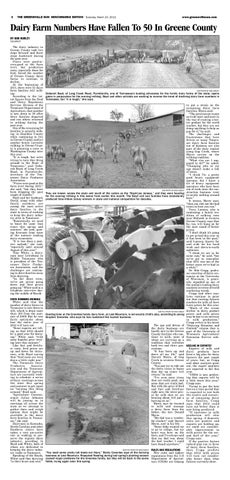
Deborah Boyd, of Long Creek Road, Parrottsville, one of Tennessee’s leading advocates for the family dairy farms of the state, opens gates in preparation for the evening milking. Boyd and other activists are working to reverse the trend of declining dairy farm numbers in Tennessee, but “it is tough,” she says.
SUN PHOTO BY BOB HURLEY
They are known across the state and much of the nation as the “Boyd-Lee Jerseys,” and they were heading for the evening milking in this scene from earlier this month. The Boyd and Lee families have consistently produced blue-ribbon Jersey winners in state and national competition for decades.
SUN FILE PHOTO BY BOB HURLEY
Feeding time at the Greenlee family dairy farm, at Lost Mountain, is not exactly child’s play, according to young Brayden Greenlee, who says he has mastered this bucket business. The ups and downs of the dairy business are hardly new to the Greene County families who continue to milk, most of whom are carrying on a tradition that stretches back two and three generations. “It has been up and down all my life,” said Darrell Myers, of Gap Creek in western Greene County. “You just try to ride out the down times in hopes that the up times will return,” he said. “I’ve seen some times that are really good, and some that are really bad. But with the price of feed and fuel and fertilizer right now, the lower prices for milk that we are hearing about will put a hurting on us.” Myers says he learned to milk and manage a dairy farm from his father, the late Donald Myers. “My dad was a wonderful teacher,” said Darrell Myers, now in his 50s. “Some folks wanted me to go to college, but my heart was here on the farm, and I’ve always said that my dad was about the best teacher I could have found anywhere.” SUN FILE PHOTO BY BOB HURLEY
RULES AND REGULATIONS
“You need some pretty tall boots out there,” Rocky Greenlee says of the dairying New rules and tighter business at Lost Mountain. Repeated flooding during last spring’s planting season regulations from the U.S caused major problems for the Greenlee family, but they will be back in the same Department of Agriculfields, trying again later this spring. ture (USDA) are helping
to put a strain on the remaining dairy farm families, Myers said. “The government wants us to do more and more in the way of creating a better product for the world market, but they are not doing anything to help us pay for it,” he said. The challenges and frustrations that have driven so many Tennessee dairy farm families out of business are also part of the daily routine along Gap Creek, where Myers carries on the milking tradition. “What else am I supposed to do?” he asked. “Changing jobs at my age doesn’t make a lick of sense. “I think I’m a pretty good heavy equipment operator, but I know a lot of heavy equipment operators who have been out of work since the construction business went to nearly nothing around here.” It means, Myers says, “that you ride out the bad times as best you can.” Terry Lawson, who is continuing a family tradition of milking cows near Mohawk in western Greene County, says that he, too, will hang on for the next round of better prices. “I don’t think it’s going to get as bad this year as it has been in the past,” said Lawson, known far and wide for his hard work and down-to-earth optimism. “I think we are in for some cuts,” he said, “but we’ve got to remember that 2011 was one of the better years we’ve had in a while.” Dr. Bob Cropp, professor emeritus of dairy economics at the University of Wisconsin, is generally regarded as one of the nation’s leading dairy analysts in terms of world marketing trends. Cropp and other analysts continue to point out that existing futures markets for milk all have lower prices for this year. “Much of the recent decline in dairy product prices and milk prices may be due to an increase in milk production,” Cropp writes in his latest “Dairying Situation and Outlook” column that is part of the University of Wisconsin Agricultural Extension Service website. DECLINE IN EXPORTS? Exports of milk and dairy products have been a big plus for dairy farmers the past couple of years, but, as Cropp and other analysts point out, the export numbers are expected to fall this year. “USDA is now predicting that exports will be a little lower this year,” Cropp says. Trying to put the best face on a time period that is expected to test both the resolve and resources of remaining dairy farm families, Cropp says that 2012 could turn out better than is now being predicted. “If increases in milk production will slow this spring, if domestic sales are positive and exports are holding up, we could see considerable improvement in milk prices for the second half of the year,” Cropp says. If the positive factors indeed play out in favor of dairy farm families, then Cropp predicts that 2012 milk prices will turn out considerably better than what futures currently show.