Scars of Prohibition
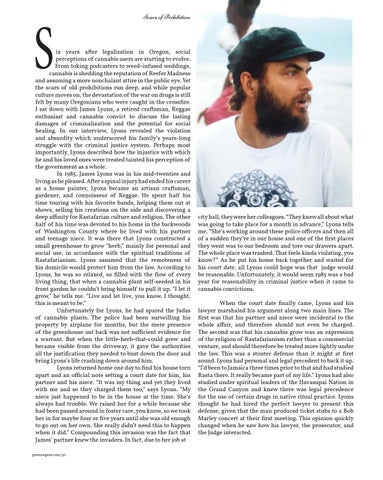
ix years after legalization in Oregon, social perceptions of cannabis users are starting to evolve. From toking podcasters to weed-infused weddings, cannabis is shedding the reputation of Reefer Madness and assuming a more nonchalant attire in the public eye. Yet the scars of old prohibitions run deep, and while popular culture moves on, the devastation of the war on drugs is still felt by many Oregonians who were caught in the crossfire. I sat down with James Lyons, a retired craftsman, Reggae enthusiast and cannabis convict to discuss the lasting damages of criminalization and the potential for social healing. In our interview, Lyons revealed the violation and absurdity which underscored his family’s years-long struggle with the criminal justice system. Perhaps most importantly, Lyons described how the injustice with which he and his loved ones were treated tainted his perception of the government as a whole. In 1985, James Lyons was in his mid-twenties and living as he pleased. After a spinal injury had ended his career as a house painter, Lyons became an artisan craftsman, gardener, and connoisseur of Reggae. He spent half his time touring with his favorite bands, helping them out at shows, selling his creations on the side and discovering a deep affinity for Rastafarian culture and religion. The other half of his time was devoted to his home in the backwoods of Washington County where he lived with his partner and teenage niece. It was there that Lyons constructed a small greenhouse to grow “herb,” mainly for personal and social use, in accordance with the spiritual traditions of Rastafarianism. Lyons assumed that the remoteness of his domicile would protect him from the law. According to Lyons, he was so relaxed, so filled with the flow of every living thing, that when a cannabis plant self-seeded in his front garden he couldn’t bring himself to pull it up. “I let it grow,” he tells me. “Live and let live, you know. I thought, this is meant to be.” Unfortunately for Lyons, he had spared the Judas of cannabis plants. The police had been surveilling his property by airplane for months, but the mere presence of the greenhouse out back was not sufficient evidence for a warrant. But when the little-herb-that-could grew and became visible from the driveway, it gave the authorities all the justification they needed to bust down the door and bring Lyons’s life crashing down around him. Lyons returned home one day to find his house torn apart and an official note setting a court date for him, his partner and his niece. “It was my thing and yet they lived with me and so they charged them too,” says Lyons. “My niece just happened to be in the house at the time. She’s always had trouble. We raised her for a while because she had been passed around in foster care, you know, so we took her in for maybe four or five years until she was old enough to go out on her own. She really didn’t need this to happen when it did.” Compounding this invasion was the fact that James’ partner knew the invaders. In fact, due to her job at greeneugene.com | 30
city hall, they were her colleagues. “They knew all about what was going to take place for a month in advance,” Lyons tells me. “She’s working around these police officers and then all of a sudden they’re in our house and one of the first places they went was to our bedroom and tore our drawers apart. The whole place was trashed. That feels kinda violating, you know?” As he put his home back together and waited for his court date, all Lyons could hope was that judge would be reasonable. Unfortunately, it would seem 1985 was a bad year for reasonability in criminal justice when it came to cannabis convictions. When the court date finally came, Lyons and his lawyer marshaled his argument along two main lines. The first was that his partner and niece were incidental to the whole affair, and therefore should not even be charged. The second was that his cannabis grow was an expression of the religion of Rastafarianism rather than a commercial venture, and should therefore be treated more lightly under the law. This was a stouter defense than it might at first sound. Lyons had personal and legal precedent to back it up. “I’d been to Jamaica three times prior to that and had studied Rasta there. It really became part of my life.” Lyons had also studied under spiritual leaders of the Havasupai Nation in the Grand Canyon and knew there was legal precedence for the use of certain drugs in native ritual practice. Lyons thought he had hired the perfect lawyer to present this defense, given that the man produced ticket stubs to a Bob Marley concert at their first meeting. This opinion quickly changed when he saw how his lawyer, the prosecutor, and the Judge interacted.