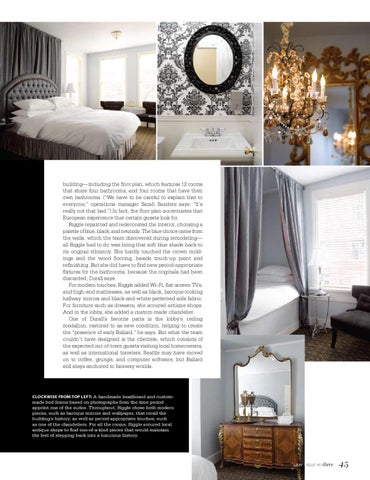
building—including the floor plan, which features 12 rooms that share four bathrooms, and four rooms that have their own bathrooms. (“We have to be careful to explain that to everyone,” operations manager Sarah Sanders says. “It’s really not that bad.”) In fact, the floor plan accentuates that European experience that certain guests look for. Riggle repainted and redecorated the interior, choosing a palette of blue, black, and neutrals. The blue choice came from the walls, which the team discovered during remodeling— all Riggle had to do was bring that soft blue shade back to its original vibrancy. She hardly touched the crown moldings and the wood flooring, beside touch-up paint and refinishing. But she did have to find new period-appropriate fixtures for the bathrooms, because the originals had been discarded, Durall says. For modern touches, Riggle added Wi-Fi, flat-screen TVs, and high-end mattresses, as well as black, baroque-looking hallway mirrors and black-and-white-patterned sofa fabric. For furniture such as dressers, she scoured antique shops. And in the lobby, she added a custom-made chandelier. One of Durall’s favorite parts is the lobby’s ceiling medallion, restored to as-new condition, helping to create the “presence of early Ballard,” he says. But what the team couldn’t have designed is the clientele, which consists of the expected out-of-town guests visiting local homeowners, as well as international travelers. Seattle may have moved on to coffee, grunge, and computer software, but Ballard still stays anchored to faraway worlds.
Clockwise from top left: A handmade headboard and custommade bed linens based on photographs from the time period appoint one of the suites. Throughout, Riggle chose both modern pieces, such as baroque mirrors and wallpaper, that recall the building’s history, as well as period-appropriate touches, such as one of the chandeliers. For all the rooms, Riggle scoured local antique shops to find one-of-a-kind pieces that would maintain the feel of stepping back into a luxurious history.
GRAY ISSUE No. three
45