ASSASSINS
LI B BY PU RV E S , PI M LI C O O PE R A & PR I S O N E R S o f C O LD I N G LE Y
The strangest part is
always the curtain call: clapping, a bit of cheering, grins of triumph from reanimated victims and stage villains who can at last cast off the character and smile. Sometimes there are relatives in the audience, emitting whistles of appreciation and the odd stamp of feet. The orchestra starts up again with a lively playout, and the conductor hands the baton to an inmate for the final flourish. And as you troop out past the wire and the walls, under the watchful but generally benign eye of the warders, an inconsequential thought comes into your head. It is always the same one. My student guests voiced it at Coldingley Jail this spring as we left Sondheim’s Assassins. “How odd.” said one “We’ve just been part of a really happy night, in prison”. I have felt that too: in the dark Victorian chapel at Wandsworth after Guys & Dolls, and again in the gym at Coldingley that night. There is something about musical theatre and opera which always lifts the heart: perhaps it is the intensity of it, that reckless effortfulness combined with tight discipline. Perhaps it is just the way the music takes the story and gives it wings. It is a magnifying-glass for emotion. And somehow, whether in the slickest professional company or the sketchiest school play, the huge emotional themes of the piece itself always transfer themselves to the players and the watchers, at that moment of the curtain call. It is not uncommon for cast and audience alike to
feel a sudden surge of something like love. Thank you for the show, thank you for all that work. Thank you for coming, and for clapping. Isn’t life great? Take musical theatre into prisons, as Pimlico Opera does, and you harness all that glee and gusto to remove for a while the sadness and boredom, the shame and depression surrounding imprisonment. You create happiness which is shared between inmates, professionals and audience (and, of course, the audience of other inmates on other nights). You demonstrate and assert, beyond all contradiction, the fact that whatever has happened in the past prisoners are human beings, capable of changing for the better. The high standard of the work proves to outsiders that talent can flower in the strangest places; to inmates it reinforces the understanding that patient effort pays, and will be applauded. It affirms that there are people out there who do not want prisoners’ gifts to go to waste. When somebody has sung to you and moved you to a tear or a laugh, you are no longer strangers. When a prison has opened its doors to a slightly nervous, uncertain audience which has never seen inside one before, a social barrier is torn down. There are other theatrical enterprises inside prisons; excellent ones, across a wide field. Increasingly the arts are accepted as useful in the penal system, on both a personal and a social level. But Pimlico Opera does what it does with particular pizazz, and mischief, and glitter, and patience, and faith.
It deserves to take a bow
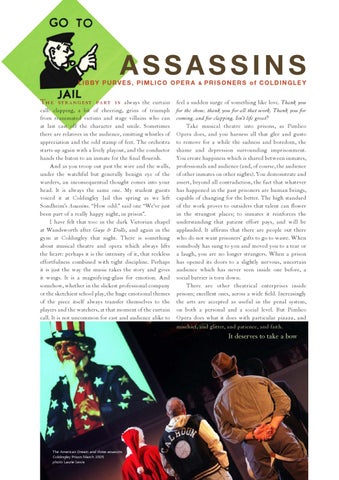
The American Dream and three assassins Coldingley Prison March 2005 photo Laurie Lewis