nurse’s corner
“Compared to the previous generations of CT scanners, 64-slice machines provide much more information, noted Dr. Allan Skrenta, Chief of Imaging at Maryland General. “Thinner slices are recorded more quickly, leading to images with even more detail.” These machines are so fast they can record motionfree images of a beating heart and the blood vessels that feed it. Among other things, images from these advanced CT scanners allow cardiologists to gauge the buildup of dangerous plaque in the arteries without the need for an invasive coronary angiogram.
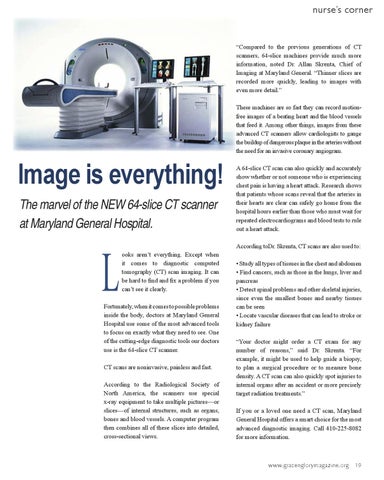
Image is everything! The marvel of the NEW 64-slice CT scanner at Maryland General Hospital.
L
ooks aren’t everything. Except when it comes to diagnostic computed tomography (CT) scan imaging. It can be hard to find and fix a problem if you can’t see it clearly.
Fortunately, when it comes to possible problems inside the body, doctors at Maryland General Hospital use some of the most advanced tools to focus on exactly what they need to see. One of the cutting-edge diagnostic tools our doctors use is the 64-slice CT scanner. CT scans are noninvasive, painless and fast. According to the Radiological Society of North America, the scanners use special x-ray equipment to take multiple pictures—or slices—of internal structures, such as organs, bones and blood vessels. A computer program then combines all of these slices into detailed, cross-sectional views.
A 64-slice CT scan can also quickly and accurately show whether or not someone who is experiencing chest pain is having a heart attack. Research shows that patients whose scans reveal that the arteries in their hearts are clear can safely go home from the hospital hours earlier than those who must wait for repeated electrocardiograms and blood tests to rule out a heart attack. According toDr. Skrenta, CT scans are also used to: • Study all types of tissues in the chest and abdomen • Find cancers, such as those in the lungs, liver and pancreas • Detect spinal problems and other skeletal injuries, since even the smallest bones and nearby tissues can be seen • Locate vascular diseases that can lead to stroke or kidney failure “Your doctor might order a CT exam for any number of reasons,” said Dr. Skrenta. “For example, it might be used to help guide a biopsy, to plan a surgical procedure or to measure bone density. A CT scan can also quickly spot injuries to internal organs after an accident or more precisely target radiation treatments.” If you or a loved one need a CT scan, Maryland General Hospital offers a smart choice for the most advanced diagnostic imaging. Call 410-225-8082 for more information.
www.gracenglorymagazine.org 19