From an unknown disorder to fundamental advances in science Mitochondria are the tiny compartments present in most cells that generate the energy needed to sustain life. Mitochondrial diseases at their severest can be both untreatable and fatal. Following 20 years of determined work, Dr Shamima Rahman has led a sequence of discoveries, giving families hope and advancing our understanding of fundamental questions in human biology. Dr Shamima Rahman “My interest in mitochondrial disorders was kindled just over 20 years ago when I first joined the metabolic team at Great Ormond Street Hospital. The first genetic causes of mitochondrial disease had been discovered at the UCL Institute of Neurology just a couple of years before. It was immediately obvious to me that this was an extremely important subgroup of inborn errors of metabolism. The challenges, both then and now, are to provide accurate and prompt diagnoses, and to develop effective treatments. “The last few years have witnessed great advances in genetic diagnosis for mitochondrial diseases, with the discovery of more than 100 disease genes, but it is likely that several hundred more genes will be linked to mitochondrial disease in the future. The funding we have received for exome sequence analysis will hopefully help to identify these genes, leading to improved genetic diagnosis for affected families. “Our long-term goal is to translate this genetic knowledge into curative treatments for mitochondrial disease, something that several members of my team are currently working on.”
When Dr Shamima Rahman first began researching mitochondrial diseases in 1991, little was known about their causes. She began by looking into one of the rarest and most severe types, Leigh syndrome. Usually affecting infants, it causes progressive and rapid brain and nerve damage. “I started by devising a classification system for a complete set of 100 or more cases of Leigh syndrome recorded at the time,” says Dr Rahman, Great Ormond Street Hospital Children’s Charity Reader in Paediatric Metabolic Medicine at the UCL Institute of Child Health (ICH). “But the more I investigated, the more confused I became. The problem was the variety of different forms of the disease, even within this small number of patients. “The situation families faced was pretty bleak,” she says. “When I started working on these diseases, we could only make a genetic diagnosis in perhaps five per cent of cases. I could tell parents their child had a mitochondrial disease, but had no idea of whether their future siblings would inherit it, or what the root cause of the disease was. Finding the genetic origin of the condition could be a year away, 10 years away – or never. The families’ willingness to help us progress with the research has been crucial.” This support, along with the increasing availability of gene-screening platform technologies, has allowed Dr Rahman to take huge strides in the intervening years. Her team has identified several disease genes, now known to be responsible for building some of the largest and most complex proteins in the human body, located within the mitochondrion’s inner structure. Principally, they relate to a family of five enzymes, complexes I–V, which form a vital part of the mitochondrion’s energy production cycle.
20 Research Review 2011/12 From an unknown disorder to fundamental advances in science
“I have a unique role in which I’m a paediatrician seeing patients, while leading a research group with access to specialists in exome sequencing, bioinformatics, and biochemistry. This could only be possible at the ICH and Great Ormond Street Hospital,” she says. “Taking complex I mitochondrial diseases as an example, we’ve been able to identify the genetic basis of half of all the cases we see.” The impact of this work is profound. Parents can now receive counselling to inform them of the exact likelihood of passing any disease-causing gene to subsequent children. They can opt to have pre-implantation genetic diagnosis, should they wish to mitigate this risk. Furthermore, genetic information is revealing the precise workings of the mitochondrial complex enzymes: the key to addressing their failure in the disease process. In one case, patients can now be treated with vitamin B2 to reduce progression of their symptoms – something unthinkable 20 years earlier. With support from Great Ormond Street Hospital Children’s Charity, Dr Rahman is now embarking on further research to close the knowledge gap for the remaining forms of complex I mitochondrial diseases. “Success in this research can be bittersweet,” reflects Dr Rahman, “as the nature of these conditions often means there’s still little we can do by way of treatment. But our work has begun to reveal how one of the most ubiquitous, yet remarkably poorly understood structures within our bodies, functions. The patients I see are helping us to fill in the bigger picture – I’ve every intention of finding new and better ways to treat their disease.”
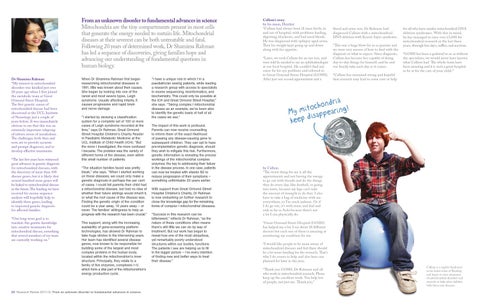
Callum’s story by his mum, Heather “Callum had always been ill since birth; in and out of hospital, with problems feeding, digesting, blackouts, and bad nasal bleeds. He was diagnosed with epilepsy aged seven. Then his weight kept going up and down along with his appetite. “Later, we took Callum for an eye test, and were told he needed to see an ophthalmologist at our local hospital. He couldn’t find any cause for his eye problems and referred us to Great Ormond Street Hospital (GOSH). After just our second appointment and a
blood and urine test, Dr Rahman had diagnosed Callum with a mitochondrial DNA deletion with Kearns Sayre syndrome. “This was a huge blow for us as parents and we were very unsure of how to deal with the diagnosis or what to expect. Since diagnosis, Callum has become less capable of doing day-to-day things for himself, and he and our family take each day as it comes. “Callum has remained strong and hopeful that research may lead to some cure or help
for all who have similar mitochondrial DNA deletion syndromes. With this in mind, he has managed to raise over £3,000 for mitochondrial research in the last three years, through fun days, raffles, and auctions. “GOSH has been a godsend to us as without the specialists, we would never have known what Callum had. The whole team have been amazing and it is such a great hospital to be at for the care of your child.”
dria n o h c o My mit isappearing! keep d
by Callum “The worst thing for me is all the appointments and not having the energy to go out with friends and do the things they do every day, like football, or going into town, because my legs can’t take the amount of strength to do that. I also have to take a bag of medicine with me everywhere, so I’m stuck indoors. Or if I do go out, it’s with mum and dad and only as far as Asda because there’s not a lot I can physically do. “Great Ormond Street Hospital (GOSH) has helped me a lot. I see about 18 different doctors but each one of them is amazing at monitoring my condition for me. “I would like people to be more aware of mitochondrial diseases and feel there should be a lot more funding for the research. That’s why I do events to help and also have one planned for later in the year. “Thank you GOSH, Dr Rahman and all who work in mitochondrial research. Please keep up the excellent work. You help lots of people, not just me. Thank you.”
Callum is a regular fundraiser in his home town of Reading and hopes to raise awareness of mitochondrial disorders and research to help other children with these rare diseases.