DR PETER KUNKEL WHO MADE ALL THIS POSSIBLE In October 1971, at the invitation of Peter, I visited IRSAC - on my way back to continue my research on the rare Mountain Gorillas at Dian Fossey’s camp in the Virunga Volcanoes in Rwanda. I spent an exciting week of discussions with Peter and his wife Irene, and their newly arrived team who had come to study Tropical Forest Ecology. It was all so very different from my previous isolation in the Virunga Volcanoes. I was also able to see (briefly) the gorillas of the Kahuzi-Biega National Park with the Park Conservator Adrien Deschryver. In contrast, a week later, any possibility of completing my research in Rwanda was made impossible by Dian Fossey shortly after my return. And so, I thought all my dreams of research were over - and I packed my bags to return home to UK. However, fortunately for me my good friends in Gisenyi - Dr Francis Dondeyne and his wife Else - told me that I should return to see Dr Peter Kunkel at IRSAC, and explain my situation. I was reluctant to do so as Michael Casimir was already there to start a study on the Kahizi gorillas. Nevertheless, after much deliberation I decided to try. It was one of the best decisions of my life - and I have always been grateful to Francis and Else for persuading me ‘not to give up’ Within moments of my surprised return to IRSAC Peter had put me to ease and assured me that I would be welcome to join his team and base my research with them. As later learned, this was typical of his empathy and enthusiasm. Within days he and Irene made sure I had excellent accommodation, so that I could send for my wife Margaret and our baby daughter Fiona. Searching for a suitable study area with gorillas was finally solved with the help of Adrien Deschryver. And so I spent an exciting year from December 1971 to December 1972 conducting the first comparative research on two sub species of eastern gorillas - for my doctoral thesis at Liverpool University - and gained my Ph.D in July 1974. Everything that followed in my life, much of which is recorder here, would not have been possible without the initial support and encouragement of Drs Peter and Irene Kunkel. I still recall Peter’s response to my early doubts “We shall see, we shall see…” Even obtaining my Visa ‘D’Etablissment’ for Zaire took him almost a year! I hope he now feels it was all worth it, and that his children and grand children understand and appreciate the remarkable work he and Irene accomplished, against huge odds and with great personal sacrifices, at IRSAC. “Asanti mingi, Bwana Mkubwa!”
IRSAC, LWIRO
A few photos of the Kunkel family relaxing at Tshibati, their home at IRSAC, Irene and Peter, their sons Stephan, Andreas and Georg
Picnic time at Tshibati may also include a beautiful, rare Serval Cat
Memories - happy and sad.
In early 1960’s Dr Peter Kunkel talks to a group of local Bambuti pygmies on the road through Kahuzi-Biega forest. They were on a hunting party - with nets, ropes and spears in their traditional hunting area. A few years later they would all be expelled when this was declared a National Park
I travelled many kilometres with Peter in his Kombie, especially though the forest to their field station at Irangi. Sadly much of upkeep on the road network after Independence was neglected - with results like this! However, within minutes there was always a happy crowd of locals willing to push you free. Sadly, today most of this region is too dangerous to travel in - even for the UN troops!
THE GOODALL FAMILY AT IRSAC
Not only did I have gorillas to study, a well stocked and beautiful library, access to lab facilities and countless daily discussions with scientists of some eleven nationalities - we had a superb social life - with a swimming pool! Margaret and Fiona enjoyed their time here very much, and made many friends. What a contrast to my previous life at Dian Fossey’s camp in Rwanda.
LOCATION OF MY STUDY AREAS
Vegetation Map of Kivu region showing large areas of deforestation west of Kahuzi-Biega National Park The two large Marais in my study area are clearly shown in brown colour, surrounded by forest in dark green, along the western ridges above Lake Kivu.
LAKE KIVU NEAR LWIRO & BUKAVU
MY MOUNTAIN HOMES
The Virunga volcanoes from Rwindi In Zaire, November 1972
Mount Kahuzi from the road up to Park Entrance
Primary montane rain Forest types
Cyperus reed swamp ‘Tingi tingi’
Forest at swamp edge and the multi layers of a complex forest canopy
Mount Biega - of the Kahuzi-Biega National Park
Aerial views of Meteo station on Mount Bukulamisa, and surrounding Primary, montane rain forest in my study area.
Primary montane rain forest cleared to make shambas, on western side of Lake Kivu, north of Lwiro.
ORIGINAL ENTRANCE TO PARK
This was the main road through the forest - all the way to Kisangani - so it became a transport hub through the forest, and through the range areas of gorillas and other animals. Problems arose with the repairs to this section of the tarmac road from Bukavu - and it ended abruptly in the middle of the forest and gave way to a mud track!
Typical secondary forest growth at the sides of the road near kilometre 34 from Bukavu.
SUB TYPES OF TROPICAL MONTANE RAIN FOREST IN KAHUZI-BIEGA PARK
Upper right - secondary forest at edge
of road Km 34 from Bukavu
Upper left, slightly higher altitude at Km 36 - start of bamboo forest with large Polycia fulva (umbrella trees)
Lower right - aerial view of overlapping canopy in Primary Montane Rain Forest. Looks like a close up of cauliflower!
Lower left - a marais (Cyperus latifolius) swamp. Small river meandering through and typical swamp edge
ADRIEN DESCHRYVER - CREATOR AND CONSERVATOR OF KAHUZIBIEGA NATIONAL PARK As an experienced former hunter in this region - Adrien would never go into these forest without his rifle. He told me “I am more afraid of these gorillas than you are! This is a special automatic rifle from Belgium. If I am charged by a gorilla, I can fire the first round into he ground in front of him - then, instantly I will have another round automatically in the chamber if I need to fire again!” Fortunately , I convinced him that he would never need to use this and we obtained some unique photos of him close to the gorillas he had started to habituate for tourism in the late 1960’s, when he was applying to then Congolese authorities to create the National Park. These behaviour of these semihabituated gorillas became the topic of my research project. my research questions focussed on how they utilised their forest home for their food plants, during the different seasons and among the different forest types at this altitude. This was much lower than the Virunga Volcanoes - and, whilst it had some similar plant species - the main forest trees were quite different.
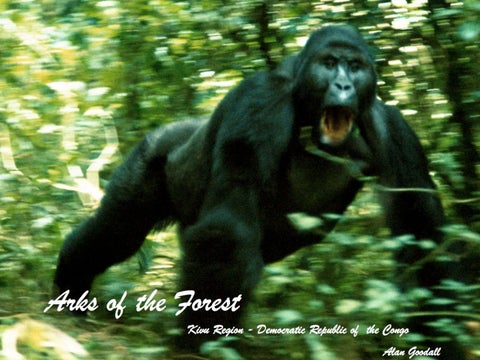
I had been charged on a daily basis by the Silverback of my main study group - who I called ‘Kalele’ from his loud vocalisations. Adrien called him ‘Casimir’ from the red tinge on his forehead Adrien agreed to try and get a photo of this impressive charge. We recorded this - and later laughed at Adrien saying ‘My heart has stopped, my heart has stopped.’ He was far less confident without his rifle! Kalele, having demonstrated his dominance with this 'bluff charge,’ went back to his feeding. You can see a piece of bamboo shoot in his
As news of my research group and Adrien’s work spread globally, tourism started to flourish in 1971. Also, several film crews came to visit us. Among them was a team from ‘American Sportsman’ who shot a program with wildlife artist Rob Glenn of Nairobi - famous for his animal bronzes. Here in the forest, within minutes Rob created a superb likeness of Kalele in a clay model. As a joke he made him a ‘guerrilla’ - with suitable weapons. Sadly Rob never made gorilla bronzes. When the program was first planned in USA - Gloria Stewart (wife of Hollywood actor Jimmy Stewart) was meant to join Rob in the forest. However, she found it too strenuous and was replaced by her daughter Kelly seen here negotiating a steep slope with pygmy tracker Patrice Lushebere, Adrien, and Rob Glenn. Kelly was so captivated by the gorillas that went on to study the gorillas in Virunga Volcanoes with Dian Fossey . Although Kelly completed get Doctoral research - she too fell out with Dian Fossey!
Bambuti pygmies on a hunting trip - as photographed by Peter in 1960’ When Kahuzi-Biega park was created they were all displaced from their forest home.
My head tracker Patrice Lushebere (he added ‘Wazi- wazi, kukata poli) to his name! Meaning he wandered around cutting the forest - while tracking for me! In the lower photo he is proceeded in through a marais by ‘Pili Pili’ Adrien’s head tracker. I was able to get some better clothes for Patricebut one day he bought some ladies suede boots at the market in Kavumu. He insisted on wearing them whilst we tracked the gorillas - even though they were too big and his feet slipped sideways as you can see! He was the chief of his local group of Bambuti pygmies, and a superb tracker - especially when I moved my study area into his old hunting ground! He knew every path and every tree. I could never have done my research without his skills. I learned a lot from Patrice and came to view the ‘jungle’ far differently through his expert eyes and tuition.
NEW CLOTHING
I was able to buy them some fleecy gilets, waterproof capes and sou’ wester hats. They were so proud of the capes and hats that they even wore them in hot sunny weather - as they waited for me to collect them, at the side of the road through the park at the start of our days work in the forest. I think they saw these as ‘status symbol’ to show their fellow Bambuti - that they had ‘Kazi’
TRACKING THE GORILLAS Much of the forest was densely overgrown - especially in areas of tangled secondary growth. Whilst this was ideal habitat for the gorillas - and had lots of their herbaceous food plants it was not easy to navigate and Patrice often had to cut our way through with his machete. However, all tracking had to stop if they spotted a bee! Their sharp eyes would follow it back to the nest - in this species it was underground with only a tiny, circular 2cms entrance. The pygmies would use their machetes to dig the bee combs out - and then relish their favourite food - honey! They always took some families, wrapped in leaves as traditionally they would have done for centuries. I had the bees identified by an expert at the Natural History Museum in London - and was surprised to discover they were a stingless species - ‘Trigona’ I discovered that the chimps in KahuziBiega forest also liked this honey. Just as Jane Goodall had seen in Gombe, the chimps here made and used tools - to break open the nests and get at the honey. In Kahuzi they bit off strong stems and used them as digging sticks. Like the pygmies, they must have followed the bees to the well hidden, tiny entrance of their underground nest. Professor Robert Hinde - my mentor at Cambridge University, told me to publish this immediately, as a short note to Nature. Foolishly I never got round to it. My findings were later confirmed by Japanese scientists from Kyoto University.
IDEAL GORILLA HABITAT In this area of Kahuzi-Biega Park much of the original Primary forest had been cut down when the Bukavu - Kisangani road was carved through here by the Belgians during their colonial rule of the Congo. In the following decades lush secondary growth quickly colonised the areas now open to light. Along the ground and climbing up the small trees were lots of luscious herbs and vines - which were the favoured food plants of the gorillas. With the help of Patrice I found they ate parts of over one hundred different species. Here Patrice is helping IRSAC botanist Jean Natikiyamana. Jean said that he was amazed at Patrice’s knowledge of the flora in the park and knew the local names of many. He could tell which were good to eat and which were good for various illnesses. Jean even tried to ‘trick’ him with some similar looking plants - but could not! I later suggested that an International drug company should employ Patrice - to search for medicines from the plants. This later opened a new discipline ‘Bioethno technology’ but unfortunately based only in the Amazon forest. Maybe a forward looking museum in Germany could fund a new research project?
Peter can name these ‌.. at Tshibati.
THE GORILLAS WERE CURIOUS TO OBSERVE THIS WHITE APE
Top left an adult black backed male
Upper right and below ‘Kalele’ the dominant Silverback of my study group in Tshibinda area of KahuziBiega National Park. In the early days of my research he would charge at me as soon as he saw me. I always managed to believe it was all ‘bluff’ and so stood my ground - and took photos!
A most impressive ‘Bluff charge’ from the number two male in my study group. He was just two metres away as I ‘panned’ my camera to take this photo.
Gorillas in KahuziBiega were all excellent climbers even the large Silverback males. They would climb especially high to reach a rare parasitic plant (Lorantheceae)Someti mes four or five were in the same tree.
They would then slide down the main trunk like a fireman going down a pole
FEEDING IN THE MARAIS
TINGI, TINGI’
Here Kalele is standing up in the marais - to watch where I am in relation to his family group.
They pulled up the Cyperus latifolius reeds, then bit off and ate the tender basal parts and roots.
THEY RANGED WIDELY FROM
MARAIS TO SECONDARY FOREST
PRIMARY FOREST
AND
BAMBOO FOREST IN
DIFFERENT SEASONS.
Two of their favourite foods, on the right the vine Urera hypselodendron - from which they expertly stripped the outer cortex layer by pulling it through their teeth.(it added a lot of fibre to their food. Since he relied on trail signs rather than direct observations - Michael Casimir published that they did NOT eat the leaves! I watched them choose and eat the tender upper leaves - and reject the older ones. which were left on their trail. I never told him this! The huge leaves of wild banana plants (Musa sp) were stripped and eaten. So too was the tender and juicy pith of the leaves and trunk. After an hour or two only parts of the main trunk remained!
Gorillas build fresh nests every night.
Here is a sub adult asleep in her nest just as the sun rises. And an adult female shares her nest tree with maybe two of her young of dierent ages.
A huge Silverback male settles down on a strong tree nest just above the ground as night falls.
A sub adult male gives a chest and hoot series vocalisation. He appears to have an old wound healing on his right shoulder probably from a fight with Kalele.
IN SEARCH OF GORILLAS After my book “the Wandering Gorillas’ was first published in hardback form by Wm. Collins in 1979, WWF asked me to carry out a survey of all Eastern Gorilla populations throughout Kivu province. This was to be an update of the first (and only) survey by George Schaller and John Emlen twenty years earlier in 1959. They found gorillas scattered in many isolated pockets in various ‘islands’ of rain forest surrounded by human populations. From September 1979 through to March 1980 I travelled extensively throughout Kivu. Sometimes Adrien Deschryver flew me, and Patrice, in his new, Italian Partenavia aircraft - especially to the mining areas in Utu region. The air strips were tiny, difficult to find scattered in the vast regions of forest and not easy to land on as they were roughly hewn from the soil. He would then leave me to find my own way around - and my own way back to Bukavu! I had many interesting journeys and adventures throughout Kivu. Sadly impossible to do today due to the turmoils in this entire region.
LUXURY AIR TRAVEL
Flying with Adrien over the rain forest from Bukavu to Kalima
NOT SO LUXURY TRAVEL BY ROAD
After independence much of the road repair equipment was left to rot, upkeep on the roads through the forest was neglected - yet they were still vital for the transport of food and goods throughout the region
Running repairs, especially of old wooden bridges was a daily task!
CROSSING THE LOWA RIVER
This old makeshift ferry took Patrice and I over in a Land rover of a Belgian mining company who helped me a lot in getting to remote places. I often stayed with them or at various missions. Many times in these travels I did not know where I would sleep that night. So, one day I would be a Baptist, another day a Catholic and another a Seventh Day Adventist. Each religious group had their own ‘defined territories’ - to save souls.
A traditional canoe, carved from an entire tree, being paddled across the Lowa river. This is a tributary of the Lualaba river which eventually flows north and west into the mighty Congo river.
IDEAL GORILLA HABITAT
When the many mining areas were created during Belgian colonial rule in the Congo, much of the original Primary Tropical Rain forest was cleared. New villages were created along the many new roads to house the local miners and their families. The secondary forest that quickly grew around the edges of these areas created ideal habitats for gorillas - with many of their main food plants in abundance. This then created an ongoing battle between the people and the gorillas - who sometimes did eat some of their crops such as banana trees.
A typical village on either side of a main road in Utu region. Belgian authorities insisted on this - as it made it easier for their military to travel quickly to any area where trouble may erupt.
SLASH & BURN
Typically the local farmers would cut down the forest, burn some large trees, and grow their crops in between the huge roots. Sometimes large areas would be clear felled.Buy often the soils in the rain forest, which had supported huge trees, quickly became leached of nutrients by heavy rain. So, the people would abandon these areas and move one to another. This ancient cycle of ‘slash and burn’ created a ‘mosaic’ of differs forest sub types which which were ideal habitat for herbivore gorillas. Thus their population was always greater in such regions than in untouched Primary Rain forest which was the ideal habitat for Chimpanzees, since it had more fruit trees.
Walikali - safe in 1979. A violent and dangerous centre of lawlessness today.
Gorillas had ripped apart this banana tree - to get at the leaves and juicy pith.
LUBERO - NORTH KIVU
This was a huge market centre. I marvelled at how the women especially would sit and wait all day, often in burning sun, to try and sell their ‘scatterings’ of maize flour or various crops.
Other women went on long and hard journeys up and down steep slopes to collect firewood for cooking. Many carried a youngster on their shoulders, often whilst pregnant with another. Sex education and family planning were either unknown - or forbidden by the Catholic church.
MOUNT TSHIABERIMU This was a beautiful and remote area of pristine montane rain forest in the northern part of Virunga National Park (ex Albert Park) I trekked and camped there over several days. I only found trail signs of gorillas but did not see any. My biggest disappointment was finding rusty old tin cans left by ‘Wazungus’ on the summit at 3094 m. They could not even be bothered to dig a hole and bury them!
Although still within the National Park Tshiaberimu is now surrounded by shambas and new villages. I saw many incursions into the forest by locals, even the families of park guards, to collect fuel wood for cooking - as they had done for centuries. What else could they
The problems created in some areas of poor soils by forest clearance can be seen here in the foreground. This is a ‘deflected succession’ of ferns - rather than a secondary forest. It then becomes useless for any farming. The original forest can still be seen up to the summit of Mount Tshiaberimu. But more was being cleared , at the age of the park boundary.
WHEAT PROJECTS OF INERA
Large areas were being clear felled and new farms for growing wheat were being created in this whole region.
WHERE ARE THE GORILLAS?
In 1959 - just twenty years before this survey of mine - George Schaller and John Emlen had found pockets of gorillas throughout this region. I found it hard to locate even a remaining forest tree! When I asked the locals about the gorillas the reply was “Niliisha kula yote ya zamani!�
I later suggested to WWF that it would be far preferable to pay the locals to catch the remaining gorillas from such tiny pockets of forest that still survived. They could then be translocated to other areas of forest - the Ruwenzori being an ideal place. My suggestion was never taken up by WWF. So the rest of the eastern gorillas ended up in cooking pots.
In contrast - this was an area of still pristine rain forest north of Lubero. The umbrella shaped trees are Musanga sp.
SLASH & BURN IN ACTION
New wheat farms were being created throughout the regions as I travelled in late 1979. Some followed the traditional Belgian practice of being along the main road north to Butembo and Beni. However, some were widespread over the newly cleared mountain slopes.
FOREST CLEARING
MOUNTAINS WEST
OF LAKE KIVU
A tea plantation viewed from the air
and areas of recently cleared forest near Lwiro
and total deforestation on very steep slopes north on the road to Goma.
REGIONS OF C OMPLETE DEFORESTATION - NOW OF LITTLE USE
Near Kalima, south Kivu province
Areas still being burnt out and cleared for mining - even of ‘remnant forest’ surviving in some valleys.
A PRISTINE REGION OF VIRUNGA PARK
In January 1980, travelling north from Beni, (where I had been a guest of Victor Ngezeyo) I visited the region of the Ruwenzori mountains, Ptolomys fabled ‘Mountains of the Moon� - what he believed (incorrectly) to be the source of the Nile. I spent a week here surveying the area for gorillas (non found as expected) but chimps had somehow crossed the wide Semliki river and were in the forested slopes.
THE RUWENZORI LOOM LARGE OVER THE VILLAGE OF MUTSORA
Victor Ngezayo kindly gave us the use of one of his chaueur driven landrovers to travel north from his compound and home in Beni.
Some of the many peaks can be glimpsed through the mists. We hired our porters and but our food and supplies here - before setting out on the three day climb.
Type to enter text
Typical dense, rain forest on the lower slopes - large straight trees, many with buttress roots. Among the lush growth of herbs and vines I found many of the gorilla food plants. So, they could easily have lived there, symmetrically with chimps - as they did in Kahuzi-Biega.
THERE WAS A MARKED ALTITUDINAL ZONATION IN THE VEGETATION AS WE
The lush herbs and vines were replaced with dense growths of impressive, giant ferns
A COLOURFUL ZONE - AMONG THE MOSSES
This was one of the most beautiful areas in the climb. We were completely surrounded by various species of sphagnum mosses growing abundantly in this very wet section of the forest. The ‘path’ was over exposed roots, which when wet were very slippery and dangerous!. Usnea moss (old mans beard) hung from the trees and occasional Senecios grew in the moss along with some pink orchids.
THE CLIMB WAS BEAUTIFUL - BUT EXHAUSTING!
As we climbed higher it grew harder and harder. Fortunately our porters carried all our heavy rucksacks. A ‘white man’s burden!’
Kiondo hut at 4,200 m. Some of the glaciers on the peaks of Mount Stanley can be seen higher up. Much has disappeared since 1980.
ONWARD AND UPWARD
Leaving the Kind hut we climbed to the top of a nearby peak Wasuwameso (4,500 m) to get a better view of the glaciers.
GIANT SENECIOS & GLACIERS.
I had already found other species of Senecios in both the Virunga volcanoes and Kahuzi mountains - where they were eaten by gorillas. But here the species were much larger and grew in dense clumps on top of tall stems. Other species of Senecios can be found in Europe - but are often tiny white flowered garden weeds!
After a cold night spent in the highest hut on the Congo side the Moraine hut - we surveyed the route up over the glacier to the summit of Mt Margherita at 5109 m.
Sadly, after struggling up the very hard ice the glacier - difficult even with crampons - we were unable to find the socalled ‘fixed rope’ which was supposed to enable an easy climb up the final 100 metres to the summit of Mt Margherita, that you can see behind me in the right hand photo.
So, I had to forgo ‘summiting’ in view of safety. I was actually more concerned of falling through the lip of the glacier - where it melted back from the rocky slopes, as you can see as my companion treads warily along! If we had fallen through we could have been ‘wedged’ in under the ice 0- and not freed until after years of global warming!
SECTIONS OF THE MOUNT STANLEY GLACIERS
Here at the lowest edge of the glaciers you can see where it has melted away from the rock below. It was incredibly hard - and full of tiny rock fragments eroded by the moving ice sheet.
REWARDS FOR HARD WORK
At Karisoke during my first research period in 1970 I often came back to my cabin in the forest wet and exhausted. Years later in 1988 it was much easier studying well habituated gorillas - as on the right
In July 1994 I was awarded my Ph.D (Doctor of Philosophy) by the University of Liverpool. Here with Margaret and some of my family especially my older brother Angus who had been my source of encouragement since I was a child.
FRIENDS RE-UNITED IN BRUSSELS
ALAN RETURNS TO KARISOKE AS DIRECTOR 1987 - 1989
I re-organised the whole management structure of the staff - who were happy to see me return to work with them. This was their favourite day - ‘pay day’ This team would then go down to their homes for two weeks - and be replaced by the other team.
Sometimes we had a sing along in Dian Fossey’s huge cabin. Here from left to right Andrew Plumtre (studied buffaloes) Stefaan Dondeyne (studied soils) Barclay Hastings (Vet) Alton Byers on guitar (Ruhengeri project) Marisa Goodall & Margaret Goodall. Fiona was with me on this side of the lounge area.
SPONSORSHIP
In 1988 I wrote a letter to Prime minister Margaret Thatcher explaining our transport problems. I never expected a reply, until shortly afterwards she gave what became known as her ‘Green speech’ about the need to protect ‘the Environment’ Fortunately, I had stressed this in my letter. Within record time - a story which went into the annals of the British Foreign office - I was presented in London, with the keys of a top of the range Land Rover by Chris Patten, Minister for Overseas Development ]. It was widely covered by BBC and other TV broadcasters in UK! The Landrover was delivered to Dar es Salaam. Jon Martino, my friend from the American Embassy in Kigali joined me to drive it to Kigali - through all sorts of weather, several National Parks such as Serengeti, Ngorongoro Crater and incredible scenery. throughout nearly 3,000 kms Here Jon drives it along a road which had just disappeared under a flash flood!
In 1988 the German Ambassador in Kigali was so pleased after I took him and his wife out to see our research gorillas that he answered my request for clothes for the men. Two huge boxes were sent to their embassy. The men were delighted with jackets and trousers and also with socks and shoes! We had several parties to celebrate. Note the porters bringing up my luggage and gear on my first arrival even two filing cabinets. But, the beer carton got first place with the men.
MUCH SADDER TIMES IN JULY 1994 A week after the war and genocide ended in Rwanda in late July 1994, I was back - via a British aid flight. In Kigali the UNAMIR Force Commander, Canadian Major General Romeo Dallaire, gave me the assistance of Major Charlie Braun (Austria) to return to Karisoke to check on the gorillas. He had received dozens of appeals for news ‘about the gorillas.’ I knew they would be fine, and was more concerned for the fate of the Karisoke staff and their families. As I suspected they had fled to safety through the forest and over the volcanoes into Congo. After trekking from Visoke for many hours I found them all safe at Bukima high above Goma and safe from the Cholera epidemic. A Zaïroise, who knew me from IRSAC, was giving them all water from a large concrete tank built to supply the gite. However, they were all in a desperate condition. I had been asked by the new Rwandan Government to tell them it was safe to return home - which Charlie and I did over beer with Nemeye and Fidele (served by our Zairoise friend who ran the gite) What I did not realise at that time was that there were some genocidaires hiding among the refugees. They tried to get everyone to stay! Some weeks later most did return - again through the forest - but sadly many of my men were later killed in socalled ‘revenge killings’ by RPA and others. A few who stayed at Bulima were later driven, like catlle, deeper into the Congo forests were many died. One of them was Sebazungu Leonard (white hat, second from right) he was the most gentle man of all the Karisoke staff. On their visit in 1988, Fiona and Marisa thought he was wonderful.
In 1999 I was asked by the new Rwandan Government (ex RPF) to be their Honorary Consul in the then ‘new’ Scottish Parliament (Our first since 300 years !) I was of course delighted and honoured to do so. My remit was to help with the rebuilding and reconstruction especially in Education. We had some great successes - also in legal matters (Gacaca) and woman’s jobs and rights. They elected 50% of women into their new parliament. Our projects in Education were lauded to the British Government by Dr David King - then Chief Scientific Officer to Tony Blair’s government. Of course, my Diplomatic dress had to be the kilt - to compete with the impressive ones from Nigeria especially! The new Minister for Education told me he had worn the kilt at school in Uganda -as his teachers were Scottish!
This was very emotional and fulfilling period for me. I worked with most of the Ministers - above Patrick Mazimpaka (Minister for Congo) He told me I had visited many more replaces in Congo than he had!. President Paul Kagame knew me well and was very supportive. Lower right Aloysie Nyumba (Head of Reconciliation) and her team in Kigali.
YET ANOTHER CAREER AND LIFE In the early 1980’s I thought my time in Africa was over. There were too many problems politically - and especially fights among the ‘Wazungu organisations’ as to who was ‘saving the gorillas’ As usual it was all about money from donors! So I returned to teaching and studied for a Diploma in Educational Technology. This led to a major new post at Strathclyde University in Glasgow - and I travelled the globe to showcase our work in using the emerging multi - media technologies in education. I was the first and only westerner to be invited to China’s National Conference on Multimedia Technology, from 1997 - 2006. Present each year were China’s top IT Scientists and I was invited each time to give a Keynote address about our work. Above in 1997 at the University of Xi’an, the city which was the ancient capital of China - and home to the Terra Cotta warriors
Below in 2003 at the University of Guizhou. I was also invited to Changsha (China’s Military University) and finally in 2006 to Kunming
THROUGHOUT CHINA I was always made welcome - and we shared many aspects of our work in the newly emerging digital technologies. The expertise of my own team was in design, production and delivery of high quality material in education. I worked closely with Michael Chen of Apple China (above left) and Professor Xu Guangyou and Li (Tshinghua University) They had created a ‘Smart Classroom to deliver courses throughout universities in China (in 1997) Professor Xu was one of China;s top IT experts - and my initial sponsor to attend each years NCMT. Above right with the organising team at Guizhou
I was also invited to travel widely throughout China - here at the beautiful city of Guilin by Professor Lianfang Liu and her husband - who was head of a new IT Development zone in Guilin.
After each conference there was always a tour to see some of the most amazing scenery in remote parts of China
A cruise on the Lijiang river from Guilin
and an incredible visit to Zhangjiajie in Hunan with thousands of jagged quartzite sandstone columns, many of which rise over 200m, and caves filled with stalactites and stalagmites, forests, rivers, waterfalls and 2 large natural land bridges, as well as endangered plant and animal species.
Type to enter text Honorary Doctor of University UWS - 2018
SEMI RETIRED IN FRANCE
And still working with digital media - to produce interactive books for teaching and enjoyment.
With best wishes for good health to everyone
And it all started here in 1971 thanks to Drs Peter and Irene Kunkel “Asanti Mingi rafiki yangu�