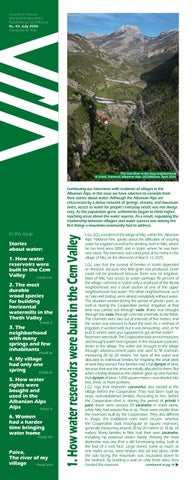
The Cem River in the Llug neighborhood of Vukël, Kelmend, Albanian Alps. GO2Albania, April 2024.
In this issue:
PAGE I-IV
PAGE II
PAGE III
PAGE IV
PAGE V
PAGE VII
PAGE II-VI
L.GJ. says that the survival of families in Vukël depended on livestock, because very little grain was produced. Grain could not be produced because there was no irrigation. Most of Nikç had access to water—perhaps 90 percent of the village—whereas in Vukël, only a small part of the Muriq neighborhood and a small section of one of the upper neighborhoods had water. The other neighborhoods, such as Cekë and Grishaj, were almost completely without water. This situation existed during the period of privati i parë, as well as during the Cooperative period. Irrigation at that time was carried out through vada. Water was brought through the vada, through concrete channels, to the fields. The channels were laid out at intervals of five meters, and the water was released to flood the land. As a method of irrigation, it worked well, but it was exhausting—and, as he puts it, where were you supposed to get all that water? Reservoirs were built. The Cooperative took several measures and brought water from Gjarpëri, in the mountain pastures, down to the village. The water was brought to the village through asbestos-cement pipes and used to fill reservoirs measuring 20 by 20 meters. Yet none of this water was allocated to individual families for irrigating the small plots of land they owned. Few families had a full dynym of land, because that was the amount initially allocated to them. But when a family divided as the children grew up and married, that dynym of land—1,000 square meters—was divided into two, three, or more portions. L.GJ. says that reservoirs (saranxha) also existed in the village before the Cooperative. They had been built by large, well-established families. According to him, before the Cooperative—that is, during the period of privati i parë—there were around 20 saranxha in Vukël alone, while Nikç had around five or six. These were smaller than the reservoirs built by the Cooperative. They also differed in shape: the traditional ones were circular, whereas the Cooperative built rectangular or square reservoirs, generally measuring around 20 by 20 meters or 18 by 18 meters. Many families in Nikç had their own saranxha, including his maternal uncles’ family. Among the most distinctive was one that is still functioning today, built at the foot of a rock face. Large stones, some as much as one meter across, were broken and set into place, while the side facing the mountain was excavated down to the bedrock. By building a wall on only three sides, they continued at pg. IV created the reservoir.
The bridge over the Paiva River, built in 1889.
Luís Gomes da Costa
Interview with M. Gj., Ndërlysaj, Shala, Albanian Alps. GO2Albania, July 2018.
continued at pg. VI II
43 2026
Water channels carved into the rock from the spring to reservoir 1 and from the reservoir toward the fields 2. Nikç, Kelmend, Albanian Alps. GO2Albania, April 2024.
continued at pg. V 43 2026
III
D. T. during the interview, Budaç, Kelmend, Albanian Alps. GO2Albania, March 2025.
continues from pg. I
IV
43 2026
During interviews with local residents, Nikç, Kelmend, Albanian Alps. GO2Albania, March 2025.
continues from pg. III
5. How water rights were bought and used in the Albanian Alps Alps
Interview with L. I., Nikç, Kelmend, Albanian Alps. GO2Albania, March 2025
43 2026
continued at pg. VIII V
Fishermen prepare to cast their nets into the river.
continues from pg. II
VI
43 2026
Wooden water trough in the yard of H. D.’s house, Nikç, Kelmend, Albanian Alps. GO2Albania, March 2025.
43 2026
VII
Hollowed-out pine trunk used as a water trough, Vermosh, Kelmend, Albanian Alps. GO2Albania, May 2026.
continues from pg. V
Co-funded by the European Union and Prespa Ohrid Nature Trust (PONT). Views and opinions expressed are however those of the author(s) only and do not necessarily reflect those of the European Union or PONT. Neither the European Union nor PONT can be held responsible for them.
vija@go2albania.org
read online
VIJA © 2026 GO2Albania and authors. All rights reserved.