INDUSTRY PERSPECTIVE
From concept to capability: Multi-Domain Operations Supporting the Alliance in its evolutionary digital journey
Strategy, Digital Transformation Implementation Strategy (DTIS), Data Strategy as well as the Federated Mission Networking (FMN) collectively establish how the Alliance will build its federated digital backbone. These frameworks outline how information superiority must be built – not as isolated systems, but as a connected, trusted ecosystem linking every level of command.
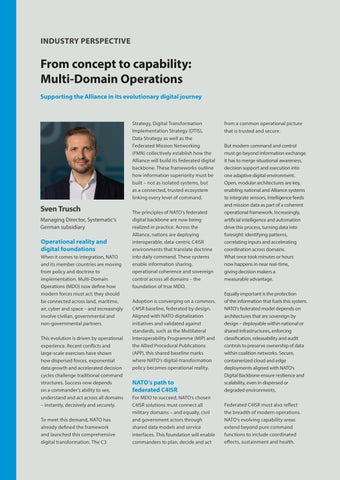
Sven Trusch Managing Director, Systematic’s German subsidiary
Operational reality and digital foundations When it comes to integration, NATO and its member countries are moving from policy and doctrine to implementation. Multi-Domain Operations (MDO) now define how modern forces must act: they should be connected across land, maritime, air, cyber and space – and increasingly involve civilian, governmental and non-governmental partners. This evolution is driven by operational experience. Recent conflicts and large-scale exercises have shown how dispersed forces, exponential data growth and accelerated decision cycles challenge traditional command structures. Success now depends on a commander’s ability to see, understand and act across all domains – instantly, decisively and securely. To meet this demand, NATO has already defined the framework and launched this comprehensive digital transformation. The C3
The principles of NATO’s federated digital backbone are now being realized in practice. Across the Alliance, nations are deploying interoperable, data-centric C4ISR environments that translate doctrine into daily command. These systems enable information sharing, operational coherence and sovereign control across all domains – the foundation of true MDO.
from a common operational picture that is trusted and secure. But modern command and control must go beyond information exchange. It has to merge situational awareness, decision support and execution into one adaptive digital environment. Open, modular architectures are key, enabling national and Alliance systems to integrate sensors, intelligence feeds and mission data as part of a coherent operational framework. Increasingly, artificial intelligence and automation drive this process, turning data into foresight: identifying patterns, correlating inputs and accelerating coordination across domains. What once took minutes or hours now happens in near real-time, giving decision makers a measurable advantage.
NATO’s path to federated C4ISR
Equally important is the protection of the information that fuels this system. NATO’s federated model depends on architectures that are sovereign by design – deployable within national or shared infrastructures, enforcing classification, releasability and audit controls to preserve ownership of data within coalition networks. Secure, containerized cloud and edge deployments aligned with NATO’s Digital Backbone ensure resilience and scalability, even in dispersed or degraded environments.
For MDO to succeed, NATO’s chosen C4ISR solutions must connect all military domains – and equally, civil and government actors through shared data models and service interfaces. This foundation will enable commanders to plan, decide and act
Federated C4ISR must also reflect the breadth of modern operations. NATO’s evolving capability areas extend beyond pure command functions to include coordinated effects, sustainment and health.
Adoption is converging on a common, C4ISR baseline, federated by design. Aligned with NATO digitalization initiatives and validated against standards, such as the Multilateral Interoperability Programme (MIP) and the Allied Procedural Publications (APP), this shared baseline marks where NATO’s digital-transformation policy becomes operational reality.