WEALTH
New money, old money But is it not strange the wealthy all seem to have passions for yachts, horses and expensive wine? “There are new tech billionaires and many of their interests are really driven by friends and education,” he says.“They never cared about wine or private aviation but when someone explains to them the deeper cultural aspects and heritage, they start to engage with it.” Friedman says when the uber-rich attend these events, they are generally not on the clock. “These people can do business with whoever they want. Does it naturally emerge from conversations? Absolutely. Is that the driver? No. These guys don’t need to get business.” New faces are starting to emerge at the usual haunts, Friedman says, with the emergence of rapid Russian and Asian self-made wealth. Last year broke records with the number of billionaires growing seven per cent to hit 2,325. “There’s an internationalisation that is happening in all of these hotspots,” says Friedman. But that might be having an impact on the likelihood of the traditional crowds to keep attending, he says. “The new billionaires from different places in the world are probably causing some of your typical billionaires to avoid them. “If all of a sudden there are a lot of people you do not know going, it can become unsettling.”
Social causes Philanthropy factors large. Friedman says: “There is a broader narrative right now in the world about the haves and have-nots and the economic gap. People’s sensitivities are heightened around these kind of issues.” About 200,000 global citizens are responsible for 18 per cent of all non-corporate philanthropy, he says. In fact, philanthropic events are the second most popular on the billionaire’s annual travel circuit (behind sporting events), with 52 per cent attending at least one such event. The Wealth-X survey shows the average billionaire will donate $100 million over a lifetime, equivalent to about three per cent of their net worth. The most popular causes are education, which attracts nearly 30 per cent of total funds and health at 12 per cent. Just over one third of the world’s billionaires even have their own private foundations, although Friedman notes it is not always necessary to reinvent the wheel. “I think the biggest challenge billionaires face from a philanthropic side is that they are used to seeing a problem, building a company to address a market issue and being successful. “The temptation is to create a new initiative [but] with philanthropy, there are already so many non-profits addressing an issue.”
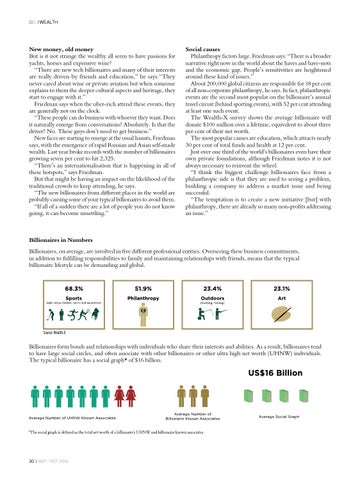
Billionaires in Numbers Billionaires, on average, are involved in five different professional entities. Overseeing these business commitments, in addition to fulfilling responsibilities to family and maintaining relationships with friends, means that the typical $ billionaire lifestyle can be demanding and global. $
$
Source: Wealth-X
Billionaires form bonds and relationships with individuals who share their interests and abilities. As a result, billionaires tend to have large social circles, and often associate with other billionaires or other ultra high net worth (UHNW) individuals. The typical billionaire has a social graph* of $16 billion.
30
SEP / OCT 2015