Philanthropy
The Ripple Effect The Voss Foundation aims to provide water and sanitation to deprived African villages but its association with luxury can be problematic By Daniel Bates
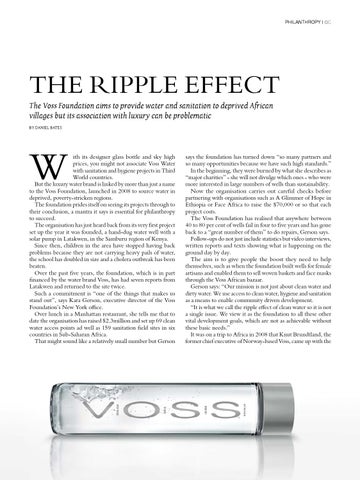
ith its designer glass bottle and sky high prices, you might not associate Voss Water with sanitation and hygiene projects in Third World countries. But the luxury water brand is linked by more than just a name to the Voss Foundation, launched in 2008 to source water in deprived, poverty-stricken regions. The foundation prides itself on seeing its projects through to their conclusion, a mantra it says is essential for philanthropy to succeed. The organisation has just heard back from its very first project set up the year it was founded, a hand-dug water well with a solar pump in Latakwen, in the Samburu region of Kenya. Since then, children in the area have stopped having back problems because they are not carrying heavy pails of water, the school has doubled in size and a cholera outbreak has been beaten. Over the past five years, the foundation, which is in part financed by the water brand Voss, has had seven reports from Latakwen and returned to the site twice. Such a commitment is “one of the things that makes us stand out”, says Kara Gerson, executive director of the Voss Foundation’s New York office. Over lunch in a Manhattan restaurant, she tells me that to date the organisation has raised $2.3million and set up 69 clean water access points ad well as 159 sanitation field sites in six countries in Sub-Saharan Africa. That might sound like a relatively small number but Gerson
says the foundation has turned down “so many partners and so many opportunities because we have such high standards.” In the beginning, they were burned by what she describes as “major charities” - she will not divulge which ones - who were more interested in large numbers of wells than sustainability. Now the organisation carries out careful checks before partnering with organisations such as A Glimmer of Hope in Ethiopia or Face Africa to raise the $70,000 or so that each project costs. The Voss Foundation has realised that anywhere between 40 to 80 per cent of wells fail in four to five years and has gone back to a “great number of them” to do repairs, Gerson says. Follow-ups do not just include statistics but video interviews, written reports and texts showing what is happening on the ground day by day. The aim is to give people the boost they need to help themselves, such as when the foundation built wells for female artisans and enabled them to sell woven baskets and face masks through the Voss African bazaar. Gerson says: “Our mission is not just about clean water and dirty water. We use access to clean water, hygiene and sanitation as a means to enable community driven development. “It is what we call the ripple effect of clean water so it is not a single issue. We view it as the foundation to all these other vital development goals, which are not as achievable without these basic needs.” It was on a trip to Africa in 2008 that Knut Brundtland, the former chief executive of Norway-based Voss, came up with the
2014 Sep / Oct
39