SUPPLY SECURIT Y & DEMAND-SIDE MANAGEMENT
With resettlement planning, consultations on replacement housing designs have been completed with households to be relocated from the reservoir area, the Polihali village area, and other project sites such as the access roads and site establishment area. Public gatherings have been held to encourage communities to take advantage of the opportunities created by the implementation of Phase II, in mitigation against the potential negative effects of the LHWP. The consultant appointed to prepare the Phase II Social Development Master Plan continues to engage communities and other stakeholder groups as part of the process to assist affected communities across the entire Phase II landscape to identify priority areas for social development initiatives. Environment Integrated catchment management and rangeland rehabilitation programmes are under implementation to protect, conserve and restore wetlands, conserve and promote the sustainable use of rangeland resources, and prevent and control soil erosion. The programme – implemented in close collaboration with communities and rangeland associations at the LHWP areas – also promotes stakeholder participation and alternative livelihoods. There is also a cultural heritage programme to preserve the culture of the affected communities. Archaeological excavations for preserving and recording tangible cultural aspects are ongoing, with 21 of 27 Stone Age sites fully mitigated. A recording of 13 rock art sites in the LHWP area was completed in 2019.
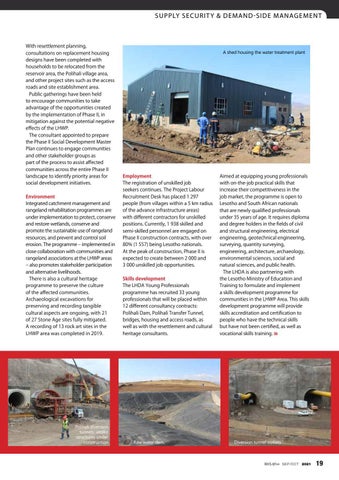
Polihali diversion tunnels’ intake structures under construction
A shed housing the water treatment plant
Employment The registration of unskilled job seekers continues. The Project Labour Recruitment Desk has placed 1 297 people (from villages within a 5 km radius of the advance infrastructure areas) with different contractors for unskilled positions. Currently, 1 938 skilled and semi-skilled personnel are engaged on Phase II construction contracts, with over 80% (1 557) being Lesotho nationals. At the peak of construction, Phase II is expected to create between 2 000 and 3 000 unskilled job opportunities. Skills development The LHDA Young Professionals programme has recruited 33 young professionals that will be placed within 12 different consultancy contracts: Polihali Dam, Polihali Transfer Tunnel, bridges, housing and access roads, as well as with the resettlement and cultural heritage consultants.
Raw water dam
Aimed at equipping young professionals with on-the-job practical skills that increase their competitiveness in the job market, the programme is open to Lesotho and South African nationals that are newly qualified professionals under 35 years of age. It requires diploma and degree holders in the fields of civil and structural engineering, electrical engineering, geotechnical engineering, surveying, quantity surveying, engineering, architecture, archaeology, environmental sciences, social and natural sciences, and public health. The LHDA is also partnering with the Lesotho Ministry of Education and Training to formulate and implement a skills development programme for communities in the LHWP Area. This skills development programme will provide skills accreditation and certification to people who have the technical skills but have not been certified, as well as vocational skills training.
Diversion tunnel outlets
S E P / O CT 2021
19