Wastewater
Reuse:
an attractive alternative In order to meet the ever-increasing demand for water in South Africa, there is growing interest in the reuse of wastewater as an alternative water supply strategy to sustain development and economic growth in the region. By Chris Swartz*
T
here are a number of drivers that make water reuse attractive as an alternative water supply strategy or means of augmentation over conventional groundwater and surface water sources. Reuse water forms a locally sourced, sustainable and reliable supply of water, and authorities are becoming increasingly aware that reuse water is no longer only an emergency supply option, but also a sustainable alternative supply. Water reuse also has a long track record of being a safe practice, mainly as a result of effective monitoring and quality control. Considerable research into health aspects and technology developments has led to a growing endorsement of reuse as an alternative water supply option, especially in areas where freshwater availability is limited.
Windhoek
Last year, the City of Windhoek celebrated 50 years of direct potable reuse. The original planners and researchers of the Windhoek water reclamation project are considered pioneers in this field. The first direct potable reuse plant was commissioned in 1968 and was the result of severe droughts in Namibia, with no other viable water sources for the City of Windhoek. Considerable research and development had taken place in Windhoek and South Africa to study health impacts, process efficiency and water management strategies. The New Goreangab Water Reclamation Plant was commissioned in 2002 to replace the original upgraded plant.
38
JULY /AUGUST 2019
Beaufort West
Beaufort West holds the distinction of having South Africa’s first direct potable reuse plant, where secondary treated wastewater is conveyed to an advanced water treatment facility for further treatment to drinking water quality standards. The plant was built in 2010 when the town’s main water supply, the Gamka Dam, dried up during a severe drought. It became operational in January 2011. Although the drought was broken in June that year by widespread rains in the central Karoo and Garden Route, the Beaufort West region is currently experiencing a very harsh drought, probably even worse than that of 2010. The water reclamation project is proving to be a reliable source of water for the town, albeit not sufficient on its own to meet the water demand of the community and industry.
eMalahleni
eMalahleni (Witbank) is an industrial town surrounded by coal-producing mines, steel manufacture and Eskom coal-fired power stations. The town’s water security was threatened not only by water shortages, but also low water quality due to high amounts of dissolved metals and salts accumulating in the catchment, mainly as a result of acid mine drainage. To address these challenges, a water reclamation plant was
constructed to treat mining effluent water to potable standards for use in the town. The plant has now been operational for several years and continues to produce safe, potable water to the eMalahleni community, while simultaneously reducing the risk of environmental contamination from the uncontrolled discharge of acid mine drainage.
City of Cape Town
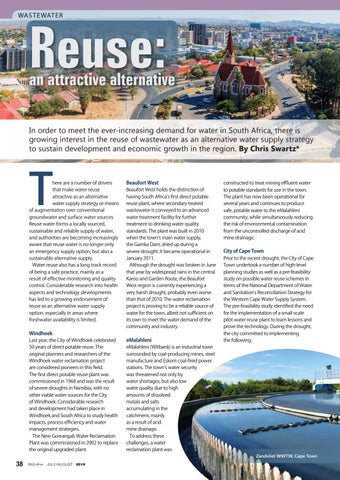
Prior to the recent drought, the City of Cape Town undertook a number of high-level planning studies as well as a pre-feasibility study on possible water reuse schemes in terms of the National Department of Water and Sanitation’s Reconciliation Strategy for the Western Cape Water Supply System. The pre-feasibility study identified the need for the implementation of a small-scale pilot water reuse plant to learn lessons and prove the technology. During the drought, the city committed to implementing the following:
Zandvliet WWTW, Cape Town