INSIGHT
Economic impact In South Africa, 95% of cargo is transported by truck. South Africa’s energy minister, Dipuo Peters, recently ntly stated that the country has a crude oil reserve of just two wo weeks and announced plans to increase the reserve, ve, which could become a priority. The United States (US) and the European Union are demanding an embargo of oil from Iran, which happens to be South Africa’s primary supplier. If enforced, South Africa could be facing a serious, two-fold problem: World oil source compositions differ. If forced to comply with the sanctions call, South Africa’s oil refineries may have to carry out reconfigurations costing millions to wean themselves off Iranian crude oil. With Sasol only producing 28% of South Africa’s daily fuel needs, this would lead to a fuel shortage. Running out of fuel raises all sorts of problems and will have huge economic implications for South Africa should it become a reality.
“The environmental risks of hydraulic fracturing for shale gas can be safely managed.” Prof Robert Mair from Cambridge University and in South Africa, mines cause far greater seismic disturbances than fracking could. “The environmental risks of hydraulic fracturing for shale gas can be safely managed, provided best practice is observed and provided it is enforced through strong regulation,” says the report’s chair, Prof Robert Mair from Cambridge University.
A solution is needed If load shedding continues to be a possible reality, and our natural energy resources continue to deplete, alternative oil sources need to be considered – and soon. From a more sustainable point of view, biofuels and natural gases are the most viable options, and Shell is already considering the possibilities.
Fracking in the Karoo Fracking has become a dirty word in South Africa’s semiarid heartland – the Karoo. It involves pumping water and chemicals into shale rock at enormous pressure to ‘crack’ open the shale and allow trapped gas to escape. Shell’s proposal to develop a series of natural gas wells is being opposed by an unprecedented public outcry. This culminated in the government placing a moratorium on shale gas fracturing until a final decision is made. What are the key concerns with fracking? In the US, where 450 000 fracking wells have been sunk – and upon which the South African anti-fracking lobby is basing its arguments – the biggest problem has been the lack of transparency. Another is unprofessional drilling methods and the lack of adherence to legislated standards. Other concerns raised include geological instability resulting in seismic activity, groundwater pollution and fire hazards due to leaking gas. A recent report from the Royal Society and the Royal Academy of Engineering says the technique is safe if firms follow best practice and rules are enforced. Tremors caused by the fracking process, such as the event in Blackpool last year, measure a fairly minor 2.3 in magnitude. The British Geological Survey can’t measure below a magnitude of 2 in towns because of the traffic,
An extensive collection of research reports and documentation regarding Shell’s proposal to frack the Karoo are available on the company’s website.
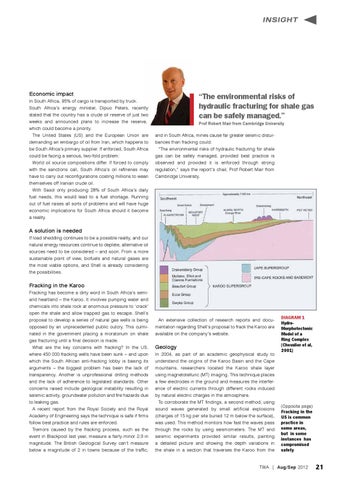
Geology In 2004, as part of an academic geophysical study to understand the origins of the Karoo Basin and the Cape mountains, researchers located the Karoo shale layer using magnetotelluric (MT) imaging. This technique places a few electrodes in the ground and measures the interference of electric currents through different rocks induced by natural electric charges in the atmosphere. To corroborate the MT findings, a second method, using sound waves generated by small artificial explosions (charges of 15 kg per site buried 12 m below the surface), was used. This method monitors how fast the waves pass through the rocks by using seismometers. The MT and seismic experiments provided similar results, painting a detailed picture and showing the depth variations in the shale in a section that traverses the Karoo from the
DIAGRAM 1 HydroMorphotectonic Model of a Ring Complex (Chevalier et al, 2001)
(Opposite page) Fracking in the US is common practice in some areas, but in some instances has compromised safety
TWA | Aug/Sep 2012
21