energy efficiency
Bracing for disruption PwC UK
According to PwC’s 2017 Low Carbon Economy Index (LCEI), the global average decarbonisation rate is less than half of what is needed to limit global warming to below 2°C.
By Chantal van der Watt*
S
outh Africa’s results in the PwC LCEI over the last eight years show evidence of progress in transitioning to a less carbon-intensive economy as a result of a decrease in intensity since 2009. However, this progress stalled after an increase in carbon intensity, coupled with limited economic growth from 2015 to 2016. As a result, South Africa placed last for performance in changing its carbon intensity for 2016. South Africa also has the highest carbon intensity per GDP. It is likely that the country will experience a combination of physical (e.g. extreme weather events), policy (e.g. for a low-carbon transition), market and technology (e.g. emerging technologies and new business models) risks.
sources (Figure 2). A change to a less carbon-intensive energy mix requires significant buy-in from all role players and a large amount of capital investment – something that is extremely challenging in South Africa’s current economic climate. In the last few years, advances in the renewable energy space have seen an increase in the amount of energy derived from solar and wind power, indicating that renewable energy policies and strategies are starting to take form. The amount of energy derived from coal
has also been decreasing since it reached a peak in 2009. South Africa has, however, in the last year, experienced a decrease in the number of approvals received for renewable energy projects that feed energy into the grid. A CSIR study1 (2017) found that in 2016, wind, solar and concentrated solar power (CSP) supplied 2.9% of the total South African system load. In 2016, a total of 385 MW of wind and 509 MW of solar power were added to the South African energy mix.
South Africa’s Depar tment of Environmental Affairs (DEA) has drafted a National Adaptation Strategy2. The strategy identifies drought, flash floods and veld fires as the climate scenarios that will worst affect South Africa due to increased global warming. As per the remarks of the Minister of Environmental Affairs at the informal International Climate Change Meeting in Montreal, it appears that South Africa has a few new policies and strategies it will be implementing: these include a
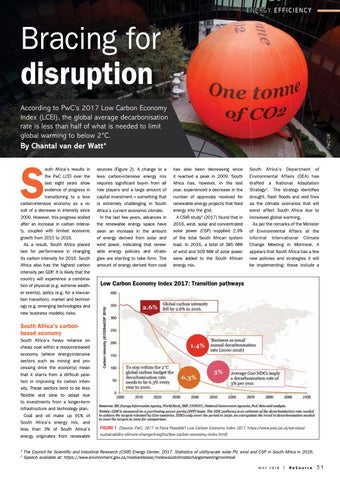
Low Carbon Economy Index 2017: Transition pathways
South Africa’s carbonbased economy South Africa’s heavy reliance on cheap coal within a resource-based economy (where energy-intensive sectors such as mining and processing drive the economy) mean that it starts from a difficult position in improving its carbon intensity. These sectors tend to be less flexible and slow to adapt due to investments from a longer-term infrastructure and technology plan. Coal and oil make up 91% of South Africa’s energy mix, and less than 3% of South Africa’s energy originates from renewable 1 2
Figure 1 (Source: PwC. 2017. Is Paris Possible? Low Carbon Economy Index 2017. https://www.pwc.co.uk/services/ sustainability-climate-change/insights/low-carbon-economy-index.html)
The Council for Scientific and Industrial Research (CSIR) Energy Center. 2017. Statistics of utility-scale solar PV, wind and CSP in South Africa in 2016. Speech available at: https://www.environment.gov.za/mediarelease/molewasatclimatechangemeetingmontreal M ay 2 0 1 8
|
ReSource
31