JANUARY/FEBRUARY 2022 • Issue 99
FOCUS
WHAT LIES AHEAD
Engaging attendees in 2022
The future of business travel
ANALYSIS
Re-establishing a business case for MICE
MEETINGS AFRICA 2022 Stepping into the New Age with the SANCB R55.00 (incl. VAT)
ISSN 1684-9264
A Convergence of Business
and Adventure
Didima Conference Centre & Wedding Venue, Cathedral Peak, Maloti-Drakensberg Park World Heritage Site: (036) 488 8000 Ntshondwe Conference Centre & Wedding Venue, Ithala Game Reserve: (034) 983 2540
Let Ideas Expand Beyond the Office
We have the freshest of air, an abundance of wildlife, the best adventure tracks and trails, breathtaking sights and scenery, but most importantly, we have conference centres in these magnificent tranquil surroundings. Didima Conference Centre accommodates delegates from 120 classroom style, 60 U-shape style to 120 seated cinema style configuration. Ntshondwe Conference centre offers a cinema style seating arrangement for up to 140, a lecture style for 90 or a single U-shaped for 45 delegates. Ntshondwe’s two breakaway rooms offers a cinema style seating arrangement for 30, lecture style for 18 and single U-shape for 16 delegates. Both conference facilities offer various accommodation options, are fully serviced and can comfortably be adapted from one-day events to multi-day workshops.
The Perfect Wedding
Make your big day perfect with unlimited privacy, breathtaking scenery, birdlife, wildlife, scenic trails, comfortable accommodation, delicious food and personalised service excellence. Dream, travel,
Discover
Online bo o king : bookings.kznwildlife.com
Web: www.kznwildlife.com
Conservation, Partnerships & Ecotourism
JANUARY/FEBRUARY 2022
CONTENTS The Planner
@theplannerguru
The Planner is growing its footprint – connect with us today!
@theplannerguru
04
the-planner-guru
04 COVER STORY: BEACON OF HOPE After it was postponed in 2021, the muchanticipated Meetings Africa will go ahead as an in-person experience at the end of February. We hear from the show’s organisers, the South Africa National Convention Bureau, on what to expect.
06 FOCUS: ENGAGING ATTENDEES IN 2022 Time is short and capacities for attendance are even shorter. Meetings dons the attendee’s hat to understand what the crux is for their attendance and participation.
12 INDUSTRY ANALYSIS Re-establishing a business case for MICE
14 COST CONTAINMENT + TRANSPARENCY A timeous solution
18 VENUE SHOWCASE Premier Hotel Quatermain
18
19 COVID RECOVERY Getting behind our industry
20 NETWORKS
28
Building connections
21 INNOVATION The power of multiplication
BEST PRACTICE 22 Data protection 24 Vaccines 26 CONTRACTS Terms + conditions apply
28 EVENT SHOWCASE IBTM World Barcelona
30 INDUSTRY INSIGHTS ‘Never let a good crisis go to waste’
REGULARS 02 Ed’s Comment 03 Tidbits 36 Miss Meet
20
30
TALKING POINTS 32 SAEC 33 AIPC 34 EGF + AAXO 35 SAACI + SACIA
ED’S COMMENT Managing Editor Shanna Jacobsen (shanna@3smedia.co.za) Chief Sub-Editor Tristan Snijders Head of Design Beren Bauermeister Contributors Sven Bossu, Glenton de Kock, Kevan Jones, Scott Langley, Greg McManus, Projeni Pather Production & Client Liaison Manager
Antois-Leigh Nepgen Group Sales Manager Chilomia Van Wijk Bookkeeper Tonya Hebenton Distribution Manager Nomsa Masina Distribution Coordinator Asha Pursotham Advertising
GREAT GRIT What sets aside successes from failures? Shanna Jacobsen discusses why we should not view any failure as a loss when success is the outcome.
A
fter being in lockdown for close to two years, many of us may feel that we have failed – failed in making money or achieving our financial goals; failed in producing results and reaching certain business objectives; and failed overall in moving forward. Yet, you are still here, trying, and defining what it means to have grit. In psychology, grit is considered a personality trait that embodies both perseverance and passion. It is a neversay-die attitude that trumps intelligence and even talent. As former NBA player Kevin Durant once said: “Hard work beats talent when talent fails to work hard.”
INDUSTRY GRIT We see evidence of an industry with true grit throughout these pages – nowhere more so than in our feature on page 12 that explores how we reestablish a business case for MICE as we move through the Covid-19 pandemic. The business events and travel market still presents a unique value proposition for clients and stakeholders because we can reach people and deliver content in such a way that gets them engaging (page 6). However, as we make use
of technology to capture and store our attendees’ personal information, we need to be increasingly aware of the risks this poses. On page 22, we unpack why data protection and cybersecurity apply more to the events industry than before. During the pandemic and various levels of lockdowns, planners, venues and service providers have had their work cut out for them but this has come with an added headache of cancellations and postponements. On this topic, we hear from the industry on page 26. From page 24, we delve into the contentious issue of vaccine passports and understand the implications of implementing mandates. We explore what is happening around the globe and closer to home. Given the successful hosting of IBTM World in Barcelona in December (see page 28), could vaccines be the light at the end of the tunnel for ensuring our industry gets back on track in 2022? As the first issue for the year, we hope that this is one that inspires you and also demonstrates the exceptional value that each of you, our valued readers and industry role players, brings to the world of MICE. On behalf of the team at Meetings and theplanner.guru, we wish each of you a remarkable year!
Vanessa De Waal +27 (0)84 805 6752 | Vanessa.DeWaal@3smedia.co.za PUBLISHED BY
Publisher Jacques Breytenbach
3S Media Production Park, 83 Heidelberg Road, City Deep, Johannesburg South, 2136 Tel: +27 (0)11 233 2600 Fax: +27 (0)11 234 7274/5 www.3smedia.co.za Meetings JANUARY/FEBRUARY 2022 © Copyright All rights reserved 2022 www.theplanner.guru SUBSCRIPTION R330.00 per annum (incl. VAT) | subs@3smedia.co.za ISSN 1684-9264 NOTICE OF RIGHTS Meetings is published bi-monthly by 3S Media. This publication, its form and contents vest in 3S Media. All rights reserved. No part of this book, including cover and interior designs, may be reproduced or transmitted in any form or by any means, electronic or mechanical, including photocopying, recording or by any information storage and retrieval system, without permission in writing from the publisher, nor be otherwise circulated in any form of binding or cover other than that in which it is published and without a similar condition being imposed on the subsequent purchaser. The authors' views may not necessarily reflect those of the publisher or associated professional bodies. While every precaution has been taken in the preparation and compilation of this publication, the publisher assumes no responsibility for errors, omissions, completeness or accuracy of its contents, or for damages resulting from the use of the information contained herein. While every effort has been taken to ensure that no copyright or copyright issues is/are infringed, 3S Media, its directors, publisher, officers and employees cannot be held responsible and consequently disclaim any liability for any loss, liability damage, direct or consequential of whatsoever nature and howsoever arising.
MEMBER OF
IN COLLABORATION WITH
Until next issue,
Shanna
The ABC logo is a valued stamp of measurement and trust, providing accurate and comparable circulation figures that protect the way advertising is traded. Meetings is ABC audited and certified.
Meetings’ must-know minutiae
MeetingPlay and Aventri merge operations to form “world’s largest event technology companies” On the back of several successful mergers and acquisitions of companies within the meetings and events software space in 2021, MeetingPlay and Aventri have announced that they will be consolidating their respective offerings. A growth equity investment from Sunstone Partners and Camden Partners also forms part of the deal, with Eric Lochner named CEO of the new entity. “This new event software powerhouse will blend visionary technology and best-in-class service to close all gaps in the planning process, offering the most complete full-service solution for meetings and events of all sizes, from conferences of 200 000+ to meetings with less than 100 attendees. The combined company will become one of the world’s largest event technology companies, servicing customers on a global scale,” stated an official release on MeetingPlay’s website.
voco comes to Africa Guests can look forward to experiencing the muchanticipated opening of the voco Johannesburg Rosebank, an IHG Hotels & Resorts property, in February 2022. As the first hotel of its kind in Africa, voco allows guests access to the Workshop17 co-working space offices and meeting facilities that offer a 24-hour business centre. In addition, all rooms come standard with high-speed Wi-Fi access. The hotel’s fully equipped gym is also available to guests 24 hours a day. For meetings and events, voco’s eventing venue, W17 the Bank, provides an eventing space with both a cafe and bar on the first floor. Eight meeting rooms are available, as well as 60 private offices, with lounges also being accessible by the hotel’s guests.
Pan-African airline targets take-off for 2023
The recent signing of the Strategic Partnership Framework between Kenya Airways (KQ) and South African Airways (SAA) is looking positive for the establishment of a much-anticipated pan-African airline in 2023. The agreement was signed in Johannesburg by Michael Joseph, chairman at KQ, and John Lamola, chairman at SAA. It was witnessed by President Kenyatta and his South African counterpart, President Cyril Ramaphosa, during Kenyatta’s visit to South Africa in late November last year. After a difficult period for both airlines, they remain committed to ensuring that they lead the charge in providing a solid foundation to support the eventual launch of a pan-African carrier.
dmg events and Media 10 announce the co-location of two local shows dmg events, owner and producer of the Hotel & Hospitality Show, together with Media 10, the organiser of Design Joburg, have announced that these two shows will be co-located at Sandton Convention Centre between 19 and 21 May 2022. “As the country moves back towards live events in 2022, there is a greater need than ever before for the design and hospitality industries to source new products, make connections and move the industry forward… Following extensive engagement with manufacturers, service providers and buyers in the hospitality sector, it was clear that partnering with the strong Design Joburg brand would bring multiple benefits to the sector,” says Evan Schiff, portfolio director: Food, Trade and Hospitality at dmg events. The partnership hopes to establish and nurture connections between a range of industries to strengthen these supply chains across Africa.
www.theplanner.guru
MEETINGS l JANUARY/FEBRUARY 2022 •
3
COVER STORY
BEACON OF HOPE
After it was postponed in 2021, the much-anticipated Meetings Africa will go ahead as an in-person experience at the end of February. We hear from the show’s organisers, the South Africa National Convention Bureau (SANCB), on what to expect.
O
n 10 November 2021, an announcement was made that sent the business events and travel industry into overdrive – Meetings Africa, together with Africa’s Travel Indaba, would be making a comeback in 2022. With Meetings Africa being the ultimate showcase of the continent’s range of MICE destinations, products and services, the industry is anticipating an exceptional three-day
experience filled with networking and engaging, informative sessions. Delegates will arrive for the same show at the same venue but, after two years during which our entire way of doing business had to change, the experience will be quite different because, as Amanda Kotze-Nhlapo, chief convention bureau officer at the SANCB says, “It has to be.”
She adds, “The conversations we will be having at Meetings Africa this year will be centred on unified strategies for the collective recovery of Africa’s business events industry. These are dialogues that we have been having among ourselves and within smaller focus groups but not as a whole, and I feel that – this year – Meetings Africa will play a stronger role than it ever has in bringing the industry together.”
ALL PROTOCOLS OBSERVED As the business events arm of South African Tourism, the SANCB will demonstrate to hosted buyers as well as Africa’s MICE industry stakeholders how to successfully run a large-scale conference and exhibition on African soil while ensuring all health and safety protocols are observed. South African Tourism’s mettle has already been tested and a standard set during the hybridformat Africa’s Travel and Tourism Summit (ATTS), which ran in September 2021 under the theme ‘Reawakening Africa’. Meetings Africa takes place on the back of ATTS at the same venue – the Sandton Convention Centre. Organisers have made it clear on the Meetings Africa website that the show will enforce a strict mask-wearing mandate and visitors and participants can expect to be screened and sanitised upon entry. Anyone who does not pass the screening will not be permitted access to the show. With capacities now at 1 000 people indoors, the number of physical attendees will need to be capped but the organisers are confident that exhibitors, visitors and hosted buyers will get to enjoy the full Meetings Africa experience. “Business events and travel were immediately and directly impacted by the Covid-19 pandemic and lockdown. After the losses we have experienced as a result of the numerous
Meetings Africa is a representation of the unrelenting spirit of an African industry that forges ahead and opens its doors to the world.” Amanda Kotze-Nhlapo, chief convention bureau officer at the SANCB
#SANCB MEETINGS AFRICA USEFUL INFO AND LINKS • Meetings Africa kicks off with its BONDay (Business Opportunities Networking Day) on 28 February 2022, with its two show days taking place on 1 and 2 March 2022 • Visitors can attend Meetings Africa for free if they register before 26 February 2022 • 200 hosted buyers are being targeted to form part of Meetings Africa, presenting an invaluable opportunity for exhibitors
cancellations and postponements, we understand the risks very clearly, but we also recognise that we need to lead by example and be a model for the rest of the industry, which we aim to achieve with Meetings Africa,” Amanda emphasises. The Covid-19 pandemic may have taken its toll on the global business events industry; however, as an important role player within the business events industry on the African continent, the SANCB remains optimistic and committed to providing solutions to ensure the right engagement can happen, safely. “We are thrilled to invite global buyers to come network and do business with our exhibitors from across the African continent. There has been a resounding call for face-to-face business engagement from our industry players, and we are confident in executing a safe event. While we understand the severe blow that has been dealt
SouthAfricaNationalConventionBureau
to the industry, we are also confident in creating a conducive platform for our participants. Buyers who will not be able to visit South Africa due to travel restrictions will be accommodated through a minimal virtual platform,” says Amanda.
THE AFRICAN OFFERING Brimming with opportunity, Africa is still considered a relatively untapped destination, which is clear in the International Congress and Convention Association rankings. In 2019, prior to the pandemic, Africa hosted just 3% of all international association meetings (415) and roughly half as many as the top-performing country, the USA (934). This alone highlights the burgeoning prospects offered by the continent. Africa could also be part of its own solution by providing the means for business travel and tourism destinations to recover and make up some of the losses from previous years.
SA_NCB
meetsouthafrica
convention@southafrica.net
A key trend identified during ATTS was the potential of domestic markets to stimulate growth and help support the tourism market in particular. “Our domestic tourists were the driving force behind our tourism and hospitality businesses over December,” noted Tshifhiwa Tshivhengwa, CEO of the Tourism Business Council of South Africa. Meanwhile, data from Statistics SA indicates that, in 2019, prior to the pandemic, domestic spend contributed 73% of the R451.5 billion in internal expenditure generated by the tourism sector. This further supports the motivation behind the SANCB’s domestic growth strategy to nurture MICE opportunities within villages, towns and small dorpies. While this is intended to promote these destinations, as well as support the growth and development of their MICE facilities and experiences, Amanda believes more needs to be done to showcase the continent and its multitude of destinations. “The only way we are going to get international buyers and delegates to experience Africa is to experience it for ourselves and tell our own stories in such a way that it elevates the perception of Africa. There is so much diversity, richness and warmth offered by the continent but, as Africans, we need to ask ourselves how we are experiencing this for ourselves and, further to this, how we are sharing this with the rest of the world,” she concludes.
south-africa-national-conventions-bureau +27 (0)11 895 3000
SouthAfricanTourism
www.businessevents.southafrica.net
FOCUS
The reason
Time is short and capacities for attendance are even shorter. Meetings dons the attendee’s hat to understand what the crux is for their attendance and participation.
O
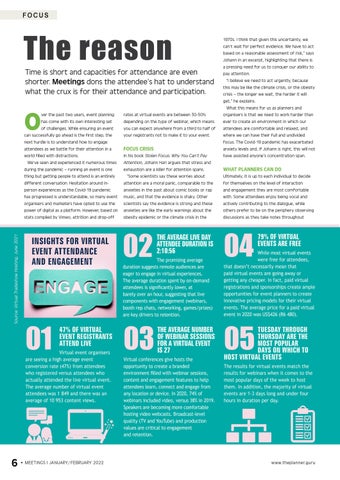
Source: Virtual Tradeshow Hosting, June 2021
ver the past two years, event planning has come with its own interesting set of challenges. While ensuring an event can successfully go ahead is the first step, the next hurdle is to understand how to engage attendees as we battle for their attention in a world filled with distractions. We’ve seen and experienced it numerous times during the pandemic – running an event is one thing but getting people to attend is an entirely different conversation. Hesitation around inperson experiences as the Covid-19 pandemic has progressed is understandable, so many event organisers and marketers have opted to use the power of digital as a platform. However, based on stats compiled by Vimeo, attrition and drop-off
INSIGHTS FOR VIRTUAL EVENT ATTENDANCE AND ENGAGEMENT
01
47% OF VIRTUAL EVENT REGISTRANTS ATTEND LIVE
Virtual event organisers are seeing a high average event conversion rate (47%) from attendees who registered versus attendees who actually attended the live virtual event. The average number of virtual event attendees was 1 849 and there was an average of 10 953 content views.
rates at virtual events are between 30-50% depending on the type of webinar, which means you can expect anywhere from a third to half of your registrants not to make it to your event.
FOCUS CRISIS In his book Stolen Focus: Why You Can’t Pay Attention, Johann Hari argues that stress and exhaustion are a killer for attention spans. “Some scientists say these worries about attention are a moral panic, comparable to the anxieties in the past about comic books or rap music, and that the evidence is shaky. Other scientists say the evidence is strong and these anxieties are like the early warnings about the obesity epidemic or the climate crisis in the
02
THE AVERAGE LIVE DAY ATTENDEE DURATION IS 2:10:56
03
THE AVERAGE NUMBER OF WEBINAR SESSIONS FOR A VIRTUAL EVENT IS 27
The promising average duration suggests remote audiences are eager to engage in virtual experiences. The average duration spent by on-demand attendees is significantly lower, at barely over an hour, suggesting that live components with engagement (webinars, booth rep chats, networking, games/prizes) are key drivers to retention.
Virtual conferences give hosts the opportunity to create a branded environment filled with webinar sessions, content and engagement features to help attendees learn, connect and engage from any location or device. In 2020, 74% of webinars included video, versus 38% in 2019. Speakers are becoming more comfortable hosting video webcasts. Broadcast-level quality (TV and YouTube) and production values are critical to engagement and retention.
1970s. I think that given this uncertainty, we can’t wait for perfect evidence. We have to act based on a reasonable assessment of risk,” says Johann in an excerpt, highlighting that there is a pressing need for us to conquer our ability to pay attention. “I believe we need to act urgently, because this may be like the climate crisis, or the obesity crisis – the longer we wait, the harder it will get,” he explains. What this means for us as planners and organisers is that we need to work harder than ever to create an environment in which our attendees are comfortable and relaxed, and where we can have their full and undivided focus. The Covid-19 pandemic has exacerbated anxiety levels and, if Johann is right, this will not have assisted anyone’s concentration span.
WHAT PLANNERS CAN DO Ultimately, it is up to each individual to decide for themselves on the level of interaction and engagement they are most comfortable with. Some attendees enjoy being vocal and actively contributing to the dialogue, while others prefer to be on the periphery observing discussions as they take notes throughout
04
79% OF VIRTUAL EVENTS ARE FREE
While most virtual events were free for attendees, that doesn’t necessarily mean that paid virtual events are going away or getting any cheaper. In fact, paid virtual registrations and sponsorships create ample opportunities for event planners to create innovative pricing models for their virtual events. The average price for a paid virtual event in 2020 was US$426 (R6 480).
05
TUESDAY THROUGH THURSDAY ARE THE MOST POPULAR DAYS ON WHICH TO HOST VIRTUAL EVENTS The results for virtual events match the results for webinars when it comes to the most popular days of the week to host them. In addition, the majority of virtual events are 1-3 days long and under four hours in duration per day.
6 • MEETINGS l JANUARY/FEBRUARY 2022 www.theplanner.guru
#ATTENDEEENGAGEMENT sessions. Although somewhat different, the common denominator is that both attendees are highly engaged – one enough to participate, and the other to keep up with the conversation and document this to perhaps produce their own report and refer to at a later stage. Understanding what the drawcard is for these types of delegates’ respective participation will help planners when it comes to structuring a marketing campaign to encourage potential attendees to register for their event. Due to the nature of each event, these reasons may be vast in how they vary but it is also where being able to define our target audience becomes critically important.
According to insights from Wyzowl released in December 2021, human attention spans decreased from 12 seconds in 2000 to just 8.25 seconds in 2015 – pretty major considering how this has dwindled in the space of just 15 years, and shocking when one considers that a goldfish has an attention span of nine seconds. However, this may be challenging to substantiate, and according to a BBC article titled Busting the attention span myth, this seems to be based on certain tasks, rather than the entirety of a person’s ability to focus. If event planners and facilitators want to command a captive audience, mechanisms to both get and hold their attention need to be used throughout their experience with you (see page 9 for our 'How To' on engaging attendees).
RETURN ON TIME INVESTED Time is a precious and irreplaceable resource that, once spent, is impossible to reclaim. This underscores how our calls to action need to provide a strong case for anyone who attends our events that there will be a distinct return on time invested (ROTI). “Time, whether spent or borrowed, is a valuable commodity; it can therefore be frustrating for team members if they feel the time they spend on their retrospectives could be better directed elsewhere – especially when retrospectives are a core practice of agile methodology! Rating a meeting’s ROTI gives each team member a platform to offer their opinion on the value of the meeting and present ways to improve it,” says a recent Team Retro article around team meetings specifically. For event planners, a positive return on the time their delegates invested might be one of the following: 1. T hey learnt something new that they may not have learnt anywhere else. 2. They made a valuable connection that led to a business conversion. 3. They thoroughly enjoyed an element of your event – speakers/ food/gifts/entertainment, etc. One of the more challenging aspects of ROTI is that it is largely sentimentbased, so developing post-event surveys and questionnaires can provide more accurate insights into how successful your audience engagement was.
www.theplanner.guru
MEETINGS l JANUARY/FEBRUARY 2022 •
7
+27 (0)11 233 2600 subs@3smedia.co.za theplanner.guru
theplanner.guru is a one-stop platform for finding venues and suppliers. It’s where you can read the hottest industry tips and trends as well as source event planning tools and gain insight from valuable information in the MICE Hub. Plan your event by using the platform’s event boards and keep up-to-date with the daily newsletters. Use these resources to take your events from great to flawless. Packed with advice, handy tips, tools, checklists and event planning insight from leading industry experts and combined with the comprehensive listings, The Meetings & Event Planner is essential if you’re organising any type of event. Published annually.
TT HH EE
E IX N H C I BE I NT TI O I VN
E
Looking for new and exciting destinations? The Incentive Planner is jam-packed with fresh ideas and top tips to turn any incentive trip into a memorable experience. Out in March and September with Meetings. The Exhibition Planner is an essential tool for exhibitors. Information is packaged in an easily digestible format addressing the entire process of planning and arranging a show stand, what to do pre-show, during and post-show. Published annually.
The Planner
@theplannerguru
This alternative monthly publication investigates new trends, ideas and strategies relevant to the meetings and events industry to keep you ahead of the planner pack. Meetings provides a platform for branding and promoting venues and service providers to the heart of the South African conferencing and event industries.
3S Media gives YOU the competitive edge as a MICE planner
www.theplanner.guru @theplannerguru
HOW TO
HOW TO…
Engage attendees in 2022 1 3 PRIORITISE SAFETY
Your delegates are not going to feel comfortable engaging in a space that does not take into account their safety. For in-person events: Make sure your protocols are communicated well and often. Ensure you have safety officers who remind people to wear masks when not eating or drinking, and that there are plenty of sanitising stations. For virtual events: Understand and address all vulnerabilities when it comes to your hosting platform. Strive to safeguard delegates’ devices and systems, as well as their personal information and how this is used.
SOME OF THE SAME RULES STILL APPLY
MAKE IT RELEVANT
Be sensitive that time is an increasingly precious resource that is not to be wasted and don’t fill space for the sake of it! For in-person events: Establish the reasons for attendance prior to the event taking place. Bear in mind that while this varies from delegate to delegate, if you can meet their objectives more readily, they will engage more easily and automatically walk away feeling positive. For virtual events: With more chance of distraction and a generally shorter timeframe in which your event happens, there is less of an opportunity to engage with your audiences online, so consider what engagement you can do both preand post-event.
CREATE LEVELS OF PARTICIPATION
Not everyone is going to want to be front and centre of the discussion, so identify different avenues through which your delegates can engage in a way that makes them comfortable. For in-person events: Eager commentators will make themselves known during the Q&A session; however, there may be an attendee who would like to put forward their question in a more discreet manner. Creating the means for them to do so could result in greater participation from members of your audience who are less vocal. For virtual events: There are numerous means to create audience engagement online. Polls and surveys strategically interspersed throughout your event together are proven not only to help with attentiveness but can be insightful talking points during your event too. Including small elements of gamification is also worth considering.
Be clear in your objectives to engage your attendees Use all the platforms and channels of communication available to you Ask your audience questions Reward participation and engagement
FURTHER READING • The 2021 Event Engagement Guide • 5 Clever Ways to Engage Attendees Before Your Event • 18 Ways to Engage Attendees at Virtual Meetings and Events • 13 Keys to Engaging the Audience at Your Next Conference Event • How to Engage Attendees at Virtual and Hybrid Events
www.theplanner.guru
Attendee engagement is the most critical component of every event – live or virtual. The present challenge is virtual event fatigue, because of the sheer quantity of events that people are being asked to participate in. Attendees need to see a value prop to attend, and then also be compelled to stay.” – Adam Sloyer, CEO of Sequence Events in New York
MEETINGS l JANUARY/FEBRUARY 2022 •
9
MEETING PLACES
Conferencing venues are a dime a dozen, but when it comes to having it all, few venues can beat attending a destination conference at the elegant Sun City Convention Centre.
HOST YOUR NEXT CONFERENCE AT ‘A WORLD WITHIN A CITY’ AT SUN CITY
T
he large capacity meeting and banqueting rooms, two auditoriums and multiple breakaway rooms were given a R150 million refurbishment shortly before the pandemic, which modernised and updated these premium spaces to meet the rapidly changing needs of the industry. Not only more interactive, the state-ofthe-art conference venues are also greener, in line with the Resort’s ISO 14001 accredited Environmental Management System. The Sun City Convention Centre is ideal for intimate or large-scale corporate events, banquets, seminars, exhibitions or teambuilding sessions for up to 5 500 delegates.
Meeting rooms can be hired as a cluster or individually. Gone are the old-fashioned trestle tables with tea and coffee; instead, delegates get to select a breakaway venue in one of the al fresco-style coffee shops. “We are first and foremost a business centre. You get your business done during the day and in the evenings, there is no better destination – or with better weather – to let your hair down and have a great time,” says Marnie Tait, Sun International National Sales Manager. “Whether it is drinks and dancing, or a gala dinner at one of the myriad venues either indoors or outdoors, we tailor-make solutions that will keep your
delegates talking about your conference for years.”
WHAT’S ON OFFER? Memorable outdoor venue spaces include the tropical beach-like Valley of Waves and The Boma. There are two additional versatile indoor/outdoor venues, namely the Sun Park and the Green House. The Green House sets the stage for the most memorable events with the most beautiful backdrop of the Gary Player Golf Course. The Sun Park is a versatile 3 000 m2 venue located in a pristine spot on the Resort and can be utilised for any type of function imaginable.
10 • MEETINGS l JANUARY/FEBRUARY 2022 www.theplanner.guru
#SUNCITY The Resort has resident stage designers, lighting and sound engineers, and a full range of audiovisual equipment available to accommodate all conferencing requirements. “Whether you need a venue for a business meeting, training course, corporate hospitality event or a conference, we have the perfect venue for you,” Marnie says. “There is little to beat the high level of interaction and collaboration that comes with meeting face to face, especially in the post-pandemic world where collaboration has been stifled by the work-from-home trend. Conferencing offers opportunities to connect, engage and create teamwork, productivity and performance.” “With Sun City’s varied range of dining and entertainment outlets adding to the many exciting activities available at the Resort, we are proud to offer conferencing with a difference,” says Nombuso Buthelezi, Sun City Resort Convention Centre Manager. “This is a one-stop shop for conferencing like no other. Delegates climb off their transport upon arrival, check into one of our wide range of accommodation options, get ready to focus on work, and follow this with an evening of exploring a world within a city. At Sun City, team building and camaraderie continue into the evenings as delegates spend time with one another, in a relaxed environment.”
ENDLESS ACTIVITIES The choices are diverse: playing golf on two 18-hole world-class golf courses, thrilling activities such as Drift Trikes, Hovercrafts and a 4×4 Grizzly Quad Challenge, water sports and confidence-testing water rides at the Valley of Waves. “Those who prefer something a little more sedate can retreat to the haven of either the Royal Salon Wellness Spa or the Gary Player Health Spa for a rejuvenating treatment,” explains Nombuso.
R556, Rustenburg, North West
With accommodation options to suit every conference organiser’s budget, each of Sun City’s four hotels has its own unique style, character and attractions. The Palace of the Lost City, currently undergoing a room refurbishment, is part of the exclusive Sunlux Collection; the five-star Cascades is elegant and central to all Sun City’s attractions; there’s always something happening at the four-star Soho; while the three-star Cabanas is located near the beautiful Waterworld Lake. Early one evening last year, two conference organisers were making their way from their hotel to the resort’s Letsatsing Boma when they spotted what they first thought was an impala.
+27 (0)14 557 1000
As they got closer, curiosity turned to astonishment when they realised it was a leopard taking a stroll across the Gary Player Golf Course. “It is this kind of moment that brings home to you just how special Sun City is,” adds Marnie. A mere two-hour drive from Johannesburg, Sun City Resort offers an abundance of elegant conference facilities that leave hosts spoilt for choice. “Come discover for yourself why we are a premier conferencing destination in South Africa!”
scenq@suninternational.com
www.suninternational.com/sun-city
I N D U S T R Y A N A LY S I S
RE-ESTABLISHING A BUSINESS CASE FOR MICE The embattled MICE industry has gone through a challenging two years, but it has also, in part, assisted other industries in staying afloat. Meetings understands more.
T
echnology – and specifically the development of ICT (information and communications technology) – has been a game changer for the way in which we work, live and play. Entities forming part of the MICE value chain are facing an interesting and most unusual paradox: they have played an increasingly important role in ensuring engagement takes place between all relevant parties across a multitude of industries over the past two years; however, this is not being reflected in bottom lines. This is largely because the platforms and delivery mechanisms of where and how these dialogues happen has shifted from in-person events to online. The way in which we generate revenue has also had to evolve. While the commercial model has unfortunately not had the opportunity to be adapted in time for meeting planners and professional conference organisers to reap the full rewards, it does not take away from the value that business events and tourism are able to deliver.
A NUMBERS GAME So, how much is the MICE industry worth? According to Allied Market Research, 2020 figures, which take into account the Covid-19 pandemic, this market is valued at around US$215 billion (R3.27 trillion). The research house says that MICE will be worth more than $1.3 trillion (R19.78 trillion) by 2028 at a CAGR of between 6.5% and 21.3%, depending on the region and timeframe. This indicates that, even with more conservative estimates, robust growth is still expected. Brandessence is more optimistic in its outlook and its research predicts the MICE industry will be worth closer to $2.3 trillion (R35 trillion) by 2027. “MICE travel and tourism is one of the fastest growing sectors, accounting for more than 10% of global GDP in 2017. Sustaining its growth and hitting industry forecasts, such as 1.8 billion international arrivals by 2030, will require the continuous innovation and reinvention across the sector. Leaders will need to foster a nimble outlook that can respond to new customer demands and expectations,
the next revolution in data capabilities, and heightened business risks,” according to a report by the Western Cape Government . The report also highlights that from the MICE acronym, meetings appear to be the fastestgrowing segment, which it attributes to the growth of SMEs. “The meetings segment [contributes] the highest share of the overall MICE industry – primarily due to a significant global rise in the number of small and medium-sized enterprises, specifically, in the emerging economies. Moreover, an unprecedented surge in travel and tourism as well as the hospitality sector has further added to the growth of this segment.”
ADDRESSING INDUSTRY CHALLENGES There is no quick-fix solution for the recovery of losses in income that have been experienced by the numerous affected companies and individuals along the MICE industry value chain. Even with the support of initiatives such as the UIF’s TERS programme in South Africa, pay-outs have been difficult to claim and the process to do so is an arduous one. As we enter the third year of the pandemic, our greatest hurdle has been finding ways to balance the health and safety of lives and, at the same time, safeguard livelihoods. “A transition to the next normal, in whatever form that takes, will come gradually when
12 • MEETINGS l JANUARY/FEBRUARY 2022 www.theplanner.guru
#BUSINESSOFMICE
people have confidence that they can do what they used to do without endangering themselves or others. Gaining that confidence will require a continuation of the progress made to reduce mortality and complications, as well as further scientific study regarding long-term health consequences for recovered patients. When confidence is restored, people will again fill bars, restaurants, theatres and sports venues to full capacity; fly overseas (except for the highest-risk populations); and receive routine medical care at levels similar to those seen prior to the pandemic,” says a McKinsey and Company analysis. Navigating the current challenges of lockdowns and risk-mitigating measures while still making a reasonable living in an industry that is changing so rapidly has seen a major talent drain. This is as a result of people becoming so desperate to ensure their survival that they have had to either leave the industry in pursuit of more lucrative alternatives or bite the bullet and scramble for whatever opportunities may come their way.
www.theplanner.guru
FOREVER ALTERED? Ultimately, we may need to prepare ourselves for an outcome in which the old commercial model no longer applies. In-person events are starting to make a comeback, but these will not look like they did previously. “Building on months of experience and some realistic expectations on global health trends,
MICE travel and tourism is one of the fastest growing sectors, accounting for more than 10% of global GDP in 2017. Sustaining its growth and hitting industry forecasts, such as 1.8 billion international arrivals by 2030, will require continuous innovation and reinvention across the sector.” – Western Cape Government
it’s not a matter of if, but how the meetings and events industry will continue to experiment and change. Despite the shift to virtual spaces, the value and hunger for in-person knowledgesharing and connection has not disappeared. As we progress, it is about finding a new medium to marry innovation with in-person interaction, enabling the events landscape to metamorphose into a new state of being,” notes Wesgro in an article. The economic potential for large-scale meetings and events is enormous and presents a major opportunity – but our approach towards how we profit from this needs to change. “As governments prioritise policies to boost economic recovery, the imperative to ensure that global events add value and create equitable public goods beyond their duration becomes even more important… As pressure on public budgets continues to rise, especially in light of Covid-19, future event hosts and organisers must demonstrate more than ever that public investments lead to public good,” highlighted the OECD in a webinar hosted in April 2021. In summary, if we are unable to substantiate ROI – which is not just limited to money – we cannot justify charging significant amounts on service or management fees. As challenging as it may be to operate according to this new model, it could be the MICE industry’s salvation in the long run, as we move to more outcomes-based experiences and away from those that just look good on the surface.
MEETINGS l JANUARY/FEBRUARY 2022 •
13
IFNONCOUVSA T I O N
Meetings was invited to view the newly launched system demo for MiceMaster – an online booking tool that takes meetings and events cost-containment and transparency to a whole new level. It is also a first for South Africa. Founder and CEO Andrew Millar sums up the offering.
A TIMEOUS SOLUTION
W
e have always been aware of the challenges businesses face when it comes to procurement for meetings, events and conferences. Now, there is a new South African travel tech company claiming to be able to cure the pain associated with planning, procuring, cost control, consolidating data and reporting on MICE (meetings, incentives, conferences and exhibitions) expenditure. “As much as 94% of the world’s foremost companies utilise online booking tools for traditional corporate travel; airlines, hotels and car rentals. These tools identify cost-saving opportunities and control travel policy, but importantly, not for the MICE sector. MiceMaster has taken the best-of-breed methodologies and morphed them into the MICE sector,” explains Andrew Millar, founder of MiceMaster.
HOW IT WORKS In its demonstration, MiceMaster revealed how it makes planners’ and travel managers’ jobs far easier by automating the meetings and events planning, management and financial processes. The system drives transparency through the supply chain quotes and services such as venue hire, accommodation, catering, audiovisual, travel, etc. The planning module rapidly creates and sends detailed briefs to PCOs, venues and service providers – all at the click of a button. Centralising data in one online platform alleviates the
14 • MEETINGS l JANUARY/FEBRUARY 2022 www.theplanner.guru
#MICEMASTER issue of getting a bird’s-eye view on expenditure, and having a fix on costs before an event adds enormous value. “There are many capable, predominantly USbased MICE planning systems, delegate registration apps, venue finders, as well as incredible interactive technologies. But we are about controlling the money, compliance and ultimately transparency,” emphasises Andrew. The benefits and functionality of the MiceMaster system may resonate well with corporates.
AN OBT FOR CORPORATE MEETINGS AND EVENTS
gauging ROI. Sadly, many companies have lost significant planner experience due to the pandemic, but even inexperienced organisers can quickly become more efficient and compliant using this software. The question we put to the founder was, how? “Using MiceMaster, organisers of all levels are guided through the entire planning process to create professional, detailed briefs quickly. The system displays choices, recommendations and considerations Andrew Millar, founder of MiceMaster
Corporates have been using online booking tools (OBTs) since the 1990s, largely to contain costs and implement travel policy rules for flights, hotels and car rental expenses. Other similarities between these OBTs and the MiceMaster OBT are easy to spot, including managing preferred partnerships, automating communication and providing exception reports to alert management of policy breaches for early intervention. Travel managers’ jobs have become far more strategic; their top priority now is to analyse data to find new ways to optimise spending, which is where an OBT excels.
MEETING OBJECTIVES AND OUTCOMES Another nifty feature of MiceMaster is that planners can set meeting objectives based on their rationale for holding a meeting. While a strategic sales indaba, team-building session or client engagement conference offers enormous value, tracking the motivation and, more importantly, the outcomes of the gathering is important when
www.theplanner.guru
Ensuring duty of care and safer events Planning is never a simple process, especially since the pandemic has opened up another can of worms – what precautions and interventions need to be planned and procured to ensure the company meets its duty of care mandate? To this end, MiceMaster has an integrated Covid-19 planning and protocol mechanism to deliver safer meetings and events – a feature many companies would welcome to minimise risk and liabilities. Easier reconciliations and real-time reporting
A DIFFERENT LEVEL OF TRANSPARENCY Pre-Covid, companies often set MICE budgets while accepting the age-old process of procuring services. After two years of the pandemic, many businesses have reduced staff numbers, tightened budgets and adopted more stringent cost-containment strategies. Identifying cost-saving opportunities will require greater transparency – from planning to payment. In Meetings’ MiceMaster demonstration, we were given insight into how company MICE policy is automated; rules are communicated while managers track policy compliance and can either approve, decline or allow the planner to rectify any issues. The system sends the vendors briefs, who submit their RFQs via MiceMaster; the system translates the quotes into templatised, transparent formats, allowing one to compare apples with apples, check rates, services and product offerings. Automated notifications allow stakeholders to track progress and spending across divisions, departments and regions while also streamlining the usual hierarchical approval process.
FURTHER BENEFITS OF MICEMASTER
Companies need to send a clear message that they have policies and systems in place to protect everyone’s health and safety; they also need to understand what all these new health and safety components are costing.” when planning and procuring the myriad services that make up an internal or external event, many of which can easily be overlooked as the planner emails briefs to the various vendors,” comments Andrew. We also saw how MiceMaster’s Fast Plan functionality works. This is ideal for events such as training courses, which are step-and-repeat affairs. The software can ‘clone’ events, allowing the planner to quickly edit details such as dates and the number of delegates, which is immediately sent to suppliers. It also means that if the event changes location at the last minute, the software will alleviate much admin and stress. Last but not least, with automation, organisers can keep suppliers updated with ever-changing event details. “It is a small benefit, but it may make a big difference to hotels. Automated notifications let hotels know when they have not been awarded the RFP, allowing them to release the allocated rooms in case of a specific function,” says Andrew.
For the first time, MICE data and costs are available to stakeholders in real time. Travel managers, auditors and accountants can quickly identify, consolidate and account for MICE spending across the board, not having to wait for different parties to manually report. The software allows businesses to compile reports in real time via the reporting module. They can also parse data and export or integrate directly to the ERP via APIs at the company’s request. How much does it cost? MiceMaster offers flexible software-as-aservice (SAAS) plans, details of which are on the www.micemasterglobal.com website. The SAAS model is one of the most common in today’s digital landscape. The company also seems adamant that businesses can rapidly implement the system using minimal corporate management personnel, as opposed to large enterprise resource planning deployments that take time and a lot of money.
MEETINGS l JANUARY/FEBRUARY 2022 •
15
AFRICA TRAVEL WEEK IS BACK
Get ready to bump elbows at Africa’s most
anticipated travel trade show as registrations open. The trade show will once again bring together pan-African & international exhibitors as well as buyers from across the globe at headline shows, World Travel Market Africa (WTM Africa) and International Luxury Travel Market Africa (ILTM Africa) taking place from 11 to 13 April in the Host City of Cape Town. For those buyers who may be unable to travel to Cape Town, Africa Travel Week has created a digital event that will run from 4 to 5 April. Both one-on-one meetings as well as virtual speed networking sessions will be available on the same platform that was successfully used for ATW Virtual 2021. The virtual event is exclusive to exhibitors and buyers only. Different buyers will attend the live event and the virtual event meaning that exhibitors will receive marked value as the buyers that they will meet online will be different to those that will be attending the physical event thereby offering a diverse and enhanced pool of buyers. The highly-anticipated live event in the host city of Cape Town will include all the highlights delegates have come to expect in previous events, including a robust speaker programme and associated events like International Business Market Africa, EQUAL Africa, Travel Forward, Sports and Events Tourism
Exchange (SETE) and the Africa Tourism Investment Summit (ATIS). Attendees can look forward to attending conference sessions with speakers from around the globe, face-to-face networking, the African Responsible Tourism Awards, press conferences and more! “Now that skies are reopening and flights to Africa are resuming, Africa Travel Week is ready to welcome travel trade partners to our hybrid event while adhering to all the necessary safety and health requirements that come with running an event during a pandemic. At Africa Travel Week, we are all about connecting people, and so the health and safety of our visitors, exhibitors and staff is of the utmost priority,” says Megan Oberholzer, Portfolio Director: Travel, Tourism and Creative Industries at RX Africa. Africa Travel Week will at all times adhere to all government guidelines and restriction for entry to the venue to ensure the safety of delegates at all times and information on safety measures will be communicated on a regular basis. “We are excited to once again bump elbows and connect in person with travel buyers, exhibitors, press and travel trade visitors. We look forward to working together to reignite inbound and outbound travel on the continent,” concludes Oberholzer.
FO V EN C U ES R E V I E W
Quatermain, says Peter Davidson, the property’s GM. Peter is supported by a strong team of staff, including Nadine Morkel, resident manager at both Premier Hotel Quatermain and its sister property a block up the road, Premier Hotel Falstaff. Nadine has been part of the Premier family for 18 years.
MEETING + BANQUETING SPACES
WHEN OLD-SCHOOL CHARM MEETS MODERN NECESSITY Far enough from the hustle and bustle of the CBD but close enough for convenience, the Premier Hotel Quatermain provides guests with an ideal sanctuary in which they can work, live and play.
W
ithin the suburbs of Sandton lies a unique property that is a world all on its own. Just 3.5 km away from the heart of the Sandton CBD is the Premier Hotel Quatermain – a winding red-brick venue nestled in a tranquil garden and filled with several points of interest along the way. Meetings magazine was in town for the day and got to experience a day in the life of a delegate at the Premier Hotel Quatermain.
THE RECEPTION + INITIAL TAKE Guests are greeted warmly at the entrance before they sign in and have their temperature checked and hands sanitised by security. There are several secure parking bays available outside the Quatermain building for guests who are just visiting, as well as those who are staying the night. A short flight of stone stairs leads visitors up to the reception area where they can check in.
Like the accommodation, the Quatermain’s seven meeting spaces and conferencing facilities offer standard features, including a flipchart, Wi-Fi, a projector and screen, bottled water, and pens and paper for delegates. At 117 m2 (9 m x 13 m), the largest closed venue at the Quatermain is the Baines room, which can seat 120 guests for a dinner. However, one of the most popular venues at the hotel is the 70 m2 Ascot room, and it is clear to see why – overlooking the Premier’s lush gardens from a bay window, the room offers natural lighting with splendid views. Another popular space for events is the Quatermain’s Library Conservatory and Deck. At 196 m2, it is ideal for informal presentations and cocktail functions. “It’s still too early to tell for us, but certainly the indicators are encouraging and that the corporate and meetings markets are cautiously positive,” notes Peter.
DRINKING + DINING Premier Hotel has developed and implemented the Premier CleanCheck standards across each of its properties “for the well-being of our guests and associates with strict adherence to social distancing, increased hygiene and sanitising and reimagined meetings spaces for your comfort and safety.”
While room service is offered to all guests, an experience at the Quatermain’s Bistro is not to be missed. With a full à la carte menu, the open, fresh and light space is well suited to daytime dining. The Riders Bar offers a traditional English high tea between 14:00 and 16:30. During winter, the fireplace is lit, adding to its cosy and homely warmth.
THE ROOMS + STAFF With simplistic yet tastefully and elegantly decorated accommodation, guests will be comfortable in one of the Quatermain’s 104 rooms, which range between standard and king suites. With free Wi-Fi, a coffee machine, a full bathroom and beautiful views of the hotel’s leafy property, guests will be comfortable even in the standard suite. The wonderful open spaces and tranquillity that the property exudes are drawcards for any executive, business traveller or planner accommodating clients staying at Premier Hotel
NATURAL TRANQUILLITY Affectionately referred to as ‘Lamb Chop’ by Nadine, the African wire sheep and its bovine companion are small aspects of the Quatermain guests are sure to enjoy. The lily pond with its terrapins and sizeable koi fish are also an attraction for nature enthusiasts, as is the list of birds that guests can try their luck at identifying. “The feeling of calm that our leafy oasis gives to all who visit us – yet still being in the heart of Sandton – is what I most love about the Premier Quatermain property,” Peter concludes.
COVID RECOVERY
GETTING BEHIND OUR The past two years have shown us that the power of collaboration can get us through anything. Meetings talks to Walk for Love founder Toni Ukachukwu.
N
o one can deny the collective personal and professional difficulties we have faced over the past two years. Nigeria-born Toni Ukachukwu, CEO of Aviators Africa, recognises that while industry value chains that have been affected by the Covid-19 pandemic, particularly tourism, our focus should be on moving forward. To this end, he recently launched the Walk for Love initiative to bring the tourism industry together in such a way that shows the dedication, passion and resilience of all who are part of it. “Walk for Love came about in the background to what has been happening in Africa during the pandemic. Being part of the aviation sector, I’ve always supported the idea of a borderless, connected Africa, so this is what got me asking myself, ‘What can I do?’ That is where the Walk for Love idea came to me,” Toni explains, also highlighting that Africa has not been a priority in the global economic agenda and pandemic recovery, which gave him further impetus to launch the Walk for Love campaign. Toni then put pen to paper and started fleshing out a draft concept for the Walk for Love initiative. This will be a 2 km walk happening concurrently in several cities across the African continent, which will also serve as a showcase for the various destinations in which it will be taking place. It will go ahead on 12 February 2022, during
industry
the month of love, under the theme of ‘Connect Africa’. “Walk for Love is a pan-African advocacy campaign to foster love within Africa. We want to encourage Africa to look within itself because Africa is ‘enough’,” notes Toni.
Toni Ukachukwu, founder, Walk for Love
CREATING MEANING Through his work with the aviation sector and the creation of the African Continental Free Trade Area, Toni believes that the time is now for Africa to play to its strengths. “Africa has been on the receiving end of this pandemic, and I asked why,” says Toni. The Walk for Love campaign’s mission is to close the gaps in the travel and tourism value chains through a pan-African project to create socio-economic development. Its vision is to foster unity and solidarity by engaging around the potential of a domestic African tourism market that is as diverse as it is inclusive. Through various events, Toni believes this will go some way in achieving these objectives
that are intended to create a borderless, selfsustaining Africa. “Every day that I wake up, I think – from a pan-African perspective – of what Africa can do in looking at how the pandemic has devastated the aviation and travel and tourism value chains. I think about what I can do to help Africa rebound. I am Nigerian but I don’t think from a Nigerian perspective – I see Africa as one and borderless,” he concludes.
READ MORE ABOUT THE WALK FOR LOVE CAMPAIGN HERE AND REGISTER YOUR INTEREST AND PARTICIPATION IN THE WALK FOR LOVE CAMPAIGN HERE.
www.theplanner.guru
MEETINGS l JANUARY/FEBRUARY 2022 •
19
NETWORKS
Relationship-building in the hospitality sector is key for growth. Meetings hears from some of the owners of ANEW properties on how this has bolstered their business.
BUILDING CONNECTIONS
R
elationship-building is vital in any industry, but particularly within the hospitality space. ANEW Hotels & Resorts’ relationship with its owners is built on shared values and a solid foundation of trust. Here, the owners of some of ANEW’s most successful properties share their insights into what sets the group apart. Patrick Eliot, owner of ANEW Hotel Hluhluwe, believes that synergy is the most important factor when forming partnerships. “The enormous benefits that flow from networking and having partners who keep up to date with every aspect of the hospitality industry are the recipe for success for any owner. No man is an island, and the synergy that flows from working with a good management company is important. ANEW Hotel Hluhluwe has built a successful partnership with the ANEW Group, which is mutually beneficial to our growth.” Mano Paxinos, director and shareholder of ANEW Hotel Hilton, adds that joining forces with a young and dynamic team was vital for the growth of his hotel. “It provides for good stewardship, the early identification of changing trends, and facilitates early adoption – leading to market leadership. ANEW was the best fit for us, as it is a young and energetic team with a collaborative approach. They have an attitude that one size does not fit all, resulting in very pragmatic execution. It is this nuance, nimbleness and access to the executive team that influenced our choice.”
HUMBLE BEGINNINGS AND STRONG FAMILY VALUES
Avi Nathan, the owner of ANEW Resort Hunters Rest, adds that having the same values makes for a highly successful
partnership. “We observe the same blend of hospitality and customer service. ANEW has proved to be reliable, up-front, and honest in all its dealings. We have no problems communicating with all its staff, who are professional and responsive. It’s a pleasure dealing with ANEW as the company observes a high quality of ethics and customer care.” He continues, “Under ANEW, we are very happy with the way the business is run, as the professionalism and attention to detail make ANEW Resort Hunters Rest a very attractive resort, which my wife and I look forward to visiting. It feels like our home away from home.” “ANEW brings its management expertise at a fair cost, and the company was born out of humble beginnings with strong family values. ANEW Hotel Hluhluwe was similarly born from humble beginnings. Under the current ownership, we are incorporating and adopting the ANEW values of honour, integrity, teamwork, excellence and courage,” says Patrick.
CHALLENGING YEAR
“ANEW has maintained strict Covid protocols and managed to keep occupancy levels high. This helped us navigate the ups and downs of the past 20 months more seamlessly,” notes Avi. Patrick continues, “During the Covid pandemic, ANEW assisted our hotel in implementing and maintaining strict protocols, which assisted guests and other third parties to enjoy our hospitality in a safe environment. Its young and energetic team members remain committed to attention to detail and consistency, and are constantly improving the standard of our hotel with strict control over finance, marketing and operations.” Mano ends off with advice for hotel owners looking for partners in the industry: “Carefully understand the shortcomings of your existing management partner and your expectations. Sometimes, the tangible takes you down a road to sacrifice the intangible, which is something that money can’t buy.”
20 • MEETINGS l JANUARY/FEBRUARY 2022 www.theplanner.guru
INNOVATION Scott Langley shares his top tips on how to look at your money.
THE POWER OF MULTIPLICATION
W
hat if I offered you a deal? Which would you rather have: a) R5 million, or b) R0.01 on 1 January that doubled every day until the end of the month (i.e. 31 days compounded)? Would you believe that the second option is more than twice as valuable as the first? It’s true! It works out to over R10 million by Day 31. That is the power of multiplication!
WHAT HAS THIS GOT TO DO WITH YOUR BUSINESS? One of the quickest ways to grow your business is using the power of multiplication. Today, technology and automation allow you to do the work once and be paid many times over, without the associated cost per product multiplying the same way. Let me give you an example. A few years ago, I had the opportunity to hear Peng Joon, a young man from Malaysia, speak about this principle. After receiving a scholarship to study in the US, he immersed himself in his newfound freedom in the West. Unfortunately, this meant he spent most of his time playing online video games instead of attending class.
www.theplanner.guru
As a result of his gaming addiction, he ended up failing most of his subjects and was sent back home with US$42 000 (R646 000) worth of college debt. Back in Malaysia, with an almost minimum wage job, he turned to the internet to find a solution to his financial dilemma. In 2009, he found success by creating an e-book called Farmville Secrets to help guide people playing Farmville, a hugely popular game on Facebook at the time. He sold this downloadable PDF for $7 (R107.69), and at the height of the Farmville craze, he was earning around $10 000 (R153 800) a day, with tens of millions of page views on his website. Within eight months, the little e-book would generate over $1.3 million (R20 million) for Peng Joon, rescuing him from his financial predicament and allowing him to go on to create many other digital products and courses in internet marketing.
WHAT ARE THE BENEFITS OF DIGITAL OR INFORMATION PRODUCTS MARKETED ONLINE? Developing a product or service using the mobility of digital platforms is of huge benefit because: •Y ou don’t have to wait to be ‘published’ by a traditional publishing house.
• You don’t have to bear the cost of printing your book. • You don’t have to pay for distributing your book. • You won’t sit with unsold boxes of books if sales are slow. • You don’t have to share your profits with a publisher. • You don’t have to be an expert to write a book. • People will pay for something that solves their problem. • The internet helps us connect with millions of people whose problems you can solve. • Your customers can enjoy your book immediately. • You can do the work once and be paid many times over. • The opportunity is almost endless. In a nutshell, information products are a great way to leverage the power of multiplication and automation to reach a wider audience with your message, generate greater revenues and build your brand. In my view, if you can solve a problem for the right audience, this offers one of the fastest and easiest avenues of generating sales and is a strategy that should not be ignored in today’s digital marketplace.
MEETINGS l JANUARY/FEBRUARY 2022 •
21
GEOCLH T FN I NOGL O G Y
BEEFED UP SECURITY information from being accessed and used purely for the benefit of cybercriminals. “Event planners and managers who run physical, virtual and hybrid events often need to manage, record and store valuable personal information about attendees, which highlights the importance of personal data security and information protection measures. As more and more aspects of events are being automated and managed through tech services and solutions, event managers need to be aware of the risks that come with these tools and what safety precautions can be taken to safeguard themselves and the valuable data they are responsible for,” says Flock Eventing Platform in its Virtual Event Data Security Guide.
A couple of years ago, nobody would have thought an event could be hacked, but living through extraordinary times has resulted in extraordinary situations that require extraordinary measures. Meetings understands how cybersecurity and data protection have become important features of event planning and organisation.
TAKING SPECIFIC MEASURES For any event that has an online component – whether it be simply capturing registrations, or your entire eventing experience being a digital one – organisers need to ensure that they can offer their delegates a degree of protection and provide them with peace of mind that their details will only be used for purposes specific to the event.
F
or a lot of event planners and coordinators, planning an event during a pandemic has meant that many of these conversations are taking place in an online environment. The planning and execution of face-to-face experiences is already stressful; however, for those who had only ever planned in-person experiences, the sudden transition to digital was complicated – understandable when challenged by a completely new platform with a range of unique technical requirements. This is even more alarming when faced with the possibility that there may be a vulnerability within the hosting platform that allows for it to be accessed by hackers. Often, this results in a malicious attempt to vilify the event with explicit or obscene content. An even more serious risk is the fact that participants’ personal data may be compromised if there are not enough or the right measures in place to prevent this
22 • MEETINGS l JANUARY/FEBRUARY 2022 www.theplanner.guru
#CYBERSECURITY
So how can and should event planners ensure they are running a watertight event in which attendees and their personal information are protected? Eventbrite has developed a five-point guide for assisting those who are hosting and facilitating online events to help them in bringing together the safest and most secure experiences for both their clients and attendees. These points are as follows: 1. C ontrol who can access the event. 2. Deter and manage disruptive activity. 3. Set expectations for how attendees should act. 4. D on’t forget to set speaker expectations. 5. Protect your personnel. As a final added measure, Eventbrite recommends keeping up with the latest trends in cyber- and eventing security, saying, “Inclusivity and accessibility for all attendees can open up your event, but have the potential to impact security. And like all tech, security technology is always changing, and the exploits and workarounds seem to move just as fast. It’s important to keep up with the latest developments so you can be aware of the security dangers that are out there. With proper attention, there’s every reason to believe your virtual event’s security can be secure and safe for all attendees. Often, simply showing that security is present is all it takes to discourage bad behaviour from even starting.”
SAFETY OF MEETINGS AND EVENT PLATFORMS UK-based Glisser’s platform offers an entire suite of services as part of its data
www.theplanner.guru
security functionality – one of which includes ‘whitelisting’. “Whitelisting your Glisser Event is an extra security measure allowing event organisers to limit who can and cannot gain entry into their event, on an individual basis. To whitelist your attendees means to allow your attendees access to the event; those not whitelisted will simply get a red notification saying ‘You’re not allowed’ and won’t allow them access to the event,” notes the event software company in its blog. The very popular Zoom platform, which now has 300 million daily meeting users, has slightly different functionality, although it has a similar purpose. “If someone tries to join your meeting and isn’t logged into Zoom with the email they were invited through, they will receive a message that says, ‘This meeting is for authorised attendees only.’ This is useful if you want to control your guest list and invite only those you want at your meeting – other students at your school or colleagues, for example,” the platform says in an article titled ‘How to Keep Uninvited Guests Out of Your Zoom Meeting’.
ATTENDEES SHOULD ALSO TAKE CERTAIN STEPS While event organisers are responsible for their event and how the information of their delegates is used, there are measures that attendees can take to mitigate any risks to themselves. “To ensure these events are smooth and successful, security needs to be a prime
consideration during each stage of the event development, though part of the onus will also lie with the attendees,” BeyondTrust says in its best practice guide for event security. They advise attendees to: • Verify the source of all emails, especially the authenticity of the source domain for a virtual event. A simple phishing email covering a well-known event can easily be spoofed. • Do not click on any embedded links or documents hosted in the virtual event. • Verify the URL destination of any shortened or tiny URLs displayed during the event, or in follow-up emails. • Never provide your corporate credentials to join a third-party virtual event! If the event is secured by a password, make sure it is unique and not reused or shared. • Do not provide any additional information outside of your name and company when joining a virtual event. This information should have been collected during the registration process. • Make sure your browser and operating system are fully patched for security vulnerabilities before joining a virtual event.
FURTHER READING Data from an organiser’s perspective Who really controls high-value attendee data from events?
INSIDER INSIGHTS 3S Media recently collaborated with Chiief to support the In conversation with… series during which Boas Chauke, CEO at BoaTech, discusses data protection and cybersecurity. For insights into how this affects a multitude of industries, click here.
MEETINGS l JANUARY/FEBRUARY 2022 •
23
H E A LT H & S A F E T Y
THE ‘RIGHT’ As the world’s nations battle for solutions to protect their citizens, a great deal of controversy has come from proposals around mandatory vaccine passports. Meetings learns more.
T
here have been many unknowns surrounding the Covid-19 pandemic that have resulted in a great deal of speculation. The development, testing and release of vaccines intended to create a degree of immunity against the virus have been cause for a significant amount of upheaval, further exacerbated by talk that, eventually, it could become mandatory to be vaccinated to gain entry into certain public and shared spaces.
solutions
There is simply no way for us to control the rate of transmission if we cannot determine a person’s vaccination or health status. It’s very controversial and there are allegations of discrimination, but we really have to come to a point where we know in an environment with lots of people… whether they are a risk to others.” – Justin van Wyk, CEO, Big Concerts
24 • MEETINGS l JANUARY/FEBRUARY 2022 www.theplanner.guru
#VACCINEPASSPORT A major argument is that not being vaccinated may compromise the health and physical well-being of the collective. The flip side of this argument is how this might encroach on human rights and free will, while also considering an individual’s cultural or religious beliefs.
THE GLOBAL DEBATE RAGES ON In France, a law was passed in midJanuary mandating vaccines. Anyone who is unvaccinated is not allowed entry into restaurants, sports arenas and other public spaces. President Emmanuel Macron has been an active proponent of mandatory vaccines and, in July 2021, his administration implemented a passe sanitaire, or health pass for anyone who is 12 years and older, mandating that they would not be allowed entry into public spaces without it. Around 77% of all French citizens are fully vaccinated and the law that was recently passed enforcing vaccines was made possible through a majority vote in France’s National Assembly of 215 members for and 58 against this mandate. The passe sanitaire saw 240 000 people take to the streets in August last year to protest its implementation. “The health pass has encouraged vaccination of many who were hesitant or reluctant, but it has not reduced hesitancy itself. A survey from September 2021 found that 42% of vaccinated people were still reluctant or had doubts about the vaccine at the time of their first dose. More importantly, the share of vaccinated people with doubts about the vaccine increased from 44% to 61% after the health pass was implemented,” an article on Nature Medicine states.
WHAT WORLD HEALTH BODIES SAY The World Health Organization (WHO) has in the past stated that mandatory vaccines should be used only as a last resort. “It is not uncommon for governments and institutions to mandate certain actions or types of behaviour in order to protect the well-being of individuals or communities. Such policies can be ethically justified, as they may be crucial to protect the health and well-being of the public. Nevertheless, because policies that mandate an action or behaviour interfere with individual liberty and autonomy, they should seek to balance communal well-being with individual liberties,” it said in a publication dated 13 April 2021.
www.theplanner.guru
DEBUNKING VACCINE MYTHS THE VACCINE DOESN’T WORK IF… …It took only a year to develop Studies into coronaviruses have been ongoing for decades, as have vaccines that may be able to prevent them. The vaccine was not developed ‘overnight’, as many seem to think; rather, there was no need until the beginning of 2020 to formulate this particular set of vaccines and make them readily and widely available. …People are still getting sick from Covid-19 The vaccine doesn’t outright prevent people from getting sick or dying, particularly if an individual already has existing comorbidities such as diabetes or heart disease. It does, however, give a person a degree of protection as it triggers an immune response within the human body that means there may be enough antibodies to prevent a serious or fatal case of Covid-19. …Covid-19 can still be transmitted Although studies are ongoing, data from the Centers for Disease Control and Prevention and medical journals such as The Lancet indicates that infections may be significantly reduced in vaccinated individuals.
Further, the WHO adds, “Mandatory vaccination should be considered only if it is necessary for, and proportionate to, the achievement of an important public health goal.”
COULD VACCINES BE MADE MANDATORY IN SOUTH AFRICA? While vaccines have not as yet been enforced at a national level, several businesses and institutions such as the University of Johannesburg (UJ) have already introduced a mandatory vaccine policy. “Although UJ does have limited distance learning offerings, it is an established residential university, with contact teaching and research. Due to this fact, the mandatory vaccination of staff and students will enhance safe and optimal access to its campuses and facilities, enabling its core functions of teaching and learning, research, and community engagement,” says UJ in its policy. As more adopters of mandatory vaccines come to the fore, it begs the question of what this might mean in terms of an individual’s Constitutional rights.
“There are a number of grounds on which certain groups of persons might object to compulsory vaccination. These range from libertarian objections to ones founded on concerns over the safety of the vaccine. The circumstances of its need and development once again raise the classical debate between individual rights and those of society as a collective,” writes Nicholas Taitz, director at Knowles Hussain Lindsey Attorneys. In addition, in South Africa, our Constitution takes into account individual rights and responsibilities, as well as those that serve the greater good, or collective. “Section 36 of the South African Constitution represents a relatively modern formulation of the agreed compromise between individual and collective rights and the limits of state power, providing that individual rights may be limited by a law of general application that is reasonable and justifiable in an open and democratic society based on dignity, freedom and equality,” says Nicholas. In early January this year, the Constitutional Court was approached to make an urgent decision around the implementation of mandatory vaccines for South African citizens. At the time of Meetings magazine going live, a decision was yet to be made.
MEETINGS l JANUARY/FEBRUARY 2022 •
25
CONTRACTS
THE FINE PRINT The detection of the Omicron variant in South Africa resulted in an almost overnight shutdown of South Africa’s outbound industry and a potential fresh wave of cancellations. Meetings hears from the business events and tourism industry on how companies are managing these ups and downs.
F
rom postponements to outright cancellations, the difficulties of working during the Covid-19 pandemic have meant that the terms and conditions of already-signed contracts and agreements are being scrutinised more closely now than ever before. New contracts are being drawn up with painstaking attention to detail because nobody can afford a costly oversight or loophole that leaves one or all parties high and dry. On 14 December 2021 – shortly after the announcement of the Omicron variant’s discovery – SITE Africa, together with the SA Events Council, hosted a two-hour webinar to unpack just some of the issues experienced by the business events and tourism industry as it negotiates and navigates the terms and conditions of its contracts. The webinar was comprised of a panel of industry stalwarts and experts who discussed how we can find a way CLICK HERE
through some of the more difficult aspects of contracts and the Ts & Cs that apply.
EXTENSIVE AND FAR-REACHING IMPACT Tes Proos, founder of Crystal Events and president of SITE Africa, led the discussion during the webinar. She was joined by several association heads, including Glenton de Kock, CEO of the Southern African Association for the Conference Industry (SAACI); Jillian Blackbeard, who heads up Africa’s Eden; and Otto de Vries, CEO of the Association of Southern African Travel Agents (ASATA), among others. “This is probably the worst-case scenario of what we could have hoped for. The outbound industry was looking forward to one of its best Decembers in many a year, even prior to 2019. Unfortunately, the industry found itself in a position where, in 48 hours, this had pretty much collapsed, with all of our primary
destinations shutting down,” said Otto. He also noted that a number of European ambassadors he met with commented that they had never seen such a well-coordinated shutdown after the announcement of the Omicron variant. Borders were immediately shut after the news came to light, with numerous airlines already scaling back capacities. “Unless this ban is lifted very quickly, we are going to find ourselves in a dire situation,” emphasised Otto. Unfortunately, the lifting of the EU’s travel bans on Southern African nations came too little too late to benefit from the busy December period, with bans falling away only in the second week of January. Similarly, Mauritius lifted its travel ban against these countries in early January. The financial impact of the bans was immediately felt; Africa’s Eden surveyed 60 of its member companies and calculated that in the first week of the various bans being implemented, they had already lost a collective US$135 000 (R2.1 million) as a result of cancelled bookings.
If you would like to watch the full webinar on demand, click here.
26 • MEETINGS l JANUARY/FEBRUARY 2022 www.theplanner.guru
#Ts&CsAPPLY STANDARDISED STANDARDS A concern raised by Glenton was the uniformity of norms and standards for the safe operation of industries such as travel, tourism and the more niche MICE industry – recognised as a subsector of tourism. “The implementation of norms and standards across the board is varied throughout our country. While we are being impacted globally, in a South African context, depending on where your event or business conference is held, you are also affected by the JOC (Joint Operating Committee) application process,” Glenton explained. The JOC was established by the City of Joburg but applies only to the City’s jurisdiction. While uniformity across the board is important, the industry, according to Glenton, is running the risk of overregulating itself by doing far more than it needs to. “We have a set of guidelines that I feel the government should take more seriously. We are excited by the new norms and standards drafted by the National Department [of Tourism] because it’s an early signal that we are going to have to self-regulate our industry,” Glenton added.
SCENARIO PLANNING To understand how to best militate against any further losses, panellists during the session looked at a range of scenarios that
WHO IS CURRENTLY BANNED FROM TRAVEL WHERE? SkyScanner has updated its travel restrictions map to show what level of restrictions are faced by those who are fully vaccinated compared to those who are not. As at 12 January 2022, travellers from South Africa were subject to the following: Restriction level
Unvaccinated
Fully vaccinated
Low
39
74
Moderate
24
25
High
93
57
Unknown
4
0
It has been wonderful to see that there is a lot more flexibility between clients and suppliers, especially from the end client being more flexible with regard to cancellation and management fees.” – Tes Proos, president, SITE Africa
can and should be considered when drawing up contracts. “After Omicron, there will be another variant. As soon as we figure how to live with it, things can only improve,” remarked Huw Tucket, executive director at Euromic. In the wake of the numerous cancellations that have scuppered many a business opportunity, Huw foresees 2022 being an ideal seller’s market to recoup losses as far as possible. Policies around postponements of accommodation were also a focus during the webinar. Andrew Camp, group manager: International Sales and Marketing at Sun International, commented that if bookings need to be postponed, flexibility is key. “From 2020 to 2021, we moved bookings at the same rate. We look at every case differently and separately but with flexibility in mind,” he said.
IN CONCLUSION Flexibility and good relationships will be key in negotiating terms and conditions. Further, training will be imperative to ensure that we can develop and maintain a world-class standard that delivers on client and guest expectations. Lastly, an understanding from clients and investors of the potential ROI and true value proposition of corporate events and travel experiences will help secure and preserve any future opportunities.
WHAT THE RESTRICTIONS MEAN Low restrictions – You can visit these countries. You’ll likely need proof of a negative Covid-19 test or vaccination to travel. Moderate restrictions – Visiting these countries is possible, but you may have to quarantine on arrival or return. You might also need to show proof of vaccination or a negative test. Major restrictions – Travel to these countries is not advised. Their borders may be completely closed to non-residents or non-nationals. Unknown – Unfortunately, SkyScanner does not have information for this destination. Please check with government sources for the most up-to-date travel advice.
www.theplanner.guru
MEETINGS l JANUARY/FEBRUARY 2022 •
27
G VOELNF TI NSGH O W C A S E E
A PREVAILING INDUSTRY IBTM World Barcelona was the first in-person event from the IBTM portfolio to take place in two years. Meetings delivers insights.
B
ased on the impressive engagement statistics coming out of IBTM World Barcelona, the show was a major success. Taking place between 30 November and 2 December 2021 in Barcelona, Spain, IBTM World closed with more than 7 000 attendees participating in 30 000 prescheduled one-on-one business meetings. The proof of the pudding was in the meetings satisfaction score, which averaged 4.7 out of 5 for the three-day event. According to a press release from the organisers of the event, feedback from delegates noted “the quality of their meetings and their optimism for the future”. With more than 1 200 exhibiting companies across 70 countries attending the show, IBTM World also welcomed new exhibitors that included Manchester City Football Club, the Sardinia Convention Bureau, and The Celtic Collection. IBTM World was also attended by 1 400 hosted buyers from 72 countries. With close to 50% being newcomers, there were plenty of networking opportunities, with fresh business prospects for exhibitors.
NEW AND DIFFERENT In an all-time first for IBTM World, the show’s Association Programme was supported by a key collaboration between regional organisations for association professionals. These were the African Society of Association Executives (AfSAE), American Society of Association Executives (ASAE), Asia-Pacific Federation of Association Organizations (APFAO), European Society of Association
Executives (ESAE), and International Congress and Convention Association (ICCA). The Association Programme was centred on three themes – exchange, inspire and solve – which, according to organisers, were designed to “spark fresh ideas, encourage peer-to-peer learning and sharing of best practice, and deliver tangible solutions to real issues facing the associations and events sector.” The main overarching theme during IBTM World was ‘New Business, New Tech, New World’, with four topical themes: trends and technology; gamification and engagement; the future of event planning; and career and personal development. These sessions were
Digitalisation has been accelerated enormously since the Covid outbreak. Lockdowns and social distancing forced end-consumers and producers to make use of online channels to keep their operations alive. On the one hand, this rapid transformation has had heterogeneous effects on different sectors. While the food and beverage industry’s online consumption increased by 34%, travel services declined by 44%. On the other hand, consumer awareness and user experience have increased their influence on online purchasing behaviour.” – Alba del Villar Olano, entrepreneur and keynote speaker at IBTM World
28 • MEETINGS l JANUARY/FEBRUARY 2022 www.theplanner.guru
#IBTMWORLD PARTICIPANTS SHARE THEIR EXPERIENCES Marina Pegoraro, representative of Assessorato del Turismo Artigianato e Commercio Regione Sardegna
“IBTM World has always been important for the region of Sardinia. Our partners have been able to reconnect with buyers and trade contacts, and tell the world about the region. It was invaluable for our stand sharers to attend the show to help gain exposure for their brands as we recover together from the pandemic. We would not have missed the opportunity to be part of the first major meeting and business trade show since the start of the crisis.” Nick Tinker, sales manager: Event Solutions at Cvent
“We’ve had a positive experience overall – for one, the fact that everyone’s here proves how much we’ve been longing to come back together for in-person events. Also, the quality of meetings this year has been fantastic; the footfall has been lower than previous editions, which is expected, but that’s allowed us to have higherquality meetings, have more time to build relationships, and make new connections. This has also meant that buyers did make an effort to speak with as many exhibitors and make the most of their attendance.” Ben Myatt Trenholm, director: Speakers and Conferences at Thinking Heads
“Three years ago, I didn’t have time to speak to all the people I wanted to in the timeframe I was given; this year, it has been much more meaningful to have full 20-minute conversations explaining to my prospective clients exactly what we do, and they also had the opportunity to explain what exactly they need. “I had 36 meetings in three days and some of these meetings were not even in my diary. The organisation and the content of IBTM World is always fantastic and I want to congratulate the entire team.” Liat Zakai, project manager at Kenes
“From an event organiser perspective, IBTM World was incredibly well run; from the shuttle at the airport, which made me feel like a VIP, to the offer of an additional night’s accommodation to make my stay more comfortable, I thought everything was very well thought out. The attention to detail was noticed and appreciated. Thank you for hosting this event and for bringing us back together.”
www.theplanner.guru
delivered by speakers from the UN, LinkedIn and BBC Creative, among others. Meanwhile, IBTM’s Elite Corporate Programme sought to better understand the needs of hosted buyers.
REPORTING AND STATS Day 1 of the show saw Alistair Turner, managing director of Eight PR & Marketing, presenting the latest IBTM World Industry Trends Report, with a comprehensive analysis of the future of meetings and events. In addition, key micro and macro trends affecting the industry, as well as the differences in global regions, formed part of the report presentation. Organisers of the show say the IBTM World app celebrated a record year, with in excess of 3 600 app downloads, 142 000 page views, and a 60% adoption rate by hosted buyers. Nearly 900 exhibitors, or 71% of all exhibitors, made use of the Emperia IBTM digital business card exchange system that saw over 20 000 digital business cards being exchanged during the show. “For me personally, this has been an incredibly rewarding three days and it has been amazing to see people reconnect after so long apart. For many, this may have been the first event they’ve attended in two years, and it’s fantastic that we were able to play our part in bringing the industry together again,” stated David Thompson, event director of IBTM World, upon the closing session of the event. “The whole team has worked exceptionally hard to make this event a success in quite challenging circumstances and I’m so proud of what we have achieved as a team. Stepping away from our screens and enjoying some face-to-face interaction, inspirational education sessions and one-to-one business meetings has been wonderful,” David concluded. IBTM World Online took place between 14 and 15 December 2021 as an addendum to the inperson experience in Barcelona.
MEETINGS l JANUARY/FEBRUARY 2022 •
29
INDUSTRY INSIGHTS
‘NEVER LET A
good crisis
GO TO WASTE’
Meetings understands from the FCM survey whether business travellers are ready to take to the skies once again in 2022.
T
he past two years have been nothing short of cataclysmic for the corporate travel industry. But as Winston Churchill famously said: “Never let a good crisis go to waste.” “The years 2020 and 2021 will go down in history as the most disruptive years in business travel to date. But the Covid-19 pandemic has also resulted in innovation, resilience and agility. Instead of letting the pandemic get us down, travel management companies like FCM have taken stock, recalibrated, relooked traveller requirements and come up with innovative solutions that prepare us for a new and better era in travel,” Bonnie Smith, GM at FCM, explains.
In a recent travel trend survey conducted by FCM in October 2021, 175 respondents from 26 countries, including South Africa, provided answers to burning issues such as the impact of vaccines on travel, how to tackle safety, what we can expect from travel costs, and many more. The vast majority (63%) of respondents indicated that new and better things await business travel in the year to come.
THE REVIVAL OF THE TRAVEL POLICY Although the freedom and appeal of ‘unmanaged travel’ was all the hype in 2019, the pandemic has given the travel policy a welldeserved boost in popularity.
“Prior to the pandemic, we saw a move towards unmanaged travel with travellers wanting to book non-traditional accommodation and low-cost flights on their own terms. Two years later, the uncertainty of the travel landscape has prompted a return to the ‘safety net’ of a corporate travel policy,” says Bonnie. In 2022, all companies – no matter how big or small – should have a solid travel policy in place. Not only will a policy help companies keep a handle on costs, but clear guidelines can help travellers feel comfortable and confident to travel again, and it will help companies ensure the best duty of care. The travel policy will also prompt companies to discuss important issues such as definitions of ‘essential’ travel. What warrants a business trip today? And how many employees are allowed to travel together at any one time? This document can also highlight Covid-19
30 • MEETINGS l JANUARY/FEBRUARY 2022 www.theplanner.guru
#FCMSURVEY
protocols and open the discussion on whether travellers will be required to be vaccinated. According to the FCM survey, the following elements are rated as very important and should be included in a 2022 travel policy: • Duty of care: 73% • Travel tracking: 46% • Expense reporting: 39% • Approval processes: 31% • Trip length: 17%.
TECHNOLOGY FORGES THE WAY Today’s technology is smooth, intuitive and very much in the background. “Customers and consumers don’t necessarily care about the tech, or how it works – just that it does. Seamlessly,” says Bonnie. Although a knee-jerk reaction has been to abandon online in favour of offline bookings, in 2022, we can expect to see an adoption of blended technology. The vast majority of business travellers now opt for online booking tools provided by a travel management company. In a nutshell, this means that they still enjoy the freedom of online booking while at the same time getting the expertise and peace of mind that come with booking through a professional. Smith explains that, as business travel recovers, more and more companies are embracing technology to help them get back on the road with confidence. This includes easy access to information, instant alerts and travel updates, always-on communication channels, and AI-enhanced booking platforms. Technology has the potential to support duty of care in unprecedented ways. Today, there are tools available to keep an eye on risks and developments in the world of travel. They can send alerts, track where travellers are and send relevant live information – straight to your mobile device.
THE TRAVELLER COMES FIRST – ALWAYS Traveller safety and well-being still trump all other concerns in a post-pandemic world. After months of lockdown and social distancing, travellers need to know their safety comes first before they hit the road.
www.theplanner.guru
The main concerns highlighted in the FCM survey showed that: •4 6% indicated safety and well-being was their main concern •3 5% are worried about quarantine measures •1 8% indicate that the cost and availability of travel services is a concern.
THE ANTICIPATION OF TRAVEL COSTS IN 2022 While corporate travel budgets remain under pressure, it’s only natural that companies are looking for a crystal ball when it comes planning and travel costs in 2022. Unfortunately, the majority of respondents predict travel costs will increase and therefore put even more pressure on tight budgets. •4 8% of respondents predict travel will be more expensive in 2022 •3 8% say prices will remain the same •1 4% are hopeful and predict travel costs will be cheaper. Unsurprisingly, companies are re-evaluating travel based on the impact on their bottom line, as well as the environment and the safety of their travellers.
HYBRID SOLUTIONS WILL CONTINUE TO SHAPE BUSINESS TRAVEL The jury is still out on whether remote work will be the future – but what is sure is that remote work and hybrid conferences will continue to take over the workplace in 2022. “It is therefore important that we reimagine our workspaces, ensuring that meetings and events for both virtual and in-person attendees are unforgettable, irresistible and impactful,” says Bonnie. The key question in 2022, according to Bonnie, will be to determine who should physically attend meetings and who can connect remotely. “Unfortunately, there is no cookie-cutter answer to this question,” she says. “When meeting new clients around initial projects, it’s important for high-level management to connect face to face in order to build trust, pick up on messages and read body language. Once you have laid the
BUILDING TRAVELLER CONFIDENCE Corporates are weighing the pros and cons of each trip carefully. They have started to realise the value of in-person meetings but are careful not to make people travel for things that could – or should – be handled virtually. This trend becomes abundantly clear in the FCM survey when respondents were asked for which reasons they would take back to the skies: •4 9% said they would travel for essential requirements •1 4% would travel to visit regional offices. Essential travel is likely to mean different things to different people, but is likely to include supplier relations, managing customer relationships, new business opportunities, building a company culture and key account management.
initial foundation, it becomes easier to collaborate virtually.” Although virtual meetings are easy and efficient, 2022 will be about finding the right balance in a true hybrid fashion, highlights Bonnie. There are many factors at play on the road to business travel recovery. But what is certain is that we can expect a gradual but steady return to healthier and more productive business travel in 2022, Bonnie concludes.
MEETINGS l JANUARY/FEBRUARY 2022 •
31
TALKING POINTS
INDUSTRY VIEWS Committed to sustainability
Owning our space Projeni Pather reminds the business events industry of the value it brings to a range of key economic sectors.
D
espite the depth of hope we held for 2021, the discomfort of 2020 still seeped through the cracks. The challenges grew, the traditions we upheld waned, the fear of tomorrow stayed, and our priorities were reordered. But it is in discomfort that we grow beyond our expectations and alter our perspective on the endless potential of 2022. You have the choice of either being weighed down by the prospect of the endless extension of the Disaster Management Act (No. 57 of 2002), or embracing the regulations and proudly hosting your exhibition or event in 2022.
THOSE WHO HAVE ADAPTED WILL SUCCEED
PROJENI PATHER is the chairperson of the Association for African Exhibition Organisers (AAXO) and the spokesperson for SA Events Council.
Businesses who harnessed the opportunities that this discomfort presented have grown, repositioned, reinvented and remained steadfast in their commitment to their stakeholders. We have been catapulted into the future while evaluating our systems and processes, balancing brick and mortar vs e-commerce, traditional vs digital marketing, staged vs authentic stories, online impressions vs engagement, and virtual reality vs face-to-face experiences. It is not too late for those who are still finding their way to reach out, dig deeper, and find new ways of taking your business forward. We are not super-spreaders but business catalysts. The exhibition and event industry’s existence is fundamental across all industry sectors. We are the pillars that support
businesses by igniting sales, growing brand awareness, creating employment, and driving brand engagement through sensory experiences. No one can deny the impact of face-toface interactions in positively supporting business activities.
CREATING AUTHENTIC CONNECTIONS The sensory experience our events create is integral to human connection. Our events bridge the divide between cultures, nations, borders and more. Without these connections, human beings are shut off from the world and each other. We need to persevere and reignite this essential connection that events offer to support our social existence, and support our mental and physical wellness. Despite the rollercoaster we have been on these past two years, the exhibitions and events industry persevered. We had the choice of quitting or proactively embracing the new landscape that lockdown regulations bestowed upon us. As exhausting as it all may have been, we are ready to take on 2022 at full speed, armed with knowledge and innovative strategies to ensure we get back to business. We need to own our space and be confident in our delivery once again; plan your calendar, present your exhibitions and events, and build back your business. You CAN work within the regulations; there is no need to cancel your meetings, events and exhibitions. Our stakeholders rely on us!
Our events bridge the divide between cultures, nations, borders and more. Without these connections, human beings are shut off from the world and each other.”
32 • MEETINGS l JANUARY/FEBRUARY 2022 www.theplanner.guru
#TRUSTUS
INDUSTRY VIEWS Cyber challenge
The other side of the coin With many events including an online element, cybercrime is becoming a new challenge for event organisers. Sven Bossu provides insights as to what we can do.
C
onvention centre managers have had their fair share of challenges over the last two years, including the implementation of digital solutions, which, in an ideal world, complement the face-toface component of organised events. In both environments – analogue and digital – organisers, sponsors and participants need to feel 100% safe. Making this the case for the digital environment might prove to be the more challenging one. During my 20 years working in the financial world, cybersecurity was always high on the agenda, and it seemed to become more important every year. There is of course a good reason for this: cybercriminals’ top priority is simply to get paid at the end of an offensive operation and banks are perceived as wealthy. Therefore, criminals are incentivised to target them because of a potentially high pay-out.
NOT JUST LIMITED TO FINANCIAL INSTITUTIONS
SVEN BOSSU is the CEO of the International Association of Convention Centres (AIPC).
www.theplanner.guru
According to a Micro Trend report, financial institutions experienced a 1 318% year-onyear increase in ransomware attacks in the first half of 2021. Other industries are also falling victim to cybercriminals. A good example of this is among manufacturing firms, which can afford minimal downtime and would likely pay a ransom to restart production. And we can of course all remember the case of Colonial Pipeline, a hack that took down the largest fuel pipeline in the US and led to shortages across the East Coast – the result of a single compromised password. The increased use of digital platforms in the world of organised events could make our industry an interesting target too. We are of course not as wealthy as the global financial institutions, but we cannot afford downtime when an event is taking place or have an event disrupted in different ways (think
‘funny’ content popping up in the middle of a live-streamed presentation). And because cybercriminals are opportunistic and go for low-hanging fruits, we should be prepared.
MAKE YOURSELF A DIFFICULT TARGET If the effort is too great compared to the expected return, cybercriminals will lose interest. This is, of course, a daunting task, as cybersecurity is in constant flux. Several basic cyber hygiene best practices should be followed, including defining processes and procedures should an attack ever take place. A research paper on hybrid events published by IAPCO and AIPC in December 2021 touches upon the topic. Gerd de Bruycker, marketing director: EMEAR at Cisco, made it very clear: “In fact, what not a lot of people know is that Cisco is the world’s largest cybersecurity company. Our platform for hybrid events has front-to-end integrated security features of the highest order – from registration through to Webex software installation.” This in-built, comprehensive, top-tier security is exactly what hybrid demands because these types of issues won’t just ruin the event, but could cause deep reputational damage. While a growing number of venues, organisers and tech companies who have their own platform appear to be paying significant attention to cybersecurity, standards for doing so are varied. Streamlining this will require a significant effort, both when it comes to putting in place the right processes – which should include the screening of new partners and personnel – and by implementing a cybersecurity culture throughout an organisation. But this will become a crucial part of the new value proposal of convention centres: providing multichannel, secure and intelligent platforms for organisers in need of bringing their global communities together.
MEETINGS l JANUARY/FEBRUARY 2022 •
33
TALKING POINTS
INDUSTRY VIEWS New year, new start
GREG MCMANUS is chair of the Event Greening Forum (EGF).
Turning over a new leaf It’s time to commit to sustainability if you want your business to stay relevant in the coming years, Greg McManus urges.
T
he past two years have shown that no business is ‘fireproof’ against a global pandemic. They have also shown that – by becoming more sustainable, and supplying services that ensure the sustainability of others – we can get through the fire and back on our feet quicker than most. Sustainability has taken on a very different focus postCovid. Most businesses and their clients are now hypertuned to the impacts of any external event and almost all are looking to futureproof their activities and services to remain relevant. Meetings, exhibitions and gatherings have inherent risks and limitations. By addressing these needs and providing sustainable health, safety, operational and logistical solutions to corporates, clients and individuals alike, you can reinvent yourself.
WALKING THE TALK But there is a caveat to this. Becoming a sustainability solutions provider means that you need to ensure everything you do as a business fully illustrates your
commitment. You need to walk the talk and appreciate the limitations that now exist in the marketplace. Align yourself with like-minded service providers and start to expect the same levels of commitment from your suppliers and business associates. By ensuring your business is futureproofed, you are demonstrating to your clients a sense of awareness and the ability to look after their interests at every chance. The EGF offers every event organiser, supplier and venue in this country a valuable opportunity to align with and share the latest thinking in sustainable events and meetings. Our network gives access to a pool of invaluable experience and knowledge for a small annual subscription, and it identifies you as a professional. The time to commit to sustainable events is now and your opportunity to add value to your business offering couldn’t be better. Visit www.eventgreening.co.za today and become part of the sustainability solution that your clients will demand in the coming years.
#INDUSTRYINSIGHTS
INDUSTRY VIEWS Intentional experiences
Purposeful events As the world settles into a phase of starting to live with Covid-19, how will we, the business events industry, respond in 2022, asks Glenton de Kock.
C
GLENTON DE KOCK is the CEO of the Southern African Association for the Conference Industry (SAACI).
oming into the third year of the Covid-19 pandemic, there are some questions that we, as representatives of the business events industry, need to ask ourselves: • How will we respond? • Will we be allowed to have sustained recovery? • Will our events be purposeful? Nearly two years have passed since the initial hard lockdown. The way we meet, and exchange knowledge, has been altered radically; however, the true value of what an event is all about has remained unchanged. Bringing the right event to the right place – where delegates can find useful and relevant networking and business opportunities, as well as tap into the innovation provided by the chosen destination – is still the true goal.
MAKE IT COUNT Destination SA has many hidden gems and 2022
INDUSTRY VIEWS Post-pandemic events
The road to recovery As the events industry prepares for a recovery in 2022, a disturbing survey published by PLASA (Professional Lighting and Sound Association) in the UK reports that there may be a few potholes to navigate, notes Kevan Jones.
T
KEVAN JONES is the executive director of the Southern African Communications Industries Association (SACIA).
he unparalleled lockdowns throughout 2020 and 2021 resulted in a significant reduction in turnover for businesses operating throughout the live events industry. This lack of work prompted an exodus of freelancers, with 64% finding work in other sectors. This experience mirrors the situation in South Africa, where many individuals have either transitioned to new industry sectors or have left the country to secure work in the events industry in the Middle East. The question to be asked is whether those individuals who changed careers or secured work outside the country will return to the sector once work returns. Unfortunately, the answer at this stage seems to be a resounding NO.
WHY? Work security has taken a hit, and there is reluctance by individuals who assumed roles in other sectors to return to an industry that doesn’t provide a reliable or sustainable income. This is particularly true in South Africa, where
www.theplanner.guru
may be the year that our industry takes clients on an exploratory journey within our own country as we aim to make meetings, conferences and exhibitions more purposeful. The impact on local communities and local businesses will be significant, and rest assured that our industry will play a part in building lasting legacies that allow for future socioeconomic growth. The year 2022 will be one in which that we pay more attention to what a destination itself has to offer and how we drive memorable experiences for all attendees, both in person and for those who may still desire the online experience. We have seen that our innovation and creativity have not stalled during this pandemic, and we look forward to what our event professionals can deliver this year.
government support for the events industry during lockdown has been minimal. During the pandemic, our sector was denied an opportunity to work and abandoned by a government whose TERS scheme failed employers and wholly ignored the plight of skilled freelancers, who made up 72% of the industry’s pre-pandemic workforce. Freelancers and companies have always had a symbiotic relationship. Without them, the sector faces an acute skills shortage that negatively impacts our ability to recover. South Africa has no recovery roadmap. Event professionals lack confidence, and there isn’t a quick solution. Training new entrants is an obvious answer, but it takes time to attain and develop the skills needed to work safely and productively in the live events sector. The bottom line is that the ongoing challenges facing the live events sector could further impede economic growth. And even though the public is keen to make up for lost time, there is a real possibility that the road to recovery will be slow and painful.
MEETINGS l JANUARY/FEBRUARY 2022 •
35
MISS MEET
After a tumultuous two years, Miss Meet understands why many are fed up and ‘over it’. She reminds us how far we’ve come.
wins
SMALL GAINS,
BIG S
ame storm, different boat.” It’s a saying that has been somewhat popularised by the Covid-19 pandemic – we may all be caught in the same storm, but our boats have different capabilities when it comes to how they assist us in weathering the storm and staying afloat. What is clear from this is that, despite the challenges and hardships, we have somehow endured the battle long enough that we may be very close to winning the war too. Now is not the time for anyone to give up on what they spent so many years working towards, and that is why, in my column for this issue, I want to reflect on what we have achieved as an industry and as individuals.
be more difficulties to be faced but we can be proud in our ability to make a call on pursuing opportunities and endeavours that have brought us to this point.
CONNECTIONS AND COLLABORATIONS KEY Take a moment to reflect on the advice you have both given and received, or the practical support you have provided or accepted. We have all had and given more help over the past two years than at any other time in our personal and professional lives. As much as we all strive to be independent, when the going gets tough, there is no other way we can survive but together.
A LEADER HAS BEEN BORN IN EACH OF US
WE HAVE PRESERVED OUR HEALTH
Following many months of having to make some very difficult decisions, we have very often had to be our own source of encouragement and inspiration. There will
By now, with how the pandemic has progressed, we all know at least one person who has had Covid-19. Hopefully, all who have had it have made it out on the other side,
but in order to so, they need to be physically well enough to pull through it, particularly if they are not yet vaccinated. As we have seen throughout the two years, our health is the most valuable asset each of us owns.
WE REALISE NOW WHAT MATTERS THE MOST The virus has spotlighted our mortality and, in turn, our fragility. For many, it has been a time for them to reflect on what they hold most dear – producing good work and earning honest money, a comfortable home, a loving family and group of friends, and living a clean, healthy and balanced life. This has seen a shift in what we value most, as well as the compromises we are prepared to make. The positive aspects of how the pandemic has impacted our lives may not always be clear but making even a small amount of progress in the current set of difficult circumstances that have set back so many is a big deal – one that we can own with pride.
36 • MEETINGS l JANUARY/FEBRUARY 2022 www.theplanner.guru
Video engages users for longer on a website. The average user spends 88% more time on a website with video content. (Forbes, 2018)
87%
of marketing professionals use video as a successful marketing tool. (Wyzowl, 2019)
Marketers making use of video get 66% more qualified leads per year. (Optinmonster, 2019)
3S Media offers robust thought-leadership panel discussions and anchor desk interviews with captains of industry. 3S Media provides the interface to host, manage and broadcast live as well as on-demand webinars. Our platform ensures the highest quality video and audio technology. This ensures flawless digital broadcasting by using enterprise-grade streaming solutions.
Webinars are ideal marketing platforms for product launches, training events and industry announcements. Our platform ensures the highest quality video and audio technology.
Book your webinar today and participate in robust thought-leadership panel discussions and anchor desk interviews with captains of industry. Novus Print (Pty) Ltd t/a 3S Media is a proud Level 2 BBBEE Contributor.
where printing is personal
CONTACT
Novus Print (Pty) Ltd t/a 3S Media is a registered member of National Treasury’s Central Supplier Database for Government. Supplier Number: MAAA0016423 Unique Registration Ref Number: FFA60BC9-37E6-4596-89D9-A00025D4C50F
SALES: Vanessa de Waal t +27 (0)11 233 2624 c +27 (0)84 805 6752 e Vanessa.DeWaal@3smedia.co.za EDITORIAL: Shanna Jacobsen c +27 (0)79 884 6939 e shanna.jacobsen@3smedia.co.za
www.meetingsafrica.co.za
ADVANCING AFRICA TOGETHER! WE ARE READY FOR BUSINESS. HELP US RESTORE BRIDGES TO BE BETTER TOGETHER. Meetings Africa returns in 2022 and we are excited to welcome back its delegates as we showcase, once again, our wealth of experience, world-class infrastructure and the warmth of our people! A premier event, Meetings Africa is a key player in creating partnerships that lead to economic growth, and as a destination, we are proud to be part of the largest industry event on the continent that is working to build a sustainable business event pipeline for the future, and rebuild for much-needed recovery. Your host South Africa is ready to welcome you with open arms and open doors and look forward to reconnecting buyers and exhibitors to advance Africa together.
For more information visit : http://www.meetingsafrica.co.za/ #MeetingsAfrica22 • #ShareSouthAfrica • #MeetHereGrowAnywhere #OpenForBusiness • #HostYourNextFaceToFaceMeeting
38 • MEETINGS l JANUARY/FEBRUARY 2022 www.theplanner.guru