HOT SEAT
FIBERPIPE THE FLOWTITE AND VECTUS RANGE
When a reinforced solution is all Leading glassfibre reinforced pipe (GRP) manufacturer, Fiberpipe owes the durability and reliability of its products to state-of-the-art manufacturing technology and strict quality control standards. Candice Landie chats to managing director Hein Momberg on Fiberpipe’s history, change of headquarters and product range.
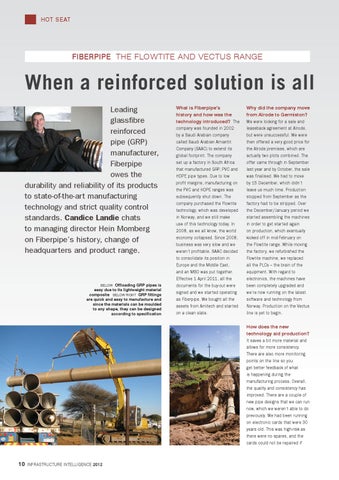
BELOW Offloading GRP pipes is easy due to its lightweight material composite BELOW RIGHT GRP fittings are quick and easy to manufacture and since the materials can be moulded to any shape, they can be designed according to specification
What is Fiberpipe’s history and how was the technology introduced? The company was founded in 2002 by a Saudi Arabian company called Saudi Arabian Amiantit Company (SAAC) to extend its global footprint. The company set up a factory in South Africa that manufactured GRP, PVC and HDPE pipe types. Due to low profit margins, manufacturing on the PVC and HDPE ranges was subsequently shut down. The company purchased the Flowtite technology, which was developed in Norway, and we still make use of this technology today. In 2008, as we all know, the world economy collapsed. Since 2008, business was very slow and we weren’t profitable. SAAC decided to consolidate its position in Europe and the Middle East, and an MBO was put together. Effective 1 April 2011, all the documents for the buy-out were signed and we started operating as Fiberpipe. We bought all the assets from Amitech and started on a clean slate.
Why did the company move from Alrode to Germiston? We were looking for a sale and leaseback agreement at Alrode, but were unsuccessful. We were then offered a very good price for the Alrode premises, which are actually two plots combined. The offer came through in September last year and by October, the sale was finalised. We had to move by 15 December, which didn’t leave us much time. Production stopped from September as the factory had to be stripped. Over the December/January period we started assembling the machines in order to get started again on production, which eventually kicked off in mid-February on the Flowtite range. While moving the factory, we refurbished the Flowtite machine, we replaced all the PLCs – the brain of the equipment. With regard to electronics, the machines have been completely upgraded and we’re now running on the latest software and technology from Norway. Production on the Vectus line is yet to begin. How does the new technology aid production? It saves a bit more material and allows for more consistency. There are also more monitoring points on the line so you get better feedback of what is happening during the manufacturing process. Overall, the quality and consistency has improved. There are a couple of new pipe designs that we can run now, which we weren’t able to do previously. We had been running on electronic cards that were 30 years old. This was high-risk as there were no spares, and the cards could not be repaired if
10
INFRASTRUCTURE INTELLIGENCE 2012