GASnews
SPRING 2019 VOLUME 30 ISSUE 1
INSIDE
3 Letter from the President 3 Letter from the Editor 4 Gillian Preston: The Power of Process 6 2019 Strattman Conjecture: Hyperopia Projects
Collaborates with Educational Programming in an Effort to Re-examine Process in Glass Flux
8 Light in Hand: The Art of Plasma and Neon 11 Matter Over Mind: The Power of Making and Made Things 14 The Unseen Installation 18 Why Don't They Want It? How Glass Works of Art
Reach Museum Collections
20 GAS Resource Links Cover: Gillian Preston, Large Clear Kinetic Necklace – Photo: Gillian Preston
GAS news
GASnews is published four times per year as a benefit to members.
Glass Art Society Board of Directors 2018-2019
Contributing Writers: Regan Brumagen, Jennifer Detlefsen, Tyler Kimball, Jamie Marie Rose, David Schnuckel, Jan Mirenda Smith Editor: Michael Hernandez Graphic Design: Ted Cotrotsos*
President: Natali Rodrigues Vice President: Tracy Kirchmann Vice President: Jessica Julius Treasurer: Heather McElwee Secretary: Kelly Conway
Staff Brandi Clark, Interim Executive Director Kristen W. Ferguson, Operations & Program Manager Helen Cowart, Office and Membership Manager Cathy Noble-Jackson, Part-time Bookkeeper *part time/contract
Matt Durran Glen Hardymon Mike Hernandez Nadania Idriss Jeff Lindsay Lynn Read Debra Ruzinsky Masahiro Nick Sasaki Jan Smith Demetra Theofanous David Willis Caitlin Vitalo (Student Representative)
2208 NW Market St., #200, Seattle, WA 98107 USA Phone: 206.382.1305 Fax: 206.382.2630 E-mail: info@glassart.org
Web: www.glassart.org
Š2018 The Glass Art Society, a non-profit organization. All rights reserved. Publication of articles in this newsletter prohibited without permission from the Glass Art Society Inc. The Glass Art Society reserves the right to deny applications for Tech Display, advertising participation, GAS membership or conference participation to anyone for any reason.
2
GASNEWS
SPRING 2019
VOLUME 30, ISSUE 1
PRESIDENT’S LETTER My dear fellow members, This GASnews finds some of you in the middle of Spring, where gardens are being tended, and the remnants of winter washed away. I am writing this letter in the middle of a blizzard, full of fat wet flakes that have closed the roads and the world seems to be blanketed in quiet. A snowstorm like this just means Spring and Summer are right around the corner. This edition of GASnews is an investigation into process. Process as a way of knowing things like material, time, experiencing, embodiment, and language. Process is the thing we, as glassmakers and artists, are responding to and actively engaging with. We make things that range from the functional all the way to the performative. Works that question how we perceive, tell stories, and think about glass as a material and as an experience. These articles reflect the breadth of the current thinking around process, spanning what David Pye has defined as the Workmanship of Risk and the Workmanship of Certainty. What ties this group together is an orbit around embodiment, the idea that “we know not through our intellect but through our experience.” 1 You will find very interesting articles in this edition about artists like Amy Lamaire, who uses process as a way to explore phenomenological opportunities. She works with plasma, highlighting the way plasma moves as it searches for ground. As Lamaire says, “The plasma does that, and the viewer becomes a part of the piece by completing the circuit through touch. It’s a literal, physical representation.” The viewer works recursively to finish the work with a touch that Amy has begun in the studio. Process transfers from maker to viewer, bringing to light, in a literal manner, the conceptual underpinnings of the work. Process can be a way of knowing and unknowing. David Schnukel’s article is an investigation into Hyperopia’s collaborative and cooperative project Glass Flux. They have developed pedagogical strategies to activate a kind of generative experience with the Workmanship of Risk which forces the students to rely on what they experience rather than what they know. This is a process that embraces experimentation and play as a grounding force in glass practise, echoing impulses found in the early studio glass movement. In reading this edition of GASnews, I have been struck by the ways we as a community rely on process as a way to understand our material and all its ensuing potential. I hope you enjoy this edition as much as I have.
1. Maurice Merleau-Ponty, Phenomenology of Perception, 1945
Warm regards,
Natali Rodrigues, President, Board of Directors
GASNEWS
W S PI N R ITNE G R 2014 9
V O L U M E 32 0 5, ISSU U EE 41
EDITOR’S LETTER Process is a ritual. We associate process with focused, laborious investments of skill and time, training the hand to perform the work our mind’s eye. Many identify with a process to provide creative direction, align with a tradition, and associate with a community. While we associate the artistic process with expression, there are many processes that govern creative careers. There are many cogs in the machine that are the logistical and practical processes of putting our glass work in the hands and views of an audience. This issue of GASnews explores what lies behind the scenes and below the surface of the making processes. In the many facets that we occupy, from the practical and logistical to the conceptual and interpretive, the glass field conducts processes that are essential to our careers. Jen Detlefsen discusses Gillian Preston’s work, where process becomes a way to layer story with ornamentation. She uses blown glass blanks to build layers of color and develop cascading forms. Her glass objects adorn the body with color and layers of sensuous pattern. For Preston, process provides the vocabulary and ground on which emotive and evocative objects are built. While there is a great romance to the processes of artistic production, there are equal, if not greater considerations in the logistics of displaying our work. For the Spring issue, Tyler Kimball provides a look behind the curtain of installation art. He describes the depth of logistical concerns that artists Martin Blank and Kathy Barnard must coordinate in the realization of large-scale glass work. The curatorial community attends to a host of processes in the interpretation and acquisition of artworks. Jan Smith describes the depth of concerns that museum staff must negotiate in taking on donated works, and Regan Brumagen uses a class project to illustrate the opportunities of accessing historical documents of the Rakow Library with rich ground to explore the nuances of the collection.
Michael Hernandez GASnews Editor
3
GILLIAN PRESTON: THE POWER OF PROCESS by Jennifer Detlefsen
Dahlia Necklace, an example of hand-drawn imagery translated into glass. Photo: Gillian Preston
Take a walk through a jewelry trade show. It’s guaranteed to tantalize your senses with objects designed to catch the eye and caress the body. The makers have spent years, even lifetimes, honing their craft, maximizing sparkle and style while also streamlining their system for peak efficiency. But you won’t see the behindthe-scenes sweat and grime in this swanky environment – only the coveted final product. At least, that’s how it used to be. Times are changing, and today’s customers are hungry for context. They want the story behind the object, to meet the maker and get a feel for the work that goes into their purchase. The same force driving restaurants to name the specific cattle ranch where your ribeye roamed is making its way into the market for upscale handmade goods. Gillian Preston has a process story that seems tailor-made for this cultural zeitgeist. Broken Plates is her line of handmade glass wearables that range from candyglossy earrings to geometrically intricate cuffs and kinetic necklaces (more on those later). The name is an allusion to
4
Green Sculptural Necklace and Cuff Set. Photo: Gillian Preston
the genesis of these items: juicy colored rondels that Preston gaffs at Pittsburgh Glass Center. This is only the first step in a complex series of machinations that utterly transform these blown color blanks. Preston got her start at the Cleveland Institute of Art, where she majored in glass with a concentration in drawing. She imagined she would follow the traditional glassy route of cup making and concept driven work. In a quirky twist of fate, Elvis himself rerouted Preston into the world of production jewelry. After graduating, Preston had limited access to the hot shop but a small kiln in her apartment. She had been experimenting with glass imagery in her conceptual practice and was prompted to make some Elvis-emblazoned cuff bracelets for a small works show. They were a hit. Despite her limited experience as a jewelry maker, she quickly realized this was an avenue to support her art while refining her craft. Preston developed a signature style that foreshadowed what would become an ever-intensifying layering of process. The resulting practice straddles the worlds of ancient craft and cutting-edge
GASNEWS
technology. Grounded in the rondel, one of the most recognizable and ubiquitous forms in the history of glassmaking, she has embraced an expanding technological arsenal as the work has evolved. Originally, Preston hand-cut her rondels into botanical shapes, then covered them with a photo-resist stencil that she developed from her own drawings. She then sandblasted their surfaces to reveal the delicate imagery, the clear glass allowing the wearer’s skin or clothing to become the contrast. To save herself from the arduous task of hand cutting and grinding these shapes, Preston discovered the waterjet cutter at a local makerspace. These machines use a digital design to cut shapes out of glass and other materials. Unlike other automated fabricators, waterjet cutters use water and abrasives as their cutting tool, making them particularly well-suited to working with glass. There is still breakage inherent in the process – but after experimentation, Preston added the step of kiln-slumping her rondels before cutting to make them as uniformly flat as possible. With that adjustment and her move to an industrial machine which is
SPRING 2019
VOLUME 30, ISSUE 1
better maintained, she has minimized her margin of error and begun to feel a sense of mastery over the method. The waterjet cut leaves a relatively clean line, one suitable for most measures but not quite the silky perfection needed in a line of fine jewelry. Preston hand polishes the edges, adds the sandblasted imagery as needed, and then brings the work back to the kiln for a final slump or gloss-up. All of the finish work is completed in Preston’s new studio – an industrial building in Pittsburgh which she recently purchased and revamped to include a cold shop, prototyping area, the space and infrastructure for several kilns, a display wall and extra studio spaces for which she hopes to find tenants now that renovations are nearing completion. At this point in time, Preston has diversified her line into two distinct categories – the aforementioned rainbow of gummy goodies, and her new series of kinetic jewelry. Preston begins this work by modeling shapes on the computer using Adobe Illustrator. She prototypes new designs in sheets of acrylic, experimenting with silhouettes and forms to come up with combinations that flatter the contours of the neckline and provide subtly sinuous movement during wear. The clear acrylic mimics the subtly tinted sheet glass that Preston reserves for the final iteration. When she finds a combination that works, she takes it to the waterjet, cutting out both the design and a hole template that drastically reduces breakage in the hardware addition step of assembly. This prototyping process has of late been a major inspiration to Preston, who has begun to play around with the possibilities of working in larger forms, including lighting elements. The reduced material cost of working with acrylic has reactivated her desire to make things on a larger scale – and sparked consideration of new ways to make her forms. Hot molds could take a laborious process of “cut-grind-hole cut-
GASNEWS
W S PI N R ITNE G R 2014 9
Behind the Scenes: An ellipse necklace being designed and prototyped in Adobe Illustrator. Photo: Gillian Preston
kiln polish-assemble” to a much simpler one of “gather-squish-anneal.” Even so, the unique facets of the objects she’s created will bear the mark of an interesting history – something that could only have been arrived upon after multiple generations of making. When Preston first started attending trade shows several years ago, she intuitively sold her story as a part of her work – including descriptive explanations and process shots, imbuing her work with the sexy allure of the hot shop. She was advised more than once that this effort would go unrewarded; people would respond much better to a sleek and elegant booth than to a didactic poster explaining how a rondel goes from molten blob to fancy platter. She adapted to fit the needs of the environment. Now, the pendulum has swung back toward the primacy of storytelling, and at the most recent NYNow trade show, Preston was invited to give in-depth demonstrations of her process to a rapt audience. For a community of people dedicated to a medium that is unruly, unpredictable and
V O L U M E 32 0 5, ISSU U EE 41
challenging to master, this is unequivocally good news. In almost every case, the pieces we as makers labor over to design, refine and market are capable of being mass-produced elsewhere for less than what it costs us to run a single kiln cycle in the process. The only way to stand out in the crowd is to market the story behind the work. The process hashtag, with over 3.2 million entries, is one of the leading trendsetters on Instagram, as more and more people spend their downtime watching “DIY” and “work in progress” videos for the satisfaction of vicarious handiwork. In this atmosphere, those who revel in detailed, multi-layered, time-intensive processes are uniquely positioned to thrive. For Preston, who freely admits to being someone who likes to push boundaries, it’s thrilling to imagine what a few more years of innovation and limit testing will produce. Jen Detlefsen is a maker, mother, writer, and veteran based in Norfolk, Virginia.
5
2019 STRATTMAN CONJECTURE:
HYPEROPIA PROJECTS COLLABORATES WITH EDUCATIONAL PROGRAMMING IN AN EFFORT TO RE-EXAMINE PROCESS IN GLASS FLUX by David Schnuckel Far left: C. Matthew Szösz, courtesy of Hyperopia Projects Left: Kim Harty, courtesy of Hyperopia Projects
Charting a Course: Visions in Glass was the title for the 48th annual GAS Conference and its programming was directed toward conversations to identify and explore new trajectories within our field. Undertones of voyage, exploration, and discovery were implied as the focal points within scheduled Conference lectures, panels, and presentations. Some of the programming was pointed to identify key changes within various aspects of the field. Others highlighted efforts to introduce progressive responses to issues of tradition, history, and convention as an opportunity to navigate – even perpetuate – the new. In fact, the 2019 Wayne Strattman Critical Dialogue Lecture at the St. Petersburg Conference was designed to specifically address the topic of redirection, risk, and discovery as it relates to process within educational programming. The collaborative alliance of Hyperopia Projects was selected to present the 2019
6
Strattman Lecture titled “Glass Flux: Disrupting Craft.” In their presentation, Hyperopia members C. Matthew Szösz (independent artist), Kim Harty (artist and Assistant Professor and Section Head of Glass at the College for Creative Studies in Detroit, Michigan) and Sean Salstrom (artist and Assistant Professor of Glass at the Rhode Island School of Design, Term Replacement) addressed the development and findings of Glass Flux, a hot shop process-based educational intervention facilitated over the past academic year. The Glass Flux project comes from two areas of consideration as indicated by Hyperopia. The group first holds a mutual interest in historical forays of the experimental as an entry point into creative activity. Instances such as Surrealist art making games, instructional art (as facilitated by Sol LeWitt) and the Fluxus art movement are conduits which Hyperopia was looking and thinking through in regards to the traditions and histories
GASNEWS
of molten glass working protocol. “We are hoping to generate a bit of synergy between these two notions,” states Hyperopia. “To take the idea that the core of a practice may be the physical act of making and marry it with intellectual strategies that employ physicality, experimentation, and improvisation to drive creativity.” Aimed at students enrolled in college programs, Hyperopia reached out to various educational entities across the globe in the Fall of 2018 to seek Glass Flux participants. For those who agreed, Hyperopia distributed a pamphlet of 29 instructional activities, scores, games, recipes, and exercises for the hot shop that were based on spontaneity, obstruction, ambiguity, and/or limitation for student participants to choose from. Some options within the Glass Flux pamphlet extend from historical sources of improvised creation such as “Alarm Clock”, adapted from A Book of Surrealist Games.
SPRING 2019
VOLUME 30, ISSUE 1
“2019 Strattman Conjecture” Photo: David Schnuckel
An option where players set a stopwatch to a random time, are tasked to create something within that time and, when the stopwatch goes off, players attach their improvised piece to each other’s in an equally unscripted manner. Other options were adapted from a contemporary glass artist’s approach to the unorthodox such as “Reassemble”, a nod to Peter Ivy. A task asking participants to blow a two-gather tumbler as large as possible and to then forego annealing it. To let it deconstruct before them after its making and then go about re-assembling the fractured object using strictly mechanical means. Some options in the pamphlet were created by Hyperopia Projects themselves. “Predicament”, a Hyperopia challenge, asks players to join all hot-working tools together on a large key ring and devise a way to still use them – amidst the complication and interference of all the other attached tools - in the making of a hot glass object. The spectrum of risk and restriction within the Glass Flux pamphlet of processbased challenges is incredibly diverse. Exploratory ventures that students were not only asked to engage in but to record and document in whatever means necessary.
GASNEWS
W S PI N R ITNE G R 2014 9
Participants were then asked to submit their documented experiences back to Hyperopia through an online submission process. “We are hoping that [Glass Flux] might be associated with a discussion of how making happens, how we define creativity, and what the relationship of artist to process [is],” adds Hyperopia. “We are also hoping to expose students to activities that may cause them to examine their values in the hot shop setting, their approach to making, or help to free them from the constraints that formal ideas of success may have placed upon their creativity.” Hyperopia’s analysis recognized a pattern in how artists engage the hot shop, whether their practice resides in the experimental or seeks proficiency in blowing glass. Regardless of whether the end of the blowslot culminates in the vessel or a hot mess, both camps of practice are in love with their respective approaches to process. It’s the activity – the creative engagement of “doing” – that Hyperopia takes interest in as an artful gesture on its own. David Schnuckel is an artist and educator, currently Assistant Professor of Glass at the Rochester Institute of Technology in Rochester, New York.
V O L U M E 32 0 5, ISSU U EE 41
5 7
LIGHT IN HAND: THE ART OF PLASMA AND NEON by Jamie Marie Rose Neon and plasma exist at the intersection of artistically fascinating and technically complex. While we have all undoubtedly witnessed the majesty of a vibrant neon sign, many of us are probably at a loss as to how such light contained within a glass tube is possible. Plasma arguably generates an even greater sense of mystery, with a field that can be interacted with and can move organically in a mesmerizing visual display. While you stare in wonder, you may question how these visually stimulating effects are produced. Simply put, electricity. For neon, a glass tube is bent into the desired form using various torches. The tube is then “bombarded.” This is a process of heating up the glass with high voltage electricity while a vacuum pump extracts all air and impurities from the tube. After the tube has been heated to 300˚ C and cooled, the glass is filled with a tiny amount of inert, noble gas, sometimes with the inclusion of mercury depending on the desired color. Neon alone will create a red-orange glow; argon a soft lilac by itself or an intense blue with the inclusion of vaporized mercury; and so on. Once the glass tube is filled, it is charged with an electrical current. While noble gasses typically remain stable, a steady electrical current will excite the electrons surrounding the atoms’ nuclei enough that they jump to a higher orbit of energy. But this state does not last forever. When the electrons inevitably fall back to their original, lower orbit, they release the excess energy by emitting photons. Light. It is a rare individual who can both create in this way and also work conceptually with the material. It is, perhaps, why so many artists who utilize neon in their practice have never so much as lit a torch. The vibrant light produced by neon is alluring; the painstaking and timeconsuming process of creating that glow… not so much. Something is lost when one decides to forgo the process for the sake
8
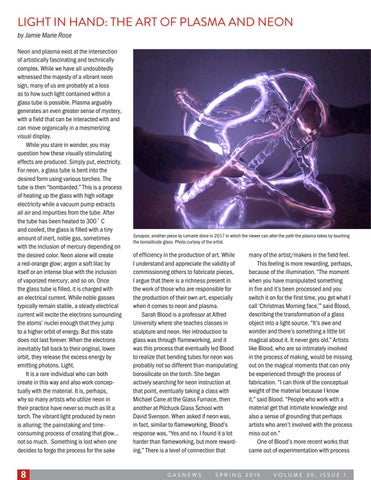
Synapse, another piece by Lemaire done in 2017 in which the viewer can alter the path the plasma takes by touching the borosilicate glass. Photo curtesy of the artist.
of efficiency in the production of art. While I understand and appreciate the validity of commissioning others to fabricate pieces, I argue that there is a richness present in the work of those who are responsible for the production of their own art, especially when it comes to neon and plasma. Sarah Blood is a professor at Alfred University where she teaches classes in sculpture and neon. Her introduction to glass was through flameworking, and it was this process that eventually led Blood to realize that bending tubes for neon was probably not so different than manipulating borosilicate on the torch. She began actively searching for neon instruction at that point, eventually taking a class with Michael Cane at the Glass Furnace, then another at Pilchuck Glass School with David Svenson. When asked if neon was, in fact, similar to flameworking, Blood’s response was, “Yes and no. I found it a lot harder than flameworking, but more rewarding.” There is a level of connection that
GASNEWS
many of the artist/makers in the field feel. This feeling is more rewarding, perhaps, because of the illumination. “The moment when you have manipulated something in fire and it’s been processed and you switch it on for the first time, you get what I call ‘Christmas Morning face,’” said Blood, describing the transformation of a glass object into a light source. “It’s awe and wonder and there’s something a little bit magical about it. It never gets old.” Artists like Blood, who are so intimately involved in the process of making, would be missing out on the magical moments that can only be experienced through the process of fabrication. “I can think of the conceptual weight of the material because I know it,” said Blood. “People who work with a material get that intimate knowledge and also a sense of grounding that perhaps artists who aren’t involved with the process miss out on.” One of Blood’s more recent works that came out of experimentation with process
SPRING 2019
VOLUME 30, ISSUE 1
Telltale Truth, a plasma piece done by Echols in 2015. Photo: John B. Klien
and mixed media is titled, I’m so Fucking Tired, done in 2017. While the neon emits a mesmerizing glow, it is far from the only striking part of the piece. Three thousand sequins behind the neon reflect the light, which then move as they are blown about by a cheap, oscillating fan installed in front of the piece – one which is adorned with just the right amount of gold streamers to read as what one could only describe as ‘sad.’ The brightness of neon and the seeming playfulness of sequins and streamers may read as joyful in another context, but they are quickly seen as a façade in this piece. Glittering, dark humor. “Everyone brings their own baggage to the work,” said Blood. “I have very personal reasons behind the work, but it also speaks to feminism, toxic masculinity, visibility and invisibility, and façade… but it’s not important that people know my story. It’s about the viewer bringing their own.” There are, within the plasma and neon community, different “camps.” Despite the similarities in the process, the mediums are, in large part, used in dramatically different ways. For Blood, the result isn’t one that interests her. “I can’t get behind it artistically,” she admits. “The quality of light is different. There’s activity with plasma, a movement that you don’t get with neon. The phenomenology is amazing, but I can’t get past the novelty. It’s exciting GASNEWS
SPRING 2019
Amy Lemaire working in the studio at Salem Community College. Photo: Matt Lim
and cool, but conceptually, I can’t pin anything on it, although I appreciate it when people can.” One person who has found the potential for conceptual grounding in plasma is Amy Lemaire. Lemaire is an artist and instructor who teaches out of UrbanGlass in Brooklyn and is also currently a flameworking artist-in-resident at the Tyler School of Art. Lemaire’s practice revolves around flameworking. Recently plasma, in conjunction with her borosilicate vessels, has become a large part of her conceptual process. “I’m working with the idea of currency and exchange,” said Lemaire. “The plasma is searching for ground, and you can see that search. There’s a lot of question in the form, but I’m interested in the inside of the vessel What’s happening in there? as a place for searching. The plasma does that, and the viewer becomes a part of the piece by completing the circuit through touch. It’s a literal, physical representation.” Lemaire has been using glass and plasma as a part of her social practice for the past few years. Thus far, she has always been present when exhibiting her recent work. Lemaire explains the plasma (which is rarely recognized by viewers) and the effect that interaction has on the piece, and an experience – as well as knowledge – is shared. VOLUME 30, ISSUE 1
“There’s a performative element, but it’s also practical,” Lemaire explained, “I use a lot of experimental processes. These pieces are not archival; I don’t know how long they’ll last. They aren’t processed like traditional neon tubes are, where everything is cleaned really well and you want a good pump every time. I’m not interested in that. I play around with what materials can be left inside the vessel while it’s being processed.” For Lemaire, the experimentation with leaving inclusions in the vessel while it’s being processed is still in its exploratory stages. “I’ve come across some effects that I like so far, but right now I’m really just using plasma as a medium for exploration. I’m trying to push it in ways that I’ve never seen before.” Lemaire offered, “One of the reasons I like to use it as a performative aid is that it helps me explore more. It gives me information that’s useful.” In Lemaire’s case, going through the procedure of making with something as enigmatic as plasma brings a deep consciousness to the work. “For me, using plasma is about making a connection, so it wouldn’t make sense to have someone else fabricate the work without my involvement,” Lemaire said. “It would be like telling someone, ‘Go on this journey for me. Explore this and let me know how it goes’. It wouldn’t work. It wouldn’t be authentic.”
9
Left: Scenic Route, a piece done by Lemaire in 2017. Photo courtesy of the artist. Right: Synapse, another piece by Lemaire done in 2017 in which the viewer can alter the path the plasma takes by touching the borosilicate glass. Photo courtesy of the artist.
One piece that has come from Lemaire’s exploratory process is titled Scenic Route, done in 2017. The piece is a cube maze made of borosilicate glass with electrodes on either end, containing a ball which rolls freely within the tubes. Viewers can play the game, rolling the ball from one end to the other and winning the maze. But when it’s electrified, the plasma line also plays the game by finding the quickest route – electricity finding the path of least resistance. There are two different variables that function relative to one another; one of the player moving the ball through the maze however they can, and the other of the physics of the plasma in the same piece at the same time. “It sets up this relationship between the two paths,” said Lemaire. “It talks about the fact that we are in an age where so many things are controlled digitally and powered by electricity. How does that influence our ability to operate beside that? What is the relationship between the paths we chose as humans alongside these other, newer sets of solutions that we choose to adopt or reject?” There are a growing number of artists who are interested in learning how to work with glass, electrical currents, and light. Rather than commission an outside fabricator to complete this work, many go to glass studios where they can consult with technicians and other, more
10
Sarah Blood working in the neon studio at Alfred University. Photo: Zack Lyman
knowledgeable artists for assistance. Percy Echols is an independent contractor and plasma and neon Technician at the Pittsburgh Glass Center who often works with such artists and is also an artist himself. Additionally, he is the host of a blog and podcast entitled ‘Taming Lightning.’ Echols uses the podcast as a tool for sharing ideas and exploring the potential for neon and plasma. Just a few of the artists Echols has worked with include Daria Sandburg, Mundy Hepburn, Robert Mickelson, and John Sharvin. While he considers himself more as a technical overseer, Echols has noticed that, through collaborative exploration, the artist’s original vision often shifts. “By investigating innovative methods of manipulating neon or plasma, we discover new ways of using it,” said Echols. “And that affects the work and helps us generate new ideas for the future.” When it comes to his personal work, Echols is interested in the interactivity of light, and so he is drawn to plasma over neon. “Plasma is great because it helps remove the barrier that typically surrounds glass – the innate fear of being too close to it. Plasma invites the viewer to not only get closer but to touch it. It makes the work interactive and playful in a way that you rarely see with glass.” Echols piece, The Telltale Truth, is GASNEWS
a set of lungs with faces illuminated by plasma, inviting the viewer to connect with an otherwise repelling representational object. “It draws inspiration from my grandmother,” said Echols. “I learned after her passing that she was our family orator or story-teller. It sort of sunk in that after a while people will only get to know you through stories, so it's important to take care what you listen to and what you say, as those can become ‘truth.’” Echols is also working on another series which – like so much of plasma-related work – is still in progress. There is no doubt that the artistic fields of neon and plasma are rapidly developing. With artists like Sarah Blood, Amy Lemaire, and Percy Echols leading the charge, there is a higher standard for presenting conceptual ideas within an experimental, highly technical field. The progress of artists embracing these processes, with more refined approaches to plasma and neon, will continue to infiltrate and find new audiences in the world of fine art. Given the recent development in these fields, I imagine that we will be seeing some highly innovative, and conceptually engaging illuminated works in the years to come. Jamie Marie Rose is an artist and writer from Illinois. She is currently an MFA candidate at Alfred University.
SPRING 2019
VOLUME 30, ISSUE 1
MATTER OVER MIND: THE POWER OF MAKING AND MADE THINGS by Regan Brumagen People come to libraries to study the knowledge contained in media: printed words, images, or sound and video files. Except when they don’t. Sometimes they come to libraries to study the artifacts that contain the written word, the ink that stains the fleshy pages of an old manuscript, or the leather cords that bind the pale, stiff parchment together. What do they hope to learn? Sheryl Boyle, associate professor at the Azrieli School of Architecture & Urbanism at Carleton University in Ottawa, Ontario, brings her graduate students to the Rakow Research Library hoping they have the chance to learn their craft more fully by engaging with original medieval texts, although her students could easily view our digitized manuscripts online. These texts are themselves the work of makers who lived hundreds of years earlier, yet the vellum and parchment pages, the ink, and the intricate rubrication all have withstood use, misuse and natural disaster for centuries. The pages contain both the knowledge inked on the page and the knowledge encapsulated in every stitched binding, historiated initial, and instance of marginalia. Boyle teaches Daedalic Exercises, a course in which she asks her students to, among other things, explore medieval “maker” texts, select one set of instructions from a text, find or create the necessary components, and follow the directions to re-create the original item. She hopes that, by getting immersed in the process of making, and learning intimately about their tools and materials, students will deepen their understanding of what it means to be a maker and to create. As Boyle notes, The Corning Museum of Glass offers a great opportunity to explore this practice. The Rakow Library owns an outstanding collection of early technology manuals, both original manuscripts and modern editions; The Studio has making facilities; and The Museum, of GASNEWS
SPRING 2019
Carleton students observe Studio glassblower at work. 2017. Courtesy of The Corning Museum of Glass.
Carleton students with Beth Hylen, Rakow Library, viewing manuscripts, 2017. Courtesy of The Corning Museum of Glass.
course, offers the chance to see the finished product on display. We have been fortunate to host several visits from Carleton University as they work through this exercise. Students visit the Library to look at originals and translations of their selected texts, visit the Studio to make glass, and tour the Museum. VOLUME 30, ISSUE 1
One student selected Vannoccio Biringucci's 1540 text De La Pirotechnia and made glass using a recipe from the book. Another student examined a recipe in the Mappae clavicula, ordered supplies from online (including gallnuts), and made ink. The Mappae clavicula has been a source of inspiration for more than one
11
Foldout illustration of a lampworker at his bench from Die Glasschmelzkunst, bey der Lampe (1769). Collection of the Rakow Research Library. CMGL 92630.
group of students. One Studio class created contemporary interpretations of books after visiting the Library. The binding of the 12th century manuscript intrigued several artists in the class, including instructor Mel George and her student Gabrielle Li, who came to the Library to examine the medieval book of recipes and then used the manuscript to inspire their own works in glass. Other researchers, of course, have explored our historical collection of technology manuals in more traditional ways: to track the development of glassmaking processes over time, to help them understand how historical objects were created, or to understand labor and working conditions through the centuries. Boyle’s students were all fortunate to be able to visit the Library and view our collections in person, but not everyone can or needs to see the original medieval and early modern texts. To meet the needs of most researchers, the Rakow Library makes every effort to digitize our unique materials and disseminate them as widely as possible. To the extent we can, we want to share our collections with the world.
12
Are you interested in exploring early technology books? See some examples below or contact us at Ask A Glass Question for more in-depth information on searching our online collection or visiting the Rakow Library in person. The Art of Glass Making by Sidney Waugh (1937). Waugh wrote his book on decorative glass processes when he was designing for Steuben Glass. Curiosities of Glass Making by Apsley Pellatt (1849): Pellatt’s book has been reproduced many times and contains a summary of historical glass processes as Pellatt, a glassmaker himself, understood them, as well as glass manufacturing in the 19th century. De la Pirotechnia (1540) by Vannocchio Biringuccio: One of the earliest books on metallurgy, Pirotechnia also covers glass and glassmaking in a chapter that includes fine wood-cut illustrations. De re Metallica (1556) by Georg Agricola: One of the first technological books of modern times, covering the mining industry, metallurgical processes, and the manufacture of glass, De re Metallica shows the glass manufacturing operation, GASNEWS
the furnace, and some of the finished ware being carried off for sale. Die Glasschmelzkunst, bey der Lampe (1769): Overview of lampworking and glassblowing, this German text shows a lampworker at his table, encircled by images of lampworked items he has presumably created, including an eye, a flower and a satyr. Mappae Clavicula (12th century): The Mappae Clavicula contains over 200 recipes for making various substances used in art and craft. In these formulas, ingredients found in the natural world are combined to produce a variety of colors and metallic effects such as gold, silver, and copper for painting, writing, and gilding and staining glass. Some recipes have fantastical-sounding elements such as dragon’s blood, although (sadly) that may have been the name for a common dye. Oil Painting on Glass by Thomas Gullick (1892). Gullick’s book includes information on painting on mirrors as well as silvering of mirrors. Regan Brumagen is Associate Librarian for Public Services at the Rakow Research Library, The Corning Museum of Glass.
Plate showing a glass furnace with workers from Agricola’s De re metallica. (1580). Collection of the Rakow Research Library. CMGL 66821.
SPRING 2019
VOLUME 30, ISSUE 1
Plate from Pellatt’s Curiosities of Glass making (1849) illustrating cane and millefiori. Collection of the Rakow Research Library. CMGL 28365.
Manuscript page from the Mappae Clavicula (12th century). Collection of the Rakow Research Library. CMGL 29711.
GASNEWS
SPRING 2019
VOLUME 30, ISSUE 1
13
THE UNSEEN INSTALLATION by Tyler Kimball
Martin Blank, Current, displayed at the Tacoma Art Museum in Washington. Photo: Terry Richel
Permanent, large-scale glass installations uniquely display an artist’s vision, energy, and time. The success of these installations is in the artist’s ability to make a visually dynamic experience through sheer volumes of glass components coming together. Often, many months that are often spent in the studio with the artist and team developing the core visual appeal through the manipulation of material. But, there is even more than meets the eye in the process of these breath-taking installations. The logistics of this process are often unseen, yet tend to be the most important parts to bring the artist’s vision to realization of a complete installation. From proposals and meetings to engineering and insurance, much of the work behind large-scale glass installations do not show through in the finished piece. These essential steps go unseen by the viewer, but without great consideration and planning, there would be nothing to see at all. 1. Initial Proposals Installation artists can work for months on concepts and proposals before any contracts are signed. These can take a number
14
of Some artists require financial deposits for the labor of sketches and calculations, but some will work fully on faith that the project will land. Martin Blank, a material sculptor that has pioneered large-scale architectural glass in-stallation, has pitched projects with no deposit on numerous occasions, and feels confidence and courageousness can speak volumes to clients. Speaking about a recent installation in New York City, at 99 Church Street, where he pitched concepts simply from the client’s interest and without upfront agreements, “It’s a capital investment. It’s an investment in yourself,” Blank states, “you’ve gotta wow them and win them over.” When proposing designs and concepts, the room is often full of powerful people, architect teams, and other design professionals. An artist, no matter how accomplished, can often be the least familiar with engineering standards and commercial real-estate guidelines. Going in with confidence and assurance is key during the initial concept and development meetings. “These people are building the world around us. These guys are a big deal,” Blank says about proposal meetings. GASNEWS
“For every meeting you have, it’s the most important meeting you’ll ever have.” Kathy Barnard, an architectural glass artist specializing in large corporate and public windows from Kansas City, Missouri, can also attest to the importance of confidence in a project proposal scenario. “It’s not just your work,” Barnard says, “it’s also how you present yourself and knowing you’re the right fit for the job.” Concepts can come in many different shapes and forms and each installation can call for different levels of details in the early stages. Artists can come into a project with anything from a simple sketch to a full portfolio of renderings, engineering specs, budget analysis, and full production timeline. Projects can arise in different ways as well. They can be sought out or the artist themselves can be sought by the developers. And through an installation artist’s career they may see the transition from the seeker to the sought. Barnard revealed, “It’s hard to go after the larger installations if you haven’t done it before.” And Blank adds, “it’s all about the first one. Once you get the first one, you’ve proven yourself and you people know you can do more.” Not every concept lands a job by any means, but every effort pushes an artist to de-velop and learn. After a lost bid for a church window installation nearly 20 years prior, Barnard recently interviewed for a similar project in the same area. Some of the panel members overlapped in the two projects. The council members had enjoyed her work in the prior proposal and had not forgotten her or her work. She won the job in the second meeting with the panel. She also speaks highly of the lost job from decades prior, in that it forced her to learn Powerpoint, which she has used to her advantage ever since. 2. Contracts Many installation artists believe that a contract lawyer is a wise investment, including both Barnard and Blank. Blank
SPRING 2019
VOLUME 30, ISSUE 1
Night view of Martin Blank’s Steam Portrait at 99 Church St., NY. Photo: Seth Wolfson
course the install team as well as all the other itemized costs that need to be added up into a final figure. If it’s not all there in the budget summary before contracts are signed and work begins, an artist can end up on the losing side. A thorough check of the budget is paramount. 4. Engineering Putting together a nice sketch or rendering for a space might look good on paper, but architects, engineers, and other design professionals are drawn more to the mechanics of the display than final look of the piece. Engineering and hardware matching up to structural codes is an absolute must for commercial buildings. If an artist’s designs don’t have these factors considered, there’s a good likelihood that any designs proposed will be met with a hard pass. Many installation artists, like Barnard and Blank, have an engineering consultant they turn to in order to complete a concept with all the logistics of hanging hardware
does not take the contract portion of an install lightly. “Have a solid contract going in. This is business.” Blank continues, “Just because you’re an artist doesn’t mean you don’t get paid.” These contracts will cover everything from progress payments to insurance to guaranteed install dates. Both Barnard and Blank have signed contracts with “upon artist’s death” clauses that state that the show must go on, with or without the artist. Having set levels of completion to guide payments is orthodox in an installation contract that can be drawn out for multiple years. This allows both the client and the artist to feel secure in such a long-term process. 3. Budget Setting a price for an installation piece can be one of the most difficult tasks of the entire process. Sometimes a budget is in place and the piece needs to be designed to fit into the established price and other times a space is required to be filled and the budget needs to be offered to the GASNEWS
SPRING 2019
client from the artist. Either way, it can restrain design and aesthetic if the budget is too tight. Barnard has dealt with small budget projects that can often leave both parties unhappy with the final piece. She feels sometimes it’s better to walk away from one that is too small for the scope of work desired. “[The budget] is another piece of the puzzle. A lot of times you have to educate the client,” Barnard says about the mouth-blown sheet glass she uses in her work, and the addition it can provide for cost and aesthetic, “If it’s an unrealistic budget for a window, then maybe they need less expensive machine-made glass or plastic.” In knowing the budget before the design, a proposal can turn into more of a mathematical equation than anything else before it is submitted. An artist will need to figure out the time spent creating the piece, the raw materials, insurance costs, engineering consultation, hardware costs, equipment rentals, shipping costs, and of
VOLUME 30, ISSUE 1
15
Detail of Barnard Install at SNB, Tulsa, OK.
and code safety. In outdoor installations, tests to withstand the local weather conditions, or public interaction, are required. Artists often have had to test their components against heavy wind loads, and understand the compromise between an ideal finished look and compliance with regulations and engineering requirements. “You have to be good at playing with others,” Blank says about the process of working within the restrictions of structural engineering within his architectural installations. “Plan on many things going wrong, and know that you’re going to have to give up on some of your aesthetic.” Blank, however, believes that an artist should find what their real values are in a piece and not let go of those. Barnard described a project at a bank in Tulsa, Oklahoma, where the theme of the piece remained, but the design changed drastically because of engineering limitations. With architects unable to budge on structural framing, rather than limit her windows within the framing, she wrapped around the framing and lightened her glass transparency to let in more light through the existing framework. “Sometimes you have to deal with restrictions and the existing environment
16
Barnard’s 40’ x 35’ window of carved glass at Stillwater National Bank Building; Tulsa, OK. Installed in 2000. Photo: Stonehouse Studio.
and work your design to fit into the space,” Barnard said about the compromise between engineering and aesthetic. 5. Production After all plans are made, renderings approved, and contracts signed, it’s time to get busy making art. In creating many components that cross multiple disciplines or materials, it can often prove to be more work than is possible by the artist alone. Creating teams of fabricators and craftspeople can aid in the more pro-duction style that is needed to attain the mass amounts of work that may be needed for large-scale installations. “I sometimes feel like a conductor in an orchestra,” Barnard said about the running of teams for her work. Adding, “You’re always trying to find the best people for the jobs that they’re best at.” When many components are needed, often more than enough are made, so that only the best pieces are used in the final work. The opening days of production can be more of a learning experience to find the most efficient and cleanest methods of creating the work. As more of the pieces of the puzzle emerge, feelings of being overwhelmed can arise, but Barnard actually revels in being surrounded by the work. She commented, “I love the creation GASNEWS
process. I love to see it finished, but there’s a little bit of sadness when it’s gone and no longer all around you.” Barnard continued, “but when it’s finally installed in the place it was designed to be, you know it’s more beautiful there than it could be anywhere else in the world.” Blank also loves the work but enjoys working towards the finished goal. “It usually comes down to hard, hard, hard work,” Blank confesses his mantra, “with great effort comes great reward.” 6. Insurance With large investments of time and material, insurance is highly suggested, and more often than not, required by contract. Both the interviewed artists have had insurance on all of their major projects, but speak of different methods. Whereas Blank adds an umbrella insurance at the start of each new major installation, Barnard runs a progressive insurance that increases as the amount of work and value increases in a piece; starting very low for raw material and sketches and then finally maximizing during the transportation and installation process. Some large-scale art pieces are, in contract, held liable by the artist after the installation period for some time. This
SPRING 2019
VOLUME 30, ISSUE 1
Installation of Kathy Barnard’s windows at Presence Resurrection Hospital Chapel in Chicago, IL. Installed in 2018.
matter is one to be looked at by contract lawyers as it can be unfair to the artist to be held accountable for the work once it’s no longer in their possession. 7. Mock-Ups There’s nothing worse in the installation game than finding that all the components don’t match up or the piece will not fit in the actual space. No one wants to make adjustments during install. An artist needs to go to all lengths to be sure that when the work arrives, the only thing left to do is unload the pieces and put the bolts into place. “There’s no room in architectural installations for surprises,” says Blank, describing the value of a smooth, sucessful install. Blank has used everything from cellophane cut-outs to represent his glass slabs in mock-ups to a series of tripods to see his work in the air. “Once you see it, you know, and that’s when you commit,” said Blank on his use of dry-assembly mock-ups. “You’ve got to see it as it is in real-life.” 8. Installation The concept has been visualized, all measures have been taken, the work has been done. Now, it’s time to put the piece in its place. This means having a knowledgeable install team ready with the necessary equipment on hand. Organization is the key to keeping the process concise. In this final chapter, all the days, months, and years that have been put into
GASNEWS
SPRING 2019
the project will come to a close. The installation can be a rewarding experience of relief for the artist, seeing their vision come together, but it can also bring on mixed feelings of accomplishment and loss, like sending a child off to school after many years of rearing. The mark of success is when an installation appears like it was meant to be a part of the space. To be an installation artist, you need to crave big projects that consume your life, with the drive to create something that will be appreciated by masses of people. “You have to have that desire to make bigger work,” Blank states, “you have to want to walk around or through the pieces you’re creating. You have to want to create whole new environments that will change wherever it’s viewed from.” To those viewing large scale architectural installation work, the awe and amazement of the viewing experience often overshadows the logistics of producing these artistic feats. In pondering the process and all the work that is needed to put glass into a grandiose display, call upon the unseen and often effortless look of the engineering, construction, and labor be-hind the work, and you’ll realize these heroic works contain more than what meets the eye. Tyler Kimball is a writer, artist, and owner of Monarch Glass Studio in Kansas City, MO. VOLUME 30, ISSUE 1
GLASHAUS The International Magazine of Studio Glass
German/ English, 4 issues p.a. 49 Euros Dr. Wolfgang Schmölders Glashaus-Verlag, Stadtgarten 4 D-47798 Krefeld (Germany) Email: glashaus-verlag @ t-online.de Web: http://studioglas.jimdo.com
17
WHY DON’T THEY WANT IT? HOW GLASS WORKS OF ART REACH MUSEUM COLLECTIONS by Jan Mirenda Smith
KéKé Cribbs, Lucinda, 1999, Hand painted mosaic glass over ceramic with applied gold leaf, Bergstrom-Mahler Museum of Glass, Gift from the Collection of Herbert and Jane Rozoff. Photo: Bergstrom-Mahler Museum of Glass
Collecting can be an emotional and aesthetic pursuit with self-imposed variables and conditions. Artwork may be acquired to appeal to an impassioned connection or personal taste. As an institutional practice, collecting is a scholarly pursuit, one that requires an understanding of historical relevance and stylistic context. For museums, this requires more discerning standards as collections are held in public trust, structured by scholarship, aesthetic achievement, and provenance. Museums are also limited by space and resources, thus must make judicious decisions to care for and research the objects collected. Thus begins a sometimes bittersweet and delicate relationship between a wellintended donor and a hoped for recipient institution. Museums acquire items through various means of purchase or as gifts. The latter is likely for sometimes eighty percent of acquisitions, as few museums have unlimited acquisition funds. Even when objects have been placed in the donor’s estate plan, they are usually considered after seriously negotiated terms between the donor and institution. It is rare that
18
a museum is not consulted regarding an intended gift. The institution establishes a basis of standard acquisitions that describe collections policies governing acquisition, care, documentation, research and records, as well as an object’s place in the scope of the existing collection and mission. Additionally, works need to be thoroughly researched and documented, as well as justified for their placement in the collection prior to consideration for acceptance at the Corning Museum of Glass according to Kelly Conway, Curator of American Glass. The process of acceptance undergoes careful scrutiny based on the examples that best fit the individual curatorial vision and strategy linked to the institutional collection vision developed by the curatorial staff and institutional leadership. At Corning, objects are subject to the rigorous research, provenance documentation and written justification to the mission, then reviewed by a curatorial team. The process can seem dismaying and daunting, as well as lack transparency for a well-intended donor. Unfortunately, GASNEWS
it is not possible for museums with limited resources and space to accept everything offered to them without adhering to institutional standards. All curators agreed that purchased works must meet the same rigorous review, as dollars are limited and in larger institutions, competition for the expense is prioritized with additional curatorial departments. Museums are long term stewards of objects and that role is taken seriously to adhere to the highest standards, and accumulate examples of the most representative examples of a period, genre, or individual artist’s work. In limited cases, more depth may be helpful in articulating a genre or work of an individual with a particularly illustrious career. In order to examine collecting further, similar questions were posed to museum colleagues about the processes within their own institutions. They were also asked to divulge any stories of some more elusive acquisitions. Dr. Jutta Page, Executive Director at the recently opened Barry Art Museum in Norfolk, VA, (formerly with the Toledo Art Museum and the Corning Museum of Glass) offered her advice. From a museum perspective considering contemporary glass in this conversation. Contemporary glass is a very limited area of collecting, as is ancient glass, although ancient glass is often difficult to authenticate. All the curatorial personnel agreed that a work under consideration has to resonate with other works already owned, in order to build a meaningful and relevant collection. Relevance is key and may be born from the overall collection focus of an institution, its location (i.e. acquiring regional or state artists), or institutional context (university museum with certain teaching and research focus, etc.). Gaps, identified by the curatorial staff, are filled as opportunities in the market-
SPRING 2019
VOLUME 30, ISSUE 1
Far left: Millefiori Pattern Stoppered Inkwell, c. 1850 Clichy La Garenne Bergstrom-Mahler Museum of Glass, Gift of Homer Perkins, Photo: BergstromMahler Museum of Glass Left: Punch Bowl in the “Tiffany” Pattern, 1904. Blank made by Union Glass Company, Somerville, Massachusetts; blown by John Lofquist (Swedish, 1874-1918). Cut by John S. Earl (British, 18371912). Blown, cut, polished glass. Corning Museum of Glass, purchased in part with funds from the Eastern Lakes Chapter of the American Cut Glass Association and the Twin Tiers Glass Collectors Group. Photo: The Corning Museum of Glass, Corning, NY
place present themselves and funding is available. Most museums cannot and will not absorb entire collections that are already formed. The acquisition has to comply with AAM regulations regarding ethics. Each museum professional stressed that provenance is critically important, accurate and complete records are essential and works should be highly documented to the extent possible. Records need to be correct including titles, collection history, and even dates. Places made and other artists involved in making it are important pieces of information. Purchase information, exhibition and publication records and identification of commissions are all important to the history of the work. Artists are advised to retain archival information, such as preparatory drawings or notebooks. All those things are important for a museum, if not to own, but at least to have a visual record. Works selected for the collection need to fit a representative style. They also need to meet high aesthetic standards, particularly for contemporary glass. Historical objects rely more on historical value than aesthetics, although the condition affects it’s value and the ability to maintain it. Works poorly repaired would be declined. Collectors sometimes fear that GASNEWS
SPRING 2019
museums are going to accept works that will be kept in storage or be sold to financially support the museum. By following a rigid set of professional standards for accreditation from the Alliance of American Museums, museums avoid these situations. Deaccessions must also be carefully considered and meet a rigorous review before being approved by the full Board of Directors. Kelly Conway, stressed the importance of preliminary work required before any acquisition could be considered for acceptance by the Corning Museum of Glass. This stringent scrutiny not only avoids the concern of deaccession, but considers the long-term obligation to care for objects it acquires. As is a practice for many museums wishing to maintain a healthy relationship with a donor, Conway and other museum colleagues offer suggestions of other institutions that may consider a gift that is declined by Corning. Most museums agree that given the scrutiny they place on selecting works, it is a burden to accept works with restrictions placed on them by the donor. This hampers future decisions of the museum. Exceptions might be made under other extenuating circumstances and some other important factors are negotiated. This is often a difficult discussion, as many donors have VOLUME 30, ISSUE 1
a significant relationship with the objects they collect. Susan Gogan, executive director of Wheaton Arts and the Museum of American Glass maintains a wish list or gap list also for the institution and seeks work that fits the criteria of historical significance or filling in an artistic vacancy. Gogan shared an elusive collecting story. We recently purchased a fairly rare and valuable Dorflinger Punch bowl, thanks to an individual donor who also sits on the Committee. The piece had become so popular among visiting artists and audiences, that we made a special effort to purchase. As far as our glass art collection, we have built a nice collection of contemporary glass over the years with donations from the Fellows and some individual collectors. However, we don’t have an acquisition budget, and for us, space is a major issue unless we could afford off-site storage. Unlike the other institutions, BergstromMahler Museum of Glass refocused solely on collecting and exhibiting glass in 2011 in addition to its well-known glass paperweight collection. This collection direction includes selective historic glass objects that inform the development of the other collections. A wish list continues to
19
Jose Chardiet, Pluma, 1984, Cast Glass, Gift from the Collection of Herbert and Jane Rozoff. Photo: Bergstrom-Mahler Museum of Glass
GAS RESOURCE LINKS To access the Glass Art Society’s up-to-date resources, just click on the links below.
CLASSES EXHIBITIONS AND WORKSHOPS CLASSES AND WORKSHOPS grow for a global contemporary glass and a representative selection of Wisconsin studio glass documenting the education programs started in Wisconsin. Bergstrom-Mahler Museum of Glass has similar requirements for considering objects and limited acquisitions funds, thus, relies heavily on acquiring works by gift that fit museum criteria. The decision to accept a substantial gift or collection would have to be considered through the lens of current focus and long term implications. Collecting is about forming relationships and a few important acquisitions came after years of pursuit because of them. This rare antique Millefiori Inkwell with a matching Stopper, by the French factory, Clichy La Garrene, was a gift by Homer Perkins, then, President of the Paperweight Collectors Association. His work became a gift four years after its use in a lecture. Recently, a large contemporary glass gift came as an unexpected surprise when museum friend and significant collector, Louise Abrahams suggested to Herbert Rozoff to consider Bergstrom-Mahler Museum as a lucky recipient for a substantial collection he and his late wife Jane,
20
built. Louise and her late husband Richard had an important contemporary glass collection gifted to the University of Michigan. The significant gift of 25 objects was made to Bergstrom-Mahler Museum of Glass without restrictions from the Herbert and Jane Rozoff Collection and was the largest contemporary glass gift the museum received, along with financial support to install the work. The collecting processes for museums involves considerations at many levels, and involves many voices, from the donor to the institutional staff and boards. Museums must make difficult decisions on the basis of their capacities for storage and the cost of caring for the artwork. Although passion may drive the love of the art and the mission of the institution, collecting for institutions is formulaic and must be approached with care to serve the best intentions of donors, the creative field, and the public. Jan Mirenda Smith is the Executive Director at Bergstrom-Mahler Museum of Glass and a Board of Directors Member of the Glass Art Society.
GASNEWS
SPRING 2019
JOB OPPORTUNITIES
FOR SALE
CALLS TO ARTISTS
OTHER OPPORTUNITIES
VOLUME 30, ISSUE 1