TRUCK NEWS
May 2016
17
Platoons can save fuel, make better use of roads Continued from page 1
“We do platooning for three reasons,” said Dr. Wolfgang Bernhard, head of Daimler Trucks globally. “It makes better use of the infrastructure, it reduces fuel consumption and greenhouse gas emissions and it increases safety.” It’s not yet clear when North American jurisdictions will allow the system to be brought here. In Germany, the government issued special permits allowing Daimler to demonstrate the system. Certain safeguards were put into place. For example, the space between the trucks must expand to 50 metres where interchanges are present, to allow cars to access off-ramps or safely merge onto the highway. This is all done automatically by Highway Pilot Connect, using GPS mapping. Following the initial demonstration, which was broadcast to media in
real-time using helicopters, Daimler allowed journalists to ride along in a platoon. The system was surprisingly simple to operate. A dash-mounted tablet indicated the location of nearby platoon-enabled trucks. Drivers simply activated the Highway Pilot Connect button on their dash to form the platoon. Daimler engineers explained that the 15 metres between tractor-trailers still left enough space to safely brake, even if one of the trailing trucks in the platoon is more heavily loaded than the lead truck. Lane changes must still be done manually. Daimler announced at the event that it will be continuing its push to achieve greater connectivity with its trucks. It will be investing €500 million into connectivity by 2020, the company claims. It says 365,000 of its trucks are already connected via FleetBoard in Europe and Detroit Connect in North America.
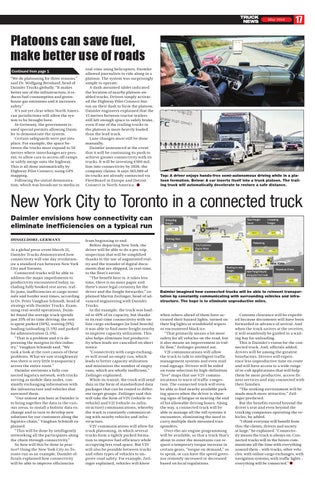
Top: A driver enjoys hands-free semi-autonomous driving while in a platoon formation. Below: A car inserts itself into a truck platoon. The trailing truck will automatically decelerate to restore a safe distance.
New York City to Toronto in a connected truck Daimler envisions how connectivity can eliminate inefficiencies on a typical run DUSSELDORF, GERMANY At a global press event March 21, Daimler Trucks demonstrated how connectivity will one day revolutionize a standard run between New York City and Toronto. Connected trucks will be able to address the major impediments to productivity encountered today, including fully booked rest areas, traffic jams, inefficiencies at cargo terminals and border wait times, according to Dr. Peter Vaughan Schmidt, head of strategy with Daimler Trucks. Examining real-world operations, Daimler found the average truck spends just 35% of its time driving; the rest is spent parked (50%), waiting (9%), loading/unloading (5.5%) and parked for administration (1.5%). “That is a problem and it is depressing the margins in this industry,” Vaughan Schmidt said. “We took a look at the root causes of these problems. What we saw straightaway was there is very little transparency across the entire route.” Daimler envisions a fully connected logistics network, with trucks serving as mobile data nodes, constantly exchanging information with the infrastructure and vehicles that surround them. “Our utmost aim here at Daimler is to bring together the data in the various areas, to install a holistic data exchange and in turn to develop new solutions for our customers along the logistics chain,” Vaughan Schmidt explained. “This will be done by intelligently networking all the participants along the chain through connectivity.” So how will this be done in practice? Using the New York City-to-Toronto run as an example, Daimler officials explained how connectivity will be able to improve efficiencies
pg 1, 16-17, 56 tn may v3.indd 17
from beginning to end. Before departing New York, the driver will be able to do a pre-trip inspection that will be simplified thanks to the use of augmented reality and the transfer of digital documents that are shipped, in real-time, to the fleet’s server. “The benefit here is, it takes less time, there is no more paper and there’s more legal certainty for the driver and the freight forwarder,” explained Martin Zeilinger, head of advanced engineering with Daimler Trucks. In the example, the truck was loaded to 60% of its capacity, but thanks to its real-time connectivity with online cargo exchanges (or load boards) it was able to find more freight nearby to improve capacity utilization. This also helps eliminate lost productivity when loads are cancelled on short notice. “Connectivity with cargo exchanges will avoid an empty run, which leads to better capacity utilization and minimizes the number of empty runs, which are wholly inefficient,” Zeilinger explained. While in-transit, the truck will send data in the form of standardized data packages that can be routed to different target groups. Zeilinger said this will take the form of V2V (vehicle-tovehicle) and V2I (vehicle-to-infrastructure) communications, whereby the truck is constantly communicating with nearby vehicles and infrastructure. V2V communications will allow for truck platooning, in which several trucks form a tightly packed formation to improve fuel efficiency while occupying less road space. But V2V will also be possible between trucks and other types of vehicles to improve road safety. For example, Zeilinger explained, vehicles will know
Daimler imagined how connected trucks will be able to reinvent transportation by constantly communicating with surrounding vehicles and infrastructure. The hope is to eliminate unproductive miles.
when others ahead of them have activated their hazard lights, turned on their fog lights or windshield wipers or encountered black ice. “That primarily means a lot more safety for all vehicles on the road, but it also means an improvement in traffic flow,” Zeilinger pointed out. V2I communications will allow the truck to talk to intelligent traffic management systems and even read road signage. Drivers will be aided on route selection by high-definition “live” maps that use V2V communications to warn of traffic congestion. The connected truck will even be able to find nearby available parking spaces when the driver is showing signs of fatigue or nearing the end of his allowable driving hours. Along the way, a connected truck will be able to manage all the toll systems it encounters, eliminating the need to carry multiple dash-mounted transponders. Over-the-air engine programming will be available, so that a truck that’s about to enter the mountains can request a temporary torque increase in certain gears, “torque on demand,” so to speak, or can have the speed governor remotely increased or decreased based on local regulations.
Customs clearance will be expedited because documents will have been forwarded in advance of arrival. And when the truck arrives at the receiver, it will seamlessly be guided to a waiting bay for unloading. This is Daimler’s vision for the connected truck. And, officials added, drivers will be among the greatest benefactors. Drivers will experience less unproductive time en-route and will have access to a wide range of in-cab applications that will help them be more productive, access fitness services and stay connected with their families. “The working environment will be made much more attractive,” Zeilinger predicted. But the benefits extend beyond the driver’s seat and even beyond the trucking companies operating the vehicles, he added. “I think everyone will benefit from this; the clients, drivers and society at large,” he explained. “Connectivity means the truck is always on. Connected trucks will in the future communicate all the time with everything around them – with trucks, other vehicles, with online cargo exchanges, with navigation systems, with traffic lights – everything will be connected.”
16-04-08 2:57 PM