SMEs are optimistic By Joe Terrett, Editor
Business Outlook 2010 << Trends
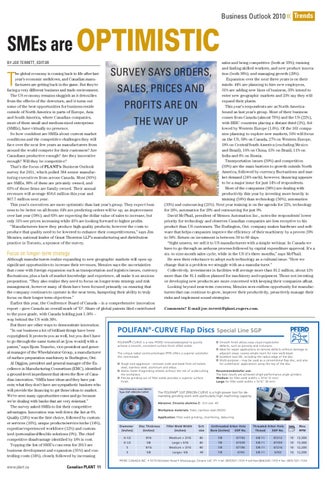
sales and being competitive (both at 33%); training and finding skilled workers, and new product innovation (both 30%); and managing growth (29%). Expansion over the next three years is on their minds: 44% are planning to hire new employees, 31% are adding new lines of business, 33% intend to enter new geographic markets and 23% say they will expand their plants. This year’s respondents are as North Americabound as last year’s group. Most of their business comes from Canada (almost 70%) and the US (22%), with BRIC countries placing a distant third (2%), followed by Western Europe (1.6%). Of the 163 companies planning to explore new markets, 56% will focus on the US, 50% on Canada, 27% on Western Europe, 18% on Central/South America (excluding Mexico and Brazil), 16% on China, 15% on Brazil, 11% on India and 6% on Russia. Transportation issues (39%) and competition (39%) are the main barriers to growth outside North America, followed by currency fluctuations and market demand (24% each); however, financing appears to be a major issue for just 14% of respondents. Most of the companies (96%) are dealing with productivity this year by investing more heavily in training (58%) than technology (50%), automation (33%) and outsourcing (23%). Next year training is on the agenda for 22%, technology for 26%, automation for 20% and outsourcing for just 9%. David McPhail, president of Memex Automation Inc., notes the respondents’ lower priority for technology and observes Canadian companies are less receptive to his product than US customers. The Burlington, Ont. company makes hardware and software that helps companies improve the efficiency of their machinery by a proven 20% to 50%. Return on investment is between 30 to 60 days. “Sight unseen, we sell it to US manufacturers with a simple webinar. In Canada we have to go through an arduous process followed by capital expenditure approval. It’s a six- to nine-month sales cycle, while in the US it’s three months,” says McPhail. He sees their reluctance to adopt such technology as a cultural issue. “How we change that is a problem we struggle with as a manufacturer.” Collectively, investments in facilities will average more than $1.2 million, about 12% more than the $1.1 million planned for machinery and equipment. Those not investing or developing new products are more concerned with keeping their companies afloat. Looking beyond near-term concerns, Menzies sees endless opportunity for manufacturers that can continue to grow, improve their productivity, proactively manage their risks and implement sound strategies.
Survey says orders,
T
he global economy is coming back to life after last year’s economic meltdown, and Canadian manufacturers are getting back in the game. But they're facing a very different business and trade environment. The US economy remains sluggish as it detoxifies from the effects of the downturn, and it turns out some of the best opportunities for business reside outside of North America in parts of Europe, Asia and South America, where Canadian companies, most of them small and medium-sized enterprises (SMEs), have virtually no presence. So how confident are SMEs about current market conditions and the competitive challenges they will face over the next few years as manufacturers from around the world compete for their customers? Are Canadians productive enough? Are they innovative enough? Will they be competitive? That’s the focus of PLANT’s Business Outlook survey for 2011, which polled 384 senior manufacturing executives from across Canada. Most (83%) are SMEs, 80% of them are privately owned, and 63% of those firms are family owned. Their annual revenues will average $58.6 million this year and $67.7 million next year. This year’s executives are more optimistic than last year’s group. They expect business to be better on all fronts: 64% are predicting orders will be up, an improvement over last year (58%); and 63% are expecting the dollar value of sales to increase, but only 31% see prices increasing while 43% are looking forward to higher profits. “Manufacturers know they produce high quality products; however the costs to produce that quality need to be lowered to enhance their competitiveness,” says Jim Menzies, national leader of Grant Thornton LLP’s manufacturing and distribution practice in Toronto, a sponsor of the survey.
sales, prices and profits are on
Focus on longer-term strategy
PHOTO: iSTOCKPHOTO
the way up
Although manufacturers realize expanding to new geographic markets will open up significant opportunities to increase their revenues, Menzies says the uncertainties that come with foreign expansion such as transportation and logistics issues, currency fluctuations, plus a lack of market knowledge and experience, all make it an anxious proposition. “They also realize they need to focus on longer-term strategy and risk management, however many of them have been focused primarily on ensuring that the company continues to operate in the near term, hampering their ability to truly focus on their longer term objectives.” Earlier this year, the Conference Board of Canada – in a comprehensive innovation Comments? E-mail joe.terrett@plant.rogers.com. report – gave Canada an overall mark of "D". Share of global patents filed contributed to the poor grade, with Canada holding just 1.36% – way behind the US with 30%. But there are other ways to demonstrate innovation. ® “In our business a lot of brilliant things have been Special Line SGP copyrighted. It protects you as well, but you don’t have to go through the same turmoil as [you would] with a ■ Smooth finish allows easy visual inspectiofor POLIFAN®-CURVE is a new PFERD innovatiodesigned to quickly defects, such as porosity and inclusions. achieve a smooth, consistent surface finish ofillet welds. patent,” says Bjorn Tranebo, vice-president and gener■ Ideal for repair applications to remove defects without damage to al manager of the Wheelabrator Group, a manufacturer adjacent areas. Leaves ample room for new weld bead. The unique radial constructioshape (PFR) offers a superior solutiofor ■ Excellent tool life, including the radius edge of the disc. this commotask. of surface preparation machinery in Burlington, Ont. ■ Multi-purpose – may be used as a conventional flap disc, and also Al Diggins, president and general manager of the Exfor underhand applications using the top of the disc. ■ Tough and aggressive - removes scale and bead from all metals: steel, stainless steel, aluminum and alloys. cellence in Manufacturing Consortium (EMC), identified Recommendatiofor use: ■ Works faster thagrinding wheels without the risk of undercutting a ground-level impediment that slows the flow of CanaThe best results are achieved ohigh-performance angle grinders the workpiece. Medium for fillet weld widths > 3/16”(5 mm) ■ Precise grinding out of fillet welds provides a superior surface dian innovation. “SMEs have ideas and they have patLarge for fillet weld widths > 5/16” (8 mm) finish. ents; what they don’t have are sympathetic bankers who Steel/Stainless steel (INOX) will provide the financing to get those ideas to market. Type SGP-ZIRKON-CURVE The POLIFAN® SGP ZIRKON-CURVE is a high-power tool for demanding grinding work with particularly high machining capacity. We’ve seen many opportunities come and go because we’re dealing with banks that are very resistant.” Abrasive: Zirconia alumina Z: Grit size: 40 The survey asked SMEs to list their competitive Workpiece materials: Steel, stainless steel (INOX) advantages. Innovation was well down the list at 6%. Application: Fillet weld grinding, chamfering, deburring Quality (24%) was the first choice, followed by customer services (16%), unique products/service/niche (14%), Diameter Disc Thickness Fillet Weld Width Grit Unthreaded Arbor Hole Threaded Arbor Hole Max. expertise/experienced workforce (12%) and custom(inches) (inches) (inches) size Bore (inches) EDP No. Thread EDP No. RPM ized /personalized/flexible solutions (9%). The chief 4-1/2 9/16 Medium > 3/16 40 7/8 67192 5/8-11 67212 10 13,300 competitive disadvantage identified by 18% is cost. 5/8 Large > 5/16 40 7/8 67339 5/8-11 67359 10 13,300 4-1/2 Topping the list of SME’s concerns for 2013 are 5 9/16 Medium > 3/16 40 7/8 67196 5/8-11 67216 10 12,200 business development and expansion (35%) and con5 5/8 Large> 5/6 40 7/8 6743 5/8-11 6763 10 12,200 trolling costs (34%), closely followed by increasing
POLIFAN -CURVE Flap Discs
PFERD CANADA INC. • 5570 McAdam Road • Mississauga, Ontario L4Z 1P1 • tel: (905)501-1555 • toll-free:(866)245-1555 • fax: (905) 501-1554
www.plant.ca
Canadian PLANT 11 PFERD1.indd 1
4/6/10 1:40:04 PM