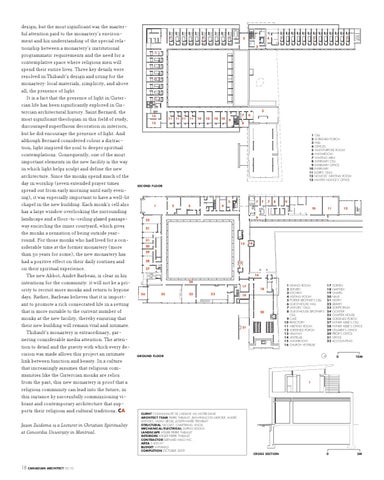
design, but the most significant was the masterful attention paid to the monastery’s environment and his understanding of the special relationship between a monastery’s institutional programmatic requirements and the need for a contemplative space where religious men will spend their entire lives. Three key details were resolved in Thibault’s design and siting for the monastery: local materials, simplicity, and above all, the presence of light. It is a fact that the presence of light in Cistercian life has been significantly explored in Cistercian architectural history. Saint Bernard, the most significant theologian in this field of study, discouraged superfluous decoration in interiors, but he did encourage the presence of light. And although Bernard considered colour a distraction, light inspired the soul to deeper spiritual contemplations. Consequently, one of the most important elements in the new facility is the way in which light helps sculpt and define the new architecture. Since the monks spend much of the day in worship (seven extended prayer times spread out from early morning until early evening), it was especially important to have a well-lit chapel in the new building. Each monk’s cell also has a large window overlooking the surrounding landscape and a floor-to-ceiling glazed passageway encircling the inner courtyard, which gives the monks a sensation of being outside yearround. For those monks who had lived for a considerable time at the former monastery (more than 50 years for some), the new monastery has had a positive effect on their daily routines and on their spiritual experience. The new Abbot, André Barbeau, is clear in his intentions for the community: it will not be a priority to recruit more monks and return to bygone days. Rather, Barbeau believes that it is important to promote a rich consecrated life in a setting that is more suitable to the current number of monks at the new facility, thereby ensuring that their new building will remain vital and intimate. Thibault’s monastery is extraordinary, garnering considerable media attention. The attention to detail and the gravity with which every decision was made allows this project an intimate link between function and beauty. In a culture that increasingly assumes that religious communities like the Cistercian monks are relics from the past, this new monastery is proof that a religious community can lead into the future, in this instance by successfully commissioning vibrant and contemporary architecture that supports their religious and cultural traditions. ca Jason Zuidema is a Lecturer in Christian Spirituality at Concordia University in Montreal.
18 canadian architect 03/10
1
1
1
2
4
1
1
1
3 1
1
1
5 13
11
11 11
11
10
10
10
10
12
7 9
6
8
1 cell 2 ScreeNeD Porch 3 hall 4 officeS 5 multi-PurPoSe room 6 WaShroom 7 WaitiNg area 8 iNfirmary cell 9 iNfirmary office 10 iNfirmary 11 elDerS’ cellS 12 NoViceS’ meetiNg room 13 maSter NoVice’S office second fLoor
0
5 1
2
3
7
7
7
8
10M
9
4
10
11
12
6
32 31
31
13
30
14
29 28
15
27 16 24 17 26
25
23
22
18
19
20
21
1 2 3 4 5 6 7 8
DiNiNg room SerVery kitcheN ViSitiNg room Porter brother’S cell gueSt-houSe hall ViSitorS’ cellS gueSt-houSe brother’S cell 9 café 10 refectory 11 meetiNg room 12 ScreeNeD Porch 13 hallWay 14 VeStibule 15 WaShroom 16 church VeStibule
17 18 19 20 21 22 23 24 25 26 27 28 29 30 31 32
ScreeN Narthex chaPel NaVe VeStry library ScriPtorium cloiSter chaPter houSe ScreeNeD Porch father abbé’S cell father abbé’S office cellarer’S office Prior’S office office accouNtiNg
0 0
ground fLoor
10M 10M
1
cLient commuNauté De l’abbaye Val Notre-Dame architect teaM Pierre thibault, JeaN-fraNçoiS mercier, aNDré limogeS, VaDim Siegel, JoSePh-marie tremblay structuraL Nicolet, chartraND, kNoll MechanicaL/eLectricaL DuPraS leDoux Landscape atelier Pierre thibault interiors atelier Pierre thibault contractor berNarD malo iNc. area 5,800 m2 budget WithhelD coMpLetion october 2009
cross section
0 0
5M 5M