Insites
Community Building
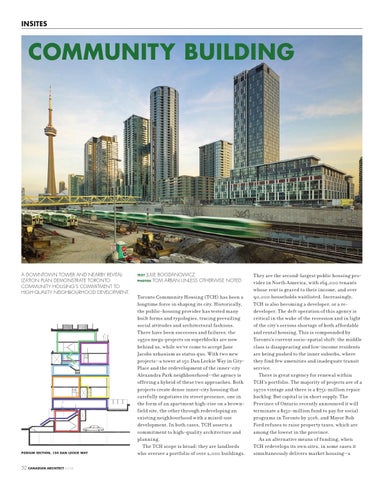
A downtown tower and nearby revital ization plan demonstrate Toronto Community Housing’s commitment to high-quality neighbourhood development.
Podium Section, 150 Dan Leckie Way
52 canadian architect 11/13
Text
Julie Bogdanowicz Tom Arban unless otherwise noted
Photos
Toronto Community Housing (TCH) has been a longtime force in shaping its city. Historically, the public-housing provider has tested many built forms and typologies, tracing prevailing social attitudes and architectural fashions. There have been successes and failures: the 1950s mega-projects on superblocks are now behind us, while we’ve come to accept Jane Jacobs urbanism as status quo. With two new projects—a tower at 150 Dan Leckie Way in CityPlace and the redevelopment of the inner-city Alexandra Park neighbourhood—the agency is offering a hybrid of these two approaches. Both projects create dense inner-city housing that carefully negotiates its street presence, one in the form of an apartment high-rise on a brownfield site, the other through redeveloping an existing neighbourhood with a mixed-use development. In both cases, TCH asserts a commitment to high-quality architecture and planning. The TCH scope is broad: they are landlords who oversee a portfolio of over 2,000 buildings.
They are the second-largest public housing provider in North America, with 164,000 tenants whose rent is geared to their income, and over 90,000 households waitlisted. Increasingly, TCH is also becoming a developer, or a re developer. The deft operation of this agency is critical in the wake of the recession and in light of the city’s serious shortage of both affordable and rental housing. This is compounded by Toronto’s current socio-spatial shift: the middle class is disappearing and low-income residents are being pushed to the inner suburbs, where they find few amenities and inadequate transit service. There is great urgency for renewal within TCH’s portfolio. The majority of projects are of a 1970s vintage and there is a $751-million repair backlog. But capital is in short supply. The Province of Ontario recently announced it will terminate a $150-million fund to pay for social programs in Toronto by 2016, and Mayor Rob Ford refuses to raise property taxes, which are among the lowest in the province. As an alternative means of funding, when TCH redevelops its own sites, in some cases it simultaneously delivers market housing—a