he chose to build his large two-story home in his current neighborhood, the Old Sixth Ward, rather than in one of the new wealthier subdivisions as was the practice of many of Houston's nouveau riche_ For this reason the two-story, brick Classical Revival house contrasts with the general character of the neighborhood. Fire Station No. 6 at 1702 Washington Avenue, built in 1903 in a late Victorian architectural style with north Italian Romanesque detailing, originally served the area known as North Side Buffalo Bayou to White Oak Bayou and the city limits. The horses were housed in stalls in either side of the central bay and the harness dropped from hangars above their stalls when the fire bell sounded. This is one of the two oldest firehouses still standing in Houston. The Knapp Chevrolet Building at 815 North Houston Avenue is one of the most recent of the architecturally significant buildings in the district. Built in 1940-41 by architect R. Newell Waters, this building is an example of late Streamline Moderne styling, though without any of the special decorative elements encountered on buildings by Joseph Finger and others who produced work in the Moderne style. The original owners, Knapp Chevrolet, continue to occupy and maintain the building. St. Joseph's Catholic Church and rectory occupy all of the 1500 block of Kane Street. Established in 1880 as the first Catholic church north of Buffalo Bayou, the original wooden church with steeple was built on the corner of Houston Avenue and Kane Street. Also on the property was a school taught by the Incarnate Word Sisters. The 1900 hurricane destroyed the original frame building, and in 1901 a new brick church was begun, designed by architect Patrick. S. Rabbit, who was trained in the office of Nicholas J. Clayton in Galveston. Rabbitt was Clayton'S partner from 1890-1898 and was married to Clayton's cousin. George E. Dickey, one of Houston's best known architects at that time, was construction supervisor. Architecturally, St. Joseph's Church displays a rich and unusual character with rounded arch Romanesque styling used in combination with opus spicatum. an ornamental bond resulting from laying bricks
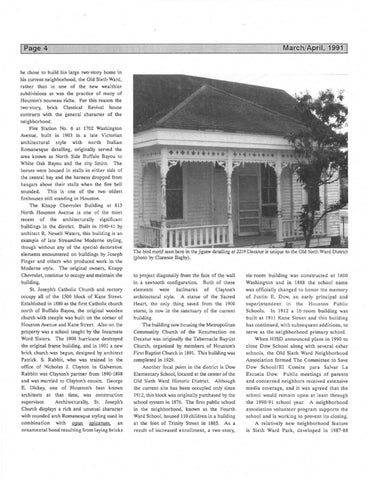
The bird motif seen bere in the jigsaw detailing at 2219 Decatur is unique to the Old Sixth Ward District (photo by Clarence Bagby).
to project diagonally from the face of the wall in a sawtooth configuration. Both of these elements were hallmarks of Clayton's architectural style. A statue of the Sacred Heart, the only thing saved from the 1900 storm, is now in the sanctuary of the current building. The building now housing the Metropolitan Community Church of the Resurrection on Decatur was originally the Tabernacle Baptist Church, organized by members of Houston's First Baptist Church in 1891. This building was completed in 1929. Another focal point in the district is Dow Elementary School, located at the center of the Old Sixth Ward Historic District. Although the current site has been occupied only since 1912, this block was originally purchased by the school system in 1876. The first public school in the neighborhood, known as the Fourth Ward School, housed 110 children in a building at the foot of Trinity Street in 1885. As a result of increased enrollment, a two-story,
six-room building was constructed at 1600 Washington and in 1888 the school name was officially changed to honor the memory of Justin E. Dow, an early principal and superintendent in the Houston Public Schools. In 1912 a 16-room building was built at 1911 Kane Street and this building has continued, with subsequent additions, to serve as the neighborhood primary school. When HISD announced plans in 1990 to close Dow School along with several other schools, the Old Sixth Ward Neighborhood Association formed The Committee to Save Dow School/EI Comite para Salvar La Escuela Dow. Public meetings of parents and concerned neighbors received extensive media coverage, and it was agreed that the school would remain open at least through the 1990-91 school year. A neighborhood association volunteer program supports the school and is working to prevent its closing. A relatively new neighborhood feature is Sixth Ward Park, developed in 1987-88