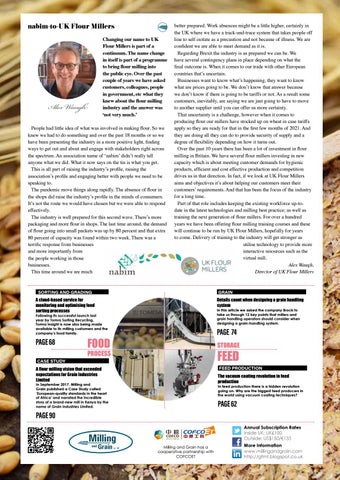
nabim-to-UK Flour Millers Changing our name to UK Flour Millers is part of a continuum. The name change in itself is part of a programme to bring flour milling into the public eye. Over the past couple of years we have asked customers, colleagues, people in government, etc what they knew about the flour milling industry and the answer was ‘not very much.’
Alex Waugh
People had little idea of what was involved in making flour. So we knew we had to do something and over the past 18 months or so we have been presenting the industry in a more positive light, finding ways to get out and about and engage with stakeholders right across the spectrum. An association name of ‘nabim’ didn’t really tell anyone what we did. What it now says on the tin is what you get. This is all part of raising the industry’s profile, raising the association’s profile and engaging better with people we need to be speaking to. The pandemic move things along rapidly. The absence of flour in the shops did raise the industry’s profile in the minds of consumers. It’s not the route we would have chosen but we were able to respond effectively. The industry is well prepared for this second wave. There’s more packaging and more flour in shops. The last time around, the demand of flour going into small packets was up by 80 percent and that extra 80 percent of capacity was found within two week. There was a terrific response from businesses and more importantly from the people working in those businesses. This time around we are much
better prepared. Work absences might be a little higher, certainly in the UK where we have a track-and-trace system that takes people off line to self-isolate as a precaution and not because of illness. We are confident we are able to meet demand as it is. Regarding Brexit the industry is as prepared we can be. We have several contingency plans in place depending on what the final outcome is. When it comes to our trade with other European countries that’s uncertain. Businesses want to know what’s happening, they want to know what are prices going to be. We don’t know that answer because we don’t know if there is going to be tariffs or not. As a result some customers, inevitably, are saying we are just going to have to move to another supplier until you can offer us more certainty. That uncertainty is a challenge, however when it comes to producing flour our millers have stocked up on wheat in case tariffs apply so they are ready for that in the first few months of 2021. And they are doing all they can do to provide security of supply and a degree of flexibility depending on how it turns out. Over the past 10 years there has been a lot of investment in flour milling in Britain. We have several flour millers investing in new capacity which is about meeting customer demands for hygienic products, efficient and cost effective production and competition drives us in that direction. In fact, if we look at UK Flour Millers aims and objectives it’s about helping our customers meet their customers’ requirements. And that has been the focus of the industry for a long time. Part of that role includes keeping the existing workforce up-todate in the latest technologies and milling best practice; as well as training the next generation of flour millers. For over a hundred years we have been offering flour milling training courses and these will continue to be run by UK Flour Millers, hopefully for years to come. Delivery of training to the industry will get stronger as utilise technology to provide more interactive resources such as the virtual mill. Alex Waugh, Director of UK Flour Millers
SORTING AND GRADING
GRAIN
A cloud-based service for monitoring and optimising food sorting processes
Details count when designing a grain handling system
In this article we asked the company Brock to take us through 12 key points that millers and grain handling operators should consider when designing a grain-handling system.
Following its successful launch last year by Tomra Sorting Recycling, Tomra Insight is now also being made available to its milling customers and the company’s food family.
PAGE 68 CASE STUDY
PAGE 74
FOOD
STORAGE
FEED
PROCESS
FEED PRODUCTION
A flour milling vision that exceeded expectations for Grain Industries Limited
The vacuum coating revolution in feed production
In September 2017, Milling and Grain published a Case Study called ‘European-quality standards in the heart of Africa’ and narrated the incredible story of a brand-new mill in Kenya by the name of Grain Industries Limited.
In feed production there is a hidden revolution going on. Why are the biggest feed producers in the world using vacuum coating techniques?
PAGE 62
PAGE 90 Annual Subscription Rates Inside UK: UK£100 Outside: US$150/€133 Milling and Grain has a cooperative partnership with COFCOET
More Information www.millingandgrain.com http://gfmt.blogspot.co.uk