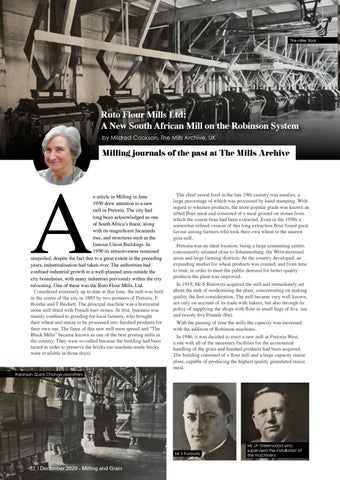
The roller floor
Ruto Flour Mills Ltd; A New South African Mill on the Robinson System by Mildred Cookson, The Mills Archive, UK
A
Milling journals of the past at The Mills Archive
n article in Milling in June 1950 drew attention to a new mill in Pretoria. The city had long been acknowledged as one of South Africa’s finest, along with its magnificent Jacaranda tree, and structures such as the famous Union Buildings. In 1950 its attractiveness remained unspoiled, despite the fact that to a great extent in the preceding years, industrialisation had taken over. The authorities had confined industrial growth to a well-planned area outside the city boundaries, with many industries previously within the city relocating. One of these was the Ruto Flour Mills, Ltd. Considered extremely up to date at that time, the mill was built in the centre of the city in 1885 by two pioneers of Pretoria, F Bourke and T Beckett. The principal machine was a horizontal stone mill fitted with French burr stones. At first, business was mainly confined to grinding for local farmers, who brought their wheat and maize to be processed into finished products for their own use. The fame of this new mill soon spread and “The Black Mills� became known as one of the best gristing mills in the country. They were so-called because the building had been tarred in order to preserve the bricks (no machine-made bricks were available in those days).
The chief cereal food in the late 19th century was mealies, a large percentage of which was processed by hand stamping. With regard to wheaten products, the most popular grade was known as sifted Boer meal and consisted of a meal ground on stones from which the coarse bran had been extracted. Even in the 1950s a somewhat refined version of this long extraction flour found great favour among farmers who took their own wheat to the nearest grist mill. Pretoria was an ideal location, being a large consuming centre, conveniently situated close to Johannesburg, the Witwatersrand areas and large farming districts. As the country developed, an expanding market for wheat products was created, and from time to time, in order to meet the public demand for better quality products the plant was improved.
In 1919, Mr S Rutowitz acquired the mill and immediately set about the task of modernising the plant, concentrating on making quality the first consideration. The mill became very well known, not only on account of its trade with bakers, but also through its policy of supplying the shops with flour in small bags of five, ten and twenty five Pounds (lbs). With the passing of time the mills the capacity was increased with the addition of Robinson machines.
In 1946, it was decided to erect a new mill at Pretoria West, a site with all of the necessary facilities for the economical handling of the grain and finished products had been acquired. The building consisted of a flour mill and a large capacity maize plant, capable of producing the highest quality granulated maize meal.
Robinson Quick Change plansifters
Mr S Rutowitz
22 | December 2020 - Milling and Grain
Mr JA Greenwood who supervised the installation of the machinery