November 2020
YOUR GLOBAL PARTNER
In this issue:
A REVOLUTIONARY WAY OF TESTING GRAIN IN A SILO
Visualise the condition of grain in real time
IN A
I LL
IN G R AI N
SO E M B ER F N ABI M
ND
• Phytogenics: Improving calves’ resilience to diseases
O
ST
EB
#1 M
YM
WA S VOTED TRU
S T E D M I LLI N G M A G A
ZI N
• Covid-19 and food security
See our archive and language editions on your mobile!
• Bucket elevator inspection Proud supporter of
R E C E N T P O LL , M
GA
Milling and Grain . Volume 131 . Issue 11 . November 2020
• Taking the guesswork out of roller maintenance
Volume 131 Issue 11
millingandgrain.com
Solid.
Move up with Brock grain handling. Get your grain where it needs to go every time. Brock grain handling equipment is a step up from the standard. Our drag conveyors have solid welded flange connections for extra durability. Our bucket elevators are welded solid on the inside and outside so moisture doesn’t penetrate the trunking. Our distributors have an inverted cone design that prevents grain dust and moisture from building up. This attention to detail translates to long-lasting equipment that keeps your operation moving. Move up at brockgrain.com
+1 812.886.5500
sales@brockgrain.com
Storage | Handling | Conditioning | Structures
COMMERCIAL BINS
• 48 m Diameter Bins (20321-48262 mt) • Peak Load Rating (6804-45360 kg) • Hopper Bins (3.7 m-14.6 m)
COMMERCIAL DRYERS
• Tower Dryers (23-281 t/h) • QuadraTouch ProTM Controls • Balanced Moisture Content
STEEL BUILDINGS
COMMERCIAL SWEEPS
BUCKET ELEVATORS
COMMERCIAL CONVEYORS
• Auger & Paddle sweeps available • Capacity includes 141-281 t/h • Patented Pivot Point • Industrial Grade Pushers
• Low Impact Head Design • Heavy Gauge Trunking • Patented Squaring Plates • Support Towers
• Industrial Strength • Built To Last • Higher Elemental Resistance • Capacity includes (984-1688 t/h) • Dust-tight and waterproof • Patented hip-style weather-tight cover • Catwalks
Sukup Worl d H eadquart ers - S hef f i e ld , Io w a U SA • w w w.su ku p .co m • in fo @su ku p .co m For service in Europe contact:
Sukup Europe A/S Hedensted, Denmark Tel +45 75 68 53 11 • Fax +45 75 68 54 70 info@sukup-eu.com • www.sukup-eu.com
Pneumatic or Mechanical Ship Loaders & Unloaders Port Equipment - Turnkey Projects
Your Solution starts here ! VIGAN Engineering s.a. Rue de l’Industrie, 16 - 1400 Nivelles - Belgium Tél.: +32 67 89 50 41 • Fax : +32 67 89 50 60 • www.vigan.com • info@vigan.com
INCREASE YOUR PROFITS WITH INTELLIGENT SOLUTIONS
Your challenge might be finding a dry bulk handling solution that ensures the profitable, sustainable growth of your business. Our expertise can provide just that. A totally enclosed Bruks Siwertell solution that ensures operations are efficient, reliable, and free from dust and spillage.
bruks-siwertell.com A PART OF BRUKS SIWERTELL GROUP
VOLUME 131 ISSUE 11
November 2020
Perendale Publishers Ltd 7 St George’s Terrace St James’ Square, Cheltenham, Glos, GL50 3PT, United Kingdom Tel: +44 1242 267700 Publisher Roger Gilbert rogerg@perendale.co.uk International Marketing Team Darren Parris darrenp@perendale.co.uk Fred Norwood Tel: +1 405 834 2043 fredn@perendale.com Asia Marketing Team Dante Feng Tel: +886 227930286 dantef@perendale.com Latin America Marketing Team Iván Marquetti Tel: +54 2352 427376 ivanm@perendale.com Pablo Porcel pablop@perendale.com Oceania Marketing Team Peter Parker peterp@perendale.co.uk Nigeria Marketing Team Nathan Nwosu Tel: +234 8132 478092 nathann@perendale.com Egyptian Marketing Team Mohamed Baromh Tel: +20 100 358 3839 mohamedb@perendale.com Turkey, Eurasia and Middle East Marketing Team Mehmet Ugur Gürkaynak Tel: +90 537 3646457 mehmetg@perendale.com Managing Editor Vaughn Entwistle vaughne@perendale.co.uk Features Editor Rebecca Sherratt rebeccas@perendale.co.uk Sub-editor Andrew Wilkinson andreww@perendale.co.uk International Editors Dr Roberto Luis Bernardi robertob@perendale.com Professor Wenbin Wu wenbinw@perendale.com Mehmet Ugur Gürkaynak mehmetg@perendale.com Design Manager James Taylor jamest@perendale.co.uk Circulation & Events Tuti Tan tutit@perendale.co.uk Development Manager Antoine Tanguy antoinet@perendale.co.uk millingandgrain.com ISSN No: 2058-5101 ©Copyright 2019 Perendale Publishers Ltd. All rights reserved. No part of this publication may be reproduced in any form or by any means without prior permission of the copyright owner. More information can be found at www.perendale.com Perendale Publishers Ltd also publish ‘The International Milling Directory’ and ‘The Global Miller’ news service Grain & Feed Milling Technology magazine was rebranded to Milling and Grain in 2015
80 - Digital services for the optimisation of the grain drying process ISSUE HIGHLIGHTS
8
NEWS FEATURES
46 Taking the guesswork out of roller maintenance:
52 Phytogenics: Improving calves’ resilience to diseases
FACES
10-35 56 Evenly mixed feed essential for consistent livestock performance 60 Poultry production and feeding
64 Covid-19 and food security
114 People news from the global milling industry
PRODUCT FOCUS
44
CASE STUDY
92
68 IAOM MEA meets ‘challenging times’ with Virtual Forum 2020 STORAGE
76 Satake introduces kit silo in Australia
80 Digital services for the optimisation of the grain drying process
72 Bucket elevator inspection
EVENTS
96 Event listings, reviews and previews
86 A revolutionary way of testing grain in a silo
TRAINING
38 Industry training news
COLUMNS
10 The Global Miller 22 Mildred Cookson 28 The Rex Wailes collection
8 GUEST EDITOR Michael Binder
94 MARKETS Rebecca Sherratt
COVER IMAGE: A revolutionary way of testing grain in a silo - page 60
112 INTERVIEW Xu Bin
Taking the LEAP towards a sustainable future
Michael Binder
Sustainability is central to the animal feed industry, and here at Evonik we play our part by developing evidenced-based products and solutions; we call it Sciencing the Global Food Challenge.
However, we are well aware that feeding our growing population in a sustainable manner is something that no one company or organisation can manage alone. We are just one cog in the huge machine that needs to work in harmony to develop and maintain our food system in a more viable, long-term manner. One step towards helping this happen is the publication of the FAO’s ‘Environmental performance of feed additives in livestock supply chains: Guidelines for assessment’. I am a member of the Livestock Environmental Assessment and Performance (LEAP) Partnership’s Feed Additives Technical Advisory Group and contributed to the development of the guidelines, especially with regards to the production and use of amino acids. The new publication explains, among many other things, how the digestibility of feed is an important contributor both to feed efficiency and to the environmental impact of feed production on livestock production. It says, “With the exception of ruminants, which are able to digest a large variety of feeds (in particular diets with a high percentage of fibres), monogastric animals (pigs and poultry) are not able to digest fibres efficiently. For this reason, a high energy diet for monogastric animals comprises mainly feed ingredients with
high digestibility (e.g. cereals and legumes). “Feed additives can be used to improve the digestibility of feed ingredients containing a higher level of undigestible nutrients (e.g. fibres), thereby increasing their energy, amino acid and/or mineral values. “By increasing feed digestibility, the availability of nutrients (carbohydrates, fatty acids, amino acids and minerals) present in the animal diet is increased. As a consequence, either animals need less feed to achieve their physiological requirements (maintenance, production) or they can produce more (e.g. by increasing their growth rate or milk/egg production). “Increased feed digestibility can be achieved either by acting on the nutrient availability in the diet or by improving the gastrointestinal tract function (e.g. influencing the microbiome).” Essential amino acids including methionine, lysine, tryptophane and threonine are, as their name suggests, required ingredients, but they lead to the formulation of animal feed which contains a relatively high level of proteins when only plant-based sources are used. These excess proteins are then excreted producing nitrous oxide and ammonia and leads to the potential for leaching into the wider environment. By providing amino acids individually and in the required quantities, the amino acid content of feed can be better managed in order to meet the animals’ requirements, without environmentally damaging excesses. The total level of protein in the diet can be reduced, leading to a reduced use of high-proteincontent feed ingredients, such as soybean meal or rapeseed meal. Working together we can help make animal feed more sustainable and help meet the global food challenge. You can read the guidelines at: mymag.info/e/972 Michael Binder, Vice President Sustainable Development, Evonik
COVID-19
GRAIN
COVID-19 AND FOOD SECURITY
A revolutionary way of testing grain in a silo
In our August issue, Milling and Grain was one of the first magazines to announce the arrival of a new, disruptive technology to visualise the condition of grain in real time.
Revisiting the pyramid, grandma, and other things
PAGE 64
PAGE 86
FOOD ROLLS
STORAGE
FEED
PROCESS
PHYTOGENICS
Taking the guesswork out of roller maintenance
Phytogenics: Improving calves’ resilience to diseases
How Bühler`s rollDetect service reduces cost and improves yields
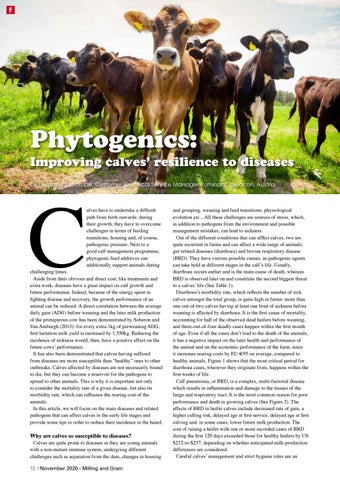
Calves have to undertake a difficult path from birth onwards: during their growth, they have to overcome challenges in terms of feeding transitions, housing and, of course, pathogenic pressure.
PAGE 46
PAGE 52 Annual Subscription Rates Inside UK: UK£100 Outside: US$150/€133 Milling and Grain has a cooperative partnership with COFCOET
More Information www.millingandgrain.com http://gfmt.blogspot.co.uk
Milling
News T
Name change: nabim to UK Flour Millers he National Association of British and Irish Millers (nabim) is changing its name to UK Flour Millers - which will be launched digitally alongside a new logo and an updated website on November 2, 2020. Roger Butler, president of nabim, now the UK Flour Millers, told the London and South West Millers Society at it’s annual general meeting held online in October, that over the past 18 months a committee has been working on the idea of making UK Flour Millers the first point of reference for anyone wanting information about the industry. He said the goal was, “Raising our visibility out the in the wider world and to actually make sure that governments, etc are aware of the scale of our industry and the value of the industry in terms of economics, our contribution to the depth and range of foods and products that contain flour,” so that flour is seen to be more than just packets on shelves. “We are raising the profile so that we are out there and in focus.” The primary objective of the various committees that had worked on the project was for millers and the industry to be seen as professional, reliable, important, modern and efficient, he told members. He said the change was coming at a good time with Ireland possibly wishing to establish its own millers’ organisation in the light of Brexit. Wider communications via weekly webinars in recent months will also be expanded by UK Millers to draw in flour millers and those within the milling sector to look at milling trends, innovation and build awareness of UK millers. MAG TV, our selection of videos on the Milling and Grain website, features various offerings that provide some insight into companies and how they run, as well as the solutions they can provide for customers. Some of the latest videos added to our MAG TV selection this month include a selection from feed processing experts Myande in China.
Integrated solutions for oil and starch processing In this video, viewers get an up close and personal tour of Myande’s manufacturing base for oil and starch processing products, showcasing their many solutions being constructed and shipped out to customers across the globe. The factory production lines run smoothly and efficiently, with clear safety precautions in place to keep workers safe from the risk of COVID-19. myMAG.info/e/977
10 | November 2020 - Milling and Grain
As summer has officially come to a close for much of the Northern Hemisphere and colder weather starts to take hold, farmers have been hoping for rainfall to help sustain their crops. As discussed in this month’s commodities report, across the globe many countries are struggling with harvest yields as a result of the ongoing droughts and dry conditions. Droughts can be particularly harmful for farmers and are becoming a persistent issue, as global warming results in extreme global temperatures. According to the Food and Agriculture Organisation (FAO), droughts can result in migration, large-scale famine and environmental degradation, but the key industry affected by drought is agriculture. Up to 80 percent of all direct impacts from droughts are absorbed by the agriculture industry, crops failing directly affecting the livelihood of farmers and the health of the wider community. Droughts cannot be prevented, but there are ways for communities to mitigate the risks of droughts. Local policymakers can adopt drought risk-management procedures and guidelines, to ensure adequate food supplies are saved in case of reduced harvests. Studies into local areas and the best drought prevention methods should also be carried out to assess the specific risks involved and how these can be mitigated. Many research centres also extensively study droughts and their effects of agriculture, including the FAO, World Meteorological Organisation (WMO) and the United Nations Convention to Combat Desertification (UNCCD). gfmt.blogspot.com
THE FASTEST FLUTING MACHINE EVER MADE
THE MOST ADVANCED AND HIGHEST QUALITY MACHINE IN THE MARKET
RETURN SPEED 105 M/MIN FLUTING SPEED 30 M/MIN Fluting Machine R-F300/1500
ADVANTAGES The fastest fluting process
Return speed 105 m/min. Cycle time -38% Less
Conical rolls possibility
Chamfering
Cutting 0 - 30 m/min
Less machine surface -30%
Stationary roll Moving tool
Return speed 105 m/min Cutting
Lower speed in-and-out fluting
Lifetime tool up/ less break out material
V Speed diagram
Adjustable cutting depth during operation
Single - and multitool
Option Steady rest with digital read-out
Option automatic length compensation of the tool
Fast exchange of tools with VDI toolholder
Option integrated OFT Profilometer Balaguer
GLOBAL SOLE DISTRIBUTOR
www.balaguer-rolls.com Facebook
Youtube
Live visual process control with camera
Option remote access with mobile phone or PC
The software which guarantees the shortest and easiest work preparation
Milling News
Lallemand Animal Nutrition opens
L
offices in Vietnam
allemand Animal Nutrition has announced the opening of its office in HoChi Minh City, Vietnam. Lallemand Vietnam will distribute the Lallemand portfolio for ruminants, poultry, and aquaculture throughout Vietnam. This includes feed additives for all species, silage inoculants, bioremediation solutions for aquaculture as well as animal environment products. The sales operations are managed by Mrs Phuong Trinh, Sales Director for Lallemand Animal Nutrition Vietnam. Paul-Antoine Croizé, Business Area Director Southeast Asia and Managing Director commented, “Lallemand Animal Nutrition solutions have been present in the Vietnamese market for more than a decade, and
the establishment of Lallemand Vietnam is a natural evolution for us. With 95 million inhabitants, Vietnam is a dynamic animal production market, ranking in the top 10 markets worldwide for aquaculture production, and strong in exports, especially for aquaculture. “This really holds great potential for our company. Today, we are a team of six in Vietnam, with extensive sales and technical expertise in the ruminant, shrimp and poultry markets, and with anticipated growth over the coming months.”
Milling and Grain - November 2020 | 13
Milling News
FEFAC publishes Feed Sustainability Charter 2030 at XXIX Congress
D
uring the XXIX Congress, FEFAC published its Feed Sustainability Charter 2030, highlighting five key ambitions regarding how the European feed industry can contribute to the development of more sustainable livestock and aquaculture value chains. The charter contains concrete feed sector actions at EU and national level featuring animal nutrition solutions that can help increase the sustainability of livestock farming operations. FEFAC President Asbjørn Børsting and BFA Managing Director Katrien D’hooghe highlighted how the charter’s actions and commitments are matching the specific EU Green Deal Objectives affecting the livestock and aquaculture sectors. The digitally livestreamed FEFAC XXIX Congress featured a panel discussion between Michael Scannell (European Commission), Pekka Pesonen (Copa-Cogeca), Philippe Weiler (Lidl Belgium), Preben Sunke (Danish Crown) and Jean-François Timmers (WWF) on the Green Deal and market expectations to the European livestock and feed industry. A key priority raised by all panellists was the need for the European feed industry and its chain partners to achieve deforestation-free soy supply chains. They also welcomed the ambitions set in the FEFAC Feed Sustainability Charter
YOUR SPECIALIST FOR BAGGING the high-performance way of packaging powdery products STATEC BINDER can draw on years of experience and in-depth knowledge. For more than 40 years the Austrian company is finding the perfect solutions for bagging and palletizing of different products . Numerous references in the food and feed industry speak for themselves – STATEC BINDER stands as a strong and reliable partner for the packaging of your products. For the packaging of flour and powdery products the CIRCUPAC is the ideal solution. The special feature of the packaging machine is the continuously rotating carousel. Find out more about this high-performance bagging carousell by visiting: www.statec-binder.com
Industriestrasse 32, 8200 Gleisdorf, Austria Tel.: +43 3112 38 580 0, office@statec-binder.com
14 | November 2020 - Milling and Grain
and encouraged FEFAC and its members to take more targeted commitments. FEFAC President Asbjørn Børsting commented, “Its a proud day today for the European Feed Industry to set its ambitions for more sustainable feed production for the 10 years to come. It was good to hear from important stakeholders what their concerns and priorities are and I can assure them that today is the beginning of a journey of measurable progress. We recognise that a deforestation-free soy supply chain is a key priority for our industry and we’re working hard on the upgrading of the Soy Sourcing Guidelines to facilitate a mainstream market solution to achieve that goal. BFA President Dirk van Thielen commented, “Even though we have had to change our original intentions for the joint FEFAC-BFA Congress, I am very pleased we managed to organise this digital event with very high quality speakers, including contributions from Stella Kyriakides (European Commissioner Public Health & Food Safety) and Willy Borsus (Vice Minister-President & Minister of Agriculture, Walloon Government). FEFAC and BFA are committed to step up the action on bringing down greenhouse gas emissions like methane, upscaling the use of co-products, tackling deforestation and reducing antimicrobial resistance.
Milling News
Registrations open for the GEAPS 2021 Safety Awards Programme
T
he Grain Elevator and Processing Society (GEAPS) is now accepting registrations for the 2021 Safety Awards Programme. The programme recognises facilities that go an entire year without a work-related lost-time injury or illness and facilities that have zero recordable work-related injuries or illnesses. Facilities that successfully complete the programme receive a plaque and recognition in GEAPS’ website and bi-monthly newsletter. Jeff Jones, MKC, GEAPS International President, noted the importance of recognition in an effective safety programme. “Safety is the most important part of everyone’s job,” Mr Jones said. “Completing the Safety Awards Programme and hanging the plaque in your plant is a great way to show your employees that you notice the hard work they put in to enforcing your safety culture.” The programme is open to any company involved in the grain industry, including elevators and other storage facilities, processing plants and mills, construction companies and suppliers. GEAPS Executive Director
16 | November 2020 - Milling and Grain
Steve Records explained how the programme fits within GEAPS’ vision as a knowledge resource for the industry. “We provide a number of safety programmes,” Mr Records said. “From our entry-level distance education course to our engulfment presentations at Exchange, we give you tools to build and enhance your safety culture. The Safety Awards Programme is a nice opportunity to recognise the work your team does putting those lessons into practice at your facility.” Companies that have participated in the past are encouraged to enroll online. For first-time companies, applications are available on the Safety Awards website. Enrollment must be completed and submitted to GEAPS by Friday, January 15, 2021. Facilities must then go all of 2021 without a work-related lost-time injury or illness and complete the online reporting form or submit their 2021 OSHA 300A form, along with the total number of personnel hours worked at the facility during the calendar year. The enrollment fee is US$95 for facilities that employ a GEAPS member, and US$140 for non-member facilities.
Milling News
LEAP launches guidelines on the environmental performance of feed additives in livestock supply chains
T
he International Feed Industry Federation (IFIF) has announced the official release of the LEAP guidelines on the environmental performance of feed additives in livestock supply chains, which were launched at the LEAP outreach event ‘Innovation to tackle climate change and pollution: Generating facts about feed additives and livestock production’ on September 21, 2020. IFIF is a founding partner of the Livestock Environmental Assessment and Performance Partnership (LEAP), which aims to improve how the environmental impacts of the livestock industry are measured and assessed. IFIF was closely involved in the development of the feed additives guidance document though its expert members participation in the LEAP TAG on feed additives and the guidelines will further support efforts to reduce the impact of livestock products on the environment. More than 500 participants from around the world joined the LEAP event, which was opened by the Agricultural Ministers from Uruguay and Ireland, together with the Food and Agriculture Organisation (FAO) Deputy Director General and the LEAP Chair 2020. Professor Ermias Kebreab and Chaouki Benchaar, leaders of the LEAP Feed Additives Technical Advisory Group (TAG), presented the final guidelines. Daniel Bercovici, IFIF Chairman, also presented at the event underlining, “the strong cooperation between IFIF and FAO/LEAP is evident in this partnership, and the IFIF FEFANA Specialty Feed Ingredients Sustainability (SFIS) Project formed the basis of the LEAP Feed Additives TAG, while the Global Feed LCA Institute (GFLI), of which IFIF is a founding member, is putting the LEAP feed guidelines into practice to support the improvement of the environmental performance of livestock production around the world.” Dr Bercovici added, “the integration of the sciencebased standard methodologies under the LEAP guidelines is key to engrave in stone these key scientific advances.”
Made in Britain, Trusted Worldwide. We are
INS CTOMAT ®
5k
Insect Detector
YOUR GLOBAL PARTNER
Want more industry news? Get weekly updates from the feed and flour milling industries with our email newsletter!
myMAG.info/e/289
Discover more at
www.tekpro.com Milling and Grain - November 2020 | 17
Milling News
M
Milleral signs deal with BUA Group for three 800tpd wheat flour mills
illeral has sealed an agreement with Nigeria’s leading foods and manufacturing conglomerate, BUA Group, to build its newest flour milling plants in Nigeria, with a total milling capacity of 2400 tonnes-per-day. Upon completion in 2021, this will bring BUA’s total installed flour milling capacity to 4000 tonnes-per-day. Milleral is a successful brand that has been manufacturing and installing milling machinery and turnkey plants for 30 years. As one of the daughter companies of Ittifak Holding,
18 | November 2020 - Milling and Grain
Milleral offers products, plants and services that can appeal to the food industry around the world. Milleral pride themselves on always working with a pioneering team spirit, developing innovative technologies needed by the global economy and manufacturing its products perfectly, according to customer demands. BUA Foods is the agribusiness and foods processing division within BUA Group, with diverse investments in the agricultural value chain in sugar, rice, edible oils, flour milling and pasta production. Upon completion, this new plant will position BUA Group as one of the leading players in flour milling in West Africa. Speaking during the signing ceremony, Milleral Chairman, Mustafa Ozdemir said, “Milleral intends to bring its experience installing machinery and turnkey plants to the international stage, in building an efficient, advanced and world class facility for BUA.” Abdul Samad Rabiu, Executive Chairman of BUA Group said, “We are excited about this partnership with Milleral to develop our new state-of-the-art flour milling plants in Nigeria. With a total milling capacity of 2,400 tonnes-perday, this will bring BUA’s total installed capacity to 4,000 tonnes-per-day upon completion in 2021. This will further deepen our involvement in the foods processing sector as well as help enhance food security in Nigeria and the West African region.”
Milling News
Sukup breaks record for world’s largest grain bin
S
ukup Manufacturing Co. has designed and manufactured the world’s largest free span grain bin, with a diameter of 165-feet. The previous record-holding bin has a diameter of 156-feet, which Sukup also manufactured and designed. Ground was broken for the new bin on September 14th, 2020, at Golden Grain Energy, an ethanol production plant in Iowa, USA. Representatives from Sukup Manufacturing attended, as well as representatives from partner organisations Buresh Building Systems Inc, a Sukup dealer located in Hampton, Iowa, and construction partner McGough Construction out of Minnesota, USA. The bin will hold 2.2 million bushels and will include 30 rings with a peak height of 155-feet and seven inches. Construction is expected to be complete in May or June of 2021. Chad Kuhlers, Golden Grain CEO, said, “This system will increase GGE’s grain storage from approximately 1.275 million bushels to almost 3.5 million bushels. We currently have about 10 days of storage, and the addition of this bin will increase our storage capacity to approximately 30 days of storage. In addition, GGE will increase its receiving capacity from 40,000 bushels-per-hour to 65,000 bushels-per-hour.” “Our customers often tell us that adding storage gives them one of the quickest returns on an investment in their
facilities,” said Brent Hansen, who manages commercial accounts for Sukup. “Storing grain in Sukup bins keeps it in better condition versus a temporary pile, and it’s safer, easier, and cost effective to reclaim the grain back into their processing facility. We always try to listen to our customers’ needs, which includes watching the bottom line.” “Sukup constantly strives push the boundaries of innovation, while maintaining the excellent customer service and high quality that the agriculture industry has come to expect of us as a family owned company,” said Steve Sukup, President and CEO of Sukup Manufacturing. “We are thrilled to again have achieved the milestone of designing and manufacturing the largest freestanding grain bin in the world.”
very stable, vibration-free and near-silent progress pellet mill More than 40 years of experience in development, engineering, and production ensures quality and continuity. The partially patented innovations of PTN’S Progress Pellet Mills offer a unique price/performance ratio. www.ptn.nl
20 | November 2020 - Milling and Grain
Scan de QR-Code for more information www.ptn.nl
Milling News
The plansifter floor at the Alsatian Mills
Luther’s new self-contained plansifter: The novel way of propelling stock by Mildred Cookson, The Mills Archive, UK
M
Milling journals of the past at The Mills Archive
y last article on the new Alsatian mills summarised a 1909 report in The Miller. When writing that, I was intrigued by the emphasis on a new Luther Plansifter, so I went back five years to the April 2nd, 1904 issue of Milling, which reviewed the equipment in detail as “the novel way of propelling stock”. This earlier article featured fine engravings of the new plansifter and a view of them installed in Van Gruisen and Co’s Mill in Boom, Belgium. At that time, the journal asserted that all millers would acknowledge that sifting on level surfaces of silk cloth or other separating material was correct in principle, but the method had not been largely adopted because the generality of sifters then in
The new Luther plansifter
22 | November 2020 - Milling and Grain
use were not free from mechanical faults. The main difficulty was not so much the application of a sifting motion, as combining it with enough agitation of the material being sifted to provide the separation without excessive vibration. Inclined sifters had been used in mills for years, although only for separating rough material, such as wheat and offals. Until the plansifter was introduced many less successful attempts had been made for dressing softer material, such as meal. The overall aim was to get the true sifting motion of a hand sieve, where the sieve is not turned over, together with agitation enough to separate the material, without disturbing the strata of heavy and light stock and with a minimum of vibration. In Britain, a new plansifter was promoted by Emil Fiechter of Liverpool. It had been invented by the Brunswick firm of Messrs G Luther, a firm of mill and silo builders established in 1846. The machine was an entirely different kind of the plansifter developed from a design first introduced into the UK by the same firm in
The plansifter floor at Van Gruisen’s Mill
the early 1890s. I have previously reviewed reports in 1892 and 1893 that first of this new form of plansifter to be used in the UK was installed at the mills of Joseph Appleby and Sons of Blackburn (see Milling & Grain March 2020, page 22). These first machines were put in by Mr Fiechter, displacing 3x3 sheet centrifugals and 3x2½ sheet reels. The new plansifter operated upon the third break meal and the reduced semolina, or a reduction meal. The old form of Luther The King of scalpers and dressers plansifter consisted of one set of superimposed sieves driven from below, whereas the new machine was divided into two sets of sieves placed on either side of two very strong columns. Across the tops of these columns there was a cross arm. At each end of the cross arm two suspenders were secured to hold the cane rods supporting the two sets of sieves on each side.
Contemporary advertisement
The base plate, from which the two columns rose, was about five feet-by-two and, in its centre, there was a rigid bearing for the lower end of the crank shaft. The latter had no footstep, the rigid bearing holding the lower end in position while it was supported by a flange at the upper end, turning upon ball bearings
WE ARE OTTEVANGER
We engineer, manufacture, build and manage your complete project in the cereal processing industry. www.ottevanger.com Milling and Grain - November 2020 | 23
Milling News in the centre of the cross arm. The crank shaft was exactly equidistant from both sets of sieves and was fitted to work in a central bearing fixed halfway up the sieves between the two sections. It was connected between the two columns with strong clasping timber round both sets of sieves. This arrangement meant that the only weight on the ball bearing supporting the crank shaft was that of the two balance regulators. One of these was on the shaft just under the cross tree and was adjustable; the other was a little above the base and was fixed. The driving pulley could be between the base plate and the bottom balance regulator or arranged below the floor by having a crank shaft which extended through the base and floor. The sieves could number from ten to twenty and made to fit over one another, with six clasping rods to each set to bind them tightly together. Each sieve was divided longitudinally into four sections with two catch trays underneath the silks, each gathering from two sections and discharging down slopes to a central aperture the whole length of each sieve. This allowed finished material to be got rid of as soon as it had gone through the silk relieving the machine of weight. On the tops of the sieves acacia beans were kept moving over the silk to keep it clean, the use of the beans was optional. The silk area on a ten-sieve plansifter was about 200 square feet. The sieves could easily be removed, the bottom ones being taken out without disturbing the top sieves and vice versa. All bearings were automatically lubricated. The lengthy article in Milling provides a lot of data on
Your partner for industrial process automation Our solutions: Design and engineering Build and installation MCC and PLC panels Software engineering PLC/SDADA MES application Batch Explorer Integration to other software packages Turn Key installations incl. training, service & support
A plansifter for all milling climatic conditions
the functioning of a ten-sieve machine, remarking on the ingenious arrangement of brushes, many described as wisps. The machine occupied a space of just 8x7 feet and took only a three-inch belt to drive, allowing the reporter to predict that it would face a useful future and Mr Fiechter should find it easy to make sales.
www.millsarchive.org
Genuine for over 50 years!
Grain Cooling
GRANIFRIGOR™ The most natural way of grain preservation • Protection against insects & fungi • Without chemical treatment • Short amortisation period • Low energy demand • Independent of ambient weather • No respiratory losses
Scan the QR-Code to discover our solutions! www.inteqnion.com
24 | November 2020 - Milling and Grain
FrigorTec GmbH • info@frigortec.com • www.frigortec.com
Milling News
Chief Agri expands product line with purchase of Rapat Industries Philippines’ assets
C
hief Agri, with its full line of grain and commodity storage, aeration, and material handling products, has announced the purchase of substantially all the assets of Rapat Industries Philippines. As a worldwide organisation that does business in six continents, the Asia location compliments Chief’s France location, Chief Phenix, and bridges the gap from their headquarters in North America. The diversity in locations allows Chief to better serve customers and efficiently fulfil orders for clients across the globe. The new Chief facility in Asia is located inside the Economic Duty Free Zone at the former Clark Airforce Base north of Manila, Philippines. The 36,500 square foot plant accommodates the design, engineering, manufacturing, and assembly of a variety of belt conveyor models. Each conveyor is designed
to meet the specific needs of the application. The personalisation of the product translates to a high-quality finished solution. With this purchase, Chief acquires the technical expertise in conveyor belt models to support their efforts to provide a complete solution for the commercial and private sectors. “The integration of the belt conveyor line into our existing business portfolio and manufacturing footprint allows us to further broaden and accelerate diversity in our overall product line, add to our customer base, and enhance our presence in complementary markets,” said Chief Industries, Inc. CEO, DJ Eihusen. “We intend to leverage these extended capabilities to better serve our existing customers domestically and abroad with increasingly valuable, competitive and cost-effective products.”
26 | November 2020 - Milling and Grain
£10 million fund to support the development of sustainable feed using insects
T
he UK has its first large scale insect farm on the way, following the recent announcement of the Industrial Strategy Challenge Fund for UK£10 million. The intention is to facilitate the development of sustainable food production. Entocycle will be responsible for the build, a London-based company dedicated to the farming of black soldier flies as a sustainable protein for animal feed. At its current London facility, Entocycle feed local waste, such as surplus fruit and vegetables, to the insects. This is understood to have less of an environmental footprint than traditional feed ingredients, such as soy or fishmeal. According to reports, the planned factory is set to be located outside London and, with funding from the Industrial Strategy Challenge Fund (ISCF), will be able to process 33,000 tonnes of food waste-per-year.
FAWEMA GmbH Wallefelder StraĂ&#x;e, 51766 Engelskirchen, Germany, Tel: +49 2263 716-0, www.fawema.com
The Rex Wailes Collection
Rex the mill magnet by Mildred Cookson, The Mills Archive Trust, UK
As Rex’s reputation spread around the world and his expertise and advice became more widely sought, he developed mutually beneficial collaborations with architects, engineers, photographers and artists. Frequently they gave him drawings and images which are now safely lodged at the Mills Archive. Wherever possible, the provenance of each item is identified in our catalogue and where a sub-collection emerges we catalogue it separately under the name of the collaborator. As this series of snapshots develops, I will highlight the contribution some of these mill recorders made in their own right. I have recently been contributing to a number of new web pages we have developed on the theme of industrial mills (ie those not involved in cereal processing) and these may now be seen by searching on https://new.millsarchive.org/ for “mills make the world go round”. Of the more than a dozen industries covered to date, I have selected three to illustrate what a wide range of mills came within Rex’s orbit. The salt mill was the last horizontal windmill at the salt pans, Salt Cay, Turks and Caicos Islands. In contrast the sawmill, with only one pair of sails remaining, was at Eckerö in the Åland Islands, an autonomous region of Finland. The photograph by Sven-Erik Krooks was taken in 1959. In 1971, Rex updated his 1936 paper on the preparation of woad in England. Woad was used to prevent cloths blue-dyed in indigo from fading. He gave a short but fascinating account using a 1935 photograph by his life-long friend Hallam Ashley of Algakirk Woad Mill in Lincolnshire. These three contrasting uses underline the wealth of our global milling history which we are making every effort to conserve.
NOTE TO OUR MEMBERS UPDATE YOUR COMPANY LISTING TODAY TO ENSURE YOU ARE INCLUDED IN THE 2021 EDITION!
Horizontal salt mill on the Turks and Caicos Islands
Derelict sawmill on the Åland Islands, Finland
Algakirk Woad Mill in Lincolnshire
FIND WHAT YOU ARE LOOKING FOR - WITH THE INTERNATIONAL MILLING DIRECTORY ONLINE
internationalmilling.com Contact the team at: enquiries@internationalmilling.com
28 | November 2020 - Milling and Grain
ONLINE | PRINT | MOBILE
Milling News Scan the QR-Code for more information www.almex.nl
EXTRUSION AND EXPANSION TECHNOLOGY YOU CAN TRUST » » » »
Pet Food extrusion (floating) Aquafeed extrusion Animal Feed extrusion Oil seed extraction
» Cereal processing extrusion » Compacting » Pre-conditioning prior to other processes
www.almex.nl
Milling and Grain - November 2020 | 29
Milling News
Depart Spare Parts establishes new office
D
epart, a company that works to deliver spare parts to domestic Turkish and international mills has opened its new location in Çorum, Turkey. The new building will include the Depart Logistics Centre with a 972m2 spare parts warehouse, the Technical Pricing Department and the Deserve brand, which provides after-sales services on a global scale. Depart receives engineering and product support from Alapala Makine, which produces high-quality machines such as grinding, cleaning, filtering, weighing and packaging systems, as well as cooperating with world-renowned suppliers and manufacturers to serve its customers with quality parts.
Henry Simon’s HSRM roller mill receives German Design Award
T
he HSRM roller mill was awarded by the German Design committee in the ‘Excellent Product Design’ category with its new look and improved functionality, the roller mill was designed in partnership with Italdesign company.The HSRM roller mill is also equipped with Advanced Sensor Technology ™, that provides real-time process monitoring for a higher operational reliability, efficiency, and safety. The German Design Awards honour innovative products and projects, their manufacturers and designers who are pioneering in the German and international design landscape, by its top-class international jury. The German Design Award discovers and presents unique design trends: a competition that advances the design-oriented economy.
PCE
PELLETING CONSUMABLES EUROPE
YOUR PARTNER FOR TOP QUALITY RING DIES available for all major pellet press brands
Scan the QR-Code to find your die!
WWW.PCE.EU 30 | November 2020 - Milling and Grain
WE PROVIDE
COMPLETE SOLUTIONS FOR ALL TYPES OF CEREALS Our quality and reliability expands to 90 types of equipment that we produce and supply from Gaziantep to the World.
We Earned Our Name From Our Work..
• Cleaning • Moisturizing • Grinding • Transport • Packaging • Installation • Electricity and Automation Equipment
asggruptr @degirmenmakina @degirmenmakina
4. Organize Sanayi Bölgesi 83404 Sok. No: 6 Şehitkamil / GAZİANTEP - TÜRKİYE Tel: +90 342 357 01 50 (10 hat) info@degirmen.com
www.degirmen.com
.THINK SAVINGS .THINK VIBRONET® VIB-MMS © ONLINE MOISTURE CONTROL WATER DOSAGE SCALE
VIBRONET ® ACCELERATED CEREAL DAMPENING
VIB-SMC © WATER MONITORING AFTER TEMPERING
HUGE ENERGY, TIME AND SPACE SAVINGS MINIMUM CEREAL TEMPER TIMES OF 2 9 H MORE TOTAL YIELD MORE LIGHT FLOUR LESS THAN 0.2 KW/ TON/ HOUR 100% MADE IN GERMANY VIBTM©
TEMPERATURE CONTROL RETROFIT KIT FOR ALL TYPES OF ROLLER MILLS FIRE PROTECTION & OPERATIONAL SAFETY
VIBRONET® GRÄF GMBH & CO. KG CEREAL DAMPING SYSTEMS, GERMANY VIBRONET.COM INFOVIBRONET.COM
NEW
DSM completes acquisition of Erber Group
O
n October 2, Royal DSM, a global sciencebased company in nutrition, health and sustainable living, announced the completion of its acquisition of Erber Group for an enterprise value of EU €980 million. The transaction, which excludes two smaller units in the Erber Group, is expected to be earnings enhancing in the first year upon completion. The acquisition of Erber Group was first announced on June 12, 2020. DSM acquired Erber Group’s Biomin and Romer Labs. Erber Group’s specialty animal nutrition and health business Biomin specialises primarily in mycotoxin risk management and gut health performance management, whereas the Romer Labs business focuses on food and feed safety diagnostic solutions. Both expand DSM’s range of higher valueadd specialty solutions. The acquisition of Erber Group’s Biomin further strengthens DSM’s expertise and reputation as a leading provider of animal health and nutrition solutions for farm productivity and sustainability, with an emphasis on emissions reduction, feed consumption efficiency, and better use of water and land. It is, therefore, very much aligned with DSM’s focus to make animal farming more sustainable from both an ecological and economical perspective. Romer Labs also complements DSM’s human nutrition and health offering to customers in the food and beverages market segments.
MOFCOM ends Chinese methionine anti-dumping investigation
F
ollowing the decision by The Ministry of Commerce of the People’s Republic of China (MOFCOM) that it is closing its anti-dumping investigation against imports of methionine originating in Singapore, Malaysia and Japan, Evonik has restated its commitment to the region. MOFCOM decided to end the investigation and will, therefore, not be implementing tariffs on this type of import. MOFCOM’s decision has been welcomed by Evonik and the company’s strong Chinese team will continue to serve the Chinese market with a range of quality products and services. Dr Emmanuel Auer, Head of Animal Nutrition Business Line at Evonik said, “We have worked closely with the Chinese authorities while they conducted their investigations. We have been completely transparent with respect to the requested data and information. “Most importantly, our customers will continue to benefit from supply reliability and security for an essential feed ingredient for a sustainable and affordable protein supply chain. We remain fully committed to our customers in China and across the world.”
Milling News
Geelen Counterflow begin production of electric dryers for China
G
eelen Counterflow has started the engineering and manufacturing of a second electric dryer for extruded petfood, to be installed in 2021 in China. High temperature industrial heat pumps will supply 2400kW of heat to a seven-deck counterflow dryer and 65 percent of that heat will be recovered and re-used in the dryer. The first electric dryer is being assembled in South Korea for another customer and will be commissioned in 2021. Both electric dryers will initially be commissioned with gas burners. This allows installation and commissioning according to standard operating procedure. A few months later, once the dryers are up and running, the Counterflow Recovery Units (CRU) will be commissioned to start recovering energy through condensation of the warm moist air coming out of the dryer. The warm water coming from this CRU will be boosted in temperature by high temperature industrial heat pumps which will supply 100 percent of the heat for the dryer, so then the gas burners can be switched off or go in stand-by mode. The net energy consumption of the dryer will then be up to 65 percent lower and consist of electricity only. If the electricity is from renewable sources, the direct and indirect CO2 emissions of the dryer can be eliminated. Since dryers are by far the biggest consumers of gas in the plant, this typically reduces the CO2 footprint of the entire
production line by more than 50 percent. It is no coincidence that Geelen’s first electric dryers will be installed in the petfood industry. The market leaders in this industry have short term ambitious targets for net zero greenhouse gas emissions in order to comply with the Paris climate agreement. Electrification through heat pumps is the only technology that enables not only the elimination of CO2 emissions from dryers but also a big improvement in energy efficiency.
Milling and Grain - November 2020 | 33
Milling News
Y
Feed machinery manufacturer Yemmak ranks highest in R&D expenditure emmak has been listed in Turkey’s Turkishtime Economics and Business portal’s R&D 250 Research Report for its expenditure on research and development (R&D). The Turkishtime portal has been running since 2013. Based on 2019 data, the company entered the top 500, ranking 385 in the list of the companies within Turkey with the highest R&D expenditure. In addition, says Yemmak R&D manager Eser Dönmez, “We are the biggest investor in R&D in our sector.” He told Milling and Grain that Yemmak is Turkey’s leading feed machinery manufacturer, providing industrial process solutions for the rendering, chemical and biomass industries and being among the few producers in Turkey and Europe that can manage machinery, processes and turnkey projects from a single center. Yemmak recognises the key role that advanced technology makes in improving Turkey’s prospects and
34 | November 2020 - Milling and Grain
believes R&D investments are crucial in this regard. In this way completing a minimum of four R&D projects each year to utilise government grants and support we have achieved our purposes such as developing the latest technology and new generation system in the short term using our R&D methodology. By increasing the budget for R&D investments, participating in all kinds of scientific studies and becoming one of the most successful companies in global area in the sector are some of our goals. Turkishtime R&D 250 Report also includes; • • • • •
Highest R&D expenditure Companies having the most R&D staff Who has most R&D projects Employing undergraduate and postgraduate staff The number of trademarks, patents, design registrations and utility models
Milling News
Limagrain Ingredients opens new production line
W
ith an investment of more than nine million euros in its site of Arques, in Northern France, and following 20 months of work, Limagrain Ingredients has extended the existing buildings and installed a new line that will enable the production of almost 15,000 tons of functional flours. Functional flours are the result of a synergy between Limagrain Ingredients’ cereal expertise, via varietal selection, and the expertise of their hydro-thermal processes. Limagrain Ingredients can meet the expectations of the agro-industry with total flexibility and naturalness, particularly in terms of gluten-free and allergen-free ingredients, with optimum microbiological characteristics, ultra-controlled particle size, and 0 dust for some products. One such example, Limagrain’s 100 percent Clean Label range, offers an alternative to thickeners and starches, to bring a Clean Label texture to ready meals, soups, breads, pastries, dairy products with a simple “flour” declaration However this new industrial line is not just a simple “third line,” it enables them to reach levels of quality, product consistency and food safety that meet the current and future demands in the agro-industry. This new installation also ensures increased safety for their employees. Gaetan Demon, Plant Director said, “Beyond these few figures, I would describe the completion of this project as a real “tour de force”. Given the financial context of the project, the imperatives of the construction deadlines, the sanitary context, as well as the maintenance of the current production 365 days a year, 24/7 throughout the construction work, there were many challenges to be taken up. This new line was inaugurated on October 7, 2020 and will develop Limagrain Ingredients’ functional flours activity, reaching an annual volume of 45,000 tons a year, in order to provide better support for their European industrial customers in their progress, particularly in terms of Clean Label initiatives.
The Power of Phytogenics! • Increases feed intake and supports digestibility • Helps to maintain flavor profile across diet changes • Beneficial for all stages of growth and development • No negative side effects or withdrawal periods • Increases profitability
Turkey removes its customs duty rate for wheat, barley and corn
T
he Turkish President has decreed that the customs duty applied on the imports of durum wheat, common wheat, red wheat, maize, white barley, malt barley and corn in Turkey has been removed until January 1, 2021. According to the official Turkish Newspaper, in addition to the import regime decision, the customs duty on wheat, barley and corn which was as much as 45 percent according to some country groups, has also been removed. With the duty on these commodities previously being 45 percent on wheat, 35 percent on barley and 25 percent on corn. The decision to change the customs duty rate was made in reaction to the increase in global grain prices from major grain exporting countries such as Russia, Ukraine and China. The main aim of the new approach is to restrict exports due to the COVID-19 outbreak and to increase wheat imports from China and similar importing countries. Turkey’s target is to avoid local price increases.
digestarom.biomin.net DIGESTAROM is a registered trademark of BIOMIN Holding GmbH (IR-681524). BIOMIN is a registered trademark of Erber Aktiengesellschaft (IR-509692).
Naturally ahead
Milling and Grain - November 2020 | 35
Presenting the next generation purifier 20-plus years of innovation has resulted in one of the most advanced pieces of equipment in the market. The HP55 is the only purifier with four rows of superimposed sieves. While it boasts a 10% increase in purification surface, the overall machine footprint has been reduced by more than 10%. Precision air-flow control is provided via four adjustment points per sieve length, for a total of 12 points.
Discover more about GEA Golfetto Sangati’s milling technology online at gea.com/milling
Mill
TRAINING The AgriFood Training Partnership (AFTP) are hosting the Management of Food Product Development course on February 1-5th, 2021, at Harper Adams University, UK. This course focusses on managing the food product development process. The concept of food product development is recognised as being vital to the economic success of food industry companies and is reflected in the constantly changing product offerings of food retailers and food services.
AFTP Management of Food Product Development The European Union is a key, lucrative market for many countries around the world, and ensuring compliance with its requirements is a major issue for trade. The EU is also a leader in the establishment of effective food law and related control systems, with its legislation frequently being used as a basis for national and regional food laws.
AFTP Knowledge Nuggets - EU Food Law The impact of food law affects each and every aspect of the agrifood industries which makes this topic relevant to anybody working in the sector. To assist attendees with their
The course will have an in-depth discussion of various flow sheets and approaches for successful milling. Understanding the influences of both the raw material and the applied milling system to optimise the production.
Buhler–KSU Flowsheet Technology Course topics include the cleaning and conditioning of wheat (advanced flow sheet technology in the cleaning section, systems and designs, practicals in the Hal Ross Mill); in-depth flow sheet technology of the milling process, new approaches
The objectives of this course are to gain a general understanding of the principles of the milling process, from wheat receiving to finished product distribution; understanding the relationship between wheat quality and the effects of the milling process; gain knowledge of different wheat types and what products each can produce; gain knowledge of flour functionality and baking performance of different flours; and learn the role each department plays in the success of the milling industry. Participants will discuss all aspects of the flour milling process, from wheat selection to milling, to flour blending and baking functionality.
IAOM – KSU Introduction to Flour Milling Topics for the course include an overview of the US milling industry; wheat production; supply and demand; wheat 38 | |November November2020 2020--Milling Millingand andGrain Grain 38
Food product development is a strategic activity by which food industry companies survive in the long term, as they strive to constantly identify innovations to meet current and future demands of consumers. This may refer to successful development of new food products, to the process of manufacturing or packaging design, to delivery innovation. Food product development has become the key strategic focus for successful food industry companies and this course examines the principles and practices of managing the process of food product development, introducing the stages involved from design to factory scale up and product launch.
understanding of EU Food Law this course looks at various aspects of food laws such as a history of EU Food law through a short online video tutorials, plus associated core and support materials. This course will also introduce attendees to the basic principles of EU Food Law, defining the space in which it operates, the kind of regulations that govern it, and the ways that laws come into being. Also explored is the way that science is factored into EU Food Law, including a summary of developments towards existing procedures, the role and current activities of the EFSA, and speculation on its future directions, as well as compliance and development of the Food and Feed Safety Alert System. The course takes place at the University of Reading, UK and begins January 9th, 2021.
in a mill flow sheet to improve extraction, operational reliability and finished product quality of a mill; flour mill operation (different approaches to milling wheat); novelties in the finished product handling section (new machines and measurement equipment for product safety). Production manager, head millers, and experienced shift managers should attend. Theoretical and practical milling background (milling school or university, prior advanced milling course from IAOM or Buhler Training Centre), please forward a copy of the certificate, KSU milling science graduate with two years practical experience or five years of shift milling experience. This course will take place November 16–20th, 2020.
classes, uses, and basic wheat chemistry; wheat cleaning and conditioning; gradual reduction process overview; milling math (extraction, tempering and blending); principles of mill flow sheets; an overview of the general milling process and major milling equipment; flour and practical hands-on experience in the Hal Ross flour mill and KSU benchtop milling and baking laboratories. Staff members wo will benefit from this course include new mill employees, mill HR staff and managers, grain and ingredient procurement managers, feed and flour sales representatives, production schedulers, warehousing and QA personnel, R&D staff, wheat breeders, grain inspection personnel, food program administrators, international wheat/ grain traders, journalists, extension agents, wheat commission staff/board members, and agricultural and business economic analysts. No previous milling experience or theory is required. This course will be held January 4-8th, 2021.
We are now accepting enrolments
for the 2020 flour milling distance learning programme
Mill
TRAINING
First certificates award to Online Milling School graduates The outcome of the first global online milling school has seen a significant percentage of attendees complete the 12 weekly courses to obtain an Online Milling School Certificate. Certificates in ‘Feed Milling Production Management’ were awarded at the end of September to those who were able to attend all 12 sessions as presented live while other attendees made up for missing session during October using the one-month window to complete the course using the on-demand service. The second course starts on December 2, 2020, says Mr Gilbert, publisher of Milling and Grain magazine, and will run through until the middle of March 2021, avoiding holiday periods such as Christmas/New Year and Chinese New Year. Subsequent course will work around Easter and Thai New Year breaks and the European holiday period of August and September. There will be three courses in 2021 with the last finishing just prior to Christmas 2021 on December 23. “It has been an exceptional period for us as the lockdown meant we had to look to other means of supporting the milling industry,” says Mr Gilbert, who teamed up with Yiannis Christodoulou, the managing director and founder of the Progressus AgriSchools based in Thailand, to create the Online Milling School venture. “Yiannis came to me with a proposal to take his regular on-location schools online and we quickly found that the demand for an industrywide training course was very real that it could be carried out in the work place and during working hours was very attractive to feedmill owners. “It wasn’t long before we joined forces to bring our respective
40 | November 2020 - Milling and Grain
expertise to bear on creating the Online Milling School,” he adds. Mr Christodoulou says, “We have the experience of running schools here in Asia for the milling industry for a number of years and Milling and Grain has a readership all over the world and connections that would help make this a global platform. “We have received tremendous support from both milling companies and from suppliers to those mill. Without their support we could not have been able to offer the course for such a reasonable price,” he adds. “And of course its success has been depended entirely on the quality of the presenters who kindly offered their services, and their knowledge, which encouraged attendees to come back week after week. This is a school and not a promotional opportunity. Subjects are dealt with in a meaningful way that while talking about products dealt with them generically.” We are also considering setting up a course in aquafeed processing from January 2021. That course will be for nine weeks in two-hour weekly sessions and also carry a certificate at the end.
The course cost
The cost of the course is US$30/session or US$360 for all 12 session which includes the certificate being awarded. “We recognise that it might not be possible for an attendee to participate every week given their work commitments and that is why we offer a period at the end of the course for students to catch up with the one or two sessions that they might have missed, adds Mr Gilbert. The idea of a certificate was initially to reward attendance, but it is already meaning more than that. Those who have attended all 12 session have a sound knowledge of the equipment being used and the theory behind management practices and machine operation that is aimed at achieving quality, efficiency and safety in their operation, says Mr Gilbert. “We are hopeful that holders of one of our certificates might find it easier to obtain a job and
Times and time zones
The dates and times for Course 2, and the three course for 2021, are outlined below. Courses are broadcast on a Wednesday each week from a Bangkok, Thailand time zone for Asia, Middle East, Africa and Europe and then from a Central American time zone a day later for North, Central and South America. The goal is to reach millers during the working day. If these times are inconvenient for your time zone, please notify the organisers at www.onlinemillingschool.com or write to: millingschool@perendale.co.uk
TIME ZONE - ASIA/PACIFICMIDDLE EAST- AFRICA-EUROPE
WEDNESDAYS- 14:00 Bangkok time /08:00 UK time
Course 2
December 2, 9, 16 January 13, 20, 27 February 3, 10, 24 March 3, 10, 17
Course 3
April 21, 28 May 5, 12, 19, 26 June 2, 9, 16, 23, 30 July 7
Course 4
October 6, 13, 20, 27 November 3, 10, 17, 24 December 1, 8, 15, 22 =========================
TIME ZONE 2 - NORTH AMERICACENTRAL AMERICA-SOUTH AMERICA THURSDAYS- 10:00 Chicago time
or progress in this very important field. We are also keen to see a common and acrossborder understanding of the fundamentals of the feed manufacturing processes and that we can do our bit to establish some form of uniformity between mills in terms of feed safety, feed quality and feed efficiency, and at the same time bring to students an understanding of the role and direction the industry is taking in meeting the growing demand for food.”
Ongoing training
Another aspect the OMS can encourage is the idea that all mill personnel need to have access to a sound foundation training and/or a refresher training that they can tap into for their continues development. This will also allow them to be better equipment should they choose to participate in more advanced learning through existing institutions and universities, says Mr Christodoulou. “We believe learning as a constant activity within the work environment,” she says. “To have workers and management engaged in the learning process means better decisions are being made based on sound practice and understanding and that we can be more efficient in the materials we use and improve and maintain the quality of products we produced.” He says the OMS is looking to suppliers to the feed milling industry for support from December this year in terms of sponsoring individual session and by encouraging and offsetting the costs for their customers’ staff to attend. “We had several companies who supported their customers by paying for their mill operatives to attend. We feel our fee of US$30 per session is more than reasonable, but often that is a significant amount for workers in some countries and the assistance suppliers could give would be invaluable in getting those staff trained.,” he says. Mr Gilbert said he was already dealing with one supporting company that wishes to pay for 20 students of customer companies in India to attend. “That’s what happened in our first course and its happening again,” he says. Mr Christodoulou says this is confirmation that the industry has a need for this type of ‘on-the-job’ training and that he and Milling and Grain will continue their partnership to establish an industry-wide training service for feed mills.
Course 2
COURSE 2
Course 3
Sessions to be covered: • Conditioning • Grinding Operations • Batching Operations • Steam and Conditioning • Mixing operation
December 3, 10, 17 January 14, 21, 28 February 4, 11, 25 March 3, 10, 17 April 22, 29 May 6, 13, 20, 27 June 3, 10, 17, 24 July 1, 8
Course 4
October 7, 14, 21, 28 November 4, 11, 18, 25 December 2, 9, 16, 23
• Pelleting Process • Raw Material Receiving and Storage • Associated Process Equipment • Quality Assurance and Control • Feed Mill Management • Digitalisation and Automation • Mill Design and Energy Usage
Registration made easy
To register for the Online Milling School please visit the website: onlinemillingschool.com. The registration and payment system can accommodate those buying the full course and those wishing to attend individual sessions. However, taking on the full course means you can enter with just a single click each month. The organisers are encouraging those who completed more than four session in Course 1 to consider taking individual sessions to complete their certificates during Course 2. If you need help to know which Session you need to complete please contact: millingschool@perendale.co.uk Milling and Grain - November 2020 | 43
Symaga Silos new steel silos
PRODUCT FOCUS November 2020 In every edition of Milling and Grain, we take a look at the products that will save you time and money in the milling process.
Symaga have recently announced that from September 2020 they will offer silos made with HX500 LAD structural steel with a yield strength of 500N/mm2, increasing resistance by 45 percent. Symaga’s steel quality improvement project is initially focused on stiffeners, helping to support a silo’s vertical load. As part of the Quality Improvement Plant, Symaga have also made strides to supply preassembled bolting, giving their customers an easier and faster assembly. According to Symaga these initiatives have come as a result of a customer’s needs survey towards Desing Thinking performance improvement.
myMAG.info/e/984 www.symaga.com
AGI Suretrack Farm
Silos Cordoba’s WinGrain
AGI SureTrack Farm empowers farmers and growers to make the most out of the resources they have, while helping producers effectively manage inventories and find resources when needed. AGI SureTrack is a hardware and software platform that includes trusted solutions for bin monitoring, automated grain conditioning, soil probes, and weather stations. Data is integrated seamlessly into SureTrack.
WinGrain is an advanced information management system that allows the control of grain storage and conditioning plants. The system is 100 percent integrated with the specifications of Silos Cordoba’s machinery line, covering the whole process, from grain reception to conditioning and unloading. WinGrain features a userfriendly and carefully designed interface, so that it may be used by employees quickly and easily all while offering all the necessary information for proper plant management. It is a multi-language, multi-user system where all the parameters may be configured for proper adaptation to any needs that may arise.
www.aggrowth.com
myMAG.info/e/983 www.Siloscordoba.com
Conserfrio F450UHT
AL300 Extruder
Conserfrio® refrigerators provide the most economic and natural preservation of all types of grains, seeds and perishable granulates such as wheat, barley, rice, corn, soybeans, rapeseed, sorghum, sunflower seeds, cotton seeds, granulated feed for cattle and alfalfa. The equipment is assembled and tested in Consergra facilities. The solution is tropicalised and specially designed to operate under extreme climatic environments. Fully automatic, the F450UHT controls the temperature of the cooled air and its relative humidity. Users can control the cooler via touch screen HMI and the intuitive menu. The F450UHT boasts smooth and silent operation, and has a metallic protective body, ensuring a long life.
Ottevanger Milling Engineers offers a range of extruders which are used for a variety of single-screw extrusion solutions for different applications. The AL300 is one of Ottevanger’s tailored solutions for the animal feed industry with a processing capacity of up to eight tonnes-per-hour. The barrel diameter is 300mm and the drive cutter runs at 7.5kW. The AL300 boasts ease of cleaning, with an intuitive control system that is easy to use. The rigid construction ensures ease of use and continuous, trouble-free operation and high-quality parts result in a top-quality product.
myMAG.info/e/981
myMAG.info/e/982
www.consergra.com
www.ottevanger.com
44 | November 2020 - Milling and Grain
FOCUS
SPECIAL FOCUS
Magi-con® dosing system
Animal feed manufacturers regularly face new challenges to meet their customers’ high level of quality requirements. This is certainly the case when it comes to adding micro-ingredients with precision. After all, adding too many micro-ingredients such as fats, enzymes, vitamins and minerals results in waste. Insufficient amounts of micro-ingredients mean lost effectiveness. Until recently, micro-ingredients, no matter whether heat-resistant or not, were applied to pellets using a spray technique, in which they were exposed to heat in the pressing process and their effectiveness was partially or completely lost. Using heat-resistant additives seemed to be a solution. However, in addition to the various production and contamination disadvantages, these are considerably more expensive, and not all micro-ingredients are available in this variant. With Magi-con® you can flexibly produce a wide range of feed in small and large quantities in your own factory and deliver products that fully meet your customers’ specifications. With Magi-con® the feed is brought to a vacuum environment and then sprayed with precision dosage. The micro-ingredients are sucked deep into the grain through the vacuum, which has the effect of simultaneously protecting them against crumbling. A thin layer of fat is then applied to the granular feed material. Thanks to this extra protective layer, and the additives drawn into the granules, the material becomes more elastic, breaking down crumbs less quickly. In addition, this allows workers to achieve higher energy values in the feed and prevents contamination. Thanks to this vacuum coating technique, you can dose micro-ingredients in powder or liquid form with maximum precision, which saves costs and offers more certainty of the actual effect. With more than 70 years of experience with industrial processes, Dinnissen is a leading specialist in process technology of powders, particles and granules. From engineering, machine development and processing, to automation and control, Dinnissen optimises and innovates your entire production process with tailor-made solutions.
myMAG.info/e/844 www.dinnissen.eu Milling and Grain - November 2020 | 45
F
Image 2: The rollDetect measuring device: Designed for precision measurement
Taking the guesswork out of roller maintenance: How Bühler`s rollDetect service reduces cost and improves yields
W
by Roman Inauen, Customer Service Sales Support, Milling Solutions, Bühler AG, Switzerland and Bill Ritchie, Technical Sales and Service, Bühler Inc, North America orn-out rollers cost plants in the food, feed and brewing industries thousands of dollars a month in lost yields, higher energy costs and lower quality product. rollDetect accurately measures wear and enables plant operators to plan the optimum maintenance plan. When is the right time to change rollers? It’s a crucial question for any plant operator in the food, feed or brewing industry, and getting the answer right can make a significant difference to the plant’s productivity and profitability. Wear-and-tear on rollers reduces yield and increases operating costs. Traditional methods of assessing wear are time consuming or subjective. rollDetect provides accurate measurements for fluted and smooth rollers. With the full service, plant operators can calculate the cost savings that can be achieved by replacing rollers at exactly the right time. Flour milling is an ancient yet complex craft. Our food value chains rely as much today as they have for millennia on the miller’s ability to turn grain into a product that is healthy, nutritious, attractive, and safe for the consumer. The grinding rollers are at the heart of the operation. Spinning at high speed, they must work in perfect harmony, accurately separating the bran from the endosperm, passage after passage, producing ever finer flour. Achieving clean sizing is a fine art. It is not only the flour mill that relies on this process. It also plays a key role in the brewing and feed industries. In grist mills like the Maltomat III MDBA and in feed mills like the multi-
46 | November 2020 - Milling and Grain
stage grinding DFZL, grinding rollers are equally central to operations. However, the grinding process subjects rollers to severe stress, stress they cannot withstand indefinitely. Constant use wears down the finely cut contours of fluted rollers and decreases the required level of roughness on smooth rollers. “When they are properly serviced, the rollers’ cutting angles act like a filet knife. In a flour mill, that is how they open up the wheat kernel. Through each break the angles change, allowing a scraping action to accurately peel off the endosperm from the bran,” says Bill Ritchie, Technical Sales and Service, North America. “If the cutting angle begins to wear, it will not cut correctly and will inhibit the miller’s ability to set the rollers properly. The process will change from a cutting action to a crushing action. This not only requires more energy; it also fails to deliver the right kind of granular product.” The consequences are significant for the flour miller. In the case of fluted rollers, the yield of pure flour extracted during sifting can drop by two, four or even six percent if the rollers are blunt. Both throughput and yield decline. An average 400 tonne (t) flour mill experiencing a drop in yield of only 0.1 percent will incur loss of revenue of approximately US $12,000 a month (based on US market prices). Energy consumption may rise by as much as 50 percent, while moisture content declines and the quality of the end product suffers. “This is significant in terms of the economics involved, but also a question of sustainability,” says Roman Inauen, Customer Service Sales Support, Milling Solutions, Bühler Switzerland. “If you can maintain a maximum yield, that means there is less waste of precious resources, like water, and more flour that is made into bread to feed people. The same principle applies for the brewing
F and feed plants. Keeping rollers in top condition means less waste and more profitability.”
Too costly for guesswork
Image 1: rollDetect’s analysis of worn out fluted rollers
Image 3: The report includes all essential information in an easy to read format
Worn out rollers are costly and compromise product quality. To maintain the profitability of a milling plant, timely replacement is essential. How can plant operators evaluate wear and determine the right moment for an exchange of rollers? Plants deploy several strategies and techniques. However, none of these are fully adequate. Some resort to generic maintenance schedules or a set volume of material processed as a marker for impending replacement. Some exchange the rollers frequently, even when they are still in working order. Some inspect rollers by scratching the surface with a fingernail without seeing if the fluting profile is intact. Others try to determine the right moment of exchange by sampling the granulation of sifted product. Increased power consumption may give clues, but it does not provide any information on which passage and roller is responsible for decreased efficiency. Moisture detection and ash curve checks may
square silo experts
SCE offers industrial steel buildings that include square silos, mostly used in feed & food processing industries. Those square silos take up less space than round silos and allow you to store 27% more.
Thanks to the specific design, you can
assemble our silos in any production unit.
SILO CONSTRUCTION & ENGINEERING Belgium HQ +32 51 72 31 28 Asia Sales Office +65 8222 90 96 www.sce.be
Milling and Grain - November 2020 | 47
F provide more accurate results but require laboratory tests. Some of these methods are highly subjective, whilst others deliver objective data but lack detailed and complete analysis, resulting in ill-informed decisions with a detrimental effect to the bottom line and quality.
Knowing rather than guessing
Bühler has more than 160 years of experience Image 4: The process flow for sustained savings in the milling industry and roller technology. As technologists we understand the commercial context our customers operate in. When rollDetect was launched it revolutionised roller inspection and smart exchange planning. Today rollDetect is in operation at more than 90 Bühler workshops around the world, improving operators` bottom Image 5: The roller exchange sweet spot line. “Ten years ago, before the introduction of rollDetect, we really felt the pain of our customers experiencing a huge Bühler consultant has performed.” drop in throughput and yields. With microscopic equipment we This is the main reason why rollDetect is offered as a inspected third party rollers at one of our workshops to get a service package rather than sold as a hardware and software better understanding of the situation,” says Ritchie. “This sparked bundle. It is also important to consider that measurement the development of rollDetect.” technologies continue to evolve at a rapid pace. The rollDetect Initially, the measuring device was used to inspect refluted service package allows customers to benefit from the latest rollers before they left the Bühler workshops. Today, the device technological developments in this area. “At Bühler we can be used in the workshop or out in the field, and the same continuously upgrade the technical components of the device can be used for smooth or fluted rollers. measuring device,” says Ritchie. “As technologists we endeavor to make our customers more profitable and maintain a high product quality. So, the service The rollDetect measuring device soon developed into something more exciting,” says Ritchie. The innovative device is fitted with a precision contour red In 2019, he visited 240 milling plants in the US alone to better tracer stylus for fluted rollers or, for smooth rollers, a roughness understand customers’ needs. blue tracer stylus equipped with a fine diamond tip. “We can Ten years on from its launch and with more than 90 rollDetect actually assess all rollers at a plant. That provides us with the units in service worldwide, Bühler provides the tools, expertise full picture rather than fragmentary piecemeal information,” and experience to precisely determine the right moment for a says Inauen. In addition, it features a positioner, the measuring refit. system and a signal converter which is connected to a PC. The system is bundled with specifically designed software, developed and continuously optimised by Bühler for accurate Truly cutting edge: The rollDetect service package analysis and wear prediction. The rollDetect measuring device The success of rollDetect rests on the unique precision of is portable and quickly installed by Bühler’s process engineers. the rollDetect device in conjunction with analytical software, available in eight languages (English, German, Japanese, Spanish, The entire measuring procedure can be undertaken with minimal interruption to the operation. Italian, Portuguese, Vietnamese and Russian), and the expertise of Bühler’s experienced process engineers, who carry out the measurements and interpret the data on-site at the customer’s Reports: Answering the two most important questions plant, whether it is a flour mill, a feed mill or a brewing machine. Are the rollers in working order and what is the absolute wear “Our deep understanding of market conditions and the specific on the rollers? Comprehensive reports containing conclusive needs of individual plants, combined with our technological data and graphical representations equip operators with the expertise, together form the rollDetect service package, providing information they need for objective decision making. “It’s a the best analysis and detailed plans of action,” says Inauen. “Over holistic approach, taking the entire process a step further,” says the past ten years we have been able to demonstrate that customer Ritchie. “The rollDetect software provides information on critical benefit significantly increases with the number of measurements a business figures and helps determine the best course of action.” 48 | November 2020 - Milling and Grain
PINGLE.
PROFESSIONAL MANUFACTURER OF GRAIN MACHINERY
★ INTEGRATED MILLING SOLUTION PROVIDER ★ ISO 9001:2015 CERTIFIED
Аdd: Zhengding, Shijiazhuang,Hebei,China Tel: +86-311-88268111 Fax: +86-311-88268777 E-mail:pingle@pingle.cn / www.plflourmill.com
F • • • •
There are four types of report: tecReport for fluted and smooth rollers, available in field mode ecoReport for fluted rollers, available in field mode rollReport Summary, available in field mode rollReport for reconditioned fluted rollers, available in workshop mode.
tecReports for fluted and smooth rollers
Generated on-site, the tecReport features detailed graphic representations of actual and target corrugation profiles. For smooth rollers, a graph displays roughness measurements. Roughness values are presented in Ra (average roughness) adhering to DIN EN ISO 4287. A user-friendly traffic light system instantly answers the most pressing questions: Are the rollers in working order and what is the absolute wear on the rollers? Based on the measured values of the surface and corrugation edge condition, initial consultative advice can already be given on-site, keeping downtime to an absolute minimum. Customers are provided with the complete findings in the report.
ecoReport for fluted rollers
The ecoReport provides customers with information on the economically optimal timing for examining rollers and a recommended date for the next roller change. The measurement values are combined with customer-specific operational data. The results form the basis for a profitability analysis, showing detailed information about the customer’s service costs, energy loss due to non-optimal maintenance as well as the resulting loss in yield. The report forecasts data on the expected yield change, recommends a date for a roller revision and calculates the saving
potential. With this holistic approach, customers benefit from Bühler’s consulting expertise, resulting in tangible savings.
rollReport Summary for fluted rollers
The report provides customers with an overview of the results of tecReports. This encompasses values on the wear status of each roller (“OK / Watch / Critical”) as well as recommendations for action (“Good” or “Exchange”).
rollReport for reconditioned fluted rollers
Rollers reconditioned by Bühler are inspected at our workshops before they are shipped to customers. A rollReport provides customers with data on an individual roller’s condition, giving peace of mind.
Key takeaways
Worn out rollers are costly: The correct timing of roller exchange saves cost and maintains quality at the highest standards. Many measuring techniques are subjective or provide incomplete and inconclusive data: The roller exchange often takes place too early or too late. rollDetect provides accurate empirical data on the condition of rollers: It is a proven system designed to provide tangible cost benefits. Designed for fluted and smooth rollers, workshops and the field: Only Bühler’s measuring device is so versatile. A holistic approach for best performance: Bühler’s rollDetect service goes beyond measuring individual rollers, providing a forecast of optimal exchange timings and predicted cost savings. www.buhlergroup.com
Milling and Grain - November 2020 | 51
F
Phytogenics: Improving calves’ resilience to diseases
C
by Delphine Lacombe, Customer Technical Service Manager Ruminant, Delacon, Austria
alves have to undertake a difficult path from birth onwards: during their growth, they have to overcome challenges in terms of feeding transitions, housing and, of course, pathogenic pressure. Next to a good calf management programme, phytogenic feed additives can additionally support animals during
challenging times. Aside from their obvious and direct cost, like treatments and extra work, diseases have a great impact on calf growth and future performance. Indeed, because of the energy spent in fighting disease and recovery, the growth performance of an animal can be reduced. A direct correlation between the average daily gain (ADG) before weaning and the later milk production of the primiparous cow has been demonstrated by Soberon and Van Amburgh (2013): for every extra 1kg of preweaning ADG, first lactation milk yield is increased by 1,550kg. Reducing the incidence of sickness would, then, have a positive effect on the future cows’ performance. It has also been demonstrated that calves having suffered from diseases are more susceptible than “healthy” ones to other outbreaks. Calves affected by diseases are not necessarily bound to die, but they can become a reservoir for the pathogens to spread to other animals. This is why it is important not only to consider the mortality rate of a given disease, but also its morbidity rate, which can influence the rearing cost of the animals. In this article, we will focus on the main diseases and related pathogens that can affect calves in the early life stages and provide some tips in order to reduce their incidence in the heard.
Why are calves so susceptible to diseases?
Calves are quite prone to diseases as they are young animals with a non-mature immune system, undergoing different challenges such as separation from the dam, changes in housing 52 | November 2020 - Milling and Grain
and grouping, weaning and feed transitions, physiological evolution etc... All these challenges are sources of stress, which, in addition to pathogens from the environment and possible management mistakes, can lead to sickness. Out of the different conditions that can afflict calves, two are quite recurrent in farms and can affect a wide range of animals: gut related diseases (diarrhoea) and bovine respiratory disease (BRD). They have various possible causes, as pathogenic agents can take hold at different stages in the calf’s life. Usually, diarrhoea occurs earlier and is the main cause of death, whereas BRD is observed later on and constitute the second biggest threat to a calves’ life (See Table 1). Diarrhoea’s morbidity rate, which reflects the number of sick calves amongst the total group, is quite high in farms: more than one-out-of-two calves having at least one bout of sickness before weaning is affected by diarrhoea. It is the first cause of mortality, accounting for half of the observed dead heifers before weaning, and three-out-of-four deadly cases happen within the first month of age. Even if all the cases don’t lead to the death of the animals, it has a negative impact on the later health and performance of the animal and on the economic performance of the farm, since it increases rearing costs by EU €95 on average, compared to healthy animals. Figure 1 shows that the most critical period for diarrhoea cases, wherever they originate from, happens within the first weeks of life. Calf pneumonia, or BRD, is a complex, multi-factorial disease which results in inflammation and damage to the tissues of the lungs and respiratory tract. It is the most common reason for poor performance and death in growing calves (See Figure 2). The effects of BRD in heifer calves include decreased rate of gain, a higher culling risk, delayed age at first service, delayed age at first calving and, in some cases, lower future milk production. The cost of raising a heifer with one or more recorded cases of BRD during the first 120 days exceeded those for healthy heifers by US $212-to-$237, depending on whether anticipated milk-production differences are considered. Careful calves’ management and strict hygiene rules are an
TAKE YOUR PLACE IN POWER UNION
YOU
27-29 MAY 2021
Istanbul Expo Center, Hall 5-6-7 Yesilkรถy - Istanbul / Turkey
9th INTERNATIONAL
Flour, Feed, Corn, Semolina, Rice, Bulghur Milling Machinery & Pulses, Pasta, Biscuit Technologies Exhibiion
www.idmavictam.com
9th Internaaonal Flour, Feed, Corn, Semolina, Rice, Bulghur Milling
Machinery and Pulses, Pasta, Biscuit Technologies Exhibiion
F important factor in the fight against outbreaks from the first hours of life onwards. He following steps can help mitigate outbreaks: • Ensuring a clean calving pen and carrying out navel disinfection • Avoiding contact between the calf and its dam, as she is the main contaminating source • Proper colostrum management in order to ensure sufficient immunity transfer • Grouping of the calves by age, to avoid contamination of the young ones by the older • Adapted housing conditions: volume-per-animal being dependant on age, individual pen or collective pen, air flux and quality, light etc. • Adequate feeding management: milk distribution (quantity and temperature), solid feed, clean water available • Prophylaxis: vaccination
Figure 1: Age distribution of diarrhoea and respiratory disease in 0–90-dayold dairy calves (Svensson et al., 2003)
How do phytogenics help?
On top of these good practices, specifically formulated phytogenic additives can become a first-choice ally to increase the resilience of the calves, helping them face and overcome challenges. Actifor® Protect is a selected blend of different plant extracts designed to improve palatability and feed intake. Furthermore, trials have shown additional benefits indicating to support the gut and the respiratory system in challenging times through a broad mode of action. The mode of action supports: • Enhanced palatability and stimulated feed intake • The maintenance of the respiratory tract’s physical conditions observed in reduced coughing scores and less respiratory treatments • Improved faecal score, indicating an improved resilience of the gut • Improved performance and efficiency Tested in research facilities, as well as in field conditions, Actifor® Protect has led to the significant improvement of health parameters such as coughing and faecal score according to McGuirk’s scoring (-30% and -23% respectively), a better resilience (higher antioxidant status, lower inflammation), a reduction of respiratory treatments and the increase of growth indicators (+7% average daily gain, -4.5% feed conversion ratio), as shown in Figure 3. Actifor® Protect can be included in the calf milk replacer and the solid feed for young ruminants, with specific recommendations for dairy and veal calves, kid goats and lambs.
Figure 2: Repartition of pneumonia cases depending on the calves’ age (CHAWG report 2014)
Table 1: Percentage of pre-weaned heifers affected and treated with antibiotics for different diseases during 2010 in the US (Dairy Heifer Raiser, 2011) Percent pre-weaned heifers Disease or disorder
Affected
Treated
% of affected heifers treated
Diarrhoea, bloat (digestive problem)
25.3 ± 8.3
18.2 ± 5.9
71.8 ± 11.1
Pneumonia (respiratory)
18.1 ± 5.9
16.4 ± 5.7
90.2 ± 6.5
Navel infection
1.5 ± 0.5
1.3 ± 0.5
87.4 ± 8.0
Lameness/injury
0.7 ± 0.3
0.5 ± 0.2
74.0 ± 12.7
Figure 3: Effect of Actifor® Protect on calf’s resilience and growth (Performance data based on pool analysis of seven trials (Europe, 2014-2020); respiratory treatments recorded in four of those trials)
Conclusion
To realise the potential of calves, focus must be given to proper calf management during rearing. Good management can be complemented with selected phytogenic feed additives such as Actifor® Protect to ensure feed intake and good growth rates along with a support of the gut and the respiratory system. References are available upon request. www.delacon.com Milling and Grain - November 2020 | 55
F
Evenly mixed feed essential for consistent livestock performance
E
by Christian Rabe, Applied Feed Technology, Evonik
nsuring animal feed is uniformly mixed is important as it means that all added nutrients are available evenly within every feed ration. It is vital that the essential and low-dosed ingredients, including vitamins, trace elements, minerals, amino acids are available in the right volume within each final feed pellet. A study conducted with 240 Ross broilers in a 42-day grow-out period by Ciftci and Ercan (2003) shows the impact of mixing homogeneity, expressed as coefficient of variation (CV) on important livestock performance factors. Feed intake and feed conversion rate (FCR) show a moderate improvement with better feed homogeneity (10% CV vs 30% CV). At the same time, flock homogeneity improved significantly which is an important economic factor. The efficiency and the profitability of the production of live animals will be directly impacted by the homogeneity of mixed feed. As a rule, homogenous feed mixes with a CV of five percent or below can be technically achieved under commercial conditions and are considered as optimal for livestock performance, particularly poultry. In this context, it is important that the analyte and assay which are being used for assessing homogeneity are suitable, sensitive and accurate to pick up the variation. The following ranking for the CV of feed additives in finalised feed is commonly used: Cv < 5% Cv 5 – 10% Cv > 10% Optimum Homogeneity Acceptable Trouble-Shooting Advisable
In regular feed production, mixing homogeneity is sometimes not managed well. Of nearly 100 commercial feed mixers tested, approximately 51 percent had mixing CVs less than 10 percent, and 19 percent of the mixers had CVs greater than 20 percent (Vogel and Laudert, 2015). There are numerous factors influencing the mixing homogeneity of final feed. One important factor is the incorporation of liquids. Even below an addition rate of three percent, special 56 | November 2020 - Milling and Grain
care has to be taken to achieve results comparable to the dosing of dry ingredients. The added liquids should be mixed longer than the dry ingredients to ensure homogeneity and to break up agglomerates that will have formed. There is the risk that, if the dosing technique for liquid addition is suboptimal, small lumps might form which are not dissolved during the mixing process, eventually leading to larger agglomerations (Behnke, 1996; Froetscher, 2005). To break up the lumps and increase mixing homogeneity, high-speed paddle mixers with spraying systems suitable for the dosed product are required. The positioning of liquid additions into the mixer and the additional wet mixing time are important to achieve homogeneity of the final feed. Also, liquid dosing systems require additional cleaning and maintenance of nozzles to prevent poor mixing results (Clark, 2009). With the time required for spraying liquids, optimal mixing time is often compromised in order to not extend batch time and reduce mill throughput. That typically leads to poorer mixing quality. It is critically important that the liquid spraying system is being operated and maintained with care to avoid fouling, which will reduce mixing homogeneity and result in under-dosing of the
Figure 1: Overall results for mixing homogeneity (CV) for amino acids added as dry bulk (n=612) in comparison to their liquid analogues (n=211). ( CV of 0 – 10% considered acceptable by most feed industry standards)
F
Blocked spraying systems and lump formation due to poorly managed liquid addition during feed mixing processes
product, with grave consequences for Table 1: Effect of diet uniformity on animal performance for broiler chickens (Ciftci and Ercan, 2003) livestock performance. Mixing time(min) 0.2 0.59 3.75 In general, materials that are similar CV grower feed (%) 30.4 11.3 9.8 in size, shape and density are more conducive to attaining a uniform Body weight gain 0 – 6 weeks (g) 2168 2191 2178 mixture than dissimilar materials, like Feed intake (g) 4131 4213 4067 solids and liquids (Fellow, 2000). It Feed conversion rate 1.906 1.923 1.869 is proven that flowability of solids is CV of sixth week Males (%) 9.5 8.1 7.4 also crucial for a homogeneous feed BW (%) Females (%) 10.3 9.6 7.5 mixture and that increasing moisture of the mixture influences the mixing The lesser mixing homogeneity observed with adding liquid homogeneity negatively by reducing the flowability of solids sources of amino acids may be due to different factors including too(Shenoy 2015). short mixing time, poor placement of the liquid inlet, simultaneous Long-term studies at Evonik Industries (See Figure 1) indicate dosing of powder and liquids, or suboptimal mixer technology. that a higher percentage of mixers did not achieve acceptable Achieving sufficient mixing results with the addition of liquids mixing quality. On average the addition of liquid forms of amino acids resulted in lower recovery of the product in the final feed, and is possible. However, they require particular care regarding design, maintenance and cleaning of the dosing and mixing poorer mixing homogeneity. Those long-term tests were conducted system. Minimising the addition of liquids and relying mostly under field conditions with different mixer sizes, equipment on dry ingredients and additives remains, in comparison, a more designs, filling levels, feed types and supplementation rates. robust concept. References available on request. The overall results were statistically evaluated for the CV of the https://corporate.evonik.com supplemented amino acid to evaluate the mixing homogeneity.
SPECIALIST IN S Q UA R E S I LO S CO M PO UND FEED P REM IX
AQ UAFEED
FLO UR PLANTS PLANTS
RICE
P ETFO O D BREW ERIES
CO FFEE ROAS TING GRAINS & S EEDS
www.tsc-silos.com Milling and Grain - November 2020 | 59
F
Poultry production and feeding
T by AB Vista, Spain
he Fifth Online Induction Session on Poultry Production and Feeding, organised by AB Vista, was held between May 29-June 8th. In total, 15 talks were presented in five different sessions. The nine speakers invited were from both academia and industry in Spain. The objective of the induction session was to present an update of the current status on poultry production and feeding, mostly focused on the Spanish market, but with some aspects relating to a more broad and international view. The topics presented across the different sessions ranged from factors influencing feed quality; components of feed and examples of energy, fibrous, and proteinaceous sources; use of additives to support gut health, legislation; mycotoxins and pathogen control in feed mills; macrominerals and electrolytic balance and performance and meat yield as the main economic targets in broiler production. Dr Medel from Innovabiotics, a company with experience in animal and human nutrition, feed and food additives, highlighted that approximately 434,777 tonnes of feed additives are used each year in Spain, 20 percent of which are zootechnical additives. These additives have been designed to promote gut health and function and are of particular interest, given the ban on use of antibiotics as growth promoters in feedstuffs. However, feed producers are aware that none of the feed additives available in the market today are effective enough to replace antibiotics. Due to the huge range of feed additives available, it is difficult to select those combinations that will come closest to replacing antibiotics. Dr Medel pointed out the importance of supporting gut function with additives as the best way to improve animal performance and reduce the opportunity of pathogens to proliferate. Another topic discussed during the webinar by Dr Mateos was the use of fibrous materials in poultry to favour the development of the gastrointestinal tract. The value of fibre will depend on the level included, its solubility, water retention capacity, fermentability and, of course, the age of the animals. Dr Mateos 60 | November 2020 - Milling and Grain
judges an excess of soluble fibre as being detrimental for the animal (in the absence of exogenous enzymes) and, if some fibre has to be included, then it should be insoluble fibre. In particular, he suggests using insoluble fibre and indeed very lignified fibre, such as oat hulls, to stimulate the development of the gizzard and to increase intestinal peristalsis. Wheat bran is another and viable insoluble fibre source. Some caution when other types of fibre are used in poultry diets was noted. Sugar beet pulp, for example, is high in soluble fibre and this is highly fermentable, so its inclusion level needs limiting. Rice hulls are a good source of insoluble fibre but need caution in use, due to a high silica content, which can be abrasive in the gastrointestinal tract. The practical advice from Dr Mateos is to use insoluble fibre in young birds as it improves gizzard development, acid production and activation of the gastric enzymes and litter quality and, of course, improves nutrient digestibility and, hence, animal performance. Feeding insoluble fibre to pullets, laying hens and breeders is also beneficial. In pullets, such fibre also helps to bulk up feed volume and enable an increased feed intake capacity, without stimulating excessive gain. In laying hens, fermentation of fibre sources is related with less aggressive behaviour and, in breeders, it may help to mitigate the welfare impact of being severely feed restricted. Dr Mateos promotes the huge potential of fibre in the formulation of poultry diets if well handled. Dr Mateos also reviewed the effects of calcium and phosphorus in poultry diets and the differences between available phosphorus and digestible phosphorus from an analytical point of view. Dr Mateos discusses the extraordinary evolution of phytase development, and confirms that some of them can release around 90 percent of total phytate phosphorus. Finally, Dr Mateos presented some of his thoughts about calcium. Although it is the cheapest nutrient in most formulas, it can result in the most expensive consequences for meat producers, should complications occur. Currently, there is not enough data regarding digestible calcium contents or birds’ requirements, but this is research that is suspected to become available in the short-term. www.abvista.com
M&G_gennaio.pdf
1
11/01/19
F
14:05
C
M
Y
CM
MY
CY
CMY
K
The Easy Way to Control Moisture Digital Moisture Sensors for Grain, Rice and Animal Feed
Hydro-Mix HT
Hydro-Mix XT
High Temperature
• • • • • •
Each sensor is a single, self-contained unit incorporating all functionality
Hydronix Ducting System
Easy to install in drying, ducting, conveying or mixing processes Simple ducting installation using the Hydronix System Hydronix digital measurement technology for precise results Wide moisture measurement range Simple to install, calibrate and maintain
enquiries@hydronix.com
www.hydronix.com
0349-Hydronix-Milling and Grain half page horizontal 190x132.indd 1
12/10/2020 Milling and Grain - November 2020 | 61
10:56
&
The new Milling Generation is coming
follow us on www.ocrim.com
www.paglierani.com
www.ai-lati.eu aderente a
www.filieraitalia.it
F
COVID-19 AND FOOD SECURITY:
Revisiting the pyramid, grandma and other things
C
by Christophe Pelletier, Food and Agriculture Strategist, Canada
OVID-19 has taken our world by storm. There has been little time to react and it will take more time to adapt. In a matter of days, our economy and societies have undergone an acid test like they had not in a long time. Important questions, many of them existential, have had to be asked. Perhaps, the most personal and intrusive one is to decide what is essential and what is non-essential, and by what, the question really has come down to who is and is not essential. This one is rather traumatic because, for many, it has meant that they lost their jobs, part or all of their income, with all the implications about their livelihoods, security, sense of purpose and future. Those who know me know that I look at many things through Maslow’s pyramid of needs. To me, the current troubled times that we are going through and how people cope, or not, with it, is very much the same as revisiting Maslow’s pyramid. Until a few months ago, the world economy seemed to run on all cylinders and, although a recession seemed to be overdue, as one tends to happen every decade or so, there was very little that indicated that the economy would slow down drastically. The stock markets where like a fun fair. Then, everything freezes over. The topic of essential vs non-essential sent us right back to the pyramid. All of a sudden, the lower layers of the pyramid took precedence. Physical security and security of food and shelter became obvious
64 | November 2020 - Milling and Grain
again, and the more superficial matters had to step back a bit.
Regulating supplies
Not only did many household budgets take a painful hit, store shelves were often scarcely filled. This pandemic has shown that our economic model is really built around quantitative growth and abundance but, should conditions change drastically, it is not as agile and resilient as we may have liked to think all this time, especially when nobody really wants to have inventories. Empty shelves did not remain empty for just a couple of days, but it took more like a couple of weeks for some products to reappear in satisfactory quantities, and some items have hardly reappeared at all, even a couple of months into this crisis. Shelves were empty, and yet farmers dumped their products, in particular dairy farmers literally pouring milk down the drain. An outrageous food waste has been taking place, in a time where food banks are overwhelmed and can get enough to help the ones in need. There is some thinking to do about connecting the links of the value chains, because it shows very little value and does not behave like a chain, either. The small shops actually did rather well in this mayhem. They adapted quickly to ensure social distancing. They took orders for pick up and for delivery and prepared them without errors. Most of all, they showed no disruption of supplies. The small meat store had meat and the baker had bread. A look at what flew off the shelves is quite revealing and a confirmation of our revisiting Maslow’s pyramid. Remember
F
the trendy times from before the Corona Wars? Yes, it feels like an eternity but, in fact, it was not that long ago. When it came to food, many of us had been convinced that the good old-fashioned foods that previous generations, all the way back to the early times of agriculture, had become about irrelevant, that farming was going to be revolutionised.
Adapting the food industry
I wrote my thoughts about this in previous articles. The virus came and we stopped flying around in planes, we have to work from home and forget about morning and evening commute, our factories had to shut down and our energy use dropped dramatically. Then, all climate monitoring showed the same thing: greenhouse gas emissions dropped significantly and the quality of our air improved, and all of that with the same numbers of cows and farm animals. Understand me well, some animal farming systems will need to change dramatically to adapt to a climate friendly approach of agriculture. We were supposed to all become vegetarians and vegans, and yet the most striking thing I could see in grocery stores was that meat, dairy and eggs were about all gone. People hoarded the recently forbidden fruit and apparently were proud to do so. With most of the staple animal products gone, what was left in the stores, then? Well, the sections with plant-based animal products surrogates were still aplenty even though the shelf space for those is usually rather small. No shortage of soy- and pea protein burgers, but no ground beef. No butter except the more “natural” ones, but plenty of margarine on the shelves. No milk today, but lots of soy and almond milk. No regular eggs, but no shortage of ones produced with special feed. On the protein side, consumers left massively the higher layers of Maslow’s pyramid, rushing back to the basics.
A comeback
Other categories that showed an amazing comeback are flour and pasta. What a change of heart! Here, too, consumers went back to the basics. Baking and cooking have been among the most popular activities during the pandemic lockdown. What happened to carbohydrates and gluten? Well, not only the pasta, flour and baking sections in the stores were desperately empty because the staples products were back in favour, but the amazing part was that the shelves with gluten-free and other carbalternative diet products were left about untouched. Flour is back, and so is bread and baked goods because 1) they are fun to make, 2) they are cheap to make and 3) they are good for you, of course with moderation that is. That is the stuff I am advocating on my other blog, The Sensible Gourmet. Take a look at it is you have time and you will see the many advantages of preparing food yourself. Baking and cooking are so much more than just that. They are an act of love and they are a unique way of connecting people and generations. This is what we are witnessing here. The need for social contact and love, the second layer from the bottom in Maslow’s pyramid is as popular as the bottom layer about basic physical needs. Baking is just a trip back to grandma’s kitchen. It is a reminder of our childhood and the atmosphere of grandma’s kitchen and the complicity that it brought around the stove. It is a reminder of the happy moments of tasting warm dough and making Milling and Grain - November 2020 | 65
Don’t let your chickens’ development be arrested.
GuanAMINO® is a creatine source which ensures optimal nutrient utilization and return over feed cost. Furthermore, it spares metabolic energy and works towards an optimized amino acid metabolism. Not sure why you should add GuanAMINO® to your feeds? Contact your Evonik representative for more information. animal-nutrition@evonik.com www.evonik.com/animal-nutrition
F a mess with chocolate cream. In the current uncertain times, it is a safe haven where love and comfort bring us a badly needed protection from a harsh reality. But the journey into nostalgia is not only limited in the kitchen. The poorly agile supply chain to large grocery stores and empty shelves showed that food supply is not a given. This has not gone unnoticed and, if baking and cooking are popular right now, so is gardening. People transform their lawns into veggie gardens and those living in apartments buy and grow herbs, tomatoes or strawberries in pots on balconies to find some sense of food security. Empty shelves and long distances bring a reflection of where food should be coming from. There is a renewed attention for local food production, this time not some much as a trendy phenomenon, but for food security reasons, which in turn is becoming trendy. The conversation is more about a philosophical “we-should” approach, but few address the important part, which is how to make it work financially and for the local producers to be competitive, especially when many consumers are going through a financial crunch.
Urban farming
Other questions would be to figure out who the farmers would have to be and where they should farm. Urban farming could be a possibility but comes with its own challenges. As someone who has a garden, I can tell you that growing your own food has advantages. I do not have to worry about residues, as I do not spray any chemicals. I also can tell you that the cost of a seed is much lower than buying produce from a store, but the untold reality about gardening is that to have a garden, you need to buy one and that if you look at it from an economic point of view and were to calculate your cost as if it were a commercial operation, you will have to include the price of the land on which you garden. Nonetheless, gardening is a great hobby. Personally, I find it very soothing to work the ground and take care of the plants with nobody around. It probably feels like a bubble or a cocoon and I can imagine that this is also part of the renewed interest about gardening. So, here we are. We revisited Maslow’s pyramid of needs. We took a trip back in time to grandma’s kitchen and garden. Grandma (at least both of mine, who were born in the early 1900s) knew scarcity. She knew the value of things and would never waste anything. She would not throw food away, as it was too precious, and the same thing is true about everything, being bits of candle, bits of soap, water or old socks that would be repaired. Grandma knew what sustainability meant. It was engrained in the way they were raised. Other things that my grandmas used to telling me to do were to always cover my mouth and nose when sneezing, wash my hands after touching things from others, in particular money. Sounds familiar? After all, they had grown up in a time when there were not many vaccines, tuberculosis and long ailments were shortening many lives and they also had been through the Spanish flu. The current crisis has led us to look for more security, but will we learn from it and will it last? The question is what will this mean for the future? How will retailers adapt, if they do? How will supply chain adapt? How will food producers manage a transition to a five-foot economy, as the Dutch government calls it? How will farmers and food producers find the work force of the future? What products should have priority in the future of food and agriculture, and will the marketing realign along grandma’s lifestyle or will we feel compel to revert as soon as possible to the precoronavirus times? These are critical questions to ensure that we will keep having food supplies secure and affordable. I will come back on these questions in future articles. https://hfgfoodfuturist.com/author/cpelletier/
Milling and Grain - November 2020 | 67
F
IAOM MEA meets ‘challenging times’ with Virtual Forum 2020
D
by Roger Gilbert and Mehmet Ugur Gürkaynak, MAG
espite Covid-19 pandemic restrictions, this year’s IAOM MEA forum took place – virtually. Following four years of successful gatherings, the main objective of the IAOM in the Middle East and Africa forum remains, says Mr Ali Habaj, the IAOM MEA Regional Director and that wasn’t going to be broken this year. He said the goal of IAOM MEA was to reach millers and provide intensive technical training and education; address challenges, discuss mill operations their consistency and improvement and resolve problems faced by milling companies in the Middle East and Africa. “On behalf of the International Association of Operative Millers MEA Region, I welcome you to the IAOM MEA Virtual Milling Forum 2020! As the world is facing extremely challenging times, where gathering with peers, colleagues and friends are restricted
or even forbidden in some cases, the way events are done have mutated from a strictly live gathering to online experiences.” Mr Habaj said therefore, this year’s forum was headed towards the virtual experience by bringing together technical staff, head millers, production managers, machinery suppliers and laboratory equipment suppliers through the Zoom online meetings platform which provides secure sharing of presentations, interaction between speakers and participants as well as allowing attendees to build their networks. He thanked the IAOM MEA Education Committee, its chairman and organizing team who brought together “this first online edition of the forum” and to all speakers and sponsors for their continuing support in its renewed mission to deliver education and training to professionals in the grain milling industries. He concluded by wishing all participants well over the threeday online experience and was looking forward to meeting everyone in person in 2021 for the 31st IAOM MEA annual conference and exposition.
The virtual programme
Each of the three days included a three-and-a-half hour online ‘Topic Session’ that started at the same time each day and provided up to five presentations plus a Q&A session. On the opening day, Tuesday October 20, 2020, Martin Schlauri, a grain milling expert with Buhler, moderated the first session that included a welcome to delegates before moving to the main topic of the day: ‘Consistent Flour Quality Starts with Wheat Cleaning.’ 68 | November 2020 - Milling and Grain
F Gluten Testing
Speakers included Mark Bason, the R&D Manager from PerkinElmer Food (Australia) talking about “New Improved System for Gluten Testing.’ Mr Bason, who has been with his company for more than 30 years, is working with applications and R&D. He started in the 1980s with what was at that time Newport Scientific. In 2007 Newport became part of Perten Instruments and today we are all part of PerkinElmer Food. In his presentation he looked at the evaluation of the gluten amount and strength that is essential for determining the quality of wheat and wheat flour. Gluten is the functional component of protein and determines many dough and processing characteristics of wheat and wheat flour. Measurements of protein content in wheat and wheat flour is today a fast and simple analysis done on wheat grain and on flour, and both on-line and in the laboratory. However, while total protein content is important, if the ability to build a gluten structure of good amount and strength is not controlled, the protein content in itself is of minor value. The measurement of gluten content and strength will make sure the user has control over the influence on the wheat from variable growing conditions, yearly growing variation, varietal variation, heat and bug damage and other sources of variation. His company has recently launched a new Perten Glutomatic® System for improved gluten testing for the grain and milling industry. The new system is improving well established standard methods used in the milling industry from grain reception to flour supply, as well as by flour purchasers like bakers and pasta manufacturers and by the academia. The new system, he says, is fully revised and modernised, with touch screen interface and is LIMS ready. It is interfaced to the balance and the centrifuge for automated tracking of test progress and automated calculations of results. All Perten Glutomatic® standard methods, like ICC 155 and 158, AACCI 12-38 and ISO 21415 are fully supported. Optional automation steps are also available in the new system.
Tempering
Other presentations came from Michael Albers, who has been with Buhler AG in Switzerland since 2017 and the Head of its Milling Solutions Training since 2019. He addressed ‘Grain Cleaning and Tempering – Key for Efficiency and Consistent Flour Quality.’ Every kilogram of wheat creates value to your company, says Mr Albers. The raw wheat delivered to the mills is not a pure grain, but contains impurities, which become mixed into the grain in the field, during, harvesting or at handling and storage. Impurities may have a negative effect on the finished product’s hygiene, mineral content (ash), smell and taste, toxicity, baking quality and colour If flour or semolina of high standards is to be produced, impurities and dust on the grain surface must be removed prior to conditioning. This is the task of the wheat cleaning. Luckily, most of these foreign materials can be differentiated by physical properties from the wheat, he says. Machines used in cleaning are based on the following differences between the grain and the impurities: Size, thickness; Magnetic response; Floating characteristics; Density, specific weight; Length and shape and Colour. Efficient grain cleaning is performed with a series of different machines. The key machines in a cleaning section are: Separators - grading by size; Aspirators - separation by air; Dry stoner - stratification by density; Magnet - application of magnetism; Scourer - surface cleaning; Optical sorter - separation by color and Indented Cylinder separation by shape. A sub-step in cleaning, but not less important, is the conditioning (dampening and tempering) of wheat. Dampening and tempering grain is done mainly to achieve the following tasks: To make the husk (bran) tough and resilient/elastic; To mellow the endosperm; To achieve consistent grinding properties; To reach the target finished product moisture. By adding water and through the tempering time, best flour yield at low ash content can be achieved. The moisture content of the wheat is not only important for the grinding condition but represents an economical factor as well for the milling company. The miller is challenged to find the optimum moisture of the wheat at 1st BK and Milling and Grain - November 2020 | 69
F reaching target moisture at the finished product flour. Depending on the climatic conditions in relation to the relative humidity and temperature, there is an evaporation loss of one to three percent during the grinding process. This is called ‘milling loss’. Moisture and starch damage Hager Ahmed AlFadl has a BSc In Biochemistry and Food Science, an MSc in Food Science and Technology and was the Quality Control Engineer previously in Wheata Industry Company Ltd, a wheat milling factory in Sudan. She spoke on the ‘Effect of Moisture Content on Damaged Starch and Quality Attributes of Wheat Flour.’ Her presentation presented the results of research into the effect of moisture content on damaged starch in wheat flour from Canadian (CWRS- hard wheat) and Australian (AH- semi hard wheat) wheat with 13.87 percent and 11.31 percent protein content, respectively obtained from wheat flour mill in Khartoum North. In her conclusions she noted that damaged starch cannot be avoided during the milling process, the results indicated it’s depend on the hardness of the wheat, tempering and the milling process. The difference in tempering produced a difference in the rate of damaged starch which caused significant change in the properties of the dough. Tempering moisture of the wheat should be determined based on the quality of the wheat. Hard wheat requires high moisture content in tempering. Damaged starch improved the flour quality but in excess rate it can be detrimental to quality. To reduce the damaged starch, high moisture content in tempering the wheat is recommended. Damaged starch content should be a parameter of relevance to optimize the milling process. Colour sorters Finally, on the first day, Gary Falk spoke to the topic of ‘The Application of Colour Sorting Machines in Wheat Milling.’ Mr Falk is the Sales Manager for Africa & Middle East for Satake & Henry Simon. He has spent the past 21 years working in the Middle East and has been involved in many development projects in countries across the MENA region. He is now based at the in Manchester, UK where he focuses on providing clients with innovative and intelligent milling solutions. Talking to the topic of colour sorters, he noted that they have been used in rice milling for almost half a century and over the past few years these machines have proven that they can be an
integral part of the wheat milling process. Colour sorters can be used to replace traditional disc and indented separators in the cleaning process, they are easier to maintain, require less space and more importantly require less power than traditional cleaning machines. They are ideally suited to wheat milling and can be used in wheat cleaning to detect and remove inner contaminants and to remove ergot wheat, burnt, fusarium, black tip and any discoloured grains. These machines inspect grains by way of digital cameras and remove contaminants by short sharp precise bursts of compressed air. Satake uses the latest advancement in technology, with high resolution full colour RGB cameras that have a wider colour spectrum and infrared capabilities. The use of LED lighting, reliable high-speed ejectors and precise feeders ensure that its colour sorters offer a higher operating capacity and an extremely consistent performance. More to come IAOM success in holding the 2020 IAOM MEA Virtual Forum (from October 20 - 22), brought together around 120 professionals from 30 countries in different languages and cultures. Among these 120 people, 56 millers were representatives of 28 different mills. Nine sessions were held in the forum, which lasted for three days in total, and the participants had the opportunity to listen to 12 valuable technical experts and ask the questions they were looking for answers. The forum was sponsored by Alapala, Bakels, Bühler, Cerealia, Cimbria, Henry Simon, ICA, Perkin Elmer, Pingle, Sefar and Vigan. Wheat cleaning, mill performance, gluten test systems, arrangement of the mill flow chart, sieve manufacturing, enzymes, whole grain and many other different issues were discussed, including overcoming the challenges from Covid-19. The three-days of sessions were moderated by Martin Schlauri from Bühler AG, Martin Ellegast from Wingmen Group and Peter Lloyd from US Wheat Associates, respectively. Held for the first time, this very successful IAOM Virtual Forum, was a first in the milling industry for this region and is an important reference for what will come next. On the last day of the forum, a ‘family photo’ was taken, which has become a tradition of IAOM meetings. Milling and Grain will be reporting more from the IAOM MEA next month.
Let Milling and Grain shine a light on your business
Don’t let COVID-19 keep your company in the dark 70 | November 2020 - Milling and Grain
Don’t let travel and exhibition curtailment keep your business in the dark. View our 2021 media kit today!
www.mymag.info/e/990
F
BUCKET ELEVATOR
P
INSPECTION
by 4B Components Ltd, USA
eriodic inspections of bucket elevators should be an essential part of any maintenance programme. Often, it is helpful to conduct these with a trusted vendor who can provide insight into solutions that go beyond just part replacement. The following are examples of common issues found during bucket elevator inspection programs conducted by 4B Components USA. This paper will provide suggestions on what to look for and explain the consequences of each issue.
Issue one: Worn/loose slide lagging
The rubber surface on the head pulley’s slide lagging may wear away, and also laggings can come loose and be in danger of scraping the casing, which can create heat and sparks. In
addition, the reduced contact between the pulley surface and the belt can cause the belt to slip under the load, which will also lead to excessive heat. Either of these heat sources could ignite a dust cloud inside the elevator, resulting in an explosion. Finally, if a perforation is worn into the casing dust can escape, and extensive hot work repair will be required. To help with early indication of these types of issues, the installation of a speed switch on the tail shaft can sound an alarm and provide automatic shutdown before a dangerous belt split condition persists. Also, a correctly positioned misalignment switch can detect a misaligned belt, a misaligned pulley or a piece of lagging that has come loose. These sensors can alarm or shut down the bucket elevator so that corrective repairs can take place.
Issue two: Broken buckets
No matter the precautions taken, tramp material such as rocks, metal wrenches and wood boards can find their way into bucket elevators. The impact of these foreign objects in the product stream takes a toll and can result in broken buckets. Impact can also knock buckets loose from the belt, diminishing throughput and could potentially cause a plugging situation. Screens and magnets located at the inlet can help capture tramp material before it enters the elevator. Plug sensors can also help to detect a blocked chute. Also, heavier duty elevator buckets with stronger front lips can withstand more impact than lighter duty.
Issue three: Excessive bucket wear
Misaligned buckets- an outside view
72 | November 2020 - Milling and Grain
Misaligned buckets- an inside view
Aside from broken buckets, prematurely worn buckets can diminish throughput and make discharge inefficient. Another
STORAGE consequence could be early discharge, resulting in material falling back down the upside of the elevator leg, also known as back-legging. Back-legging just adds to the problem of premature wear because additional material ends up in the boot and the buckets must dig through it, wearing them further. Causes of this issue could include an under tensioned belt, improper belt speed, excessive digging or material buildup in the boot, as well as possibly the wrong style of elevator bucket being installed. If the material being elevated is too abrasive for the bucket resin being used, employing digger buckets or changing to nylon or polyurethane buckets may help. 4B Components’ engineering group can assist with these issues along with any corrections to the elevator leg design, belt speed and bucket spacing.
F
Steel digger bucket
Issue four: Loose sprockets on the head shaft
The head sprocket on continuous discharge chain bucket elevators can come loose from the shaft because the set screw in the keyway may fail. The sprocket may wander, and the buckets eventually scrape the casing. Here, again, is metal-onmetal friction. Aside from wearing the buckets prematurely, this friction is a heat source that could lead to a dust explosion. The installation of an extended range proximity switch on each side of the leg casing can sound an alarm when the chain moves over and can automatically shut down the elevator if the condition persists.
Jumbo heavy duty elevator bucket
Issue five: Chain wear
In continuous chain bucket elevators, the chain barrels may start to flatten. This indicates possible chain stretch and/or
CCS Nylon Digger Bucket
When it Comes to Aquafeed Production Carefully Choose Who You Partner With for Equipment Solutions MAX.
393.31 [9990]
MAX.
391.31 [9939]
15.00 [381]
Ä‚12.00 [305]
MIN.
29.19 [741] F085 SHIMPO
36.91 [937]
31.19 [792]
MIN.
67.28 [1709] 39.00 [991] 101.44 [2577]
30.38 [772] BIN Inlet
DCC Inlet
1.93 [49]
In the aquafeed business, you either 18.00 [457] sink or swim. 1.00 Contact Extru-Tech NPT today at 785-284-2153 or visit us online at www.extru-techinc.com
Extru-Tech Offers Smooth Sailing [6855] 3 _ Purpose Built Aquafeed Equipment Solutions 3 Floating or Sinking Feeds from a _ Single System 3 Advanced Densification _ Technology 199.38 [5064] 3 _ Consistent Sub 1.0mm Feed with No Waste 3 Team of Professional Aquafeed _ 12.56 [319] Equipment Specialists 15.88 [404] 24.59 [625]
03 54
51
06
0
15.00 [381]
256T
108.28 [2750]
P.O. Box 8 1.00 NPT [STEAM] 100 Airport Road Sabetha, KS 66534, USA 57.69 Phone: 785-284-215366.50 [1465] [1689] Fax: 53.25 785-284-3143
2.00 NPT [WATER]
2.00 NPT [STEAM]
3/4 NPT
2.00 NPT 80 NORGREN
0
88.00 [2236]
160
extru-techinc@extru-techinc.com www.extru-techinc.com 48.00
MAXUM SIZE 10
[1219]
ET-302.indd 1
102.13 [2594]
52.19 [1325]
2
278.03 [7062]
End of Head
CYL. Disch.
269.88
What the Competition Offers
3 _ High Maintenance 3 _ Many Promises 3 _ Limited Capacity
19.16 [487]
64.83 [1647]
108.59 [2759]
30.00 [762]
[1353]
Milling and Grain - November 2020 | 73
2/2/18 10:01 AM
284.00 [7214]
F
TouchswitchTM Belt and Pulley Misalignment Sensor
Whirligig® Speed Switch
Auto-SetTM Flush Probe Plug Switch
Easifit Pneumatic Air Ratchet Tool
Fanged Elevator Bolt with Fender Washer and Nylock Nut
WDA Extended Range Proximity Sensor
improper meshing with the sprockets. The chain is wearing prematurely, or stretching, and impeding the efficient function of the entire system. Periodically inspect the chain barrels and chain for excessive wear, cuts, grooves, or flat spots. Chain barrel wear results in “hooked” sprocket teeth which accelerates chain wear, so it is important to also inspect the sprockets.
Issue six: Loose fasteners
The nuts and lock washers that secure elevator bolt fastening systems can come loose. Inattention during installation and the constant vibrations of the elevator can work these items loose. This is the reason equipment manufacturers recommend the regular tightening of elevator bolts throughout the life of the bucket elevator. No one wants an elevator bucket to become detached and cause damage. 74 | November 2020 - Milling and Grain
Easifit Elevator Bolt
One solution to this problem is the use of fanged style elevator bolts, in conjunction with a nylon insert lock nut (nylock). The fangs bite into the belt cover and prevent the bolt from rotating as a nylock nut is applied. Once in place, it is less likely that the nylock nut will back off due to system vibration. Another solution is the installation of an EASIFIT Elevator bolt. These specialty bolts incorporate a hex at the end of the bolt, which locks into a special tool, in order to stop the bolt from turning when a Nylock nut is installed. In this article, we have shared six common problems identified during 4B bucket elevator inspections. Many other issues can arise, and our team of bucket elevator specialists is qualified to inspect and provide solutions to help bring your bucket elevator back to its optimum performance. Call us at 309-698-5611 to book your bucket elevator inspection. www.go4b.com
See us in Hanover:
EuroTier
Hall 21, Stand E14 February 9 – 12, 2021
HYGIENIC FEED KAHL EXPANDER – FOR FEED AND FOOD SAFETY The most efficient hygienic process for all feed types: Feed hydrothermally treated by means of the expander has particularly good flow properties from silo cells and automatic feeders, is free of pathogenic germs thanks to the thermal treatment and is easily soluble in water. Expanded structurized feed is a good alternative to mealy pig feed, pellets or granulated pellets. KAHL expanders are available in different versions and for all typical capacities in feed plants.
AMANDUS KAHL GmbH & Co. KG Dieselstrasse 5–9 · 21465 Reinbek Germany · +49 (0)40 727 71-0 info@akahl.de · shop.akahl.de · akahl.de
Turner Process Equipment Ltd. Colchester/Great Britain +44 (0)1206 752 017 sales@turnerprocessequipment.co.uk
F
Satake introduces kit silo in Australia
I
by Sid Jain, Sales Engineer, Satake Australia Pty Ltd, Australia n July 2020, Satake Australia Pty Ltd, a subsidiary of Satake Corporation, Japan, announced its new modular silo, which allows for easy storage of bulk materials and boasts easy installation and extreme longevity. Satake Australia’s manufacturing plant in Allora, Queensland, which was previously known as Denny’s Engineering, is known for its top quality and long-lasting silos. Founded in 1956, Denny’s Engineering, the family-owned silo manufacturer run by Bob Denny, had earnt its reputation in a small town, 200km west of Brisbane. After Satake Corporation acquired the business in 2015, the focus of the company shifted to explore the market in the rest of Australia, with the goal to export high-quality silos globally in a costeffective manner. In 2019, the Managing Director of Satake Corporation, Yoshimasa Tomoyasu, visited Allora and formally started the Kit Silo project, a project that can be easily installed by customers without need of an experienced crew present. The President of Satake Australia, Kenji Yamashita and General Manager of the Silo Division, Warwick Tickner, estbalished an engineering team utilising both Australian and Japanese engineers. The team worked very efficiently and provided schematics for their first design- a 35° cone bottom silo, which could provide storage of between 85-155mt of whole wheat. The silo produced was a modular type silo (i.e. if a customer purchased a 85mt silo, they can increase capacity at a later stage by adding an extra layer of sheet metal, increasing storage to 155mt when required). The silo came with a complete set of fasteners and an instruction manual for installation on site. The unique design of this silo does not require any special tools or
76 | November 2020 - Milling and Grain
holding frames on site for installation. Customers can simply hire a crane and install it themselves. This silo will be first introduced in Australia, primarily aimed at farmers and customers in remote areas such as Western Australia, Northern territory and Northern Queensland. Silo sales representative, Caillum Coleman, says, “Due to good rainfall in most part of the country this year, we are expecting a higher yield in summer crops. Also, due to the challenging export times we are facing, the demand for crop storage on farms in Australia has increased. As the demand goes up, so does the requirement for our installation crew to travel interstate to install these silos. As COVID-19 has presented many challenges, including interstate travel restrictions, we see kit silo as a great product to help meet customer demand. General Manager Tickner also notes, “with standard silos,
30
th
YEARS
A N N IV E R S A R Y
UNIVERSAL RECLAIM SYSTEM
E L P M I S • T R A M S • E F A S FIND THE PERFECT
ing inciple of undermin Based upon the pr les of bulk materials. residual pi e foot of ating action at th A continuous vibr sive layers of product, es a pile abates succ flowing, until complete e cohesive or fre sidual pile. clearance of the re
SOLUTION BIOMASS
d
Guarantee Total Clearance
Pellets • Wood chips • Sawdust Bagass • Coffee grounds
AGROFOOD
Soybean meal • Sugar • Cereals Oil seeds • Flour
INDUSTRIES
Potash • Fly ash • RDF • Plastics
CONTACT US
30 YEARS
WORLDWIDE EXPERIENCE
ISO 9001 : 2015 AB Certification
VIBRAFLOOR
Z.A. 27 rue de la Tuilerie 71640 Dracy-le-Fort / France Phone: +33 (0)3 85 44 06 78 Fax: +33 (0)3 85 44 06 79 E-mail: vibrafloor@vibrafloor.com
w w w . v i b r a f l o o r. c o m
Powe red by innova tio n
F
we must use transport trucks of excessive weights and sizes to transport the materials, which prohibits the vehicles to drive overnight and sometimes be required to drive slower during daytime. With this new silo design, we can fit approximately three silos in one 40’ container. This will allow for faster delivery at a reduced freight cost to the customer and, by avoiding the use of over-sized loads on truck, it will also improve road safety”. Tickner also adds that “this new design does not compromise the quality of the silo, and still delivers the same long-lasting quality product for customers as our standard silos do. We are already working on next design, which provides storage of up to 230mt of wheat. Satake’s silos are famous for their innovative engineering, hence they proudly share that the first silo made by Denny’s Engineering in Allora was installed at a dairy feed farm in Gladfield, Queensland in 1981, and it is still fully operational and used on a daily basis. The reason Satake’s silos are strong and long-lasting in the market is due to three major reasons: • Heavy-duty base: The base of these silos has a special radius ring which provides very strong and stable support • Channel legs: When you are looking to purchase a silo, many silo manufacturers use pipes for their legs. In contrast, the heavy-duty bases of Satake silos are supported by special channel legs. Channel legs provide extreme stability and longevity • Internal stiffeners: Satake silos are installed with special stiffeners inside the base to provide extra strength The customer will access to a complete range of accessories supplied by Satake for these silos. The accessories include, but not limited to: • Aeration systems • Moisture control units • Fumigation systems • Complete ladder systems with cage(s) and handrails • A manual lid on top (controlled from the ground) • Air vent(s) for air/pressure release Tickner also mentions that all silos manufactured by Satake Australia uses high quality Australian steel to ensure the quality of the final products. With extensive knowledge and experience in grain and cereal milling industry, Satake engineers, supplies, installs and manages complete turnkey milling projects to provide all kinds of grain processing solutions. With this introduction to Satake Australia’s Kit Silo, Satake envisions this to be a strong step forward in the line of products supplied by their different manufacturing plants around the world. www.satake.com.au
Milling and Grain - November 2020 | 79
F
STORAGE
Digital services for the optimisation of the grain drying process
H
by Volker Josel, Product Manager, Bühler GmbH, Germany
igh yield and ultimate homogeneity of the product are the main dryer requirements of a grain collection point operator. For this the energy input should be minimal, the drying process has to run without any disturbance and the product needs to be dried as close to the target moisture as possible. As a grain dryer is not an isolated element in the collection point, the interaction of the drying process with the other processes must be seamless. Over the years, various improvements in the design of grain dryers have increased their energy efficiency. One example is the reuse of heating energy, whereby an air recirculation system (not saturated, but hot exhaust air) is fed back into the supply air for the drying of grain, saving up to 20 percent of the energy required for heating. Another example is Bühler’s Eco Cool, which is used for the drying of very moist corn that has an input moisture of more than 30 percent. Eco Cool is a conditioning and cooling section after the actual corn dryer that enables a further 15-20 percent of the heating energy to be saved. While there are many examples of such mechanical dryer optimisations, tight margins and sustainability issues are also driving the need for further optimisation of the drying process to continuously reduce
80 | November 2020 - Milling and Grain
energy consumption, losses and waste. Optimisation of a grain dryer based on purely mechanical improvements, however, is now reaching its limits: • The design of today’s grain dryers is already mature, which means that further mechanical design improvements are laborious and very cost-intensive • Mechanical design improvements alone are also unable to exploit the full optimisation potential Optimisation needs to be balanced towards the achievement of many goals, with different parameters depending on each other. At the same time, a grain dryer has to work as smoothly as possible and be coordinated with the other machines in the collection point. This means that intelligent optimisation is required. Automatic Moisture controls are a vital first step towards intelligent optimisation. These control the drying process based on product moisture and, with the help of sensors and algorithms, the process is continuously adapted to ensure that the outlet moisture of the product is as constant and close to the target moisture as possible. With its new service “DryMate”, however, Bühler is taking a significant step further. This service comprises three components: • Automatic moisture control • Mobile view • Technologist report which are described below in more detail:
Automatic moisture control
This control is characterised by its accuracy
140 COUNTRIES
BIGGEST STORAGE PROJECTS
35 MILLION M3 BUILT
FLEXIBILITY AND ADAPTIBILITY
Improved steel quality, bolting
Stiffeners made with HX500 LAD structural steel, increasing resistance by 45%. Preassembled bolting now as a standard supply.
- YOUR PARTNER FOR STORAGE symaga.com • +34 91 726 43 04 • symaga@symaga.com
F compared to other moisture control systems. The hourly laboratory measurements required to determine incoming and outgoing moisture levels are no longer necessary and are replaced by a one-off calibration procedure in the morning. Based on the input and output moisture, the automatic moisture control continuously creates an almost exact model for the moisture distribution in the product column of the dryer and can, thus, precisely control the drying process. In the manual process the product is usually over-dried to avoid conveying product that is too moist into the silos. For example, experience shows the corn is usually dried about one percentage point below the target moisture to be “on the safe side”. With the automatic moisture control, the degree of over-drying is significantly lower – in other words the yield is about 0.7 percent higher. This also means that less heating energy is consumed and drying is more consistent. Assuming a collection point with a throughput of 20,000 tonnes of corn-per-year, this equates to annual savings of around EU €35,000 (at Central European costs). This data is plant-specific and is just one example, but it does show the scale of the potential. Significant savings can be made by avoiding over-drying, which makes DryMate a highly attractive option, even for countries with low energy and labour costs.
Mobile view
Within the plant’s Wi-Fi area, DryMate allows continuous viewing of both essential dryer parameters, the savings and their respective development over time being made by DryMate on a mobile device such as a tablet or smartphone. This ensures ongoing process transparency which, of course, enables the optimal operation of the dryer. For example, the mobile view allows plant managers to continuously check the dryer parameters and intervene quickly in case of deviations. But employees can also act immediately in case of problems and align with their supervisors if necessary, as the information is available at every point. Errors such as over-drying and excessive energy consumption are noticed immediately at the time of their formation and, hence, long before the weekly check of the energy bill. They can either be completely avoided or corrected almost instantly, leading to significant cost savings.
Increase nutritional value with our innovative split-grinding solution. Optimized feed conversion rate. Improved feed quality. Higher line-capacity.
BO CAR
HY D
RAT
PR O
T EI
N-R
I CH
R AW
T ER MA
IAL
S IAL TER MA W HRA - R IC
E
Split-grinding: Minimum investment. Maximum results. Pre-grinding has a proven advantage over post-grinding when considering the digestive properties of the nutrients, but a pre-grinding set-up requires a high investment. Our newest split-grinding process combines the best of both worlds. So instead of making one grinding batch with all the raw materials, or invest in a pre-grinding set-up, split-grinding enables you to grind separate subbatches of different raw materials, which enhances the nutritional value, increases the quality of the feed, all at a low investment. www.aarsen.com/machines/hammer-mills
Milling and Grain - November 2020 | 83
S
F Technologist reports
Monthly or, if agreed, at shorter intervals, a Bühler technologist will summarise drying history. The development of the most important drying parameters is analysed, leading to recommendations for the optimisation of the drying process and, if necessary, important maintenance recommendations. This supports a continuous improvement process, for example, an optimal drying process for new products/recipes can be established much faster and, in the case of changing personnel, the optimisation potential quickly becomes transparent. Maintenance recommendations reduce the likelihood of malfunctions and so dramatically increase process efficiency, even at very well-managed reception points. DryMate is not just another dryer feature, but a holistic service package and partnership offer. As the product is always dried as close as possible to the target moisture, the plant operator is supported in yield maximisation, and the service continuously provides deep insights into the drying process, allowing for corrective measures at all times. Last but not least, the technologist reports provide additional vital information on how to optimise the drying process. The control of Bühler dryers can also be perfectly integrated into plant control systems, ensuring that the interplay of drying with every other process works perfectly. All of this means that Bühler’s solutions point far into the future. The drying process is not only optimised in conjunction with the plant process but also in terms of sustainability and energy consumption. In this way, plant operators can both optimise their processes and dramatically cut their energy use. www.buhlergroup.com
Tel: +86 13510 372500 Email: gime@vip.126.com
Specialists in:
COLOUR SORTERS RICE MILLING MACHINES CONVEYORS AND ELEVATORS With our world wide sales network and after-sales support, we can guarantee that our customer obtain the best service continuously. Gime Tech Park, Zixu Road 270, Yunmeng City, 432508, Hubei Province, China
84 | November 2020 - Milling and Grain
www.gimetech.com
F
A REVOLUTIONARY WAY OF TESTING GRAIN IN A SILO
I
by Vaughn Entwistle, Managing Editor, Milling and Grain
n our August issue, Milling and Grain was one of the first magazines to announce the arrival of a new, disruptive technology to visualise the condition of grain in real time—while it was still inside a grain silo. The technology employed an innovative new robotic device named Crover, which was able to ‘swim’ through solid granular media such as sand, grains and powders. The first version of the Crover robot is intended to help grain operators monitor the conditions of cereal grains in long-term storage, helping them maintain the quality of their stock and preventing spoilage of the grains, so that more food can reach our table. How do they do this? Crover actually ‘swims’ through the grain column within a silo. The robot is equipped with sensors that provide real-time data on the temperature and moisture levels. In theory, it could be equipped with any number of sensors; for example, equipping it with sensors for monitoring carbon dioxide levels could also enable it to detect insect infestations.
A novel form of locomotion
When I first interviewed Lorenzo Conti, Crover’s Founder and Managing Director, back in August, I was very curious about the design of the robot and wanted to see some photos so I could understand how its unique design allowed it to move through grain. However, at that early juncture, the company was reticent about circulating photos as certain key patents were still being applied for. Mr Conti explained to me how the design came about: “During my PhD at the University of Edinburgh, I discovered a novel physical law, which represents the first feasible method for locomotion in bulk solids, what I like to call the Crover effect!”
Victorious on the technological ‘battlefield’
The new Crover robot was first unveiled at this year’s TechCrunch Startup Battlefield, “the world’s preeminent start-up competition”. Known by fans of the HBO series ‘Silicon Valley’ and by tech enthusiasts globally, TechCrunch Startup Battlefield features 20 carefully selected startups from across the world,
The Crover team
86 | November 2020 - Milling and Grain
F
each presenting on the main stage of the TechCrunch Disrupt annual conference, which is celebrating this year its 10th anniversary. Usually held in San Francisco, for the first time the event took place virtually for a global audience of hundreds of thousands of live viewers. Previous contestants include Dropbox, Fitbit, Trello, Yammer.
Patented technology
Lorenzo Conti, Managing Director and Founder of Crover
The company has been granted a UK patent, as well as international patent applications, on what is considered to be the world’s first feasible method for locomotion in bulk solids. Crover’s first industrial pilots began last month, with two grain co-operatives in the UK, and the team aim to offer the product commercially from next summer. Future potential applications of the technology include underground exploration on other planets, the recovery of buried objects, and travelling across desert sand. www.crover.tech
Crover can be used with ease through the online app
Save time, frustration and money. INTRODUCING WENGER’S NEW MODULAR EXTRUSION INTEGRATION (MOXI) Wenger’s plug-and-play solution for extrusion process design and implementation reduces system installation time by up to 60 percent. It literally eliminates the need to design interconnection piping between devices, and reduces the requirement for local contractors – who may be unfamiliar with current extrusion process design standards. With MOXI, there are no floor-mounted extruder components; so the extruder barrel is clear of all system attachments, while providing ready access for maintenance, cleaning and sanitizing. Know more about the extreme benefits and customized options of MOXI. Email us at info@wenger.com today.
Developed and supported by
PHONE: 785.284.2133 | EMAIL: INFO@WENGER.COM | WENGER.COM USA
|
BELGIUM
|
TAIWAN
|
BRASIL
|
CHINA
Milling and Grain - November 2020 | 87
®
Behlen Steel
BUILT TO LAST Behlen Grain Systems... Standing the test of time with competitive prices and Customer Service second to none. COMMERCIAL GRAIN BINS Behlen bins range in size from 2,630 to 1,500,000 bushels. These silos feature a unique trapezoidal wall panel design.
COMMERCIAL HOPPER TANKS Behlen hoppers are designed to ensure strength, ease of assembly, and trouble free operation.
GRAIN STORAGE BUILDINGS Behlen buildings are highly efficient, low cost grain storage structures, allowing you to store grain up to 20’ against sidewalls.
R U O Y H T I W P L E H N E L . S H E N B O I T T U LE L O S E G
A R 520 O 5 . 3 T 5 5 . S 0 0 8 GRAIN ehlengrainsystems.com or Call: Visit: b
®
Industry Profile
Munson Machinery
N
Unique solutions for the feed processing industry
ew York-based solution providers Munson Machinery Company Inc was founded in 1823 and offers a variety of unique solutions for the feed processing industry, as well as industries such as pharmaceuticals, beverages, cement, pesticides and wood products. The company produce a variety of innovative machines catered to a variety of processes, ranging from mixing, blending, liquid/solid separation and size reduction, managing both coarse and fine materials. When asked what their formula is for their established and continued success, Munson Machinery attribute this to their unwavering commitment to both service and quality, which leads to relationships with clients that are long-lasting, successful and reliable. Munson Machinery was originally founded on the philosophy that quality equipment should be uniquely tailored to client specifications, and this special service continues to provide customers with state-of-the-art service, as well as a competitive price. Munson Machinery’s mixers are available for both batch and continuous mixing processes, and they offer a wide variety of solutions that can cater to every need. The company offer plow, paddle and ribbon blenders, as well as cylindrical, cone and fluidised bed mixers. For those who run smaller operations, mini mixers are also available, offering capacities of between 7-425 litres (l). The rotary batch mixers on offer are also compatible with agriculture produce in the milling process. 90 | November 2020 - Milling and Grain
The company also offers a wide range of size reduction solutions, ranging from heavy-duty cutters and de-clumpers for large bulk, mini cutters and rotary knife cutters for coarse materials as well as pin, hammer and attrition mills for the handling of fine materials. This wide variety of solutions, which can all be unique catered to the client’s own specifications, offers customers a truly unique solution every time. Munson Machinery’s testing laboratory is also available for customers to witness the testing of a variety of solutions. Machinery demonstrations are readily available and give clients the opportunity to explore the solutions Munson Machinery has on offer.
4B Designs and Manufactures Components for Bucket Elevators and Conveyors Elevator Buckets
Elevator Bolts
Hazard Monitoring Systems
Belting & Splices
Speed Switches
Conveyor Chain
Belt Misalignment Sensors
With sales and technical support offices in North America, Europe, Asia, Africa, Australia and China along with a worldwide network of distributors, 4B can provide practical solutions for any application no matter the location.
Engineering Solutions Since 1888
Bearing Temperature Sensors
Plug Switches
www.go4b.com/milling
F CASE STUDY
CASE STUDY
Brewing and malting elevator re-design
G
4B Group were approached by a client, looking to better utilise their existing grain elevator to transport “green malt”
reen malt can be notoriously difficult to transport, and a client came to 4B Group requesting assistance and expert advice in regards to their current elevator and conveying solutions. After installation, it was apparent the elevator was problematic and not functioning as expected. The installed buckets were CCS127 buckets, which replaced the obsolete J127 HDP buckets which were originally installed. After some discussion with 4B, the prognosis was that the pulley may be too small for the projection of the CCS12x7 bucket. This was expected to be cured by installing CCS 12x6 buckets, but the problem still persisted, although not with the same level of severity.
Image 1: Before
Solution
After a site visit to inspect what the company had installed, it was apparent the elevator was set up to transport free flowing grain. This setup was incorrect for the handling of green malt which, by nature, is wet, sticky and does not flow with ease. The conclusion was that the product was not fully discharging into the outlet but was, in fact, falling down the return leg back into the boot. 4B recommended two minor alterations to solve this problem: • Modify the outlet by lowering it into a suitable position, to ensure complete discharge of the product from the bucket into the outlet • Reduce the revolutions-per-minute (RPM) of the pulley to provide the correct discharge stream.
Image 2: After
Results
After implementation of both of these modifications, the problem was completely resolved. The feedback was positive. The elevator ran smoother with less loading on the motor. The batch time was also reduced, to the point where it is now the most efficient part of the process. 92 | November 2020 - Milling and Grain
Image 4: A CCS-bucket Image 3: The plant processing green malt
SUMMER DROUGHTS CONTINUE INTO AUTUMN
by Rebecca Sherratt, Features Editor, Milling & Grain
On a global scale, this seasons wheat production is expected to reach 763.4 million tonnes (mt), approximately 1.2mt higher than the previous season.
Wheat A particularly dry summer has been experienced throughout the northern hemisphere and much of the southern hemisphere. This has affected global agricultural commodity values and yields, particularly in both South America and the Black Sea regions. Autumn is expected to see increased rainfall in some countries, but droughts and dry conditions may persist, putting pressure on farmers. As a result of this, the UK is expected to maintain its solid position in the global wheat market. UK harvest reports show their harvest to be almost complete, with estimates of national spring barley yields seeing between a 1-6% increase. Wheat, winter barley, oats and winter oilseed are all expected to see varying drops in yields, ranging from between 6-23% drops, but this should not cause any considerable changes to the UK’s current market position. On a global scale, this seasons wheat production is expected to reach 763.4 million tonnes (mt), approximately 1.2mt higher than the previous season. Major export declines by leading countries have been offset by increased production in Russia, Canada and Australia. Total wheat production in Canada has reached a 5.6% increase compared to last season, with a total production of 34.10mt. This primarily consists of winter wheat and durum production figures. The US is expected to harvest 49.69mt of spring wheat this harvest. In addition, US exports are expected to again rise as China continue to purchase extensive agricultural commodities, following their trade deal earlier in the year. In Ukraine, the dry weather led to wheat production figures reaching 25.1mt, a small drop from the previous harvesting year where Ukraine produced 19.17mt. Ukrainian growers note that winter wheat sowing for 2021 has yet to begin, due to severe droughts. In contrast to much of the northern hemisphere, Australia has seen growth in wheat exports, owing to increased rainfall. Production is estimated to reach 28.5mt this season, which is expected to cater to Asian and North African demand. Rainfall will continue throughout October, but farmers will be watchful as there remains a risk of flooding. Maize This season, the estimate for global maize production is forecast at 1160mt, a 39mt increase compared to the previous season. Similar to wheat production, the northern hemisphere has been subject to dryness and reduced yield, whilst the southern hemisphere has seen increased production figures. The seasonal changes as summer ends are resulting in farmers closely monitoring maize, the values of which will be subject to weather conditions. US farmers have expressed their desire to increase both maize and soyabean acreage, with the goal of better returns in the 2021/22 harvesting season. This season, the US are expected to produce 378.47mt of maize. This figure
94 | November 2020 - Milling and Grain
is a reduction on earlier estimates, following the derecho storm that wreaked havoc on Iowa in early August. Despite the complications of the storm, the US maize harvest is still expected to be the second largest on record. China’s increased export purchases have also been exhibited with maize, with 996mt of maize scheduled for export in the current harvest season. The European Association Coceral has also revised the EU’s maize forecast for 2020, reducing from the total maize production figure of 64.6mt predicted in August, down to 62.8mt. France was hit especially hard by their current weather patterns, soft wheat exports decreasing by a significant 51%, production reaching a total of 6.60mt compared to last season’s 13.46mt. Similar situations can also be seen in Italy and Romania. The vast majority of EU agricultural commodities saw decreased production due to extended periods of dryness. This season, the EU’s wheat production is estimated to reach 129.30mt. Brazilian maize hit a new record this season, with production figures exceeding 102.5mt, an estimated 39mt of which will be exported to China. Both Brazil and Argentina may be subject to dry conditions over the next few months, as a result of La Niña and decreased temperatures. Soyabean and rapeseed The soyabean market continues to prosper, following China’s increased market demand in recent weeks. South America is expected to increase supply of soyabeans to ensure stable supplies. As a result of increased US soyabean production, prices of UK and French rapeseed have seen sharp decreases. Pressured prices could increase, depending upon the success of the US soyabean harvest. Despite this, the dry weather may result in US soyabean yield being a smaller figure than originally estimated. In a bid to stimulate export revenue, Argentina announced a decrease in soyabean taxes on October 1st. This was met with mixed opinions, as some consider this proposal will lead to minimal profits. The country’s 2020/21
soyabean harvest is expected to reach 50mt, remaining at roughly the same figure as the previous harvest year. Brazil’s 2020/21 harvest is expected to reach 133mt, compared to the previous harvest season of 126mt. Although yields have decreased, increased acreage has resulted in this forecast increase. Canadian rapeseed production is estimated to reach 19.5mt this harvest year, up 3% from August 2020 forecasts and down 2% from the five-year average. Similar to Brazil’s soybean harvest, this is a result of increased acreage, rather than increased yield. Australia has also experienced increased rapeseed production due to steady rainfall.
Take a closer look! … because that’s what we do, too. On every single FILIP cleaner, we monitor every detail throughout the entire manufacturing process. We know that our proven quality will guarantee effective sieve cleaning within your plansifters. And that, in turn, will ensure a high yield from your passages.
Efficient. Quality. Cleaning.
FILIP GmbH • Müllereibürsten • Anemonenweg 4 • D-33335 Gütersloh Telephone: +49 (0)5241 29330 • Telefax: +49 (0)5241 20321 E-mail: info@filip-gmbh.com • www.filip-gmbh.com
SIEVE CLEANERS
95 | November 2020 - Milling and Grain
INDUSTRY EVENTS 2020
9-12 TUSAF 2020 Antalya, Turkey http://tusaf2020.org POSTPONED UNTIL MARCH/APRIL/MAY 2021 4-5 JTIC 2020 France www.jtic.eu 5-7 Livestock Taiwan 2020 Taiwan www.livestocktaiwan.com 23-4 Fi Europe CONNECT 2020 Online www.figlobal.com 2021
January
The 5th Annual Aqua Feed Extrusion Conference co-organized by VIV, International Aquafeed and Fish Farming Technology magazine and Dr Mian Riaz of Texas A&M University is once again taking place on 10-11 March, 2021. The conference will be hosted as a LIVE online event over the course of two days. This rendition of the conference will specialise in extrusion and the related equipment for aquatic feeds. The two-day conference will feature a variety of industry expert speakers delivering innovative presentations on how users can make the best use of their extrusion machinery and aqua feed systems. There are few speaking slots still available. Interested companies can email to Dr Mian Riaz (mnriaz@tamu.edu) regarding the opportunity to speak at this conference. For sponsorship opportunities, companies can email Tuti Tan (tutit@perendale. co.uk). 10-13 IAOM Eurasia 2021 İstanbul, Turkey www.iaom-eurasia.info
6-8 16th ICC Cereal and Bread Congress Christchurch, New Zealand www.icbc2020.icc.or.at The 16th ICBC Conference will be held in Christchurch, New Zealand on January 6-8th, 2021 and is continuing the established ICC event series. The conference will feature plenary sessions and concurrent sessions embracing the challenges and opportunities facing the cereal science community. Themes for the conference include cereal nutrition for health-conscious consumers, food safety and security, sustainable agricultural technology systems, milling and bread making technology and much more. 27-28 Paris Grain Day 2021 Paris, France www.parisgrainday.com 2021
February 9-12 Eurotier 2021 Hanover, Germany www.eurotier.com
13-16 125th Anniversary IAOM Conference and Expo Little rock, Arkansas, USA www.iaom.info/annualmeeting/
10-11 The Aquafeed Extrusion Conference Online mymag.info/e/989
November
The IAOM Annual Conference and Expo is the premier educational event for grain milling and seed processing professionals. The annual event gathers milling and allied trade professionals from around the world for three days of education, networking and fellowship. Educational and technical programmes presented at the conference assist millers in improving yields, productivity, customer satisfaction and safety. The programs are presented by seasoned professionals in the field who have experienced the issues affecting millers first-hand. 26-30 Agrishow Brazil Ribeirão Preto, Brazil www.agrishow.com.br 2021
5-7 FIGAP 2021 Guadalajara, Mexico www.figap.com
10-12 VIV Asia 2021 Bangkok, Thailand www.vivasia.nl POSTPONED UNTIL 22-24 SEPTEMBER 2021
6-7 3rd Agrifood International Congress Port Tarragona, Spain www.agrifoodporttarragona.com
The VIV Asia 2021 exhibition offers a unique selection of companies, including global market leaders and regional, as well as national, Asian players of growing importance. Professionals active in the production of pig meat, fish, dairy, poultry meat and eggs from Feed to Food all have numerous reasons to meet once more in Bangkok and be part of the premium show in the heart of Asia. At VIV Asia 2021, more business profiles will be covering the whole supply chain from Feed to Food in one place. A new venue with bigger exhibition ground and enhanced and modern facilities supports this strategic development to lift-up the show to the next level.
18-20 Ildex Vietnam 2020 Ho Chi Minh City, Vietnam https://www.ildex-vietnam.com
17-18 Solids Dortmund 2020 Dortmund, Germany www.easyfairs.com Postponed from 24-25 June to 17-18 March
25-3 Interpack 2020 Düsseldorf, Germany www.interpack.com
26-28 Livestock Philippines 2021 Pasay City, Philippines www.livestockphilippines.com 27-29 Agritechnica Asia 2021 Bangkok, Thailand www.agritechnica-asia.com 2021
2021
March 9-11 AFIA Purchasing and Ingredient Suppliers Conference 2021 Orlando, Florida, USA www.afia.org
☑ = Meet the Milling and Grain team at this event 96 | November 2020 - Milling and Grain
23-25 Indo Livestock 2020 Jakarta, Indonesia www.indolivestock.com
April 11-13 PIX AMC Gold Coast, Australia www.pixamc.com.au
June 9-10 Cereals 2021 Lincolnshire, UK www.cerealsevent.co.uk
18-20 IDMA and VICTAM EMEA 2021 Istanbul, Turkey www.idmavictam.com POSTPONED UNTIL 27-29 MAY 2021 2021
☑
19-21 Rice Market and Technology Convention 2021 Panama www.ricemtconvention.com
10-13 Mill Tech Istanbul 2021 Istanbul, Turkey www.milltechistanbul.com
20-23 GEAPS Exchange 2021 Columbus, Ohio, USA www.geapsexchange.com POSTPONED UNTIL 6-9 AUGUST 2021
May
10-12 VIV Turkey 2021 Istanbul, Turkey www.vivturkey.com 2021
July 21-23 Lanka Livestock 2021 Colombo, Sri Lanka www.lankalivestock.com
GIVE THE RIGHT CHOICE
Zhengzhou Golden Grain Equipment Engineering Co.,Ltd Flour Mill Engineering & Service Integrated Solution Provider
THE BUSINESS NETWORK LINKING PROFESSIONALS FROM FEED TO FOOD
MOSCOW UTRECHT QINGDAO ISTANBUL ABU DHABI MUMBAI BANGKOK NAIROBI KIGALI
HO CHI MINH JAKARTA
*NEW DATES MEAT & POULTRY INDUSTRY RUSSIA 2021 MOSCOW | MAY 25-27
VIV ASIA 2021* BANGKOK | SEPTEMBER 22-24
VIV TURKEY 2021 ISTANBUL | JUNE 10-12
VIV MEA 2021 ABU DHABI | NOVEMBER 22-24
ILDEX VIETNAM 2021* VIETNAM | JULY 21-23
ILDEX INDONESIA 2021*
POULTRY AFRICA 2021 KIGALI | SEPTEMBER 1-2 VIV QINGDAO 2021 QINGDAO | SEPTEMBER 15-17 MEAT PRO ASIA 2021* BANGKOK | SEPTEMBER 22-24
JAKARTA | NOVEMBER 24-26 VICTAM AND ANIMAL HEALTH AND NUTRITION ASIA 2022 BANGKOK | JANUARY 18-20 VIV EUROPE 2022 UTRECHT | MAY 31-2 JUNE
Organized by
EVENT ROUND UP IDMA and Victam 2021 Parantez International Fair and Victam International, the organisers of events for the grain and feed milling sectors, have combined their success and expertise to establish IDMA and Victam EMEA. IDMA and Victam EMEA 2021 will serve as a revival for the industry. The exhibition, which has already attracted great demand, will offer a platform where suppliers will complete their production capacities. The exhibition will be a great opportunity for suppliers who want to increase their overseas trade. This strong cooperation will bring together suppliers and investors who have been temporarily distanced due to the pandemic. IDMA and Victam EMEA will bring together all components of the grain, feed, and pulses sectors under one roof on a stronger and wider platform, creating significant added value. Mr Sebas Van den Ende, General Manager of Victam International BV, points out that both parties signing the agreement are aiming to have the strongest and largest event in the region. Mr Van den Ende continues his speech as follows, “This cooperation provides an entry into the region for Victam and a strategic path for IDMA to respond to growing competition. This cooperation, which adopts a win-win strategy, may create a synergy in sales, marketing, and operations and may be a proactive answer for companies wishing to enter the region. The cooperation aim is to have long-term cooperation for the benefit of both parties.” The event will be held in Istanbul, Turkey for the ninth time on 18-20th March, 2021.
IPPE 2021 announces cancellation IPPE 2021, due to take place January 26-28th, 2021, has been cancelled. The organisers announced the event cancellation in October: “The health and safety of all IPPE participants is paramount. After thoughtful and thorough consideration, show management for the International Production & Processing Expo (IPPE) has made the difficult decision to not hold the in-person component of IPPE 2021 in Atlanta, scheduled for January 26-28th. The decision was based on numerous factors, including extensive surveys, direct feedback from our industries and other stakeholders, as well as the expected decrease in participation due to the challenges presented by the COVID-19 pandemic. “For many decades, our industries have engaged in an in-person event to serve and connect leaders in networking, learning opportunities and experiencing new technology. However, we concluded that due to the challenges of the pandemic and safety concerns, we could not offer the type of experience the industries have come to expect by bringing key decision-makers from across the globe to Atlanta,” said IPPE show management. “To ensure the essential industries remain connected, IPPE show management will offer exhibitor marketplace engagement and a slate of educational programs for attendees and exhibitors during the week the event is scheduled and beyond. Further details regarding the education programs and engagement opportunities are forthcoming. “We are replicating the elements that can deliver the most value in a digital environment. While we know we cannot simply transfer the live, in-person experience of IPPE to an online offering, we will provide buyer engagement through an exhibitor marketplace showcase with direct communication options with industry suppliers in addition to online educational opportunities,’ stated IPPE show management. ‘Even though we cannot offer an in-person event in 2021, we look forward to the global poultry, egg, meat and animal food industries returning to Atlanta for what is expected to be a much anticipated IPPE, scheduled January 25-27th, 2022.”
FIGAP 2021
Recently hosted webinars:
• September 2nd,9th,16th,23rd, 30th: Sessions 8-12, The Online Milling School - myMAG.info/e/866
• August 17th-September 23rd: AFIA Feed Industry Institute – myMAG.info/e/920 • September 17th: Hygienic flour processing, Bühler myMAG.info/e/944
• September 17-19th: VIV Qingdao Online - myMAG. info/e/943 • September 24th: Stone milling: Timeless technology, Alapala - myMAG.info/e/913
Upcoming webinars:
• November 5-7th: Livestock Taiwan Expo and ForummyMAG.info/e/976 • November 23rd-December 4th: Fi Europe Connect myMAG.info/e/975 100 | November 2020 - Milling and Grain
FIGAP 2021 will have the largest areas of specialisation in the livestock sector, where attendees can see the latest trends and technological innovations, with new approaches in research and development. Visitors and exhibitors from more than 40 countries will be in attendance, ensuring the event caters to all branches of the industry such as animal health, nutrition, technology, genetic innovation, reproduction, machinery and management. Mexico is one of the most important countries in the development and breeding of animals for consumption, striving every day to become the leader in the livestock sector, while Jalisco ranks first in the national level. That is why all these characteristics make FIGAP boost the sector to promote and attract more investment to the state and the country. In this edition we will have at least 250 leading international companies, from Europe, Asia, the United States, Canada, Central, South America as well as Mexico, with official pavilions from Illinois, Iowa, China, Holland, Canada that seek to meet and meet the needs of our visitors who come to have direct contact with specialists in the field looking for new business opportunities.
CRASH COURSES
INDUSTRY TRAINING IN AN HOUR OR LESS.
R EGI S T E R ONLINE
www.geaps.com/crash
SPACE
2020 by Antoine Tanguy, French-Edition Coordinator, Milling and Grain, France
T
he SPACE 2020 exhibition, much like many other events taking place this year, took on the colossal task to reinvent itself due to our unprecedented pandemic situation. Indeed, SPACE 2020 was hosted 100 percent digitally for the first time ever. The event, which, in normal circumstances, attracts 1400 exhibitors at the Parc-Expo in Rennes, (two-thirds of which are international exhibitors) also featured upwards of 100,000 visitors over the four days. SPACE 2020 confidently reached new platforms in order to best serve the livestock industry. Through their website and mobile app, exhibitors and visitors were able to schedule B2B meetings, which served as a great opportunity for networking. Users were able to filter by sectors and products/services to find the company they were looking for. In addition, although exhibitors were unable to display their products in a traditional stand for attendees to see, SPACE 2020 offered an online solution. Exhibitors could upload information and images of their solutions through the SPACE website and mobile app, for attendees to explore at their own leisure.
104 | November 2020 - Milling and Grain
InnovSpace
Even through the pandemic, companies have developed innovative solutions for the livestock market, and there is no reason to not appreciate and reward them. SPACE 2020 renewed their focus on technological innovation, through their annual InnovSpace awards. A total of 26 products and services were awarded the coveted InnovSpace awards during this year’s SPACE exhibition. The full list of laureates is available on the SPACE website, but many are worth an honourable mention: One especially unique InnovSpace winner was Balancius™ by DSM Nutritional Products, the only muramidase-degrading PGNs that is authorised for broilers. Balancius™ is the first muramidase (microbial enzyme) made to degrade and minimise the negative effects of bacteria for poultry. More than 50 trials proved the efficacity and the improvement of the use of Balancius™. The product has been authorised since May 2019 in Europe. The Granulometry by ELVUP was another very interesting award winner. This solution analyses the theoretical degradability of starch in rumen. More and more, corn is used in ruminant feed because it produces slow-release energy. Corn granulometry allows users to better understand the average size and homogeneity of particles. Once aware of particle size and homogeneity, feed producers can change and improve their feed
recipes to cater to their own specific requirements. Another notable award winner is the Granul’ar-TEKH by AR-TEKH, an automation system developed to control organic granule production lines. The system allows the operator to control the various stages of pellets production. Granul’arTEKH records the whole pellet production process, launches customisable alerts and is available to download via smartphone or PC.
Many new features
Another new feature introduced as part of SPACE 2020 was the podcasts. SPACE has officially become the first agricultural show to launch its own podcast platform. Attendees can access all SPACE podcasts via the official SPACE website. Most podcasts are available in French, with a select number available in English, further demonstrating the continued development and international dimensions of SPACE. These podcasts offer listeners the opportunity to listen to industry experts talking about animal health and nutrition, different key players within the food and feed industry and their role, as well as key ideas regarding how to re-connect the consumer and the producer in these times of social distancing. The other tool SPACE implemented for professionals is their official SPACE conferences. These events were broadcasted for attendees to watch live. In total, an impressive 85 conferences took place during the four days of the show. If attendees were not able to catch them live, they are all available to watch on demand on SPACE’s official website. Much akin to the SPACE podcasts, conferences are primarily hosted in French with some available in English. Conference topics included ‘Animal feed : The future of
feed’, ‘Trends in aquaculture hatcheries’, ‘Prospects for swine markets and the sector, post COVID-19’ as well as market focus conferences, specialising in countries such as Ukraine, Canada and Latin America. The SPACE team implemented a variety of new and innovative tools for members of the livestock sector, to ensure all these key players have ready access to innovations and information, despite the challenges COVID-19 presents to us all around the globe. SPACE 2020 was a great success and showcases the great variety of offerings companies can provide, reagrdless of whether an exhibition takes place in person or online. This digital package that the SPACE tea, have developed will be offered as a complimentary service as part of the show in the next few years. These online offerings, however, will not replace the exhibition that take place every year in Rennes, France. The SPACE organisers are greatly looking forward for the next edition, which will take place at the Parc-Expo, Rennes, September 14-17th, 2021.
FE E D AN D B IOFU E L
YOU KNOW YOUR PRODUCT. WE KNOW PRODUCTIVIT Y HOW CAN WE HELP FEED YOUR BUSINESS?
At ANDRITZ, our aim is to give every animal feed miller the optimal combina tion of feed quality, safety, and capa city utilization. Whether you’re looking to achieve a unique nutrient blend, lower operating costs, or achieve complete
feed traceability, we have your needs covered from raw material intake to bulk loading of finished feed. Whatever your ambitions, our marketleading solutions and aftermarket services can help you get there. So put our process knowledge
to work, and let’s talk pro ductivity. Find out how our worldclass solutions can feed the future of your business at andritz.com/ft.
ANDRITZ FEED & BIOFUEL A/S ⁄ Europe, Asia, and South America: andritzfb@andritz.com USA and Canada: andritzfb.us@andritz.com ⁄ andritz.com/ft
Milling and Grain - November 2020 | 105
Elevator & conveyor components 4B Braime +44 113 246 1800 www.go4b.com
To be included into the Market Place, please contact Tuti Tan at tutit@perendale.co.uk
Air products Kaeser Kompressoren +49 9561 6400 www.kaeser.com
Amino acids Evonik Nutrition & Care GmbH +49 618 1596785 www.evonik.com/animal-nutrition
Bagging systems FAWEMA +49 2263 716-0 www.fawema.com Statec Binder +43 3112 38 5800 www.statec-binder.com TMI +34 973 25 70 98 www.tmipal.com
Bakery improvers ERKAYA +90 312 395 2986 www.erkayagida.com.tr Mühlenchemie GmbH & Co KG +49 4102 202 001 www.muehlenchemie.de
Bulk storage NACHI EUROPE GmbH +90 216 688 4457 www.nachi.com
Bulk storage Bentall Rowlands +44 1724 282828 www.bentallrowlands.com Chief +1 308 237 3186 agri.chiefind.com Lambton Conveyor +1 519 627 8228 www.lambtonconveyor.com Silo Construction & Engineering +32 51723128 www.sce.be Silos Cordoba +34 957 325 165 www.siloscordoba.com Sukup +1 641 892 4222 www.sukup.com TSC Silos +31 543 473979 www.tsc-silos.com
Cereal and pulse conditioning Vibrafloor +33 3 85 44 06 78 www.vibrafloor.com
Henry Simon +44 0161 804 2800 www.henrysimonmilling.com
Colour sorters
Lambton Conveyor +1 519 627 8228 www.lambtonconveyor.com
Bühler AG +41 71 955 11 11 www.buhlergroup.com Cimbria Srl +39 0542 361423 www.cimbria.com
Maxi-Lift Inc +1 972 735 8855 www.maxilift.com
Gime Tech Company Limited +86 1351037 2500 www.gimetech.com
Tapco Inc +1 314 739 9191 www.tapcoinc.com
Satake +81 82 420 8560 www.satake-group.com
Yemtar Feed Mill Machines +90 266 733 8550 www.yemtar.com
Computer software Inteqnion +31 543 49 44 66 www.inteqnion.com
Enzymes ERKAYA +90 312 395 2986 www.erkayagida.com.tr
Coolers & driers Chief +1 308 237 3186 agri.chiefind.com
JEFO +1 450 799 2000 www.jefo.com
Consergra s.l +34 938 772207 www.consergra.com FrigorTec GmbH +49 7520 91482-0 www.frigortec.com Geelen Counterflow +31 475 592315 www.geelencounterflow.com Grain technik +91 114608 9500 https://graintechnik.com FAMSUN +86 85828888 www.famsungroup.com Soon Strong Machinery +886 3 9901815 www.soonstrong.com.tw Sukup +1 641 892 4222 www.sukup.com Wenger Manufacturing +1 785-284-2133 www.wenger.com Yemmak +90 266 7338363 www.yemmak.com Yemtar Feed Mill Machines +90 266 733 8550 www.yemtar.com
Elevator buckets 4B Braime +44 113 246 1800 www.go4b.com Maxi-Lift Inc +1 972 735 8855 www.maxilift.com Tapco Inc +1 314 739 9191 www.tapcoinc.com Yemtar Feed Mill Machines +90 266 733 8550 www.yemtar.com
PLP +39 05 23 89 16 29 www.plp-systems.com
Extruders Almex +31 575 572666 www.almex.nl Andritz +45 72 160300 www.andritz.com Extru-Tech Inc. +1 785 284 2153 www.extru-techinc.com Manzoni +55 19 3765 9331 www.manzoni.com.br Wenger Manufacturing +1 785-284-2133 www.wenger.com Yemmak +90 266 7338363 www.yemmak.com Yemtar Feed Mill Machines +90 266 733 8550 www.yemtar.com
Feed nutrition Adisseo + 33 1 46 74 70 00 www.adisseo.com Biomin +43 2782 8030 www.biomin.net Evonik Nutrition & Care GmbH +49 618 1596785 www.evonik.com/animal-nutrition
JEFO +1 450 799 2000 www.jefo.com Nutriad +32 52 40 98 24 www.nutriad.com PHIBRO +1 201 329 7300 www.pahc.com Phileo +33 320 14 80 97 www. phileo-lesaffre.com
Feed milling Dinnissen BV +31 77 467 3555 www.dinnissen.nl FAMSUN +86 85828888 www.famsungroup.com Kay Jay Rolls +91 9878 000 859 www.kjrolls.com Milltech Tel: +90 332 502 13 00 www.milltech.com.tr Ottevanger Milling Engineers +31 79 593 22 21 www.ottevanger.com PLP +39 05 23 89 16 29 www.plp-systems.com Wynveen +31 26 47 90 699 www.wynveen.com Van Aarsen International +31 475 579 444 www.aarsen.com Viteral +90 332 2390 141 www.viteral.com.tr Yemmak +90 266 7338363 www.yemmak.com Zheng Chang +86 2164184200 www.zhengchang.com/eng
Grain handling systems Chief +1 308 237 3186 agri.chiefind.com Cimbria A/S +45 96 17 90 00 www.cimbria.com Lambton Conveyor +1 519 627 8228 www.lambtonconveyor.com
Hammermills Alapala +90 212 465 60 40 www.alapala.com Aybakar AS +90 312 398 0247 www.aybakar.com.tr Bühler AG +41 71 955 11 11 www.buhlergroup.com
Vigan Engineering +32 67 89 50 41 www.vigan.com
Mill design & installation Alapala +90 212 465 60 40 www.alapala.com ASG Group (Değirmen Makine) +90 342 357 01 50 www.degirmen.com
Dinnissen BV +31 77 467 3555 www.dinnissen.nl
Bühler AG +41 71 955 11 11 www.buhlergroup.com
Ottevanger Milling Engineers +31 79 593 22 21 www.ottevanger.com
Genç Degirmen +90 444 0894 www.gencdegirmen.com.tr
Selis +90 222 236 12 33 www.selis.com.tr
Golfetto Sangati +39 0422 476 700 www.golfettosangati.com
Soon Strong Machinery +886 3 9901815 www.soonstrong.com.tw
Henry Simon +44 0161 804 2800 www.henrysimonmilling.com
Viteral +90 332 2390 141 www.viteral.com.tr Van Aarsen International +31 475 579 444 www.aarsen.com Wynveen +31 26 47 90 699 www.wynveen.com Yemmak +90 266 7338363 www.yemmak.com Yemtar Feed Mill Machines +90 266 733 8550 www.yemtar.com Zheng Chang +86 2164184200 www.zhengchang.com/eng
Laboratory equipment Bastak +90 312 395 67 87 www.bastak.com.tr ERKAYA +90 312 395 2986 www.erkayagida.com.tr Gime Tech Company Limited +86 1351037 2500 www.gimetech.com Perten Instruments +46 8 505 80 900 www.perten.com Tekpro +44 1692 403403 www.tekpro.com
Loading/un-loading equipment
Sukup Europe +45 75685311 www.sukup-eu.com
Dinnissen BV +31 77 467 3555 www.dinnissen.nl
Tapco Inc +1 314 739 9191 www.tapcoinc.com
Golfetto Sangati +39 0422 476 700 www.golfettosangati.com
Yemtar Feed Mill Machines +90 266 733 8550 www.yemtar.com
Neuero Industrietechnik +49 5422 95030 www.neuero.de
IMAS - Milleral +90 332 2390141 www.milleral.com Ocrim +39 0372 4011 www.ocrim.com Ottevanger Milling Engineers +31 79 593 22 21 www.ottevanger.com Sangati Berga +85 4008 5000 www.sangatiberga.com.br Satake +81 82 420 8560 www.satake-group.com Selis +90 222 236 12 33 www.selis.com.tr Silo Construction & Engineering +32 51723128 www.sce.be Wynveen +31 26 47 90 699 www.wynveen.com Yemtar Feed Mill Machines +90 266 733 8550 www.yemtar.com Zaccaria +55 19 3404 5700 www.zaccaria.com.br
Moisture measurement Hydronix +44 1483 468900 www.hydronix.com Vibrafloor +33 3 85 44 06 78 www.vibrafloor.com
Mycotoxin management Adisseo + 33 1 46 74 70 00 www.adisseo.com
107 | November 2020 - Milling and Grain
Biomin +43 2782 8030 www.biomin.net
Zheng Chang +86 2164184200 www.zhengchang.com/eng
Inteqnion +31 543 49 44 66 www.inteqnion.com
Packaging
Yemmak +90 266 7338363 www.yemmak.com
Scalling
Fundiciones Balaguer, S.A. +34 965564075 www.balaguer-rolls.com
Sifters
Yemtar Feed Mill Machines +90 266 733 8550 www.yemtar.com
ASG Group (Değirmen Makine) +90 342 357 01 50 www.degirmen.com
Pelleting Technology Netherlands (PTN) +3 73 54 984 72 www.ptn.nl Soon Strong Machinery +886 3 9901815 www.soonstrong.com.tw
Dinnissen BV +31 77 467 3555 www.dinnissen.nl Filip GmbH +49 5241 29330 www.filip-gmbh.com
Roller mills Alapala +90 212 465 60 40 www.alapala.com
Pellet press
ASG Group (Değirmen Makine) +90 342 357 01 50 www.degirmen.com
Statec Binder +43 3112 38 5800 www.statec-binder.com
Yemmak +90 266 7338363 www.yemmak.com
TMI +34 973 25 70 98 www.tmipal.com
NorthWind +1 785 284 0080 www.northwindts.com
Shandong Jintai Rolls Co., Ltd +86 533 3058815 www.jintai-rolls.jssytm.com
Statec Binder +43 3112 38 5800 www.statec-binder.com
Statec Binder +43 3112 38 5800 www.statec-binder.com
Vibrafloor +33 3 85 44 06 78 www.vibrafloor.com
Rolls
FAWEMA +49 22 63 716 0 www.fawema.com
Palletisers
Reclaim system
Ottevanger Milling Engineers +31 79 593 22 21 www.ottevanger.com
Aybakar AS +90 312 398 0247 www.aybakar.com.tr
TMI +34 973 25 70 98 www.tmipal.com
Fundiciones Balaguer, S.A. +34 965564075 www.balaguer-rolls.com
Process control
Neogen Corporation +44 1292 525 600 www.neogen.com
Dinnissen BV +31 77 467 3555 www.dinnissen.nl
Roll fluting
Genç Degirmen +90 444 0894 www.gencdegirmen.com.tr IMAS - Milleral +90 332 2390141 www.milleral.com Henry Simon +44 0161 804 2800 www.henrysimonmilling.com Milltech Tel: +90 332 502 13 00 www.milltech.com.tr
Gazel +90 364 2549630 www.gazelmakina.com Selis +90 222 236 12 33 www.selis.com.tr
Silos Behlen Grain Systems +1 900 553 5520 www.behlengrainsystems.com A/S Cimbria +45 9617 9000 www.cimbria.com CSI +90 322 428 3350 www.cukurovasilo.com
Ocrim +39 0372 4011 www.ocrim.com
Lambton Conveyor +1 519 627 8228 www.lambtonconveyor.com
Viteral +90 332 239 01 41 http://viteral.com.tr
Pelleting Technology Netherlands (PTN) +3 73 54 984 72 www.ptn.nl
MYSILO +90 382 266 2245 www.mysilo.com
Yemtar Feed Mill Machines +90 266 733 8550 www.yemtar.com
Pingle +86 311 88268111 www.plflourmill.com
Obial +90 382 2662120 www.obial.com.tr
Selis +90 222 236 12 33 www.selis.com.tr
Silo Construction & Engineering +32 51723128 www.sce.be
Soon Strong Machinery +886 3 9901815 www.soonstrong.com.tw
Silos Cordoba +34 957 325 165 www.siloscordoba.com
Yemtar Feed Mill Machines +90 266 733 8550 www.yemtar.com
Soon Strong Machinery +886 3 9901815 www.soonstrong.com.tw
Yemmak +90 266 7338363 www.yemmak.com
Plant Yemtar Feed Mill Machines +90 266 733 8550 www.yemtar.com
108 | November 2020 - Milling and Grain
Sukup +1 641 892 4222 www.sukup.com
Symaga +34 91 726 43 04 www.symaga.com
Tanis +90342337222 www.tanis.com.tr
Top Silo Constructions (TSC) +31 543 473 979 www.tsc-silos.com
Temperature monitoring Inteqnion +31 543 49 44 66 www.inteqnion.com
Training B端hler AG +41 71 955 11 11 www.buhlergroup.com IAOM +1 913 338 3377 www.iaom.info IFF +495307 92220 www.iff-braunschweig.de Kansas State University +1 785 532 6161 www.grains.k-state.edu nabim +44 2074 932521 www.nabim.org.uk Ocrim +39 0372 4011 www.ocrim.com
28TH PRINT EDITION
OUT NOW! PERENDALE PUBLISHER'S INTERNATIONAL MILLING DIRECTORY 28 IS NOW ON AVAILABLE. With close to 30 years of publication behind it, the International Milling & Grain Directory (better known as the IMD) is a high-visibility, high-prestige directory for your company to appear in if you are selling products or services to millers. The IMD enjoys a global reach of more than 50,000 readers. New for IMD 28 you will find fascinating articles drawn from our sister publication, Milling and Grain. These articles provide real world examples from each different milling specialty, including interviews with leading industry figures, case studies based on visits to flour mills, feed mills and grain storage and handling manufacturers around the world. Contact the team: Tuti Tan tutit@internationalmilling.com Mehmet Ugur G端rkaynak mehmetg@perendale.com
Member news B端hler are re-certified with the latest ISO 9001:2015 international quality standard for their optical sorting solutions Evonik launch their own product for enhancing energy metabolism in livestock, called GuanAMINO速 Myande recently signed a contract with the Youth Development Foundation to fund the establishment of Myande Hope Primary School, to continue their goal of providing an education, bursaries and scholarships to children throughout China Yenar present at the twelfth and final Online Milling School presentation, concerning Design and Construction
The International Milling Directory is free to join if you are a supplier company. List your company, products and services today! If you would like to order a print copy of the Directory, please visit our website at:
internationalmilling.com
Vibrators Vibrafloor +33 3 85 44 06 78 www.vibrafloor.com
internationalmilling.com
Weighing equipment PLP +39 05 23 89 16 29 www.plp-systems.com TMI +34 973 25 70 98 www.tmipal.com Vibrafloor +33 3 85 44 06 78 www.vibrafloor.com
Yeast products Leiber GmbH +49 5461 93030 www.leibergmbh.de Phileo +33 320 14 80 97 www. phileo-lesaffre.com
Milling and Grain - November 2020 | 109
myMAG PRODUCTS AND SERVICES FEATURED IN THIS ISSUE
What is The Market Place The Market Place is a collaboration between Milling and Grain magazine and our sister titles, The International Milling Directory and The Global Miller. The Market Place aims to connect the print and the digital world, bringing more content that will be of interest, as well as direct links to the content that you want to see. Throughout this edition of the magazine you will find QR codes and myMAG links that can link to various content from all three publications. MAG TV MAG TV is Milling and Grain magazine’s video channel. Featuring content about new products, interviews with industry professionals, industry event content and much more
P
Advertised products in this issue
91
4B Braime Elevator Components Ltd
myMAG.info/e/418
PROFILE
82
Alapala Makina Gida San. ve Tic. A.S.
myMAG.info/e/568
29
Almex
myMAG.info/e/570
75
Amandus Kahl (Germany)
myMAG.info/e/257
105
Andritz (Denmark)
myMAG.info/e/100
78
Altinbilik
myMAG.info/e/571
31
ASG GROUP - DEGIRMEN MAKINA SANAYI VE TICARET LTD. STI.
65, 67, 69 Bastak Gida Makine Medikal
myMAG.info/e/102
88
Behlen Mfg Co
myMAG.info/e/104
35
Biomin Holding GmbH (Austria)
myMAG.info/e/256
3
Brock Grain Systems
myMAG.info/e/261
116
Buhler (Switzerland)
myMAG.info/e/90
53
Cimbria (Denmark)
myMAG.info/e/592
110
COFCOET (Xi'an) International Engineering Co., Ltd
myMAG.info/e/183
30
Consergra
myMAG.info/e/197
50
CSI
myMAG.info/e/112
21
Degirmencioglu Makina San. Tic. Ltd. Sti
myMAG.info/e/621
34
Dinnissen
myMAG.info/e/316
41
Erkaya Laboratory Instruments Co
myMAG.info/e/173
66
Evonik Degussa (Germany)
myMAG.info/e/113
73
Extru-Tech Inc
myMAG.info/e/7388
25, 115
FAMSUN
myMAG.info/e/121
27
FAWEMA
myMAG.info/e/603
95
FILIP GmbH
myMAG.info/e/114
24
FrigorTec
myMAG.info/e/7288
11
Fundiciones Balaguer
myMAG.info/e/305
mymag.info/e/37
myMAG links myMAG links are shortened hyperlinks that will take you directly to content when typed into a browser
57
Jiangsu ZhengChang Cereal Oil and Feed Machinery Co.,Ltd
myMAG.info/e/189
29
Koyuncu Sanayi Fircalari Tekstil Plastik San. Tic.Ltd.Sti.
myMAG.info/e/932
58
Lambton Conveyor Ltd
myMAG.info/e/123
12
Myande Group Co., Ltd.
myMAG.info/e/624
39
Nabim
myMAG.info/e/306
79
NorthWind Technical Service
myMAG.info/e/782
19
Obial /ALTUNTAS HAVALANDIRMA TURIZM SAN TIC A.S.
myMAG.info/e/128
62
Ocrim
myMAG.info/e/129
36
Pavan Group
myMAG.info/e/267
49
Pingle Group - Hebei Pingle Flour Machinery Group Co. Ltd.
myMAG.info/e/258
61
PLP Liquid Systems srl
myMAG.info/e/140
2
Satake (Japan)
myMAG.info/e/304
47
SCE
myMAG.info/e/263
71
Selis Makina Endustri VE TICARET LTD. STI.
myMAG.info/e/148
51
Shandong Jintai Rolls Co.,Ltd
myMAG.info/e/8511
101
Silos Cordoba
myMAG.info/e/151
6
Siwertell AB
myMAG.info/e/931
14
Statec Binder GmbH
myMAG.info/e/791
4
Sukup Manufacturing
myMAG.info/e/156
81
Symaga (Spain)
myMAG.info/e/153
9
Tapco
myMAG.info/e/159
17
TekPro
myMAG.info/e/309
85
The Essmueller
myMAG.info/e/161
83
Van Aarsen International B.V.
myMAG.info/e/162
77
Vibrafloor
myMAG.info/e/664
93
Gazel Degirmen Makinalari San. TIC. LTD. STI.
myMAG.info/e/182
32
Vibronet Graef
myMAG.info/e/663
84
Gime Technologies
myMAG.info/e/680
5
Vigan Engineering
myMAG.info/e/166
33
Grain Technik Pvt Ltd
myMAG.info/e/747
87
Wenger (US)
myMAG.info/e/168
18
Guttridge
myMAG.info/e/853
13
Yemmak
myMAG.info/e/170
61
Hydronix
myMAG.info/e/3322
16
Yemtar
myMAG.info/e/8488
42
Imas
myMAG.info/e/119
15
Yenar Döküm A.S.
myMAG.info/e/171
24
Inteqnion
myMAG.info/e/190
26
Zaccaria
myMAG.info/e/671
Milling and Grain - November 2020 | 111
the interview
Xu Bin, Chairman, Myande Group
This month Milling and Grain takes the opportunity to interview Mr Xu Bin, chairman of the Chinese Myande Group as it plays an increasing role in the international milling sector and is a supporter of our magazine. Mr Xu Bin tells us his company has always adhered to core concepts of creating value for customers and continuously engaging with the grain processing industry around the world. The company is also a leading provider of integrated solutions in the oils and fats sector, starch and derivatives industry along with meal fermentation, evaporation and crystallization. Would you please say something about Myande Group’s main business activity and achievement?
Myande provides customers with integrated engineering services, which include process design, equipment manufacturing, design and supply of automatic control systems, installation, commissioning and training. According to diversified customer needs, we provide customised solutions. The largest projects in the food and feed processing industries in China have been undertaken by Myande. We have proudly constructed a 6000 tonnes-per-day soybean crushing plant, as well as a 3000 tonnes-per-day canola seed crushing plant, a 700 tonne-per-day corn germ crushing plant and 1000 tonne-per-day soybean white flake plant. Over the past five years, Myande has become a global engineering company and has supplied more large-scale turnkey projects, this means 5000 tonne-per-day oilseed crushing and 1000 tonne-per-day oil refinery, than any other engineering company in the world. We have also exported to Europe a large-scale complete oilseeds crushing line. In terms of capacity, this crushing line is the largest one among all crushing lines ever exported to Europe by a Chinese engineering company.
What do you think makes your company an industry leader in its field?
Our mission statement says that “with professionalism, we manufacture high quality mechanical products and supply complete solutions that enable our clients to succeed. We are dedicated to create a bright future for us as well as for our clients.” In order to realise that, we have established the international talent strategy by enrolling top experts internationally and forming a team of highly-qualified engineers. We cultivate a culture of passionate people and inspire innovation. We support our employees and their professional goals because an investment in our people is an investment in our future. With innovation in mind, we always insist on continuous R&D. Our annual R&D expenditure exceeds 10 percent of our total sales. A professional R&D team of nearly 100 people promotes the more efficient developments within the entire industry. In addition, we always adhere on our customer-oriented principle, actively carry out research on cutting-edge technology and products and maintain our industry’s leading position. Myande has developed a series of largescale, high-end intelligent equipment and advanced production technologies. And they have been widely applied in many large edible oil mills, and have solved many developmental pain points and helped customers achieve extraordinary results.
You have mentioned a focus on innovation. Is AI an important aspect of today’s equipment?
We have an intelligent manufacturing base which features high intelligence, automation and efficiency in which various sensors, intelligent control system, industrial robots and automated production lines are adopted.
112 | November 2020 - Milling and Grain
We have formed the manufacturing system that integrates design and manufacturing, intelligent management, data and information gathering and control automation. We are committed to providing excellent process solutions, and have strict requirements on the quality of equipment manufactured. The stability and reliability of equipment are prerequisites for creating value and benefits. Myande is an industry-leading manufacturing platform, with a manufacturing workshop area of nearly 80,000 square meters consisting of cutting, machining, welding, painting, assembly, packing and other sections. Three high-power laser cutting machines, modern machining equipment, gantry machining center, welding robots and other advanced processing equipment ensure the accuracy of each component. Sandblasting, rust removing, pickling ceramicisation, and powder coating ensure the final quality of equipment. We have complete quality control systems and quality control methods that are fully recognised and appreciated by our global customers.
You mentioned earlier that you have enrolled international engineers. Do you have a global sales network that provides customer support?
Myande has a highly effective worldwide sales and service network with branches and agents in many countries. Delivery time and delivery quality have been recognised and praised within the industries we serve.
We understand that Chinese companies operate differently from those in other countries. What management philosophy creates the spirit and provides the impetus for an enterprise such as yours?
Passion, precision and honesty is not only expressed in the origin of the name of Myande, but these also the core value of the company and the code of conduct for all employees. We also have clearly defined values that each of these three words include. For example, Passion stands for: curiosity, sense of mission and responsibility, clear vision, creativity, initiative, team spirit and fast action; Precision stands for attention to details, workmanship, professionalism, accuracy and seeking excellence; Honesty stands for kindness to people, positive view of the world, frankness in communication, completeness in expression, faithfulness to commitments, enabling clients to succeed, empowerment of employee development, respect to shareholders and social responsibility.
How would you open up and develop greater opportunities in the international marketplace?
Myande actively responds to the national initiative of ‘One Belt, One Road’. With our strong corporate strength and breakthroughs in innovation, we have spread our footprint throughout the Middle East, Asia, Africa, Europe and America. In 2020, Myande exported the complete equipment for processing 3000 tonnes per day soybean, 2000 tonnes per
day rapeseed and 2700 per day sunflower seed to Russia. It has been the largest edible oil completely equipped project exported to Europe from China so far, with completely independent intellectual property rights. Through cooperation with customers, we have has undertaken more than 300 projects in more than 30 countries around the world, which has been fully recognised by customers.
What is the future development plan for your company?
We manufacture high quality mechanical products and supply complete solutions that enable our clients to succeed. We are dedicated to creating a bright future for us as well as for our clients. Facing the future, we need to focus on improving the following. First, further strengthen technological innovation and insist on leading the development of enterprises through technology. We will further increase investment in research and development, strengthen the introduction and training of talent, attach importance to the combination of industry-university-research and further strengthen cooperation with well-known research institutes at home and abroad. Second, we will also use information technology for system monitoring and remote maintenance for customers under their authorisation, so as to resolve problems that may occur in the production process in a timely way. Third, we will further improve the level of intelligent manufacturing and make greater strides on the basis of the industry’s global leadership. The “intelligent factory” created needs to use sensors, intelligent control systems, industrial robots and automated production lines through the deep integration. Finally, we will establish a more meticulous global service system to be closer to customers. We actively follow the national initiative of ‘One Belt, One Road’ and ‘Going Global,’ excavate customer needs, makes full use of our diversified advantages, optimise process plans and product upgrades, and accelerate international business systems.
PEOPLE THE INDUSTRY FACES Nikolaus Jungbluth steps down as head of Leiber GmbH Animal Nutrition’s Business Unit
T
he Leiber Business Unit for Animal Nutrition has made some personnel changes. The previous head of business unit, Nikolaus Jungbluth, has decided after 11 years to leave the company, in order to tackle a new professional challenge. He has passed the management baton to Helge Jakubowski who had been working in the company since November 2018 as Key Account Manager & Team Leader Sales Germany. “In the name of the shareholders and the entire Leiber Team, I thank Herr Jungbluth for the successful development of the Business Unit Animal Nutrition within Leiber“, said CEO Bernd Schmidt-Ankum. “We wish him all the best and hope he has success both professionally and personally. At the same time, we are pleased to have found Herr Jakubowski to fill this position and thereby allow the seamless continuation of the work carried out there.”
Helge Jakubowski responded, “I am looking forward to this new professional challenge and will dedicate myself to the continued commitment of Leiber to animal nutrition.”
AB Vista appoints new Managing Director
A
B Vista has recently appointed Juan Ignacio Fernandez as Managing Director, replacing Richard Cooper who has retired after 16 years in the role. Mr Fernandez is an Agriculture Engineer by training with animal production specialisation and holds an MBA along with various qualifications in animal nutrition. He has over 25 years of experience in the industry, having worked for different feed additives companies before joining AB Vista in 2015.
Commenting on his appointment, Mr Fernandez said, “I’m delighted to have taken up the position and, while Richard will be a tough act to follow, it has been immensely beneficial to have had the opportunity to work so closely with him over the past three years. The industry is not without its challenges, particularly in current times. However, AB Vista has consistently demonstrated its ability to bring scientific advancements to the animal nutrition industry with products such as Quantum Blue and more recently Signis. I will be looking to continue to build upon the company’s success in feed enzymes, applying the strengths of AB Vista to the wider feed additive market.
Peter Steiner appointed Global Head of Business Unit for Mühlenchemie
M
ühlenchemie is pushing ahead with the specific focus of its brands with Peter Steiner as the new Global Head of Business Unit. By doing so, the specialist in flour improvement will be taking a further organisational step into the future.
Mr Steiner contributes over thirty years of experience in the international functional ingredients industry. His task will be to structure and gear Mühlenchemie’s services even more closely to its customers’ needs in a volatile and globalised market.
As Dr Matthias Moser, the Managing Director responsible for the firms and brands of the Food Ingredients Division of the Stern-Wywiol Gruppe, explained, “With Peter Steiner we have acquired a wealth of know-how for Mühlenchemie in respect of strategy, change management and team formation. By perfecting these competences, we are raising our philosophy of ‘Understanding Flour’ onto a new level.”
Rachel Meyer joins Zinpro marketing team
Z
inpro Corporation, the industry leader in performance trace mineral nutrition for livestock, poultry, aquaculture and companion animals, recently announced that marketing professional Rachel Meyer has joined the company.
Ms Meyer joined the company as Regional Marketing Manager for North America and will serve on the global advisory team for companion animals. She brings more than ten years of animal production and marketing experience to the position, most recently as Global Communications and Sustainability Manager for an animal health and nutrition company. “Rachel is an outstanding leader who has demonstrated success managing marketing for nutrition-related products across the North America region,” said Matt Douglas, Regional Business Enterprise Leader – North America for Zinpro. “Her leadership will further our ability to reach our customer base across multiple species markets for improved animal performance, sustainability and profitability.”
114 | November 2020 - Milling and Grain
Arrius®. A new era in milling. With Arrius, Bühler has developed the heart of milling from scratch. Every single component was newly conceived: the roller pack; the drive unit; the feeding module; the switch cabinet; the user interface. Hence, Arrius is not an incremental improvement of a roller stand, but the first fully integrated plug & play grinding system – a step change towards autonomous flour milling. Find out more about Arrius: buhlergroup.com/arrius
Innovations for a better world.