F
Why should I care about moisture?
I
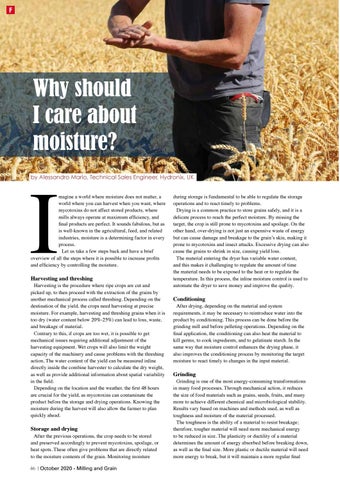
by Alessandro Mario, Technical Sales Engineer, Hydronix, UK magine a world where moisture does not matter, a world where you can harvest when you want, where mycotoxins do not affect stored products, where mills always operate at maximum efficiency, and final products are perfect. It sounds fabulous, but as is well-known in the agricultural, feed, and related industries, moisture is a determining factor in every process. Let us take a few steps back and have a brief overview of all the steps where it is possible to increase profits and efficiency by controlling the moisture.
Harvesting and threshing
Harvesting is the procedure where ripe crops are cut and picked up, to then proceed with the extraction of the grains by another mechanical process called threshing. Depending on the destination of the yield, the crops need harvesting at precise moisture. For example, harvesting and threshing grains when it is too dry (water content below 20%-25%) can lead to loss, waste, and breakage of material. Contrary to this, if crops are too wet, it is possible to get mechanical issues requiring additional adjustment of the harvesting equipment. Wet crops will also limit the weight capacity of the machinery and cause problems with the threshing action. The water content of the yield can be measured inline directly inside the combine harvester to calculate the dry weight, as well as provide additional information about spatial variability in the field. Depending on the location and the weather, the first 48 hours are crucial for the yield, as mycotoxins can contaminate the product before the storage and drying operations. Knowing the moisture during the harvest will also allow the farmer to plan quickly ahead.
Storage and drying
After the previous operations, the crop needs to be stored and preserved accordingly to prevent mycotoxins, spoilage, or heat spots. These often give problems that are directly related to the moisture contents of the grain. Monitoring moisture 46 | October 2020 - Milling and Grain
during storage is fundamental to be able to regulate the storage operations and to react timely to problems. Drying is a common practice to store grains safely, and it is a delicate process to reach the perfect moisture. By missing the target, the crop is still prone to mycotoxins and spoilage. On the other hand, over-drying is not just an expensive waste of energy but can cause damage and breakage to the grain’s skin, making it prone to mycotoxins and insect attacks. Excessive drying can also cause the grains to shrink in size, causing yield loss. The material entering the dryer has variable water content, and this makes it challenging to regulate the amount of time the material needs to be exposed to the heat or to regulate the temperature. In this process, the inline moisture control is used to automate the dryer to save money and improve the quality.
Conditioning
After drying, depending on the material and system requirements, it may be necessary to reintroduce water into the product by conditioning. This process can be done before the grinding mill and before pelleting operations. Depending on the final application, the conditioning can also heat the material to kill germs, to cook ingredients, and to gelatinate starch. In the same way that moisture control enhances the drying phase, it also improves the conditioning process by monitoring the target moisture to react timely to changes in the input material.
Grinding
Grinding is one of the most energy-consuming transformations in many food processes. Through mechanical action, it reduces the size of food materials such as grains, seeds, fruits, and many more to achieve different chemical and microbiological stability. Results vary based on machines and methods used, as well as toughness and moisture of the material processed. The toughness is the ability of a material to resist breakage; therefore, tougher material will need more mechanical energy to be reduced in size. The plasticity or ductility of a material determines the amount of energy absorbed before breaking down, as well as the final size. More plastic or ductile material will need more energy to break, but it will maintain a more regular final