F
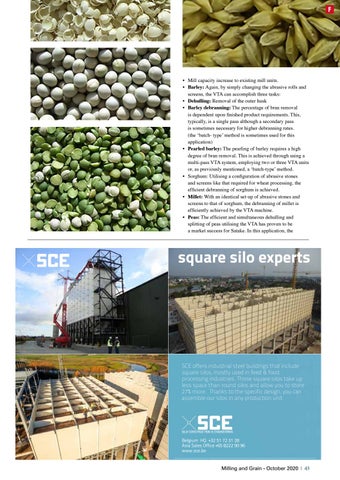
• Mill capacity increase to existing mill units. • Barley: Again, by simply changing the abrasive rolls and screens, the VTA can accomplish three tasks: • Dehulling: Removal of the outer husk • Barley debranning: The percentage of bran removal is dependent upon finished product requirements. This, typically, is a single pass although a secondary pass is sometimes necessary for higher debranning rates. (the ‘batch- type’ method is sometimes used for this application) • Pearled barley: The pearling of barley requires a high degree of bran removal. This is achieved through using a multi-pass VTA system, employing two or three VTA units or, as previously mentioned, a ‘batch-type’ method. • Sorghum: Utilising a configuration of abrasive stones and screens like that required for wheat processing, the efficient debranning of sorghum is achieved. • Millet: With an identical set-up of abrasive stones and screens to that of sorghum, the debranning of millet is efficiently achieved by the VTA machine. • Peas: The efficient and simultaneous dehulling and splitting of peas utilising the VTA has proven to be a market success for Satake. In this application, the
square silo experts
SCE offers industrial steel buildings that include square silos, mostly used in feed & food processing industries. Those square silos take up less space than round silos and allow you to store 27% more.
Thanks to the specific design, you can
assemble our silos in any production unit.
SILO CONSTRUCTION & ENGINEERING Belgium HQ +32 51 72 31 28 Asia Sales Office +65 8222 90 96 www.sce.be
Milling and Grain - October 2020 | 43