F
ROLL MEASUREMENT
A
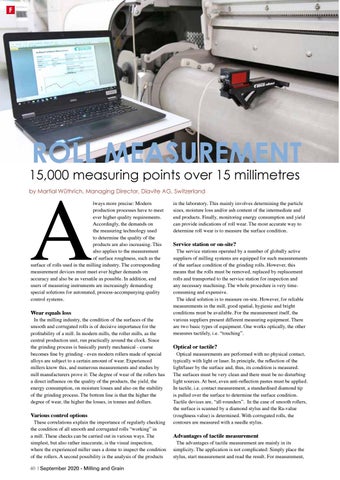
15,000 measuring points over 15 millimetres by Martial Wüthrich, Managing Director, Diavite AG, Switzerland lways more precise: Modern production processes have to meet ever higher quality requirements. Accordingly, the demands on the measuring technology used to determine the quality of the products are also increasing. This also applies to the measurement of surface roughness, such as the surface of rolls used in the milling industry. The corresponding measurement devices must meet ever higher demands on accuracy and also be as versatile as possible. In addition, end users of measuring instruments are increasingly demanding special solutions for automated, process-accompanying quality control systems.
Wear equals loss
In the milling industry, the condition of the surfaces of the smooth and corrugated rolls is of decisive importance for the profitability of a mill. In modern mills, the roller mills, as the central production unit, run practically around the clock. Since the grinding process is basically purely mechanical - coarse becomes fine by grinding - even modern rollers made of special alloys are subject to a certain amount of wear. Experienced millers know this, and numerous measurements and studies by mill manufacturers prove it: The degree of wear of the rollers has a direct influence on the quality of the products, the yield, the energy consumption, on moisture losses and also on the stability of the grinding process. The bottom line is that the higher the degree of wear, the higher the losses, in tonnes and dollars.
Various control options
These correlations explain the importance of regularly checking the condition of all smooth and corrugated rolls “working” in a mill. These checks can be carried out in various ways. The simplest, but also rather inaccurate, is the visual inspection, where the experienced miller uses a dome to inspect the condition of the rollers. A second possibility is the analysis of the products 40 | September 2020 - Milling and Grain
in the laboratory. This mainly involves determining the particle sizes, moisture loss and/or ash content of the intermediate and end products. Finally, monitoring energy consumption and yield can provide indications of roll wear. The most accurate way to determine roll wear is to measure the surface condition.
Service station or on-site?
The service stations operated by a number of globally active suppliers of milling systems are equipped for such measurements of the surface condition of the grinding rolls. However, this means that the rolls must be removed, replaced by replacement rolls and transported to the service station for inspection and any necessary machining. The whole procedure is very timeconsuming and expensive. The ideal solution is to measure on-site. However, for reliable measurements in the mill, good spatial, hygienic and bright conditions must be available. For the measurement itself, the various suppliers present different measuring equipment. There are two basic types of equipment. One works optically, the other measures tactilely, i.e. “touching”.
Optical or tactile?
Optical measurements are performed with no physical contact, typically with light or laser. In principle, the reflection of the light/laser by the surface and, thus, its condition is measured. The surfaces must be very clean and there must be no disturbing light sources. At best, even anti-reflection pastes must be applied. In tactile, i.e. contact measurement, a standardised diamond tip is pulled over the surface to determine the surface condition. Tactile devices are, “all-rounders”. In the case of smooth rollers, the surface is scanned by a diamond stylus and the Ra-value (roughness value) is determined. With corrugated rolls, the contours are measured with a needle stylus.
Advantages of tactile measurement
The advantages of tactile measurement are mainly in its simplicity. The application is not complicated: Simply place the stylus, start measurement and read the result. For measurement,