F
Considering the options: Pushbutton vs HMI display controls
T
by Gary Roberts, Automation, Northwind, USA
hose of us that are familiar with controls systems have seen some of the benefits that can be gained when using a human machine interface (HMI) versus using a simple pushbutton control panel. Some of the main benefits an HMI provides include increased efficiency, safety, and overall functionality. While a pushbutton panel is easily understood and simple, it can be severely limiting in the level of complexity the systems it can handle. Another limitation is that the efficiency of a pushbutton panel depends solely on the experience of the operator.
Pushbutton control panels
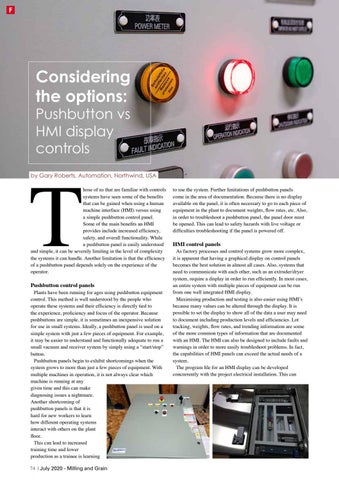
Plants have been running for ages using pushbutton equipment control. This method is well understood by the people who operate these systems and their efficiency is directly tied to the experience, proficiency and focus of the operator. Because pushbuttons are simple, it is sometimes an inexpensive solution for use in small systems. Ideally, a pushbutton panel is used on a simple system with just a few pieces of equipment. For example, it may be easier to understand and functionally adequate to run a small vacuum and receiver system by simply using a “start/stop” button. Pushbutton panels begin to exhibit shortcomings when the system grows to more than just a few pieces of equipment. With multiple machines in operation, it is not always clear which machine is running at any given time and this can make diagnosing issues a nightmare. Another shortcoming of pushbutton panels is that it is hard for new workers to learn how different operating systems interact with others on the plant floor. This can lead to increased training time and lower production as a trainee is learning 74 | July 2020 - Milling and Grain
to use the system. Further limitations of pushbutton panels come in the area of documentation. Because there is no display available on the panel, it is often necessary to go to each piece of equipment in the plant to document weights, flow rates, etc. Also, in order to troubleshoot a pushbutton panel, the panel door must be opened. This can lead to safety hazards with live voltage or difficulties troubleshooting if the panel is powered off.
HMI control panels
As factory processes and control systems grow more complex, it is apparent that having a graphical display on control panels becomes the best solution in almost all cases. Also, systems that need to communicate with each other, such as an extruder/dryer system, require a display in order to run efficiently. In most cases, an entire system with multiple pieces of equipment can be run from one well integrated HMI display. Maximising production and testing is also easier using HMI’s because many values can be altered through the display. It is possible to set the display to show all of the data a user may need to document including production levels and efficiencies. Lot tracking, weights, flow rates, and trending information are some of the more common types of information that are documented with an HMI. The HMI can also be designed to include faults and warnings in order to more easily troubleshoot problems. In fact, the capabilities of HMI panels can exceed the actual needs of a system. The program file for an HMI display can be developed concurrently with the project electrical installation. This can