F
Vitaris:
A MODULAR SYSTEM FOR THE BEST GRAIN CLEANING
E
by Bühler Group Switzerland
very miller knows that it is the quality of what goes in that counts. That is why cleaning grain is one of the most important steps in the milling process. Removing impurities makes the biggest difference to the quality of the final flour and makes an essential contribution to ensuring food safety. Vitaris is a modular system from Bühler that enables the miller to achieve a high-quality final product reliably and efficiently. Milling plays an essential role in the food value chain by grinding grain so that its nutrients can be more easily digested. Taking grain and turning it into flour has been the miller’s job for thousands of years. But as simple as the basic process of grinding may sound, achieving a high-quality final product requires skill, experience and sophisticated machinery. When wheat and other grains arrive at the mill, they contain many different types of impurities that have entered the mix at different stages. Metal, stones, weeds, other grains and general debris can all become part of the mix during growth, harvest, storage, and transportation. During the growing season, for example, too much rain can cause the wheat to become mouldy or it might be attacked by insects and diseases. Shrunken, broken, diseased and damaged grains have to be removed. If these impurities are left in the mix, it will affect the quality and odour of the final flour and may pose a health risk. Certain impurities also affect machine efficiency. Cleaning is, therefore, an essential step in the milling process and one that, ultimately, has the most significant impact on the quality of the flour. Removing each of these different types of impurity requires a different process – and therefore a different type of machine. A separator takes out the overs, a concentrator sorts light and heavy fractions, an aspiration channel takes out the lights in the light fraction, a destoner separates according to specific weight. Each of these machines takes up space in the mill and has its own energy requirements. What is more, as every batch of grain
44 | July 2020 - Milling and Grain
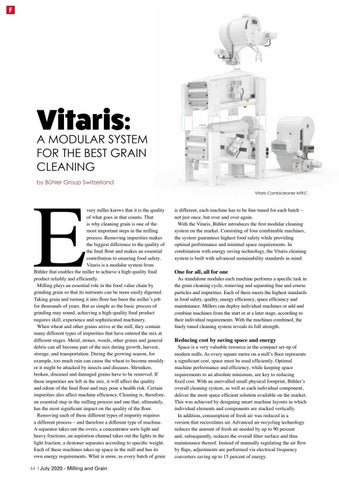
Vitaris Combicleaner MTKC
is different, each machine has to be fine-tuned for each batch – not just once, but over and over again. With the Vitaris, Bühler introduces the first modular cleaning system on the market. Consisting of four combinable machines, the system guarantees highest food safety while providing optimal performance and minimal space requirements. In combination with energy saving technology, the Vitaris cleaning system is built with advanced sustainability standards in mind.
One for all, all for one
As standalone modules each machine performs a specific task in the grain cleaning cycle, removing and separating fine and course particles and impurities. Each of them meets the highest standards in food safety, quality, energy efficiency, space efficiency and maintenance. Millers can deploy individual machines or add and combine machines from the start or at a later stage, according to their individual requirements. With the machines combined, the finely tuned cleaning system reveals its full strength.
Reducing cost by saving space and energy
Space is a very valuable resource in the compact set-up of modern mills. As every square metre on a mill’s floor represents a significant cost, space must be used efficiently. Optimal machine performance and efficiency, while keeping space requirements to an absolute minimum, are key to reducing fixed cost. With an unrivalled small physical footprint, Bühler’s overall cleaning system, as well as each individual component, deliver the most space efficient solution available on the market. This was achieved by designing smart machine layouts in which individual elements and components are stacked vertically. In addition, consumption of fresh air was reduced in a version that recirculates air. Advanced air-recycling technology reduces the amount of fresh air needed by up to 90 percent and, subsequently, reduces the overall filter surface and thus maintenance thereof. Instead of manually regulating the air flow by flaps, adjustments are performed via electrical frequency converters saving up to 15 percent of energy.