February 2020
YOUR GLOBAL PARTNER
In this issue:
INTEGRATED FEED MILL: Balancing quality and quantity in grain production
• Phytogenics: Green powerhouses amongst the available additives
Milling and Grain . Volume 131 . Issue 02 . February 2020
• Online quality measurement in corn processing • High-shear extrusion • 2020 Alltech Global Feed Study
See our archive and language editions on your mobile!
• Can wheat’s New Year strength last? Proud supporter of
Volume 131 Issue 2
millingandgrain.com
Commercial Series Material Handling Incline conveyors offer flexibility and reliability Our materials and engineering make the difference Elevators & Conveyors engineered for strong, reliable, commercial performance Globally recognized for customer service and quality products, our team of experienced Dealers and Staff will assist you in determining the system that will suit your needs.
ÂŽ
Grain Storage
Dryers
Material Handling Systems
Catwalk and Tower Systems
Lemanco Bulk Storage Systems
Caldwell Grain Conditioning
COMMERCIAL BINS
• 48 m Diameter Bins (20321-48262 mt) • Peak Load Rating (6804-45360 kg) • Hopper Bins (3.7 m-14.6 m)
COMMERCIAL DRYERS
• Tower Dryers (23-281 t/h) • QuadraTouch ProTM Controls • Balanced Moisture Content
STEEL BUILDINGS
COMMERCIAL SWEEPS
BUCKET ELEVATORS
COMMERCIAL CONVEYORS
• Auger & Paddle sweeps available • Capacity includes 141-281 t/h • Patented Pivot Point • Industrial Grade Pushers
• Low Impact Head Design • Heavy Gauge Trunking • Patented Squaring Plates • Support Towers
• Industrial Strength • Built To Last • Higher Elemental Resistance • Capacity includes (984-1688 t/h) • Dust-tight and waterproof • Patented hip-style weather-tight cover • Catwalks
Sukup Worl d H eadquart ers - S hef f i e ld , Io w a U SA • w w w.su ku p .co m • in fo @su ku p .co m For service in Europe contact:
Sukup Europe A/S Hedensted, Denmark Tel +45 75 68 53 11 • Fax +45 75 68 54 70 info@sukup-eu.com • www.sukup-eu.com
Pneumatic or Mechanical Ship Loaders & Unloaders Port Equipment - Turnkey Projects
Your Solution starts here ! VIGAN Engineering s.a. Rue de l’Industrie, 16 - 1400 Nivelles - Belgium Tél.: +32 67 89 50 41 • Fax : +32 67 89 50 60 • www.vigan.com • info@vigan.com
Engineered To Suit You AGI EMEA is a leader in design and manufacturing of grain storage and handling equipment. Storage, Conveyors, Elevators, Catwalks, Platforms, Temperature Sensing
For more information on AGI’s full catalog of products and solutions contact emea@aggrowth.com or +39 051 798 107
AGGROWTH.COM | @AgGrowthInl
VOLUME 131 ISSUE 2
February 2020
Perendale Publishers Ltd 7 St George’s Terrace St James’ Square, Cheltenham, Glos, GL50 3PT, United Kingdom Tel: +44 1242 267700 Publisher Roger Gilbert rogerg@perendale.co.uk International Marketing Team Darren Parris darrenp@perendale.co.uk Martha Cornwell Tel: +1 913 2083770 marthac@perendale.com Fred Norwood Tel: +1 405 834 2043 fredn@perendale.com Asia Marketing Team Dante Feng Tel: +886 227930286 dantef@perendale.com Latin America Marketing Team Iván Marquetti Tel: +54 2352 427376 ivanm@perendale.com Pablo Porcel pablop@perendale.com Oceania Marketing Team Peter Parker peterp@perendale.co.uk Nigeria Marketing Team Nathan Nwosu Tel: +234 8132 478092 nathann@perendale.com
72 - The integrated feed mill: Balancing quality and quantity in grain production
Egyptian Marketing Team Mohamed Baromh Tel: +20 100 358 3839 mohamedb@perendale.com Turkey, Eurasia and Middle East Marketing Team Mehmet Uğur Gürkaynak Tel: +90 537 3646457 mehmetg@perendale.com Managing Editor Vaughn Entwistle vaughne@perendale.co.uk Features Editor Rebecca Sherratt rebeccas@perendale.co.uk International Editors Dr Roberto Luis Bernardi robertob@perendale.com Professor Wenbin Wu wenbinw@perendale.com Mehmet Ugur Gürkaynak mehmetg@perendale.com Design Manager James Taylor jamest@perendale.co.uk Circulation & Events Tuti Tan tutit@perendale.co.uk Development Manager Antoine Tanguy antoinet@perendale.co.uk millingandgrain.com ISSN No: 2058-5101 ©Copyright 2019 Perendale Publishers Ltd. All rights reserved. No part of this publication may be reproduced in any form or by any means without prior permission of the copyright owner. More information can be found at www.perendale.com Perendale Publishers Ltd also publish ‘The International Milling Directory’ and ‘The Global Miller’ news service Grain & Feed Milling Technology magazine was rebranded to Milling and Grain in 2015
ISSUE HIGHLIGHTS
8
NEWS FEATURES
42 Phytogenics: Green powerhouses amongst the available additives
44 grapas - Termico Silo THT
FACES
10-34 46 grapas - Rollcare 48 How much yield will you leave in the field this harvest? 54 Online quality measurement in corn processing
58 Beyond the Ri’ichi: Part 3: Processing
118 People news from the global milling industry
PRODUCT FOCUS
40
CASE STUDY
80 STORAGE
long-grain rice Husking
68 Securing the future of Nigeria’s agriculture
62 Aqua Feed Extrusion
64 High-shear extrusion
66 2020 Alltech Global Feed Study
EVENTS
90 Event listings, reviews and previews
72 The integrated feed mill
76 Railway bulk grain conveying project, China
TRAINING
38 2020 IGP course schedule announced
COLUMNS
20 Mildred Cookson 32 Rebecca Sherratt
10 GUEST EDITOR Marco Prati
84 MARKETS John Buckley
COVER IMAGE: The integrated feed mill: Balancing quality and quantity in grain production See more on page 72
116 INTERVIEW Dr Heike Knoerzer
Ensuring healthy feed for the future
Marco Prati
For engineering companies, like ourselves, the animal feed market offers us the opportunity to improve technology and create new systems in order to increase the quality of the finished products and ameliorate the benefits to the end users: animals and people.
If we think of the emergence and spread of antimicrobial resistance (AMR) in human health care that has created a growing global threat, we can begin to understand that the animal feed market is oriented in finding new other means of preventing infections and reduce antibiotic use in animal production. If antibiotic alternatives are chosen well and applied correctly, in many cases an antibiotic alternative should bring return on investment. Examples: If a probiotic stabilises the intestinal flora of a turkey, it will be more resistant to intestinal pathogens of all types, and even if they might still require treatment, they will recover from it faster. When antibiotics are used, the intestinal microbiome becomes unbalanced, taking on a gambling towards the future intestinal health of the animal. When good antibiotic alternatives are used, intestinal health is affected, but in contrast to antibiotics, for the better. One example of this could be during the first weeks after the birth of calves. They are often infected with pathogens that cause diarrhoea and may lead to death. If the calf is lucky enough to overcomes the disease, it will, in any case, result in weakness and reduced growth in the long-term. A deterrent could be the use of antibodies from hen eggs, which could help to strengthen the calf’s immune system and increase resistance towards such diseases. Other additives could be oregano oil (effective in many clinical strains of bacteria, including Escherichia coli and pseudomonas
aeruginosa), extract of garlic, onion, probiotics, prebiotics, enzymes, organic acids, butyrate, vitamins, trace elements, yeasts and fungi, antimicrobial peptides, rare earth elements and clays. This is the horizon that our gaze should have. However, we must pay attention on how we handle all these products because, normally, they are affected by high temperature and mechanical stress that could damage their organoleptic characteristics or dissolve, causing loss of quality and money. Therefore, the investment in using new products will not achieve the target benefits if we don’t also pay the same attention in how we handle the goods. For example, the dosing of the liquid products is very important, no matter if we are talking about a simple pump or a more complicated system. Every “ingredient” has characteristics that must be evaluated during the engineering stage of the project. Many products must be dosed accurately in order to have exactly the same percent advised in the formulation, not only for a correct use in the feed but also to avoid waste of costs due to incorrect dosage. A system also that can permit a perfect distribution of the liquids in the mash, using a mechanical emulsion that can combine different liquids, with different characteristic all together will permit a perfect CV with an increase of quality. Equally, when we talk about powder ingredients, we must consider using very precise systems, designed with a customised view in order to be suitable to all the different possible characteristics. With high technological systems it is possible to apply directly on the finished product (pellet, extruded products, flake products) the additives, with the final benefit of cost reduction because there will be no need to overdose the additive and this systems will also keep the physical and chemical characteristics of the additives unchanged. It is very important to work together in a team, each with their own skills to obtain results that can improve global nutrition security.
Marco Prati, CEO, PLP Liquid Systems
ANALYSIS
CONVEYING
Online quality measurement in corn processing
Zheng Chang undertake railway bulk grain conveying project, China
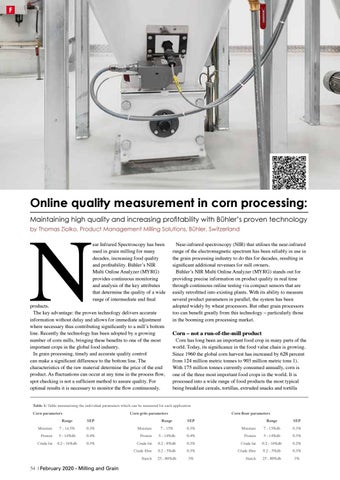
Near Infrared Spectroscopy has been used in grain milling for many decades, increasing food quality and profitability. Bühler’s NIR Multi Online Analyzer (MYRG) provides continuous monitoring and analysis of the key attributes that determine the quality of a wide range of intermediate and final products.
PAGE 54
Alashankou, Xinjiang, is the most important land port city in Western China and the node city of the Belt and Road.
PAGE 76
FOOD
STORAGE
FEED
PROCESS MILL
PHYTOGENICS
The grapas shortlist
Green powerhouses amongst the available additives
Termico Silo THT - By Wingmen Group Rollcare - By Yenar
The growing demand for more animal-friendly production has developed into a global phenomenon.
PAGE 44
PAGE 42 Annual Subscription Rates Inside UK: UK£100 Outside: US$150/€133 Milling and Grain has a cooperative partnership with COFCOET
More Information www.millingandgrain.com http://gfmt.blogspot.co.uk
Milling
News
In this issue of Milling and Grain one of our many articles discusses the latest solution by Wingmen Group that has entered into the running for the GRAPAS Innovations Awards 2020: the Termico Silo THT.
Patrick Gloggner, Bakels Group CEO, Johannes Wick, CEO Bühler Grains & Food, Armin Ulrich, Bakels chairman, Stefan Scheiber, CEO Bühler Group, Mark Macus, CFO Bühler Group (left to right)
Bühler Group sells flour ingredient business to Swiss company Bakels
B
ühler Group has sold its flour ingredient business to Bakels. The Swiss group manufactures and distributes innovative bakery ingredients and application solutions. 70 employees of Bühler Guangzhou moved to the new owner with immediate effect. Both parties have agreed not to disclose the selling price. “With Bakels, we have found an excellent owner and strategic partner for flour ingredient solutions,” says Johannes Wick, CEO of Bühler’s Grains & Food business. Bakels is a Swiss enterprise with more than 2,750 employees. Its main focus is on ingredients for bakery and confectionary. “Flour ingredients have been a missing link in our portfolio so far,” says Armin Ulrich, Bakels’ chairman. “We are excited to close that gap now by taking over Bühler’s well-positioned business and strengthen our position in China.” Bakels will partner with Bühler to develop the flour ingredients business, Ulrich adds. The two companies will cooperate strategically to offer flour ingredient solutions under Bakels’ lead to milling and bakery customers. Bühler was active within the flour ingredient business since 2010. During this time, the company gained great expertise and excellent customer relations. The business proved profitable over the last years, focusing mainly on the Chinese market. Be it the growing demand for baked foods, increasing food safety levels, and the rise of highly nutritional food: The outlook of the flour ingredient business looks very positive. Bühler’s strategic direction sees process solutions and customer services at its core. “Bühler has been active in the flour ingredients business to understand the entire value chain in order to provide better consulting capabilities throughout the life cycle of assets. Now we can do this even better, thanks to our professional partner who is active in a large array of segments,” says Johannes Wick. “We are convinced that this business can unleash its full potential on a global scale, with Bakels as owner and Bühler as a strategic partner,” he adds. 10 | February 2020 - Milling and Grain
The Termico Silo THT solution is an interesting machine for targeting pests in flour or grain silos, which utilises heat to eliminate infestations. Whilst we have covered a variety of chemical fumigation techniques in Milling and Grain, heat treatment is a topic we are interested in exploring in much more depth. Heat treatment can pose a variety of advantages when compared to the more traditional pest infestation systems, including the fact that the solution is 100 percent poison-free and removes the need for potentially dangerous chemicals during treatment. Heat treatment effectively enables employees to feel safe and secure as they work after the treatment period, and no authorities or permits are required to be present or obtained in order to conduct this treatment. So, how exactly does heat treatment work? In the majority of systems, a heated liquid slows through insulated pipes to heat exchangers, which are strategically placed within key problem areas in silos or grain bins. Both thermal imaging technology and heat probes are used to ensure that all target pests are exterminated. The heat works primarily by denaturing the protein within the target insect’s body, causing dehydration. This also eliminates eggs and larvae. In an era where sustainability is becoming more and more of a concern, heat treatment is certainly a remarkably sustainable and friendly solution for the environment.
GF
MT
gfmt.blogspot.com
LATEST TECHNOLOGY FOR THE FOOD PROCESSING INDUSTRY Upgrade your roller mill by using only Balaguer Rolls. Ask your roller mill supplier to provide Balaguer Rolls on your machines.
Milling News
New in North America: Delacon’s heat stress solution
D
uring IPPE 2020, Delacon brings its latest heat stress product for poultry to North America. Biostrong® Comfort is now available in the USA and Canada. Every year, hot and humid weather wreaks havoc on poultry production worldwide. Rising temperatures can significantly reduce bird performance due to lower feed intake and reduced feed efficiency, which, in turn, can lead to reduced body weight gain and egg production. A heat stress product is now available to help birds in North America beat the heat. Biostrong® Comfort, developed by Delacon to support poultry at the highest temperatures and humidity levels, aims to lessen the impact of heat stress, estimated to cost the poultry industry more than US $100 million per year. “Our special formulation of flavonoids, essential oils and other phytogenic active ingredients supports feed intake and specific nutrient supply for better performance,” says David Harrington, Species Leader Poultry at Delacon.
Without support of the bird’s natural antioxidative defence mechanisms, the balance between the production of free radicals and antioxidants can be quickly disturbed, he explains. “Plant-derived antioxidants provided by Biostrong Comfort can help maintain this balance and support the production of the endogenous antioxidative capacity of the bird.” Key benefits of Biostrong® Comfort include its ability to help maintain growth performance and feed conversion ratio in hot, humid conditions, as well as helping to promote feed intake and support resilience of poultry to mitigate the specific effects of heat stress. The goal is to provide poultry with the necessary energy and supporting nutrients to maintain a normally functioning natural defence system and stable intestinal function in hot and humid climates. “Supplementing with Biostrong Comfort contributes to improvements in body weight gain and feed conversion in heat stress conditions”, adds Harrington.
Extrusion and expansion technology you can trust
www.almex.nl 12 | February 2020 - Milling and Grain
Milling News
New Zealand feed manufacturers upgrade testing of imported ingredients
T
he New Zealand Feed Manufacturers Association (NZFMA) has recently upgraded its FeedSafeNZ auditing and testing regime to include additional testing of non-grain ingredients imported from
overseas. The move is in response to more imported non-grain ingredients arriving in the country from an increasing number of countries of origin. “While the quality of feed manufacturing is already spot-checked by the New Zealand Ministry for Primary Industries (MPI) and is regularly audited by AsureQuality, one of the country’s leading quality assurance organisations, the new sources have brought some uncertainty about the accuracy of labelling and the quality of the raw material, especially vitamins and minerals, added to feed,” says Michael Brooks, Executive Director of the NZFMA.
New Zealand’s animal feed industry comprises some 40 manufacturers and blenders located throughout the country and produces 1.2 million tonnes of bulk and bagged feed per year. The main species catered for, in descending order, are meat chickens, layer hens, dairy cows, pigs and calves. The NZFMA’s FeedSafeNZ stockfeed quality assurance programme, established in 2015, requires NZFMA members to undergo a stringent testing regime that involves a thorough on-site audit of their ingredients, plant and storage facilities and operations by the independent third-party auditor, AsureQuality, which provides food safety and biosecurity services to the food and primary production sectors worldwide. Only FeedSafeNZaccredited sites are permitted to use the FeedSafeNZ logo on their packaging and other materials. Michael Brooks says, “For farmers, especially, it is crucial that the quality and integrity of the food we produce in New Zealand remain uncompromised. This enhancement to our FeedSafeNZ accreditation programme provides stock owners with extra assurance that the feed they are purchasing is manufactured to the highest possible standard.”
Milling and Grain - February 2020 | 13
Milling News
US wheat industry praises passing of US-MexicoCanada agreement
U
S wheat growers are very pleased that the US House of Representatives has passed the US-Mexico-Canada Agreement (USMCA). This past year, the National Association of Wheat Growers (NAWG) and US Wheat Associates have forcefully spoken out on their behalf about the need for the USMCA. “Agriculture desperately needed a win for economic recovery, and passing the USMCA was that win,” said National Association of Wheat Growers (NAWG) President and Lavon, Tex, farmer Ben Scholz. “NAWG applauds those Members of Congress for their support and hard work to advance this critical trade deal one step closer to the finish line.” “Mexico’s flour millers import more US wheat than any other country and they have been very anxious about
the outcome of this trade agreement,” said US Wheat Associates (USW) Chairman and Paulding, Ohio, farmer Doug Goyings. “At the end of a conference with those millers last June, we agreed to work together to get USMCA implemented. Our colleagues at NAWG have enthusiastically joined that effort on Capitol Hill and we thank them for their support.” USMCA retains tariff-free access to imported US wheat for those long-time flour milling customers in Mexico, a crucial step toward rebuilding trust in the US as a reliable supplier in this important, neighbouring market. In addition, the USMCA makes important progress towards more open commerce for US wheat farmers near the Canadian border by allowing US varieties registered in Canada to receive reciprocal grading treatment.
Multimillion-dollar expansion of Innovation and Development Centre
W Take a closer look! … because that’s what we do, too. On every single FILIP cleaner, we monitor every detail throughout the entire manufacturing process. We know that our proven quality will guarantee effective sieve cleaning within your plansifters. And that, in turn, will ensure a high yield from your passages.
Efficient. Quality. Cleaning.
FILIP GmbH • Müllereibürsten • Anemonenweg 4 • D-33335 Gütersloh Telephone: +49 (0)5241 29330 • Telefax: +49 (0)5241 20321 E-mail: info@filip-gmbh.com • www.filip-gmbh.com
SIEVE CLEANERS
14 | February 2020 - Milling and Grain
enger Manufacturing, Inc, has begun work on a US $13 million renovation project to expand and modernise the Wenger Technical Centre in Sabetha, USA. The Wenger Technical Centre is a facility dedicated to innovation and continuous improvement of extrusion process systems for food, feed and industrial applications. The Wenger Technical Centre houses full-scale extruders, dryers and ancillary components to provide a real-world development environment for extrusion-based products and processes. “This renovation is a strategic reinvestment into a facility that has long served our industries as the critical hub for innovation and continuous improvement,” says Lafe Bailey, Co-CEO and President of Sales and Corporate Development. “The Technical Centre has held global importance to the extrusion industry since 1954, and we are committed to both renewing, and expanding, the roles and responsibilities that the Wenger Technical Centre holds in the industries we serve.” The modernisation will include enhancing preventative measures for food safety. It will expand the scope of market-facing services while also further enhancing existing innovation projects already active in the Wenger pipeline.
Milling News
YOUR GLOBAL PARTNER
Feed yeast market size to exceed US $1bn by 2029
T
he global feed yeast market has witnessed substantial growth in the past few years and will continue to progress promisingly throughout the forecast period of 2019-2029. Projected to reach beyond US $1bn towards the end of 2029, the global feed yeast market will observe a healthy CAGR during the forecast period. Probiotics with yeast-based ingredients are gaining rapid traction, as they help in vitamin production, management of toxins, effective digestion of fibres and increase absorption of nutrients, especially in cattle. Yeast-based probiotics are also gaining popularity in the animal nutrition industry for use as an animal feed supplement. The study notes that ruminants hold the largest share in the global feed yeast market among all segments by livestock, attributable to high use of feed yeast to boost gut health of cattle. Live yeast is expected to hold the largest share in the global feed yeast market among all segments by product type, as it is among
the key ingredients in animal feed for all species. Live yeast prevents decrease in rumen pH in ruminants and enhances the fibre digestion in equines. The Middle East and Africa are expected to be lucrative markets for manufacturers in the feed yeast market, attributable to a five percent increase in animal feed production, as compared to 2017. Dry yeast is projected to be the most attractive segment in the feed yeast market, owing to increasing use of active dry yeast, coated active dry yeast, and brewer’s dry yeast in animal feed. Stakeholders in the feed yeast market are adapting their market strategies as per the current trends in the market. Leading manufacturers are have adopted for strategies such as acquisitions, strategic collaborations, and global expansion. Additionally, these companies are also focusing on investments in research and development facilities to further provide tailored solutions for the feed yeast market.
Want more industry news? Get weekly updates from the feed and flour milling industries with our email newsletter!
myMAG.info/e/289
Milling and Grain - February 2020 | 17
Milling News
A
Women in Food and Agriculture Survey results
griBriefing’s Women in Food and Agriculture initiative, launched in early 2019 to promote the role of women across the agribusiness supply chain, has announced the release of an industry-wide survey, in conjunction with Alltech. The aim throughout the initiative has been to highlight the current state of our industry. This is not about giving women special treatment or an unfair advantage, but about ensuring we have the facts and skills required to create a level playing field.
Conducted in October 2019, the results catalogue the opinions and experiences of over 2,500 employees working in food and agriculture business around the world. The results have been reviewed by AgriBriefing’s own journalists, with additional data analysis by independent market research consultants Savanta ComRes. The report showcases the differences in opinions between men and women, how women perceive their employers, workplace culture and what our industry believe are the barriers holding women back. Elisabeth Mork-Eidem, Group Event Director at
AgriBriefing commented, “The aim of the survey was to explore the current situation regarding gender diversity in agricultural organisations across the whole agricultural supply chain. The survey results shine an interesting light on how the industry is perceived from those who work in it and shows that there is still work to be done to remove barriers. The industry still needs to act on gender diversity and the benefit will be stronger business outcomes.” The survey asked participants to select some of the biggest barriers they faced in progressing their career in food and agriculture. On equal pay more than half of all women agreed equal pay was an issue, compared to a third of men. Women working in ag-tech cited lack of mentors as a barrier to progression more frequently than most, women working in trading agreed the least. Mark Lyons, CEO of Alltech said, “We need to create an environment for facilitating conversations; where female mentors can be sought, and to establish programs within our organizations that facilitate mentorships.” For the most part however, the survey shows that the industry is making great progress and employees are feeling positive about the future. 58 percent feel that women are well-represented in the industry and 79 percent agree that their organisation is becoming more inclusive. The results of the survey were presented by Mark Lyons, CEO of Alltech at the Women in Food and Agriculture Summit in Amsterdam.
A SOLUTION FOR EVERY FEED PRODUCER WYNVEEN HAMMER MILL GHM
The GHM hammer mill is equipped with adjustable shear plates, resulting in higher capacities with less energy consumption. Wynveen Hammer Mills are suitable for frequency control, so that various finenesses and structures can be produced without the need for screen change (in terms of perforation).
18 | February 2020 - Milling and Grain
Interested in our Hammer Mill range?
www.wynveen.com
Milling News
The Star Corn Millers’ Society Ltd new roller mill at Oldham
The opening of the Star Corn Millers’ Society’s new roller mill at Oldham: Wednesday October 21st, 1891 by Mildred Cookson, The Mills Archive, UK Milling journals of the past at The Mills Archive
This new roller mill was reviewed in The Miller (December 7th, 1891) after their reporter had been invited with others to the opening ceremony and tour. The 20 sacks-per-hour plant, fitted out by Robinsons, was started up at by James Lownds, Chairman of the Star Corn Millers’ Society. The original Star Mill was erected in 1869 and had done good work for several years. It was remodeled and enlarged with a new plant fitted in one portion of the building when the entire mill was destroyed by fire towards the end of 1889. Early in March the following year, the directors resolved to rebuild the mill on a more extensive scale along with a special maize plant. The new mill was a handsome structure; its most prominent architectural feature was the square tower fitted with its large tank for the automatic sprinklers now installed. Mr Spencer the mill manager conducted the tour, highlighting the millwright’s excellent work, such as the shafts; the second and third motion shafts were fitted with Mr Breton’s automatic oil feeders. The grain silo building, on the westerly side of the site, featured a strong substantial brick wall dividing off the silo bins (shown as the honeycombed section in the plan). They were six storeys high, including basement and attic, with a floor space of 90x40 feet. 46 large wheat silo bins for the storing and blending of the wheat occupied the centre part for the four floors. Each silo was eight-feet in diameter by 50-feet deep, divided from its neighbour by a nine-inch brick wall of pressed bricks. The whole silo could hold around 2,300 tonnes of wheat, ready to be discharged automatically. In the basement were the appliances 20 | February 2020 - Milling and Grain
for mixing the wheat, a series of spiral conveying worms, three for moving the dirty wheat, three for blending purposes. The wheat cleaning was done on several floors with two horizontal brush machines, 16 barley and cockle cylinders and two horizontal wheat scourers. On the first floor were five elevator bottoms, a wheat washer, a whizzer and the lower portion of the dryer and cooler. The second floor had two horizontal brush machines, 16 barley and cockle cylinders and the hoppered bottom of the two clean wheat bins. The third floor had two horizontal wheat scourers, two horizontal brush machines, a ‘Trent’ automatic grain weigher,
A perspective view of the purifier floor
The Trent automatic grain scale
two rotary grading sieves, and an elevator bottom. The fourth floor had seven elevator heads, a warehouse separator, the top portion of the Mallison’s patent wheat dryer and the Parkinson’s patent wheat cooler. All the wheat machines had fans attached to them to convey the dust away to the dust room over the wheat cleaning department. To clean the wheat thoroughly, it passed over the preliminary sieves, then on to rotary sieves which sized the grains, then onto barley and cockle cylinders to remove oats, barley and small seeds. It was then ready for washing to remove stones and earth. From there it went to the Mallinson’s wheat dryers and Parkinson’s wheat cooler, which had been recently introduced by Thomas Robinson with the intention of ensuring regularity of the flour and improving the elasticity of the gluten in the wheat. Once the wheat was mixed by the automatic mixers it was then elevated to another silo for blending. The third wheat cleaning process consisted of scourers and brushes with quick revolving beaters rotating inside a serrated conical cylinder of iron that had fine slot holes to allow dust to fall through. The considerable friction scoured off any extraneous dirt that could be adhering to the berry.
Plan of the Star Corn Millers’ roller mill
The roller floor measured 118-feet long and 29-feet wide. This part of the building had five floors and contained the twenty sack-per-hour roller mill plant. The first floor had 26 double roller mills arranged in two straight lines for the breaking down of the wheat on the system of five breaks, the flouring of the dunst, middlings and semolina etc. The five breaks were done on 10 roller mills, each, each break being accomplished on two double machines. The first break was done on two roller mills each fitted with three grooved chilled iron rolls 30x9 inches. The second and third breaks were done on four roller mills, each fitted with four grooved chilled iron rolls, 36x9 inches. The fourth and fifth break were done on four roller mills with four grooved chilled iron rolls, 30x9 inches. The flouring of the dunst, middlings and semolina was done on 16 double roller mills of which two had four smooth chilled iron rolls of 36x9 inches, two with rolls 30x9 inches., and the remaining 12 double machines had four smooth chilled rolls of 24x9 inch. The second floor contained a row of 11 Koh-i-nor purifiers, shown in the perspective view, along with a Trent automatic grain
You can now purchase the training manuals used in the nabim flour milling distance learning programme. Great as a handy reference guide, you can buy the textbooks singly or as a set of seven.
Please email training@nabim.org.uk to order your copy
Milling and Grain - February 2020 | 21
Milling News
A perspective view of the roller floor
The Green’s Economiser
weighing machine and a magnetic separator. The third floor had 14 centrifugal flour dressing machines, a long band conveyor and an elevator bottom. On the fourth floor there was a rotary scalper for the first break, two scalpers for the second break and two for the third. They were all double scalpers. Also here were two scalpers with single sieves for the fourth break, a reel 13-feet long for the fifth break, two bran dusters, four centrifugal flour dressing machines and four long silk reels for dusting sizing and treating the chop. The top floor had 24 elevator heads and the air trunk which carried the dust to the collecting department over the wheat cleaning section. At the north end of this floor was the packing room for the flour and offals. The small provender mill shown on the floor plans contained three sets of millstones, one oat crusher and one bean and corn splitter, together with the necessary rotary sifters required for
The Witter automatic sprinkler and fire alarm
treating Indian corn, oats and barley. They also installed an improved sack hoist for taking up corn etc. Electric light lit the whole premises, including the flour mill, offal mill, warehouse and offices. Fire prevention was top of the list in requirements after the previous disastrous fire and so the Witter patent sensitive automatic sprinkler system was installed with 1,108 sprinklers fitted throughout the complex. The motive power for the machinery came from a pair of double compound engines. The steam required to drive them came from two boilers 30x8 feet, placed in the boiler house along with a set of Green’s economisers.
www.millsarchive.org
Our History Gime Tech, based on Hubei Food Processing machinery Works in 1950s, is serving our customers from all over the world by manufacturing a high-quality rice mill machinery. Our Factory Our factory occupy area 40,000 square meters, and also have capacity of 120 tons per day, it is located in Yunmeng city, 80 km far from Wuhan city. Our Product We supply rice mill machine, feed mill machine, cereal processing machine, color sorter, silo, packing machine and related accessory. Our products are used for rice milling, grain processing, corn milling and cereal milling. Our Certificate We are an ISO 9001:2000, CE certificate company, our main goal is that supply high quality and reasonable price products.
Contact us: Gime Tech Park, Zixu Road 270, Yunmeng City, 432508, Hubei Province, China 22 | February 2020 - Milling and Grain
E: gime@vip.126.com T: +86 13510 372500
www.gimetech.com
WI
BE
UN
NN
ST
LO
AD
I B J
ER
SH
20
IP
ER
A W
LO SY A
18&
AD
ST
’19
ER
EM
R D
&
S
YOUR SPECIALIST FOR
SHIP(UN)LOADERS Our customers rely on NEUEROs Shipunloaders and Shiploaders in Romania at the Black Sea.
Comvex - Constanta, Romania, 2019
efficient unloading
reduced noise
reduced dust
more efficient than comparable systems
< 80 dB through noise supressing constructions
lowest dust emission
Quality Made in Germany
Over 100 years of experience
NEUERO produces reliable and
Our customers rely on NEUEROs
high-quality conveyor systems with
know-how and quality awareness
German Engineering.
for over 100 years.
Get in contact +49 5422 9 50 30 neuero@neuero.de www.neuero.de 340 - 2020
140 BIGGEST STORAGE 35 MILLIO COUNTRIES PROJECTS M3 BUILT
VISIT US
• Grain Tech Kiev. Ukraine. 18 Feb. - 20 Fe • VICTAM. Moscow. 24 Mar.- 26 Mar. Stan
- YOUR PARTNE
symaga.com • +34 91 726
ON FLEXIBILITY T AND ADAPTIBILITY
eb. Stand 12F nd A099
Higher galvanization for our roof: ZM310
Symaga increases the zinc magnesium galvanization from ZM250 to ZM310. We improve roof sector protection.
ER FOR STORAGE -
6 43 04 • symaga@symaga.com
Exceptional Protein Digestiblity with a Powerful Protease The amount of available protein in feedstuffs can range based on the source. Studies show that by including CIBENZA® protease in diets, you can either reduce the total amount of protein in formulated feed or use less digestible, lower-cost alternatives1.
www.novusint.com/CIBENZA
1
Study available upon request.
®NOVUS and CIBENZA are trademarks of Novus International, Inc. and are registered in the United States and other countries. ©2019 Novus International, Inc. All rights reserved. 4284_Perendale
Milling News
H
The Prince of Wales becomes Patron of the Sustainable Food Trust
is Royal Highness The Prince of Wales has accepted an invitation to become the Patron of the Sustainable Food Trust (SFT). The announcement was made at the launch of the organisation’s Progress Report in London. The report outlines the development and successes of the SFT over the last eight years. Commenting on the announcement, Patrick Holden, Founder and CEO of the Sustainable Food Trust (SFT) said, “The decision by The Prince of Wales to accept this invitation comes at a vital moment in history, when the pressures that unsustainable land management, farming and food production systems are putting on the planet’s ecosystems are threatening to precipitate irreversible
climate change, biodiversity collapse, the further destruction of natural capital, food insecurity and massive and unaffordable damage to public health.” Mr Holden continued, “As an organisation that works internationally, with high-level contacts across the world, the SFT is in a unique position to promote greater collaboration between individuals and organisations in leadership positions, encouraging them to embrace united strategies for addressing these unparalleled threats to human civilisation as we know it. I would like to acknowledge on behalf of the board and staff of the SFT the huge dept of gratitude that we owe to The Prince of Wales for his vision and leadership in this field.”
Milling and Grain - February 2020 | 27
Milling News
® ®
Accurate bulk grain sampling, from end to end of the load.
YOUR GLOBAL PARTNER
Discover even more at www.samplex.co.uk
E
nergy is, besides the raw material and labour costs, one of the biggest cost factors for flour millers today. Costs for energy are increasing year by year and affect the production costs and margins of flour millers globally. The reduction of energy costs is becoming more and more important to remain as a miller in a competitive market, says Andreas Hummel, CTO of Wingmen Group. Limón GmbH is one of the leading services and solution providers in Germany in the area of energy management and energy efficiency concerning various industries. Wingmen Group is a globally active as consultant for projects, flowsheets and energy optimisation in the flour and grain processing industry. With the energy expertise of Limón and the process and project knowledge of Wingmen Group, both companies are confident that they can support flour millers to reduce their energy consumption. As the first energy alliance specific for the global milling industry Wingmen Group and Limón will offer combined services, including project consultation for new flour mill projects and plant expansions, energy audits and analysis of existing facilities and plants and training for milling employees to find and analyse energy saving potential.
®
New strategic partnership for energy consulting in the flour milling industry between Wingmen Group and Limón
Milling and Grain - February 2020 | 29
Species-specific solutions gaining traction in feed enzymes market, finds FMI study
A
ccounting for over 60 percent of the total production costs, animal feed remains one of the highest investment areas in the animal farming sector. A new market research study says that as feed enzymes are witnessing growing acceptance over antibiotics within the feed industry, the global market for feed enzymes will showcase a healthy growth outlook over the period of forecast (2019 - 2027). Manufacturers are introducing advanced feed enzymes to cut down on expenses and improve feed-stuff utilisation. This would remain another strong factor assisting the growth of feed enzymes market in the near future. The FMI study suggests that the feed enzymes market will be prominently driven by high demand for carbohydrasebased feed enzymes in the foreseeable future. However, protease-based feed enzymes are set to witness maximum
si
Milling News
growth opportunities. The most commonly used feed enzymes in the poultry industry are phytase and carbohydrase, as they target phytic acid complexes in plant ingredients and remove the viscous fibre in cereals. Feed enzymes are also gaining significant traction in poultry, as they help in effective utilisation of raw materials and reducing feed costs. Besides, the demand will be higher for aquatic animals, attributing to increasing fisheries and farming practices, and rising awareness concerning sustainable and responsible fish farming. Players operating in the feed enzymes market must focus on the development of species-specific feed enzymes benefiting animals at all life-stages and reducing risk of diseases. Manufacturers may benefit from introducing cost-effective products in emerging economies, which are primarily agrarian. Key players operating in the feed enzymes market strive to deliver highquality additives and ingredients for animal feed to ensure healthier animals with improved efficiency and productivity. Manufacturers are, thus, producing animal-specific enzymatic solutions to provide effective solutions.
nce 1963
ILDEX Vietnam 2020
International Livestock, Dairy, Meat Processing and Aquaculture Exposition
18-20 March 2020 Saigon Exhibition and Convention Center (SECC) Ho Chi Minh City, Vietnam
For more than 50 years!
Ecological heat treatment
DEBUGGER … the natural pest control method
8,711
300+
trade visitors
brands displayed
130
booths
30 countries
5,920 m2 exhibiting space
• Guaranteed removal of insects in all stages of development
90% satisfied quality of visitor 85% intend to visit next edition
• No chemical substances required • Easy to perform • Cost-effective and efficient
“We create marketplaces that build relationships and business opportunities - worldwide.” ORGANIZED BY
FrigorTec GmbH • info@frigortec.de • www.frigortec.com
1,924
International Participants 40 countries
EMPOWERED BY
EVENT PARTNER
Contact us at ildex@vnuexhibitionsap.com or tel: +6626700900 more information www.ildex-vietnam.com
Milling and Grain - February 2020 | 31
Milling News
RDS A W A S N IO INNOVAT GRAPAS: Join us for the GRAPAS Conference next month!
Rebecca Sherratt
The application deadline for the GRAPAS Innovations Awards are now closed, and our team of international industry expert judges are now analysing all of the applicants, to decide the winners of the GRAPAS Innovations Awards 2020. Milling and Grain are again extremely happy with our final set of applicants. We have a brilliant line up of solutions from a variety of companies spanning the globe, from Yenar, Eye-Grain, Wingmen Group, Henry Simon, FrigorTec, Dinnissen, Brabender, Petkus and Henan Jingu Industry Development Co Ltd.
A brilliant set of speakers and applicants
Along with our brilliant applications for GRAPAS, we are also very pleased to announce that we have three keynote speakers presenting their own thoughts on flour milling and innovation at the GRAPAS Innovations Conference: • Mr Bobby Ariyanto, Senior Vice-President of Manufacturing, Bogasari Flour Mills, Indonesia • Professor Li Dongsen, Deputy Secretary General for the China Wheat Milling Association, China • Mr Norman Loop, General Manager, FlourWorld Museum, Germany
Get your GRAPAS Innovations Conference tickets while you still can!
There is now only a limited amount of time to register for the GRAPAS Innovations Conference, to see all our award applicants in action. The GRAPAS Innovations Conference is taking place at VICTAM Animal Health and Nutrition Asia on March 24th. To register for the conference, simply visit the VICTAM Animal Health and Nutrition Asia official website and register for the exhibition, then add the GRAPAS Conference to your list of conferences you would like to attend. Tickets for entry into the GRAPAS Innovations Conference are $99 each, so book your seats now and take advantage of this brilliant deal! For any enquiries regarding either the GRAPAS Innovations Awards or the Innovations Conference, feel welcome to email me at rebeccas@perendale.co.uk.
See the winners of the GRAPAS Innovations Awards being crowned at VICTAM Animal Health and Nutritioon Asia on March 24th,, during the VICTAM Network Reception.
Bühler’s digital security now certified with ISO 27001
A
t the end of January 2020, Bühler’s information security management system has been certified with the most respected cyber security standard: ISO 27001:2013. With this certification, Bühler showcases how important information security is for the company. ISO 27001 protects key areas such as internal business IT, the automation solution Mercury MES, the Bühler Insights platform, and the myBühler customer portal. “Today, over 85 percent of our solutions can be connected to Bühler Insights. We want to show our customers that their data is as secure with us as it is currently possible. Digital services from Bühler conform to the highest possible security
32 | February 2020 - Milling and Grain
standards,” says Stuart Bashford, Digital Officer at Bühler Group. Bühler is further digitalising its processes and is offering more solutions based on connected assets powered by its digital platform Bühler Insights. As Bühler and its customers share more and more data, it is also part of the company’s mission to protect the data partners entrusted to Bühler, and to keep those data as secure as possible. Therefore, Bühler has decided to have its relevant processes certified according to the ISO 27001 standard. Manfred Goetz, CIO at Bühler Group, says, “We now have a certified information security management system with dedicated policies, processes, and controls. This means that our digital teams must adhere
to strict guidelines. Engineering, development, and support of all our current and future digital solutions will benefit from the ISO 27001 certification.” Bühler acknowledges the value of the digital data it receives and works with, which is why the company has laid this groundwork to protect them. The now fully implemented information security management system also verifies that Bühler’s own IT landscape is maintained and controlled according to the most important IT security standards. ISO 27001 protects Bühler’s global internal business IT and its advanced digital solutions, both of which are vital for providing secure services for Bühler’s businesses spanning 140 countries.
Milling News
The Power of Phytogenics! • Increases feed intake and supports digestibility • Helps to maintain flavor profile across diet changes • Beneficial for all stages of growth and development • No negative side effects or withdrawal periods
Nabim launch Easy Peasy Baking Campaign to get Britain baking
• Increases profitability
N
abim, the National Association of British and Irish Millers, is launching its Easy Peasy Baking Campaign and encouraging non-bakers to stick the oven on and get baking. The campaign is designed to prove that baking at home can be simple, quick, cost effective and doesn’t need complicated equipment. Nabim recently conducted a survey, which found that 24 percent of non-bakers say that baking takes too much time, 22 percent don’t bake because of a lack of energy and 19 percent find baking too difficult. The campaign is designed to alleviate those barriers to baking and get the nation enjoying tasty home-baked treats. Proving that baking is for everyone, nabim will be sharing Easy Peasy Baking recipes that are easy, quick and inexpensive, demonstrating that bakes can be made using equipment and ingredients that most people already have in their cupboards – easy peasy! Consumers will be able to join in on the Easy Peasy Baking fun on social. Twitter, Facebook and Instagram pages have been created in order to create a community that shares bakes, recipes and tips and inspires novices to get baking! Everyone can easily join the campaign on social media, by going to @EasyPeasyBakes on Twitter and Facebook and @easypeasy.bakes on Instagram.
digestarom.biomin.net DIGESTAROM is a registered trademark of BIOMIN Holding GmbH (IR-681524). BIOMIN is a registered trademark of Erber Aktiengesellschaft (IR-509692).
Naturally ahead
Milling and Grain - February 2020 | 33
The Rex Wailes Collection Sails and earthquakes by Mildred Cookson, The Mills Archive Trust, UK The Milling and Grain Room at the Mills Archive was set up with the help of Perendale Publishers to house the Rex Wailes Collection, the most important mill collection of the 20th century. To explain more of the context to visitors, our archivist, Nathanael has created three interpretative panels. Using images from the collection that we have so far come across, they show the life and times of Rex himself, some of the gems already uncovered, and an idea of the amount of work needed to care for and save some of the damaged items. Many of the drawings are in need of conservation. An appeal has been set up to help with the funding of this and I hope it will enable us to be able to repair the damaged drawings so as to be able to allow access to them. For more information see https://millsarchive.org/appeals/rex Rex’s background as an engineer served him well in understanding the function of the many types of mills and their machinery which he visited and wrote up in great detail. As well as his own photographs, documents and drawings, he was given much by local people on his travels in the UK and the rest of the world. The Mills Archive always makes sure that our collections as they are catalogued are available to view both on our web site and by a personal visit to Reading. One of my favourite images is the 1900 photograph of the millwrights Wakes & Lamb putting up a sail on the windmill at Coleby Heath in Lincolnshire. It was a tall six sail tower mill, sadly pulled down in 1942 due to the proximity to the airfield. The stump remained in the mid-1950s, but had gone by the early 1970s. The aftermath of the earthquake at Wents Mill, Peldon in Essex is captured in a photograph from 1884. The mill largely escaped but the mill house looks in danger of collapsing. The original was given to Rex by Mrs Went in March 1956. Her husband had been the schoolboy with the black arm band. His father had recently died and his brother was running the milling business Both are good historical examples underlining how important these images are to be kept for future generations. With support from the milling world we can release so much more. 34 | February 2020 - Milling and Grain
ABP120 Automatic Bag Placing Bagging Line
Heavy duty design More than 20 bags/minute
Able to handle pp woven bags (w or w/o pe liner), pp laminated, paper, etc. Flat or gusset reforming User friendly operator interface
Elevation Packaging & Equipment, Inc. Omaha, Nebraska 68131
+1 402.999.0827
www.elevationpkg.com info@elevationpkg.com
www.golfettosangati.com info@golfettosangati.com
Mill
TRAINING In a world where policy, technology and research are constantly changing, it’s important that the agricultural industry adapts to growing possibilities of improvement. While the importance of deepening industry professional’s education is at an all-time high, Kansas State University’s IGP Institute continually works to address opportunities and
2020 IGP course schedule announced challenges in the field of agriculture. To ensure the education of participants, the IGP Institute plans on hosting 24 on-site courses in 2020 that are open to the public. IGP will be facilitating its annual procurement and purchasing short courses. The initial IGP–KSU Basic Grain Procurement and Purchasing course will be offered April 20–24th, with the IGP– KSU Advanced Grain Procurement and Purchasing section to be offered the following week of April 27–May 1st. A field trip to a major export facility will be offered in between the courses. “I’m thrilled to be teaching these courses this year as it will be a great opportunity for both new and experienced people in the industry to stay up-to-date on these topics,” says Allen. In addition to the usual feed manufacturing courses that take place at the IGP Institute, Carlos Campabadal, grain storage and feed manufacturing outreach specialist, is excited to announce a brand- new milling management in feed manufacturing course to be held in 2020. “We’re working to develop this milling management course with the goal to teach participants about better tools to measure efficiency in production, quantify costs, and overall optimise their mill,” says Campabadal. The IGP Grain Purchasing course is divided into continuous, back-to-back, one-week sessions. The first week will investigate how grain is traded and transported. This will include USDA grading standards and how they are implemented, how to read a USDA report, the examination of world S&D for grains, how to establish a proper contract, grain trade rules, and international contracts along with arbitration systems and issues.
IGP-KSU Grain Purchasing Course The second week of the course will delve into the realm of commodity price risk management. The class will study the workings of commodity exchanges, futures trading, hedging and price risk management. This will include discussions of futures, options and OTC contracts and how they are applied to a risk management strategy. Also included is a hands-on simulation activity where participants can apply what they have learned so far. In addition, KSU and IGP are planning a field trip to a Houston export facility in the middle of these two session segments. This event is especially aimed at international grain/soybean buyers, government officials and others responsible for the purchase, shipment and handling of US grains and soybeans. This course is especially useful to individuals in private companies taking on the responsibilities for grain purchasing formerly done by government agencies. The course will be taking place from April 20-May 1st. 38 | February 2020 - Milling and Grain
The course will cover in-depth discussions of flow sheet diagrams and milling processe as well as optimum machine adjustment and mill handling.
Bühler-KSU Expert Milling The course topics for the course include comparisons of special cleaning systems which offer the possibility to improve milling performance further than a regular cleaning section; tempering of wheat (systems, bin designs, possible traps, various tempering philosophies and their application, pretempering systems, flow sheet options for optimum sanitation in and around the tempering bins); bacteria count reduction by scouring, peeling, light peeling and pearling; in-depth flow sheet technology (comparison of international flow sheets with milling systems in the US, discussion of differences and possible application of system parts in US milling; practical exercises in the Hal Ross Mill (the perfect break release, optimum purifier set-up, judging sifting performance - finding the ideal area between poor dressing and bare dressing), starch damage (what is it, its effects on water absorption, attrition flour - production and usage; flour quality: general quality control and assurance, flour aging, etc.); and mill pneumatic systems (in-depth pneumatics with practical measurements and adjustments in the Hal Ross Mill). This event is ideal for production manager, head millers, and shift managers.
Holmen NHP200 Series 2
PRODUCT FOCUS February 2020 In every edition of Milling and Grain, we take a look at the products that will save you time and money in the milling process.
The NHP200 Series 2, is the flagship Holmen pellet durability tester used worldwide for calculating the Pellet Durability Index (PDI) of feed and wood pellets by simulating the pellet transportation environment from mill to trough. The NHP200 Series 2, is a desktop tester suitable for laboratories and busy testing environments, designed to provide a quality benchmark that can be used to monitor the standard of output and optimise a mills production. A minimal amount of human input ensures consistent and reliable results, as well as allowing more time for the operator to complete other tasks. Fitted with a 2.5mm diameter perforated hopper, the NHP200 Series 2, is ideal for testing pellets with a diameter of 3-12mm.
myMAG.info/e/347
NIR technology for corn (maize) Near Infrared Spectroscopy has been used in grain milling for many decades increasing food quality and profitability. Bühler’s NIR Multi Online Analyser (MYRG) is now also available for corn products. It monitors moisture, crude fat, fibre, starch and protein in raw corn, flaking grits or corn flour. The key advantage: the proven technology delivers accurate information without delay and allows for immediate adjustment where necessary thus contributing significantly to a mill’s bottom line. With the latest Bühler NIR generation, one spectrometer evaluates up to six measuring points simultaneously. The robust yet compact sensors can easily be retrofitted into existing plants.
Macrowave™ RF Insect Disinfestation/Pasteurisation System Radio Frequency Company’s New Macrowave™ Disinfestation/Pasteurisation Systems use a high frequency electric field proven to effectively control pathogens and insect infestations in all their life stages. As an alternative to noxious gasses or carbon-producing thermal techniques, Radio Frequency Company offers a new line of systems for disinfestation and/or pasteurisation of flour, oat and corn meal, nuts, spices, pasta, etc, either packaged or in bulk. Radio Frequency Company has developed a line of energy saving Macrowave™ RF Disinfestation Systems that operate at 40MHz where the depth of penetration and uniformity of heating are optimised, thereby ensuring the effective kill of insects, eggs and meal worms.
myMAG.info/e/702
radiofrequency.com
Six eyes strive for top quality corn
FrigorTec Debugger
Real-time analysis of raw material and end products at different measuring points, allowing smart and continuous control of ongoing production – this is the true strength of the NIR Multi Online Analyser MYRG. The scope of supply of MYRG now also includes pre-calibrated applications for corn products. For raw material, sensors are positioned after pre-cleaning, to measure moisture, contents of crude fat and fibre, starch and protein. At the other end of the process, the sensors measure the parameters of the finished product like flaking grits or maize flour and are ideally suited for retrofitting to bulk scales. With the latest Bühler NIR generation, one spectrometer evaluates up to six different measuring points. MYRG is distinguished by its durability and reliability. Only the measurement probe is located in the production environment.
myMAG.info/e/345 40 | February 2020 - Milling and Grain
German company Frigortec is well known for its excellent line of grain coolers. Now Frigotec is heating things up with its new Debugger line of heat treatment products specifically designed for the heat treatment of mills, bakeries, grain stores, pasta production, herb process, cereal stores and coffee processing to name just a few. Heat treatment avoids the use of chemicals by making use of the fact that air temperatures greater than 45 °C kill not only adult insects but also eggs and larvae. The built-in temperature controller and safety temperature limiter also prevents damage to buildings and equipment by ensuring the air temperature never exceeds 60 °C. The Debugger is a modular method comprised of three debugger units of different outputs along with a power distribution panel.
myMAG.info/e/346
FOCUS
SPECIAL FOCUS
Type K Seed Cleaners
Petkus Type K Seed Cleaners are optionally equipped with or without an indented cylinder (trieur). The K-series stands for robust and reliable cleaning machines, which are the best choice for smaller capacities of industrial cleaning or seed cleaning of grain, oilseeds, pulses, grass and vegetable seeds. The high standard of cleaning is achieved by a combination of several cleaning processes: the screening system, the air aspiration system, and the indented cylinder. The product is moved from the inlet hopper through the pre-aspiration duct where light rejects, husk and dust are separated. Afterwards, the product is transported to the screen compartment. The top screen separates large and coarse rejects and is cleaned by means of a screen agitator. Light rejects are separated by the bottom screen and a brush carriage cleans the bottom screen. The screened product is transported through the final aspiration duct where further light rejects with a lower density are separated by the air flow. The cleaned product is transported to the indented cylinders where short rejects such as broken grains and round weed seeds are rejected. The cleaned seed is then moved to the bagging devices on the indented cylinder and can be bagged-off here. Type K Seed Cleaners boast efficiency, ease of use and being maintenance free. They also contain one screen compartment and two screen layers, with an impressive working width of up to 1120mm. K Cleaners also come with infinitely adjustable feeders with a ribbed feeding roller. There are four varieties of the Petkus Type K Seed Cleaner available currently, the K 531, K 541, K 12 and K 6. The K 6 is the most compact model, at 2914mm x 1337m x 2100mm, weighing in at 920kg with an output of 1.2 tonnes-per-hour (tph) for seed cleaning and 1.75tph for pre-cleaning. The largest model is the K 531, at 4845mm x 1972mm x 2248mm, weighing in at 100kg. This Type K Seed Cleaner processes 2.5tph of seeds and has a pre-cleaning capacity of 3.5tph.
myMAG.info/e/339 Milling and Grain - February 2020 | 41
F
Phytogenics: Green powerhouses amongst the available additives by Anne MĂśddel, Dr. Eckel Animal Nutrition, Germany
T
he growing demand for more animalfriendly production has developed into a global phenomenon. Animal welfare organisations, food retailers and consumers are all calling for solutions to improve animals’ well-being. Relevant efforts have often been focussed on production systems and management. However, there are many other ways to improve animal welfare. Examples thereof are breeding, transport, medication and, most of all, feeding. The common denominator in all these is that they require investment. The obvious question is: What’s the bottom line? We need solutions to increase animal welfare and profitability at the same time. And this is where phytogenic feed additives come into play.
From nature, for nature
Antibiotics are still the typical product of choice in many countries, since they appear to be a safe bet to ensure profitability. Their use in feed throughout the decades has shown that production can be increased by suppressing negative environmental factors. The penny has dropped: we have finally come to realise that this is not the way to go. In fact, it is a dead end. The incidence of antibiotic resistance, constantly on the rise, puts even more pressure on the production chain. 42 | February 2020 - Milling and Grain
The focus on animal welfare in modern agriculture is no mere trend but a requisite, both from an ethical and from an economic point of view. It is a far-reaching issue that concerns all stakeholders in the food value chain, including suppliers, retailers and consumers. Considering that feeding is the first link of the production chain, it seems logical to intervene at this level to improve animal welfare. Research has shown that feed additives can have a positive effect on animal welfare. And here, phytogenic substances are in the vanguard. Meanwhile, a number of studies have shown that combinations of phytogenic active ingredients could effectively replace antibiotics, preventing bacterial resistance and improving safety and animal welfare. Depending on their components, phytogenics possess a broad spectrum of activities. For example, some support gastrointestinal health, others are anti-inflammatory. And they can achieve even more. Specific phytogenic feed additives have a positive effect on feed digestibility, on the gut microflora and, last but not least, on growth and performance. Since the available resources are used more efficiently, productivity increases. Ultimately, it benefits both humans and animals because a healthy gastrointestinal tract improves litter quality, decreases emissions, reduces the amount of medication administered and makes food safer and healthier overall.
F Established impact
Let’s take the common hop (Humulus lupulus) as an example of the numerous phytogenics. Hop has been used in medicine for thousands of years. It is the ingredient of choice in beer production due to its flavour, antimicrobial and preservative properties. It contains specific phytochemicals with structures similar to those of ionophores—molecules that increase the permeability of cell membranes to ions—which can inhibit grampositive bacteria, making it a very promising natural alternative to antibiotics in animal feed. Dr Eckel’s innovative feed additives leverage all of this. The German manufacturer’s idea of influencing animal welfare through feeding has long been proven to be the right strategy, as amply demonstrated by its products bearing the ‘Animal Welfare Inside’ seal. These phytogenic feed additives, which have been specifically developed to improve animal welfare, are truly viable solutions that alleviate stress-related problems, reduce inflammation, support the immune system and ultimately improve animals’ performance. Anta®Phyt is a case in point. A phytogenic formulation, containing selected hop components and other plantbased ingredients. Studies have shown that this feed additive, designed to support a healthy microflora in the digestive tract, has a positive influence on performance parameters such as daily weight gain and feed conversion, as well as animal welfare related parameters.
Feeding to improve animal welfare
Anta®Phyt impacts animal welfare in numerous ways: it reduces Clostridium in poultry, Streptococci in pigs and pHlowering lactic acid bacteria in ruminants. The positive effects on
gastrointestinal health can be clearly seen in all animal species. In the case of poultry, the most obvious include drier litter, less footpad lesions, generally less diarrhoea and better feed conversion. In the case of ruminants, the benefits include reduced susceptibility to subacute ruminal acidosis and decreased somatic cell count in milk. The antibacterial effect of Anta®Phyt can be demonstrated by a standardised in vitro test. On the basis of its minimum inhibitory concentration (MIC), it is clear
"The penny has dropped: we have finally come to realise that this is not the way to go. In fact, it is a dead end. The incidence of antibiotic resistance, constantly on the rise, puts even more pressure on the production chain" that Anta®Phyt can also be used effectively against pathogens frequently found in livestock production, such as Staphylococci, Streptococci and Campylobacter, and Clostridia. Improved well-being and performance in animals, healthier and safer products for consumers, better productivity for producers, more sustainability and protection for the environment: phytogenic additives have great potential. And so far, results and experience show that, in the right combination, they actually deliver! www.dr-eckel.de
FE E D AN D B IOFU E L
YOU KNOW YOUR PRODUCT. WE KNOW PRODUCTIVIT Y HOW CAN WE HELP FEED YOUR BUSINESS?
At ANDRITZ, our aim is to give every animal feed miller the optimal combina tion of feed quality, safety, and capa city utilization. Whether you’re looking to achieve a unique nutrient blend, lower operating costs, or achieve complete
feed trace ability, we have your needs covered from raw material intake to bulk loading of finished feed. Whatever your ambitions, our marketleading solutions and aftermarket services can help you get there. So put our process know ledge
to work, and let’s talk productivity. Find out how our worldclass solutions can feed the future of your business at andritz.com/ft.
ANDRITZ FEED & BIOFUEL A/S ⁄ Europe, Asia, and South America: andritzfb@andritz.com USA and Canada: andritzfb.us@andritz.com ⁄ andritz.com/ft
Milling and Grain - February 2020 | 43
F
SHORTLIST #3: TERMICO SILO THT - BY WINGMEN GROUP Our GRAPAS Innovations Awards 2020 applicants
WILL THIS INNOVATION BE THE
P
ests in grain and food processing industries are worldwide known as a big challenge. Due to perfect environmental development conditions in food processing plants it is an extremely difficult to control pests efficiently especially in a tropical climate. Heat treatment for pest control in food processing plants is a well-known and proven technology which has been used for years, mainly in Europe, Japan and North America since Methyl Bromide was banned for fumigation in food processing plants. Complete factories and plants are heated up to a temperature of above 50°C for a period of 24-48 hours, with impressive results. Insects in each development stage die due to the increase of their body temperature. No chemicals are used!
Pest control in silos
During plant fumigations or heat treatments, usually storage silos are excluded from treatment as most of them still contain product. In most plants it is, from a production planning point of view, simply not possible to keep all the silos empty at the same time for a scheduled clean. Therefore, each of silo is fumigated individually according to their availability and treatment schedule during regular plant operation and production. Challenges with silo fumigation during regular plant operation can include: • For each individual fumigation there may be approvals required from public authorities • Public authorities such as the police and surrounding authorities need to be informed about the fumigation well in advance • Only external service companies or a company’s internal colleague with all the licenses, certificates and trainings 44 | February 2020 - Milling and Grain
?
required can execute a fumigation • During the fumigation the building, or at least the area below and above the silos, need to be evacuated and are not permitted to be entered • A phosphine fumigation needs at least three-to-five days for a successful treatment, depending on the surrounding ambient temperature • Explosion risks (Due to phosphine) • General health and safety risks for employees
Wingmen Termico Silo THT solution for heat treatment in silos and bins
The patented Termico Silo THT was specifically invented to perform heat treatment for pest control in bins and silos with a size of up to 450m3 during the full plant operation. The equipment can be installed on individual silos and operates automatically and energy efficient due to the recirculation air system.
Working principle
Through a flexible duct, hot air is released in the discharge area of the silo and rises up along the silo’s walls. The air is extracted on top of the silo through a filter unit with a fan and blown out through the heating unit/flexible duct again. Due to the air discharge on the lowest point of the silo and the constant air movement, an equal heat distribution within the silo is provided and potential cold spots where pests can survive are eliminated. Due to the rising hot air in the silo, the side walls heat up and insects reveal themselves and soon are exterminated due to the hot ambient temperatures in the silo.
Automatic operation
The Termico Silo THT is operates completely automatically. As soon as the preselected operation temperature is reached, the heat remains on this temperature for a predefined period. Afterwards the machine stops automatically, and all the equipment can be removed.
F • The overall treatment duration is usually divided into two phases: • The heating up phase (Giving the silo time to reach the preselected target temperature) • Exposure phase (A predefined time in which the silo must be kept within the pre-selected target temperature for extermination) • The overall treatment takes between 16-48 hours depending on ambient temperature, silo material and size.
Operation safety
The Termico Silo THT is specifically designed to avoid any risk of dust explosions, due to the low temperature. Through the unique filtering system the heating elements of the machine are protected from any dust. Additionally, the heating elements are specially designed to operate with a surface temperature in the
machine below 180°C. (For dust explosions to be a potential risk at least 280°C is the required heat). Additional to the temperature control unit, the machine contains a safety temperature sensor what causes a shut down in case of the solution exceeding the recommended safe temperature. Advantage of the Wingmen Termico Silo THT heat treatment application include: • It being a 100 percent poison-free solution • No product contamination risk • No risk for employees • No authorisation and cooperation with local authorities required • No annual trainings required • A sustainable and environmentally friendly solution • Low energy consumption due to the recirculation air method www.wingmengroup.com
The GRAPAS Innovations Awards 2020 are a recognised industry award of excellence for the best innovations in food processing technology, with past winners including Petkus, Bühler, 4B, Selis, Henry Simon and more. We already have nine brilliant applications for the 2020 awards that we decided need their own series in the magazine to help discuss their many innovative features, and this is the third in a series about our impressive GRAPAS applicants. Rebecca Sherratt, Features Editor, Milling and Grain
SPECIALIST IN S Q UA R E S I LO S
w ww.tsc-silo s.co m
Milling and Grain - February 2020 | 45
F
Our GRAPAS Innovations Awards 2020 applicants
#4: ROLLCARE - BY YENAR
SHORTLIST
WILL THIS INNOVATION BE THE
A
s the flutes of rolls wear out over time, millers squeeze them more and try to get as much use out of them as they possibly can. Wearing out flutes affects many parameters in the milling process, such as the yield capacity. The capacity of yield decreases due to wear, also leading to increased energy consumption and a decrease in product quality. Nowadays, most millers determine the time to change the rolls by their own personal experiences with such devices and machinery. Yenar, however, have a solution to help with this. First released on the market in October 2019 at IAOM Southeast Asia in Jakarta, the latest innovation from Yenar’s R&D centre is the rollCare Profile Measurement Device, a solution designed to optimise the use of rolls in the mill. This device is the only solution designed for said purpose in the world that uses laser technology to measure roll life. After the initial measurement, rollCare allows users to compare stats by overlapping automatically the measured profile and the theoretical one and providing users with accurate deviations.
46 | February 2020 - Milling and Grain
?
F With rollCare, users can easily determine the optimal time required to re-flute their rolls. With rollCare, users can check the flutes status of various rolls while actively fluting on the fluting machine. Millers can also control the carbide’s angles before fluting operations, providing a system to check whether angles are correct or still need sharpening/adjustment. rollCare measures the depth, land, sharp angles and dull angles, radius, pitch and flute area. These statistics are then calculated automatically to analyse the wear percentage of flutes.
The specifications of rollCare
Millers can measure the profile of rolls while sitting in the comfort of the mill operator’s room, thanks to rollCare’s wireless connectivity and rechargeability. The solution needs only one full charge to be able to be used for a full 24 hours. rollCare measures rolls by using laser technology, as mentioned above, and thanks to this innovative new design the device records data with excellent accuracy and via rapid data collection. Users can verify all types of corrugation style in rolls, especially when measuring the thin flutes that can often pose more difficulty for the average roller measurement device. American style corrugating forms such as RBV, Stevens and Dawson can also be measured. There is no diameter range for rollCare, so millers can use it for flour milling rolls, flaking rolls and many more. The solution is also portable. Specially designed software allows users to measure easily all the parameters required with toolbars. Users then need to input manually the theoretical flow sheet of the rolls they wish to analyse, then the program automatically draws a graph of the
profile and overlaps both profiles. Millers can export the results as a PDF or DXF to easily keep profile records of each fluted roll. The software is designed by Yenar, with our 25 years of experiences in the roller milling business. The solution is easy to operate and boasts powerful capabilities, reflecting Yenar’s brilliant engineering expertise. www.yenar.com.tr
We engineer, manufacture, build and manage your complete project in the cereal processing industry. Our expertise in project management, engineering and production ensures the successful realization of machines, process lines and complete installations for:
» » » » »
Feed mills Premixes and concentrates Aqua feed and Pet food installations Grain processing lines Soybean processing
www.ottevanger.com Milling and Grain - February 2020 | 47
F
How much yield will you leave in the field this harvest?
T
by Phil Clancy, Next Instruments, Australia he term ‘yield gap’ refers to the difference between the actual yield and the potential yield that can be achieved across a farm or field. Across the world, the yield for wheat crops varies from approximately 2t/ha to 8.7t/ha. Australia has the lowest average yield across the country whereas Europe has the highest. Table 1 shows the data from the GRDC on the yield and yield gap across eastern Australia. The table shows that Australian farms are producing around 50 percent of the wheat that is the potential to produce. Water is a limiting factor in many regions of Australia. Farmers have no ability to affect the rainfall, whereas they can take action where their fields are nutrient limited. Nitrogen, phosphorus and potassium are the key nutrients that can drive yield. However,nitrogen is the major nutrient that directly increases yield if applied correctly. Brill et al, 2012, have shown that variable rate fertilization of nitrogen can produce a positive yield response in zones where the protein content of the grain is less than 11.5 percent. Figure 1 shows the effect of applying 0, 30, 60, 90 and 120kg/ha of Nitrogen in Australia wheat variety trials. Note that at 120kg/ha nitrogen fertilisation rate, the yield reaches an optimum of 4.1t/ha and the protein content was 11.2 percent. In contrast, at lower rates of nitrogen application, the yield is lower, and the protein content is also lower. The CropScan 3300H On Combine NIR Analyser measures protein in real time as the grain is stripped in the field. Measuring protein and yield of the grain across the field allows a new field map to be generated, ie, protein/yield correlation quadrant map (See figure 2). This map shows four performance zones which can show farmers where they can produce a positive yield and protein response by selectively applying more nitrogen fertiliser into the zones that are nitrogen limited.
48 | February 2020 - Milling and Grain
Figure 1- Grain yield (t/ha) and protein concentration (%) from 10 wheat varieties with 0, 30, 60, 90 and 120 kg/ha applied nitrogen in a trial at Parkes in 2011 (Brill et al)
How much nitrogen to apply?
A farmer, Matt Hill, Esperance, WA, conducted strip trials to see how much yield increased with the application of higher rates of ‘Flexi N’ nitrogen fertiliser. He applied 50, 100, 120 and 200 l/ha rates in the red zones of the adjacent field. The red zone had previously produced low yield and low protein wheat, and thereby was projected to produce a positive yield response to increased nitrogen fertiliser. Table 2 shows the yield and protein response to increases in the rate of nitrogen applied across the field. Figure 3 is the plot of the yield vs nitrogen rate, which shows that approximately 100 litres of Flexi N fertiliser produces an additional 0.6t/ha and
F approximately one percent higher protein. Mr Hill realised that he could have increased this and heightened the nitrogen rate even further. With the cost of the Flexi N at US $.69/l, then the return on investment can be shown in Table 2.
How many dollars are left in the field?
Based on the data collected by Mr Hill, the following chart provides a means of estimating the cost of under fertilising and what additional income could have been achieved by using a CropScan 3300H On Combine Analyser to define the performance zones based on protein and yield.
Figure 2- Protein, yield and protein/yield correlation maps for a wheat field in Young, NSW, 2016 Figure 2.2- Protein/yield correlation maps, wheat field, Esperance, WA
Discussion:
Variable rate nitrogen fertilisation has been an option for farmers for 20 years, yet so few farmers are actually using VRF to increase their incomes. It has been suggested that VRF is too hard to implement or that applying more nitrogen does not always produce positive yield responses. However, the yield gap is a reality in Australian grain farming and a solution for closing the yield gap offers the industry the greatest step forward to sustainability. The CropScan 3300H provides the one piece of information that can resolve the two issues that have limited VRF implementation, i.e., a method of measuring nitrogen availability and uptake across the fields. Protein is directly related to nitrogen by a factor of 0.175. For every kilogram of protein in a tonne of grain, 175 grams of nitrogen is stripped from the soil. By combining protein and yield data off the combine, protein/yield correlation quadrant maps can
be generated that clearly shows how much and where nitrogen was stripped from the soil. Approximately 30 percent of all grain fields across Australia under perform in terms yield and protein. By identifying those
When it Comes to Aquafeed Production Carefully Choose Who You Partner With for Equipment Solutions MAX.
393.31 [9990]
MAX.
391.31 [9939]
15.00 [381]
Ä‚12.00 [305]
MIN.
29.19 [741] F085 SHIMPO
36.91 [937]
31.19 [792]
MIN.
67.28 [1709] 39.00 [991] 101.44 [2577]
30.38 [772]
DCC Inlet
CYL. Disch.
1.93 [49]
In the aquafeed business, you either 18.00 [457] sink or swim. 1.00 Contact Extru-Tech NPT today at 785-284-2153 or visit us online at www.extru-techinc.com
Extru-Tech Offers Smooth Sailing [6855] 3 _ Purpose Built Aquafeed Equipment Solutions 3 Floating or Sinking Feeds from a _ Single System 3 Advanced Densification _ Technology 199.38 [5064] 3 _ Consistent Sub 1.0mm Feed with No Waste 3 Team of Professional Aquafeed _ 12.56 [319] Equipment Specialists 15.88 [404] 24.59 [625]
03 54
51
06
0
15.00 [381]
256T
108.28 [2750]
P.O. Box 8 1.00 NPT [STEAM] 100 Airport Road Sabetha, KS 66534, USA 57.69 Phone: 785-284-215366.50 [1465] [1689] Fax: 53.25 785-284-3143
2.00 NPT [WATER]
2.00 NPT [STEAM]
3/4 NPT
2.00 NPT 80 NORGREN
0
88.00 [2236]
160
extru-techinc@extru-techinc.com www.extru-techinc.com 48.00
MAXUM SIZE 10
[1219]
ET-302.indd 1
102.13 [2594]
52.19 [1325]
2
278.03 [7062]
End of Head
269.88
What the Competition Offers
3 _ High Maintenance 3 _ Many Promises 3 _ Limited Capacity
19.16 [487]
64.83 [1647]
108.59 [2759]
BIN Inlet
30.00 [762]
[1353]
Milling and Grain - February 2020 | 49
2/2/18 10:01 AM
284.00 [7214]
F Table 1: Yield gap results for the GRDC regions- 15-year (1666-2010) area weighted values Region
Ya (kg/ha)
Yw (kg/ha)
Yg (kg/ha)
Y(%)
SLAs
Northern
1668
3580
1912
46.6
48
Southern
1827
3519
1692
51.9
117
Western
1651
2977
1326
55.5
63
National
1806
3477
1671
51.9
259*
*of the 259 SLAs used in the national analysis, 31 fall outside GRDC regions
Table 2: Yellow represents actual field data, green represents extrapolated data Protein (%)
Applied Flexi N (l/ ha)
Yield (t/ ha)
Flexi N Cost ($)
Payment ($/ha)
Additional profit ($/ ha)
8.3
0
3.7
0
1184
0
8.7
50
4.1
34.5
1312
94
9.1
100
4.4
69
1408
155
9.6
120
4.8
82.8
1536
269
10.1
200
5
138
1600
278
10.6
250
5.3
172.5
1696
340
11.1
300
5.6
207
1792
401
11.6
350
5.8
241.5
1856
431
Table 3. The cost of lost yield as a result of under fertilisation Dollars (US$) left in the field per ha
zones in a field where the protein is less than 11.5 percent and the yield is average or less than average, then a positive yield response can be achieved by applying more nitrogen. Using an approximate factor of 0.6 t/ha yield response per 100 litres of nitrogen per percent protein allows the farmer to compute how much nitrogen should be applied to achieve the optimum yield. Table 4 shows this simple computation. The other benefit of using the protein/yield correlation quadrant maps is that it makes implementation of VRF simple. The four performance zones; green, blue, red and yellow, show how the plants have accessed and taken up nitrogen from the soil. The green zones are the sweet spots in the field where the plants have achieved their full yield potential. the blue zones are most likely water limited. The red and yellow zones are where the plants were nitrogen limited at some stages in the growth cycle. As such, a VRF prescription can be developed where the rate of nitrogen fertiliser is held constant in the green zones and increased in the red and yellow zones. These zones are where the low-lying fruit can be gathered, and a positive yield response can be achieved. The implementation of VRF becomes very simple and will ensure positive results. The blue zones are where there are other factors affecting the plants growth. Further investigation may be required, ie soil pits, to understand what is limiting the plants growth in these zones.
Conclusion
Researchers and agronomists have been aware of the
50 | February 2020 - Milling and Grain
Protein (%)
3.5t/ha
4.0t/ha
4.5t/ha
5t/ha
5.5t/ha
6t/ha
6.5t/ha
8.5
-$330
-$275
-$220
-$165
-$110
-$55
$0
9
-$275
-$220
-$165
-$110
-$55
$0
$0
9.5
-$220
$165
-$110
-$55
$0
$0
$0
10
-$195
-$130
-$65
$0
$0
$0
$0
10.5
-$130
-$55
$0
$0
$0
$0
$0
11
-$65
$0
$0
$0
$0
$0
$0
11.5
$0
$0
$0
$0
$0
$0
$0
Table 4. Amount of additional Flexi N required to achieve the optimal yield Additional Flexi N to reach optimum yield (l) Yield (t/ha)
Protein 8.5%
Protein 9%
Protein 9.5%
Protein 10%
Protein 10.5%
Protein 11%
Protein 11.5%
3.5
315
263
210
158
105
53
0
4
263
210
158
105
53
0
0
4.5
210
158
105
53
0
0
0
5
158
105
53
0
0
0
0
5.3
105
53
0
0
0
0
0
5.6
53
0
0
0
0
0
0
5.8
0
0
0
0
0
0
0
significance of protein in developing VRF nitrogen applications, however there has not been available an instrument to measure the seed protein and therefore the nitrogen availability and uptake across the field. The CropScan 3300H On Combine NIR Analyser is the missing piece of the precision agriculture puzzle. By combining protein and yield with GPS coordinates, a complete picture of the nitrogen availability and uptake can now be achieved. www.nextinstruments.net
PINGLE.
PROFESSIONAL MANUFACTURER OF GRAIN MACHINERY
★ INTEGRATED MILLING SOLUTION PROVIDER ★ ISO 9001:2015 CERTIFIED
Аdd: Zhengding, Shijiazhuang,Hebei,China Tel: +86-311-88268111 Fax: +86-311-88268777 E-mail:pingle@pingle.cn / www.plflourmill.com
&
The new Milling Generation is coming
follow us on www.ocrim.com
www.paglierani.com
www.ai-lati.eu
F
N
Online quality measurement in corn processing: Maintaining high quality and increasing profitability with Bühler’s proven technology by Thomas Ziolko, Product Management Milling Solutions, Bühler, Switzerland ear Infrared Spectroscopy has been used in grain milling for many decades, increasing food quality and profitability. Bühler’s NIR Multi Online Analyzer (MYRG) provides continuous monitoring and analysis of the key attributes that determine the quality of a wide range of intermediate and final
products. The key advantage: the proven technology delivers accurate information without delay and allows for immediate adjustment where necessary thus contributing significantly to a mill’s bottom line. Recently the technology has been adopted by a growing number of corn mills, bringing these benefits to one of the most important crops in the global food industry. In grain processing, timely and accurate quality control can make a significant difference to the bottom line. The characteristics of the raw material determine the price of the end product. As fluctuations can occur at any time in the process flow, spot checking is not a sufficient method to assure quality. For optimal results it is necessary to monitor the flow continuously.
Near-infrared spectroscopy (NIR) that utilises the near-infrared range of the electromagnetic spectrum has been reliably in use in the grain processing industry to do this for decades, resulting in significant additional revenues for mill owners. Bühler’s NIR Multi Online Analyzer (MYRG) stands out for providing precise information on product quality in real time through continuous online testing via compact sensors that are easily retrofitted into existing plants. With its ability to measure several product parameters in parallel, the system has been adopted widely by wheat processors. But other grain processors too can benefit greatly from this technology – particularly those in the booming corn processing market.
Corn – not a run-of-the-mill product
Corn has long been an important food crop in many parts of the world. Today, its significance in the food value chain is growing. Since 1960 the global corn harvest has increased by 628 percent from 124 million metric tonnes to 903 million metric tons 1). With 175 million tonnes currently consumed annually, corn is one of the three most important food crops in the world. It is processed into a wide range of food products the most typical being breakfast cereals, tortillas, extruded snacks and tortilla
Table 1: Table summarising the individual parameters which can be measured for each application Corn parameters
Corn grits parameters
Range
SEP
Moisture
7 - 14.5%
0.3%
Moisture
Protein
5 - 14%db
0.4%
0.2 - 16%db
0.3%
Crude fat
54 | February 2020 - Milling and Grain
Corn flour parameters
Range
SEP
Range
SEP
7 - 15%
0.3%
Moisture
7 - 15%db
0.3%
Protein
5 - 14%db
0.4%
Protein
5 - 14%db
0.3%
Crude fat
0.2 - 8%db
0.3%
Crude fat
0.2 - 16%db
0.2%
Crude fibre
0.2 - 5%db
0.3%
Crude fibre
0.2 - 5%db
0.3%
Starch
25 - 80%db
3%
Starch
25 - 80%db
3%
F chips. Corn also plays an increasingly important role in animal feed and energy generation. Corn consumption in Asian countries, such as Indonesia and India, is also on the increase. More than 20 million tons are consumed each year in Indonesia, where growth rates have been 70 percent. In India, consumption of corn-based cereals expected to grow at a CAGR of 18 percent by 2020. Global population growth and growing demand for gluten-free diets are likely to support these upward trends in many regions. Hundreds of varieties of corn are grown in different regions of the world. It thrives wherever there are warm and humid conditions. The most important corn varieties are plata maize, grown especially in Argentina with round, hard and smaller grains, yellow corn, grown mainly in USA and Europe with yellow, semi/hard large grains and white maize, grown mainly in southern Africa with white, hard and large grains. As the market for this diverse grain grows, there is an increased need for a quality monitoring system that can accurately and quickly detect changes in its various characteristic. Corn products have different measurable attributes depending on the variety and final use. For example, the fat content of corn is approximately three-to-four percent, corn flaking grits is <1 percent compared to >20 percent in germ flour. The particle size of brewers grits ranges between 1,200 and 300µm; whereas in maize meal it is with less than 355µm. As a result, entirely different production flows are designed with the finished product in mind. In contrast to wheat processing, the corn milling process diagrams vary much more depending on the country or region.
Multiple measuring points
Bühler’s NIR Multi Online Analyzer (MYRG) meets all these challenges. In response to varying requirements for different end products different measuring points for Online NIR can be set. For corn flour, NIR measurement sensors are placed after cooling, monitoring moisture, contents of crude fat, crude fibre, polar starch and protein. The sensors can be placed at various points in the corn mill. For raw material, sensors are positioned after pre-cleaning, to measure moisture, contents of crude fat and fibre, polar starch and protein, and thus ensure optimal storage control and overall quality control. At the other end of the process, the sensors measure the parameters of the finished product like flaking grits or maize flour as it arrives in the hopper scale. The direct online control in the mill allows for immediate correction of settings in the process should parameters differ from specifications. Bühler’s newest generation of NIR spectrometers have been proven to achieve a remarkable level of accuracy. Comparison of the Standard Error of Prediction (SEP values) achieved by the NIR spectrometers with those from lab methods demonstrate that the system performs well in continuous production.
Summary
With its application in corn processing this industry too is set to benefit from the many advantages of a proven Online NIR system designed to respond to its specific requirements – reliably, accurately and cost-effectively.
Australasia’s foremost poultry and milling industry conference is set to return to the Gold Coast in 2020 for the biggest and best event yet! Partnership and exhibition opportunities now available. Contact info@pixamc.com.au.
References
Source: USDA, Foreign Agriculture Service, Production, Supply, and Distribution Database. www.buhlergroup.com
GOLD COAST CONVENTION & EXHIBITION CENTRE | AUSTRALIA
Direct information link myMAG.info/e/345 Milling and Grain - February 2020 | 57
F
Beyond the Ri’ichi: Part 3:
Processing long-grain rice - Husking
L
by Hiromi Saita, Senior Staff, International Management Office, Satake Corporation, Japan
ong grain rice processing, as well as short grain, requires unique technology and techniques due to their physical characteristics. As a manufacturer, we continuously develop and improve equipment for long grain rice. Satake utilises technology gained from a long history of processing short grain rice and experience from processing various products.
58 | February 2020 - Milling and Grain
Let’s take a look at long grain paddy husking
There are two basic yet fundamentally important requirements to husk long grain rice. Firstly, proper paddy feeding to the husking equipment is required. When feeding paddy in vertical free fall, grain may overlap each other and cause grain breakage due to excessive pressure at a localised point on the grain. In other words, inappropriate feeding leads to a drastic decrease in yield for long grain rice. It is important to feed paddy evenly without stacking, to ensure the long life of the husking equipment. Secondly, in many 24-hour-operation large-scale facilities, the two rubber rolls are swapped every one or two days to evenly distribute rolls wear. When using poor quality rubber rolls, swapping become more frequent, so does downtime and it becomes more significant as the number of machines increases. Sometimes, at these facilities, operators are hired specifically for rubber rolls swapping and replacement. To reduce machine maintenance and down time, it is important to increase the throughput capacity of each machine while minimising the frequency of roll swapping and replacement.
F
Satake, in 1997, adopted its time proven Optical Sorter Product Conveying Chute to achieve steady paddy feed. The technology originally developed for the Optical Sorters was adopted for Huskers. Paddy was conveyed in the chute without overlapping and then fed into the gap centerline between the two, left and right, rubber rolls. The rubber rolls were laid out in an inclined position perpendicular to the chute. The Satake Husker not only achieved steady single layer product conveyance but also increased husking capacity. However, this solution required constant adjustment of the chute angles to re-direct the flow of paddy towards the gap centerline as it keeps shifting, as the rubber rolls gradually wear out. Satake resolved this issue by incorporating a
VIV MEA 2020 Abu Dhabi
9-11 March - Stand 09M025
mechanism that adjusts the chute angle automatically in Huskers FT-type, introduced in 2004. The drive section of FT-type Husker also incorporated Doubletoothed timing belts used in Satake’s flour milling machines. Unlike Hex or V-belts, the power transfer loss due to belt slippage which reduces husking capacity was eliminated. Furthermore, the size of the aspirator, where husk and brown rice are separated, was increased to meet the larger paddy husking needs. The length of the fan case section was extended along with grain spreading feature. Also, aspirator section, once fully closed, was redesigned to be more accessible, able to open and close from the side, together with a step platform for easier access and faster maintenance.
Visit us!
VICTAM ASIA 2020 Bangkok 24-26 March - Stand A020
Increase nutritional value with our innovative split-grinding solution. Optimized feed conversion rate. Improved feed quality. Higher line-capacity.
CA
RBO
PR O
HY
D
ER AT
RIC
HR
T EI
N-R
I CH
M R AW
R AT E
IAL
AW
Split-grinding: Minimum investment. Maximum results. Pre-grinding has a proven advantage over post-grinding when considering the digestive properties of the nutrients, but a pre-grinding set-up requires a high investment. Our newest split-grinding process combines the best of both worlds. So instead of making one grinding batch with all the raw materials, or invest in a pre-grinding set-up, split-grinding enables you to grind separate subbatches of different raw materials, which enhances the nutritional value, increases the quality of the feed, all at a low investment. www.aarsen.com/machines/hammer-mills
Milling and Grain - February 2020 | 59
S
F
Introduced in 1997, this popular model featured chutes that significantly improve processing capacity, yield, and husking ratio
Launched in 2007 and still being continually developed, this model is subject to great demand, particularly among the large-scale factories, in order to eliminate the cumbersome labour required to swap the rubber rolls
Sharing its technology, this was a larger capacity model of HR10PP debut in 2004. It was particularly popular among facilities seeking for capacity increase upgrades, with space constraints, and those taking sanitation into account
As previously mentioned, the roll-type Paddy Husker utilises peripheral speed differential of the two rolls to remove the husk. The rubber roll on the main shaft rotates at a higher speed than the one on the countershaft, so the roll on the main shaft will wear faster than the one on the countershaft. The peripheral speed of the main shaft roll decreases as roll’s diameter reduces by the wear, causing husking ratio to drop. Therefore, it is required to swap rubber rolls periodically, and the greater the number of machines, the higher the labour cost will be. The DD-type, first introduced in 2007, had an air-clutch switching system. The main shaft and countershaft speeds could be automatically interchanged, and the optimum peripheral speed differential could be maintained at all times, thus eliminating the need for swapping the rolls. The DD-type continues to improve, 60 | February 2020 - Milling and Grain
adopting idler switching system for example, to achieve better maintenance and reliability since then. The adaptation of chute and feeder in Paddy Husker for overseas use has enabled Satake to remove husk for long grain rice with high yields. Introduction of automatic roll switching systems, along with other improvements, reduced machine maintenance downtime and operation cost. As rice species differ from one country to another, Satake is continuously improving the long grain rice processing equipment by combining technology and knowhow gained from all areas of its business, to offer optimum solutions to the industry. In our next article, we will explore long grain rice milling in further detail, both milling methods and their characteristics.
https://satake-group.com
COMPLETE FEED MILLS, PLANTS AND MACHINES TURN-KEY SOLUTIONS — Turn-key feed mills and plants for compound feed, shrimp and fish feed, pet food, premix / concentrate, roughage, straw, green forage.
AMANDUS KAHL GmbH & Co. KG Dieselstrasse 5–9 · 21465 Reinbek · Hamburg, Germany +49 (0) 40 72 77 10 · info@akahl.de · akahl.de
F
EXTRUSION Aqua Feed Extrusion
CPS- Partners in project feasibility, design and implementation by Corporate Project Services, USA
The Aqua Feed Extrusion Conference, coorganised by International Aquafeed, Dr Mian Riaz of Texas A&M University and VIV is taking place again in March 2020! The Aqua Feed Extrusion Conference is taking place on March 23rd at VICTAM and Animal Health and Nutrition Asia, Bangkok. This event conferences will feature a variety of industry expert speakers delivering innovative presentations on how users can make the best use of their extrusion machinery and aqua feed systems. Currently confirmed speakers include Andritz, Clextral, Jefo Nutrition, Bühler, Amandus Kahl and Wenger, to name a few. In this series, our conference speakers will be providing articles about the latest innovations in extrusion and nutrition processing technologies. To find out more about these two conferences please email Rebecca Sherratt (rebeccas@perendale.co.uk)
T
he food industry is evolving and now, more than ever, manufacturers need to ensure their current and future operations are compliant with industry standards. But for many extrusion-based feed and food companies, greenfield and brownfield projects are not a common occurrence and few teams have extensive experience in this area. Extrusion plants are a substantial investment that require process experience, knowledge of up-todate technology and detailed planning. Many manufacturing companies need a partner who has knowledge and aptitude to manage modern plant design and the intricacies of food safety standards. Corporate Project Services (CPS) encompasses both. CPS is an expert in extrusion-based technology. Whether your extrusion project is for aquafeed, pet food or human food, you need a partner with the experience and expertise to help navigate this rapidly evolving industry. Below are five areas where CPS can guide your company through the complexities of today’s food manufacturing environment.
Expanding the scope of your team
Resource allocation is often an issue with new plant installations because companies typically cannot afford to spin off their brightest people onto a multi-year special assignment. There’s great benefit in having an outsider’s perspective—such a partner can be your eyes and ears externally while you stay focused on internal priorities. By establishing a closely integrated working relationship with an outside partner, the client maintains oversight without the hassle and without internal resources getting monopolised with implementation. Having a dedicated team also speeds up timelines, so projects can reach completion faster than if they were driven by an internal team with competing priorities.
Helping you get the most from your investment
You need a partner with the breadth of experience and know-how to customise
62 | February 2020 - Milling and Grain
F a plan for your unique vision and goals. A good partner will weigh the pros and cons of various factory designs and equipment when formulating recommendations, but sometimes the model with the most “pros” exceeds budgetary constraints. That doesn’t have to prevent you from meeting your goals, however, and the right partner will optimize the design within the available budget and ensure you achieve the expected return on investment.
Gaining buy-in from internal stakeholders
CPS sees this scenario frequently: A company has massive production goals, and the best solution is to build a new factory. Selling the project internally is the first hurdle, and it’s overwhelming to figure out where to start. So many factors go into decision making when the stakes are this high, and your chances of getting approval are much better when you have the right information to justify the investment. How quickly will you get payback? What will the facility look like? What is the flow going to be? What does a day in the life of an operator look like? You want a partner who understands what decision makers need to know to buy in to the project—the needs of a CEO or CFO will be different than a R&D director, and your partner should be able to help you deliver that to whomever is sitting across the table.
Taking the concept to market
The difference between success and failure often depends on the implementation, so bridging the gap between concept and contractor is critical to achieve a successful installation. The goal with any project should be to build a factory with minimal disruptions and change orders. That requires your partner to make sure what is detailed on paper is communicated concretely to the contractor and other collaborative vendors to ensure specifications on capacities, utilities and other pertinent details are understood by all involved parties. Having accurate information enables a sound bid from the very beginning so the project isn’t fraught with surprises and chaos.
Providing safety assurance
Safety may be the biggest issue on the table for food producers today. The right partner can help a company circumvent millions in losses in a factory by creating a food safe culture that is easy to manage and sustain for the long term. Also, key is knowing how to conduct comprehensive food safety audits—preventing widespread downtime or even saving a factory from a complete shutdown. You need a partner who can advise on better ways to automate processes so businesses can scale-up production without sacrificing quality and while still maintaining a safe and clean manufacturing environment. Your partner should be able to think through the situation to mitigate risks for all scenarios that could arise in a factory environment.
Finding the right expert
Food safety concerns brought on a new climate of intense crutinisation of factory operations, which, in turn, forced companies to take drastic measures to assure regulators and the public that their processes are safe. Manufacturing companies need a partner who’s been through all the scenarios, who can communicate effectively with every level and function in your organisation, who can advise on all the nuances of safety, and who can collaborate with your internal team and your contractors to lead the project to fruition. At Corporate Project Services, we’ve devoted our careers to this and can align anywhere your project calls for expert guidance. Collectively, the CPS team has more than 120 years of experience in the industry with expertise in management, engineering, sales and international factory integration, all which give us unequaled know-how in project planning services. We are in factories every day talking with industry experts about best practices. From cost analysis through implementation and everything in between, Corporate Project Services is equipped to be your partner every step of the way to ensure your project meets the design criteria and your unique objectives. If you have challenges you’d like to discuss with an outside expert, please reach out to our team and we would be glad to help. https://corporateprojectservices.com Milling and Grain - February 2020 | 63
F
EXTRUSION High-shear extrusion:
An alternative method of processing waste by-products and feed ingredients in times of infectious disease outbreaks
O
by Janeth Colina, Insta-Pro International, USA
utbreaks of infectious diseases threaten the health of livestock and have a major economic impact on the food industry. Diseases affecting the poultry industry such as avian influenza, virulent Newcastle disease and salmonella, cause flock’s devastation. On the other hand, the world pork industry is facing risks with the outbreak in China and Eastern Europe of African Swine Fever (ASF), a highly contagious hemorrhagic disease affecting both domestic and wild pigs. The serious decrease in production and the subsequent economic losses due to disease outbreaks are tangible in high mortality of animals, revenue decreasing, expenses related to quarantine measures and the subsequent increase in prices of animal products. Prevention through a systematic biosecurity program is one of the bests ways to protect swine and poultry from the risk and dissemination of infectious diseases. However, it is relevant to point out that, in the case of the outbreak of an infectious disease the pathway of spread may involve contaminated infectious inanimate objects (ie animal trailers, worker’s boots, utensils, etc), feed ingredients and additives. In fact, it has been demonstrated that most viruses survived in commodity soybean meal, lysine hydrochloride, choline chloride,
64 | February 2020 - Milling and Grain
among others (Dee et al, 2018) which attributes to the rapid spread of a pathogen during a foreign animal disease outbreak. One report (Dee et al, 2019) about the survival of viral pathogens in animal feed ingredients under transboundary shipping models highlighted that the half-life estimates of ASF in conventional and organic soybean meal is over four days. The USDA has reported that importing of ASF-contaminated products, including contaminated pork products and feed ingredients derived from ASF-infected pigs remains a significant threat to the introduction for ASF-free countries. While the data is limited, a study demonstrated even at minimal infectious doses, ASF-contaminated feed and water can lead to disease in pigs (Niederwerder et al, 2019). Taken together, importing ASF-contaminated products is a major concern because the entrance of complete feed, ingredients, and additives to swine farms is a common practice which implies a higher risk of exposure and transmission of diseases. While the origin point of introduction remains unclear, the vast and rapid spread of ASF across both Europe and Asia could in part be attributed to transmission from ASF-contaminated products, including contaminated pork and animal-derived feed ingredients. For this reason, enhanced biosecurity, including surveillance and entry control of contaminated pork, by-products, and even feed ingredients of plant origin are needed. Considering alternative methods for processing ingredients for animal feeding and disposal of contaminated by-products is an
F option to avoid the introduction of transboundary spread of infectious diseases. Aligned with previous statements, high shear-dry extrusion processing is one alternative method which offers the advantages of continuous processing, flexibility, efficient control over process variables and high product quality through commercial sterilisation (the “kill step” for microorganisms). The high-temperature, short time, extrusion cooking process uses friction as the sole source of heat to deactivate antinutritional factors naturally present in raw soybean and other oilseeds, and to destroy live microorganisms in waste by-products as shown in a study conducted through a collaboration with Dr Don Reynolds from the Iowa State University Veterinary Medicine Research Institute. The trial was conducted by extruding turkey carcasses that had a group of avian infectious agents added to them. Infectious agents were resilient viruses, salmonella and coccidia. Dr Reynolds aseptically collected the pre- and postextruded material for the determination of its microbiological quality. Subsequently, feeding trials were performed. Results showed that high-shear dry extrusion is an effective alternative to process waste materials into high quality feed ingredients free of pathogens. After performing that study, commercial sterilisation through high-shear dry extrusion was proven and the FDA sent letters of no objection to process swine and poultry carcasses into reusable feed ingredients.
"While the data is limited, a study demonstrated even at minimal infectious doses, ASFcontaminated feed and water can lead to disease in pigs" Most poultry by-products and other animals contain high moisture which cannot be effectively dried or dehydrated without adversely affecting their nutritional value. An option is diluting the by-product with an ingredient such as soybean meal, corn, or wheat middlings, to reduce its moisture to a level so that the extruder can process it properly. Extrusion can achieve full cooking, commercial sterilisation, and partial dehydration on a mixture of 40-50 percent by-products with the dry ingredient of choice. According to the testimony of the largest swine producer in Russia’s Tula region, high-shear dry extrusion has allowed the processing up to 4,000mt of swine waste (from slaughterhouses) per year and including up to 30 percent of co-extruded sterilised swine waste and grains in the diet for finishing pigs with successful results on performance and profitability. High-shear dry extrusion provides an alternative of by-products processing while properly sterilising, transforming the by-product into a useable feed ingredient. Knowing the costs associated with disposal of animals due to infectious diseases, what environmental regulations could be avoided, what ingredients could be processed and how co-extruded ingredients work in a variety of situations can help to decide applying for this technology. Currently, ASF is the primary global threat to the pork industry; however, emerging pathogens pose the same detrimental effect to livestock health and economic burden which will require stricter biosecurity measures. High-shear dry extrusion under proper processing parameters offers feasible strategies, an environmentally sound and technologically appropriate way to reduce the risk of infectious disease transmission – specifically emerging disease dissemination through contaminated feed ingredients and offers a secure way to deal with the disposal of infected or diseased animals. www.insta-pro.com Milling and Grain - February 2020 | 65
F
O
by Vaughn Entwistle, Managing Editor, Milling and Grain
n 27 January 2020, Alltech held its annual evaluation of compound feed production for 2020. The event, which was hosted at Alltech’s Kentucky Headquarters, is the most complete of its kind, and draws upon data from more than 140 countries and approximately 30,000 feed mills. The survey was hosted by Alltech President Dr Mark Lyons, who this year fronted a panel of industry leaders including Jack Bobo, CEO, Futurity, USA; Bianca Martins, General Manager, Alltech, Mexico; Matthew Smith, Vice President, Alltech, UK; and Brian Lawless, North American Species Manager, Alltech, USA. The group discussed the trends behind the data and their implications for the global market. Topics ranged from consumer demand to the adoption of new technology. The event was also broadcast in a public livestream, allowing people from all over the world to attend.
Volatility affects world markets
2019 was a volatile year and the event began with a discussion of global forces that have impacted the world’s feed markets. Uppermost, was African Swine Fever (ASF), which had a devastating effect on China, which has most of the world’s pigs. Not surprisingly, ASF caused a staggering drop-off in feed sales to China (around 11%). China’s problems are particularly difficult to address, given the diffuse nature of its production base, where 98 percent of farmers own fifty or fewer pigs. China’s problems have had a knock-on effect for much of the region as the whole South-East Asian corridor is massively influenced by China, 66 | February 2020 - Milling and Grain
which will continue to dominate far into the future. Global data indicates feed production by species as: broilers 28%; pigs 24%; layers 14%; dairy 12%; beef 10%; other species 6%; aquaculture four percent; and pets two percent. Predominant growth came from the layer, broiler, aqua and pet feed sectors.
Megatrends
Currently, the world consumes more pork than poultry, but Food Futurist Jack Bobo predicts that a seismic shift in feed sales will soon take place as we hit a point at which poultry will overtake pork production. Part of this will be caused by the difficulty smaller pig farms (such as in China) will find in its efforts to restock after ASF. Meanwhile geopolitical tensions in the Middle East and the ongoing trade war between the USA and China are further disrupting factors. However, difficulties in one region/food group can cause opportunities for others. This could lead to countries such as Latin America becoming big winners. Colombia has never been a pork exporter, but the country recently shipped its first container of pork to China, and countries such as Mexico are also learning how to export. But while pork has serious problems, other areas such as poultry, aquafeed and pet feed continue to grow.
Future concerns
The four major focuses for the future of the feed industry continue to be; environment, sustainability, regulation, and greenhouse gases (GHG). As Doctor Lyons pointed out, we are now a globalised, connected market.
F Environment: Governments may choose to concentrate on environmental concerns rather than market concerns Sustainability: This needs to be encouraged at the global level, not just a local level. We are now watching to see how the coronavirus impacts global feed supplies/costs? Biosecurity: Security is a major concern going forward. Every two-tothree years we have outbreaks such as Avian flu, ASF, etc. If we are going to continue to grow, we need to look back and study these outbreaks so we can understand how to deal with future incidents. For better security we need to create a robust industry Consumerism: Most of the world now operates in a consumer-driven marketplace. The lowest price is no longer the primary determining factor in food purchases. Consumers are more educated than ever and demand food that is sustainably and ethically grown with traceability throughout the food production chain.
The AgTech Revolution
While climate change and water shortages remain serious problems, the rise of AgTech is helping to cope with such changes and increase productivity while lowering costs. Innovations such as the use of robots and drones are driving costs down and reducing environmental impacts while increasing yield. Last year the percentage of money spent on food in the largest countries went down. Farmers and producers have become more efficient, producing more food at a lower cost. The take away message is that producers need to embrace change and be a part of it. Emissions and waste have gone down because of modern agriculture practices. Efficient producers have the lowest environmental footprint. Companies such as Maple Leaf in Canada say they will be carbon neutral by 2025. Farmers are producing more with less. Ireland is taking a leaf out of New Zealand’s book in its goal of achieving net zero emissions within 15 years.
Social changes are directly influencing consumer demands
The United Nations forecasts that the world’s population will increase from 7.2 billion today to 8.1 billion in 2025, with most growth taking place in developing countries and more than half in Africa. But another statistic also needs to be factored in. The populations of many countries are not only growing
in numbers, they are also becoming more affluent (a good example is the Philippines). These more affluent consumers not only require food, they demand high quality food and highquality protein. Forecasts predict that today’s trillion-dollar protein industry will grow to two trillion dollars by 2050.
Alternative proteins
Many new eating trends have developed over the last decade. Vegetarianism and veganism is increasing in popularity with flexitarian, keto, paleo and other lifestyles that have led to the demand for alternative proteins. While this is having an impact, it is still a minority player. For example, one in three purchases in the UK are for milk alternatives such as soy, almond, rice, hemp, almond, coconut and so on. Despite this, all these milk alternatives combined account for less than one percent of milk produced in Europe.
Food providence
An informed public doesn’t just care about price of their food, they also want to know where that food is produced and that it has been produced in a safe manner. Worldwide, European consumers tend to lead these conversations. That said, the effects might be less than one might think. A good example is the recent craze for milk alternatives. One in three purchases in the UK are milk alternatives. But despite that, all milk alternatives combined still account for less than one percent of milk produced in Europe. The growing epidemic of obesity and type 2 diabetes is now a global issue. While many new diets are gaining favour, the problem of obesity could be ameliorated by reducing the serving sizes of food and beverages. Just producing a smaller serving size for soda would have a huge impact on the number of calories consumed in a day.
Planet of Plenty
Futurist Jack Bobo had some encouraging final words that echo the Alltech vision of a ‘Planet of Plenty’: The rate of population growth will slow down after 2050. This makes the next thirty years the most important years in the history of agriculture. But the public won’t let producers use the newest technology unless they trust the industry. There’s never been a better time for the industry to allow science to show us the way. www.alltechcoppens.com Milling and Grain - February 2020 | 67
F
STORAGE
SECURING THE FUTURE OF NIGERIA’S AGRICULTURE
F
by Laurelyn Concepcion, Brand and Content Manager, GrainPro, USA
ood has evolved in so many ways throughout human history. From survival to pleasure, the way food is shared and popularised has become a global and cultural phenomenon. Cuisines and cooking styles have known to connect even the most distant places and people worldwide. But the source of food remains the same. Farming and agriculture, in general, are still seen as too traditional, especially in developing countries. It is treated as a bygone profession that is not as appealing as other higher-paying jobs. Nonetheless, it is undeniable that the agricultural sector is still one of the most important industries for both developing and developed countries. In 2018, it has been estimated that 28 percent of the world’s employed population—or about one billion people work in the agricultural sector. However, around one third of the food produced worldwide is lost each year, despite a large workforce and the multitude of projects that support this sector. According to the Food and Agriculture Organisation (FAO), this amounts to an estimated of 1.3 billion tonnes of wasted or lost food. In many cases, much of this loss occurs because of improper post-harvest handling. For example, some farmers store their commodities at high levels of moisture which leads to mould growth and accelerated quality degradation. Insect and pest infestation are also leading causes of food loss due to inferior storage facilities. Similarly, transporting agricultural commodities
68 | February 2020 - Milling and Grain
without proper equipment can also lead to losses caused by insects and moulds. Traditional practices, such as using roads or bare ground as the drying area, can also lead to contamination and serious quality loss when drying commodities such as rice, beans, coffee or spices. These practices leave commodities vulnerable to animals and erratic weather. Most devastating are the effects of climate change on smallholder farmers. Without mitigating action, the rise in temperatures brought by climate change leads to a significant increase in mould growth and insect infestations. In Nigeria, where the agricultural sector is a major part of the economy, these challenges are being addressed through the collective efforts of public and private entities. One such private company is Babban Gona, a social enterprise founded in 2012 that inspires and enables hardworking smallholder farmer members reach their full potential. They do this by providing a private sector channel for costeffective delivery of enhanced agricultural technologies as well as end-to-end services. Babban Gona’s model helps their members optimise yields and labour productivity while simultaneously improving market access, thereby generating jobs to address youth unemployment. This, in turn, solves insecurity challenges in Nigeria. In the journey to establish itself, Babban Gona recognised agriculture as the industry to look into. After all, the agricultural sector’s 26 percent fiscal contribution in 2016—the largest made by a single sector that year—helped Nigeria’s economy slowly come out of recession. The potential is clearly present, especially with the fact that 67 percent of all jobs in Nigeria are in the agricultural sector. Babban Gona’s business model is simple. The social enterprise acts as a farmer cooperative and provides services such as training, credit, agricultural inputs, and marketing services to ensure the success of smallholder farmers. Adequate storage is provided to smallholder farmers, so the quality and quantity of their crops are not compromised. This practice ensures that their farmer members can sell their produce at competitive prices. This storage system uses GrainPro Cocoons to ensure the integrity of the harvested crops. Using the concept of hermetic technology, the crops are kept safe in a modified
F
atmosphere and because the oxygen levels are kept so low, insects and moulds are kept at bay. Food safety is also addressed through the use of the cocoons. Aflatoxin, a toxic substance caused by mould growth, has been observed to contaminate maize in Nigeria. Serious health hazards are linked to consuming food laced with this substance, so mitigating aflatoxin contamination is an important action when resolving issues concerning public health and food safety. Thus, challenges such as insect infestation, mould growth, aflatoxin contamination, and oxidation are easily kept at bay with the use of these large-scale storage units. Additionally, collectively storing crops can help to significantly reduce logistic and warehousing costs. With more to sell and the quality of their products secured, smallholder farmers can achieve higher profits without
significantly increasing their expenses. By understanding the smallholder farmers in-depth, Babban Gona is able to offer a holistic solution to address insecurities and effectively remove risks faced by its members. With the aid of technology and innovative solutions, Babban Gona impacts over 20,000 families in more than 1,000 villages within North Central and Northwest Nigeria. Increased profit has helped families achieve a better and safer lifestyle, enabling them to afford good healthcare and education. Opportunities are more abundant and better choices are being made. With Babban Gona’s actions towards the aim to impact one million farmers by 2025, Nigeria’s agricultural sector will surely be transformed for the better. https://babbangona.com
Milling and Grain - February 2020 | 69
®
Behlen Steel
BUILT TO LAST Behlen Grain Systems... Standing the test of time with competitive prices and Customer Service second to none. COMMERCIAL GRAIN BINS Behlen bins range in size from 2,630 to 1,500,000 bushels. These silos feature a unique trapezoidal wall panel design.
COMMERCIAL HOPPER TANKS Behlen hoppers are designed to ensure strength, ease of assembly, and trouble free operation.
GRAIN STORAGE BUILDINGS Behlen buildings are highly efficient, low cost grain storage structures, allowing you to store grain up to 20’ against sidewalls.
R U O Y H T I W P L E H N E L . S H E N B O I T T U LE L O S E G
A R 520 O 5 . 3 T 5 5 . S 0 0 8 GRAIN ehlengrainsystems.com or Call: Visit: b
®
F
STORAGE
The integrated feed mill:
T
Balancing quality and quantity in grain production by Anderson Feed Technology, USA
he North American feed industry is good at what it does. Most highcapacity feed mills are generally constructed based on previously successful designs and the tried-andtested principle of ‘if it ain’t broke… don’t fix it’. But the industry also remains highly competitive. So, with more pressure than ever on mill owners and operators to increase efficiency, overcome the next chokepoint, and reduce cost of ownership, is it time to consider a new way of thinking about feed production? One recently created American-Dutch milling equipment partnership thinks so; in fact, it knows so. With a growing track record of turnkey projects for mid-sized installations and mills producing speciality products like organic feed internationally… it now plans to bring this winning formula to North America. The first port of call for North American manufacturers when planning and building a new feed mill has traditionally been the Engineering, Procurement & Construction (EPC) contractor. And why not? On the face of it, this makes sense. After all, the core skill of any chartered EPC is construction. They are extremely good at building large production plants. They are experienced with a wide network of sub-contractors and specialist equipment vendors; and they are often cost effective. But in an industry facing increasing pressures – not least biosecurity and the growing complexity of feed recipes – how much do they really know about the intricate, interlocking chain of processes needed to produce feed truly effectively? This is the thinking behind Anderson Feed Technology, a new joint venture between Anderson International Corp and the Dutch milling engineering experts Ottevanger. “It’s all based on a more customised approach that meets the specific needs of the feed mill customer,” explains Wayne Cooper, the Production Consultant for Anderson Feed
72 | February 2020 - Milling and Grain
Technology, who has worked as a production manager in feed and grain for some 23 years. “Instead of starting with the physical structure of the building, we start by visualising the final product. What ultimately does a feed mill need to produce based on the specific needs of the farmer and his animals – not just in terms of feed quantity but also quality?” Once this has been established, the feed mill needs to create an integrated, automated environment to deliver the product with maximum efficiency, via a process where equipment and entire machine lines are synchronised at every stage from intake to storage.
F
“Get this right, and everything else follows,” says Cooper, “Only then do we start thinking about constructing the four walls of the feed mill.”
Changing needs
The North American milling industry has always been primarily about quantity and the race to meet local demand, says Cooper, but his eyes were opened on a recent stint working as a feed production manager in Russia. “In Russia the capacity is on a different level to what we see in North America,” he recalls. “It was a real challenge to manage quality control and ensure some level of biosecurity. It was then that I started exploring different European feed equipment manufacturers and looking around at new concepts – and discovered Ottevanger.” Ottevanger Milling Engineers is a 110-year old family business and part of the Dutch-headquartered Triott Group of companies. It specialises in the design and manufacture of equipment and complete turnkey installations for the grain-processing and
compound feed industry. “It’s a proven solution that works wherever in the world it has been implemented,” explains Eric Stibora, Vice President of Sales at Anderson Feed Technology. “Today, they have dozens of installations all over the world – from Thailand to Russia to Egypt to Columbia to Ireland.” The idea now is to adapt this experience of creating integrated production for mid-sized and specialist milling operations worldwide for the American market. The question is, can it work?
The quest for quality
According to Cooper, the need for improved feed quality and provenance is only going to increase, which makes a more precision-based feed process more important than ever. “In North America, feed, quality is generally assumed – but this is not necessarily a good thing,” he says. Increasingly, feed quality equals food quality – an increasingly hot topic for millions of North American meat consumers. He cites the increasing use of biologicals in feed recipes –
increase your energy efficiency and have above standard pellet hardness With the MonoRoll HE
Please contact us for a brochure request and for the possibilities within your company.
info@ptn.nl - www.ptn.nl
Milling and Grain - February 2020 | 73
F
STORAGE which often involves integrating two, three, sometimes four different concentrated biological ingredients into the feed production process. This is not an easy task, especially when conducted manually. “As soon as you have to start physically handling the product, you lose efficiency, consistency and quality – and this becomes even more challenging when you’re running a 24-7 operation with shift hand-over and the sheer difficulties that many feed mills are experiencing in finding quality night shift workers in areas like the Midwest, where unemployment is often extremely low right now,” says Cooper. When you walk into an integrated feed mill it can sometimes be difficult to even find a human on the factory floor – such is the level of automation. Take grain quality. Traditionally, this process has been monitored and maintained through manual sieve analysis. But now, Anderson Feed Technology has launched an automated solution in North America called GrainCam that monitors every detail of the grain, 24/7 – thus delivering a higher quality product produced faster, with less labour and fewer product recalls. Another example is the company’s new High Efficiency (HE) Roller Mill that produces feed more hygienically (thus maintaining high quality) while delivering higher performance at lower energy consumption – another potential benefit for feed mills. “In general, production efficiency and energy efficiency go hand-in-hand,” explains Stibora. “It represents a win-win for the feed mill, not only reducing energy costs but also carbon footprint.” On their own, these two innovations add real value to the feed
production process. But when you combine them, the benefits become exponential (see sidebar): an automated, energy-efficient process that produces a consistently high-quality product.
Mitigating risk
Traditionally, the philosophy was that if you ran out of capacity, you built a new mill. While in many cases this still holds true, new ideas and technology now have the potential to make this process less painful and more profitable via a turnkey solution managed by a single vendor that understands every detail of feed production. Meanwhile, a new generation of milling equipment and automated production has the potential to tackle chokepoints, free up capacity and enable mill owners to get more from the assets they have, thus reducing cost of ownership. “The feed industry has traditionally been rather conservative,” says Stibora. “But in our experience with feed mills worldwide, being risk averse actually puts manufacturers at greater risk, because modern production thinking is all about using automation and precision to mitigate risk - for example through equipment or operator error. Ultimately, you are only as strong as your weakest link.” Cooper concludes, “I’ve spent most of my career operating mills, just like our customers do. I’m an operations guy like them and I know the challenges. That’s why we are so excited about the potential of our Anderson Feed Technology venture in balancing the ‘best of quality and quantity’ to create 21st century production that’s good for feed mill profitability, farmers and consumers.” www.andersonfeedtech.com
CONSISTENT FEED QUALITY! WITH THE SINGLE SHAFT PADDLE MIXER
4545 BOYCE PARKWAY STOW, OHIO 44224 INFO@ANDERSONFEEDTECH.COM
74 | February 2020 - Milling and Grain
www.andersonfeedtech.com
F
STORAGE
ZHENG CHANG UNDERTAKE RAILWAY BULK GRAIN CONVEYING PROJECT, CHINA
A
lashankou, Xinjiang, is the most important land port city in Western China and the node city of the Belt and Road. As the first integrated free-trade zone in Xinjiang, Alashankou, integrated free trade zones receive various types of imports from the countries along the Belt and Road, which are distributed or processed to the Chinese domestic market. Benefiting from the increasingly expanding and improving open pattern, Alashankou integrated free trade zone is constantly exhibiting strong development vitality. Grain Engineering, as a high-end storage engineering brand of Zheng Chang Group, is the large-scale grain drying, storage, transportation, safekeeping equipment integrated solution provider. It has been actively responding to the Belt and Road Initiative. With the strong engineering and equipment delivery ability, it has undertaken three large-scale projects in the Alashankou integrated free trade zone, namely Aiju storage project, Jinshahe storage project and the Jingang bulk grain conveying project. The project will use two railways to distribute bulk grain with an hourly conveying capacity of 1600t/h. It will undoubtedly become the largest railway bulk grain distribution project for the Belt and Road, which has great strategic significance for the whole grain industry.
76 | February 2020 - Milling and Grain
Industry Profile
Famsun
I
Famsun Sci-Tech Industrial Park: Aspiring to be the most advanced production base for feed machinery
n this new era of global Industry 4.0 abundant agricultural production is still the cornerstone of human development. Every year, over two trillion tonnes of cereals are produced on this planet, but nearly 800 million people still lack food. As a leading enterprise in global agriculture and husbandry Famsun has, over the past five decades, dedicated itself to providing efficient and sustained solutions to the agriculture and husbandry sectors for safer, healthier and more environmental-friendly food across the world. Famsun has always made joint efforts with global agricultural and husbandry producers. They stick with the thought of ‘Creating System Value’ in three key engineering areas of feeding, breeding and oilseed production to provide system solutions for our partners. From farm-to-table, Famsun has held fast to its reputed ‘Made with Wisdom’ and its sincere serving spirit, that has won the trust and support of partners in over 120 countries and regions worldwide. To build a ‘trinity platform’ for research and development in Asia, Europe and America, Famsun has also built production bases in countries such as Egypt and has an established global marketing service network. The brand ‘Made in China’, can now be held up as a banner of efficiency, environmental protection and intelligent that provides credible services for global partners in both agriculture and husbandry.
78 | February 2020 - Milling and Grain
Today, technical innovation has become the key driving force of Famsun. We have established four main research institutions; in Germany, USA, Denmark and in China, with joint ventures and cooperation agreements in five top technical companies in the USA and Spain. Famsun focus on promoting the transformation of production, management and marketing modes and accelerate the application of Big Data, Cloud Computing and Internet of Things. Recognition of Famsun value takes roots in our common responsibilities, common initiations and common benefits; the spirits of Famsun also originates from our joint ambitions, joint efforts and joint ventures. As the world-leading agricultural machinery manufacturer and engineering service provider, Famsun now has the discourse power to set international standards and make joint efforts with developing countries. In Africa, the company built up production bases to increase local employment, improve farmer income and help more hungry children. In southeast Asia, they also provided skills training and build breeding bases to improve the conditions of grain stores and design production and loan mechanisms for local farmers, bringing them hope for the further. Along ‘The Belt and Road’, Famsun provided all-round supports in equipment, services and financing for local partners, vigorously increasing the developmental level of local agriculture and husbandry. Standing at a high level, Famsun will endeavor to provide more reliable safeguards for all industry chains to ensure grain and food security for all peoples of the world!
Confidence in our grain systems now, durability we can pass on. Brock grain systems and Brock dealers have been helping grain facilities protect their grain since 1957. It is a relationship built on trust, commercialgrade quality and long-lasting results. Bushel after bushel, you can count on Brock for reliable grain storage, handling, conditioning and structures. BROCK SOLIDÂŽ means you can count on your grain systems today and for years to come. Contact your Brock dealer at brocksolid.com/dealers.
Storage | Handling | Conditioning | Structures
+1 574.658.4191 sales@brockgrain.com
F CASE STUDY
CASE STUDY
A history of innovation The origins of the Germany company Petkus go back to when young Christian Friedrich Röber opened his first forge in 1852.
F
rom the very beginning, Röber specialised in the manufacture of agricultural machinery, including malt cutters, choppers, beet cutters, ploughs, harrows and manual threshing machines. By 1874, the first factory was built alongside the river Erbstrom to take advantage of the free hydropower. The factory was soon converted to steam power, which remained the norm when Röber’s sons, Call and Rudolf, took over the business, and changed its name to CF Röber Söhne and began to specialise in the manufacture of seed and grain cleaning equipment. The company continued to thrive and grow over the following years, even managing to flourish in a period where the benefits
80 | February 2020 - Milling and Grain
to yield of seed cleaning were not fully appreciated by the marketplace.
The iron curtain years
During the turbulent post-war years with a divided Germany, Petkus Technologies proved to be so unique and exceptional that the company managed to survive difficult times and political chaos – from the expropriation following the Second World War to the privatisation following the reunification of Germany.
Reunification
In November 1989, the Berlin Wall came down and the process of the reunification of the two Germanies began. And by 1994, Mark Scholze and Luca Celeghini decided to carry on the tradition of the international company’s prosperous formative decades
CASE STUDY F by reuniting Röber with Petkus. The company is currently located in Wutha-Farnroda. By 1994, Mark Scholze and Luca Celeghini decided to carry on the tradition of the international company’s prosperous formative decades by reuniting Röber with Petkus. The company is now located in WuthaFarnroda. By 2011, to honour the Petkus founder, the Röber Institute Innovation Centre (R&D) was established. Today, the company possess over 350 employees working on sales, service and engineering in hubs in 23 countries. The company has installed over 200,000 cleaning machines and 2,000 complete seed-lines in the past 40 years. Double-digit average growth rate of the Petkus Group in the last ten years demonstrates the trust that customers place in their competence and proficiency.
Site visit
In 2019, the editorial team of Milling and Grain magazine attended Aquaculture Europe in Berlin, Germany. As our route back to the UK took us very close to the Petkus facility in Wutha-Farnroda, we took the opportunity to pay a visit to the company. The company’s immaculate campus, in keeping with its roots as a skilled fabricator, proved to be very impressive. Many of the buildings were designed and built by Petkus themselves. We met with several representatives of the company in one of their bespoke buildings; Heike and Knut Ulbricth, who provided a presentation on the company’s colourful history. Following this, we were given a tour of the facilities. Not surprisingly, because Petkus was an East German company, the USSR, Bulgaria, Hungary, Cuba, Egypt, Libya, Algeria and Syria,
EFFICIENT DRYING PERFORMANCE CAN DRIVE PROFITABILITY. Wenger Customized Dryers, Audits and Upgrades Are Designed to Match the Task Customization is key to a dryer meeting specific product needs. And Wenger delivers unsurpassed quality in custom convection drying with options at virtually all major decision points – single or multiple pass and stage, a variety of widths, heat sources, and capacities. Additionally, our dryer audit program provides thorough inspection and re-balancing of your current drying process. Upgrade opportunities for existing systems can be true game-changers. Know more about Wenger dryers as the best choice for a new process or for replacing or enhancing older, less efficient dryers. Email us at info@wenger.com today.
PHONE: 785.284.2133 | EMAIL: INFO@WENGER.COM | WENGER.COM USA
|
BELGIUM
|
TAIWAN
|
BRASIL
|
CHINA
Milling and Grain - February 2020 | 81
F CASE STUDY
represented its main markets prior to 1987. These days, however, Petkus is a global player with world-wide sales that have experienced a steady growth of around 12 percent per annum since 2004. While Europe and the former USSR counties account for the vast majority of these sales, Petkus has also managed to enter the US and Australian markets.
Engineering excellence
“Made in Germany” has long been a hallmark of quality and Petkus products are one of the best examples of the truth of that statement. The fabrication and assembly of Petkus equipment takes place in spotlessly clean buildings that provide a comfortable, shirt sleeve environment for employees. The quality and attention to detail shines in all the company’s products, which are assembled with counter-sunk fasteners so as to provide beautifully deburred and prepped, silky-smooth panels all powder coated for aesthetics and longevity. Petkus has developed the “turnkey” concept which combines turnkey plants plus experience, advice and expertise. During our walk-though of the factory, we say many examples of this trademark modular construction shrink-wrapped, palleted and ready for shipping to locations around the world where they are assembled on-site.
A history of innovation
Petkus has been an innovator since its earliest days, a tradition which continues to this day. In 2019, Petkus won the GRAPAS Innovations Award at the 2019 VICTAM show for its OptoSelector 901t. Petkus developed in the OptoSelector 901t a unified system of analysis combining the full-colour
RGB method and a special light transmission method based on the translucent features of the seeds. This was made possible through the use of a special lighting system, which is characterised by an intensive, software controlled light source, exact focusing and perfect homogenisation of light across the entire working width of 900mm. Along with this, highly sensitive optical sensors are used to capture residual light passing through the grains. As a result, the OS 901t has the ability to sort grains using full-colour RGB analysis, analysis of geometrical parameters, as well as analysis on the basis of the light transmission method of objects in a single pass through a machine with a capacity of up to 15 t/h.
That famous logo
Although Petkus has been through some major changes over the years, especially in the political and socio-economic realms, some things have remained relatively constant. The company started its business with a solid focus on seed cleaning and it still manufactures seed cleaners, although modern Petkus equipment employs state of the art technology such as stereo camera systems and NIR technology. Similarly, the famous Petkus logo depicting a man sowing seed remains as the symbol of the company, although the design has passed through several iterations. Today’s logo has been modernised to match modern trends toward simple graphics that still convey a traditional message. As Petkus leads the way into the future, perhaps the next iteration will feature a robot sowing seed? Joking apart, it seems likely that the engineering acumen of Petkus will keep the company at the forefront of innovation far into the future. www.petkus.com
GO MOBILE!
YOUR GLOBAL PARTNER
漀渀 琀栀攀 眀愀礀 琀漀 琀栀攀 昀甀琀甀爀攀
刀☀䐀 吀伀倀 ㈀㔀
圀攀 愀爀攀 愀洀漀渀最 琀栀攀 琀漀瀀 ㈀㔀 挀漀洀瀀愀渀椀攀猀 琀栀愀琀 椀渀瘀攀猀琀 洀漀猀琀 椀渀 刀☀䐀 猀琀甀搀椀攀猀 椀渀 吀甀爀欀攀礀⸀ 圀攀 愀爀攀 琀栀攀 猀攀挀琀漀爀 氀攀愀搀攀爀 椀渀 刀☀䐀 椀渀瘀攀猀琀洀攀渀琀猀⸀
眀眀眀⸀洀椀氀氀攀爀愀氀⸀挀漀洀 、䴀䄀币 䴀愀欀椀渀愀 匀愀渀愀礀椀 䄀⸀币⸀ 㐀⸀ 伀爀最愀渀椀稀攀 匀愀渀愀礀椀 䈀氀最攀猀椀 㐀 㜀⸀ 匀欀⸀ 一漀㨀㠀 㐀㈀㌀ 䬀漀渀礀愀ⴀ 吀ﰀ爀欀椀礀攀 倀 㨀 ⬀㤀 ㌀㌀㈀ ㈀㌀㤀 㐀 䘀 㨀 ⬀㤀 ㌀㌀㈀ ㈀㌀㤀 㐀㐀 眀眀眀⸀洀椀氀氀攀爀愀氀⸀挀漀洀 ⴀ 椀渀昀漀䀀洀椀氀氀攀爀愀氀⸀挀漀洀
GLOBAL MARKETS Can wheat’s New Year strength last?
by John Buckley
The 2018/2019 French wheat season started as it ended, with extreme heat and drought. Despite these conditions, the quantity cropped is very satisfying, with a record harvest for common wheat. The qualitative aspects are also good, however, there are differences between each region.
Enough crop issues have emerged around the globe this winter to let the benchmark US wheat price retain most of the near 13% gains achieved in 2019 (basis CBOT nearby futures). Australia’s record heat and drought have slashed production prospects from the normal 20-25m tonnes to 15.5m or less, suggesting exports will crash to a multi-year low of 8.5m (versus the three-year, 2015-2018 range of 22/15.5m). Drought has also trimmed Argentina’s crop to 19m or less and a new government there is raising taxes on its exports. Moving further up the league of top exporters, Russia has not achieved the big comeback it expected from a 2018 drought year, adding perhaps 2m tonnes or less to that poor total at some 73.5m. Its exports may be down by almost 2m to 34m tonnes versus the previous year’s record 41m, but would not be low compared with the long term trend. The former biggest exporter, the US has been in the news after sowing probably its smallest wheat area in 110 years - in response to disappointing wheat prices. Yet last year’s crop was not a bad one at some 52m tonnes (up almost 1m on the year and 5m bigger than in 2017) while US carryover stocks will remain relatively large at over 26m. On the plus side for production, so bearish for prices, Europe did get a crop rebound versus the drought-reduced 2018 level, increasing output by over 17m tonnes and on present pointers, could ship out 7m more than last season. Ukraine’s record 29m tonne crop (plus 4m) will also feed a similar gain in exports. Finally, Canada produced a relatively large 32.4m tonne harvest that, for the second year running, will keep its export customers better fed than usual. For the 2020 Northern Hemisphere crops, the auspices are mixed. The US had a late start and some less than ideal weather – dryness in key winter wheat heartlands of Kansas and Texas - but has recently had better conditions, boosting crop ratings. But the lower winter-sown acreage may need to be balanced with higher spring plantings. Russian farmers, on the other hand, exceeded their planned area and last year’s acreage by some 3-4% and are believed to be aiming to restore the next crop to the 80m tonne level. Despite some dry periods, it was recently said to be in better shape this winter although, as 2019 reminded markets, spring and summer weather tends to have the most impact on the final result. Ukraine sowed significantly less winter wheat this autumn and has been keeping a lookout for potential frost damage. European wheat crops may have been sown on a smaller area, especially in France and the UK where bad weather held things up. So far, the winter has been fairly normal temperature wise but, as in the US, more spring wheat may have to be sown to compensate. Canada’s main wheat crop is spring sown so an unknown quantity at this stage. However, with wheat prices there performing better than rapeseed, a key rival for farmland, wheat acreage could increase. Wheat prices have also been benefitting from broader commodity market strength emanating from relief at the Trump Administration’s longawaited trade agreement with China. Albeit at this stage, a ‘phase one’ precursor to the hoped-for broader pact, it shores up market ideas that much more US agricultural export trade could now be
84 | February 2020 - Milling and Grain
in the offing, possibly including wheat. US total wheat exports are meanwhile running in line with government forecasts – plus 6% on the year but capable of achieving a much larger gain if some of its rival suppliers do run short. That has helped the price rally in Chicago where nearby deliveries recently hit 16-month peaks. The EU wheat market has been rising more cautiously, boosted by the bloc’s so-far stellar seasonal export performance but restrained by the size of this season’s crop increase and the ongoing risk that any further price rises could cede export business to east European rivals. However, while Russia’s export sales have been accelerating recently, winter port conditions usually bring a slowdown. Ukraine has already seen a moderate drop in its November wheat exports but, seasonally, has still moved over 40% more wheat onto world markets than at this time last year. US markets have also benefited from speculative funds buying back their previously massive ‘short’ bets on prices falling. However, the strength of the US dollar has recently tended to restrain bullish sentiment - as has the Middle east tension which could lose US trade to Iraq and other regional customers. That said, this region is less important to the US than its much bigger wheat export markets in Latin American and Africa.
XVII
I N T E R N A T I O N A L
C O N F E R E N C E
April 22-23, 2020 INTERCONTINENTAL, KYIV, UKRAINE
NEW GLOBAL RULES OF 20’s PREMIERE EVENT FOR THE GLOBAL LEADERS OF GRAIN AND OILSEED INDUSTRY
Wheat factors to watch in early 2020:
A firm undercurrent into the New Year also reflected reports that Russia may revamp its grain export controls to avoid sales exceeding its estimated surplus. Russia’s wheat belt has had a dry, milder than usual month, leaving crops exposed to any sudden deep freezes and in need of good rains before coming out of dormancy in the spring. In addition, the rouble recently hit its highest level versus the US dollar since May 2018, all so far keeping export quotes edging higher Record global wheat stocks have risen 45m tonnes over the past four years, mostly within China, which now holds over half the ‘surplus.’ Are these stocks real or derived from out-dated estimates of supply and demand and what quality are they? China’s domestic millers have showing scant interest at regular auctions of these older supplies and continue to import better grade wheat to maintain quality of their flour grists Wheat prices cannot get too far ahead of maize, which has risen more slowly in recent months, potentially attracting feed demand away from wheat (about 18% of wheat is used in feeds) How competition evolves between Europe and the Black Sea exporters – and their currency exchange rates – will likely remain a big factor in medium-term wheat pricing too Key wheat importers like Egypt, Algeria and Indonesia still seem ready to pay recently firmer prices but some might trim their purchases if the market gets too frisky. Canada may help fill gaps in Australia’s usually strong presence in the Asian import market EU wheat exports set a sizzling pace from this year’s larger crop, capitalising on Russia’s later than expected start to export sales. Competition between Europe and the ‘Black Sea’ suppliers will likely continue to have a big influence on wheat pricing for some months yet Abnormally high price premiums are being demanded for US soft red winter wheat (as traded on the benchmark CBOT futures contract) over normally more valuable hard winter and spring wheat classes. US soft red stocks wheat are forecast to slide for a second year running to under 3m tonnes, their lowest for some years and half the level at which they started last season. Soft red wheat also costs more than hard red on physical export markets. As the most plentiful type on the world market, soft wheat usually attracts the strongest competition between major suppliers so anything that supports its price sends a mildly bullish signal to other producers.
ORGANIZER
GENERAL SPONSOR
Export competition restrains maize OFFICIAL SPONSOR SPONSORS
SUPPORTED BY
REGISTRATION
www.ukragroconsult.com
700+ Delegates
CONTACTS
conference@ukragroconsult.org Tel/Fax +38 (044) 364 55 85
500+ Companies
50+ Countries
86 | February 2020 - Milling and Grain
Two factors have restrained an upward move in maize prices in the face of a friskier wheat market. One has been a bigger US crop than many in the markets expected a few months ago. The other has been ample supply from the USA’s export competitors. As we go to press, the market is digesting January’s much anticipated ‘final’ US crop update from the USDA. This probably won’t be the last word as the Department intends
to resurvey acreage that had still be harvested after a late start to the growing season and some weather problems since. However, until that process is completed, it will be the yardstick used to calculate seasonal supply/demand and ending stocks. What has surprised most observers is that rain-delayed sowings still managed to get done and harvested on a slightly larger area than in 2018. Average yield, while down 4.8% on the year, was pitched a little higher in January than in December, so the crop came in at a higherthan-expected 347.8m tonnes. The USDA also made a late downward adjustment of 2m tonnes to the 2018 crop so that net decline for 2019 was only 16.5m tonnes – again less than expected. USDA also added some to EU and Russian crop estimates, so the global total actually edged up to 1.11bn tonnes whereas most analysts had expected it to fall with a lower US crop estimate. There was no big-sell-off on this news as USDA also raised its estimate of US feed usage, bumping total consumption up by 4.8m for 2018/19 and 5.8m for 2019/20, which left US stocks steady on the month, if still down 8.4m on the year. World stocks still eased by over 2m tonnes due to revised Chinese demand and stock estimates. The other notable revision to the US January data was a 2m tonne cut in exports, which had been well flagged by recent poor weekly and seasonal updates. This will be a key factor going forward, underlining the constant erosion of US market share by its more competitive rivals in Latin America (Brazil and Argentina) and the Black Sea region (Ukraine and Russia), both of whose crop estimates also edged up in January. The US has mainly lost export trade in Asia, not nearly offset by bigger sales to its top buyer, Mexico (despite the latter’s threat to look elsewhere when President Trump’s border wall plans were looking more provocative). In total US seasonal sales are running 42% lower than at this time last year and actual shipments are down by much more. US exporters continue to cling to hopes that a trade deal might boost maize to China but the latter’s recent decision to suspend plans for a mandatory 10% corn ethanol blend in fuels might make it more likely that PRC imports the green fuel from the US or Brazil instead – which would at least help maize demand in this sector in the origin countries. Maize factors to watch in early 2020
Mild support has come recently from dry weather stressing crops in southern Brazil but with some rain in the forecast, a big crop there still looks likely. Possibly of more importance is Brazil’s growing domestic corn demand in feed and ethanol, possibly bringing its export season to an earlier finish as stocks tighten. Currently a 101m tonne crop is expected by USDA to enable exports of 39.5m tonnes – slightly more than last season. Argentina is meanwhile expected to produce 50m (versus last year’s record 1m) and ship out 33.5m (up slightly).
Latin American exports grew by over 45% last season and as much as 68% versus the previous marketing year Fourth largest exporter Ukraine is meanwhile expected to produce close to last year’s record 35.8m tonnes and maintain exports over 30m (versus a range of 16/21m shipped out in the seasons prior to 2018/19 Another reason for restraint in the maize market is the view that US farmers will sow more this spring to recoup export market share. Late last year, the USDA suggested planted acreage could jump 5.1% to 94.5m and yields to 176.5 bu/acre for a record 395m tonne harvest. A Purdue University/CME (who run CBOT futures) poll meanwhile found 14% of respondents intended to raise plantings at least 10%, some by as much as 20%. It could mean a large, even burdensome crop World maize stocks are estimate to drop 50m tonnes or
Milling and Grain - February 2020 | 87
15% over three-years including 2019.20. About 10m of that has been in the US, twice that amount in China And higher Argentine export taxes could reduce its maize production and exports next season, taking some pressure off prices Largest importer, the EU is forecast to take in almost 17% less maize this season but has so far imported more Distant futures markets portray limited maize price gains for 2020. Proteins and oilmeals
An eagerly awaited US soybean crop update from the USDA proved a damp squib after the Department, as in its maize estimates, reduced harvest area but raised yield enough to leave the number fractionally higher than before – if still almost 23.7m tonnes down on the year. That is heavily offset by carry-in stocks from last season of 24.7m - more than double the previous years. Again, this wrong-foot the majority of traders looking for a downward revision to the current crop, but the market reaction soon faded. Despite some dry weather issues, the two big competitors for soya exports – Brazil and Argentina, are both still set for another huge harvest, enabling them to remain keen export suppliers of both whole soybeans and soya meal. Production of the latter is currently expected to increase by about 1.9%, mainly within Argentina. Soya meal consumption is seen growing 2.1%, the bulk of this in Europe and the US. Demand growth remains slower than normal for a second season thanks to China’s swine flu outbreak which shows no sign yet of ending any time soon. While that begs some price restraint, it’s partially offset by US hopes that its exports will rally back to something closer to normal as so called ‘phase one’ trade agreement with China ends a two-year tariff war that wiped out US sales to the latter – the world’s largest customer - at one point. Brazil and Argentina will presumably sell less to China and, on past experience, will not be slow honing their prices to win other markets – presumably at the expense of some US trade. This season’s US sales to date to China were recently up by 159% in the year but it has lost some of last season’s larger sales to Europe (down 45%), Latin America (down 52%) and some Asian buyers. At the end of the day, the US will probably not export vastly more soya but any improvement in sales may give a mild lift to soybean futures prices. (As 2019 drew to a close these had reached 18-month highs but had been a lot dearer in the preceding season or two). At this stage, the USDA is predicting seasonal average prices for soya meal within the US of $305/short ton, slightly cheaper than in 2018/19 and compared with $345 in 2017/18. Last year, US farmers cut their soybean acreage by over 14% to a multi-year low, seeing little early hope of recouping lost China trade. The wet US spring didn’t help either. Will farmers boost acreage this spring – or go with maize instead?
88 | February 2020 - Milling and Grain
Rapeseed
Rapeseed will be making a smaller contribution to world oilmeal supply season, following smaller crops in Europe, Canada and Australia. Fortunately for consumers, some supplementing supplies will be coming from bigger harvest in the former Soviet Union, especially Ukraine, a major source for European users. Rapeseed prices have edged up to multi-month highs on the benchmark EU and Winnipeg futures markets recently with support from the tighter physical position and from firmer soya markets. Canadian rapeseed consumption – which fell sharply last year as it lost export trade to China – has been bouncing back on very strong domestic crush, partly to feed product export markets. In the EU, Paris futures traded at their highest price since March 2017 amid reports that weather challenges had got crops off to a shaky start in many parts of Europe, possibly questioning whether all of the low 2020 planted area would be harvested. Frost was also posing a risk to Ukraine’s autumn sown crop. But thanks largely to Canada carrying forward large old crop stocks, rapeseed has tended to lag soya’s price advance so far. A firm price seems likely to persist for rapeseed/products with global production at multi-year lows, likely trimming rape meal consumption somewhat. 2020 is already shaping up another potentially tight year for Europe based on reduced sown area. Canada’s farmers, sowing most of their canola in the spring, may not be willing to step into the gap if they get better prices for wheat but, at this stage, it is still carrying quite large stocks from earlier bigger harvests and the lost trade to China. Amid some its worst drought problems in recent memory Australia’s contribution to export supply looks highly uncertain. Ukraine may again raise output but probably will not make up for global shortfalls elsewhere. The USDA expects global rapeseed production to drop by almost 4.7m tonnes this season with consumption of the meal down to multi-year lows. UK Farm advisory body AHBD suggested the EU might need to import more than 6m tonnes of rapeseed this season. With Australia down, it may face more competition from other importers in the months ahead.
INDUSTRY EVENTS 2020
February
21-24 GEAPS Exchange 2020 Minneapolis, Minnesota, USA www.geaps.com/exchange-expo
18-20 Grain Tech Expo 2020 Kiev, Ukraine www.grainexpo.com.ua 2020
March
CONFERENCE
3-5 AgraME 2020 Dubai, UAE www.agramiddleeast.com 9-11 VIV MEA 2020 Abu Dhabi, UAE www.viv.net
☑
11–13 AgriTek/FarmTek Astana 2020 Nur-Sultan, Kazakhstan www.agriastana.kz
7-9 124th IAOM Annual Conference and Expo Portland, Oregon, USA www.iaom.info
23 The Aqua Feed Extrusion Conference Bangkok, Thailand bit.ly/extasia20
International Aquafeed magazine and Dr Mian N Riaz, Head of Extrusion Technology at Texas A&M University are hosting a oneday Aqua Feed Extrusion Conference at VICTAM and Animal Health and Nutrition Asia on March 23rd, 2020. This conference focusses on extrusion principles, raw material, grinding, aqua feed extrusion, different types of extruders and their application, drying of aqua feed, how to improve the aqua feed quality, managing the aqua feed facility and several other related topics. Our conference also boasts a variety of international extrusion specialist speakers, including members of Wenger, CPS, Jefo, Buhler, Reynolds Engineering, Clextral, Amandus Kahl and Andritz! The conference will be hosted at Benjasiri Room 2, Novotel Bangkok Sukhumvit 20 as part of VICTAM and Animal Health and Nutrition Asia
24-26 ☑ VICTAM and Animal Health and Nutrition Asia 2020 Bangkok, Thailand http://vivhealthandnutrition.nl
17-19 Purchasing and Ingredient Suppliers Conference 2020 Seattle, Washington, USA www.afia.org
2020
24 GRAPAS Innovations Conference Bangkok, Thailand mymag.info/e/291
☑
25 Build My Feedmill Conference Bangkok, Thailand bit.ly/bmfmbangkok20
☑
15-17 16th ICC Cereal and Bread Congress Christchurch, New Zealand www.icbc2020.icc.or.at 27-1 Agrishow 2020 Ribeirão Preto, SP, Brazil www.agrishow.com.br Agrishow is the biggest and most important agricultural technology trade show in Brazil and one of the largest in the world. It is the only trade show that brings together agricultural solutions for all types of crops and property sizes and it is recognised as the leading showcase for the main technological trends and innovations in agribusiness. Agrishow receives more than 150,000 professionals from all regions of Brazil and abroad, who visit the exhibition to see up close 800 brands on display in an area of 520,000sqm. In addition to presenting innovation, new technologies and best practices in field handling techniques, Agrishow also plays an important role in developing the agricultural industry by providing a prosperous environment for doing business, making connections and driving the evolution of agribusiness in Brazil. 7-9 Agritechnica Asia 2020 Bangkok, Thailand www.agritechnica-asia.com 2020
May 7-13 Interpack 2020 Düsseldorf, Germany www.interpack.com
April 1-2 Solids Dortmund 2020 Dortmund, Germany www.easyfairs.com
National and international exhibitors will present their technologies and solutions for the processing, handling, storage, transport and analysis of powders, granules and bulk solids sectors at Solids Dortmund 2020. Trade visitors are top decision-makers and buyers searching for specific solutions and come from processing industries such as mechanical and plant engineering, chemicals, pharmaceuticals, mining, stone and earth extraction, food and feed, metal, glass and recycling. Solids Dortmund brings together 500 exhibitors with over 6,200 trade visitors. The focus is on the exchange of products and technical innovations in the processing industry. The entire value-added chain of process engineering for powders, granules and bulk solids will be presented on site. 18-20 ILDEX Vietnam Ho Chi Min City, Vietnam www.ildex-vietnam.com
7-9 Livestock Malaysia 2020 Malacca, Malaysia www.livestockmalaysia.com
☑
☑
☑ = Meet the Milling and Grain team at this event 90 | February 2020 - Milling and Grain
7-9 ☑ 124th IAOM Annual Conference and Expo Portland, Oregon, USA www.iaom.info
7-13 PIX AMC 2020 Gold Coast, Australia www.pixamc.com.au 28-30 Livestock Philippines 2020 Manila, Philippines www.livestockphilippines.com
AMINONIR® Advanced – Discover the next generation of NIR
Feeling ground down by NIR? Free up your time with AMINONIR® Advanced, the new service that analyzes unground samples – at the point of delivery. Determine raw material and finished feed content in minutes, to optimize your inventory management and feed specification, and control costs. It’s fast, accurate and covers the largest number of feed ingredients used by the industry. Get started now! animal-nutrition@evonik.com www.aminonir.com
INGREDIENT ANALYSIS
FINISHED FEED ANALYSIS
ALL PARAMETERS FROM ONE SCAN
BEST NUTRITIONAL MATRIX
IDMA AND VICTAM FLOUR
FEED
PULSES & RICE
PASTA & BISCUIT
CORN & SEMOLINA
INTERNATIONAL EVENT FOR GRAIN AND FEED MILLING INDUSTRIES
POWER UNION FOR A BETTER FUTURE
For more information: www.idmavictam.com
Parantez International Fair
+90 212 347 31 64 info@idmavictam.com Gökevler Mah. 2312 Sok. Ginza Corner Plaza No:16/37 Esenyurt İSTANBUL / TURKEY
+31 33 246 4404 info@idmavictam.com Victam Corporation P.O. Box 197 3860 AD Nijkerk THE NETHERLANDS
Organized by
in co-location with
EVENT ROUND UP
V
Vietnam: A top investment destination in Asia for 2020
ietnam is one of the best investment destinations in Asia and is the main producer of livestock and aquaculture. Vietnam not only meets domestic consumption, but also exports to many countries. The Ministry of Agriculture and Rural Development of Vietnam reported that the livestock and related sectors’ exports were worth US $855.4 million and are expected to reach $1.2 billion in the next year. According to the Directorate of Fisheries, total seafood production in September 2019 reached 733.5mt, of which capture output hit 251,000mt and the aquaculture volume touched 328.5mt. This means that Vietnam is the destination that international stakeholders are interested in to expand their markets throughout Asia, and that’s why VNU Exhibitions Asia Pacific, with the strong partner, Minh Vi Exhibition & Advertisement Services Co, Ltd will host ILDEX Vietnam 2020, to provide an international business platform for the livestock and aquaculture industries. This show will help you to connect with buyers, find business opportunities and will be presenting technology and innovations in equipment, machinery, and IT systems from animal feed to farm processing, all in one place. The 8th edition of the International Livestock, Dairy, Meat Processing and Aquaculture Exposition, Vietnam (ILDEX Vietnam), is structured to be an international trade exhibition covering many profiles including pig, poultry, dairy, egg and meat processing. Top domestic and international companies will be presenting their 94 | February 2020 - Milling and Grain
products to top buyers and industry people in Vietnam. For over 16 years, we have promoted the Vietnamese market as a destination for international investors. ILDEX 2018 attracted 1,924 international participants from 40 countries during the three days of the exhibition with more than 100 successful meeting requests. ILDEX Vietnam 2020 will be held March 1820th, 2020 at Saigon Exhibition and Convention Centre, Ho Chi Minh City, Vietnam. Exhibition highlights ILDEX Vietnam is a biennial international exhibition focusing on Livestock, Dairy, Meat processing and aquaculture. The event has proven to be a great opportunity for local and international firms to not only introduce new products, but also get updates on contemporary market trends, see new technology, and acquire new knowledge at the event’s extensive seminar programs presented by renowned key speakers. This exhibition builds a marketplace for both local and international industry players and professionals to expand their business through a wide range of highlight activities including International Pavilions, the B2B Matchmaking Program, the Hosted Buyer Program and many more. Mr Kevin Zhao, Project Manager of ILDEX Vietnam said that “At ILDEX Vietnam 2020, over 75 percent of the total exhibitors are international brands, especially from the farm production segment. We have more than 60 of the world’s leading manufacturers
showcasing their equipment, which is a distinct advantage of ILDEX Vietnam. “Moreover, at this edition, we are pleased to welcome lots of new companies who will be exhibiting in Vietnam for the first time and are ready to share their latest products and innovations with the Vietnamese buyers, such as Huali, Texha, Brodrene Hartmann, Rotecna, Inberg etc. We will host 250 leading companies from 30 countries plus seven international pavilions from the Netherlands, France, the United States of America, China, the United Kingdom, Italy and the Czech Republic. The exhibition hall will be divided into zones representing four main industrial sectors: animal health, feed ingredients/additives, farm production and meat processing/handling. A diverse mix of displays and categories will bring leading stakeholders, manufacturers, importers & exporters and professionals under one roof.” Conference highlights: Feedinfo ILDEX are delighted to announce an exclusive cooperation with Feedinfo, who will be hosting brand new Formulation Briefings at ILDEX Vietnam 2020. Feedinfo’s Formulation Briefings have been created specifically for Asian formulation professionals and nutritionists from feed mills and integrated farms, and will focus on African Swine Fever, alternatives to antibiotics and cost-effective formulation. Simon Duke, Editor-in-Chief of Feedinfo News Service explained, “Feedback by our readers on the Vietnamese market is extremely positive. We know this is a fastexpanding, exciting market and we think the opportunities for companies operating in the region are vast. “With thousands of animal nutrition and feed professionals attending ILDEX Vietnam, we felt the perfect way to begin our partnership with VIV was to create an event for these attendees addressing the biggest challenges they face. This new alliance allows ILDEX Vietnam’s industry audience to gain the value of being at one of the region’s largest exhibitions, combined with the high-level live content Feedinfo is known for.” The briefings will take place on Thursday 19 March and are free for ILDEX Vietnam 2020 attendees.
Celebrate with us at interpack 2020 in DĂźsseldorf, Germany, Hall 6 / C31
FAWEMA GmbH Wallefelder StraĂ&#x;e, 51766 Engelskirchen, Germany, Tel: +49 2263 716-0, www.fawema.com
EVENT ROUND UP AB Vista and Besta Biotech hold International Phytate Summit in Taiwan
A
B Vista, in cooperation with its Taiwan distributor, Besta Biotech Co, recently hosted the “International Phytate Summit” in Tainan, Taiwan, to discuss the latest research on phytate and its multi-factorial impact on animal production. The by-invitation-only event has helped more than one hundred participants, including nutritionists, formulators, feed millers and farmers, understand the anti-nutritional factors of phytate and identify advances in diet formulation to combat the anti-nutritional effect of phytate. Opening the summit, Dr Bi Yu, from National Chung Hsing University Department of Animal Science, highlighted the importance of further understanding the ‘break down’ products of phytate, particularly phytate esters and inositol, and their impact on the animal. The session began with the topic “Phytate in animal feeds, its intestinal degradation and resulting inositol levels in the blood of pig and poultry”, presented by Dr Imke Kuhn, Senior Research Manager at AB Vista. This was followed by a presentation by Dr Charles Brearley from
T
ICBC Conference 2020 he 16th ICBC conference will be held in Christchurch, New Zealand between the 15th and the 17th of April 2020 and is continuing the established ICC event series. The International Association of Cereal Science and Technology was formed in 1955 at the 3rd International Cereals and Bread Congress and is a key international organisation in the field of milling, dedicated to international cooperation, the dissemination of knowledge, and the improvement in safety and quality of cereal-based foods. The association hosts its headquarters in Vienna, Austria but has members represented from all five continents including industry and academia. The conference will feature plenary sessions; concurrent sessions embracing the challenges and opportunities facing the
University of East Anglia, explaining how inositol improves feed conversion ratio in poultry and how the severity of Woody Breast myopathy is reduced through modulation of oxygen hormeostasis-related genes in broiler chickens. Dr Audrey McElroy from Texas A&M University presented on the topic “Interaction of calcium and necrotic enteritis in broilers”. Dr McElroy shared a recent trial that shows that not only inclusion rate of calcium, but also limestone source and solubility characteristics effect broiler performance and mortality during naturally occurring necrotic enteritis. Dr Mike Bedford, Research Director from AB Vista presented “Superdosing of Phytases.” Sharing detailed trial data, Dr Bedford concluded that superdosing of phytases will improve nutrient availability, while coupled with antioxidants and supplemental zinc, it will result in faster growth of the broiler as well as reduced Woody Breast incidence. “AB Vista regularly organises scientific forums such as these to provide our customers with the latest nutritional applications, insights and trial results, as well as showing them practical examples of how these can help in their businesses,” said Dr Bedford.
cereal science community; poster displays and competitions; a networking dinner for all our contributors to develop long lasting collaborations throughout the world; industry focused workshops; a trade display for equipment and food manufacturing; and of course the opportunity to participate on study tours to acquaint yourself with the culture, food and environment of New Zealand. Themes for the conference include food safety and security, sustainable agriculture, noodle quality, alternative grain crops, analytical methods for quality determination, extrusion techniques, molecular approaches to grain breeding and more. Speakers confirmed for the event include Charles Brennan of Lincoln University, who will chair the conference, as well as Ke Bein of Henan University and Kati Katina of the University of Helsinski, to name a few.
96 | February 2020 - Milling and Grain
S
SPACE 2020 PACE 2020 will take place September 15-18th at Rennes, France and is the leading exhibition for animal production and livestock sciences. In 2002, SPACE will also be revitalising its focus on aquaculture, with its own section of the exhibition dedicated to marine species and fish production. The event will also play host to the Innov’SPACE Awards again, ich will feature 46 winners from various product, equipment and/or services specialists. Winners of the Innov’SPACE Awards in 2019 included Calipro, Fancom, MixScience, Valorex and Wisium. Conferences will also run throughout the event, discussing a variety of topics such as cattle, sustainable farming, low-carbon farming, animal health and nutrition and biosecurity. Plenty of B2B meetings will also be hosted and the event is great opportunity for all industry members to network ad build connections.
4B Designs and Manufactures Components for Bucket Elevators and Conveyors Elevator Buckets
Elevator Bolts
Hazard Monitoring Systems
Belting & Splices
Speed Switches
Conveyor Chain
Belt Misalignment Sensors
With sales and technical support offices in North America, Europe, Asia, Africa, Australia and China along with a worldwide network of distributors, 4B can provide practical solutions for any application no matter the location.
Engineering Solutions Since 1888
Bearing Temperature Sensors
Plug Switches
www.go4b.com/milling
EVENT ROUND UP
Zheng Chang’s Tianmu Lake Forum for the feed industry From December 16-18th, 2019, the 8th Tianmu Lake Forum and the Establishment of Jiangsu Zheng Chang Pellet Mill Sci & Tech Co, Ltd was successfully held by the beautiful Tianmu Lake. company was jointly established by Zheng Chang Group, the China Feed Industry Association and the Jiangsu Feed Industry Association. With the theme of “Stability and Reliability Enables Long-lasting Development - New Technology, New Processes and New Development”, this forum invited a number of well-known experts and scholars in the industry, as well as more than 100 domestic and foreign elites of famous feed groups, to discuss and share problems and points of development for the feed industry. From the early development of China’s first pellet mill to the largest pellet mill Type 1208(75t/h) in China, Zheng Chang have achieved the manufacture of complete, stable and reliable pellet mills for the industry! The establishment of Zheng Chang Pellet Mill Sci&Tech Company aims to focus on the core business of pellet mill R&D, manufacturing and related accessories services, and provides customers with more comprehensive and professional pellet mill solutions. Mr Yan delivered the opening speech for the Tianmu Lake Forum. He also analysed the current situation and trend of China’s feed industry development from multiple perspectives, and gave suggestions on the feed production situation in 2019.
The panel discussion focused on the problems and development of processing equipment, with many brilliant ideas being shared
Professor Wang Hongying, the Executive Director of Chinese Cereals and Oils Association Feed Branch
Expert Speeches
Mr Kang shared the many advantages that feed processing equipment and feed processing technology can provide, and explained how feed factories should implement safe production systems and aim towards sustainable development, dust explosion prevention, environmental protection, space management and pest management. With a large number of pictures and statistics, Mr Jichao showed attendees the seven highlights of Conti Group’s highgrade piglet feed, and provided a new understanding of the huge competitiveness and growth of expanding technology to the enterprise. By displaying the research data of different starch sources and their unique characteristics, Dr Yie explained the influence of different starch sources on the quality of extruded aquatic feed and provided a new direction for the research and exploration of new and old materials of extruded aquatic feed. As a member of the agricultural and animal husbandry feed industry, serving as the first enterprise with more than 101 years of history within China’s feed industry, Zheng Chang Group has witnessed, contributed to and benefited from the national reform and helped the country prosper, making an important contribution to the development of China’s agricultural and animal husbandry feed industry. As a professional and authoritative technology platform in the industry, Tianmu Lake Forum has provided effective technology and services for feed enterprises for eight consecutive years.
Mr Yan Kuiyou, a Director of the National Animal Husbandry Station and China Feed Industry Association
Mr Liu Jichao, the Vice President of Conti Feed Group
Mr Cao Kang, the Editor of Modern China Feed Engineering
Dr Yang Jie, Feed Research Institute, Chinese Academy of Agricultural Sciences
Milling and Grain - February 2020 | 99
EVENT ROUND UP The Sixth International Symposium on Whole Grain Food and Health was successfully held in Haikou, Hainan province
O
by Dr Wu Wenbin, Milling and Grain, China
n November 17-18th, 2019, the China Institute of Grain and Oil, Food and Reserve Bureau of Hainan province, Yangpu International Logistics of Grain and Oil Processing Industrial Park in Hainan amnd several other organisations joined together to organise the Sixth International Symposium on Whole Grains and Health in Haikou City, Hainan province, China. The theme of the conference was ‘developing the whole grain industry and promoting healthy Chinese action’. Nearly 300 experts, scholars and business representatives from France, South Korea, Switzerland and China in the whole grain field participated in the event. Whole grain is an internationally recognised healthy food which has a positive preventative effect on diabetes, cardiovascular disease and promotes intestinal health. In recent years, the European Union, the United States, Canada and other developed countries have set off a wave of action promoting whole grain diets, whilst China’s research on the basic theory and application of whole grain is still in its infancy. This international symposium was a special conference hosted by the China Grain and Oil Association. The conference was rich in content and diverse in form, featuring a brilliant opening ceremony, invited reports, special reports, closing ceremony awards, presentations as well as a technical visit. The opening ceremony was presided over by a Vice Director and Secretary-General of China’s Grain and Oil Institute, Wang Lirong. Fellow speaker Guei-feng Chang, pointed out that the Chinese cereals and oils industries are the reigning authority regarding China’s food industry amd should continue to actively in promoting the healthy operation of China. During the meeting, a signing ceremony of the framework agreement on strategic cooperation between Hainan Provincial Grain and Material Reserves Bureau and the Henan University of Technology was also held. Talks by members of the Henan University of Technology, such as professor BianKe, the French Academy of Agricultural Sciences’ Joel Abecassis, as well as others, were hosted. These esteemed experts discussed the latest processing technology and innovative developments within the sector. During these meetings, seven companies including Hainan Yangpu International Grain and Oil Logistics and Processing Industrial Park, Jiangsu Zhifefang Food Technology Co, Angel Yeast Co, and Tresoubang Trading Co, also presented innovative
technologies and products relevant to the whole grain field. After the meetings, delegates networked and found out more about each topic presented in Hainan Yangpu International Grain and Oil Logistics Processing Industrial Park.
Have you seen our website?
YOUR GLOBAL PARTNER
Now featuring MAG TV! - exclusive video content from companies and events across the globe! Also, find our archive content by topic
millingandgrain.com
EVENT ROUND UP
EVENT ROUND UP
2020
Part of GRAPAS Asia 2020, March 24 – 26, the dedicated event for the grain and rice processing industries within Asia
MARCH 24TH 2020 BANGKOK, THAILAND A ONE-DAY CONFERENCE FOR MILLERS OF FOOD, FLOUR & RICE THE GRAPAS INNOVATIONS AWARDS Join us to discover more about our 2020 applications from Brabender, Henry Simon, Dinnissen, Henan Jingu, FrigorTec, Wingmen Group, Eye Grain, Yenar and Petkus
Trade show for granules, powder & bulk solids technologies SOMETHING IS MOVING HERE!
Free registration with code 2011 a t s o l i ds - do rt m und.c o m Premium Partner:
Messe Dortmund www.solids-dortmund.com
Milling and Grain - February 2020 | 103
EVENT ROUND UP
L
VICTAM and VIV join forces once again
ast year, the Victam Corporation and VIV worldwide announced their partnership in Asia for the VICTAM and Animal Health and Nutrition Asia 2020 exhibition in Bangkok, Thailand. It was recently announced that the two exhibition brands will further continue their partnership by organising VICTAM International and VIV Europe together at the Jaarbeurs exhibition grounds in Utrecht in 2022 from May 31st-June 2nd. “This means that the VICTAM International exhibition will move back from Cologne, Germany to its home country, the Netherlands, and where it all started in 1965, the Jaarbeurs in Utrecht. The set-up of the exhibition is different from the set-up in Asia as VIV Europe and VICTAM International will be co-located but with each exhibition in their own halls,” says Mr Sebas van
TUSAF’s 16th Congress and Expo set to bring together the wheat and flour industries, Turkey
T
he Turkish Flour Industrialists Federation (TUSAF) is a non-government organisation which aims to provide solution-orientated strategies for the flour milling industry. TUSAF conducts research in line with the needs of the sector, and cooperates with public organisations, professional organisations and industry stakeholders. In addition to holding annual international congresses and exhibition, it also brings together the industry in the form of national and regional meetings.
104 | February 2020 - Milling and Grain
den Ende, General Manager of the Victam Corporation. “We are enthusiastic about the synergy and good cooperation that VICTAM and VIV have established. This partnership continues with a different program in Europe, which will bring to the animal husbandry industry an even wider and richer platform in 2022. We look at the co-location of VIV Europe and VICTAM International as an important achievement after nearly four decades of independent growth and development of the respective events in Europe and in the world,” says Mr Heiko M. Stutzinger, Director of VIV worldwide, and Managing Director of VNU Asia Pacific. “Today, the strong network of VICTAM in feed technology and animal feed processing, together with the Feed to Food concept that VIV Europe is famous for, are ready to deliver a very complete and professional platform to exhibitors and visitors.” concludes Mr Stutzinger. The organizers are looking forward to welcoming the feed and animal health industries from May 31st – June 2nd, 2022 at Jaarbeurs in Utrecht, The Netherlands.
From the 12-15th March, 2020, TUSAF will hold the 16th congress and expo at Titanic Mardan Palace Hotel in Antalya, Turkey with the title ‘Wheat and Flour: Production, Trade and Sustainability’. This event will bring together industrialists, traders, suppliers, mill machinery, bread and bakery products producers, as well as many industry stakeholders - hosting more than 950 national and international delegates, with at least 50 exhibition areas. With the speakers and invitees will gather for the aim of evaluating the problems of wheat and flour markets, sustainability dynamics in agriculture, global grain policies and trade, and to propose solutions with the leaders of the industry. The congress will cater to speakers of Turkish, English and Russian.
F
The Easy Way to Control Moisture Digital Moisture Sensors for Grain, Rice and Animal Feed
Hydro-Mix HT
High Temperature
• • • • • •
Hydro-Mix XT
Each sensor is a single, self-contained unit incorporating all functionality
Hydronix Ducting System
Easy to install in drying, ducting, conveying or mixing processes Simple ducting installation using the Hydronix System Hydronix digital measurement technology for precise results Wide moisture measurement range Simple to install, calibrate and maintain
enquiries@hydronix.com
www.hydronix.com
Milling and Grain half page horizontal 190 x 132 plus 3mm bleed.indd 1
Milling and Grain - February 2020 | 10512:43:47 01/10/2018
REGISTRATION IS NOW OPEN! NETWORKING
EDUCATION
EXPO HALL
WWW.GEAPSEXCHANGE.COM
THE EVENT FOR GRAIN AND RICE PROCESSING INDUSTRIES MARCH 24 – 26, 2020 BITEC, BANGKOK, THAILAND
WHY ATTEND?
check Specific conferences with key topics in line with your interests check Build your network check Business matchmaking opportunities check Access to the industry exhibition
OFFICIAL SHOW WEBSITE check grapas-asia.com Registration: end 2019
IN COOPERATION WITH: Milling & Grain Magazine
IN CO-LOCATION WITH: VICTAM and Animal Health and Nutrition Asia 2020
VICTAM AND ANIMAL HEALTH AND NUTRITION 2020 THE TOTAL ANIMAL FEED AND HEALTH EVENT
Organized by:
YOUR GLOBAL PARTNER
MARCH 24 - 26 BITEC, BANGKOK THAILAND
WHAT’S ON SHOW: check Rice milling and sorting technology check Flour milling technology check Flakers, extruders check Grain processing systems check Additives RELATED CONFERENCES: check GRAPAS & Global Milling Conference Asia 2020 check Grain Storage Seminar Technical Seminars by exhibitors SUPPORTED BY: check Thai Rice Millers Association check Ministry of Industry check The Thai Chamber of Commerce check Thailand Convention and Exhibition Bureau ORGANIZED BY: Victam International BV PO Box 197, 3860 AD Nijkerk, The Netherlands T: +31 (0)33 246 4404 F: +31 (0)33 246 4706 E: expo@victam.com Please visit our website: grapas-asia.com See us on Twitter, Facebook and LinkedIn or scan the QR code
Yemtar Feed Mill Machines +90 266 733 8550 www.yemtar.com
Elevator buckets 4B Braime +44 113 246 1800 www.go4b.com
To be included into the Market Place, please contact Martyna Nobis +44 1242 267700 - martynan@perendale.co.uk
Air products Kaeser Kompressoren +49 9561 6400 www.kaeser.com
Analysis
Certification
Maxi-Lift Inc +1 972 735 8855 www.maxilift.com
GMP+ International +31703074120 www.gmpplus.org
Sweet Manufacturing Company +1 937 325 1511 www.sweetmfg.com
Colour sorters R-Biopharm +44 141 945 2924 www.r-biopharm.com
A-MECS Corp. +822 20512651 www.a-mecs.kr
Romer Labs +43 2272 6153310 www.romerlabs.com
Bühler AG +41 71 955 11 11 www.buhlergroup.com
Amino acids Evonik Nutrition & Care GmbH +49 618 1596785 www.evonik.com/animal-nutrition
Bag closing Cetec Industrie +33 5 53 02 85 00 www.cetec.net Imeco +39 0372 496826 www.imeco.org TMI +34 973 25 70 98 www.tmipal.com
Bakery improvers ERKAYA +90 312 395 2986 www.erkayagida.com.tr Mühlenchemie GmbH & Co KG +49 4102 202 001 www.muehlenchemie.de
Bulk storage
Petkus +49 36921 980 www.petkus.com
Tapco Inc +1 314 739 9191 www.tapcoinc.com Yemtar Feed Mill Machines +90 266 733 8550 www.yemtar.com
Elevator & conveyor components 4B Braime +44 113 246 1800 www.go4b.com
Satake +81 82 420 8560 www.satake-group.com
Computer software
Henry Simon +44 0161 804 2800 www.henrysimonmilling.com
Adifo NV +32 50 303 211 www.adifo.com
Lambton Conveyor +1 519 627 8228 www.lambtonconveyor.com
Inteqnion +31 543 49 44 66 www.inteqnion.com
Maxi-Lift Inc +1 972 735 8855 www.maxilift.com
Coolers & driers A-MECS Corp. +822 20512651 www.a-mecs.kr
Petkus +49 36921 980 www.petkus.com
Chief +1 308 237 3186 agri.chiefind.com
Tapco Inc +1 314 739 9191 www.tapcoinc.com
Consergra s.l +34 938 772207 www.consergra.com
Yemtar Feed Mill Machines +90 266 733 8550 www.yemtar.com
Bentall Rowlands +44 1724 282828 www.bentallrowlands.com
FrigorTec GmbH +49 7520 91482-0 www.frigortec.com
Chief +1 308 237 3186 agri.chiefind.com
Geelen Counterflow +31 475 592315 www.geelencounterflow.com
Lambton Conveyor +1 519 627 8228 www.lambtonconveyor.com
AB Vista +44 1672 517 650 www.abvista.com
FAMSUN +86 514 87848880 www.famsungroup.com
Petkus +49 36921 980 www.petkus.com
ERKAYA +90 312 395 2986 www.erkayagida.com.tr
Manzoni +55 19 3765 9331 www.manzoni.com.br
Silo Construction Engineers +32 51723128 www.sce.be
Petkus +49 36921 980 www.petkus.com
Silos Cordoba +34 957 325 165 www.siloscordoba.com
Soon Strong Machinery +886 3 9901815 www.soonstrong.com.tw
Sukup +1 641 892 4222 www.sukup.com
Sukup +1 641 892 4222 www.sukup.com
TSC Silos +31 543 473979 www.tsc-silos.com
Suncue Company Ltd sales@suncue.com www.suncue.com
Cereal and pulse conditioning Vibrafloor +33 3 85 44 06 78 www.vibrafloor.com
108 | February 2020 - Milling and Grain
Wenger Manufacturing +1 785-284-2133 www.wenger.com Yemmak +90 266 7338363 www.yemmak.com
Enzymes
JEFO +1 450 799 2000 www.jefo.com PLP +39 05 23 89 16 29 www.plp-systems.com
Extruders Almex +31 575 572666 www.almex.nl Andritz +45 72 160300 www.andritz.com Extru-Tech Inc. +1 785 284 2153 www.extru-techinc.com Insta-Pro International +1 515 254 1260 www.insta-pro.com
Manzoni +55 19 3765 9331 www.manzoni.com.br Wenger Manufacturing +1 785-284-2133 www.wenger.com Yemmak +90 266 7338363 www.yemmak.com Yemtar Feed Mill Machines +90 266 733 8550 www.yemtar.com
Feed nutrition AB Vista +44 1672 517 650 www.abvista.com Adisseo + 33 1 46 74 70 00 www.adisseo.com Biomin +43 2782 8030 www.biomin.net Delacon +43 732 6405310 www.delacon.com DSM +41 61 815 7777 www.dsm.com Evonik Nutrition & Care GmbH +49 618 1596785 www.evonik.com/animal-nutrition JEFO +1 450 799 2000 www.jefo.com Novus +1 314 576 8886 www.novusint.com Nutriad +32 52 40 98 24 www.nutriad.com PHIBRO +1 201 329 7300 www.pahc.com Phileo +33 320 14 80 97 www. phileo-lesaffre.com
Feed milling
Yemmak +90 266 7338363 www.yemmak.com
Grain handling systems
Zheng Chang +86 2164184200 www.zhengchang.com/eng
Laboratory equipment
Cargotec Sweden Bulk Handling +46 42 85802 www.cargotec.com
Bastak +90 312 395 67 87 www.bastak.com.tr
Chief +1 308 237 3186 agri.chiefind.com
Brabender +49 203 7788 0 www.brabender.com
Cimbria A/S +45 96 17 90 00 www.cimbria.com Lambton Conveyor +1 519 627 8228 www.lambtonconveyor.com Petkus +49 36921 980 www.petkus.com Sukup Europe +45 75685311 www.sukup-eu.com Tapco Inc +1 314 739 9191 www.tapcoinc.com Yemtar Feed Mill Machines +90 266 733 8550 www.yemtar.com
Hammermills Alapala +90 212 465 60 40 www.alapala.com
ERKAYA +90 312 395 2986 www.erkayagida.com.tr Perten Instruments +46 8 505 80 900 www.perten.com Petkus +49 36921 980 www.petkus.com Tekpro +44 1692 403403 www.tekpro.com
Loading/un-loading equipment Golfetto Sangati +39 0422 476 700 www.golfettosangati.com Neuero Industrietechnik +49 5422 95030 www.neuero.de Vigan Engineering +32 67 89 50 41 www.vigan.com
Mill design & installation
Aybakar AS +90 312 398 0247 www.aybakar.com.tr
Alapala +90 212 465 60 40 www.alapala.com
Bühler AG +41 71 955 11 11 www.buhlergroup.com
Bühler AG +41 71 955 11 11 www.buhlergroup.com
Christy Turner Ltd +44 1473 742325 www.christy-turner.com
Christy Turner Ltd +44 1473 742325 www.christy-turner.com
Dinnissen BV +31 77 467 3555 www.dinnissen.nl Ottevanger Milling Engineers +31 79 593 22 21 www.ottevanger.com
Christy Turner Ltd +44 1473 742325 www.christy-turner.com
Selis +90 222 236 12 33 www.selis.com.tr
Kay Jay Rolls +91 9878 000 859 www.kjrolls.com
Soon Strong Machinery +886 3 9901815 www.soonstrong.com.tw
Ottevanger Milling Engineers +31 79 593 22 21 www.ottevanger.com
Viteral +90 332 2390 141 www.viteral.com.tr
PLP +39 05 23 89 16 29 www.plp-systems.com
Van Aarsen International +31 475 579 444 www.aarsen.com
Wynveen +31 26 47 90 699 www.wynveen.com
Wynveen +31 26 47 90 699 www.wynveen.com
Van Aarsen International +31 475 579 444 www.aarsen.com
Yemmak +90 266 7338363 www.yemmak.com
Viteral +90 332 2390 141 www.viteral.com.tr
Yemtar Feed Mill Machines +90 266 733 8550 www.yemtar.com
Genç Degirmen +90 444 0894 www.gencdegirmen.com.tr Golfetto Sangati +39 0422 476 700 www.golfettosangati.com Henry Simon +44 0161 804 2800 www.henrysimonmilling.com IMAS - Milleral +90 332 2390141 www.milleral.com Ocrim +39 0372 4011 www.ocrim.com Omas +39 049 9330297 www.omasindustries.com Ottevanger Milling Engineers +31 79 593 22 21 www.ottevanger.com Petkus +49 36921 980 www.petkus.com Sangati Berga +85 4008 5000 www.sangatiberga.com.br
109 | February 2020 - Milling and Grain
Satake +81 82 420 8560 www.satake-group.com
Cetec Industrie +33 5 53 02 85 00 www.cetec.net
Selis +90 222 236 12 33 www.selis.com.tr
Imeco +39 0372 496826 www.imeco.org
Silo Construction Engineers +32 51723128 www.sce.be
TMI +34 973 25 70 98 www.tmipal.com
Tanis +90342337222 www.tanis.com.tr
Moisture measurement Brabender +49 203 7788 0 www.brabender.com
Petkus +49 36921 980 www.petkus.com
Yemmak +90 266 7338363 www.yemmak.com
Pingle +86 311 88268111 www.plflourmill.com Selis +90 222 236 12 33 www.selis.com.tr Soon Strong Machinery +886 3 9901815 www.soonstrong.com.tw Tanis +90342337222 www.tanis.com.tr
DSL Systems Ltd +44 115 9813700 www.dsl-systems.com
Unormak +90 332 2391016 www.unormak.com.tr
Inteqnion +31 543 49 44 66 www.inteqnion.com
Yemtar Feed Mill Machines +90 266 733 8550 www.yemtar.com
Ottevanger Milling Engineers +31 79 593 22 21 www.ottevanger.com
Packaging Aybakar AS +90 312 398 0247 www.aybakar.com.tr
Roll fluting Christy Turner Ltd +44 1473 742325 www.christy-turner.com
Safe Milling +44 844 583 2134 www.safemilling.co.uk
Cetec Industrie +33 5 53 02 85 00 www.cetec.net
Fundiciones Balaguer, S.A. +34 965564075 www.balaguer-rolls.com
Yemmak +90 266 7338363 www.yemmak.com
Kay Jay Rolls +91 9878 000 859 www.kjrolls.com
Rolls Entil +90 222 237 57 46 www.entil.com.tr
Imeco +39 0372 496826 www.imeco.org
Reclaim system
Fundiciones Balaguer, S.A. +34 965564075 www.balaguer-rolls.com
Mondi Group +43 1 79013 4917 www.mondigroup.com
Kay Jay Rolls +91 9878 000 859 www.kjrolls.com
TMI +34 973 25 70 98 www.tmipal.com
110 | February 2020 - Milling and Grain
Yemtar Feed Mill Machines +90 266 733 8550 www.yemtar.com
Process control
Nutriad +32 52 40 98 24 www.nutriad.com
A-MECS Corp. +822 20512651 www.a-mecs.kr
Pelleting Technology Netherlands (PTN) +3 73 54 984 72 www.ptn.nl
Zheng Chang +86 2164184200 www.zhengchang.com/eng
Biomin +43 2782 8030 www.biomin.net
Palletisers
Viteral +90 332 239 01 41 http://viteral.com.tr
Yemtar Feed Mill Machines +90 266 733 8550 www.yemtar.com
Mycotoxin management
Yemtar Feed Mill Machines +90 266 733 8550 www.yemtar.com
Ocrim +39 0372 4011 www.ocrim.com
Plant
Vibrafloor +33 3 85 44 06 78 www.vibrafloor.com
Yemmak +90 266 7338363 www.yemmak.com
Kay Jay Rolls +91 9878 000 859 www.kjrolls.com
Soon Strong Machinery +886 3 9901815 www.soonstrong.com.tw
Zaccaria +55 19 3404 5700 www.zaccaria.com.br
FAWEMA +49 22 63 716 0 www.fawema.com
Henry Simon +44 0161 804 2800 www.henrysimonmilling.com
Pelleting Technology Netherlands (PTN) +3 73 54 984 72 www.ptn.nl
Yemtar Feed Mill Machines +90 266 733 8550 www.yemtar.com
Adisseo + 33 1 46 74 70 00 www.adisseo.com
IMAS - Milleral +90 332 2390141 www.milleral.com
Pellet press
Wynveen +31 26 47 90 699 www.wynveen.com
Hydronix +44 1483 468900 www.hydronix.com
Genç Degirmen +90 444 0894 www.gencdegirmen.com.tr
Tanis +90342337222 www.tanis.com.tr
Roller mills Alapala +90 212 465 60 40 www.alapala.com Christy Turner Ltd +44 1473 742325 www.christy-turner.com
Vibrafloor +33 3 85 44 06 78 www.vibrafloor.com
Sifters Filip GmbH +49 5241 29330 www.filip-gmbh.com Gazel +90 364 2549630 www.gazelmakina.com Petkus +49 36921 980 www.petkus.com Selis +90 222 236 12 33 www.selis.com.tr
Silos Behlen Grain Systems +1 900 553 5520 www.behlengrainsystems.com Bentall Rowlands +44 1724 282828 www.bentallrowlands.com Chief +1 308 237 3186 agri.chiefind.com CSI +90 322 428 3350 www.cukurovasilo.com Lambton Conveyor +1 519 627 8228 www.lambtonconveyor.com MYSILO +90 382 266 2245 www.mysilo.com
Kansas State University +1 785 532 6161 www.grains.k-state.edu
PLP +39 05 23 89 16 29 www.plp-systems.com
nabim +44 2074 932521 www.nabim.org.uk
TMI +34 973 25 70 98 www.tmipal.com
Ocrim +39 0372 4011 www.ocrim.com
Vibrafloor +33 3 85 44 06 78 www.vibrafloor.com
Yeast products
Vibrators Tanis +90342337222 www.tanis.com.tr
Leiber GmbH +49 5461 93030 www.leibergmbh.de
Vibrafloor +33 3 85 44 06 78 www.vibrafloor.com
Phileo +33 320 14 80 97 www. phileo-lesaffre.com
Weighing equipment Imeco +39 0372 496826 www.imeco.org
Contact: martynan@perendale.co.uk
Obial +90 382 2662120 www.obial.com.tr Petkus +49 36921 980 www.petkus.com Silo Construction Engineers +32 51723128 www.sce.be Silos Cordoba +34 957 325 165 www.siloscordoba.com Soon Strong Machinery +886 3 9901815 www.soonstrong.com.tw Sukup +1 641 892 4222 www.sukup.com Symaga +34 91 726 43 04 www.symaga.com Tanis +90342337222 www.tanis.com.tr Top Silo Constructions (TSC) +31 543 473 979 www.tsc-silos.com
Temperature monitoring Agromatic +41 55 2562100 www.agromatic.com Inteqnion +31 543 49 44 66 www.inteqnion.com Tanis +90342337222 www.tanis.com.tr
Training Bühler AG +41 71 955 11 11 www.buhlergroup.com IAOM +1 913 338 3377 www.iaom.info IFF +495307 92220 www.iff-braunschweig.de
28TH PRINT EDITION
OUT NOW! PERENDALE PUBLISHER'S INTERNATIONAL MILLING DIRECTORY 28 IS NOW ON AVAILABLE.
Member news
With close to 30 years of publication behind it, the International Milling & Grain Directory (better known as the IMD) is a high-visibility, high-prestige directory for your company to appear in if you are selling products or services to millers.
• Labomiz Scientific Ltd – USA
The IMD enjoys a global reach of more than 23,400 readers. New for IMD 28 you will find fascinating articles drawn from our sister publication, Milling and Grain. These articles provide real world examples from each different milling specialty, including interviews with leading industry figures, case studies based on visits to flour mills, feed mills and grain storage and handling manufacturers around the world.
The latest companies to join the IMD include:
• Phoenix Specialist Services – UK Alapala complete the renovation of a onetonne-per-hour cleaning line in Limagrain Seed Factory Dinnissen confirm their entry into the GRAPAS Innovations Awards 2020 with their latest Hamex Hammermill Geelen Counterflow sign a three-year agreement to ensure that all their overseas shipping will be climate neutral Bühler join the Aqua Feed Extrusion Conference on March 23rd, one day before VICTAM and Animal Health and Nutrition Asia in Bangkok, Thailand
The International Milling Directory is free to join. List your company, products and services today at:
internationalmilling.com
Milling and Grain - February 2020 | 111
Profile
Surpassing customer expectations
T
The Wingmen Group he Wingmen Group supports customers across the grain and food processing industries in the areas of consulting, solutions and services.
Wingmen Consulting
Energy consulting: For new or existing plants, Wingmen’s energy consulting solutions help to reduce the power consumption of your plant Project consulting (commercial and technical): Wingmen’s professional experts provide advice to customers for any kind of food project, no matter the size, big or small. Wingmen proudly support their customers from the initial idea and concept all the way through until the food factory is running as desired Technology Consulting: Technological reviews of your
112 | February 2020 - Milling and Grain
processes are carried out as well as flow diagrams created to optimise your existing plant or project for your needs
Wingmen Solutions
FactoryClean is the ideal solution to improve food safety, quality management and cleaning procedures in your food production plant. Be ready for any audit at any time due to the automated paperless documentation and online accessibility system. Users can utilise the FactoryClean system as their own unique selling point towards their own customers and ensure they remain one step ahead of competition. Through use of Wingmen sensors and robotic technologies plants will have their own unique ‘nervous system’ which allows any food producer to act prior to issues, instead of reacting to already occurring issues. Automatic cleaning robots are well known in private households. Wingmen Group has also introduced cleaning robots to the food industry and milling industry. Wingmen robots are all equipped with food grade certified brushes and all the robots can be used as standalone models or integrated into the FactoryClean system. Knowing the process and environmental conditions in a food plant is also key to success in the future and a competitive advantage. The future is today, with Wingmen’s monitoring systems. By measuring different parameters of the plant like temperature, air humidity, dust level, air quality etc, Wingmen solutions ensure users are always aware of how their facility is operating. With the company’s Wingmen-Termico solutions, they can provide users with a 100 percent poison-free pest control solution through heat treatment applications for your plant or silos.
YOUR GLOBAL PARTNER
myMAG PRODUCTS AND SERVICES FEATURED IN THIS ISSUE What is The Market Place The Market Place is a collaboration between Milling and Grain magazine and our sister titles, The International Milling Directory and The Global Miller. The Market Place aims to connect the print and the digital world, bringing more content that will be of interest, as well as direct links to the content that you want to see. Throughout this edition of the magazine you will find QR codes and myMAG links that can link to various content from all three publications. MAG TV MAG TV is Milling and Grain magazine’s video channel. Featuring content about new products, interviews with industry professionals, industry event content and much more
mymag.info/e/37
myMAG links myMAG links are shortened hyperlinks that will take you directly to content when typed into a browser
P
Advertised products in this issue
21
NABIM > myMAG.info/e/626
myMAG.info/e/719
98
4B > myMAG.info/e/418
myMAG.info/e/758
23
NEUERO > myMAG.info/e/627
myMAG.info/e/721
6
AGI > myMAG.info/e/575
myMAG.info/e/708
26
NOVUS > myMAG.info/e/629
myMAG.info/e/724
59
ALAPALA > myMAG.info/e/568
myMAG.info/e/741
15
OBIAL > myMAG.info/e/631
myMAG.info/e/715
12
ALMEX > myMAG.info/e/570
myMAG.info/e/711
56
OCRIM > myMAG.info/e/632
myMag.info/e/740
65
AMANDUS KAHL > mYMAg.info/e/572
myMAG.info/e/745
51
OTTEVANGER > myMAG.info/e/633
myMAG.info/e/737
47
ANDRITZ > myMAG.info/e/574
myMAG.info/e/735
63
PTN > myMAG.info/e/639
myMAG.info/e/744
74
PROFILE
ANDERSON > myMAG.info/e/579
myMG.info/e/761
40
PAVAN > myMAG.info/e/337
myMAG.info/e/733
67,69,71
BASTAK > myMAG.info/e/685
myMAG.info/e/746
13
PORT TARRAGONA > myMAG.info/e/712
myMAG.info/e/713
76
"BEHLEN > myMAG.info/e/749
myMAG.info/e/748
2
SATAKE > myMAG.info/e/645
myMAG.info/e/705
33
BIOMIN > myMAG.info/e/584
myMAG.info/e/729
35
SELIS > myMAG.info/e/649
myMAG.info/e/730
82
BROCK > myMAG.info/e/587
myMAG.info/e/752
43
SILOS > myMAG.info/e/650
myMAG.info/e/734
120
BUHLER > myMAG.info/e/345
myMAG.info/e/762
4
SUKUP > myMAG.info/e/652
myMAG.info/e/706
3
CHIEF > myMAG.info/e/591
myMAG.info/e/704
24
SYMAGA > myMAG.info/e/682
myMAG.info/e/722
16
COFCO > myMAG.info/e/589
myMAG.info/e/716
9
TAPCO > myMAG.info/e/658
myMAG.info/e/709
61
Consergra > myMAG.info/e/593
myMAG.info/e/743
49
TSC > myMAG.info/e/656
myMAG.info/e/736
89
CSI > myMAG.info/e/590
myMAG.info/e/755
29
TEKPRO > myMAG.info/e/660
myMAG.info/e/726
17
DINNISSEN > myMAG.info/e/595
myMAG.info/e/763
28
THE ESSMUELLER > myMAG.info/e/597
myMAG.info/e/725
97
ERKAYA > myMAG.info/e/596
myMAG.info/e/757
79
VAN ARSEN > myMAG.info/e/662
myMAG.info/e/750
90
EVONIK > myMAG.info/e/691
myMAG.info/e/756
5
VIGAN > myMAG.info/e/665
myMAG.info/e/760
53
EXTRU-TECH > myMAG.info/e/599
myMAG.info/e/738
85
WENGER > myMAG.info/e/666
myMAG.info/e/753
60
FAMSUN > myMAG.info/e/696
myMAG.info/e/742
18
WYNVEEN > myMAG.info/e/667
myMAG.info/e/717
14
FILIP > myMAG.info/e/601
myMAG.info/e/714
27
YEMMAK > myMAG.info/e/668
myMAG.info/e/167
31
FRIGORTEC > myMAG.info/e/604
myMAG.info/e/728
19
YENAR > myMAG.info/e/670
myMAG.info/e/718
11
FUNDICIONES BALAGUER > myMAG.info/e/605
myMAG.info/e/710
101
ZACCARIA > myMAG.info/e/671
myMAG.info/e/759
110
GAZEL MAKINA > myMAG.info/e/607
myMAG.info/e/177
81
ZHENGCHANG > myMAG.info/e/698
myMAG.info/e/751
22
GIME > myMAG.info/e/680
myMAG.info/e/720
75
GRAINTECHNIK > myMAG.info/e/679
myMAG.info/e/747
30
HENRY SIMON > myMAG.info/e/608
myMAG.info/e/727
101
HYDRONIX > myMAG.info/e/333
myMAG.info/e/332
87
IMAS > myMAG.info/e/613
myMAG.info/e/754
39
IMECO > myMAG.info/e/614
myMAG.info/e/732
37
LAMBTON > myMAG.info/e/616
myMAG.info/e/731
Visit Milling and Grain at mymag.info/e/294 myMAG is a short link system published in our print versions (and carried in our digital editions) that take you directly to the most relevant additional information about a company, a product or service, a video, or any other relevant content you might be interested in.
Milling and Grain - February 2020 | 115
the interview
Dr Heike Knoerzer, Head of Knowledge Management and Head of PETKUS Academy, PETKUS
Dr Heike Knoerzer’s fascination for farming began back in childhood. Heike grew up on a seed farm and food production quickly became an integral part of her life and something she grew to be greatly passionate about. She completed her PhD in Agronomy at the University of Hohenheim, Germany in 2010. Heike joined Petkus back in 2014 and in her six years with the company has continued to pursue her interests in food production as Head of Knowledge Management and Head of Petkus Academy. What brought you into this industry?
I was born on a seed production farm in Southern Germany, and already as a child I thought being a farmer is one of the most fascinating professions. My enthusiasm and dedication to agriculture, and especially to seeds, drove me to study agronomy. Breeding, cropping, processing – it is like one coin but with multiple sides; complete different businesses. I wanted to comprehend and connect the knowledge of those strands. I wanted to go behind the complexity and multidimensional nature of the seeds business. My professional career is based on the combination of science and business. After my PhD in agronomy I worked as a postdoc at the department of bio-based products and bioenergy crops at the Universität Hohenheim before I entered the business world. I worked for a large international breeding company (Dow AgroSciences) and was involved in portfolio management working closely together with the breeders.
How long have you worked for Petkus?
I have worked for Petkus for five years. Collecting, editing and disseminating the vast experience the company has is one of my key tasks: making knowledge available. In addition, keeping pace with new trends and developments in the business is a key element for success. Thus, the scientific networking and screening of evolving technologies is another element. The knowledge gained is reflected in internal position papers, textbooks and what we call white papers. Therein, the individual and partwise country-specific processing procedures, all physical characteristics of the respective seed such as breaking point, drying behaviour, rupture point, thermal conductivity, coefficient of friction etc are documented. Those booklets can serve as guidelines for seed line and silo plant engineering.
Where have you worked previously and what was your job title? I worked as a Product Development Agronomist at Dow Seeds Europe (now Corteva). I was responsible for the development and product positioning of maize and HOLLI oilseed rape varieties for the Northern European markets.
What academic qualifications do you have and from where? I studied Agronomy with the focus on plant production systems at the Universität Hohenheim (Stuttgart/Germany). After my studies I got a German Research Foundation (DFG) scholarship and did my PhD in collaboration with the Universität Hohenheim (Stuttgart/Germany), the China Agricultural University (Beijing/China) and the CSIRO (Perth/ Australia).
I also studied Literature and History and worked as a journalist. That is one of the reasons I am involved in public relations here at Petkus. The combination between technical knowledge and editing knowledge is a key element of my job as knowledge manager.
116 | February 2020 - Milling and Grain
What is your proudest achievement?
To have developed, designed and established a Northern Europe spanning HOLLI oilseed rape trial network including variety testing and agronomic field trials. With the results of the trials in combination with scientific studies and a partwise sponsored PhD project I was able to draw up a cropping guide for the production of HOLLI oilseed rape. It was a bit of successfully practicing applied science.
What technology do you think sets Petkus apart from its competition?
Maybe it is not so much a single technology that sets Petkus apart, but the sum of machine integrated innovative features, matched components and harmonised systems. Therefore, Petkus technologies are characterised by a high sorting accuracy. The OS f-class, an optical sorter for vegetable and flower seeds, is a good example. High resolution cameras and long-life LEDs alone are no assurance for good sorting performance. The synchronisation of the optical system, the hardware-software package as well as the design of the optical boxes and the ejection play an essential role when it comes to clear recognition of defects. The Petkus philosophy is to provide technological solutions rather than just machines in order to help the clients to reach their goal. Nowadays, clients tend to stand out from their competitors with offering special quality labels and with developing their individual seed coating recipes. Therefore, the Petkus/Roeber HySeed bio concept is a good example for responding to future challenges, to offer a solution and to take customisation into account. As the chemical seed coating is socio-political challenged, the HySeed biotechnology offers a bio-physical alternative for seed hygienisation and treatment. Activated steam pasteurises the seed surface and eliminates fungal and bacterial pathogens. The steam treatment can be combined with biologicals or other bio-based agents within the same platform which offers customised recipe development and individualised seed conditioning settings.
As a woman in a predominantly male-dominated industry, did you face any special challenges?
Most of them can withstand the pressure I exert on my male colleagues to perform. No seriously, sometimes you are underestimated when you are a woman in a technology based surrounding. One has the feeling of comparatively more power and performance to render and to give more emphasis to things. Sometimes you need to be tough and strict beyond the mere proficiency. I gained the experience and understanding that your opinion and statements tends to be more scrutinised. But there is also the opposite situation that I have gentlemen colleagues who treat me more than courteously. It always depends on the team and the individuals.
We live in an age of climate crisis, dwindling resources, and increasing regulation. What changes do you foresee for Petkus over the coming decades? I expect the rise of problem weeds and impurities, greater seasonal variation and increasing pressure of fungal,
bacterial and viral infestations. Thus, post-harvest cleaning and sorting efficiency and precision must meet higher standards. It goes hand in hand with seed and grain rescue measures. We need to feed the world with healthy food and cannot afford to waste grain productions. In some countries we still face the issue that post-harvest loss is half the harvested amount. Under the prospects of climate change, loss of arable land and the declining plant protection toolbox of (chemical) active ingredients, the gap between harvested yield and safeguarding yield has to be bridged. Post-harvest technologies will become a major bridge. Single seed analysis, precise elimination of infested kernels and problem weeds, secure machine/ plant operation procedures as well as sorting for quality ingredients are the key words. Eg if the average lot doesn’t meet the protein content specification, but a subset, a sorting technology that can separate high protein grains from low protein grains has to be available. In addition, automation with regard to machine handling and defect recognition, self-learning systems and procedures as well as sorting precision while reducing good seed loss will become essential. Intelligent machines with decision support tools could help to reduce errors and fine-tune processing procedures. Those tools also support the traceability and documentation of processes which will get more and more important. After all, energy-saving technologies will come into focus. Thus, designing seed and grain cleaning technologies will get more sophisticated and needs manufacturer with the relevant expertise. Petkus is well positioned here.
PEOPLE THE INDUSTRY FACES LDC Group promotes new COO
L
ouis Dreyfus Company BV (LDC) has announced the appointment of Michael Gelchie as Chief Operating Officer (COO) of the Group, with immediate effect, reporting to Chief Executive Officer, Ian McIntosh. Michael will join LDC’s Senior Leadership Team.
Michael Gelchie began his career at LDC in 1990 and worked for the group in different senior trading and management positions in LDC’s sugar, rice and cocoa businesses. Andrea Maserati has decided to leave the company to pursue other interests.
“I take this opportunity to thank Andrea for his big contribution to the company over the past eight years, and wish him all the best for the future,” said Margarita Louis-Dreyfus, Chairperson of the Supervisory Board of LDC.
Richeng Luan new COFCO Chairman
C
hinese grain trading group COFCO have recently announced that Mr Richeng Luan is their new chairman. Mr Luan has already proven his abilities and skill in this role, as chairman of multiple COFCO subsidiaries, including hina Agri, Chinatex and COFCO Trading.
He has also been the Vice-President of COFCO since 2016 and was responsible for the sugar, cotton, grains and oilseeds sections of the business. Luan succeeds Mr Jingtao Jin, who was chairman from October 2018, who is now taking on a new role as President of the China Grain Reserves Group.
Steve Adams joins Mennel Milling
S
teve Adams recently joined Mennel Milling as Director of Operations for the company’s milling division. In his role, Adams is responsible for the operational oversight of the company’s legacy flour milling business.
With a primary focus of providing global management of Mennel’s six milling facilities as well as ongoing training for more than 150 mill employees, Adams will lead the mill team through shifting trends and facilitate the implementation of innovative efforts to achieve continued excellence in the milling industry.
Prior to joining Mennel in September, Adams was plant manager at Miller Milling Co for 16 years. Earlier, he was Operations Manager at American Italian Pasta Co. for five years and production manager at Hormel Foods for more than five years.
“One of the keys to Mennel’s more than 130-year old success is our commitment of bringing new talent into our organisation that truly fits who we are,” said David Marty, Vice-President of Operations at Mennel. “We are thrilled to formally welcome Steve to the team. His level of experience and industry knowledge will undoubtedly serve us well in our continual drive for operational excellence.”
Herbonis Animal Health appoints “phytogenius” Martin Broetel as Head of Technical Marketing Department
H
erbonis, pioneering in research and manufacturing of phytogenic feed products, announced during IPPE in Atlanta the appointment of Martin Broetel as Head of Technical Department based in HQ in Augst, Switzerland. He is responsible for product development, regulatory affairs as well as all marketing activities. Due to their bioactive properties and synergistic effects, phytogenics provide a scientifically proven, effective, safe and thus, innovative alternative as performance enhancers in animal nutrition to meet growing consumer demand for sustainable, safe food- without jeopardising the environment or animal welfare. Martin has more than 18 years of international experience in the phytogenic feed additive industry. Following his studies of animal nutrition at the University of Nottingham and agricultural management and marketing at Royal Agricultural University, he gained his first hands-on experience with phytogenics in the pharmaceutical sector.
“With Martin, we have gained an experienced phytogenius personality, whose mind-set and passion for phytogenics in animal nutrition resonates with the company`s mission and vision. As Herbonis enters a transition phase from being a 100 percent scientific company to be more commercially driven, he will deliver the required technical marketing support to our customers but also broaden the product portfolio to deliver innovative know-how transfer in order to meet tomorrow`s challenges of the feed industry”, says Dr Rätus Boehlen, CEO. 118 | February 2020 - Milling and Grain
No matter whether overnight oats, oat muesli or porridge - oats are always in fashion. Why? Because they’re healthy, versatile and taste great! Visit our application centers around the world to work with our integrated oat technologies from cleaning to flaking. Let’s create the future of oats together. www.buhlergroup.com/oat
Oats never get old.
Innovations for a better world.