F
STORAGE
COMBUSTIBLE DUST EXPLOSIONS IN GRAIN PROCESSING AND HANDLING FACILITIES
M
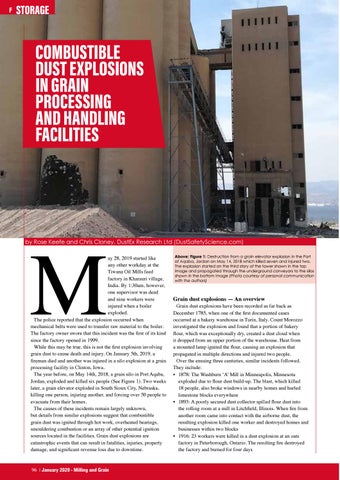
by Rose Keefe and Chris Cloney, DustEx Research Ltd (DustSafetyScience.com) ay 28, 2019 started like any other workday at the Tiwana Oil Mills feed factory in Kharauri village, India. By 1:30am, however, one supervisor was dead and nine workers were injured when a boiler exploded. The police reported that the explosion occurred when mechanical belts were used to transfer raw material to the boiler. The factory owner swore that this incident was the first of its kind since the factory opened in 1999. While this may be true, this is not the first explosion involving grain dust to cause death and injury. On January 5th, 2019, a fireman died and another was injured in a silo explosion at a grain processing facility in Clinton, Iowa. The year before, on May 14th, 2018, a grain silo in Port Aqaba, Jordan, exploded and killed six people (See Figure 1). Two weeks later, a grain elevator exploded in South Sioux City, Nebraska, killing one person, injuring another, and forcing over 50 people to evacuate from their homes. The causes of these incidents remain largely unknown, but details from similar explosions suggest that combustible grain dust was ignited through hot work, overheated bearings, smouldering combustion or an array of other potential ignition sources located in the facilities. Grain dust explosions are catastrophic events that can result in fatalities, injuries, property damage, and significant revenue loss due to downtime. 96 | January 2020 - Milling and Grain
Above; Figure 1: Destruction from a grain elevator explosion in the Port of Aqaba, Jordan on May 14, 2018 which killed seven and injured two. The explosion started on the third story of the tower shown in the top image and propagated through the underground conveyors to the silos shown in the bottom image (Photo courtesy of personal communication with the authors)
Grain dust explosions — An overview
Grain dust explosions have been recorded as far back as December 1785, when one of the first documented cases occurred at a bakery warehouse in Turin, Italy. Count Morozzo investigated the explosion and found that a portion of bakery flour, which was exceptionally dry, created a dust cloud when it dropped from an upper portion of the warehouse. Heat from a mounted lamp ignited the flour, causing an explosion that propagated in multiple directions and injured two people. Over the ensuing three centuries, similar incidents followed. They include: • 1878: The Washburn ‘A’ Mill in Minneapolis, Minnesota exploded due to flour dust build-up. The blast, which killed 18 people, also broke windows in nearby homes and hurled limestone blocks everywhere • 1893: A poorly secured dust collector spilled flour dust into the rolling room at a mill in Litchfield, Illinois. When fire from another room came into contact with the airborne dust, the resulting explosion killed one worker and destroyed homes and businesses within two blocks • 1916: 23 workers were killed in a dust explosion at an oats factory in Peterborough, Ontario. The resulting fire destroyed the factory and burned for four days