F
STORAGE
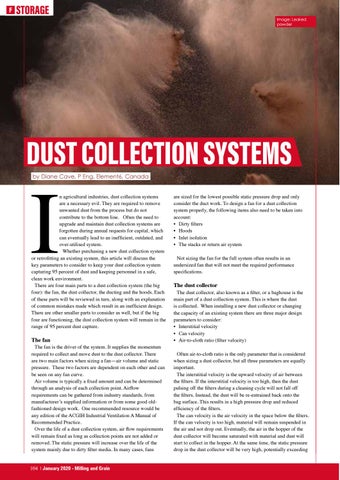
Image: Leaked powder
DUST COLLECTION SYSTEMS
I
by Diane Cave, P Eng, Element6, Canada
n agricultural industries, dust collection systems are a necessary evil. They are required to remove unwanted dust from the process but do not contribute to the bottom line. Often the need to upgrade and maintain dust collection systems are forgotten during annual requests for capital, which can eventually lead to an inefficient, outdated, and over-utilised system. Whether purchasing a new dust collection system or retrofitting an existing system, this article will discuss the key parameters to consider to keep your dust collection system capturing 95 percent of dust and keeping personnel in a safe, clean work environment. There are four main parts to a dust collection system (the big four): the fan, the dust collector, the ducting and the hoods. Each of these parts will be reviewed in turn, along with an explanation of common mistakes made which result in an inefficient design. There are other smaller parts to consider as well, but if the big four are functioning, the dust collection system will remain in the range of 95 percent dust capture.
The fan
The fan is the driver of the system. It supplies the momentum required to collect and move dust to the dust collector. There are two main factors when sizing a fan—air volume and static pressure. These two factors are dependent on each other and can be seen on any fan curve. Air volume is typically a fixed amount and can be determined through an analysis of each collection point. Airflow requirements can be gathered from industry standards, from manufacturer’s supplied information or from some good oldfashioned design work. One recommended resource would be any edition of the ACGIH Industrial Ventilation A Manual of Recommended Practice. Over the life of a dust collection system, air flow requirements will remain fixed as long as collection points are not added or removed. The static pressure will increase over the life of the system mainly due to dirty filter media. In many cases, fans 104 | January 2020 - Milling and Grain
are sized for the lowest possible static pressure drop and only consider the duct work. To design a fan for a dust collection system properly, the following items also need to be taken into account: • Dirty filters • Hoods • Inlet isolation • The stacks or return air system Not sizing the fan for the full system often results in an undersized fan that will not meet the required performance specifications.
The dust collector
The dust collector, also known as a filter, or a baghouse is the main part of a dust collection system. This is where the dust is collected. When installing a new dust collector or changing the capacity of an existing system there are three major design parameters to consider: • Interstitial velocity • Can velocity • Air-to-cloth ratio (filter velocity) Often air-to-cloth ratio is the only parameter that is considered when sizing a dust collector, but all three parameters are equally important. The interstitial velocity is the upward velocity of air between the filters. If the interstitial velocity is too high, then the dust pulsing off the filters during a cleaning cycle will not fall off the filters. Instead, the dust will be re-entrained back onto the bag surface. This results in a high pressure drop and reduced efficiency of the filters. The can velocity is the air velocity in the space below the filters. If the can velocity is too high, material will remain suspended in the air and not drop out. Eventually, the air in the hopper of the dust collector will become saturated with material and dust will start to collect in the hopper. At the same time, the static pressure drop in the dust collector will be very high, potentially exceeding