F
STORAGE
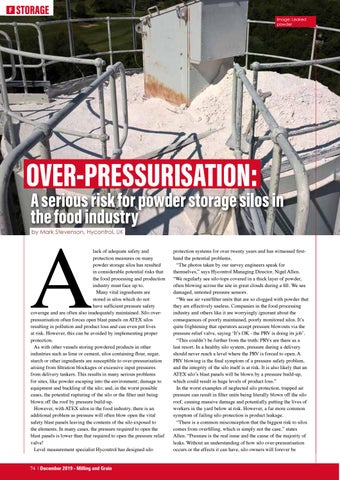
Image: Leaked powder
OVER-PRESSURISATION:
A serious risk for powder storage silos in the food industry
A
by Mark Stevenson, Hycontrol, UK
lack of adequate safety and protection measures on many powder storage silos has resulted in considerable potential risks that the food processing and production industry must face up to. Many vital ingredients are stored in silos which do not have sufficient pressure safety coverage and are often also inadequately maintained. Silo overpressurisation often forces open blast panels on ATEX silos resulting in pollution and product loss and can even put lives at risk. However, this can be avoided by implementing proper protection. As with other vessels storing powdered products in other industries such as lime or cement, silos containing flour, sugar, starch or other ingredients are susceptible to over-pressurisation arising from filtration blockages or excessive input pressures from delivery tankers. This results in many serious problems for sites, like powder escaping into the environment; damage to equipment and buckling of the silo; and, in the worst possible cases, the potential rupturing of the silo or the filter unit being blown off the roof by pressure build-up. However, with ATEX silos in the food industry, there is an additional problem as pressure will often blow open the vital safety blast panels leaving the contents of the silo exposed to the elements. In many cases, the pressure required to open the blast panels is lower than that required to open the pressure relief valve! Level measurement specialist Hycontrol has designed silo
74 | December 2019 - Milling and Grain
protection systems for over twenty years and has witnessed firsthand the potential problems. “The photos taken by our survey engineers speak for themselves,” says Hycontrol Managing Director, Nigel Allen. “We regularly see silo-tops covered in a thick layer of powder, often blowing across the site in great clouds during a fill. We see damaged, untested pressure sensors. “We see air vent/filter units that are so clogged with powder that they are effectively useless. Companies in the food processing industry and others like it are worryingly ignorant about the consequences of poorly maintained, poorly monitored silos. It’s quite frightening that operators accept pressure blowouts via the pressure relief valve, saying ‘It’s OK - the PRV is doing its job’. “This couldn’t be further from the truth: PRVs are there as a last resort. In a healthy silo system, pressure during a delivery should never reach a level where the PRV is forced to open. A PRV blowing is the final symptom of a pressure safety problem, and the integrity of the silo itself is at risk. It is also likely that an ATEX silo’s blast panels will be blown by a pressure build-up, which could result in huge levels of product loss.” In the worst examples of neglected silo protection, trapped air pressure can result in filter units being literally blown off the silo roof, causing massive damage and potentially putting the lives of workers in the yard below at risk. However, a far more common symptom of failing silo protection is product leakage. “There is a common misconception that the biggest risk to silos comes from overfilling, which is simply not the case,” states Allen. “Pressure is the real issue and the cause of the majority of leaks. Without an understanding of how silo over-pressurisation occurs or the effects it can have, silo owners will forever be