F
n i g n i l l i m e c i R Japan ) s a e s r e v o (and
A
by Hiromi Saita, Senior Staff, International Management Office, Satake Corporation, Japan
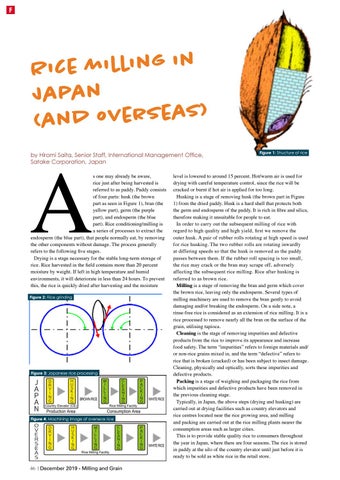
s one may already be aware, rice just after being harvested is referred to as paddy. Paddy consists of four parts: husk (the brown part as seen in Figure 1), bran (the yellow part), germ (the purple part), and endosperm (the blue part). Rice conditioning/milling is a series of processes to extract the endosperm (the blue part), that people normally eat, by removing the other components without damage. The process generally refers to the following five stages. Drying is a stage necessary for the stable long-term storage of rice. Rice harvested in the field contains more than 20 percent moisture by weight. If left in high temperature and humid environments, it will deteriorate in less than 24 hours. To prevent this, the rice is quickly dried after harvesting and the moisture
Figure 2: Rice grinding
Figure 3: Japanese rice processing
Figure 4: Machining image of overseas rice
46 | December 2019 - Milling and Grain
Figure 1: Structure of rice
level is lowered to around 15 percent. Hot/warm air is used for drying with careful temperature control, since the rice will be cracked or burnt if hot air is applied for too long. Husking is a stage of removing husk (the brown part in Figure 1) from the dried paddy. Husk is a hard shell that protects both the germ and endosperm of the paddy. It is rich in fibre and silica, therefore making it unsuitable for people to eat. In order to carry out the subsequent milling of rice with regard to high quality and high yield, first we remove the outer husk. A pair of rubber rolls rotating at high speed is used for rice husking. The two rubber rolls are rotating inwardly at differing speeds so that the husk is removed as the paddy passes between them. If the rubber roll spacing is too small, the rice may crack or the bran may scrape off, adversely affecting the subsequent rice milling. Rice after husking is referred to as brown rice. Milling is a stage of removing the bran and germ which cover the brown rice, leaving only the endosperm. Several types of milling machinery are used to remove the bran gently to avoid damaging and/or breaking the endosperm. On a side note, a rinse-free rice is considered as an extension of rice milling. It is a rice processed to remove nearly all the bran on the surface of the grain, utilising tapioca. Cleaning is the stage of removing impurities and defective products from the rice to improve its appearance and increase food safety. The term “impurities” refers to foreign materials and/ or non-rice grains mixed in, and the term “defective” refers to rice that is broken (cracked) or has been subject to insect damage. Cleaning, physically and optically, sorts these impurities and defective products. Packing is a stage of weighing and packaging the rice from which impurities and defective products have been removed in the previous cleaning stage. Typically, in Japan, the above steps (drying and husking) are carried out at drying facilities such as country elevators and rice centres located near the rice growing area, and milling and packing are carried out at the rice milling plants nearer the consumption areas such as larger cities. This is to provide stable quality rice to consumers throughout the year in Japan, where there are four seasons. The rice is stored in paddy at the silo of the country elevator until just before it is ready to be sold as white rice in the retail store.