F
ANCIENT GRAINS
A
Consumption and milling trends by Peter Marriott, Area Sales Manager, Henry Simon
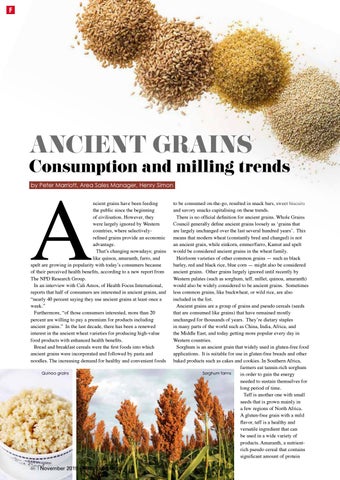
ncient grains have been feeding the public since the beginning of civilisation. However, they were largely ignored by Western countries, where selectivelyrefined grains provide an economic advantage. That’s changing nowadays; grains like quinoa, amaranth, farro, and spelt are growing in popularity with today’s consumers because of their perceived health benefits, according to a new report from The NPD Research Group. In an interview with Cali Amos, of Health Focus International, reports that half of consumers are interested in ancient grains, and “nearly 40 percent saying they use ancient grains at least once a week.” Furthermore, “of those consumers interested, more than 20 percent are willing to pay a premium for products including ancient grains.” In the last decade, there has been a renewed interest in the ancient wheat varieties for producing high-value food products with enhanced health benefits. Bread and breakfast cereals were the first foods into which ancient grains were incorporated and followed by pasta and noodles. The increasing demand for healthy and convenient foods Quinoa grains
46 | November 2019 - Milling and Grain
to be consumed on-the-go, resulted in snack bars, sweet biscuits and savory snacks capitalising on these trends. There is no official definition for ancient grains. Whole Grains Council generally define ancient grains loosely as ‘grains that are largely unchanged over the last several hundred years’. This means that modern wheat (constantly bred and changed) is not an ancient grain, while einkorn, emmer/farro, Kamut and spelt would be considered ancient grains in the wheat family. Heirloom varieties of other common grains — such as black barley, red and black rice, blue corn — might also be considered ancient grains. Other grains largely ignored until recently by Western palates (such as sorghum, teff, millet, quinoa, amaranth) would also be widely considered to be ancient grains. Sometimes less common grains, like buckwheat, or wild rice, are also included in the list. Ancient grains are a group of grains and pseudo cereals (seeds that are consumed like grains) that have remained mostly unchanged for thousands of years. They’re dietary staples in many parts of the world such as China, India, Africa, and the Middle East, and today getting more popular every day in Western countries. Sorghum is an ancient grain that widely used in gluten-free food applications. It is suitable for use in gluten-free breads and other baked products such as cakes and cookies. In Southern Africa, farmers eat tannin-rich sorghum Sorghum farms in order to gain the energy needed to sustain themselves for long period of time. Teff is another one with small seeds that is grown mainly in a few regions of North Africa. A gluten-free grain with a mild flavor, teff is a healthy and versatile ingredient that can be used in a wide variety of products. Amaranth, a nutrientrich pseudo cereal that contains significant amount of protein