F
Feed industry professionals, academics and business people learned about inner workings of a feed mill at the Build my FeedMill Conference on March 13 at VIV Asia. In conjunction with Milling and Grain, VIV Asia hosted 12 speakers who presented information about their feed mill and storage products. Those in attendance were led through the entire milling process, from intake and conveying to weighing, grinding, pelleting, drying and cooling and storage.
#5 Crushing roller mill
H
by Maren WeĂ&#x;els, Amandus Kahl, Germany
igh-quality ingredients and an optimal formula are the most important factors in animal feeding. The importance of the feed structure, however, often goes unmentioned, although recent findings of the feed industry have shown that it is an at least equally important factor for successful
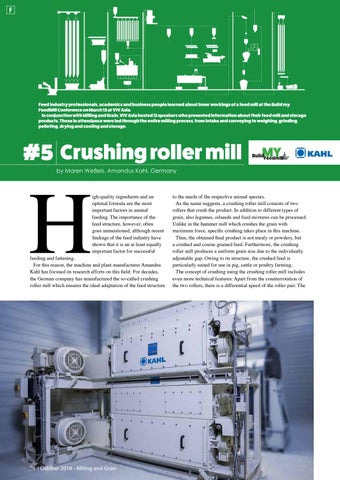
feeding and fattening. For this reason, the machine and plant manufacturer Amandus Kahl has focused its research efforts on this field: For decades, the German company has manufactured the so-called crushing roller mill which ensures the ideal adaptation of the feed structure
78 | October 2019 - Milling and Grain
to the needs of the respective animal species. As the name suggests, a crushing roller mill consists of two rollers that crush the product. In addition to different types of grain, also legumes, oilseeds and feed mixtures can be processed. Unlike in the hammer mill which crushes the grain with maximum force, specific crushing takes place in this machine. Thus, the obtained final product is not mealy or powdery, but a crushed and coarse-grained feed. Furthermore, the crushing roller mill produces a uniform grain size due to the individually adjustable gap. Owing to its structure, the crushed feed is particularly suited for use in pig, cattle or poultry farming. The concept of crushing using the crushing roller mill includes even more technical features: Apart from the counterrotation of the two rollers, there is a differential speed of the roller pair. The