February 2019
YOUR GLOBAL PARTNER
In this issue:
GLOBAL FEED SURVEY The premier insight into the global feed industry - 2019 Alltech Global Feed Survey
• Mobilising rice value chains towards sustainability
Milling and Grain . Volume 130 . Issue 2 . February 2019
• Kenya grapples with maize contamination • The global antibiotic challenge • Catwalks and towers for grain handling
See our archive and language editions on your mobile!
• The Flour Milling Seminar
Event review Proud supporter of
Volume 130
Issue 2
millingandgrain.com
COMMERCIAL BINS
• 48 m Diameter Bins (20321-48262 mt) • Peak Load Rating (6804-45360 kg) • Hopper Bins (3.7 m-14.6 m)
COMMERCIAL DRYERS
• Tower Dryers (23-281 t/h) • QuadraTouch ProTM Controls • Balanced Moisture Content
STEEL BUILDINGS
COMMERCIAL SWEEPS
BUCKET ELEVATORS
COMMERCIAL CONVEYORS
• Auger & Paddle sweeps available • Capacity includes 141-281 t/h • Patented Pivot Point • Industrial Grade Pushers
• Low Impact Head Design • Heavy Gauge Trunking • Patented Squaring Plates • Support Towers
• Industrial Strength • Built To Last • Higher Elemental Resistance • Capacity includes (984-1688 t/h) • Dust-tight and waterproof • Patented hip-style weather-tight cover • Catwalks
Sukup Worl d H eadquart ers - S hef f i e ld , Io w a U SA • w w w.su ku p .co m • in fo @su ku p .co m For service in Europe contact:
Sukup Europe A/S Hedensted, Denmark Tel +45 75 68 53 11 • Fax +45 75 68 54 70 info@sukup-eu.com • www.sukup-eu.com
Pneumatic or Mechanical Ship Loaders & Unloaders Port Equipment - Turnkey Projects
1968 2018
1350 machines installed in more than 100 countries! VIGAN Engineering s.a. Rue de l’Industrie, 16 - 1400 Nivelles - Belgium Tél.: +32 67 89 50 41 • Fax : +32 67 89 50 60 • www.vigan.com • info@vigan.com
VOLUME 130 ISSUE 2
February 2019
Perendale Publishers Ltd 7 St George’s Terrace St James’ Square, Cheltenham, Glos, GL50 3PT, United Kingdom Tel: +44 1242 267700 Publisher Roger Gilbert rogerg@perendale.co.uk International Marketing Team Darren Parris Tel: +44 1242 267707 darrenp@perendale.co.uk Martha Cornwell Tel: +1 913 2083770 marthac@perendale.com Fred Norwood Tel: +1 405 834 2043 fredn@perendale.com Latin America Marketing Team Iván Marquetti Tel: +54 2352 427376 ivanm@perendale.co.uk New Zealand Marketing Team Peter Parker peterp@perendale.co.uk Nigeria Marketing Team Nathan Nwosu Tel: +234 8132 478092 nathann@perendale.co.uk
Managing Editor Vaughn Entwistle vaughne@perendale.co.uk Production Editor Rebecca Sherratt rebeccas@perendale.co.uk Features Editor Matt Holmes matth@perendale.co.uk International Editors Dr Roberto˘ Luis Bernardi robertob@perendale.co.uk Professor Wenbin Wu wenbinw@perendale.com Mehmet Ugur Gürkaynak mehmetg@perendale.com Design Manager James Taylor jamest@perendale.co.uk Circulation & Events Tuti Tan tutit@perendale.co.uk Development Manager Antoine Tanguy antoinet@perendale.co.uk ©Copyright 2018 Perendale Publishers Ltd. All rights reserved. No part of this publication may be reproduced in any form or by any means without prior permission of the copyright owner. More information can be found at www.perendale.com Perendale Publishers Ltd also publish ‘The International Milling Directory’ and ‘The Global Miller’ news service
Grain & Feed Milling Technology magazine was rebranded to Milling and Grain in 2015
102 - Achieving optimal results with your grain
FLUTING MACHINES
Egyptian Marketing Team Mohamed Baromh Tel: +20 100 358 3839 mohamedb@perendale.com
ISSUE HIGHLIGHTS
2
NEWS FEATURES
48 The Alltech Global Feed Survey 56 Solar power 60 Digital agriculture
64 How rice analysing equipment should be used to increase profit
FACES
6-38
68 Bogasari Flour Mills chooses Ocrim’s innovation for H, I & J mills 74 Mobilising rice value chains towards sustainability
128 People news from the global milling industry
PRODUCT FOCUS
46
CASE STUDY
108
78 Kenya grapples with maize contamination
STORAGE
82 The global antibiotic challenge 86 The real feed wonder ingredient
88 Catwalks and towers for grain handling
94 A dome for every demand 98 Grain driers
102 Achieving optimal results with your grain
EVENTS
114 Event listings, reviews and previews
TRAINING
46 Building the next generation of leaders at the AFIA Conference
COLUMNS
12 Mildred Cookson 36 Rebecca Sherratt
4 GUEST EDITOR Dr Imran Hassan
110 MARKETS John Buckley
COVER IMAGE: The Alltech global feed survey - See more on page 48
126 INTERVIEW Markus Dedl
ISSUE HIGHLIGHTS RICE
MAIZE Kenya grapples with maize contamination
The level of aflatoxin in maize, produced or imported and stored in East Africa, continues to be a cause for concern among the region’s consumers and millers, on the back of a weak regulatory framework and uncoordinated approach in tackling the contamination.
Mobilising rice value chains towards sustainability
As the world’s population skyrockets and global food demand continues to grow, securing our future food supply will be crucial, especially for staple foods such as rice.
PAGE 74
STORAGE Catwalks and towers for grain handling
Shipping steel internationally is expensive. Allstate Tower has found a way to cut shipping expenses while still delivering a great steel product that exceeds international standards.
PAGE 88
PAGE 78
DOME SILOS A dome for every demand
With greater focus on food safety and increased capacities, storage structures need to get more sophisticated too. Enter a monolithic, steel-reinforced concrete dome from Dome Technology, a company that has been building domes for more than four decades in capacities ranging from 5,000 to 200,000 metric tonnes.
PAGE 94
FOOD
STORAGE
FEED
PROCESS
FLOUR MILL SURVEY
Bogasari Flour Mills chooses Ocrim’s innovation for H, I & J mills - Jakarta, Indonesia
Ocrim, one of the most renowned companies in the world for the construction of milling plants, is one of the main suppliers of the Indonesian Bogasari Flour Mills and has been since 1971. Indeed, both boast years of loyal partnership, which has enriched and strengthened their business and the countries they belong within.
PAGE 68
The Alltech global feed survey
RICE How analysing equipment should be used to increase profit
FEED The global antibiotic challenge
This article explains how rice millers can effectively take advantage of laboratory analysing equipment or apparatus, such as the Milling Meter MM1D, one of the most basic and important pieces of analysing equipment, which will be described in detail later.
The feed-to-food chain is currently facing a serious issue as the overuse of antibiotics in farming comes ever closer to a causing a global health crisis. Their improper use is leading to the growth of antibiotic-resistant bacteria that is becoming a major threat to human health.
PAGE 64
PAGE 82
Dr Pierce Lyons enjoyed speaking to the press and it’s an enjoyment that his son Dr Mark Lyons carried forward in late January when he presented the 2019 Alltech Global Feed Survey which he says “is the premier insight into the global feed industry,“ Dr Mark Lyons was presenting the figures for 2018, the eighth annual survey carried out by the company during an online press conference for journalists around the world.
PAGE 48
Confidence in our grain systems now, durability we can pass on. Brock grain systems and Brock dealers have
handling, conditioning and structures.
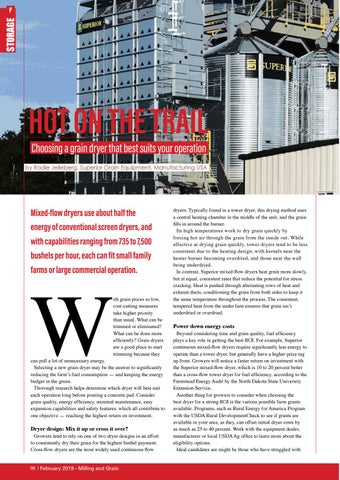
been helping grain facilities protect their grain since 1957. It is a relationship built on trust,
BROCK SOLIDÂŽ means you can count on your
commercial-grade quality and long-lasting
grain systems today and for years to come.
results. Bushel after bushel, you can count
Contact your Brock dealer at
on Brock for reliable grain storage,
brocksolid.com/dealers.
Storage | Handling | Conditioning | Structures
+1 574.658.4191 brock@brockgrain.com
Grains, silos, storage and the IOT Dr Imran Hassan is an Animal Nutritionist with 17 years’ experience in compound feed manufacturing and the storage of grains in all regions of Pakistan. He holds an M Sc (Hons) in Animal Nutrition from the University of Agriculture in Faisalabad. Dr Hassan is currently working as an Assistant General Manager on-site of the Sharif Feed Mills in Okara, a major player in the compound feed manufacturing market in Pakistan, and is responsible for all operations including Processing, Quality Assurance, Research and Development and General Administration. A current FAO report states that 33 percent of grain is spoiled on the journey from fields to mouths; this is a serious matter in the challenge to address hunger. The era of silo storage has reached its peak and will continue to contribute to the percentage of spoiled grains unless good silo management practices are adopted and the IOT (internet of things) is used. Grains that are stored in silos are at high risk of quality degradation for the consumer unless the safety practices for silo workers is improved by an awareness of good management practices known by the acronym – SLAM. Sanitation: Disinfection and fumigation of the grain silos, (both practices are of vital importance). Loading: The shelf life of the cleaned grains depends on their moisture content and temperature while in the silos.
2019
We can control moisture by drying and temperature by cooling, both of which are highly cost effective and readily available. In this regard, homogenous distribution of blended grain distribution practice is recommended. This can be achieved by the use of a grain spreader or by the use of the correct coring practices. Aeration: Silos are equipped with aeration systems, if these are not operated according to the weather conditions, grains will spoil. Monitoring: All the above conditions should be monitored and controlled remotely with the help of IOT. The idea of a regional weather station with a field team to support, ensure and rescue the operations that change with weather changes should be organised by governments and the private sector. Industry and academia should collaborate to improve performance and achieve the target of reducing the quantity of spoiled grains. Climate change is a serious threat for global populations and is changing the agribusiness; it is now the time not only to promote SLAM (good silo management practices) but also IOT. Some of the big players in grain handling should help the developing countries to implement the measures described above. Dr Imran Hassan, Assistant General Manager, Sharif Feed Mills, Pakistan.
http://bit.ly/grapas19
13 JUNE 2019 COLOGNE, GERMANY A ONE-DAY CONFERENCE FOR MILLERS OF FOOD, FLOUR & RICE ISSN No: 2058-5101
Milling and Grain has a cooperative partnership with COFCOET
Annual Subscription Rates Inside UK: UK£100 Outside: US$150/€133 More Information www.millingandgrain.com http://gfmt.blogspot.co.uk
40 YEARS OF TESTED STRENGTH
One Tapco Nylon Elevator Bucket Supports a 9700 Pound* H1 HUMMER Ambient Temperature: 17 °F (-8 °C)
TAPCO’S CC-XD (Xtreme Duty) gray nylon elevator bucket supports a 9700 lb. H1 Hummer vehicle. Testing confirms that it will support over 20,000 lbs., more than two Hummers!
TAPCO’S CC-XD (Xtreme Duty) blue polyethylene bucket will support 9,000+ lbs.
Tapcoinc.com
TAPCO’S CC-HD (Heavy Duty) blue polyethylene bucket will support 5,000+ lbs.
314.739.9191 / St. Louis, Missouri USA No 814
*4399 kg
Milling
News
Pastazym PD greatly improves the cooking tolerance of pasta
P
asta tends to stick together quickly, if it is cooked, or kept hot too long. The quality, and therefore, the tolerance of the pasta suffers considerably, especially when lowprotein flours are used. In Pastazym PD, the Ahrensburg flour expert Mühlenchemie has developed a new enzyme system that ensures excellent cooking stability of the pasta, even under extreme conditions. Not only does this have a positive influence on consumers’ purchasing decisions; above all, it proves extremely useful in the food service sector. The optimal raw material for producing high-quality pasta is hard wheat, but fluctuating wheat qualities, restricted availability and unstable prices are increasingly causing pasta manufacturers to resort to soft wheat or mixtures of hard and soft wheat. Pasta, with this composition, has considerably less tolerance, in respect of cooking times, and the desired al dente bite of the pasta is lost. Just a small amount of Pastazym PD – 40 g per 100 kg flour – extends the cooking time to as long as 20 minutes, and ensures a pleasant mouth feel as well as reducing the stickiness of the cooked pasta. Mühlenchemie’s innovative enzyme was first used at high altitudes, where the reduced air pressure lowered the boiling point of the water. This, in turn, increased the cooking time for the pasta. With Pastazym PD, it was possible to achieve acceptable quality, in spite of prolonged cooking times of up to 20 minutes, with a significant difference, as compared to untreated pasta. The use of Pastazym PD is also of interest to pasta manufacturers, who supply companies in the food service and restaurant sectors; these are than able to guarantee their customers uniformly high quality in spite of long standing times and frequent re-heating of the pasta. Pasta manufactured with the addition of Pastazym PD is classified as a “clean label” product and does not require adjustment of the label declaration – a fact that makes it particularly attractive to consumers.
6 | February 2019 - Milling and Grain
In this month’s issue of Milling & Grain, we discuss extensively our company’s recent trip to Italy, and the various companies we have visited over the course of the trip. Some of these companies were also discussed in last month’s issue, but the trip was very expansive and informative. Italy, as well as Greece, is very unusual and distinctive. As part of the EU, it is one of the only countries with a Mediterranean climate, thus enabling them to produce a much wider variety of crops than many of the residing EU countries. Italy produces over 50 percent of the EU’s rice and 45 percent of its soybeans, making it a very large and crucial exporter. Italy is also the EU’s fourth largest corn-producer, as well as their fifth-largest wheat-producer. Wheat production in Italy, for 2017/18, was estimated at 7.2 million tonnes, and the wheat harvest occurs primarily in June. Common wheat was the primary crop produced, but Italy also often produce durum wheat in the south. Corn production in Italy was estimated at 6.4 million tonnes for 2017/18, 90 percent of which was harvested in the Po Valley, in Northern Italy. The humid, subtropical climate of Po Valley makes it ideal for crops to grow and many regard it as the most important agricultural area in Europe. Rice production is a particularly ancient and well-honed tradition in Italy, having been taking place for hundreds of years. The Po Valley carries an abundance of water, ideal for paddy fields and rice production. The tributaries that flow through Po Valley carry water from the Alps’ glaciers. The United States Department of Agriculture (USDA) estimated that 2017/8 milled rice production in Italy was 1.1 million metric tonnes (mmt). August and September are the critical months for rice production, where fluctuating temperatures could cause damage to crops. The challenge currently facing rice farmers in Italy is the high costs of rice production, which are only increasing year-on-year, as well as the difficult task of providing competitive prices, versus cheaper imports. As the environment and climate continue to fluctuate, due to climate change, who knows what could happen to the future of Italy’s crop production? Or the rest of the worlds, for that mater?
GF
MT
gfmt.blogspot.com
Milling News
Minimising arsenic poisoning in crops
O
n World Soil Day each year, the University of Warwick looks at ongoing research into the growing of crops in arsenic-contaminated soil without the edible part of the plant being affected. Arsenic in soil is a worldwide problem. Found in soil and water all over the world, arsenic is a cancercausing chemical. Absorbed by plant roots, the chemical can enter to the edible part of the crop. The chemical is carcinogenic and is naturally found in water supplies and soil, particularly in Bangladesh and the north-eastern part of India. Arsenate is the most abundant form of arsenic and is structurally similar to phosphate. Therefore, it is easily incorporated in to plant cells through phosphate uptake pathway – the process of the roots absorbing nutrients. However, when a plant absorbs arsenic it can translocate it up to the edible part of the plant – ultimately arsenic enters the food chain. Plants have an inherent capacity to cope with arsenic stress by producing metal-chelating peptides called phyochelatins (PCs). PCs detoxify the arsenic and restrict the movement of arsenic in the roots. Which in turn helps to reduce the root-to-shoot translocation of Arsenic. Phyochelatins are therefore essential in trapping the arsenic absorbed by the plant in the roots. Scientists at the University of Warwick wanted to make plants with more phytochelatins in the roots, to stop any of the arsenic escaping and travelling up the shoot to the
edible part of the plant. This is being done by making transgenic plants with reduced cytokinin hormone in the roots. This means phytochelatin is boosted and can detoxify and hold more arsenic in the root. Dr Mohan TC, from Dr Alex Jones Laboratory, School of Life Sciences at the University of Warwick is doing this pilot study in transgenic Barley and is now looking at doing it in rice plants, thanks to funding from the Medical and Life Sciences Research Fund (MLSRF), UK. “To stop the cancer-causing arsenic entry into the food chain, it is essential to develop safe crops, through restricting the translocation of arsenic to edible part”, Dr Mohan says. “In our current project, we are trying to manipulate cytokinin hormone in rice plants through genetic engineering and we expect to increase the roots detoxification capacity of the transgenic rice.”
COMPLETE FEED MILLS, PLANTS AND MACHINES TURN KEY SOLUTIONS Turn-key feed mills and plants for compound feed, shrimp and fish feed, pet food, premix / concentrate, roughage, straw, green forage.
AMANDUS KAHL GmbH & Co. KG Dieselstrasse 5–9 · 21465 Reinbek Hamburg, Germany +49 (0) 40 72 77 10 info@akahl.de · akahl.de
8 | February 2019 - Milling and Grain
The positions of both Turner works in Ipswich in 1885
British engineering firms: The works of ER & F Turner, including the carter roller system in the course of manufacture at St Peter’s & Grey Friars Works, Ipswich - Part one Milling journals of the past at The Mills Archive
by Mildred Cookson, The Mills Archive, UK A series of articles in The Miller and Milling, in the 1880s and 1890s, on the British engineering firm ER & F Turner have attracted my attention. Over a couple of decades, reporters made various visits to their works and to mills where they were installing machinery. They had established a productive relationship with J Harrison Carter of 82 Mark Lane, London and manufactured roller mills and other machines used in his system of flour milling. After a works visit, one reporter enthused (The Miller, June 1885, pp 321 - 326) that he had seen proof “that the great industry of grain flouring machinery was evident in the factory and that Mr Carter should be congratulated on having found co-workers to supply his customers with machinery of the best British make and material”. As Turners were among the oldest millwrights in England, it was not surprising that their works were producing a wealth of flour milling machinery. The works had doubled in size since
The middlings roll and break roll fitting and erecting shop
12 | February 2019 - Milling and Grain
Carter’s connection with the firm, and, in the mid 1880s, the increased output activity was entirely due to the great success of the Carter system. The June 1885 article describes the two Ipswich sites, Grey Friars and St Peter’s, in detail. The firm of Messrs ER & F Turner of Ipswich dated back to 1837, when it was founded under the name “Bond, Turner & Hurwood.” The capital came from the two senior partners, Bond & Turner, whereas the conduct of the business rested largely in the hands of Mr Hurwood, who was himself a practical millwright and engineer. Both Bond and Turner died towards the end of 1846, and the following year one of Turner’s sons, Mr ER Turner, joined Hurwood and the business ran as Hurwood & Turner until 1851, when the name was altered to ER Turner & Co. Eventually, Mr F Turner joined the firm and it became known as ER & F Turner. In 1846, Bond, Turner and Hurwood agreed a contract to fit up a steam mill for Joseph Fison of Ipswich. The plans for the mill were drawn up under the direction of Mr Hurwood. The plant, which comprised a pair of 20 horse power compound engines, hursts and gearing for eight pair of stones, with corn cleaning and flour dressing machinery, was entirely built in Turner’s St. Peter’s Works.
Erecting shop for centrifugals, scalpers, purifiers, dressing reels etc
In May 1850, Mr Hurwood patented a metal grinding mill, which, at the time, attracted a great deal of notice. The invention related to “the construction of the grinding surfaces of metal mills, and to the arrangement made for forcing a constant current of air between the grinding surfaces of mills generally, to facilitate and improve the operation”. The International Exhibition of 1851 awarded the invention a prize medal, stating “the best metal mills that have been produced are those of Messrs Hurwood of Ipswich”. This invention continued to be a specialty, long after Hurwood’s retirement. The firm’s millwrighting inventiveness carried on, and, in 1855, a patent was taken out by ER Turner for “a most remarkable invention”, which was said to have embodied the principle of gradual reduction, as understood by modern millers. The invention was described, in the specification, as machinery designed for crushing and grinding grain to produce fine flour or meal, by the combined and simultaneous operation of crushing and grinding in one machine. It described a wood or iron framework, a pair of crushing or bruising rollers and a pair of millstones, with necessary gearing for driving the same. The under, runner, millstone was driven by an upright spindle, which derived its motion from a horizontal shaft, via a pair of bevel wheels. The upper stone was fixed in an iron case, upon the upper side of which case rested a frame carrying the two crushing rollers, and the hopper for containing the grain to be crushed and ground. It was specified that one of the rollers could be of larger diameter than the other; the larger roller was driven from the same horizontal shaft which drove the runner stone by means of a belt drive. The grain was first distributed by means of a feed roller between the crushing rollers, and, after crushing it,
Plan of Turner’s Grey Friars engineering works
descended through the eye of the top stone on to the runner, where it is ground in the usual manner and discharged through a spout fitted onto the case of the stone casing. Although the mill was not manufactured for very long, the reporter concluded “it is evident that had the product obtained from the smooth rollers only been subjected to scalping, we would have been face to face with an epitome of the gradual reduction process as now understood”. The firm continued with their advanced ideas on flour milling and was well aware of other innovations. In 1862, Turners undertook to construct a mill plant designed by Mr GA Buchholz. This was based on the original design under Buchholz’s patents, and was fitted in mills in the United Kingdom, as well as in France. Early in the year 1877, Mr Carter gave Messrs Turner the first order for his middlings mill, which, by 1885, had become well known all over the world.
www.perryofoakley.co.uk sales@perryofoakley.co.uk +44 (0)1404 890300
Since 1947
The UK’s Most Experienced Manufacturer of Materials Drying & Handling Equipment
Capacities of up to 1000tph available - Heavy duty, galvanised construction - Ranges suitable for grain & bulk materials • Continuous Flow Grain Driers • Belt Driers • Chain & Flight Conveyors
• • • •
Belt & Bucket Elevators Belt Conveyors Aspirator Cleaners Levelling Conveyors
• Augers & Screw Conveyors • Ducting & Valves • Twin Trace Conveyors
Call now to discuss your drying & handling needs! Milling and Grain - February 2019 | 13
One small trial. One giant leap for your methionine savings. Evonik PROXYMet
s at u t i Vis booth E IPP 2525 A
Scan the QR code to watch the PROXYMet video
Seeing is believing. We know that. Which is why we’ve engineered PROXYMet™, a product designed to confirm the superior nutritional value of MetAMINO® versus methionine hydroxy analog. In addition to published studies and trials: With PROXYMet™ you can easily verify the facts yourself in your own facility. To set up a free trial contact your local Evonik representative today! www.evonik.com/animal-nutrition
Milling News
A Robinson patent double horizontal roller mil
Interior of chill roll foundry, Grey Friars works
Turners had a flourishing export trade
The Grey Friars Works was the outcome of rapid extension of the Carter system and covered two acres. Here, the chilled rollers were cast, turned and grooved, and the roller mill frames and other iron castings were brought from St Peter’s works and fitted into their several machines. All the rest of the flour millwrights’ work was conducted here. Both works were connected by telephone. In addition to the men working on site, there were over 300 men listed on the books at Mark Lane during 1884/5 who were engaged on erecting the plants. I will return to the Turner story in the next issue. The holdings at the Mills Archive mean that I can only provide geographical and historical snapshots. If you would like to know more, please email me at mills@millsarchive.org
St Peter’s Ironworks was situated, as the plan shows, on the river Orwell, covering an area of an acre and a half. On entering the office, you would pass into the adjoining show-room, which featured a line of Carter roller mills, as well as the corn grinding mills for which Turner’s were celebrated. Export trade was booming and the corn grinding mills were apparently on special request. Not a week would go by without important consignments being forwarded to different points of the compass. From the showroom you could enter the foundry, a lofty and spacious building, square in shape, in which 73 men were employed. Here, the frames for the Carter break rollers, as well as their pulleys, were cast; everything, in fact, except the rollers themselves which were cast in a separate and special foundry. Close to the furnace was a doorway leading to the open air and a yard stacked high with pig-iron and coke, ready for feeding the cupolas. The view from here took in the river Orwell, and close by was Cranfield Brothers’ fine new mill, which was described as being one of the most marked successes of modern milling.
CUSTOM AQUATIC FEED SOLUTIONS ARE WAITING Surround Yourself with Unparalleled Resources for Extrusion and Drying Systems Do you know what aquatic feed you need to produce – but unsure of the next steps? Wenger will put unsurpassed technology and process expertise to work, developing flexible solutions specific to your operation. We expertly evaluate and guide the development and processing applications for floating, sinking, shrimp and micro aquatic feeds. Every one of our systems is customized, serving you best by going beyond a standardized approach. Let us help you solve production challenges now. Email us at info@wenger.com today.
FLOATING
SINKING
SHRIMP
SALMON
MICRO
PHONE: 785.284.2133 | EMAIL: INFO@WENGER.COM | WENGER.COM USA
|
BELGIUM
|
TAIWAN
|
BRASIL
|
CHINA
Milling and Grain - February 2019 | 15
Milling News
Stefan Scheiber, CEO of Bühler
Bühler focus on Consumer Foods with new segment
B
ühler are now addressing the global food market with a newly created segment: Consumer Foods. By combining the current chocolate, nuts, bakery and coffee business with the Haas business, the new organisation will be able to support customers even better in these global markets, through simplified interfaces, integrated solutions, innovation, and services. Germar Wacker, now CEO of Haas, is leading the new segment and joining Bühler’s Executive Board. For Bühler Group, the creation of a new business segment is a milestone in its over 150-year history. In the recent past, the company has operated two businesses, Advanced Materials and Grains & Food. Triggered by the acquisition of the Austrian Haas Group, Bühler is aligning its setup and forming a new business truly focused on Consumer Foods and confectionery, with integrated solutions to produce wafers, biscuits, baked goods, chocolate, pralines, filled products, nuts, coffee, and more.
Germar Wacker, CEO of Consumer Foods
“With this move, we can create significant value for our customers and position ourselves as clear leader in the growing consumer foods market,” says Bühler CEO Stefan Scheiber. Since its acquisition in January 2018, Haas has operated as a separate Bühler business. The integration showed remarkable results in a very short time. Bühler and Haas already serve many key customers together, work jointly on customer projects, and are in discussion with numerous interested partners. The new organisation, which combines all consumer foods related technologies and solutions in one segment, is the logical next step to serve customers from one single point of origin. “With this new, strong business pillar in the field of processing technologies in consumer foods, we can offer specialised knowledge, as well as research and development, to the needs of our customers in that sector,” says Germar Wacker, who is currently CEO of Haas and will lead the new segment. As a consequence, Germar Wacker will become member of the Executive Board of the Bühler Group. Milling and Grain - February 2019 | 17
Milling News
T
TABADER host meetings in conjunction with IDMA ABADER will carry the Gathering of Doyens to the international arena Ĺn 2019 thanks to IDMA Fair’s international network. TABADER, the first parent organisation for companies operating in cereal and pulses processing technologies, storage and analysis systems, continues its preparation to hold the 2nd International Gathering of Doyens and the award ceremony that gathered huge interest last year. The Gathering of Doyens is expected to have colorful scenes that will be held in WOW Hotel, in conjunction with IDMA Fair, which is the biggest gathering of the sector on the international area on 20 March 2019. Every year, TABADER investigates and brings together values of the sector on cereal, pulse, feed milling and technologies. As part of the 2nd International Gathering of Doyens and Award Ceremony, the organisation will present awards to those who contributed to the sector for at least half a century and who made names on cereal and pulse milling and their technologies around the world. During the 2nd International Gathering of Doyens and the Award Ceremony, TABADER will present awards in six categories: the Half Century in the Sector, Those Who Left Us, Those Who Contributed to the Development of the Sector, Those Who Brought Value to the Sector, Young TABADER, and The Establishment of the Year. TABADER International Gathering of Doyens and the Award Ceremony will have an international concept in coming years.
Before the International Gathering of Doyens and the Award Ceremony, TABADER will also host the Flour, Feed, and Pulses Summit (IFP-2019). TABADER, which continues its efforts for the summit in full swing, will host the business people that will evaluate the problems, economy, and future of flour, feed and pulses sector worldwide. Renowned doyens around the world will come together and share their opinions during the summit. In order to meet its training targets to educate qualified people for the sector, TABADER will hold the International Certified Miller Training during IDMA, to be held between March 21-23, 2019 in the fair avenue. In two different halls for flour and feed sector, the training will be held simultaneously in English and Turkish. On the first day of the three-day long training, topics such as energy management, innovation, research and development, production and development, quality control, and risk analysis will be discussed. For two days, the training will cover storage techniques particularly for grain (flour) milling and feed milling, new trends in the world, diagram, design, additives and vitamins, quality control, automation, machine and mechanic maintenance, ration preparation, pre-cleaning, and breaking lines. The theoretical training that will be provided by academicians and industry representatives will be supported with new product and technology showcases in the fair area. Participants will have certifications after the three-day long program.
Milling and Grain - February 2019 | 19
We apply a smart engineering to reach the smile of the investors and users. Not revolutionary items, but efficient and reliable machines to get high performance plants assuring a very fast payback on investment. 160 years of satisfying operation in every part of the globe are our reference.
Simple becomes easy.. www.ai-lati.eu
Smart & Smile
.. and Smart with us! www.paglierani.com
www.ocrim.com
Milling News
R
Responsible innovation key to smart farming
esponsible innovation, that considers the wider impacts on society, is key to smart farming, according to academics at the University of East Anglia (UEA). Agriculture is undergoing a technology revolution, supported by policy-makers around the world. While smart technologies will play an important role in achieving improved productivity and greater eco-efficiency, critics have suggested that consideration of the social impacts is being side-lined. In a new journal article, Dr David Rose and Dr Jason Chilvers, from UEA’s School of Environmental Sciences, argue that the concept of responsible innovation should underpin the so-called fourth agricultural revolution, ensuring that innovations also provide social benefits and address potentially negative side-effects. Each of the previous revolutions was radical at the time - the first representing a transition from hunting and gathering to settled agriculture, the second relating to the British Agricultural Revolution in the 18th century, and the third to post-war productivity increases, associated with mechanisation and the Green Revolution, in the developing world. The current ‘agri-tech’ developments come at a time when the UK government has provided £90 million of public money to transform food production in order to be at the forefront of global advanced sustainable agriculture.
e-Rhodimet® Nutrition Guide available on smartphone
e
-Rhodimet® Nutrition Guide (e-RNG) is a tool designed by Adisseo to calculate the amino acid requirements of various animal species. It gathers the amino acid requirements for poultry species, including broilers, pullets, laying hens, turkeys and ducks, for swine, including piglets, growingfinishing pigs, gilts, gestating and
YOUR GLOBAL PARTNER
lactating sows, entire males, and for aquaculture, including freshwater fish, marine fish and shrimps. The recommendations are expressed in digestible amino acids, and when not available, on total amino acids. e-RNG is an interactive tool, that allows nutritionists and formulators to calculate the amino acid requirements of various animal species under different rearing conditions. Taking into account the actual performances of their animals (feed intake, weight gain and feed conversion), this software recalculates precisely the digestible amino acids requirements to use in feed formulation. Digestible amino acid composition is provided for main raw materials used in feed
GO MOBILE! 22 | February 2019 - Milling and Grain
Many other countries are also prioritising smart agri-tech. This, combined with private investment from organisations, including IBM, Barclays, and Microsoft, means that ‘Agriculture 4.0’ is underway, with technologies such as Artificial Intelligence (AI) and robotics increasingly being used in farming. Writing in Frontiers in Sustainable Food Systems, Dr Rose, a lecturer in Human Geography, and Dr Chilvers warn though that agri-tech could also have side-effects, bringing potential environmental, ethical, and social costs. “In light of controversial agri-tech precedents, it is beyond doubt that smart farming is going to cause similar controversy. Robotics and AI could cause job losses or change the nature of farming, in ways that are undesirable to some farmers. Others might be left behind by technological advancement, while wider society might not like how food is being produced,” said Dr Rose. “We therefore encourage policy-makers, funders, technology companies and researchers to consider the views of both farming communities and wider society. We advocate that this new agricultural tech revolution, particularly the areas funded by public money, should be responsible, considering the winners, but particularly the potential losers of change. Agriculture 4.0: Broadening responsible Innovation in an Era of Smart Farming’, David Rose, Jason Chilvers, is published in Frontiers in Sustainable Food Systems.
formulations. These assets make e-RNG a great decision-making tool for the nutritionist in their day to day business. The application can now be used on smartphones in an easy and convenient way. In addition to this new access as a smartphone application, you can enjoy the tool on your tablet and also download it on your computer. In any case, you will need an access code to use the application, that you can get on the official website (https:// feedsolutions.adisseo.com). The tool is available in different languages: English, French, German, Spanish, Portuguese, Turkish, Arabic, Chinese and Polish.
Realize the Hidden Value Decrease mortality, reduce condemnations, improve egg production and positively impact your customer’s profitability when you formulate with MINTREX® chelated trace minerals compared to other mineral sources.
®NOVUS and MINTREX are trademarks of Novus International, Inc., and are registered in the United States and other countries. ©2019 Novus International, Inc. All rights reserved. 4186_PERENDALE FY19
Milling News
Primeval superfood meets 21st century
A
t this year’s Hi Europe & Ni, GoodMills Innovation showcased a functional ingredient rich in heritage but one that had long been forgotten: Tartary buckwheat, which contains phytochemical rutin, an effective ingredient for traditional chinese medicine. This prehistoric pseudo grain scores highly as an ingredient, thanks to its added nutritional value and, as a result of state-of-the-art refinement technology, offers the best taste properties for various applications. The grain specialist also used the trade show to present a prebiotic wholegrain fibre concentrate, before its official market launch next year. Thanks to specially processed dietary fibres, this is regarded as optimum “feed” for intestinal flora. The RutinX product range includes both flour and crispies, made from fermented tartary buckwheat. The high content of rutin, which is a known antioxidant and anti-inflammatory, is of particular nutritional interest. Also rich in the trace element zinc, baked goods with RutinX support carbohydrate
24 | February 2019 - Milling and Grain
metabolism. In early 2019, additional scientific studies will be launched to investigate the blood sugar-regulating properties of this superfood. Michael Gusko, Managing Director of GoodMills Innovation, says, “despite all the health benefits of tartary buckwheat, it also offered us a great challenge: the taste. That’s because the rutin contained in the pseudo grain causes a very strong bitter note. However, we found the solution in a patented, special fermentation process. This allows us to achieve an optimal sensory profile and, at the same time, maintain the full nutritional benefit and even expand it.” RutinX is ideally suited for bread and roll recipes, as well as for pastries. Visitors to the stand were able to sample biscuits based on wheat flour in combination with RutinX crispies and RutinX flour, to get an idea of how well and simple taste and health benefits can be combined. Moreover, the good sensory and technological characteristics of RutinX also allow for other applications such as pasta, muesli and functional drinks. Professor Ivan Kreft, Emeritus of the Biotechnical Faculty of Ljubljana, was also available to answer questions about Tartary buckwheat. He commented, “this buckwheat combines the taste of the good old days with today’s high demands for healthy food. For me it is despite its long history – an ingredient of the future, a true European superfood.”
Balaguer Rolls committed to excellence Balaguer rolls and machines are 99% exported directly to 130 countries into 5 continents. The greatest OEM´s around the world fit Balaguer Rolls on their roller mills, and they trust Balaguer quality to be part of their own project
BR-SM18 Achieves the fastest sandblasting process while reducing energy use at the minimum
www.balaguer-rolls.com Facebook
Youtube
BR-D247 The fastest & the most reliable grinding & fluting machine ever seen
OFT 2.0 One and only OPTICAL FLUTING TEST available around the world
Technology
Milling News
H
Henry Simon held its one team strategy meeting in Istanbul
enry Simon’s Sales and Marketing teams gathered in the Polat Renaissance Hotel in Istanbul reently, to discuss their strategy going forward into 2019. The meeting, which was co-chaired by Alapala CEO Mr Görkem Alapala and Satake Executive Officer, Mr Tomoyasu Yoshimasa, saw 2019 regional/global sales and marketing strategies being discussed in extensive detail. Country and regional sales managers shared their targets and discussed the new steps to be taken in conjunction with the new global economic order.
When it Comes to Aquafeed Production Carefully Choose Who You Partner With for Equipment Solutions MAX.
393.31 [9990]
MAX.
391.31 [9939]
15.00 [381]
Ă12.00 [305]
MIN.
29.19 [741] F085 SHIMPO
36.91 [937]
31.19 [792]
MIN.
67.28 [1709] 39.00 [991] 101.44 [2577]
30.38 [772] BIN Inlet
DCC Inlet
1.93 [49]
In the aquafeed business, you either 18.00 [457] sink or swim. 1.00 Contact Extru-Tech NPT today at 785-284-2153 or visit us online at www.extru-techinc.com
Extru-Tech Offers Smooth Sailing [6855] 3 _ Purpose Built Aquafeed Equipment Solutions 3 Floating or Sinking Feeds from a _ Single System 3 Advanced Densification _ Technology 199.38 [5064] 3 _ Consistent Sub 1.0mm Feed with No Waste 3 Team of Professional Aquafeed _ 12.56 [319] Equipment Specialists 15.88 [404] 24.59 [625]
03 54
51
06
0
15.00 [381]
256T
108.28 [2750]
P.O. Box 8 1.00 NPT [STEAM] 100 Airport Road Sabetha, KS 66534, USA 57.69 Phone: 785-284-215366.50 [1465] [1689] Fax: 53.25 785-284-3143
2.00 NPT [WATER]
2.00 NPT [STEAM]
3/4 NPT
2.00 NPT 80 NORGREN
0
88.00 [2236]
160
extru-techinc@extru-techinc.com www.extru-techinc.com 48.00
MAXUM SIZE 10
[1219]
28 | February 2019 - Milling and Grain
ET-302.indd 1
102.13 [2594]
52.19 [1325]
2
278.03 [7062]
End of Head
CYL. Disch.
269.88
What the Competition Offers
3 _ High Maintenance 3 _ Many Promises 3 _ Limited Capacity
19.16 [487]
64.83 [1647]
108.59 [2759]
30.00 [762]
[1353]
2/2/18 10:01 AM
284.00 [7214]
SEFAR NYTALÂŽ. The name you can trust.
F
DA
Headquarters Sefar AG Hinterbissaustrasse 12 9410 Heiden – Switzerland Phone +41 898 57 00 filtration@sefar.com
www.sefar.com
NT
O
LI
A
FO
Since 1830, Sefar is the single-source supplier to millers for all products for sieving, grading, and dust filtration as well as connector sleeves, sieve cleaners and tensioningDequipment. SAFETY
CO MP
Milling News
Denny’s merges with Satake Australia to further enhance the synergy of Satake Group
S
atake Corporation has announced a merger of two of its subsidiaries in Australia, Denny’s Engineering and Welding Pty Ltd (DEW) and Satake Australia Pty Ltd (SAU). The merger began on January 1st, 2019. DEW is now a Denny’s Silo division of SAU and continues designing and manufacturing of grain silos and grain handling equipment under “Denny’s” brand. DEW joined Satake Group in June, 2015, when SAU acquired 100 percent of its ownership. The acquisition provided a multi-faceted benefit to both companies, providing DEW access to a new global and expanded domestic sales network with focus on South East Asia and the Pacific Region. The deal provided Satake Group an access to world class bulk handling and storage equipment, further enhancing their capabilities as the leading supplier of rice and grain handling solutions in the world.
S
Kenji Yamashita, President and CEO of Satake Australia said, “we have spent a successful four years since the acquisition, integrating technologies and the culture of the two companies in order to bring ourselves into higher level of expertise in our specialty areas; grain handling and processing, without sacrificing any of the elements that made both companies successful over several generations.” Mr Yamashita said, “the time is ripe, with powerful reinforcement of the Denny’s Silo division, SAU will now further enhance and push its business to all area in the grain processing industry. Satake Australia will take full advantage of the synergies of Satake Group as a whole. From grain processing equipment to grain handling and storage, providing total solutions to our existing and potential customers’ business needs. We are very excited about this merger.”
Sump gate warning system wins AE50 Award
ukup Manufacturing Co’s new Intermediate Sump Gate Warning System for Grain Bins has been honoured by the American Society of Agricultural and Biological Engineers (ASABE) as among the 50 outstanding innovations of 2018. The patent-pending system shuts off grain bin unloading equipment and warns the bin operator if an unloading gate is open when it shouldn’t be. The system protects against off-centre unloading, which is a top cause of damage to large grain bins. The warning system will be featured in the January/ February special issue of ASABE’s magazine Resource: Engineering & Technology for a Sustainable World. “We’re very pleased to receive this prestigious award,” said Charles Sukup, President of Sukup Manufacturing Co. He said the award highlights the company’s emphasis on finding ways to make grain handling and storage more safe, profitable and efficient. The company has won 21 AE50 Awards. The annual competition is sponsored by Resource magazine, published by ASABE, which is an international scientific and educational organisation dedicated to the advancement of engineering applicable to agricultural, food, and biological systems.
Safe operation of grain bins has become a greater concern, as bins have gotten bigger to keep up with higher yields and enable operators take advantage of grain price fluctuations. Large commercial bins can have upwards of 20 intermediate sumps. Usually, they are opened and closed independently of one another, using manually controlled gates. Besides risk from the higher number of intermediate sumps, the potential for off-centre unloading is greater, due to larger amounts of grain. Sukup Manufacturing Co’s 156’ diameter bin, which is the largest free-span bin in the world, can hold nearly two million bushels of grain. Warning operators about improper use of intermediate sumps greatly reduces the likelihood of off-centre unloading, which can occur when intermediate sumps are opened before grain has stopped flowing through the centre sump. Off-centre unloading puts excessive downward pressure on the bin sidewalls and can lead to buckling or catastrophic failure. If an intermediate sump is opened prematurely, the warning system shuts off the unload system and alerts the operator with a horn, voice, and/or flashing lights. Textmessage warnings are optional.
27TH EDITION
internationalmilling.com
OUT NOW GET YOUR COPY TODAY! bit.ly/buyIMGD Milling and Grain - February 2019 | 31
www.golfettosangati.com info@golfettosangati.com
Milling News
The evolution of maize is more complex than thought
N
ew evidence reveals that the evolution of Maize in South America is more complex than initially thought, and there was a further geographical area in which partial domestication occurred in the Southwest Amazon - according to an international collaboration of researchers including the University of Warwick, and published in the journal ‘Science’. It was originally thought that maizeone of the world’s most important crops, domesticated once, with only minor changes happening from its original state as teosinte, to fully developed maize we know today – called diverse landraces. However, researchers have found that domesticated maize started
evolving 9,000 years before present (BP) in Mexico under human influences, at 7,500BP it traversed to Central America, and 6,500BP into South America, into a geographical area known as a secondary improvement centre. This was discovered by analysing forty landrace (developed maize) and archaeological maize genomes, from South America. Based on the genomic, linguistic, archaeological and paleoecological data, researchers suggest that South-western Amazonian maize was a secondary improvement centre for partially domesticated maize, therefore, maize didn’t fully form in South America until it had left it’s homeland of Mexico. Professor Robin Allaby from
the School of Life Sciences at the University of Warwick comments, “this work fundamentally changes our understanding of maize origins. It shows that maize did not have a simple origin story, that it did not really form the crop as we know it, until it left its homeland.” The first Author, Dr Logan Kistler of the Smithsonian’s National Museum of Natural History in Washington DC comments, “it’s the long-term evolutionary history of domesticated plants that makes them fit for the human environment today,” he says. “Understanding that history gives us tools for assessing the future of corn as we continue to drastically reshape our global environment and increase our agricultural demands on land around the globe.”
Extend your product range with your very own idea of malt flours.
www.schulz-craftmalting.com KASPAR SCHULZ Brauereimaschinenfabrik & Apparatebauanstalt GmbH. Bamberg – Germany
34 | February 2019 - Milling and Grain
Milling News
grapas 2019 by Rebecca Sherratt The GRAPAS Innovations Awards are now generating a lot of attention, and Netherlands-based processing technology company, Dinnissen is the latest company to apply for the awards! Dinnissen’s innovative new product for the flour, rice and pasta industry is the Pegasus Wingdoor Mixer, what boasts an optimal mixing design and more hygienic process, due to its enforced structure and extractable shafts. The wingdoor in Dinnissen’s new model also has larger wing doors for easy access, which means it is easier to use than ever before. International companies, from all over the globe, will be exhibiting their products to thousands of Victam International attendees, and your company could be there beside them, or even crowned as the GRAPAS Innovations Awards winner!
INNOVATIONS AWARDS The GRAPAS Innovations Awards are made to the most innovative food machinery technology, created in the past two years. The winners of the awards will receive the coveted GRAPAS trophy and each applicant will get a chance to present their innovation at the GRAPAS Conference, on June 13th, 2019 in Cologne, Germany. Companies who apply for the award will receive a multitude of benefits, including free entry to Victam International and the GRAPAS Conference, a free booth at Victam International, to showcase your innovative product, alongside extensive coverage before and during the GRAPAS event. Your company, and product, will be featured extensively in Milling & Grain magazine’s ‘Special Focus’ and ‘Product Focus’ sections, alongside our extensive press coverages of the event. Entries will also be featured on our Global Miller and IMD blogs, alongside our weekly newsletters. This brilliant opportunity serves as a great chance for companies to get their latest food machinery innovations seen by an international audience, so apply now!
New Mediterranean cereal, Tritordeum, voted Ingredient of the Year
T
ritordeum has won the first award in the category Best Better-for-You Ingredient of the Year at the Food Matters Live Awards 2018. Tritordeum is a new Mediterranean cereal with real benefits for the farmer, the consumer and the environment that has come to stay. Its grain is suitable for a wide range of cereal- based foods and beverages. In this second year of the Food Matters Live Awards, the jury has selected the Mediterranean cereal from the Spanish start-up company Agrasys as a solution that can help manufacturers create better-for-you food and drink products. Another five finalists were selected in the same category. As a crop, Tritordeum is more sustainable and has a better ecological footprint. It is a robust cereal, adapted to the inclemency of climate change. It stands up well to drought and high temperatures. “The fact that Tritordeum makes efficient use of water and has good resistance to diseases makes it a more sustainable cereal with reduced environmental impact”, said Verónica Guerra.
How to apply
Applications for the GRAPAS Innovations Awards are simple: simply contact myself, or Tuti Tan, and we can forward you the necessary form to complete. All we need is a description of your innovative product, and what it brings to the food/milling industry. Companies will also need to register to attend Victam International, (registration is open now).
GRAPAS Conference
Registration for the GRAPAS Conference is also open now! Early-bird prices are still available for the conference until March 1st- at €49. From March 2nd onwards, ticket prices will return to standard pricing at €99. Confirmed speakers for the conference include George Marriage, President of NABIM and The Crop Trust, the international organisation dedicated to crop preservation. For more information, please contact us: Rebecca Sherratt – rebeccas@perendale.co.uk Tel: +44 1242 267700 36 | February 2019 - Milling and Grain
Tritordeum is cultivated in the Mediterranean area Spain, Italy and the South of France. Today, 70 percent of the production comes from local farmers with organic certification. Agrasys works with local farmers under repurchase agreements without price fluctuations, supporting the local economy and following a philosophy of respect for sustainable principles. Apart from its sustainability advantages, Tritordeum is also winning supporters in the food and beverage sector because of its nutritional benefits: high levels of fibre, unsaturated fatty acids, antioxidants, like lutein, and much more digestible gluten. The Agrasys managing director Pilar Barceló collected the iconic trophy on behalf of the company, together with Verónica Guerra, Communication and Marketing manager. “This is very important recognition for our cereal and the best letter of introduction for our entry to the UK market”, said Pilar Barceló at the ceremony.
Milling News
John Innes Foundation bursary awarded to ambitious agriculture student
A
talent for crops and a strong work ethic helped Harry Goring win a prestigious bursary for students wishing to start a career in farming, from a non-farming family background. The Royal Agricultural University (RAU) student has won the independent John Innes Foundation bursary which supports undergraduates preparing for farm management and crop production careers. Harry is studying a Foundation degree in Agriculture and Farm Management at the RAU in Cirencester, where he joined from Easton and Otley College in East Anglia. He is the second RAU student in succession to win the annual bursary, following Agriculture with Applied Farm Management student, Alex Neason. The funding will pay Harry’s complete course fees and allow him to stay on to study a full degree. He will also benefit from expert mentoring from UK’s largest farm management company, Velcourt. The bursary is open to students from ten universities offering Agricultural degrees on a competitive basis. Harry, from Halesworth, Suffolk, says, “I have had a passion for farming from a very young age. Although I don’t have a family farm at home, I have grown up around farming and began working for my great uncle, corn carting at age 13.
“I didn’t perform amazingly at school, but I was inspired to go to agricultural college [Easton campus, Norwich], where I excelled. I moved on to the RAU and, so far, it’s been a great experience for me. Not only has it provided excellent tuition, but also highlighted some of the possibilities available to young graduates. “Having worked for seven farm businesses, I have gained a lot of experience within the industry and I plan on continuing to work around the county to add to this further. The industry is going to rely on a range of young talent to drive it forward. I’ve always been enthusiastic about my future but gaining this award has opened some exciting opportunities that I’m looking forward to exploring. I knew I wanted a career in farm management, and this hasn’t changed in the slightest. As well as entering students for external awards such as the John Innes Foundation, RAU offers a range of scholarships and support packages, including the Core Bursary for students from lower income families and the Widening Access Financial Support Bursary for those living in areas with lower progression rates to university.
Evonik reveals findings from methionine trial
E The perfect partner for process automation Our Solutions: Design and engineering Build and installation MCC and PLC panels Software engineering PLC/SDADA MES application Batch Explorer Integration to other software packages Turn Key installations incl. training, service & support
info@inteqnion.com www.inteqnion.com
38 | February 2019 - Milling and Grain
vonik recently revealed a new White Paper at IPPE in Atlanta, addressing the ongoing debate on the relative nutritional value of methionine sources in poultry diets. The paper ‘Recent broiler trial confirms 2018 EFSA (European Food Safety Authority) scientific opinion on methionine sources while validating the experimental approach’ is by Andreas Lemme and Victor Naranjo, Evonik Nutrition & Care GmbH. It examines different methionine sources under various performance parameters. Visitors to IPPE 2019 were also able to try out Evonik Animal Nutrition’s PROXYMet™; a product designed to confirm the superior nutritional value of MetAMINO® versus methionine hydroxy analog-free acid (MHA-FA). Using PROXYMet™, customers can now verify the bioefficacy published in numerous studies and trials by themselves. “Switching to MetAMINO® makes it possible to achieve optimal performance results while realising substantial savings,” says Alfred Petri, Senior Vice President of Sales Animal Nutrition. “Only 650g of MetAMINO® is required to achieve the same nutritional value as 1,000g MHA-FA. And this is in addition to the other advantages of MetAMINO® – like ease of handling, improved miscibility and shorter batch cycles in feed production”, he concludes.
har�on�ou� coe���tence of technology and nature
www.tan s.com.tr
We are proud to be with you in the journey of harvesting seedlings with our technology and advancing mill solutions that have been advancing for 62 years to add blessings to what they give to the earth.
Mill
Training IGP-KSU Feed Manufacturing course Taking place June 18-21, 2019, the IGP-KSU Feed Manufacturing course covers a variety of topics, including grain storage, mill management, pest control, batching and mixing, extrusion, drying and cooling, pelleting, feed plant design, mould and mycotoxins. The event will be attended by a variety of industry members, such as feed mill owners, managers, supervisors and maintenance personnel.
This interactive course is also a great networking opportunity for those in the feed industry. The course costs US $1,200, ($950 for students), which also covers daily transportation from the hotel to IGP, lunch, coffee breaks and the closing ceremony banquet. Major elements in the feed industry will be explored and those who attend will receive extensive, vital information for the industry.
Students in agriculture have grown five percent in last decade
I
n the UK, a recent study conducted by The Knowledge Academy revealed information regarding the increase in popularity of agriculture studies among students. The study found that, between 2007-8 and 2016-17, changing student demand has been reflected in the courses universities offer. In terms of student numbers, significant increases have been seen in Veterinary Science, biological Sciences and the Mathematical Sciences in the 2007-8 and 201617 period, (47%, 40% and 29% respectively). Veterinary Science received the most notable change, growing from 4,850 students in 20078, to 7,145 students in 2016-17, an increase of 47 percent. Agriculture and related subjects have seen an increase of 5.4 percent.
You can now purchase the training manuals used in the nabim our milling distance learning programme Great as a handy reference guide You can buy the textbooks singly or as a set of seven Please email training@nabim.org.uk to order your copy
42 | February 2019 - Milling and Grain
Mill
Training
The Grain Elevator and Processing Society (GEAPS) and Kansas State University (K-State) will launch a Grain Elevator Managers Course (GEM) May 7-10, 2019. The course is an evolution of the existing Grain Elevator Managers course that the K-State IGP Institute has historically offered. It is being developed and produced jointly with GEAPS and K-State to expand their combined portfolio of professional development programs.
GEAPS offer Grain Elevator Managers Course “The Kansas State Grain Science faculty have enjoyed a great working relationship with GEAPS for more than 10 years and this is a logical progression of that professional partnership,” says Gordon Smith, director of the IGP Institute and Head of the Department of Grain Science and Industry. Robert Taylor, GEAPS International President, Cargill, noted that it is another new experiential learning opportunity that leverages the experience of GEAPS members and the academic expertise of K-State. “We are constantly monitoring the needs of the grain handling
GEAPS Exchange 2019 Registration is now open for the Grain Elevator and Processing Society’s (GEAPS) 90th International Technical Conference and Exposition, or Exchange, March 9-12, 2019 at the Ernest N Morial Convention Centre in New Orleans. The conference is a great opportunity for grain handling and processing operations professionals to build their skills, expand their professional network and browse the latest products and services in the industry. GEAPS Exchange 2019 features over 360 exhibitors in the Expo Hall, nearly 40 hours of educational programming and a variety of networking opportunities at social events. For the first time this year, GEAPS offers free daily admission to the Expo Hall for GEAPS members, and a new discount for additional booth workers who are members.
44 | February 2019 - Milling and Grain
and processing operations industry, and looking for ways to deliver on our promise as the knowledge resource,” Taylor says. “We have had very positive feedback on our existing portfolio with K-State, and we look forward to delivering an outstanding course for new and future elevator managers.” The four-day course focuses on best practices for grain handling facility operations and grain quality management. It also explains the science behind the processes. It provides new managers the information they need to correctly interpret the experiences they will have managing grain quality, and the insight they will need to evaluate and optimize established operations practices including: • Operations Safety and Workforce Management • Grain Handling Systems Design and Equipment Maintenance • Grain Quality Characteristics and Supply Chain Value Considerations • Drying and Aeration Optimization • Stored Grain Pest Management • Temporary Storage Options and Management The course will take place at the K-State IGP Institute Conference Centre in Manhattan, Kansas. The registration fee for the joint course will be $1,000, the same as the currently-offered course, but discounted to $670 for GEAPS members.
GEAPS International President Robert Taylor, Cargill, has attended Exchange for the past 10 years. He is impressed by the continual growth of the Expo and educational programs. “The growth of this show over the last few years is encouraging,” Taylor said. “Along with a huge number of exhibitors, we are seeing more and more companies reserving larger spaces and bringing more equipment. This gives attendees more opportunities to get handson with equipment. Along with our Expo Pods and the new grain entrapment rescue demo, the Expo is a great opportunity to build your skills and learn about the newest products and technologies.” The Expo currently has 368 exhibitors showing products and services in 18 categories. The hall includes 20 first-time exhibitors, four spaces for interactive Expo Pods, a grain entrapment demo and a GEAPS booth. Lunch is also provided in the Expo Hall for free every day for attendees. In addition to meeting suppliers and customers in the Expo Hall, Exchange 2019 features a number of social events to meet new colleagues and reinforce business relationships. The conference kicks off with the Get-Acquainted Party on Saturday, March 9. Held a couple blocks from the convention centre at Generations Hall, the party will feature a crawfish boil, New Orleans-inspired buffet, drinks and entertainment. A complimentary shuttle will be available to take attendees between the party, the convention centre and Exchange hotels. The conference closes with the President’s Reception and Banquet on Tuesday, March 12. The event includes a gourmet meal, a traditional Mardi Gras parade with a variety of entertainers and recognition of GEAPS’ highest-award winners. After the conference, attendees are invited to tour the ZenNoh grain facility on the Mississippi River. The tour lasts approximately two hours and must be purchased a la carte with any registration option.
Zheng Chang SFSP 138F Series Winner Hammer Mill
PRODUCT FOCUS February 2019 In every edition of Milling and Grain, we take a look at the products that will save you time and money in the milling process.
Zheng Chang’s SFSP Series Winner Hamer Mill boasts a very high output, and minimal energy consumption. It is also easily upgradable, with spare parts being easy to equip and install. Its multi-chamber design ensures the grinding chamber works efficiently and quickly, while the hammer suffers minimal wear, whilst the service life of the whole machine is optimal. The feed volume in the SFSP is automatically adjustable, to improve the efficiency of the model, and the machine can also be equipped with bearing vibration, remote temperature detection systems, alarms and automatic stops.
www.zhengchang.com
Pegasus® Wingdoor Mixer The latest GRAPAS Innovations Award entry, the Pegasus Wingdoor Mixer, is an innovative machine for use in food, feed and petfood mixing. Recently, Dinnissen designed, built and delivered several wingdoor mixers for the pet food and premix industry. In this specific industry, blending of kibbles and premix calls for efficient cleaning. Dinnissen, therefore, invented the Front-toFront system for the mixer’s bomb doors several years ago, which makes it possible to completely empty the mixer. Now they also have the option of supplying large wing doors, for easy access. Apart from efficient and effective cleaning, due to the improved accessibility, wing doors offer a huge advantage for inspection purposes. The quick-action locks combined with safety interlocks create a safe and ergonomic environment for your operators.
www.dinnissen.nl
Flexicon flexible screw conveyor Flexible screw conveyors in popular sizes are now available for shipment in two-to-five days as ready-to-assemble packages with Flexicon’s Quick-Ship Programme. Conveyor tubes and screws offered through the programme are supplied in any length from three to 12 metres, in diameters from 67 to 115 mm OD. Also included as standard are a stainless-steel floor hopper, 45 or 90 degree discharge adapter, TEFC or wash-down duty motor, and water-resistant control panel. The conveyors can transport a broad range of bulk materials from large pellets to sub-micron powders, including friable products, abrasives and materials prone to pack, cake, bind or smear, with no separation of blends. The inner screw can be removed through a lower end cap for wash down and inspection, and the conveyor tube flushed with water, steam or cleaning solution.
www.flexicon.com
Hebei Pingle PLMFKA Roller Flour Mill
Hexie Group livestock feed hammermill
Hebei Pingle’s PLMFKA Roller Flour Mill is made of optimal materials to ensure maximum customer satisfaction. The grinding rolls inner material is HT250, and the outer layer is composed of cemented carbide, to ensure minimal wear and optimal life. With an alloy thickness of between 20-25mm. Automatic centrifugal-casting molding is used for various parts of the machine. The hardness difference of the rollers is less than 4Hs, and the roller mill surface is sprayed, to ensure a smooth surface and uniform colouring, along with being treated with electrostatic spraying technology.
The Hexie Group livestock feed hammermill has an advanced crushing chamber that effectively breaks materials, sieves small particles and works with a range of raw materials, from corn, sorghum, wheat and beans. It has a capacity of between three-to-five tonnes, and the power is available in two models, 22 and 30kW respectively. Both models have a main shaft speed of 2950r/min. The application of tungsten carbide ensures that the wearable parts have an extended life, whilst the tear circle-type grinding chamber effectively eliminates circumfluence phenomenon whilst grinding, herein increasing the machines production capacity.
www.plflourmill.com 46 | February 2019 - Milling and Grain
www.hxfeedmill.com
FOCUS
SPECIAL FOCUS Dust explosions in industrial facilities can be devastating due to the extreme rise in pressure. IPD, the system for suppressing and isolating dust explosions from BS&B Safety Systems, detects critical rises in pressure to the millibar and reacts at lightning speed. The highly effective extinguishing agent smothers any flame in an accumulating explosion in a fraction of a second, long before the explosive pressure is unleashed. When used for isolation, the IPD system stops the explosion spreading to connected parts of the facility. This provides effective protection to people, machinery and the environment. To make sure the IPD system is ready for use again quickly after being triggered, the designers at BS&B developed a new, modular design. This allows for immediate resetting on site, reducing production downtime to a minimum. Unlike other solutions on the market, the owner or operator can reset the system independently after triggering. The extinguishing unit consists of an unpressurised, easily replaceable extinguishing agent cartridge and a pressurised container that is filled with nitrogen during installation or reset. The lack of a pyrotechnic trigger means that none of the individual components or the completed system are classified as hazardous goods. This makes both handling and spare parts logistics and management much easier. It also shortens delivery times and reduces cost of ownership, as there is no need to comply with the obligatory safety regulations for transport that apply to conventional systems. Furthermore, the extinguishing unit requires no extra discharge nozzle for the agent. Instead, the integrated rupture disc becomes an aerodynamic outlet when activated. The design avoids the use of plumbing that can become blocked. Alongside the extinguishing unit, the explosion suppression and isolation system feature a control unit with touchpad and the patented Triplex sensor. This ensures constant, real-time monitoring of the process pressure, allowing for fast and reliable activation. Three highly sensitive pressure sensors are arranged in a way that maximises sensitivity while avoiding activation from vibrations. In the event of a power cut, the internal battery continues operation for at least eight hours. This provides enough reaction time to establish a secure energy supply. The IPD explosion suppression and isolation systems are used in all production environments where flammable dust is created or powdered substances are stored, handled and processed. Examples include the chemical or
BS & B Safety Systems IPD pharmaceutical industries, as well as the production of foods, feed and engineered woods. By responding to the incipient stage of a dust explosion, the IPD System reduces the pressure developed by the combustion event to a safe low level, as low as 0.2 bar. This is the combined result of having a low nitrogen gas pressure to disperse the extinguishing agent and the use of sodium bicarbonate as a fast heat absorbing agent.
The new IPD system was developed by global safety specialist BS&B. They took a product that has been deployed successfully throughout Asia and the Americas for over 20 years and updated it for use, according to EN standards. This updated version for Europe has been engineered with ATEX certification. BS&B offers a global network of qualified maintenance technicians, who can help with user training, service and looking after the low-maintenance components.
www.bsbsystems.com Milling and Grain - February 2019 | 47
F
THE ALLTECH
GLOBAL FEED SURVEY
D
r Pierce Lyons enjoyed speaking to the press and it’s an enjoyment that his son Dr Mark Lyons carried forward in late January when he presented the 2019 Alltech Global Feed Survey which he says “is the premier insight into the global feed industry.” Dr Mark Lyons was presenting the figures for 2018, the eighth annual survey carried out by the company, during an online press conference for journalists from around the world. It was back in the early 1990s when Dr Pierce Lyons “started to talk to us about the amount of feed tonnage around the world,” Dr Mark Lyon,s President and CEO of Alltech, remembered. Speaking to the worldwide press from his company’s headquarters in Kentucky, USA, Dr Mark Lyons recalled his father saying that “At some stage in the future there will be a billion tonnes of feed produced and that gave Alltech a sense of what was really possible.
“India, one of the fastest growers in feed production terms this year, is up 13 percent by our estimates, which is also reflected in the eight percent GDP growth that we see" 48 | February 2019 - Milling and Grain
“He told us that if we could sell US$1 into every tonne of feed we would be a billion-dollar company. That change the ambition and direction of our business, and as he always did, made us think bigger and bigger.” Now with the information the company has been able to gather over the past eight years, it has provided different insights. It shows changes in economic growth, changing production levels and changes within industries while identify new trends in the 144 countries surveyed, he says. Dr Mark Lyons says the survey is now sought after as people
F
“Two years ago, the feed industry crossed the threshold of one billion tonnes and is expected to maintain an upward trajectory as the world’s population continues to grow" “dig a little bit deeper and add and compile their own information to extrapolate new finding. “So this year, with our 8th annual global survey, we are able to show that we are beyond that one billion, at 1.1 billion tonnes of feed produced in 2018. This represents an estimated three percent increase over the previous year, similar to last year, with about 30,000 feed mills reporting. “We reach out to our colleagues early in the year and touch base with them throughout the year, to get information from our feedmill customers, in over 144 countries. We are talking to feed associations and governments and what we find is that we have to create this estimate because the information received is calculated in so many different ways. “And so, through that process, we come up with this
It’s hard to imagine the grain and bulk processing industry without the use of the Cryloc rotary sifters. Due to the Atex 20 certifcation, the Cryloc is specifically designed to be added above your Hammermill. Before grinding, the fines are sifted out so that only the raw materials are processed through the Hammermill. Thus creating an optimal and safe grinding process.
WWW.WYNVEEN.COM Milling and Grain - February 2019 | 49
A Triott Company
OPTIMAL SECURITY ASSURED WITH OUR CERTIFIED ATEX20 CRYLOC ROTARY SIFTER.
F estimate that allows us to really think about the data in deeper ways.”
Asia leads but faces challenges
Two years ago, the feed industry crossed the threshold of one billion tonnes and is expected to maintain an upward trajectory as the world’s population continues to grow — particularly the middle class, which is increasingly showing its interest in protein consumption. In terms of regional production, Asia continues to lead the way with almost 400 million tonnes of feed. 36 percent of global feed with Europe representing a quarter, North America 18 percent, Latin America 18 percent, Africa four percent and Middle East just two percent. “If we look for growth it is Africa that offers the greatest opportunity, which reflect the economic growth seen in this continent and in particular in countries such as Kenya and Tanzania and where VAT on feedstuffs has been removed. “The poultry sector is really dominating what we are seeing in Asia,” adds Dr Lyons. China remains the major feed producer and has done so with 180-190 million tonnes annually for several years and maintained those levels in 2018. “The major species in China is the pig and we are entering into the Year of the Pig. Forty-two percent of overall feed production in China is going to pigs. There is a lot of discussion around this right now with the outbreak of African Swine Fever. This will be a challenging and interesting year in the Chinese market. “India, one of the fastest growers in feed production terms this year, is up 13 percent by our estimates, which is also reflected in the eight percent GDP growth that we see. It’s a great market that is led by poultry. We also saw something interesting which surprised us. Petfood production in Asia grew 13 percent across a diverse number of countries. This is a new area we should be taking a look at.” A graphic highlights Asia’s dominance shows that this region is the largest producer of aqua feeds, layer and poultry feeds and is also experiencing rapid growth in pet feed production, in the order of 13 percent in countries such as Indonesia, Taiwan, Thailand and Sri Lanka.
Some quick facts from the survey
1. The top eight countries produce 55 percent of the world’s feed production 2. Vietnam saw an increase of nearly one million metric tons of aquaculture feed, contributing to the estimated six percent growth of the Asia-Pacific region’s aquaculture feed production in 2018 3. Morocco saw the largest growth of any country in Africa thanks to the addition of two new feedmills as well as an extension to an existing feedmill late last year 4. Although not typically known for its pig production, India took a big leap in pig feed production in 2018. Why? The industry is trending toward more organised farming in areas like Kerala and Punjab, with new feed millers contributing to this growth 5. Where’s the beef? Feed production for beef was stagnant this year. Not only that, but the third-largest producing region, Asia-Pacific, dropped enough to let Latin America step up and take the bronze 6. Southeast Asia’s feed production represents over 50 | February 2019 - Milling and Grain
F
“Norway is Europe’s largest producer of aquafeed, contributing 45 percent of the region’s total aquafeed production " 20 percent of the Asia-Pacific region’s feed production. Indonesia, Vietnam, The Philippines and Thailand carry most of the weight and contribute to 93 percent of Southeast Asia’s feed production. 7. Showing seven percent growth last year and 13 percent this year, India is clearly growing its feed production at a rapid clip, not just in one, but in all species! From aquafeed to goat grains, India’s feed production increased across all 13 categories assessed 8. The European Union (EU) countries contribute to more than 50 percent of all major species feed production in Europe (with the exception of aquafeed) 9. Norway is Europe’s largest producer of aquafeed, contributing 45 percent of the region’s total aquafeed production 10. Layer feed grew by four percent globally, indicating a growing need and continued interest in this efficient protein source 11. After years battling African Swine Fever, Estonia is back in the game, showing a more than three-fold increase in pig feed
production over last year 12. Eighty percent of European turkey feed production occurs in the EU 13. Higher costs of corn and soy reduced Brazil’s broiler feed production by two percent eating away at the entire region’s total and making Latin America the only region to see a decrease in broiler feed production 14. Dairy showed growth in all regions, indicating the ongoing affinity for this protein source 15. Africa’s feed production grew the most of any region at five percent. Expected to have one of the fastest-growing populations, how will this region farm in the future? Will it embrace conventional farming or leapfrog other methods and embrace Agriculture 4.0? 16. Turkey feed saw a big leap in Spain with an additional 300,000 tonnes of feed estimated in 2018 17. Pet feed reassessed: It turns out Europe is not the primary producer as originally thought! North America leads by about 200,000 tonens of feed, making it a close race. With a renewed focus on value rather than volume in the pet food sector, who will lead in 2019 and beyond? 18. Insect protein is working its way into aquaculture feed production 19. The North American regions continues its steady course of two percent growth; the biggest contributors to this increase were beef and broiler each at three percent
Alternative protein sources
Perhaps, someday, the advent of alternative proteins — such as lab-grown meats and plant proteins — will change the way we study the feed industry, Alltech says it is post conference press statement. “These are the concepts that will alter the feed industry in the future, forever changing the way we produce our food. For now, however, the Alltech Global Feed Survey is a snapshot of the industry as it is today.”
52 | February 2019 - Milling and Grain
SUPERIOR RELIABILITY THAT HOLDS HECTARES
OF EFFORT AND
YOUR FUTURE Superior offers farm and commercial bins that give you storage volume up to 795,000 bushels (21,500 metric tons).
+1.701.428.3853
SUPERIORBINS.COM
r u o o t e m o c l e W ! r o t a g i v a N l a t i g Di t the righ d n fi n a s, uc Here yo eatment agent r t . flour dditives a r o s t n ingredie .com nchemie le h e u vigator.m www.na
A member of the Stern-Wywiol Gruppe
#shareyourexperiences
Mühlenchemie. German Quality Worldwide.
Mühlenchemie the flour specialist
“It’s not enough to improve flour. You have to understand it.” Marvin Jaeger, Area Sales Manager South-East Afrika, Mühlenchemie
Compensate. It’s something we’re called on to do when weather and temperatures lead to uneven grain quality. Our flour improvers are adapted to regional conditions and ensure that flour has consistently excellent working properties. Fortified with micronutrients, they also help improve the supply of vitamins and minerals to people around the world. So that later generations are healthy too.
#understandingflour
www.muehlenchemie.com
F
SOLAR POWER
A
lternative power sourcing is one of the hottest topics in the poultry business today, and not just in the UK and US, but all over the world. The effects of solar-powered applications are also changing the farming landscape in unexpected ways. The financial benefits are life-changing for some, because solar energy reduces and/or eliminates the need for high electric consumption and the high utility costs that have plagued the agricultural industry for many years, causing many to go under. One of the surprising effects to powering a poultry farm with renewable energy is that the growing operations themselves also become exponentially more efficient. The reduced monthly costs often free up farmers to make equipment upgrades and other much-needed, operational improvements to strengthen the quality of their brand. This, in turn, reduces high mortality rates and strengthens that farmer’s supply chain. It is an investment that
56 | February 2019 - Milling and Grain
Coastal Solar is setting the standard for renewable energy in the agriculture industry by Mollee D Harper, Coastal Solar, USA
directly affects the bottom line. Clay Sikes is the owner and CEO of Coastal Solar Power LLC, headquartered out of Hinesville, Georgia, USA. Clay leads a team of construction management professionals, who have spent the past five years focused on PV solar solutions for American integrators, farmers and suppliers. In this article, Clay shares the secrets to his success in the Southeast, how he’s been able to help farmers overcome the initial investment, and what mobility now means for the agricultural business, not just in being able to move a solar unit around on the farm, but delivery of solar internationally to help create sustainable food sources. We also learn the importance of this ongoing tandem project to offset runoff and CO2 emissions through a reforestation effort to plant one million trees.
The hardworking agriculture industry deserve a miracle
Farmers have suffered some of the greatest losses as a result of high fuel and electric costs, since before the recession of
F
2008. Coupled with the resurgence of farm-to-table living, organic produce and locally sourced food, the demand for their toils and their challenges have never been greater. Committed to the land and delivering its bounty to our tables, renewable energy applications were traditionally cost-prohibitive to many farmers worldwide. As solar energy has evolved, the benefits have too. It seems the tide has finally changed in favor for the men and women who work tirelessly to feed us.
Helping american poultry farmers find their ROI with solar
The agriculture industry is one of the greatest-poised to take advantage of the financial benefits of the ongoing solar energy movement. Yet, the initial investment has been one major barrier for farmers, integrators and poultry growers to make the switch to renewable energy. Over the past several years, the numbers have finally tipped in favor of the US farmer, through the USDA REAP grant program. In 2016, the USDA announced nearly US $1.9 million in
USDA grants for farmers to make their move to solar power. With numerous tax credits (at the state and federal level) and USDA REAP grants available, farmers are now able to offset their solar conversion costs by more than 50 percent. By reducing dependency on electricity by up to 70 percent, most farmers are seeing full cost recovery in just a few years’ time. Once farmers have added solar energy, their savings on utility
Discover the Benefits of Renewable Energy
Helping Farmers Cut Costs and Grow
www.CoastalSolar.com Milling and Grain - February 2019 | 57
F bills are considerable allowing rural businesses to move out of the red, in many cases, for the first time in years. Clay Sikes, CEO of Coastal Solar Power LLC offers, “in the last five years, we helped many poultry farmers move forward with solar solutions, and as a result they were able to save a significant amount of money. We had a 98 percent success rate in acquiring USDA REAP Grants for these poultry farmers, as well as receiving tax credits that equal 55 percent without any state incentives. Between grants and tax incentives, our poultry customers are realizing a full return projected within a few years.” Mr Sikes continues, “I am fortunate I have been able to assemble the industry’s most experienced construction management team, whose entire focus is to help our farmers get out from underneath this heavy burden with a custom-fit solar solution, that is not only environmentally responsible, but one that affects their overall sustainability, quality of product and profitability. “By helping our customers apply for REAP grants and assessing their unique business model and utility expenses, we have had great success helping farmers overcome the financial hurdle to move to renewable energy. By doing this, we have helped to free them up from worrying about high utility bills, so they can focus on quality of brand and growth.” “One thing that really helps us stand out from others in the USA, is our personal design capability that allows us to visit any farm, and analyse what that specific farmer needs. We consider ourselves a boutique solar company”, Mr Sikes continues. “We custom design every system to meet the needs of the individual. In many cases, in designing systems, it is not the production capabilities of solar, but the financial needs of the farmers that we impact the most.” “To that point, we often spend more time with the farmers’ accountants than we do with the farmers themselves. When the design is complete, it is not just a design that meets the farmer’s needs, but also financials that meet their needs for long-term sustainability.” “Coastal Solar is now a supplier to the poultry industry. We can provide pre-engineered, packaged solar systems, ground or roof mounted, for domestic and international customers. This is based solely on the solar production capabilities of the systems’ kWh (electricity generated by the solar).” Mr Sikes explains, “keep in mind that there will still need to be an additional power source, whether it is grid power or in remote locations batteries or generators for the system to operate effectively. We will also include the on-site consulting, as well as design-build capabilities, utilising local labor forces, at an additional cost. All of this will be built around an initial intake form or questionnaire so that we can build a system based on their individual needs.”
Expansion of mobile solar units - On the farm, and abroad
Mr Sikes continues, “in the process of our efforts to positively affect the farming industry in the US, we developed a mobile solar device we call ‘The Unit’. The Unit was designed to offset power needs for pivot irrigation. As farmers know too well, pivot irrigation pumps use a lot of electricity. During the summer, the power company may reduce the voltage to meet load demand in other areas that limits the electricity to the pump. In some circumstances, farmers are limited to certain hours of the day that they can irrigate their crops. Our mobile solar unit can be taken to the pump where the power is needed. This allows that pump to run uninterrupted.” “Our mobile solar unit can be used all around the farm because 58 | February 2019 - Milling and Grain
it is mobile. It basically functions as a solar powered mobile generator. In certain circumstances, it can be taken to the barn, to the house, to the field, and it can be used for irrigation, light, heat, and more. We believe this unit will become as a common to a farm as a tractor. By adding a battery or generator system. It’s an independent power source that really functions like a miniature power factory that can be used anywhere that it is needed”, Mr Sikes explains. “We are beginning to get inquiries for our mobile solar unit from foreign countries, and even governments. They are interested in us packing this in a container form and shipping to that country, specifically Africa, Brazil and New Guinea. We have experience working all over the Caribbean and Africa. We have also done a lot of mission work in Haiti over the last 30 years. We see the need for what we are doing all over the world.”
Infrastructure for distribution
“We are sitting in an area designated as a key distribution hub in the US for exports to foreign countries. Our home base is close to four major ports – Savannah, Charleston, Brunswick, and Jacksonville. We have nearby access to the CSX railroad. We front on I-95, a main North-South corridor. We have nearby access to I-26 leading into the Carolinas, I-16 leading into Atlanta, I-75 and I-85 and I-10 going all the way over to California.” “We have thousands of square footage of warehouse space that we can use for this mission. And, our near goal is to become a distributor of renewable energy all over the world. Why is this important? It allows us to always have product at the absolute best price available. Most solar companies buy wholesale from distributors. But, rarely do any of them buy straight out of the manufacturing facility, like we do.” “We are in a contracted partnership with a logistics firm in Charleston, SC that handles all our shipping, trucking and transportation needs – from Singapore to Georgia. We can service the complete distribution, getting solar energy to farmers here at home, as well as those who are combating hunger in countries all over the world. No other solar company can compete with this.” “We do buy American as often as we can. We are in a freeport zone so we can hold high amounts of inventory without paying a high inventory tax at the end of the year. We also take advantage of tariff-free zones to bring our product into to avoid the high cost of tariffs on renewable energy products.” Mr Sikes concludes, “all of these factors have really come together for us this past year. We see ourselves as a global company that can go anywhere we are needed in the world.”
Environmental stewards and one million trees
Mr Sikes shares, “part of the global warming issue is green house gases. One of the greatest offsets to green house gases is solar energy because you are using no fossil fuels with solar energy. You don’t contaminate the air with fossil fuels.” “The other side to that is the trees. Trees absorb a great deal of carbon monoxide. We are planting one million trees in three years. We are 75 percent of the way to that goal. We are doing this in Florida and Georgia. We have a correlation with our efforts on both sides of the house – renewable energy as well as environmental stewardship. We have planted 90 trees for every panel we put up. Our goal is to plant one million trees. We’ve planted 650,000 trees and have another 350,000 to go.” “We are serving the earth and doing our part to offset runoff damage, CO2 emissions and global warming. We do that through conservation, tree planting, along with our solar efforts. To that end, we brought in Dane Smith to serve as an agricultural
F consultant. His background includes knowledge on this process exactly. Dane is spearheading our tree planting initiative, covering site preparation through everything else that goes in to creating a true conservation system.” Dane Smith, Agricultural Consultant for Coastal Solar Power, LLC explains the service; “I have worked with the Natural Resources Conservation Service (US federal agency) for 23 years. My life’s work has been in environmental stewardship. I have wanted to go into solar and alternative energy for some time. I studied how to take each acre of land, determine its full potential for use and maximize its natural resources for man.” Smith continues, “Trees are a natural resource. We can always bring them back. Even with digital today, there probably isn’t a desk without paper on it. There is always going to be a need to put the trees back. Environmental stewardship to bring these urban areas back into natural forestry is a great thing for many reasons.” The Natural Resources Conservation Service, formerly known as the Soil Conservation Service, is an agency of the United States Department of Agriculture that provides technical assistance to farmers and other private landowners and managers. Smith adds, “the benefits of reforestation are tenfold. This is not only an important effort to combat global warming and erosion that negatively affect the earth, but they also affect our water supply, the animals, plants and people who live on it. We also do conservation easements on large development tracts. What we do there is we take land that is previously ear-marked and approved for development. We take it out of development and put it back into forestry.” “If you reclaim 1000 acres of land that was marked for development, it has probably already been M&G_gennaio.pdf 1 11/01/19 14:05bulldozed. To put
that land back into use in forestry, you have to create the best atmosphere for the landowner and the land itself.” “When the trees mature, they will absorb 40 tonnes of CO2 annually, offsetting huge affects of global warming produced by man, over time. We can offset erosion, clean up our streams, preserve a better water quality, foster new plants, support the prosperity of our wild life, as well as keep the earth aesthetically pleasing to people.” Clay Sikes, CEO of Coastal Solar Power, LLC concludes, “our commitment to the earth is deep, and our stewardship ongoing. Integration of the agricultural services in our mission at Coastal Solar was important to us personally and professionally. We are now discussing benefits with our poultry farmers about tree service and solar together. This is also a differentiator for us.” “The whole reason I got into this business was the potential to serve others. The entire Coastal Solar effort, the primary objective, was never about making a lot of money. It was to be a blessing and help others with this great technology. I think this is really important for others to understand. Virtually everyone here on my team has that same heart. We are not here for the money. We are committed to make a difference through environmental stewardship.” www.coastalsolar.com
C
M
Y
CM
MY
CY
CMY
K
Milling and Grain - February 2019 | 59
F
DIGITAL AGRICULTURE
T
The power of ZEMA by Rebecca Sherratt, Production editor, Milling and grain
he world is unpredictable, and nobody knows this better than farmers. With climate change drastically a ffecting the amount of rain we get yearly and temperatures soaring, crops are becoming a dangerous game, as farmers never know what will happen next. ZE has a solution for this: ZEMA. The Vancouver-based data company, responsible for the data and software technologies for thousands of companies globally, has designed one comprehensive data analytics software that can keep farmers and traders up to date with the latest in yields, stocks and prices, as well as monitoring the success of their own crops and their expected income. With this technology, the future of farming needn’t be so uncertain.
Minimising the risks
ZE are acutely aware of the risks and challenges that farmers and traders face, and their goal is to provide software that can harvest this data and find solutions to these problems. By turning data into intelligence, ZEMA’s advancements can innovate agriculture into a new digital frontier, making sense of big and real-time data, and considering geopolitical risks and opportunities. ZE have placed the risks of agriculture into three categories: Population- One big issue is where will we gather enough food to feed everyone? The most recent EU estimate suggested there are 7.3 billion people on Earth, however, this will rise by 2.3 60 | February 2019 - Milling and Grain
billion, up to 9.6 billion by 2050. Lack of investment- In the past thirty years, developing countries’ investments in agriculture has dropped significantly, especially when compared to developed countries. This is resulting in low productivity and stagnant agricultural production in these developing countries, placing a strain on other developed countries to provide food for those countries which are struggling to maintain their produce. Climate change- Water scarcity, extreme weather conditions and rising global temperatures are all having severe effects on crop yields. Crops failing can have drastic effects on countries, most notably places such as India, where farmers commonly commit suicide during droughts where the annual hurricanes don’t arrive to nourish the fields. The food supply chain is very delicate, complex and therefore also easy to disrupt. Alongside all the environmental changes that affect prices of items, agricultural products also often have high transport costs, which also are subject to change and can affect local and regional prices. Wheat, in particular, is subject to sudden shifts in price. In the past ten years alone, the price of wheat has shifted dramatically. Some years, transport costs of wheat has accounted for 15 percent of the overall price for the produce, whereas other months it has suddenly inflated up to being 20 percent of the overall costs, placing a serious strain on buyers and traders. Russia in 2014 also underwent a similar crash, when prices of agricultural goods were subject to sudden changes, and global sanctions caused problems for the country, almost leading to
F
the collapse of the Ruble. Banks failed, wheat, dairy, meat and vegetables soared in price, and Russia blocked imports from the West. This carried a knock-on effect to other countries, with crops, oil, energy and aviation. Mediocre crop conditions in the US resulted in a further rise in prices and a decrease in production, whilst the
Ruble weakening led to the strengthening of other currencies.
Solving the problem with data
ZE believe that these problems can be averted by the utilisation of suitable data software and efficient planning. Up-to-date supplies of data, primarily financial contracts on commodities,
SILO CONSTRUCTION & ENGINEERING Â
Milling and Grain - February 2019 | 61
F
Above: Image from the agriculture dashboard
are the best defence, according to ZE. Ensuring to allow for riskpricing with an up-to-date market sentiment is hugely beneficial, as farmers and traders will be ready for any situation that approaches them. Advances in agricultural data have also been vast and incredibly beneficial. Granular and sensor data are now available, which can provide even more highly accurate predictions of crop sizes and potential yields. This precision farming is a tool which ZE urge farmers and traders to use, and in correlation with their data software, can ensure that harvests are easy to record, manage and understand. Other technologies are also available that need to begin to be widely used, such as GPS fertiliser distribution, in-field moisture and temperature sensors and environmentally optimised crop rotations and yield monitors. However, the problem that again rears its ugly head, even with the use of reliable technology and data, is the fragmentation of these statistics. The collaborative union of the world’s crop and weather data could be an indispensable tool for farmers worldwide, to understand how the next month, year, or decade of farming will appear. With all our data divided up by individual farms and farmers, no significant results can be gathered that provide conclusive, reliable data.
ZEMA: All in one
ZEMA offers one comprehensive, fully integratable software technology that collects farming data, and combines it with the latest data from all other farms also using the same software. Through this technological teamwork, ZEMA gives even more efficient, informative and useful data, to help farmers and traders keep on track with their crops and harvests, as well as being a serious competitive advantage. This new software also isn’t just for the biggest names in 62 | February 2019 - Milling and Grain
farming and trading, smaller companies and even individual farmers are using ZEMA, by signing on with major companies such as John Deere and Monsanto, to pool their precision farming data in one centralised database. This unified system gathers over 8,500 data feeds from over 800 data suppliers, gathering files and information and delivering it in an easy to process package. The software then offers a variety of formats and tools for those in the agricultural market to use, with market analysis, spreadsheets and development tools. Users have access to business intelligence (BI) tools, billing and invoicing, custom apps, analysis tools and structured query language (SQL) tools. ZE claim that, through use of their data software, agriculture industries have reduced output costs by up to 15 percent, and their crop yields have increased by 13 percent.
Features of ZEMA
ZEMA collects public and private data from a multitude of sources, such as financial institutions, government agencies, exchanges, famers and the traders who utilise the software. The catalogue that is made from the gathered data is then made into an easily-accessible set of applications. Users of ZEMA are able to access: • Internal data collection and support • Format- and industry-agnostic architecture • Global data reach • One single point of data access • Real-time data capturing • Public, third-party and proprietary data collection. The data that ZEMA gathers is also continually assessed and graded, to ensure only the best, reliable and accurate information makes it into the database. The ZE team regularly monitors the ZEMA databases, ensuring cleanliness, completeness and
F timeliness of all incoming data. User permissions, usage pattern reviews and auditing systems are also available for clients to set up, so that they can thoroughly monitor their employees, promoting data security. Data can be discreetly assigned to specific users, event logs can be viewed, and data entitlements can be adjusted to client specifications.
Market Analyser
One of the especially useful ZEMA tools for those working in agriculture is the Market Analyzer. This tool, with an assorted range of prebuilt mathematical and statistical formulas, enables users to build interactive tables, graphs and charts to export to MS Excel and share with other ZEMA users and systems. With the ability to freely manipulate and transform data, Markey Analyser is an innovative new tool for farmers and traders, wanting to compare and analyse their crops, harvest, yield and profits in easy to view and manage charts and figures. Users of Market Analyser reap multiple benefits, including: • Access to free-form formulas to build with • Cross-source comparisons • Prebuilt formula libraries Highly customisable graphs and charts • The ability to share and save analysis with multiple users worldwide • Prepare spot, forecast and futures analysis. For those in a farming or trading team who might not need to be so tech-savvy or interactive with ZEMA technology, the Dashboard application serves as an interesting way to view all the crucial information they may require, in an informationrich, collaborative and user-friendly interface. All your needed
Mycofix® 5.0
MYCOFI
information, from charts to graphs and text are available on one screen. ZEMA emphasises flexibility, and this is also reflected in its integration with a bevy of third-party software. All the data gathered in ZEMA can easily move through to other systems and software, to fit each unique business requirement. ZEMA works with SAS, Lacima, Matlab, IDC FutureSource, Tableau, Power Pivot and Spotfire, to just name a few.
About ZE
Founded in 1995, ZE is run by President and CEO Dr Zak El-Ramly. For the past 23 years, ZE has provided customers with innovative software solutions in a variety of industries, especially those in the farming, agriculture and trading industries. ZE have gained a plethora of awards for their technical innovations, winning the Commodity Business Award 2016 in Data Management and, in the same year, being positioned in the top 100 of the most promising solution providers, by CIO Review. The ZE team have always ensured to be family-oriented and have succeeded in this goal with their close relationships and attention paid towards clients and various business partners. As the company has grown they have remained private and family run, but only continue to add to the ZE family with the many hundreds of businesses, farmers and traders who use their services. With all these technical services available to farmers and traders at the simple click of a button, the future of the agriculture industry can continue to prosper, despite the oncoming challenges that overpopulation and climate change pose.
X
Absolute Protection Powered by science to actively defend against multiple mycotoxins* With 3 combined strategies
ADSORPTION BIOTRANSFORMATION BIOPROTECTION
Genuine for over 50 years!
Grain Cooling
GRANIFRIGOR™ The most natural way of grain preservation
*Authorized by EU Regulations No 1115/2014, 1060/2013, 1016/2013, 2017/913 and 2017/930 for the reduction of contamination with fumonisins, aflatoxins and trichothecenes.
•
Protection against insects & fungi
•
Without chemical treatment
•
Short amortisation period
•
Low energy demand
•
Independent of ambient weather
•
No respiratory losses
mycofix.biomin.net F r i g o r Te c G m b H • i n f o @ f r i g o r t e c . d e • w w w. f r i g o r t e c . c o m
Naturally ahead
Milling and Grain - February 2019 | 63
F
Rice millers
How analysing equipment should be used to increase profit By Yoshito Matsumoto, Manager, China Marketing, Satake Corporation
T
his article explains how rice millers can effectively take advantage of laboratory analysing equipment or apparatus, such as the Milling Meter MM1D, one of the most basic and important pieces of analysing equipment, which will be described in detail later. Satake strongly believes that smart application of analysing equipment can contribute to improving profit in the milling industry. Unfortunately, Satake has seen too many rice mills wherein analysing equipment were routinely operated incorrectly. Some rice milling facilities do not even possess any analysing tools. In these rice mills, milling machine adjustment can only be done with operators’ knowledge and skills acquired from experience. Furthermore, milling datas including incoming raw materials and final products’ conditionss are often not captured quantitatively as well. Satake would like to propose a potentially lucrative procedure, based on collecting pertinent data from analysing equipment, for competitive advantages.
Satake analysing equipment
First and foremost, rice millers need to recognise the benefits of using analysing equipment. Laboratory equipment is not just tools to measure indices, provided on a Figure 1 QC checklist as routine work, it is directly connected to profit and could be considered a lucrative strategy. Sharing this point of view among managers and operators is the first step towards an effective implementation of analysing equipment. MM1D, for example, measures whiteness/milling degree, but also provides a tool to manage and help achieve a more profitable operation. MM1D can measure whiteness/milling degree simultaneously for both brown and white rice. The range of whiteness degree is 0-100, where 0 is jet-black and 100 is as white as oxidised magnesium powder. It can determine the rice degree of whiteness. In Japan, whiteness degrees of brown and white rice are approximately 20 and 40 64 | February 2019 - Milling and Grain
respectively. Please note, whiteness degree fluctuates with rice varieties and grain conditions. On the other hand, milling degree range is 0 for brown rice and 100 for white rice, with all bran layer and germ removed completely, but leaving starch inside the grains untouched. The milling degree is derived from the measurement of both reflected light from rice and transparent light going through it. Using a mathematical formula, a curve can be generated to show the relationship between whiteness and milling. It also provides the calculated milling degree that indicates how well the rice is milled. The following is a summary of what needs to be considered when using a milling meter effectively. 1) Depending on varieties, there are high-low whiteness degree intrinsic tendencies. For example, the best whiteness degree for a certain variety A is 40, while for variety B it could be 38. Therefore, it is not appropriate to determine milling target in terms of whiteness degree, without considering the variety characteristics 2) After scratching (milling) the surface of brown rice, actual milling ratio can be measured, based on the weight of bran removed, directly proportional to whiteness degree. Once scratch encroaches on starch, whiteness degree rate-of-increase dwindles 3) If a starch layer is removed, rice will absorb excessive water,
F resulting in gooey texture affecting taste, because of Figure 2 starch diffusion into water during cooking It is highly recommended to check (2) manually, if a friction type laboratory mill and a whiteness meter are accessible. First, prepare brown rice and put it gradually into the mill without any load. Measure periodically removed bran weight and whiteness degree. Then, plot all points from test results (see figure two). The dots illustrate a decrease in whiteness gradient when the whiteness degree is equal or exceeds approximately 40. Once the dots are connected, you will realize that there will be two lines, with the first line starting from brown rice, which can be expressed in one straight line until a certain point, which shows that weight of rice is directly proportional to whiteness degree, and the second straight line with lower gradient once whiteness hits 40 (see figure three). Apparently, the whiteness degree and actual milling degree have a linear relationship, in the early stage of milling. Once the milling process crosses over the border to the starch layer, the gradient starts to taper off. In other words, at this point, which is also called the clipping point, when rice milling reaches the starch layer, the rate-of-increase in whiteness is lower compared to an earlier stage of the milling process. The clipping point would be the target for rice milling, since this is the point where maximum quantity of bran is removed and no starch is damaged. Ideally, if the clipping point is a known parameter, it would be the ultimate target for the milling process. By using the MM1D readings properly, we could avoid excess milling and produce consistent high-quality tasty rice, which will
Figure 3
enhance the mill’s profitability. For many rice millers in China and Korea, the priority in rice milling operation is the finished rice appearance because it attracts consumers’ attention. They value whiter rice over taste and quality. Many consumers are unknowingly purchasing potentially good rice but with inferior milled quality. Does it truly benefit the industry and the market? As Japan experienced in the past, excessively polished and whiter rice will eventually be taken out by true quality rice with a superior taste. The market demand will eventually shift from whiter appearance to a more tasty and high-quality rice. Soon, current operation will no longer be effective, and profitability of the industry will suffer. Only mills equipped with proper scientific milling operation management will be able to respond effectively to the market demand. The industry may also see additional benefits, such as easier milling operations and product quality control, to
Milling and Grain - February 2019 | 65
F Figure 4
allow a more consistent production. Operation relying heavily on millers’ experience can be significantly improved by scientific control and monitoring by using data from the laboratory equipment. The data will also show the variety and daily production lot differences, to help maintain the quality of their product. Satake manufactures not only drying, milling, sorting and other post-harvest grain processing machines, but also pre-harvest analysing equipment and post milling machines, such as industrial cooker systems. The analysing equipment made it possible to operate processing machines under various processing conditions and raw materials with different characteristics. History shows that processing machines were always developed in conjunction with laboratory equipment. For example, in many countries, dryers are being manufactured to dry paddy, however, uneven and unstable drying was a common problem. A few decades ago, Satake, by using single kernel moisture meters, solved the problem and can now supply dryers with minimum moisture content deviations. Reasons why Satake believes in the importance of the ‘pre’ and ‘post’ harvest processes of rice is because it is detrimental to the production of consistent tasty quality rice. We are aware that we need to consider not only drying, husking and milling processes, but also all the other processes, from paddy seed to cooked rice. The following information shows important factors in each process and their influence on taste.
Indices for tasty rice production
The factors considered in various interactions can determine final taste. One mis-handled step in a process may degrade the latent taste of rice. Seeking the best efficiency in one section does not necessarily lead to the best in the overall process. For instance, if farmers, in order to achieve maximum profit, delay harvest to obtain larger crops, it would actually increase the amount of cracked paddy and lead to potentially unsatisfactory and tasteless rice afterwards. In order to achieve the best quality in both technical and commercial terms, the parties involved in each individual process must know and understand the entire product flow from farmers to consumers. www.satake-group.com
CONFERENCE A one day short course for aquafeed processing professionals
YOUR GLOBAL PARTNER
March 13th, 2019
Bangkok, Thailand Taking place as part of VIV Asia 2019
www.bit.ly/extrusionasia19
Have you seen our website? FISH FARMING TECHNOLOGY
Now featuring MAG TV! - exclusive video content from companies and events across the globe! Also, find our archive content by topic Try it today at:
millingandgrain.com 66 | February 2019 - Milling and Grain
PINGLE. PROFESSIONAL MANUFACTURER OF GRAIN MACHINERY ★ INTEGRATED MILLING SOLUTION PROVIDER ★ ISO 9001:2015 CERTIFIED
Аdd: Zhengding, Shijiazhuang,Hebei,China Tel: +86-311-88268111 Fax: +86-311-88268777 E-mail:pingle@pingle.cn / www.plflourmill.com
F
MODERNISE THE MILL
by Ocrim, Italy
Bogasari Flour Mills chooses Ocrim’s innovation for H, I & J mills - Jakarta, Indonesia
O
Ocrim, one of the most renowned companies in the world for the construction of milling plants, is one of the main suppliers of the Indonesian Bogasari Flour Mills and has been since 1971. Indeed, both boast years of loyal partnership, which has enriched and strengthened their business and the countries they belong within.
nce again, Bogasari Flour Mills, one of the most renowned milling companies in the world, has chosen Ocrim to perform a complete retrofit and expansion project, in two phases, of the H, I & J mills of Jakarta with precise production objectives. The lines have been in service for over 40 years and originally supplied by Ocrim, for a capacity of 800 tonnes/24h for each line. The two phases involved, in the first instance, the retrofit and expansion of the cleaning lines and, secondly, the complete retrofit and expansion of the three milling lines with the requirement to take them to the maximum capacity possible within the same building footprint. Ocrim has eagerly accepted the challenge and have transformed the three milling lines, reaching a daily capacity of 50 percent higher than the previous ones, i.e. for a capacity of 1200 tonnes / 24h for each line. The new lines feature all new equipment of the latest generation. It has been a real gamble, both in researching the ideal layout and in optimising space. To achieve the desired results it was necessary to reinforce
68 | February 2019 - Milling and Grain
F the civil structure of the building, due to additional loads, integrating the building with an additional floor to exploit as much as possible the concept of energy savings applied to the entire plant and, moreover, with a very innovative and efficient diagram, it has been possible to implement Ocrim’s last generation double deck roller mills, used in an optimal way to obtain an excellent final product, and to apply modular plansifter with 10 channels also for a concrete optimisation of the spaces.
Franciscus Welirang, CEO of Bogasari Flour Mills and Alberto Antolini, CEO of Ocrim, sign the customised roller mill
“The Ocrim automation department has equipped the three lines with the innovative @rollermills software that allows the operator to control the mills remotely via tablet" It should be remembered that, 40 years ago, a similar cutting-edge work was carried out on the original project in order to obtain a state-of-the-art plant and LKK roller mills were installed, which were already considered a futuristic cut at that point in time. Today, for this new project, it is
BORN TO STAY ALIVE
NEW GENERATION Sc 47
The yeast probiotic reference
HR+
To respond to the increasing technological requirements of feed manufacturers, Phileo developed the new generation Actisaf® Sc 47 HR+, with highest resistance to the main stress factors encountered by the yeast probiotic during pelleting process: COMPRESSION & FRICTION - HEAT - HUMIDITY Compatibility with ACIDS in the feed formula comes as the 4th constraint taken into consideration in this multifactorial approach.
phileo-lesaffre.com
Milling and Grain - February 2019 | 69
F
technology machines, where the presence of stainless steel has been predominant. This way, it is possible to guarantee the utmost quality of the finished products, in line with the requests of both the Bogasari Flour Mills and the final customers. At the same time, Ocrim implemented some innovative features and solutions, such as, for example, the automatic sieve press on the plansifters, in order to guarantee ease of operation and reduced maintenance downtimes. Therefore, the goal for the H, I & J mills project & I is the investment into the future for Bogasari Milling business, which is ready for the Industry 4.0 age. The Ocrim automation department has equipped the three lines with the innovative @rollermills software that allows the
possible to note that Ocrim has reserved the same attentions and have conceived the entire work through an innovative approach that regards the design, technical and technological aspects. Another important element of this new project is relating to the timing of action and operation with which the work proceeded. The project, in fact, was approached in phases, as required by Bogasari Flour Mills, in order not to jeopardise existing production. This choice led Ocrim to implement specific strategies, in terms of planning and installation methods, in order not to disturb the production of the other two mills, starting with the replacement of the cleaning lines, to arrive at the grinding lines, stopping one line at a time. Ocrim has equipped the three lines with state-of-the-art
HAMEXÂŽ HAMMERMILL HamexÂŽ mills distinguish themselves through the very fine grinding of high-fat products. Dinnissen hammermills are designed from experiences in the field, characterised by high efficiency, stability and durability. Our expertise and experience enable us to find the right solution for every situation! www.dinnissen.nl
AR
S OF
INNO
VA
TI ON
70
YE
More information
19
70 | February 2019 - Milling and Grain
48-2018
Preservation is key
www.bentallrowlands.com
E: info@bentallrowlands.co.uk
F operator/operators to control the mills remotely via tablet and then to program them with a single operation, carried out at any point of the mill and no longer necessarily through the panel on the machine. This system allows users to intervene promptly in case of adjustments, and production optimisation, since the operator is no longer required to act on the roller mill on-board control, it almost completely cuts down the setting time of the entire line and is also innovative for safety purposes, because, despite running on Wi-Fi, it guarantees a secure protection from external agents. The concept of modularity, of which Ocrim is a mastermind, was introduced, to reduce the production loss for maintenance operations, thus optimising the relative planning. The modularity grants the possibility to stop only a part of the mill, allowing maintenance only on the affected machines without stopping the entire line: this leads to more productivity and flexibility in the planning of scheduled or emergency maintenance. All this was possible thanks to technological solutions for layout, plant design and cutting-edge automation. Ocrim has experienced this umpteenth challenge as an arduous “test” because of the particular requirements of Bogasari Flour Mills, which have generated new initiatives and solutions by Ocrim that has used all its state-of-the-art knowledge to achieve a
From right: Franciscus Welirang and Alberto Antolini
result above all expectations. Once again, therefore, Ocrim have proven to be an attentive, reliable and innovative partner. Once again, it is chosen by one of the largest milling companies in the world to carry out cuttingedge investments. Once again, Ocrim is proud of its work that has enhanced both its and Bogasari Flour Mills’ know-how and experience, from a technological and plant engineering point of view. www.ocrim.com
Grain and Flour Analyzer Experts Ash
Moisture Protein
Gluten Falling Number
• 50+ years knowledge and expertise • Functional and compositional analysis • Flour, grains and oilseeds www.perten.com
Milling and Grain - February 2019 | 73
F
SUSTAINABLE RICE MOBILISING RICE VALUE CHAINS TOWARDS SUSTAINABILITY
A
By Rebecca Sherratt, Production editor, Milling & Grain
s the world’s population skyrockets and global food demand continues to grow, securing our future food supply will be crucial, especially for staple foods such as rice. However, a shortfall in supply is expected due to declining productivity growth on rice farms. In the 1960s and 70s, rice productivity growth was exceptionally high. During the 1970s and 1980s, rice yields increased by around 2.4 percent per year (pa), but since then, yield growth has stagnated to just 0.4 percent pa. Moreover, there is less land available due to land conversion, soil salinity and water scarcity. By 2050, it is expected that global demand for rice will grow significantly; however, due to extreme weather events and adverse climate change impacts, a shortfall in production is projected if the trends continue. To meet global demand, the International Rice Research Institute (IRRI) projects that production needs to increase by 25 percent over the next 25 years. The importance of rice in providing food and nutritional security for half of the world’s population is widely recognised.
74 | February 2019 - Milling and Grain
However, rice farming presents huge sustainability challenges, particularly in its use of water and fertilisers, and in the emission of large amounts of greenhouse gases from flooded rice fields. According to IRRI, rice production uses 34-43 percent of the world’s irrigation water. For every one kilogram of rice produced, approximately 2,500 litres of water is used. In addition, rice accounts for about 13 percent of the global nitrogen fertiliser supply and is responsible for 5-10 percent of global methane emissions. The picture is further complicated when we consider that rice not only contributes to climate change through greenhouse gas (GHG) emissions but is also highly a victim of climate change. Rice farmers are among the world’s most vulnerable to climate change impacts such as drought, flooding, temperature rise, extreme weather events and rising sea levels. So how can the global rice sector address the challenge of boosting production on existing rice lands to meet demand, while at the same time protecting the environment, mitigating climate change impacts and safeguarding farmers’ livelihoods? The Sustainable Rice Platform: A springboard for collaborative action Recognising the scale and complexity of this challenge, the Sustainable Rice Platform (SRP) was launched in 2011 as a global
F multi-stakeholder alliance led by UN Environment, IRRI and GIZ alongside several governmental, value chain and civil society partners. Its mission is to promote efficiency and sustainability of resource use in the global rice sector through an alliance that links production, policy making, trade and consumption. The SRP and its partners aim to encourage wide-scale adoption of sustainable, climate-smart best practices by smallholder rice farmers, while boosting farm incomes and protecting the environment. The alliance has since expanded into a global multi-stakeholder partnership, with almost 100 institutional members consisting of government agencies, private-sector actors, research institutes and civil society organisations. The SRP pursues the following objectives: Develop a context-dependent modular standard for sustainable rice production, including decision-making tools and quantitative sustainability impact indicators Develop and promote outreach models that enable large-scale adoption of best practices through supply chain mechanisms and public policy advocacy Establish an international platform globally recognised for its role in promoting continuous improvement in rice sector sustainability with broad participation from all actors throughout the value chain, the public sector and non-profit organisations. What is the SRP Standard? In 2015, the SRP launched the world’s first voluntary sustainability standard, the SRP Standard for Sustainable Rice Cultivation. The Standard offers an objective and widely recognised working definition for sustainability in rice. The SRP Standard was launched, together with a set of SRP Performance
Indicators, to enable monitoring of progress and impacts of best practice adoption on the farm. These tools are currently undergoing revision following to incorporate feedback from a multi-country pilot farm-level implementation over the past two years. The revision follows global standard-setting guidelines established by the International Social and Environmental Accreditation and Labelling Alliance (ISEAL). Version 2.0 of the SRP Standard and Performance Indicators was launched in January 2019.
X V I I N T E R N AT I O N A L C O N F E R E N C E
APRIL 10-11, 2019 KYIV, UKRAINE
PREMIERE EVENT FOR THE GLOBAL LEADERS OF GRAIN AND OILSEED INDUSTRY
700+ Delegates
500+ Companies
GENERAL SPONSOR
E XC LU S I V E E XC H A N G E S P O N S O R
SPONSORS
REGISTRATION www.blackseagrain.net
50+ Countries
ORGANIZER
SUPPORTED BY
CONTACTS conference@ukragroconsult.org Tel/Fax +38 (044) 220 5242
Milling and Grain - February 2019 | 75
IS 2019 THE YEAR YOU WILL TRANSFORM YOUR MILL MAINTENANCE? Rotaflex cleans more cost effectively than anything else. That’s why millers in more than 60 countries have already joined the Rotaflex Revolution!
Rotaflex Mill Spout Cleaning System • No fumigants • Unrivalled results • No downtime • One-man operation • Used in more than 60 countries • Creates maintenance savings • Easily used by just one operator
ROTAFLEX. ONE SYSTEM THAT WILL TRANSFORM YOUR CLEANING PROCESS FOREVER. Visit: www.rotaflex.com
Email: info@rotaflex.com
Telephone: +44 1268 786999
F The SRP Standard encourages stepwise improvement to reward progress toward full compliance. It comprises 46 requirements, categorised under eight themes, each with a specific sustainability aim and impact (See Figure 1). Participating farmers are scored between 1-100 on a scale, with at least 90 points allowing a claim of ‘Sustainably cultivated rice’. (see Figure 2). In order to measure the impacts of adoption of on-farm sustainable practice, the following indicators (known as Performance Indicators) are used: • Profitability • Labour productivity • Grain yield productivity • Food safety • Total water productivity • Nitrogen-use efficiency • Phosphorus-use efficiency • Pesticide-use efficiency • Greenhouse gas emissions • Health and safety • Child labour • Women’s empowerment Taken together, the SRP Standard and Performance Indicators can serve as a working definition for sustainable rice production, enabling benchmarking and objective comparison of the sustainability of any rice system according to agreed metrics.
Benefits for farmers and planet
A variety of benefits are available to SRP members, including access to innovative tools and partnerships, support for Standard implementation in value chains as well as a policy tool. Members help shape the alliance and contribute to advancing the rice sustainability agenda; moreover, participation in SRP’s activities can contribute to organisational targets under the UN Sustainable Development Goals. Following two years of on-farm pilots in diverse rice environments around the world from 2016-2017, analysis by IRRI reports significant benefits for both farmers and the environment. The results show significant savings in water and chemical usage, reduced greenhouse gas emissions as well as higher net incomes for rice farmers. These encouraging early outcomes have strengthened the resolve of SRP and its members to redouble its efforts to achieve rice sector transformation by expanding its programmes and partnerships.
“The SRP tools have shown us what is possible; our challenge now is to mainstream adoption of climate-smart, sustainable best practices. We call upon governments, along with supply chain actors, financial institutions, scientists and development partners to work together to mainstream adoption of low-emission rice farming and help translate these climate change benefits into economic benefits for farmers,” said Dr Wyn Ellis, SRP Coordinator. www.sustainablerice.org Milling and Grain - February 2019 | 77
F
Kenya grapples with maize contamination
T
by Shem Oirere, Freelance journalist
he level of aflatoxin in maize, produced or imported and stored in East Africa, continues to be a cause for concern among the region’s consumers and millers, on the back of a weak regulatory framework and uncoordinated approach in tackling the contamination. Kenya has become the latest country to report new incidents of aflatoxin contamination of maize imported recently, to tackle a famine crisis triggered by prolonged drought in early 2017. The quality of stored cereals in the country has dominated headlines for several months now, as millers and other stakeholders discussed the safety of the maize imported during a four-month duty free import window, that millers were allowed to ramp up their stocks to mitigate effects of the 2017 drought. Government agencies, led by the Kenya Bureau of Standards (KEBS), which prepares standards relating to products, measurements, materials and processes, in addition to promoting them at national, regional and international levels, were called into action after thousands of 90kg bags of maize, among the 44 million that had been imported between May and September of 2017, were later found to be discolored. A large share of the maize imports came from Uganda, Ethiopia, Zambia, Ukraine, Russia and Mexico, and were sold to the National Cereals and Produce Board (NCPB), a state-owned firm that promotes commercial trading in grains in Kenya. KEBS says 256 of the samples collected from maize depots in 37 of the Kenya’s 47 counties, were tested at its Nairobi
78 | February 2019 - Milling and Grain
“KEBS says 256 of the samples collected from maize depots in 37 of the Kenya’s 47 counties, were tested at its Nairobi laboratories and found to be unfit for human consumption, because they contained mycotoxins which the World Health Organization describes “toxic compounds that are naturally produced by certain types of fungi and grows on cereals, dried fruits, nuts and spices.” The affected maize is estimated to be worth US $74 million"
laboratories and found to be unfit for human consumption, because they contained mycotoxins which the World Health Organization describes “toxic compounds that are naturally produced by certain types of fungi and grows on cereals, dried fruits, nuts and spices.” The affected maize is estimated to be worth US $74 million. “The sampling of the maize was done as per the relevant sampling standard, EAS 900:2017, as agreed in advance in a meeting with the National Cereals and Produce Board,” said Phoebe Gituku, KEBS spokesperson. Other state agencies involved in the testing the quality of the maize at the NCPB depots include thr Kenya Plant Health Inspectorate Service, Kenya Agricultural & Livestock Research Organisation and the NCPB itself. Although the report and recommendations by KEBS have been submitted to the Senate for debate and action, the NCPB has insisted on more tests on the maize samples, to reconfirm the findings before a decision is taken on next course of action, after separate investigations showed the maize was good for human consumption.
F “We had two tests done by other organisations and they told us the maize was good for consumption,” said Albin Sang, Acting NCPB Managing Director. Despite the NCPD position on the matter, Ms Gituku insists “KEBS stands by the report presented to the Senate on white maize quality and NCPB depots countrywide.” The tests were carried out based on parameters of moisture content, browning and presence of foreign matter. “KEBS boasts of state-of-the-art modern testing equipment and highly qualified and competent personnel,” added Ms Gituku. The difference in opinion between KEBS and NCPB, both government agencies, is symptomatic of existing challenges in streamlining food safety tests, not only in Kenya, but in East Africa. Last August, a forum on aflatoxin prevention and control, organised in Nairobi by the East African Community (EAC), a regional intergovernmental organisation of six partner states of Kenya, Burundi, Uganda, South Sudan, Tanzania and Rwanda, in partnership with USAID and the International Institute for Tropical Agriculture, was told most of these countries operate a food safety regulatory system, that is based on the multiple agencies model. “Under this multiple agencies system, the food safety regulatory responsibilities are shared between government ministries/ agencies, such as health, trade and industry, tourism, livestock and agriculture, which leaves overlapping mandates, and often conflicts among these agencies,” said a policy brief released at the Nairobi forum. “This greatly hampers the food control activity, due to poor inter-agency coordination, inadequately accessible testing
technology, weak inspection capacities, lack of clarity on roles and responsibilities of food regulatory bodies and inadequate human and technical resources,” said the policy brief. For Kenya, the reported presence of aflatoxins in the recently imported maize is the latest in a series of such contamination of maize, since 1981. The 2004 maize contamination was the worst in this country of more than 50 million people, after it killed more than 125 people after they ate the cereal with Aspergillus flavus, the major producer of aflatoxin. Even as Kenya’s Senate continues to prepare a report on the aflatoxin contamination of the millions of bags of maize in the NCPB silos across the East African country, it emerged at the August forum in Nairobi that up to 60 percent of aflatoxin contamination in food has been reported in many parts of the East African region. “The EAC region has a weak system of enforcing the adopted standards for aflatoxin control, due to poor interagency coordination, lack of accessible testing technology, weak inspection capacities, and lack of clarity on roles and responsibilities of food regulatory bodies,” said the brief. Maize farming in Kenya has been characterised by erratic production volumes and increasing importation, that has multiplied eight times, between 2013 and 2017, to more than 1.3 million tonnes. Maize production had reduced from 3.4 million tonnes to 3.2 million, by the end of 2016, largely because of persistent drought and weak government policy. The reduction forced the government to allow importation of 1.7 million metric tonnes in 2017, some suspected to have been of poor quality.
Future-proofing your feed production starts with co-creating the perfect fit. Let’s talk new construction. Let’s talk modernization.
Y CIT PA CA
HEALTH SA FET YE NV IRO NM EN DO T SI
All great ideas start with a dialogue. What’s your ambition?
INTAKE
NG
COATING
IN GR
CIENCY EFFI GY ER EN DING
THE PERFECT FIT
We at van Aarsen believe that sharing know-how and co-creation are essential in finding the perfect fit. Whether you are looking to modernize or expand your feed production, want to replace aging machinery with future-proof innovations, or need advice in the planning and setup of a completely new feed mill, Van Aarsen is the knowledge partner for you. Take a look at the customer stories on our website and discover how we realize our customers’ ambitions.
O
EE D
OF
W NE RS HI P
SA FE TY
T OS LC TA TO
G IN OL CO
MI XIN G
FLEXIB ILITY
L
G IN AD O
IN ION DIT CON
PEL LET ING
G
F
CONTINUITY
www.aarsen.com/customer-stories KALMAR LANTMÄN
2017-12-01, Adv. feed Mill OPTIMIZE190x132_MAG .indd 1
Milling and Grain - February 2019 | 81
15-10-2018 17:04:27
F
THE GLOBAL ANTIBIOTIC CHALLENGE
Nutreco partners to solve the global antibiotic challenge through integrated cooperation across the feed-to-food chain
T
by Nutreco, the Netherlands
he feed-to-food chain is currently facing a serious issue as the overuse of antibiotics in farming comes ever closer to a causing a global health crisis. Their improper use is leading to the growth of antibiotic-resistant bacteria that is becoming a major threat to human health. “It’s an issue that every player in the food chain needs to take seriously — and we need to work together to solve,” said Rob Koremans, CEO of Nutreco, a global animal nutrition and aqua feed company. “As a company, Nutreco is committed to finding new methods to grow healthy animals without the use of antibiotics, in partnership with our customers and others in the industry, and we are making strides every day.” The heavy use of antibiotics on farms creates resistant bacteria that gets into soil, water and even the fruits and vegetables we eat through animal manure, eventually spreading to humans. “If we don’t change our farming methods, the problem of antimicrobial resistance (AMR) is set to become a major human health crisis,” says Nutreco Corporate Sustainability Director José Villalón. “The World Health Organisation (WHO) is predicting that if no action is taken today, by the year 2050, more people are estimated to die of bacterial infections due to resistant bacteria than of cancer. “The WHO anticipates that up to 10 million people will die each year because of AMR compared to eight million, due to cancer. This is the principle health risk that our children and grandchildren will be facing in their lifetimes”, Mr Villalón says. José stressed that there is an urgent need for all players in the food chain to play their part in solving this issue — and it can be done if we work together. “The problem with antibiotic use on the farm is not one of use, it’s one of abuse,” said Otto Seijler, General Manager at Nutreco company Trouw Nutrition Hifeed. “Antibiotics are useful tools for treating sick animals, but the problem comes in when they’re used prophylactically, something that is unfortunately still a common protocol in animal husbandry. “When we see antibiotics used prophylactically on a farm, it’s often covering up poor farm management, that leads to increased stress and disease in farmed animals,” says Mr Seijler. “For example, some farms inoculate hatching eggs, so the bird is treated, just in case there is any disease, even when no symptoms are present.” Antibiotics are also used to address poor nutrition and stimulate improved growth performance. “All of this misuse can be significantly reduced or eliminated by a holistic approach to farm management combined with functional health diets and better animal nutrition.”
82 | February 2019 - Milling and Grain
F Solving the problem
Nutreco and its divisions, Trouw Nutrition and Skretting, are putting a major focus on addressing this problem by helping customers improve how they manage their farms. Mr Seijler said that a focus on early life nutrition can have a significant impact on reducing the need for antibiotics. “On a poultry farm, often the strongest chicks hatch first. But they have to wait for the weaker to hatch before they get their first feed, in the process becoming weaker themselves and more susceptible to disease. “In nature, most animals are born healthy, and we need to support them from that moment. Focusing on how to manage this phase of life is a better way to avoid antibiotics.” He said it’s not about replacing antibiotics – just reducing their misuse. “There is no silver bullet — we have to look at every aspect of how farms are managed and where we can make improvements to health outcomes”, concluded Mr Seijler. Nutreco is working with customers all over the world, to educate them on the dangers of antibiotics and how to manage their farms better and improve animal health. The first step is to build awareness. “There is still a widespread lack of knowledge about the severity of the problem,” said Mr Seijler. It’s also about creating a sense of responsibility among the top leadership of professional farms and integrators. “We need to educate customers about the urgency to act and how it can even be a differentiator for them. Animal production is an extremely competitive business — particularly in the area of poultry — and producers need to be able to see the advantage for their business. So, we work with them to create a new value proposition and communicate to their customers why it’s worth paying extra for products raised without antibiotics.” Once the producer is on board, Nutreco sends a team to the farm to analyse the situation and determine where positive changes can be made. “First, we study the environment, auditing the general bio security and looking at things, like whether the proper ventilation is in place,” said Mr Seijler. “We check the water quality, because gut health is very important in creating stronger animals that are resistant to disease, so we need to prevent infections from coming in via the water system. And finally, we analyse the feeding systems to make sure the animals are getting optimal nutrition.” Mr Seijler described a customer in the Middle East that recently went through this process. “This customer now produces over 25 million birds per year with no antibiotics because of a successful integration of improved nutritional concepts, farm management and close control on gut health and water management. They are producing healthier birds at a feed conversion rate that is identical to the competition.” The customer had already been looking to differentiate better in their market, and the team from Trouw Nutrition Hifeed helped them to see that they could produce a product that was perceived as healthier for families. Trouw Nutrition Hifeed even went to talk to local retailers and fast food chains, to educate them about the problem and help build a market for the product. “Ultimately, the customer boosted market share by 6 percent, and even more importantly, achieved a 12 percent rise in fresh market share. Our teams cooperate on the farms consistently throughout the year, to ensure that the farmer or integrator is receiving the support they need,” he said. “We believe this is the future – we do not accept that antibiotics will be the next cancer and want to do everything we can to
prevent that.” To succeed, however, will require partnering across the food chain. “The issue of AMR is a significantly important and complex one,” says Mr Villalón. “It cannot be resolved by one entity alone. There needs to be global alignment across the industry and the geographies.” He said there have been successes already in certain national industries, such as Norway, which has nearly eliminated antibiotic use in farmed salmon in the last decade and the Netherlands, where governmental regulation and multistakeholder commitments between 2006 and 2009 led to a 63 percent drop in its usage in poultry. “But, eliminating the health threat to the global population at large can only be done if the entire global industry abides by reform and adopting the animal nutrition and best practices technologies to reduce use and eliminate abuse.” Nutreco contributes to the global effort by aligning with the WHO One Health programme, collaborating with the UN Food and Agriculture Organisation (FAO) — which works to raise awareness on AMR and advise nations on building biosecurity protocols — and leading the discussion on this topic in the International Feed Industry Federation (IFIF). “Animal nutrition is our expertise. It’s what we live and breathe every day, and as a major company we feel we have a significant contribution to make,” says Mr Koremans. “You cannot be a serious industry player and look the other way on such a critical issue as the AMR challenge. The ‘call to action’ has been raised, so as a responsible industry we need to work together to address the issue with practical and effective solutions.” www.nutreco.com
Milling and Grain - February 2019 | 85
F
THE REAL FEED WONDER INGREDIENT
A
By Matt Holmes, Features editor, Milling & Grain Finnish company says resin from pine trees is the key additive for healthy animal feeds. Exhibiting at EuroTier 2018, Eija Valkonen, Manager (R&D) at Suomen Rehu spoke to Matt Holmes, of Milling & Grain magazine, about the wonder ingredient which has performed successfully in different countries. The idea of Progres® comes from an old Finnish folk medicine wisdom: if you rub rosin into wounds, they will heal faster. Recently, scientific research has shown that rosin-containing salve, indeed helps to heal even severe chronic sores and infected wounds. Coniferous trees, like spruce and pine, produce resin, in order to protect themselves against bark and wood-boring insects and microbial pathogens. Resin acids are a group of bioactive compounds found in tree resin. Progres is a novel patented feed innovation – the only resin acid product in the global feed market. It supports the gastrointestinal integrity and function of animals in a scientifically proven way. Progres was developed by Suomen Rehu and was internationally launched in 2015. Suomen Rehu’s wide, multi-national R&D network was involved in the research efforts that led to this innovation. The bioactive component of Progres are resin acids. Progres is sustainably produced from a side-stream of the paper industry called crude tall oil. Tall oil contains fatty acids, resin acids, and other hydrocarbon derivatives. The production of Progres, with its specific refining process, does not involve any chemical modification. In fact, the resin acid cocktail in Progres comes directly from the two most common coniferous trees in Finnish forests: The Scots pine and the Norway spruce. In Progres, resin acids are present in a defined percentage. Resin acids are non-volatile and heat stable, and they can be measured in the product or in samples of compound feed. It needs just 0.5 – 1.0 kg per tonne of animal feed and the costs of inclusion are competitive in terms of return on investment. “We are the first company in the world to use resin acid-based product in animal feeds and it really does have an effect,” said Eija. “Our field trials show it can help to sustain animal health and improve their performance.” Due to its unique mode of action, Progres has shown consistently excellent results in different countries and production conditions. The product demonstrated a statistically significant effect in 70 percent of the trials completed by independent institutes. In trials with an intentional challenge factor, like coccidiosis, the success rate rose to 80 percent. In both institutional and field trials, Progres has consistently improved: The growth and feed conversion of broilers and turkeys The final slaughter weight and feed conversion of veal calves Sow’s and piglets’ performance Finland has plenty of trees to produce Progres. Around 75 percent of the country is covered in forest. Proges is a very Finnish product – a fact the company is very proud of. The website says:
86 | February 2019 - Milling and Grain
F
“Pure nature, high standards in animal welfare and good performance of animals in production systems are making Finland very interesting place for companies around the world. “We are very proud to tell our customers about the Finnish philosophy in animal production and we have been taking in small groups of people to Finland to show them the Finnish way of doing things. “Our collaboration with domestic agricultural companies is very good and we are happy that, together with them, we can take people to see farms to show in practice how it’s done. “We believe that approaches practiced routinely in Finland, are required and achievable for other countries also. “Global responsibility in animal protein production forces companies to find new solutions and concepts to meet the challenges of the future, demands from consumers and retailers
and to utilize, in optimal ways, the genetic potential of animals.” Progres directly supports intestinal integrity and favourably modifies intestinal microbiota. This results in improved performance and welfare of animals in different production conditions. Progres was discovered by Juhani Vuorenmaa, who wanted to know if he could use resin in animal feeds as he remembered his grandfather using it to heal infected wounds. Woodsmen would rub the resin into open wounds and watch it heal the cut. Progres was awarded with the prestigious Prize for Innovations, which is bestowed biennially by the Chemical Industry Federation of
Finland. The Federation said: “Progres, a feed ingredient developed by Forchem and Hankkija from tall oil, may be used to replace antibiotics in feed to improve the sustainability of livestock production and food purity. Progres has already been awarded several patents and it is extensively used to address the global need to replace feed antibiotics in livestock production.” Juhani Vuorenmaa (R&D Director) says, “on a personal level, this was a remarkable acknowledgement of our persistent work for replacing feed antibiotics and for producing more sustainable and safer food.” Proges also won Best Idea for 2017 taking 43 percent of all votes on the Netherlands Association of Veal Farmers’ website. www.suomenrehu.com
Ottevanger Milling Engineers is a leading global supplier of production equipment and processing lines for the grain processing and compound feed industry. Our expertise lies in engineering, manufacturing, project management, and cereal processing. We plan, design and manage the construction of complete production facilities or individual lines for processes such as:
» Feed mills » Premix and concentrate plants » Aqua feed and Pet food installations » Cereal processing lines » Biomass installations
A Triott Company
Visit us at IPPE Hall A Booth 1554
www.ottevanger.com Milling and Grain - February 2019 | 87
STORAGE
F
CATWALKS AND TOWERS FOR GRAIN HANDLING
S
by Erin Schmitt, Pittsburg Tank & Tower Group, USA hipping steel internationally is expensive. Allstate Tower has found a way to cut shipping expenses while still delivering a great steel product that exceeds international standards. Originally used just for communication towers, when Allstate Tower ventured into making material handling and support structures, they incorporated angle construction into
the design. “We stuck with what we knew,” says Alisha Saalwaechter, Manager of Sales and Project Management for Allstate Tower. Pittsburg Tank & Tower Group, a trio of companies that
88 | February 2019 - Milling and Grain
includes Allstate Tower, has completed projects in more than 60 countries worldwide. Perhaps the most appealing aspect of its repertoire that Allstate Tower can offer the international market is angle construction. The support structures can be containerised for shipping and international exports. Angle construction stacks neatly into a container, unlike welded construction, which requires much more space. An average container can hold 40,000 pounds. With angle construction, the full weight capacity can be maximised in a way that’s not possible with welded construction. Since angle construction needs less room, it requires using fewer containers – cutting down on shipping costs. All the steel structures are designed in accordance with AISC Manual of Steel Construction, IBC and ASCE Standards or per customer specifications. Finishes are available in hot-dipped
STORAGE
F
galvanised, painted, powder coated, and GalvXtra rustic brown. The two most popular exports are various styles of catwalks and towers. Engineers can tailor each catwalk system or tower to suit the unique requirements of all agricultural facilities. Offering overhead walkway stability and freeing up valuable storage space, catwalks grant easy access to materials and machinery like silos, tanks, hoppers, processing equipment and sortation systems. They can also double as platforms for conveyor systems that move products throughout a facility.
What Allstate has to offer: Walk-thru truss catwalk
The walk-thru truss catwalk is designed in accordance with AISC Manual of Steel Construction, and it also meets International Building Code (IBC) and American Society of Civil Engineers (ASCE) standards. Each catwalk is constructed with ASTM A529-50 Grade 50 mill certified structural steel angle. Welded and factory assembled options are available for the walk-thru truss catwalks. Custom widths and spans can also be included upon request. There are also several finishing options available – hot dipped galvanised, painted, powder coating and GalvXtra rustic brown.
Handrail truss catwalk
Security is premium, especially when traversing tall structures. It’s good to have something stable to hold onto for added safety. Handrail truss catwalks can provide that security. Handrails are found on both sides of the platform-like structure. Each handrail truss catwalk is constructed with ASTM A-500 Dual Grade B & C mill certified steel box tubing. Custom widths and spans can be ordered. One of the handrail truss catwalks
most attractive features is that it has welded side panels that can help reduce field installation time and labor.
Bottom box truss catwalk
Stability is the name of the game with a bottom box truss catwalk, which, like the name implies, resembles a box. Constructed with structural steel angle, the sturdy framework meets international standards. Welded and factory assembled options are available. Engineers can also design the catwalks with custom widths and spans to best suit the customer’s needs.
Goal-post towers
Have a limited amount of space? Goal post towers are the winning steel support structure for tight spaces. Whether it is free-standing, or bin attached, these towers are sturdy examples of ASTM A592-50 Grade 40 mill certified structural steel angle. The tower includes a top load support beam that provides additional support. Bin attachment brackets, foundation designs, and ladder and cage assemblies are all optional features that can be included with the towers.
Elevator support towers
Grain elevators protect and store the product, but elevator support towers help keep elevators functioning and upright. Foundation designs are provided for every tower. ASTM A325 galvanised structural hardware is also used on all connections. Designs for the elevator support towers are versatile. Beam, tube, pipe, and angle are all readily available styles. There are also a variety of optional features that can be included, like an elevator mounting system. Access bracing can be located at any elevation, depending on what’s needed for the application. Tower mounted ladder and cage systems are another option that is available, as are switchback and wraparound stairs. Platforms available include head service, distributor and internal.
Catwalk support towers
Structural integrity is assured since each catwalk support tower is designed with state-of-the-art finite analysis software. The software also enables engineers to accurately design a catwalk support tower for maximum possible capacity in angle, tube, pipe, and beam styles. Top load support beams are included with each catwalk. Customised options include interior and exterior catwalk landing platforms, switchback and wraparound stairs, and tower mounted ladder and cage systems. 90 | February 2019 - Milling and Grain
WHETHER CORN, WHEAT OR SOY, IPPE FEEDS ALL YOUR BUSINESS NEEDS
atLanta, ga Usa | FEB. 12 - 14, 2019 R EgIstER now at www.ippexpo.org
Join us for the 2019 IPPE where everything you need to manufacture animal foods is on display. Feed your business needs, and connect with more than 30,000 industry professionals in feed, meat, poultry and more at one powerhouse of a show in February!
ÂŽ
ÂŽ
GRAIN SYSTEMS
No matter what configuration you are looking for Behlen can design and engineer the facility you need. We offer some of the largest capacities in the industry which means better installed cost per ton!
For more information go to: behlengrainsystems.com or Call: 800.553.5520
Behlen is the GLOBAL solution for all of your grain storage needs. Our equipment is engineered to the highest standards; you can count on it to stand up to the rigors of today’s tough commercial and industrial applications.
ur o y p e e k o t ow h s w o n k n e l Beh ! t u o s t n e m le e e h t d n a n i grain
INNOVATIVE ROOF SYSTEM Behlen puts steel where it counts for outstanding strength and durability.
UNIQUE WALL SYSTEM Behlen flat-sided wall corrugation provides extra strength and a superior weather seal.
behlengrainsystems.com
EAVE TENSION RING Extra Heavy-Duty Tension Pipe provides superior resistance to wind damage.
800.553.5520 ÂŽ
STORAGE
F
A DOME FOR EVERY DEMAND
Whatever the product and whatever the storage requirements, Dome Technology has a storage solution for that
W
by Rebecca Long Pyper, Dome Technology, US ith greater focus on food safety and increased capacities, storage structures need to get more sophisticated too. Enter a monolithic, steelreinforced concrete dome from Dome Technology, a company that has been building domes for more than four decades in capacities ranging from 5,000 to 200,000 metric tonnes. “The dome is an affordable structure that fits the grain industry well. Concrete is going to be more durable, making a dome more of a long-term investment, compared to other storage options,” says Dome Technology Sales Manager Heath Harrison, a grain-industry expert of 20 years, who previously worked in management for major grain companies in the Midwest and West Coast of America.
The shape of domes today
Historically, the most popular domes for grain customers are the hemispheric dome and the DomeSilo. Companies with ample land might select the hemispheric dome, a storage solution that can be built to hold any amount. On the other hand, companies requiring substantial storage on a smaller parcel of land might consider the DomeSilo, a tall and narrow dome in which product can be stacked deep on a small footprint. Increased capacity is made possible by geometry: the double curvature of the dome lends itself to building up, rather than out, and the curve provides strength at all points of the 94 | February 2019 - Milling and Grain
structure, even at the apex. The entire interior of a dome can be used to contain product, not to mention domes are designed to withstand high wind and seismic events. Every dome model delivers flexibility. For products where explosion is a concern, round relief panels channel pressure out of the structure, preventing structural damage. Integrating existing reclaim systems is always an option with a dome. And for companies moving product from barge to storage to truck in short order, the Drive-Thru DomeSilo might be the answer.
Longevity and low maintenance
A dome differs from steel tanks and silos in key ways, including upfront and long-term cost savings. A dome has a longer life cycle than a steel tank, and compared to a silo of similar dimensions, a single dome stores more product. Diverse foundation systems may reduce deep-foundation costs. A dome can be built quickly; once the outer weather-proofing membrane is in place, equipment moves inside so construction can proceed regardless of the weather. This allows for construction to take place year-round.
Other dome benefits include strength, climate control and optional food-safe features
Strength: The dome’s tolerance for cyclic throughput is high because of its structural integrity. Filling and emptying will stress any structure, but a dome’s rebar can accept the force without fatigue problems; the stress is not channelled to weak spots, like bolts or seams, because there aren’t any. The robust nature of a dome doesn’t require regular maintenance, and the concrete shell’s lifespan is indefinite. For processors, shuttle loaders and exporters, blending can be a key component. The strength of the dome makes blending and mixing
F possible. A dome is cost competitive with silos, when providing the ability to pull from multiple gates, an option limited with steel tanks. “Domes allow you to maximise blending capability, giving companies the opportunity to maximise profits and efficiencies,” Mr Harrison says. “It’s also allowing us to cycle the bin multiple times, which can be an issue with other storage.” Climate control: A stable interior climate begins with the first step of the building process, with inflation of the PVC airform that provides the form for what will become the concrete shell. The airform remains in place indefinitely to provide weatherproofing for the structure. With the airform inflated, polyurethane-foam insulation is applied to the inside, as part of the construction process, and to protect the concrete shell for the lifetime of the structure. Shotcrete is then applied, with rebar providing reinforcement. With construction complete, a dome staves off some boundary issues steel bins and silos face. In addition to the airform acting as an impermeable membrane, the heat-sink properties of the reinforced concrete shell, combined with the outer layer of polyurethane foam, prevents extreme interior temperature fluctuation. This reduces heating and cooling of the walls and air inside, minimising or eliminating condensation that damages grain’s integrity. Aeration systems, customised to each project, also ensure climate control. These can be built into the floor or included in removable tunnel systems. Food-safe options: Recent expensive recalls have led industry experts to anticipate changes to the Food Safety Modernisation Act and government regulations, within the next five years, requiring grain companies to cover ground piles. “The public is becoming more aware of where their food comes from, due to the media and education, and companies are seeing increased
Milling and Grain - February 2019 | 95
STORAGE
F costs, due to recalls and food-safety issues, so food-safe storage is definitely getting more focus and will continue to in the years to come,” Mr Harrison says. “Domes are a great solution for reducing ground-pile losses and increasing food-safe storage capacity for any company looking at reducing expenses, gaining efficiencies and maximising their operation.” For those working with ground piles, the hemispheric dome can utilise the same footprint, or even shrink it up a bit, and incorporate existing tunnels and conveyance systems. Those in the milling industry can select food-grade coating on a dome’s interior. Dome Technology has been applying polyurea on the inside surface of sugar domes for years. Stainless-steel conveyance and reclaim screws and lubrication, with food-grade mineral oils, meet food-safe requirements. A turnkey solution: According to Mr Harrison, more grain and milling companies are interested in selecting a single company to manage the entire scope of a new project. Dome Technology’s expertise in engineering and construction suits them for this kind of role; for instance, Dome Technology built a canola dome for agricultural-goods processor Louis Dreyfus Commodities in Yorkton, Canada, and also provided engineering, mechanical works and tunnel systems. The team additionally completed a Louis Dreyfus Commodities project in Cahokia, Illinois, a dome capable of storing 18,000 metric tonnes of grain, that tied into an existing barge loader, and provided access to a rail pit on site. The company selected Dome Technology, after determining a concrete dome would be the best solution for its canola storage needs at the Yorkton site, says Louis Dreyfus Project Manager
Ross McEllhiney. “This is our first time in using concrete domes for this type of storage, and Dome Technology was determined to be the most qualified for this application and location,” he says. By working with an expert team, to design and execute a custom facility, companies will reap benefits from capacity to throughput. www.dometechnology.com Dome Technology has pioneered the Drive-Thru DomeSilo, a tall, skinny dome with drive-through capability, that stores more product on a smaller footprint than a silo of comparable dimensions and allows for direct load-out. The Drive-Thru will provide 100 percent live reclaim utilising a reclaim screw or sweep. The Drive-Thru DomeSilo incorporates all structural, mechanical, electrical and control systems to provide a complete turnkey solution from receiving to vessel loading. “Companies can save on building a single drive-through storage facility, by eliminating the need for multiple mechanical systems, operators and structures,” Dome Technology Sales Manager Lane Roberts says, noting that the Drive-Thru DomeSilo complete package is less expensive to build than a silo-centric system of similar capacity. The model debuted in the cement industry in the summer of 2018 but is now available for grain companies too. “We can offer a viable alternative to the conventional storage that is better quality, it’s going to last longer, and it’s got more versatility,” Roberts adds.
ANDRITZ partnership We will go all the way with you
Your partner for Feed & Biofuel Technologies
ANDRITZ Feed & Biofuel A/S Europe, Asia, and South America: andritz-fb@andritz.com USA and Canada: andritz-fb.us@andritz.com
96 | February 2019 - Milling and Grain
ANDRITZ offers a broad ran ge of aftermarket services, which includes service, sup port and followups, repairs and spare and wear parts. ANDRITZ is a global leading supplier of technologies, sys tems and services of advanced industrial equipment for the feeding and fueling feed indu stries. We design and manufac ture all key process equipment as well as offer complete plant solutions.
www.andritz.com/ft
STORAGE
F
HOT ON THE TRAIL Choosing a grain dryer that best suits your operation
by Rodie Jelleberg, Superior Grain Equipment, Manufacturing USA
Mixed-flow dryers use about half the energy of conventional screen dryers, and with capabilities ranging from 735 to 7,500 bushels per hour, each can fit small family farms or large commercial operation.
W
ith grain prices so low, cost-cutting measures take higher priority than usual. What can be trimmed or eliminated? What can be done more efficiently? Grain dryers are a good place to start trimming because they
can pull a lot of unnecessary energy. Selecting a new grain dryer may be the answer to significantly reducing the farm’s fuel consumption — and keeping the energy budget in the green. Thorough research helps determine which dryer will best suit each operation long before pouring a concrete pad. Consider grain quality, energy efficiency, minimal maintenance, easy expansion capabilities and safety features, which all contribute to one objective — reaching the highest return on investment.
Dryer design: Mix it up or cross it over?
Growers tend to rely on one of two dryer designs in an effort to consistently dry their grain for the highest bushel payment. Cross-flow dryers are the most widely used continuous flow 98 | February 2019 - Milling and Grain
dryers. Typically found in a tower dryer, this drying method uses a central heating chamber in the middle of the unit, and the grain fills in around the burner. Its high temperatures work to dry grain quickly by forcing hot air through the grain from the inside out. While effective at drying grain quickly, tower dryers tend to be less consistent due to the heating design, with kernels near the heater burner becoming overdried, and those near the wall being underdried. In contrast, Superior mixed-flow dryers heat grain more slowly, but at equal, consistent rates that reduce the potential for stress cracking. Heat is pushed through alternating rows of heat and exhaust ducts, conditioning the grain from both sides to keep it the same temperature throughout the process. The consistent, tempered heat from the under fans ensures that grain isn’t underdried or overdried.
Power down energy costs
Beyond considering time and grain quality, fuel efficiency plays a key role in getting the best ROI. For example, Superior continuous mixed-flow dryers require significantly less energy to operate than a tower dryer, but generally have a higher price tag up front. Growers will notice a faster return on investment with the Superior mixed-flow dryer, which is 10 to 20 percent better than a cross-flow tower dryer for fuel efficiency, according to the Farmstead Energy Audit by the North Dakota State University Extension Service. Another thing for growers to consider when choosing the best dryer for a strong ROI is the various possible farm grants available. Programs, such as Rural Energy for America Program with the USDA Rural DevelopmentCheck to see if grants are available in your area, as they, can offset initial dryer costs by as much as 25 to 40 percent. Work with the equipment dealer, manufacturer or local USDA Ag office to learn more about the eligibility options. Ideal candidates are might be those who have struggled with
F worn out or inefficient equipment. Typically, thisIn the United States, this typically requires completing an energy audit, which includes gathering statistics on how much energy was saved after switching to a new unit.
Plan to be on the grow
It’s also important to not be shortsighted when choosing a new dryer. How many bushels are dried with the current operations, and will the same size dryer fit needs in five years? Consider how easy it may be to expand a dryer as the farm grows. For a tower dryer, growers can select the model needed and then, months or years later, add modules to dry more grain bushels on the farm. Once ready, this requires purchasing numerous components to complete the expansion. For example, a fan, heater controls and burner must be added in addition to the new modules. With the Superior mixed-flow dryer, growers can work with the manufacturer to equip the dryer with the motors and electrical components required for the most tiers that would be needed. For example, growers can start with 10 tiers, for a 1,400-bushel (about 37.84 metric tonnes) capacity, but select the motor and electrical components suited for a 26-tier unit. This significantly reduces the cost and time spent to upgrade the dryer later.
Don’t get burned
Everybody knows how dangerous dryers can be; that’s why it’s critical to select a dryer with safety features that prevent fires as well as reduce the risk of injury and machine damage. Look for a dryer that features a true-piloted gas train, which prevents the pilot light from reigniting when the main flame goes out, which could cause the dryer to fill with gas and potentially cause an explosion. Consider also choosing a flame rod rather than a UV sensor for
PERFECTION IN FLOUR PACKING
FAWEMA GmbH Wallefelder Straße, 51766 Engelskirchen, Germany Tel: +49 2263 716-0, info@fawema.com
www.fawema.com
Milling and Grain - February 2019 | 99
STORAGE
F the most accurate flame readings. The flame rod converts energy from the pilot flame into an electrical signal, but UV detectors can misinterpret reflected sunlight as the pilot flame. The false alarm causes the burner to open and the dryer to fill with flammable propane gas. Check with the manufacturer that the dryer also comes equipped with a liquid gas regulator that ensures a dryer’s vaporiser doesn’t get overloaded with propane, which can foul the air and waste fuel. Also, look for a dryer manufacturer with a design that specifically prevents hot spots from developing in the unit. The concentrated heat of tower dryers allows fast drying, but it can cause material smouldering. Superior Mixed-flow dryer designs use greater airflow coupled with corner openings to prevent hot spots.
Send downtime down the road
We get it: Growers have a seemingly endless amount of tasks on the farm. It’s good to know some things can be simple. From easy to replace parts to fewer cleaning steps, dryer downtime can be minimised with a Superior mixed-flow design. Tower dryers need routine screen monitoring because corn chaff builds up in the screens. While the screens prevent “bee’s wings” from damaging the fans and heaters, downtime for cleaning each week delays drying cycles. MixedSuperior mixed-flow dryers handle chaff by using the airflow to push it out the corner exhaust venting.
Prepare Your Dryer for Harvest
When it’s time to get the dryer fired up for this year’s harvest, be sure to complete a maintenance check-up. Just like a pickup truck, routine maintenance ensures all the components are in top working order for smooth operation. Here are four key tasks to complete before harvest: • Open each drop-down door and remove debris with a pressure washer or air compressor. • Check the quality of the fan motor belts for cracks or fraying. Replace if excessively worn. • Ensure proper fan belt tension, and check it periodically as under- and over-tensioned belts cause premature failure. • Lubricate the bearings on the drag conveyors and fan motors and replace bearings, if necessary. • With just a few maintenance procedures, the dryer will be ready to go.
100 | February 2019 - Milling and Grain
Prevent additional downtime by choosing designs with easily accessible components. Consider whether the serviceable components can be reached without using a ladder. For example, a Superior mixed-flow design places the gas train at eye-level on the platform. Additionally, find the balance between maximising technology and ensuring easy serviceability on control panels. Some tower dryers use a programmable logic controller with an easy-tooperate touchscreen interface and remote mobile monitoring from a tablet, computer or smart phone. While the user-friendly interface enhances convenience, it can result in extensive downtime if it fails since trained technicians and specialised components will be needed for repairs. Some Superior mixed-flow dryers manufacturers build utilise solid-state controls with off-the-shelf components that can be easily replaced after a quick stop at the local electrical supply house. Speak with the manufacturer to verify the control panel type and ensure you never have to wait for a component to be manufactured or shipped. This ensures better peace of mind by reducing downtime.
Tough times call for good decisions
While low grain prices might seem like the time to avoid new equipment purchases, that’s not always the case. Some investments can save money and increase profit in the long run. It all comes down to evaluating your operational needs and matching those to the dryer size and design that will give you the best quality grain drying for the highest bushel prices and the least amount of energy expenses. It never hurts to consider safety factors and features that can save time down the road in preventative maintenance and repairs, too. When that’s done, it’s easy to rest assured that expenses have been trimmed for the slim times and will help make even greater profits when bushel prices increase again.
About the Author
Rodie Jelleberg, customer service manager at Superior Manufacturing, and has been with the company for more than five years. Since Superior purchased EXCEL grain dryers three years ago, he has taken an active role in research and development and was the key designer for the gas train and electrical system. As customer service manager, he regularly meets with current and potential customers to provide grainhandling solutions. www.superiorbins.com
STORAGE
F
ACHIEVING OPTIMAL RESULTS WITH YOUR GRAIN
A
by Lambton, Canada
ccording to the Food and Agriculture Organisation (FAO), ‘by 2050, the world population would grow by over a third and reach 9.1 billion. This would require raising overall food production by 70 percent, implying significant increases in the production of several key commodities like cereal production that would have to grow by almost one billion tonnes and meat production by over 200 million tonnes to a total of 470 million tonnes.’ With this increasing demand, food security is important now more than ever. As the global food production increases, the storage requirements will increase with it. At Lambton, we aim to provide our clients with all solutions required for their growing needs, allowing them to store without worry. We give design consultations and custom services to many markets: feed, seed, food, fertiliser, grain (farm and commercial), processing, and industrial.
The key to a successful grain system is proper planning
At Lambton, we know grain storage and handling is a longterm investment that can maximise your returns with a strategic approach. Our team provides you with the most cost-effective and productive equipment from our factory to your facilities. Lambton’s more than 50 years of experience makes it the trusted source for quality and service support. Our equipment can provide your grain facility with durability and reliability.
Single drum pre-cleaner
Double drum pre-cleaner
102 | February 2019 - Milling and Grain
Lambton manufactures grain elevators, grain bins, unload augers, en-masse conveyors, divided pan conveyors, round and level bottom conveyors, tube conveyors, hopper bins, bulk feed tanks, flow accessories, valves, distributors, feed milling equipment, loop systems, grain cleaners, catwalks, structural and support systems, custom design and fabrication services. They also provide storage capacities up to 20,000 MT and handling capacities up to 1,500 MTPH.
One source, one solution
Lambton Conveyor Limited is one of the very few companies to offer complete solutions for your grain system. Lambton brings together all the components from pre-cleaning to storage, along with the engineering and service support. Lambton’s pre-cleaning equipment includes single drum precleaners, double drum pre-cleaner and the ultra-clean. Grain pre-cleaning is very important as it removes contaminants, prior to processing, that could otherwise damage your equipment. Our single deck and double deck drum pre-cleaner help remove coarse impurities with low power consumption. They bring high capacities with smooth operation, along with robust and reliable design. These cleaners can be widely used for precleaning grains in feed, oil, flour, rice milling, grain storage/warehouse, food and many other industries. Lambton also manufacture the UltraClean, a gravity screen cleaner, designed to remove fines from a wide range of commodities. The unwanted materials are sifted through the screens by reversing the direction of grains as it falls through. It is a bolted assembly constructed using galvanised steel that ensures a long service life and easy maintenance.
The Ultra-clean
Grain loop self-cleaning corner
Grain care, our commitment
In Symaga Silos we are passionate about storage and always look forward to the next grain care challenge. Consolidated as one of the main manufacturers of industrial silos, Symaga is currently involved in the biggest storage projects around the world. Our commitment is to offer better, all-technical, global, and tailored services to each project. We account for over 7,000 projects, with more than 28 million m³, in more than 140 countries.
Symaga To Roll Out New Project Department We are improving our technical capacity with a new PROJECT DEPARTMENT, innovating to give tailor-made solutions to every new challenge in grain handling. Our professional team is ready to assist you in your new venture. . New Department made up of Project leaders, focused on - Comprehensive planning with precise timings - Seamless follow-up with a single contact point - Prompt problem-solving
Visít us
GRAIN TECH FEED TECH GRAIN TECH INDIA 12 - 14 Feb., 01 - 03 Feb., 19 - 21 Feb.,
IPPE
28 - 30 August, Kiev, Ukraine Atlanta, USA Stand: C11225-9India Stand: F12 Bangalore, Stand: G24
Pune, India Stand: A27, Hall A
WEST BENGAL
15 - 17 Feb., Kolkata, India Stand: B16-17, Hall B
symaga.com • +34 91 726 43 04 • symaga@symaga.com
漀渀 琀栀攀 眀愀礀 琀漀 琀栀攀 昀甀琀甀爀攀
刀☀䐀 吀伀倀 ㈀㔀
圀攀 愀爀攀 愀洀漀渀最 琀栀攀 琀漀瀀 ㈀㔀 挀漀洀瀀愀渀椀攀猀 琀栀愀琀 椀渀瘀攀猀琀 洀漀猀琀 椀渀 刀☀䐀 猀琀甀搀椀攀猀 椀渀 吀甀爀欀攀礀⸀ 圀攀 愀爀攀 琀栀攀 猀攀挀琀漀爀 氀攀愀搀攀爀 椀渀 刀☀䐀 椀渀瘀攀猀琀洀攀渀琀猀⸀
眀眀眀⸀洀椀氀氀攀爀愀氀⸀挀漀洀 、䴀䄀币 䴀愀欀椀渀愀 匀愀渀愀礀椀 䄀⸀币⸀ 㐀⸀ 伀爀最愀渀椀稀攀 匀愀渀愀礀椀 䈀氀最攀猀椀 㐀 㜀⸀ 匀欀⸀ 一漀㨀㠀 㐀㈀㌀ 䬀漀渀礀愀ⴀ 吀ﰀ爀欀椀礀攀 倀 㨀 ⬀㤀 ㌀㌀㈀ ㈀㌀㤀 㐀 䘀 㨀 ⬀㤀 ㌀㌀㈀ ㈀㌀㤀 㐀㐀 眀眀眀⸀洀椀氀氀攀爀愀氀⸀挀漀洀 ⴀ 椀渀昀漀䀀洀椀氀氀攀爀愀氀⸀挀漀洀
F Grain storage
The final quality of grain highly depends on using appropriate post-harvest storage solutions. Lambton manufacture stiffened and unstiffened grain bins available for farm and commercial storage utilisation. Lambton’s use of G115 galvanised steel for all grain bins, with 28 percent more zinc protection than industry standard, provides significantly more resistance to weathering and corrosion. Our bins are available with extra caulking, an eave sealing kit and full, as well as partial, aeration floors to suit any application. Lambton also provides high volumes of aeration, depending on your needs for proper commodity storage, along with various temperature monitoring and control systems for your grain protection. Large 18-inch roof exhaust fans with optional automatic shutoff are provided to reduce condensation inside bins. Extruded roof vent openings can be pre-punched into roof sheets, as requested, to ensure weather sealing and quick assembly. We have design technologies that optimise bin construction with accurate calculations for various seismic zones, wind stresses, roof-mounted equipment loads, and snow, including evenly distributed and unbalanced snow loads.
Grain handling
For more than 50 years, Lambton has been setting global standards for custom-engineered, quality-built grain handling equipment like bucket elevators and chain conveyors, among many other pieces of equipment. Lambton offers a wide range of chain conveyors (levelled and inclined) with level conveyors in capacities up to 760 MTPH and inclined conveyors in capacities up to 380 MTPH. The head and boot section of Lambton chain conveyors come complete with long lasting roller-bearings, with optional auto grease. Auto grease ensures your drag always operates with the proper amount of lubrication. Lambton bucket elevators are one of the most efficient, reliable and economical in the market today, with capacities available up to 1,200 MTPH. Some of the features include: galvanised modular bolt together design, standard double row spherical roller bearings on head sections and an internal contoured head cap liner, for efficient handling of various commodities. Most models come with a fully assembled trunk from the factory, for quick assembly on-site. In order to protect your handling equipment from damage, and avoid downtimes in operation, Lambton provide optional monitoring features like alignment sensors, temperature monitoring, level/plug indicators, blockage detectors, etc.
Product innovations
Lambton Conveyor Limited is constantly innovating products, according to the changing needs of the customers. Lambton has a product line that is diverse and provides equipment efficiency to customer satisfaction. While planning for a new grain equipment or expanding or upgrading your existing equipment, it is of utmost importance to consider multiple commodities to be stored and conveyed along with the flexibility for all future expansions or additions. One of Lambton’s many product updates is the new ultra lock distributor, currently manufactured in Lambton’s China facility. It is the ultimate sealed distributor solution that ensures your product will flow without losses or leaks, no matter whether your product is corn, wheat, cornmeal or any flour. The vertical actuation ensures that the spout is located accurately in the outlet. To achieve this level of sealing, Lambton has developed a lock
Ultra lock distributor
Corn and bean storage facility in Michigan, featuring farm and commercial bins with bucket elevators, chain conveyors and other accessories.
and seal system for the spout. This spout has a conical tip that will raise and lower, creating a seal with the selected outlet spout. This is achieved using single drive motor to ensure serviceability and operating costs were not increased by adding additional drives. Lambton also recently introduced the grain loop self-cleaning corner. The company came up with this product with one of their dealers, after receiving various requests from customers. This corner will help to immensely reduce cross-contamination among various commodities. The company’s other product update is a chain conveyorselfcleaning fixed idler boot assembly. Lambton introduced this update because some customers required reduced boot length, while others required better cleanout, so this fulfills both requirements. Some of its features include a contoured end and reduced length, compared to the standard boot. The shorter length allows it to be used in tighter spaces, reducing the length of the receiving pit and providing more flexibility in retro-fit applications. The contoured end helps to improve clean-out in the boot section, by reducing material left behind, thereby decreasing the chances of cross contamination between commodities. Lambton’s continuing focus on customer service and innovation has solidified it with a global dealer network completing projects in more than 40 countries. Lambton’s services do not end at installation, as they aim to provide the best services throughout the life of equipment. www.lambtonconveyor.com
Chain conveyor-self cleaning fixed idler boot assembly
Milling and Grain - February 2019 | 105
Industry Profile
Polnet
F
Professional drying and storage facilities
or the past 30 years, Polnet has been manufacturing professional drying and storage facilities for a variety of industries, most notably livestock, veterinary and bulk materials. Starting out as designers of automated livestock feeding devices, Polnet has rapidly expanded to deal with a variety of industries and products. Some of their latest products include the production of a storage plant in Kolbuszowa, Poland, with a capacity of an astonishing 2000 tonnes, and a warehouse and drying base in Belarus. Polnet’s state-of-the-art manufacturing facility, in Zalesie Wielkie, Poland, uses cutting-edge technology to meet each custom and individual requirement of their customers.
Experts in silos
Despite silos being one of Polnet’s newest ventures, they are already proving themselves to be experts in the industry. Polnet break their silos range down into five categories: Cereal grain funnel farm silos – These are primarily used for the storage of grain, for smaller agriculture farms, with a capacity ranging from 27-157 tonnes Large cereal grain funnel silos – These silos are used for long-term storage of grains and come installed with cleaners and dryers. Their capacity ranges from 94-1055 tonnes Flat-bottomed farmer silos for cereal, grains and corn – This variety of silo can be used to store grain, as well as leguminous plants and corn. These range in capacity form 30-300 tonnes Large flat-bottomed silos – These are similar to the previous category of silo, except they differ in that they have a smaller base perforation surface. The interior is optimally aerated, and 106 | February 2019 - Milling and Grain
can be produced with a capacity of up to 1000 tonnes Cereal grain silos with internal funnel – These combine the various advantages of both flat-bottomed and funnel silos. These guarantee an easy unloading of grains, alongside excellent air circulation One interesting service Polnet offer is that their silos are available insulated. This increasingly more popular service ensures the stable and secure maintenance of temperature within a silo. Polnet’s insulated silos are insulated with pressed mineral wool, which can protect the product from both very hot and very cold temperatures. You can choose to purchase accessories, such as grain dryers, separately. Polnet offer these, in a variety of models, and at excellent quality. They also create bucket elevators, a multitude of different conveyors, electric slide gates and collecting hoppers. Most of their products are made from a high-grade galvanised steel and boast ease of maintenance and use. Polnet product an especially varied selection of conveyors, to suit each and every purpose: Straight chain conveyors – Designed for the horizontal transport of a variety of seeds and grain Angle chain conveyors – Designed specifically for changing levels of transport, these are available in three different angles, 15, 30 and 45 degrees. Auger and circulating conveyors- These are created for the purpose of adapting to the diameter of a silo One of Polnet’s newest products is their latest grain dryer, made of steel and zinc. Their high-pressure centrifugal fans ensure optimal grain drying, to minimise pests and overheating of bulk material, and each dryer is fully insulated, and condensation-proof. Their grain dryers also boast a variety of models- 12, in fact- and so there is one for every client’s
Industry Profile
individual needs and specifications.
Serving every industry
Polnet don’t stop with just building silos, they also cater to the feed industry, creating a variety of machinery, ranging from disc crushers, mixers, liquid components and much more. They also create maintenance, ventilation, and heating systems for livestock farms, alongside manure tanks and penning, to ensure every aspect of the livestock process is accounted for. All of Polnet’s machines are manufactured at a professional quality and are quality-assured for a near-flawless finish. Upon request, bespoke and custom features can also be created for clients, reflecting Polnet’s own emphasis in brilliant customer service and care. In addition to this, Polnet also specialise in veterinary equipment. Their knowledge in animal care also proudly transfers to their livestock machinery and products. Their real care for animals and knowledge of their needs and cares, really reflects in how their livestock products are both effective and cater to the animal’s optimal comfort and safety.
Looking ahead
Polnet are currently working on a variety of new products, especially with regard to silos. Polnet’s international market is also expanding, with them now having established two branches in Austria and Belgium, and having a sales network also consisting of Africa, Mexico, Belarus and Ukraine. As their customer demand and satisfaction only continue to soar, Polnet could well be on their way to becoming an iconic name in the grain storage industry. www.polnet.pl
Take a closer look! … because that’s what we do, too. On every single FILIP cleaner, we monitor every detail throughout the entire manufacturing process. We know that our proven quality will guarantee effective sieve cleaning within your plansifters. And that, in turn, will ensure a high yield from your passages.
Efficient. Quality. Cleaning.
FILIP GmbH • Müllereibürsten • Anemonenweg 4 • D-33335 Gütersloh Telephone: +49 (0)5241 29330 • Telefax: +49 (0)5241 20321 E-mail: info@filip-gmbh.com • www.filip-gmbh.com
SIEVE CLEANERS
Milling and Grain - February 2019 | 107
F CASE STUDY
CASE STUDY
Grain Craft revitalise Kansas facility
T
After a year-long improvement project, UScompany Grain Craft has announced completion of their refined Kansas milling facilities.
he expansion and upgrade have given the flour mill increased warehouse storage space and enhanced loading and packaging efficiency within the mill. This is the largest expansion in the mill’s history, their second-largest expansion being back in 1995, with the addition of their second mill. “This mill has been a part of this town for more than a hundred years,” says Clint Church, McPherson Plant Manager. “We are proud to not only solidify its continued heritage but to also contribute to the improvement of the community through better traffic patterns and a revitalised building aesthetic to downtown McPherson. The expansion project also includes a new wheat unloading
Grain Craft continues to mill and pack the original W-R flour sold by Wall-Rogalsky
108 | February 2019 - Milling and Grain
Recent overhead view of the completed McPherson mill project
facility, boasting a high-speed wheat receiving pit with a dumpthrough scale that enables trucks to both unload and weigh wheat simultaneously. This addition to the facility has now enabled Grain Craft’s Kansas facility to double their unloading capacity. This refinement took place over two phases: phase one included the building of a new shipping area, packing line, robotic palletising line and office space, whilst phase two saw the introduction of space for multiple robotic palletisers. During the expansion Grain Craft added new equipment in various areas of the McPherson mill to increase productivity, enhance safety for the employees and solidify the ability to meet current and future customer demands. The modernisation also allowed Grain Craft to make environmentally-friendly improvements, such as the incorporation of insulated metal panels to reduce HVAC demand. In addition, the reconfiguration of the loading and unloading patterns at the wheat unloading building will provide enhanced safety by reducing truck volume in high traffic areas. Another way in which Grain Craft prepares for the future, is through highly engaging internship experiences. Every year, selected students attend and work at their flour mills for placements in both Food Safety & Quality and Mill Operations. All travel expenses are paid including one trip home and one trip to an event at the Chattanooga, TN home office. Interns also receive housing and competitive pay. American based Grain Craft produces a variety of bulk and bagged flours, suitable for a wide range of products for the baking, food service, pizza and tortilla industries.
Pete Frederick, Grain Craft President; Tom Brown, McPherson Mayor; and Scott Roberts, Grain Craft Senior Director Operations – East
Improving the future of flour
The Grain Craft Craft mill in McPherson, Kansas has undergone a range of changes throughout its lifetime. From humble beginnings, the McPherson mill was built in 1906, as The Wall-Rogalsky Milling Company. The mill was then sold to Cereal Food Processors in 2000, a steadily-growing company which was the nation’s largest independent flour mill, and the fourth-largest flour mill. In 2014 a merger between Milner Milling, Pendleton Flour Mills and Cereal Food Processors became Grain Craft. “The driving factors for this important investment is Grain Craft’s strong commitment to its customers and employees”, says Pete Frederick, Grain Craft President. “The strategic improvements we have made at McPherson
position us for future growth and enhance our ability to provide a high level of service to our customers.” The refinements Grain Craft have made to their Kansas mill position them as strong contenders in the flour milling industry, and their future looks especially bright. According to the 2019 Grain and Milling Annual, by Sosland Publishing Company, Grain Craft is the third-largest US flour miller with a daily production capacity of 161,500 cwts overalland 7,200 cwts at the McPherson mill. Their flour serves customers throughout the US, through 14 milling locations. As they continue to expand and refine their business, their role in the flour milling industry will become more and more vital, as we further strive to feed the world.
STORE SMART STORE SQUARE
Expander AL300 + TCS 500 x 3000
Extruders and Expanders
www.tsc-silo s.co m
Visit us IPPE Ha at Booth 15ll A 54
Almex extruders are used for : » Pet Food extrusion » (floating) Aquafeed extrusion » Animal Feed extrusion » Oil seed extraction » Cereal processing extrusion » Compacting » Pre-conditioning prior to other processes
info@almex.nl
Visit us at IPPE Hall A Booth 1554
www.almex.nl
Milling and Grain - February 2019 | 109
WORLD GRAIN AND FEED MARKET REVIEW
by John Buckley
The last USDA forecast was for record ending stocks of 26m tonnes more than double last year’s already large level and versus an average 6m tonnes in the previous three years.
Dearer wheat still good value? Crop upsets effectively came to the rescue of ailing wheat prices in the recently-ended calendar year, raising costs for consumers, but arguably helping to stall farmer sowing cuts that could risk less secure supplies down the road. Steep declines in Russian, Australian and European production and a drop in Ukraine’s crop, took 30m tonnes, or 4.5 percent, off world output and boosted value on the bellwether CBOT futures market by about 18 percent over the year. Paris milling wheat futures put in an even stronger performance, closing about 28 percent up. The relative restraint in the US was partly explained by it carrying much larger leftover stocks from the previous season (enough to cover its own annual consumption or export needs even before the next harvest!) Alongside an 8 percent crop increase in last year’s US crop, and amid sluggish exports, this has kept US supplies at comfortable levels. Underlining that, it should finish the current season with still high stocks of some 26.5m tonnes – perhaps even more if a much vaunted recovery in exports in the second half of this season fails to match predictions (our current view is that it could come close). The same might apply to Europe too, as its currently forecast ending stock of 11m tonnes (down three million on the year) also depends on its severely lagging exports improving closer to last year’s (already low) 23m tonnes. Regardless of plentiful US supply, North American and European futures - and the international market for physical grain - have had no choice but to rise with the strong price trend from what has traditionally been the cheap end of the market – Russia and Ukraine. Russian prices for 12.5 percent protein bread wheat were recently reported to be trading as high as US $250 per tonne compared with $194 back in January – more even than, traditionally far dearer, quality Germany wheat. It means the Russians have done quite well income-wise, even in their year of lower exports (currently seen falling by about 12% from the previous season’s record levels), especially when taking account of a weaker rouble, raising suppliers’ returns in local currency from the dollarquoted world market. As well as these ‘Black Sea’ origins, the Australian wheat market has also been firm in latter 2018, fuelled by a drought that not only slashed the crop but boosted domestic feed demand in the dry east of the country, where livestock lost their pasture. Argentine wheat, at one stage, looked like taking up the mantle of cheap export contender on the back of a larger crop. However, that origin too has suffered weather problems recently, excessive rain hurting quality, pushing up the price and disrupting attempts to work into import markets normally dominated by Europe (especially France in Algeria). While on paper, there seems more than enough wheat to go around (ending stocks forecast at 268m tonnes will hardly be low, by historical comparison), a large chunk remains unavailable to the market in China - estimated to hold well over half the forecast 2018/19 global carryover of some 268m tonnes. That equals about 36 percent of annual wheat consumption. But, take China out of the equation and the stock/use ratio drops below 26 percent (though again, this is not a tight number historically). Where are wheat prices likely to go in 2019? Will there be a return on the CBOT market to last August’s peaks in the $5.70s or the EU futures summer highs of almost €220/tonne? Recently, both markets have traded well off those. However, forward futures suggest CBOT can rise by about eight percent over the year to March 2020 (around $5.65/5.70) while Paris quotes distant positions about six percent cheaper. That mixed bag makes 2019 a difficult guess. The US market is currently watching two key factors – hoping for a domestic export recovery and trade talk that domestic winter wheat acreage may be lower than expected, after some autumn sowing disruption from bad weather. US exports have been forecast by the USDA to increase by almost 26 percent this season, or by 6m-to-29m tonnes. Things got off to a slow start. By October, the strong early-season pace of
110 | February 2019 - Milling and Grain
Russian exports had pushed the US 25 percent under what it achieved this time last year. By December, the gap had narrowed to just 10 percent, but recently it widened out again to 12 percent. The main decline in US sales has been to African countries, especially Algeria and Nigeria. However, recent relative restraint in US wheat prices has helped sustain trade hopes that exports can again start to catch up in the final months of the season (ends May 31 in the US) as Russian competition pulls back amid tightening supplies of its export quality bread wheat. This is already forcing shippers to go deeper into Russia’s vast interior for fresh supplies, sharply raising transport costs. Reports of railcar shortages to move the grain are also making exporters and their customers wary of booking new Russian orders. For the full season, the USDA predicts Russian shipments will drop by about five million tonnes to 36.5m. Traders have been cautious about embracing Russian pullback talk too quickly, given a history of sales from the top exporter often exceeding expectations However, this year may be different. With its ending stocks expected to slide to a three-year low, the government needs to safeguard adequate supplies at affordable prices for its domestic consumers. That may not mean direct curbs on sales but could result in ‘administrative’ measures to slow exports, like increasing checks on cargoes. US winter wheat sowings were earlier estimated by the USDA to have covered an area of 32.53m acres. That was due for revision in January, but thanks to a partial government shutdown over President Trump’s disputed Mexican Wall funding, this report, along with much other key January data, was delayed indefinitely. Analysts suggested the figure should be trimmed back to about between 31.7m and 32.3m after bad weather delayed plantings in some areas. The lower estimate would be down 2.7 percent on the year. So far, the crop is not reported to have suffered significant frost damage and with drought areas shrinking this year, yield prospects may be good. Spring wheat sowings were also due to be estimated soon. The US grew a bigger spring crop last year and could plant more to capitalise on perceived tighter supplies of this and other high-quality wheat on the world market. So could Canada, where farmers are seeing relatively better returns from wheat versus canola, its main rival for crop land. The US and Canada were the only major exporters to get significantly larger harvests this season, the latter’s crop recently up-rated by its government to 31.8m tonnes – about six percent better than in 2017 and promising larger exports from this source at least. Russia’s current crop is estimated to have dropped by 13-15m tonnes from the previous year’s record 85m but is still one of its biggest while the official export forecast of 37m tonnes would be its second best. About two-thirds of it has already been sold. Strong Russian into year-end and a smaller domestic crop were the main factors reducing EU seasonal exports by 27 perent versus same period last year The French farm ministry estimated a 3.5 percent increase in its winter wheat area, while French analyst Strategie Grains estimated the total EU crop area could expand six percent, to 24.7m hectares The EU wheat market has been restrained by heavy maize imports, competing in the feedgrain sector, helping wheat consumption fall by three million tonnes, or 3.8 percent this season
World wheat consumption grew by 40m tonnes from 2014 to 2017 but is thought to be stagnating in 2018/19. Growth in world trade soared by 20m tonnes in the two years prior to 2017/18, probably influenced partly by lower prices during much of that period. Last season, trade growth was flat and this season it is thought to have gone into reverse by four million tonnes or two percent - taking demand pressure off prices Australia’s crop shortfall will help reduce competition among exporters - a maximum 17m-tonne harvest pointing to exports at a 10-year low of around 10.5m tonnes Early pointers to a bigger Indian crop could mean exports resuming from this supplier this year The US recently sold wheat to top importer Egypt for the first time since early 2018, competing against dominant suppliers Russia, Ukraine and Romania. However, as well as its higher freight costs, US sales may be challenged by a strong dollar, adding to importers’ landed cargo costs. US sellers will also have to resist joining in too quickly when futures get frisky. Competitive export market should restrain maize costs World demand for maize is relatively strong this season. Consumption is seen rising by 45m tonnes and imports by 12m to a new record 163m tonnes. Consumption growth is led by China (+13m), the US (+6m) and a number of Asian and Latin American countries. European corn use is also growing, showing an above-trend increase of some 6.5m tonnes, displacing wheat from animal feeds. It makes the EU the largest growth component in this season’s imports (+3m-4m tonnes). Fortunately for the EU and other consumers, exportable supplies are expanding too. In the first half of this season, importer reliance has been heavy on Ukraine where a record 35m-tonne crop has added about 11m tonnes to its export potential. Ukraine has taken full advantage of the expanding EU supply deficit, reducing shares supplied to this market by competing exporters like Brazil. Ukraine has also helped fill a huge 25.5m tonne shortfall in South American production last spring. And not least, import markets have been well-fed by US corn which, after another decent crop last summer, has recaptured a lot of the trade it lost to the LatinAmerican suppliers (and Ukraine), earlier in the decade. Maize values on the bellwether US futures market have seen a smaller rise than wheat, about 14 percent over last year after shedding bigger gains seen in the late spring, when LatinAmerican crop fears were at their height. Recent price restraint has largely reflected the bigger than expected Ukrainian crop and ideas that South American harvests will make a huge comeback over coming months. At the turn of the calendar year, the USDA was estimating a 23m-tonne regional increase although recent hot, dry weather in Brazil and some flooding problems in Argentina suggest that might, now, 111 | February 2019 - Milling and Grain
be a little optimistic. Latin-American supply growth will also be offset somewhat by tighter starting stocks, about eight million tonnes lower than last year’s. The markets are also expecting the US to plant more maize this spring in place of soybeans – though how these two commodities will carve up their land shares is a matter for much debate, dependent on (a) how much lost US trade comes back from former top customer China (see oilmeal sector below) and (b) price relationships between the two at planting time. US farmers and their customers may have too many soybeans piling up in stocks but the maize market is hardly short of supplies either. January was an odd month for the US markets, especially maize and soya, as the partial US government shutdown robbed analysts of a wealth of data due from the Agriculture Department. That included final estimates for both crops (currently expected a bit lower than previous forecasts); the US quarterly stock reports – from which the trade calculates grain and oilseed usage; US planting estimates; and not least, monthly World Agricultural Supply/Demand Reports (WASDE). If that were not enough of an information famine, markets also had to get by without usual twice-weekly summaries of US export sales, as well as daily reporting of any large trades, leaving them dependent on whatever commercial traders and analysts were prepared to reveal (or guess). The futures markets currently suggest maize will cost about eight percent more this time next year, soya about six percent more. China will step up attempts to reduce its vast corn security stocks, much of them old, of dubious quality, but presumably useful for plans to expand bio-ethanol production. China holds two-thirds of this season’s estimated world maize stock of some 309m tonnes US markets have also been watching ethanol – an important sector accounting for 44.5 percent of US domestic maize consumption. Production has been constrained by weak energy markets and firmer corn costs cutting profit-margins, so could be due for a downward revision when the USDA data comes back on tap. Or maybe China could, as some analysts expect, import more from the US. The latter is also due to use more in ethanol if year-round ‘E15’ - a higher corn ethanol blend is approved US final crop figures - Private analysts have been trimming their estimates to around 365/369m tonnes, compared with the USDA’s last forecast of 371.5m on slightly lower harvest area and yield numbers. It’s not enough to significantly change the supply/demand balance within the US itself Bigger Brazilian and Argentine crops will eventually weigh on corn values globally Ukraine’s seasonal exports are 67 percent higher than last year’s. With another 18/20m still to come and bigger South American crops around the corner, US traders might be challenged to export 62m tonnes as the USDA forecasts (not far off last year’s higher-than-usual number). However, some Ukrainian officials have been forecasting a smaller crop this year as yields retreat to more normal levels (early estimates around 27m – down 8.5m tonnes) European farmers had bad luck with the weather in recent seasons. More normal conditions could take some of the upward pressure off this market, especially if wheat production rebounds too, as currently seems possible. That would suggest reduced EU
112 | February 2019 - Milling and Grain
maize imports, with implications for the world market/export values. Overall, strong global growth in world maize imports has been testimony to the relatively good value it has presented in recent years. Oilmeal prices rally on Latin-American soya crop problems, China buying Oilseed meal costs have been rising in the past two months, as weather issues forced analysts to scale back their South American soya crop forecasts while top buyer China returned to buy US supplies for the first time in many months. Chicago soya futures have responded with a near 10 percent increase from their November lows, lending a firmer tone across the oilmeal complex. Sentiment has also been stiffened by constant reminders of a tighter EU rapeseed market, following last year’s crop shortfalls – and the likelihood that things won’t get much looser in the next season that starts later this summer. More about rapeseed in our next review. Soya is by no means tight, nor likely to become so under any of the current scenarios. Brazil’s crop – which late last year looked capable of soaring to 130m tonnes or more, is now widely seen closer to 115/120m – but that’s still a massive crop compared to the ten-year average. Argentina’s outlook may not quite get to the earlier forecast 55/55.5m tonnes but will still be way above last year’s droughtdepleted 37.8m. First Latin-American harvests have started so these crops will be making their mark in the weeks ahead. On top of that, the US still has to find a home for more of the surplus soya accruing from last year’s record 125m tonne crop. China is finally giving it some help. Having imported a fraction of the US beans it took last year, amid the trade dispute between the two countries, it has recently bought some 3m-to-5m tonnes and may take as much as nine millon if ‘truce’ talks with the US continue to go well later this month. But that will still leave the US with a surplus headache. The last USDA forecast was for record ending stocks of 26m tonnes - more than double last year’s already large level and versus an average 6m tonnes in the previous three years. As bigger Latin-American supplies flow, the CBOT market could come under renewed downward price pressure, weighing on the oilmeal complex as a whole.
4B Designs and Manufactures Components for Bucket Elevators and Conveyors Elevator Buckets
Elevator Bolts
Hazard Monitoring Systems
Belting & Splices
Speed Switches
Conveyor Chain
Belt Misalignment Sensors
With sales and technical support offices in North America, Europe, Asia, Africa, Australia and China along with a worldwide network of distributors, 4B can provide practical solutions for any application no matter the location.
Engineering Solutions Since 1888
Bearing Temperature Sensors
Plug Switches
www.go4b.com/milling
Industry events 2019 IDMA 2019 JANUARY
17 – 19/01/19 - Lanka Livestock 2019 Sri Lanka WEB: www. lankalivestock.com
FEBRUARY
12-14/02/2019 - IPPE USA WEB: www.ippexpo.org
I
DMA 2019, the leading exhibition for all things milling, feed and machinery, is taking place soon, at the Istanbul Expo Centre Hall, rooms 9, 10 and 11, Yesilkoy, Turkey. Now in its eight rendition, the exhibition will host a variety of training programmes for feed and grain, as well as the latest in semolina, rice, corn, bulgur, pasta, biscuit technologies and many more.
The latest market developments will be present, as well as technological improvements, developing markets and information on the latest trends in the milling and feed industries. The event will be attended by a variety of people, including academics, CEOs, mill managers, chairmens and members of organisations, officials and employees. The exhibition is taking place March 20-23rd.
MARCH
05-07/03/19 AgraME 2019 UAE WEB: www. agramiddleeast.com/en/ 9-12/03/2019 - GEAPS Exchange 2019 USA WEB: www.geaps.com 13-15/03/19 - VIV Asia Bangkok WEB: www.viv.net/ events/viv-asia-2019bangkok 20-23/03/19 - IDMA Turkey WEB: www.idma.com. tr/en
T
SAWSANA 2019
he ninth International Agriculture Exhibition, also named SAWSANA 2019, is taking place in Amman, Jordan, with the date to be confirmed, in the spring of 2019. The aim of the event is to promote the agriculture sector in Jordan, and encourage investments in the sector, along with encouraging cooperation between governments and private agencies in friendly Arab and foreign countries. Spaces are available for companies to exhibit, and there will be specialists from all food sectors, including, but not limited to, seeds, plant production, animal production, packing and wrapping, agricultural journalism, post-harvest preparations and much more.
N.1 INTERNATIONAL TRADE SHOW FROM FEED TO FOOD FOR ASIA
There will also be specific focusses upon fresh and frozen food, organic food, seafood, production lines and cereals. More than 15 ministers from Arab and foreign countries will attend the exhibition, along with many factory owners and CEOs. SAWSANA 2019 is the ideal platform, that allows professional networking of individuals in the food and agriculture industry. It helps maximise the opportunity to grow business, and for attendees to get updated with the latest market technologies and trends. The event will be held at the International Centre of Exhibition and Conferences (ICEC), on Airport Road.
VIV ASIA 2019 BANGKOK, THAILAND MARCH 13-15
ENGINEERING
supported by organised by
114 | February 2019 - Milling and Grain
WWW.VIV.NET
PROCESSING OF POULTRY AND EGGS, RED MEAT, FISH AND DAIRY PRODUCTS Completing the total Food Chain
sales@kjrolls.com www.kjrolls.com
Advantages of Our Rolls
• Helps to reduce energy costs
• Shorter downtime of the mill
• Longer roll life
• Better toughness & wear resistance
• Less maintenance costs
Materials
• Roll Grinding & Fluting Machine
• Roll Fluting Machines
• Roll Grinding Machine
• Roll Sand Blasting / Frosting Machine
Kay Jay Chill Rolls Pvt Ltd 27 Industrial Area Phase – II, Panchkula – 134 113, India. Tel: +91 9878 000 859 Fax: +91 172 256 8156 Email: sales@kjrolls.com
MANUFACTURER IN GERMANY
Walzen Irle GmbH www.walzenirle.com MANUFACTURER IN INDIA
Irle Kay Jay Rolls Pvt Ltd www.ikjrolls.com
Industry events
V
IV Asia, taking place in Bangkok, Thailand, is hosting several conferences by Perendale Publishers, including the Build my FeedMill event. Co-organised by VIV Asia, this two-hour event, taking place on March 13th, 2019, gives ten suppliers the opportunity to talk about their own products, and how they assist in the everyday running and managing of a feed mill. In the primary exhibition hall of VIV Asia, against a large backdrop of a diagram of the inner workings of a feed mill, companies will speak about their own feed machinery technologies, and how they relate to one of the following steps of the feed mill process; intake and conveying, storage, weighing, grinding, pelleting, expanding, extruding, drying and cooling, automation and feed formulation. Each company involved will get 10-minutes to talk about their chosen product, and how it serves its purpose in the workings of a feed mill. Their expertise and discussions will be seen and heard by VIV Asia’s many attendees, including CEOs, feed mill
managers and feed mill employees, providing the companies with brilliant exposure for their products, and a great chance to enlighten the audience on the intricacies of the feed mill process. 2018’s Build my FeedMill event was a huge success, with involvement from companies such as Lambton Conveyors, Sukup, KSE, Zheng Chang, Van Aarsen, Amandus Kahl, Adifo Software, Tornum, Famsun and Agentis Innovations. Milling & Grain magazine is now calling for speakers to get involved in Build my FeedMill 2019! Participants will receive this brilliant opportunity to speak about their product on-stage, as well as receive extensive coverage in Milling & Grain magazine, as well as on our Global Miller blog, and our weekly newsletters. Five percent of proceeds will also go towards the Milling4Life charity, a non-profit organisation dedicated to relieving malnutrition and poverty, through the development of food and feed milling technology throughout the world. For further information please contact: Miss Rebecca Sherratt Email: rebeccas@perendale.co.uk Tel: +44 1242 267700
Early rEgistration opEns in January! For more information, contact USRPA staff at: info@usriceproducers.com or + 1 (713) 974-7423 Or visit our website at:
www.RiceMTConvention.com 116Millng | February 2019 - 1Milling and Grain and Grain Ad.indd
12/11/2018 11:07:18 AM
Industry events
2nd Regional Flour Milling Seminar 2018
L
– Bangkok, Thailand
by Vaughn Entwistle, Managing Editor, Milling & Grain
oy Krathong is one of the most picturesque festivals in Thailand where people gather around lakes, rivers and canals to pay respects to the goddess of water, by releasing beautiful lotus shaped rafts, decorated with candles, incense, and flowers onto the water. On the night of the full moon, Thais launch their krathong on a river, canal or a pond, making a wish as they do so. The krathong symbolise releasing of the negativities of the past year, and embracing the positivities of the year to come. Through a happy coincidence, the Second Regional Flour Milling Seminar was held at the Marriot Marquise Queen’s Park in Bangkok, Thailand on November 19, 2018, during the festival of Loy Krathong. The seminar was organised and sponsored by Swiss milling company, Bühler, in collaboration with Bunge, a major agribusiness and food company that is also involved in food processing, grain trading and fertilisers. According to Andreas Hummel, Bühler’s Area Sales Manager in Thailand, there are some 19 flourmills in Thailand and Myanmar. Bühler enjoys a 90 percent market share in Thailand, and a 60 percent market share in Myanmar. So, it wasn’t surprising that the conference attendees at the conference included some 70 flour millers from Bühler mills across both countries.
A full day of important information
The seminar opened with remarks from Mark Ledson, Bühler Managing Director, Thailand and William Syers, Distribution Director for Bunge. Most of the lectures were given in English, although the organisers had thoughtfully provided headphones for translations from English to Thai and vice-versa.
Performance boost through maintenance
First up was Dirk Eifert, Senior Process Engineer with Bühler, who gave a very persuasive presentation about the cost savings 118 | February 2019 - Milling and Grain
inherent in pursuing Planned Maintenance versus, what he termed, reactive maintenance. Reactive maintenance typically occurs only after something has broken down, which results in inevitable downtime with a loss of production. Planned maintenance, by contrast, can take place when production is slow or when one line is shut down. Similarly, mills typically focus their maintenance efforts on rolls and sieves, often servicing them only after damage or excessive wear has occurred. But this can be a false economy, as increased roller wear reduces flour quality and results in a loss of ash flour, moisture, and yield. Also, tightening rolls to compensate for wear adversely impacts throughput capacity. Moreover, it is cheaper to reflute the rolls more often than to over tighten rolls, a strategy which dramatically increases energy use/costs. To help keep mills running efficiently, Bühler now offers a preventive maintenance service, which covers everything from sieve conditioning and tightening to inspection, cleaning and thermal treatment. The service is carried out by Bühler-trained technicians to ensure the certification required by mill operators.
New equipment in milling solutions
Dominique Kull, Bühler’s Head of Technology South East Asia, provided a preview of new products on the market. Here are a few samples:
Pesa Mill
Atta Flour is the flour of choice for many Indian people living around the world. Typically, Atta is manufactured in roadside mills using stone milling wheels, often under less-thanhygienic conditions. To meet this need, Bühler has produced the PesaMill™, the first industrial process technology for the production of whole wheat Atta flour, providing a completely authentic taste and exemplary sanitation. The turnkey units are shipped preassembled in their own container, and feature an energy efficient electromechanical design versus pneumatic flour conveying.
Industry events Bran Finisher MKLD
The bran finisher is used for processing wheat, rye and durum. It removes flour particles still adhering to the bran, reducing to a minimum the residual starch content of the bran. It can also be used for pre-extraction in the mill before the screening process. What sets this unit apart from others is its compact, space efficient size and its quiet and efficient direct drive system that consumes 30 percent less energy than similar units.
Small Plansifter Seginus MPAS
Next up is the Small Plansifter, which is suitable for rye, corn, or durum wheat mills. This amazingly compact unit is 30 percent smaller, thanks to its magnetic drive, (using the same technology as magnetic levitation trains). The unit is made from stainless steel for easy cleaning and features wood-free sieves for optimum hygiene.
Truck unloading sieve MKTA
During bulk loadout operations, a low risk of contamination always remains. The Bühler truck unloading screen maximises food safety as early as the intake process.
PSM MYTA Mobile
This mobile device enables millers to measure the particle sizes during the various grinding processes of a flourmill.
Asia wheat flow evolution in the next decade
William Syers, the Distribution Director-Grains for Bunge Asia Pte Ltd provided a very interesting overview of grain buying patterns in the region, compared with what’s happening in the
global market. Here is a summary of his major points: • Forecast strong population and economic growth for Asia in the next decade: especially SEA & SA • Asian middle class to exceed the rest of the world combined by 2030 • Strong correlation between increased gdp/hd and increased calorific consumption, especially for MW • SEA has led demand growth for last 10 years. This is forecast to continue, but will also ramp up in SA • In markets where corn cannot be imported, (due to local regulations) we expect strong growth for FW • In the next decade, we expect MQ demand to increase 10-12 million metric tonnes (mmt) and FW by 10mmt. • For MW, this will probably come from Bsea, EU and Argentina, USA and Canada (assuming Australian production remains flat). • For FW, this will probably come from Bsea, EU and Argentina • If current utilisation rates continue, it is forecast that an
Resource-Full Get an Updated Edition Today Find everything you need for grain, feed and seed at Seedburo Equipment Company. In print or online, we are stocked with inventory to keep your facility running smoothly. Get Seedburo’s latest catalog edition, in hand, on your countertop by requesting a printed copy at: www.seedburo.com or by phone, 800-284-5779.
800-284-5779 | 312-738-3700 | www.seedburo.com | sales@seedburo.com Milling and Grain - February 2019 | 119
Industry events additional 10-12mmt of milling capacity will need to be built in the next decade.
Education possibilities in the milling industry
After lunch, the seminar recommenced with a presentation by Andreas Hummell, Area Sales Manager Milling, Bühler. Many prospective millers need the proper training, in order to achieve the best outcomes at their mill. Specially trained Bühler experts pass on their know-how in their technology and training centres in Uzwil, Switzerland, as well as in centres of competence worldwide. If required, they can also hold courses at a site anywhere in the world. What’s more, the training is also available in a number of languages. Beside the Bühler training centres in Uzwil and Wuxi with their modern facilities, the following milling schools and training possibilities were introduced to the audience: • Training Centre Beilngries, Germany • SORTEX Training Centre London, Great Britain & SORTEX Training Centre Stockton, USA • Training Centres, USA - Minneapolis, MN; Raleigh, NC; Manhattan, KS • China – Wuxi
The African Milling School.
Courses here are based upon the European dual education system and the following courses are offered to students from the African and Middle East Region: Apprenticeship Program for Miller • Two years dual milling vocational program • Advanced Training for Head Miller • One year dual training • Expert courses for experienced staff • Short courses and personalised courses
Nabim
Although based in the UK, Nabim also offers distance-learning courses with seven modules
Swiss School of Milling
Courses are available in English and German. The courses start with a six-month correspondence course followed by a six-month course in St Gallen, Switzerland, with final graduation
The new Bühler plant system
Winata Ajissaputra, Automation Manager, Bühler, next spoke about Industry 4.0 which promises to be the biggest industrial revolution since steam power. • Industry 1.0 was steam power, which drove new factories • Industry 2.0 was the introduction of electricity, which led to mass production • Industry 3.0 was the advent of electronics, which led to smart phones, laptops and PLCs • Industry 4.0 is based on existing technology, but with the addition of a number of ‘smart technologies.’ These include IoT – the Internet of Things. Big Data (the ability to process high volumes of low-density, unstructured data). Predictive Maintenance, and Augmented Reality.
Bühler Automation
involves the introduction of new software. Not just selling the hardware components but also the software to enable machines to work together. To maintain currency, updates will be released every three weeks. Part of the automation solution will include two plant control systems: Mercury Manufacturing Execution System (MES), which makes 120 | February 2019 - Milling and Grain
all processes within the mill accessible on any device. Bühler’s MES can integrate a milling plant and control capability with all of wider processes, bringing millers advantages of true factory automation and the IoT. Integrating data from sales and customer orders, to raw material, resource consumption, storage and shipping can transform plant efficiency. Uptime, product quality and consistency, compliance and regulation, safety and operator error can all be positively impacted. Autonomous decision-making can smooth production and automatically fix problems. 24/7 mobile monitoring and alerts allow milling personnel to be more agile and remote diagnostics enable maintenance and support from anywhere in the world. Mercury MES brings a number of advantages; • Quality assurance • Traceability for food safety • Uptime maximisation • Energy use optimisation
JUNO
JUNO is web-based software that helps millers achieve affordable and intuitive line and plant automation. Juno can process foodstuff from raw material to final product. It focuses on making process automation straightforward, intuitive, and affordable. It can quickly yield a significant return on investment with Juno, improving efficiency and line availability.
Bühler insights
The result of collaboration between Bühler and Microsoft, Bühler’s IoT platform for digital services sends data to Microsoft’s Azure Cloud for storage and processing and then the data is sent back to Bühler. The system provides permanent monitoring with recommended settings and employs Predictive Maintenance to change spare parts to achieve an increase in mill performance.
Haas - The new family member of the Bühler group
Next up, Robert Hilbinger, Sales Asia Pacific, Bühler-Haas introduced his company and explained what Haas will be bringing to Bühler. Haas began life as a locksmith shop in Austria in 1905. By 1948, it has expanded into manufacturing milling equipment. It further consolidated its presence in the industry, by acquiring Mondomix, and then partially integrating the Patreider brand. In 2018, the company joined the Bühler family. Haas brings to Bühler a complementary portfolio of specialised equipment for producing cookies, crackers, wafers, cones, waffles biscuits, convenience foods, and cakes. They are capable of providing full turnkey solutions.
Importance of supplier audits
After the coffee break, John Proulx, Purchasing Director of Griffith Foods, spoke about the importance of supplier audits. With consumers becoming increasingly concerned about what exactly goes into their food, including GMOs, foreign bodies, allergens, and so-called “fake foods” (such as substandard wheat), traceability is now crucial. Modern consumers are more enlightened, and many are only interested in consuming healthy foods, obtained from sustainable sources, that are safe and have a low impact on the planet—even down to biodegradable packaging. Now that the Global Food Safety Initiative (GSFI) are performing surprise audits, supplier audits have become more critical than ever.
Optimising the milling value chain
William Syers from Bunge finished out the day with another
Industry events excellent presentation. Mr Syers described the four pillars of differentiation:
1. Logistics/location • • • • •
Proximity to a deep port Efficient discharge capacity and storage Suitable scale (trend to larger vessels) Proximity to main/premium flour market Multi-purpose of back-haul logistics for in-bound/out-bound
2. Procurement/risk management • • • • •
Understanding the current drivers of market direction and origins available Understanding of the variables impacting grain price Strong relationships with a few reliable suppliers Understand and use of risk management tools when appropriate Procurement skills outside of wheat (packaging, enrichments, energy)
3. Operational efficiency • • • • • •
Advanced and efficient mill design Energy efficiency Technical milling know-how for optimisation of commercial yield Proper mill balance/consistency Measurement and pro-active use of KPIs Best-in-class use of preventative and operational maintenance
4. Product differentiation • • • •
Higher proportion of tailored flours versus generic brands Speed in response to new consumer trends Specialist/premium flours/mixes Strong food safety policies and procedures
• Procedures to ensure ingredient/additive quality • Market appropriate product split (whole grain, healthy) • Use of end-product specialists in pro-active customer service Mr Syers explained that, as landed wheat represents 75-80 percent of total costs, it is essential for millers to ensure that they have lower RM costs than their competitors. Furthermore, when buying wheat, a combination of timing and knowledge of futures gives millers the best chance. Finally, it is essential to be the best-in-class to have a competitive advantage over other mills.
Lucky draw makes someone’s day
That completed the day’s presentations, which was followed by a group photo, and then a prize drawing. The third and second prizes were headphones and wireless speakers. The first place prize was very special: A one-week training course of choice at Bühler’s Training Centre in Switzerland. The lucky winner was Mr Aung Zaw Lin, Production Manager of OK Brothers Flour Mill from Yangon in Myanmar. Congratulations!
A roof with a view
Following the seminar, Bühler & Bunge very graciously hosted a Loy Krathong reception. 37 floors up on the ABar Rooftop, guests were able to enjoy a beverage while looking down on the park below, where locals had gathered to float their krathong on the small lake. As the sun set and the full moon floated between the high rises dotting the Bangkok skyline, the orange glow of the krathong’s candles made for a moving sight with much promise for the year to come. Thank you, Bühler & Bunge, for an instructive and memorable seminar. www.bühlergroup.com https://bunge.com
Progress Pellet Mill
Visit us at IPPE Hall A Stand 1554
Specialist in Pelleting Equipment info@ptn.nl - www.ptn.nl Milling and Grain - February 2019 | 121
Suncue Company Ltd sales@suncue.com www.suncue.com Tornum AB +46 512 29100 www.tornum.com
To be included into the Market Place, please contact Tom Blacker +44 1242 267700 - tomb@perendale.co.uk
Air products Kaeser Kompressoren +49 9561 6400 www.kaeser.com
R-Biopharm +44 141 945 2924 www.r-biopharm.com
TSC Silos +31 543 473979 www.tsc-silos.com
Cetec Industrie +33 5 53 02 85 00 www.cetec.net Imeco +39 0372 496826 www.imeco.org
Croston Engineering +44 1829 741119 www.croston-engineering.co.uk Lambton Conveyor +1 519 627 8228 www.lambtonconveyor.com Petkus +49 36921 980 www.petkus.com Silo Construction Engineers +32 51723128 www.sce.be
122 | February 2019 - Milling and Grain
VAV +31 71 4023701 www.vav.nl
Petkus +49 36921 980 www.petkus.com
Yemtar Feed Mill Machines +90 266 733 8550 www.yemtar.com
Elevator & Conveyor Components 4B Braime +44 113 246 1800 www.go4b.com J-System info@jsystemllc.com www.jsystemllc.com
Inteqnion +31 543 49 44 66 www.inteqnion.com
Lambton Conveyor +1 519 627 8228 www.lambtonconveyor.com
Coolers & driers A-MECS Corp. +822 20512651 www.a-mecs.kr
Morillon +33 2 41 56 50 14 www.morillonsystems.com
Chief Industries UK Ltd +44 1621 868944 www.chief.co.uk
Bühler AG +41 71 955 11 11 www.buhlergroup.com
Adifo NV +32 50 303 211 www.adifo.com
Bin dischargers
INDUSTRIES UK
Tapco Inc +1 314 739 9191 www.tapcoinc.com
Computer software
Mühlenchemie GmbH & Co KG +49 4102 202 001 www.muehlenchemie.de
Bentall Rowlands +44 1724 282828 www.bentallrowlands.com
Sweet Manufacturing Company +1 937 325 1511 www.sweetmfg.com
A-MECS Corp. +822 20512651 www.a-mecs.kr
Satake +81 82 420 8560 www.satake-group.com
Bakery improvers
Bulk storage
STIF +33 2 41 72 16 80 www.stifnet.com
Colour sorters
Fischbein SA +32 2 555 11 70 www.fischbein.com/eastern
Denis +33 2 37 97 66 11 www.denis.fr
Elevator buckets
GMP+ International +31703074120 www.gmpplus.org
Bag closing
TMI +34 973 25 70 98 www.tmipal.com
Yemtar Feed Mill Machines +90 266 733 8550 www.yemtar.com
Certification
Amino acids Evonik Nutrition & Care GmbH +49 618 1596785 www.evonik.com/animal-nutrition
Yemmak +90 266 7338363 www.yemmak.com
Sukup +1 641 892 4222 www.sukup.com
Analysis
Romer Labs +43 2272 6153310 www.romerlabs.com
Wenger Manufacturing +1 785-284-2133 www.wenger.com
Silos Cordoba +34 957 325 165 www.siloscordoba.com
INDUSTRIES UK
Petkus +49 36921 980 www.petkus.com
Chief Industries UK Ltd +44 1621 868944 www.chief.co.uk
Sweet Manufacturing Company +1 937 325 1511 www.sweetmfg.com
Consergra s.l +34 938 772207 www.consergra.com
Tapco Inc +1 314 739 9191 www.tapcoinc.com
FrigorTec GmbH +49 7520 91482-0 www.frigortec.com
Yemtar Feed Mill Machines +90 266 733 8550 www.yemtar.com
Geelen Counterflow +31 475 592315 www.geelencounterflow.com Famsun (Muyang) +86 514 87848880 www.muyang.com
VAV +31 71 4023701 www.vav.nl
Enzymes
Petkus +49 36921 980 www.petkus.com
AB Vista +44 1672 517 650 www.abvista.com
Sukup +1 641 892 4222 www.sukup.com
JEFO +1 450 799 2000 www.jefo.com
Extruders
Grain handling systems Cargotec Sweden Bulk Handling +46 42 85802 www.cargotec.com
Almex +31 575 572666 www.almex.nl Andritz +45 72 160300 www.andritz.com Extru-Tech Inc. +1 785 284 2153 www.extru-techinc.com Insta-Pro International +1 515 254 1260 www.insta-pro.com Wenger Manufacturing +1 785-284-2133 www.wenger.com Yemmak +90 266 7338363 www.yemmak.com Yemtar Feed Mill Machines +90 266 733 8550 www.yemtar.com
Feed nutrition AB Vista +44 1672 517 650 www.abvista.com Adisseo + 33 1 46 74 70 00 www.adisseo.com Biomin +43 2782 8030 www.biomin.net Delacon +43 732 6405310 www.delacon.com DSM +41 61 815 7777 www.dsm.com
iness, ce is crucial. e in ours.
preservatives and flavouring substances that all share Production returns will follow suit – be it meat, fish,
om for your local contact.
Evonik Nutrition & Care GmbH +49 618 1596785 www.evonik.com/animal-nutrition JEFO +1 450 799 2000 www.jefo.com Novus +1 314 576 8886 www.novusint.com Nutriad +32 52 40 98 24 www.nutriad.com
Feed milling Kay Jay Rolls +91 9878 000 859 www.kjrolls.com Ottevanger Milling Engineers +31 79 593 22 21 www.ottevanger.com Wynveen +31 26 47 90 699 www.wynveen.com Van Aarsen International +31 475 579 444 www.aarsen.com
INDUSTRIES UK
Chief Industries UK Ltd +44 1621 868944 www.chief.co.uk Cimbria A/S +45 96 17 90 00 www.cimbria.com Lambton Conveyor +1 519 627 8228 www.lambtonconveyor.com Petkus +49 36921 980 www.petkus.com Sukup Europe +45 75685311 www.sukup-eu.com Sweet Manufacturing Company +1 937 325 1511 www.sweetmfg.com Tapco Inc +1 314 739 9191 www.tapcoinc.com Yemtar Feed Mill Machines +90 266 733 8550 www.yemtar.com
Hammermills Alapala +90 212 465 60 40 www.alapala.com
CHOPIN Technologies +33 14 1475045 www.chopin.fr ERKAYA +90 312 395 2986 www.erkayagida.com.tr Next Instruments +612 9771 5444 www.nextinstruments.net Perten Instruments +46 8 505 80 900 www.perten.com Petkus +49 36921 980 www.petkus.com
Level measurement BinMaster Level Controls +1 402 434 9102 www.binmaster.com FineTek Co., Ltd +886 2226 96789 www.fine-tek.com
Loading/un-loading equipment Golfetto Sangati +39 0422 476 700 www.golfettosangati.com Neuero Industrietechnik +49 5422 95030 www.neuero.de Vigan Engineering +32 67 89 50 41 www.vigan.com
Mill design & installation
Bühler AG +41 71 955 11 11 www.buhlergroup.com
Alapala +90 212 465 60 40 www.alapala.com
Dinnissen BV +31 77 467 3555 www.dinnissen.nl
Bühler AG +41 71 955 11 11 www.buhlergroup.com
Ottevanger Milling Engineers +31 79 593 22 21 www.ottevanger.com
Genç Degirmen +90 444 0894 www.gencdegirmen.com.tr
Selis +90 222 236 12 33 www.selis.com.tr
Golfetto Sangati +39 0422 476 700 www.golfettosangati.com
Viteral +90 332 2390 141 www.viteral.com.tr
IMAS - Milleral +90 332 2390141 www.milleral.com
Van Aarsen International +31 475 579 444 www.aarsen.com Wynveen +31 26 47 90 699 www.wynveen.com Yemmak +90 266 7338363 www.yemmak.com Yemtar Feed Mill Machines +90 266 733 8550 www.yemtar.com Zheng Chang +86 2164184200 www.zhengchang.com/eng
Laboratory equipment
Ocrim +39 0372 4011 www.ocrim.com Omas +39 049 9330297 www.omasindustries.com Ottevanger Milling Engineers +31 79 593 22 21 www.ottevanger.com Petkus +49 36921 980 www.petkus.com Sangati Berga +85 4008 5000 www.sangatiberga.com.br
Viteral +90 332 2390 141 www.viteral.com.tr
Bastak +90 312 395 67 87 www.bastak.com.tr
Satake +81 82 420 8560 www.satake-group.com
Yemmak +90 266 7338363 www.yemmak.com
Brabender +49 203 7788 0 www.brabender.com
Selis +90 222 236 12 33 www.selis.com.tr
123 | February 2019 - Milling and Grain
Silo Construction Engineers +32 51723128 www.sce.be Tanis +90342337222 www.tanis.com.tr
Yemtar Feed Mill Machines +90 266 733 8550 www.yemtar.com
Palletisers
TMI +34 973 25 70 98 www.tmipal.com
Moisture measurement
ervatives and flavouring substances that all share
CHOPIN Technologies +33 14 1475045 www.chopin.fr
Pelleting Technology Netherlands (PTN) +3 73 54 984 72 www.ptn.nl
Hydronix +44 1483 468900 www.hydronix.com
Viteral +90 332 239 01 41 http://viteral.com.tr
Ocrim +39 0372 4011 www.ocrim.com Pelleting Technology Netherlands (PTN) +3 73 54 984 72 www.ptn.nl
Yemtar Feed Mill Machines +90 266 733 8550 www.yemtar.com
Petkus +49 36921 980 www.petkus.com
Zheng Chang +86 2164184200 www.zhengchang.com/eng
Pingle +86 311 88268111 www.plflourmill.com
Process control
Selis +90 222 236 12 33 www.selis.com.tr
DSL Systems Ltd +44 115 9813700 www.dsl-systems.com
Tanis +90342337222 www.tanis.com.tr
Inteqnion +31 543 49 44 66 www.inteqnion.com
Imeco +39 0372 496826 www.imeco.org Mondi Group +43 1 79013 4917 www.mondigroup.com Peter Marsh Group +44 151 9221971 www.petermarsh.co.uk
124 | February 2019 - Milling and Grain
Kay Jay Rolls +91 9878 000 859 www.kjrolls.com
Plant
FAWEMA +49 22 63 716 0 www.fawema.com
Yemmak +90 266 7338363 www.yemmak.com
Henry Simon +44 0161 804 2800 www.henrysimonmilling.com
Rentokil Pest Control +44 0800 917 1987 www.rentokil.co.uk
Packaging
TMI +34 973 25 70 98 www.tmipal.com
IMAS - Milleral +90 332 2390141 www.milleral.com
Pest control
Next Instruments +612 9771 5444 www.nextinstruments.net
Cetec Industrie +33 5 53 02 85 00 www.cetec.net
Genç Degirmen +90 444 0894 www.gencdegirmen.com.tr
Yemmak +90 266 7338363 www.yemmak.com
or your local contact.
NIR systems
Alapala +90 212 465 60 40 www.alapala.com
Yemtar Feed Mill Machines +90 266 733 8550 www.yemtar.com
Adisseo + 33 1 46 74 70 00 www.adisseo.com
Nutriad +32 52 40 98 24 www.nutriad.com
Roller mills
Pellet Press
Mycotoxin management
duction returns will follow suit – be it meat, fish,
Tanis +90342337222 www.tanis.com.tr
Imeco +39 0372 496826 www.imeco.org
Zaccaria +55 19 3404 5700 www.zaccaria.com.br
Biomin +43 2782 8030 www.biomin.net
Leonhard Breitenbach +49 271 3758 0 www.breitenbach.de
Cetec Industrie +33 5 53 02 85 00 www.cetec.net
Yemtar Feed Mill Machines +90 266 733 8550 www.yemtar.com
ness, e is crucial. e in ours.
Kay Jay Rolls +91 9878 000 859 www.kjrolls.com
A-MECS Corp. +822 20512651 www.a-mecs.kr
Wynveen +31 26 47 90 699 www.wynveen.com
Brabender +49 203 7788 0 www.brabender.com
Fundiciones Balaguer, S.A. +34 965564075 www.balaguer-rolls.com
Ottevanger Milling Engineers +31 79 593 22 21 www.ottevanger.com
Unormak +90 332 2391016 www.unormak.com.tr
Safe Milling +44 844 583 2134 www.safemilling.co.uk
Yemtar Feed Mill Machines +90 266 733 8550 www.yemtar.com
Yemmak +90 266 7338363 www.yemmak.com
Rolls Entil +90 222 237 57 46 www.entil.com.tr
Roll fluting Fundiciones Balaguer, S.A. +34 965564075 www.balaguer-rolls.com Kay Jay Rolls +91 9878 000 859 www.kjrolls.com
Reclaim System
Temperature monitoring Agromatic +41 55 2562100 www.agromatic.com
Vibrafloor +33 3 85 44 06 78 www.vibrafloor.com
Sifters
CHOPIN Technologies +33 14 1475045 www.chopin.fr
Filip GmbH +49 5241 29330 www.filip-gmbh.com
Dol Sensors +45 721 755 55 www.dol-sensors.com
Petkus +49 36921 980 www.petkus.com
Inteqnion +31 543 49 44 66 www.inteqnion.com
Selis +90 222 236 12 33 www.selis.com.tr
Supertech Agroline +45 6481 2000 www.supertechagroline.com
Silos Behlen Grain Systems +1 900 553 5520 www.behlengrainsystems.com Bentall Rowlands +44 1724 282828 www.bentallrowlands.com
Tanis +90342337222 www.tanis.com.tr
Training Bühler AG +41 71 955 11 11 www.buhlergroup.com
Chief Industries UK Ltd +44 1621 868944 www.chief.co.uk
IAOM +1 913 338 3377 www.iaom.info
CSI +90 322 428 3350 www.cukurovasilo.com
IFF +495307 92220 www.iff-braunschweig.de
Lambton Conveyor +1 519 627 8228 www.lambtonconveyor.com
Kansas State University +1 785 532 6161 www.grains.k-state.edu
MYSILO +90 382 266 2245 www.mysilo.com
nabim +44 2074 932521 www.nabim.org.uk
Obial +90 382 2662120 www.obial.com.tr Petkus +49 36921 980 www.petkus.com Silo Construction Engineers +32 51723128 www.sce.be Silos Cordoba +34 957 325 165 www.siloscordoba.com Sukup +1 641 892 4222 www.sukup.com Symaga +34 91 726 43 04 www.symaga.com Tanis +90342337222 www.tanis.com.tr Top Silo Constructions (TSC) +31 543 473 979 www.tsc-silos.com
Ocrim +39 0372 4011 www.ocrim.com
Vibrators
Our directory, soon to be in its 27th incarnation, has continued to provide those in the food and feed industries with the best source for contacts from around the globe. Every year, our directory only continues to expand, and new companies are joining all the time. The International Milling Directory reaches a massive group of industry experts and customers, as we regularly distribute copies worldwide at trade shows and various events. Only recently, our team have distributed copies at Vietstock 2018, JTIC and many more events!
Latest updates
27TH EDITION
OUT NOW GET YOUR COPY TODAY! bit.ly/buyIMGD Four new companies have joined the IMD database this year already: • BioSupply – UK • BLDC Motor Inc – USA • Haiyan Shangjia Hardware Co Ltd – China • Taizhou Huangyan Jmt Mould Company Ltd – China
Member news
Tanis +90342337222 www.tanis.com.tr
Adisseo signed an agreement with French energy supplier, Engie, to supply their plant with 100 percent renewable power for ten years
Vibrafloor +33 3 85 44 06 78 www.vibrafloor.com
Ottevanger Milling Engineers recently finished building a 120-tonne feed mill in Saudi Arabia, for Fakieh Poultry Farms
Weighing equipment Imeco +39 0372 496826 www.imeco.org Mondi Group +43 1 79013 4917 www.mondigroup.com TMI +34 973 25 70 98 www.tmipal.com
Yeast products Leiber GmbH +49 5461 93030 www.leibergmbh.de
Petkus released their new book: Petkus- A History of Strong Seed and Healthy Grain Sukup’s Sump Gate Warning System won the AE50 Award Wenger announced their participation in the Aqua Feed Extrusion Conference, a one-day conference at VIV Asia encompassing all-things extrusion
The International Milling Directory is free to join. List your company, products and services today at:
internationalmilling.com Milling and Grain - February 2019 | 125
the interview
Markus Dedl, CEO, Delacon
Milling and Grain spoke to Markus Dedl, CEO of phytogenic feed-additive company Delacon, at EuroTier in Hanover. Since its beginning in 1988, Delacon has followed the vision of founder Helmut Dedl to pioneer a natural way to keep animals performing and healthy. With investment in research and development of plant-based feed additives, Delacon started to replace belief with fundamental knowledge. For this new category of feed additives, Delacon created its own market and coined the term ‘phytogenic feed additives.’ Today Helmut’s vision is being continued by his son, Markus who is now CEO of Delacon since 2010.
What is Delacon’s ultimate goal and vision, for the industry? How have Delacon helped shape the industry into what it is today? I can remember smelling the garlic and onion and pepper in our hallway at home – my father had been an industrial chemist working for a local company and he had a strong vision to reduce the use of antibiotics. . It was a scientific product and it needed a scientific name – phytogenics.
Going in the direction of phytogenic feed additives hadn’t been done before. The sheer fact that we are dealing with natural ingredients has its charm and a good feeling. Also, it is extra motivating because it has a positive impact in the world. It is essential to continue to follow the vision to pioneer a natural way to keep animals healthy and performing because it has carried us to where we are today. The vision has become a reality, but we are still not done working to replace antibiotic growth promoters in animal nutrition in the whole world.
What is your personal approach with getting young people interested and involved in the food industry? Do Delacon offer opportunities for young people to get involved and learn more about additives? Consumers have the power to change every aspect of the animal livestock industry. Their concerns, their acceptance of production methods, should be critical in how our customers and how we ourselves organise our businesses. Millenials outnumber Generation X and are far more influential than the baby boom generation. Millennials, born between the early 80s and mid 90s, are the most highly educated and culturally diverse group of all generations, closely connected to their social and environmental surroundings they are expected to make up approximately half the workforce by 2020. They are the consumers of today and will be the big spenders of tomorrow. It is this group of people, highly involved with what they eat and how it is produced, we need and want to communicate with. We think there is a tremendous opportunity to connect with millennials with a story about animal wellness, good management practices and natural plant-based feed ingredients.
Do these connections with your consumers also reflect Delacon’s own personal philosophy of transparency and honesty? It’s essential to know what makes the world go around on a consumer’s level. Yes, we develop and manufacture additives, our customers make feed and their customers produce animal protein.
That said, there is a great potential to interact with consumers and educate them about the way we cater to their protein needs. We have to be honest, agriculture has a dilemma
126 | February 2019 - Milling and Grain
to some extent when it comes to consumer trust and communication. We want to be transparent, in order to do that we have to communicate and above all, have an honest story to tell.
Delacon have grown incredibly quickly in the past few decades. Has this been challenging for the company, in any way? Growth is, of course, a double-edged sword. In the last 10 to 15 years, we have had annual growth of 20 percent on average. We know 20 percent is a figure where were we can grow comfortably without compromising our integrity. When you grow much faster than that, we think it gets difficult to maintain the culture and level of service for our customers.
Could you tell us more about Delacon’s latest product, Fresta® Protect, and what this product offers for the feed industry?
One out of every five piglets is estimated to be impacted by post-weaning issues. Fresta Protect, a natural, phytogenic product, will help livestock producers get around these postweaning challenges. This phytogenic feed additive enhances palatability of the feed, hence helping to keep piglets in good condition during the post-weaning phase. With Fresta Protect, we successfully developed a product that meets clear customer demands for a phytogenic feed additive that stabilises performance through stimulating feed intake post-weaning. During the development process we have used our newest insights on the modes of action of phytogenic actives.
What do you see as a possible challenge that the industry may face over the next five years and how will your company play a part in prevention or solving it?
One of the major challenges will be that we shape animal nutrition sustainably in the future. We are absolutely convinced that phytogenic feed additives represent a key solution for this challenge, due to their holistic and broad-spectrum efficacy. It is our responsibility, in the speciality feed additives sector, to provide sustainable solutions. We have a lot of animals to feed with our phytogenic ingredients, and we want to help producers do this in a sustainable way.
Would you say that networking at events such as these is more or less as important as the science and engineering that goes behind the technology within the additives and feed industry? Would you say they facilitate each other?
Of course, both is necessary, and I would agree that they facilitate each other. Science was, and will always be, the basis for our business activities, but you never can replace the personal contact with people, especially when it comes to explaining our products in detail.
PEOPLE THE INDUSTRY FACES Andrea Nagata new Product Manager for Biorigin
A
ndrea Nagata has recently been hired as Bioorigin’s new Product Manager. A graduate in Veterinary Medicine, and Postgraduate in Administration and Marketing, Ms Nagata has more than 15 years of experience in the animal nutrition industry and product development.
Andrea Nagata
According to Alessandro Rocha, the Feed Business Global Manager, Biorigin “are challenged with a bold growth. Our strategy is to add value to our client’s products by offering innovative solutions. Having Andrea in the Feed team, as a link between the commercial and technical area and the market needs, reinforces our commitment to always provide the best to our clients.”
Andrew Rosenthal joins Reading Bakery Systems
A
ndrew Rosenthal has joined Reading Bakery Systems (RBS) as a Project Manager. Reporting to Director of Engineering, Tremaine Hartranft, Mr Rosenthal will manage delivery of projects, control project scopes, budgets and schedules.
Andrew Rosenthal
Mr Rosenthal has previously worked as a Project Manager at Reading Truck Body and a Design Engineer at Vermeer Corp. Mr Rosenthal also has a bachelor’s degree in Mechanical Engineering from Rowan University. “We are looking forward to working with Andrew; we believe his skills and experience will be a benefit to RBS and our customers,” Mr Hartranft said.
Bühler North America appoints Andy Sharpe new President and CEO
B
ühler Inc, a global leader in process engineering and technology for food, feed and advanced industrial materials, has announced the appointment of Andy Sharpe as new President and CEO.
Mr Sharpe started with Bühler in 1996, when he was hired as Market Manager to establish the company’s European office in Stamford, UK. Later, he was appointed Regional Director to serve market needs for the company’s European, Middle Eastern and African markets.
Andy Sharpe
“We are happy, that with Andy Sharpe, we were able to find a seasoned and successful Business Leader as successor for René,” said Bühler Group’s Global Head of Sales and Service, Dieter Voegtli. ”Andy’s appointment will allow us to further develop relationships with our customers, based on the foundation laid by René and to provide continuity to our teams in North America.”
Vortex hires new Sales Manager for Mexico
V Efrén Shayd Carmona Loya
ortex has announced the appointment of Efrén Shayd Carmona Loya as Regional Sales Manager for Mexico. Mr Shayd has joined the team at Vortex Latinoamérica, a division of Salina Vortex Corporation located in Querétaro.
In this role, Mr Shayd is responsible for working directly with original equipment manufacturers (OEMs), end users, and industry specialists to further expand Vortex sales throughout Latin America. Mr Shayd brings with him more than 12 years of industrial sales experience. “I am very happy and proud to now be a part of the Vortex family! I believe this is just the beginning of something much bigger. I believe that if you give clients quality attention and promptly attend to their needs with respect and cordiality, client expectations will be fulfilled”, Mr Shayd says.
Erik de Graaff joins Van Aarsen International as new Sales Director
E
rik developed from Salesman to General Manager and Sales Director, with both national and international responsibilities.
During his career he worked in different industry fields, both national and international, but the majority of his working years he has been active in the area of solids handling and processing in several industries like petfood, plastics and the chemical industry.
Erik de Graaff
Erik intends to strengthen the global position of Van Aarsen as one of the leading companies in feed mill design and construction. By strengthening the agent network, creation of partnerships with customers and further development of the sales team, his aim is to secure the continuous growth of Van Aarsen.
128 | February 2019 - Milling and Grain
Your partner at every step of grain management. As the global population increases, so does demand for grain. Already millions of tons of grain are collected and handled around the world every year. Meeting constantly growing demand while maintaining high quality standards and minimizing raw material losses requires the most up-to-date plant and equipment. Bßhler Grain Quality & Supply has the capabilities and know-how to provide you with the best solutions at every step of grain processing: engineering & automation, conveying, cleaning, drying, storing, dedusting, loading and unloading. Together with you, we can help to feed the world! Got a question? Let´s talk: grain-quality-supply@buhlergroup.com
Innovations for a better world.